

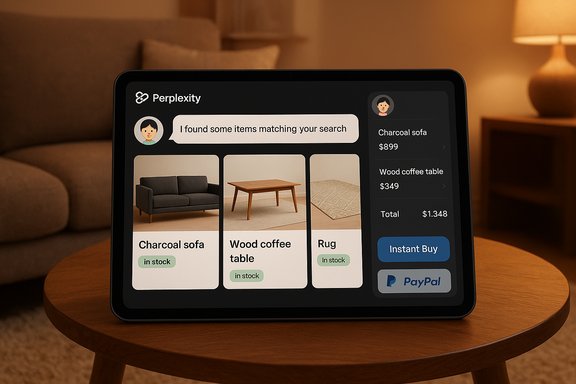
Ashley Furniture’s decision to make the entire shopping journey — from discovery to checkout — available inside Perplexity’s conversational interface, with PayPal powering payment, is a decisive bet on a new commerce model that industry watchers call agentic commerce: AI-driven discovery fused with instant, in-chat transactions. The move places Ashley among an early group of major furniture retailers testing whether conversational agents can reliably shorten the path from browsing to buying, increase average order value, and capture demand that would otherwise evaporate across tabs, wishlists, and abandoned carts.
AI-first shopping experiences have moved quickly from proofs-of-concept to production pilots across major platforms. Over the last year, Perplexity launched an in-app shopping surface that links product cards to participating merchants and offers an “Instant Buy” route using PayPal, and multiple retailers have begun exposing catalogs and live inventory to conversational agents. Independent reporting and platform press releases make clear this is not an isolated experiment — it’s part of an industry-wide push to fold discovery and payment together inside chat and assistant surfaces. At the same time, prominent retail brands are investing in on-site generative tools that keep control of data and experience: Wayfair’s Muse (a visual, generative inspiration tool that links directly to Wayfair’s catalog) and IKEA’s assistant in the OpenAI GPT Store are examples of on-property AI that preserve first-party data while offering AI-driven discovery. These alternative approaches create a useful contrast to Ashley’s choice to participate in Perplexity’s platform-level commerce network.
For retailers: treat agentic commerce as a new channel that should be measured, instrumented, and governed like any other high-stakes distribution pipeline. For consumers: the new path promises convenience but requires vigilance — verify specs, delivery timelines and return policies before completing agentic purchases.
Source: AIM Media House Ashley Furniture Takes Its Shopping Experience Inside an AI Engine
 Background
AI-first shopping experiences have moved quickly from proofs-of-concept to production pilots across major platforms. Over the last year, Perplexity launched an in-app shopping surface that links product cards to participating merchants and offers an “Instant Buy” route using PayPal, and multiple retailers have begun exposing catalogs and live inventory to conversational agents. Independent reporting and platform press releases make clear this is not an isolated experiment — it’s part of an industry-wide push to fold discovery and payment together inside chat and assistant surfaces. At the same time, prominent retail brands are investing in on-site generative tools that keep control of data and experience: Wayfair’s Muse (a visual, generative inspiration tool that links directly to Wayfair’s catalog) and IKEA’s assistant in the OpenAI GPT Store are examples of on-property AI that preserve first-party data while offering AI-driven discovery. These alternative approaches create a useful contrast to Ashley’s choice to participate in Perplexity’s platform-level commerce network. What Ashley announced — the headlines
- Ashley rolled out a fully transactional shopping experience inside Perplexity’s conversational interface: shoppers can request recommendations, browse curated options, add items to cart, and complete checkout without leaving the chat.
- PayPal provides the checkout and payment rails via its Instant Buy / agentic commerce services, enabling express payments and buyer protections in the Perplexity flow. PayPal and Perplexity announced this capability as part of a broader partnership that went live for U.S. users during the holiday window.
- The introduction included promotional incentives (e.g., limited-time PayPal rewards) intended to drive consumer trials and accelerate adoption of the in-chat purchase path.
Why this matters: the strategic case for agentic commerce
Conversational commerce that includes native checkout offers several immediate business advantages for a mass-category player like Ashley:- Compressed funnel and lower friction. Removing the tab hop between discovery and checkout can materially reduce abandonment — a particularly valuable gain in furniture, where the purchase often involves multiple SKUs and decisions about finishes, dimensions, and delivery. An in-chat one‑flow experience shortens time-to-cart and reduces the cognitive load of multi-site browsing.
- Higher AOV and bundling opportunities. Conversational agents can nudge complementary purchases and suggest cross-sells in context (e.g., a sectional + coffee table + rug bundle), potentially raising average order values and improving margin capture on coordinated purchases.
- Access to new discovery surfaces. A growing cohort of users begins product discovery inside chat apps and assistant surfaces rather than on retail websites. By participating in Perplexity’s marketplace of merchant connectors, Ashley can capture demand that never touches its direct web properties.
- Marketing and retention upside. Agentic channels can persist preferences (with opt-in), enabling follow-up prompts for upsells, complementary items or reorders, which — if integrated into an omnichannel CRM — can drive improved lifetime value.
How the integration works (technical anatomy)
The practical plumbing for Ashley → Perplexity → PayPal commerce combines three core components:- Catalog & product feed integration. Retailer product metadata (variants, dimensions, price, images), live inventory status, and fulfillment rules must be exposed as machine-readable feeds or APIs so an agent can generate accurate product cards and availability statements.
- Conversational agent & retrieval. Perplexity’s interface uses retrieval-augmented generation and product-ranking heuristics to present curated cards and follow-up questions. It routes a user’s “add to cart” action to the agentic checkout layer.
- Tokenized checkout and payment security. PayPal provides express payment tokens, identity verification, and buyer protections; these services are invoked by the agent to complete the purchase inside the chat, with PayPal serving as the payment rail. This reduces friction while maintaining a trusted payment layer.
Competitive landscape: where Ashley sits versus Wayfair, IKEA and others
Three strategic patterns are emerging among large home-furnishing retailers:- Platform-first, third-party agent presence (Ashley + Perplexity). Gain reach by appearing inside external assistants; accept shared ownership of discovery and some data exchange with the platform. This strategy accelerates distribution but risks ceding the user’s primary interaction data to the agent host.
- On-property generative tools (Wayfair’s Muse). Build AI-powered inspiration and discovery directly on the retailer’s site so first-party signals (browse behavior, saved collections, uploads) remain within the brand’s ecosystem. Wayfair’s Muse is an example: generative visuals and shoppable inspiration feed directly back to Wayfair’s catalog, preserving customer data and CRM continuity.
- Hybrid platform partnerships + in-house assistants (IKEA). Combine external platform experiments with strong on-property AI assistants to balance external reach and data control. IKEA’s GPT Store assistant shows how retailers can experiment externally while keeping core services in-house.
Strengths of Ashley’s approach
- Speed to market and trialable scale. Partnering with Perplexity and PayPal allows Ashley to participate in the agentic commerce wave quickly without rearchitecting its entire commerce stack.
- Lower initial engineering lift. SDKs and merchant connectors reduce the code and product work required compared with building a native generative experience from scratch.
- Holiday-season tailwind for trial. Launching agentic checkout ahead of holiday shopping can be a smart demand-capture tactic: high-intent shoppers are more likely to convert when friction is reduced.
- Leverage of existing internal AI investments. Ashley’s internal usage of AI (forecasting, supply chain optimization, Copilot deployments and hundreds of identified AI projects) gives the company operational maturity that can support an ambitious external play. Public reporting documents Ashley’s active AI work and executive-level commitment.
Risks, trade-offs, and operational pitfalls
Agentic commerce comes with a distinct set of hazards that Ashley and its peers must actively mitigate:- Data ownership and lifetime value leakage. When discovery starts on Perplexity, first-party signals (session-level intent, dialog weights, follow-up queries) may be stored by the platform, making it harder for Ashley to own customer lifecycle insights. Over time, loss of that telemetry undermines personalization and retention strategies.
- Catalog freshness and fulfillment friction. Conversational agents require accurate SKU mapping, live inventory, and precise delivery/assembly messaging. In furniture, wrong-size or wrong-color errors are costly: returns are heavier, logistics more complex, and customer loyalty suffers. Agentic systems must integrate robustly with fulfillment SLAs or risk elevated return rates.
- Recommendation errors and trust erosion. Agents that surface outdated or mismatched recommendations (older models, incorrect finish, incompatible dimensions) will accelerate returns and complaints. The literature on early agentic shopping shows a pattern: assistants sometimes prefer well-documented older SKUs over more recent, correct options because the signal strength (reviews, content) is higher for the older items. This creates a "stability bias" that retailers must address.
- Complex dispute resolution. Checkout initiated inside an agentic surface creates tri-party flows (consumer ↔ Perplexity ↔ Ashley, with PayPal as the payment provider). Chargebacks, refunds, and fulfillment exceptions require clear ownership and rapid reconciliation processes.
- Regulatory and antitrust scrutiny. Platforms that control discovery and checkout attract regulatory attention. Transparency about rankings, sponsored placements, and how Instant Buy coverage is selected will be areas of policy interest.
Evidence, verification and claimed numbers — what’s verified and what needs caution
- Ashley’s Perplexity integration and PayPal-powered checkout are confirmed in Ashley’s press release and PayPal’s announcement of Instant Buy integrations. These are public, verifiable facts.
- Perplexity’s consumer shopping surface and the Instant Buy capability were reported independently by outlets including The Verge and Tom’s Guide, corroborating features and marketing-level promotions.
- Executive quotes about AI’s strategic importance (for example, Todd Wanek’s fire-to-caveman metaphor and the scale of Ashley’s internal AI projects) are documented in trade reporting and public interviews; they reflect leadership intent but are forward-looking and subjective. Wanek himself has been quoted making references to hundreds of AI projects at Ashley, which supports the claim that Ashley has a broad AI program. Treat those statements as leadership framing rather than audited performance metrics.
- Industry claims about conversion lifts and “AI-attributed” order multipliers should be treated cautiously. Early multipliers (e.g., vendor-reported 7x or 11x growth in AI traffic in some companies) are internal telemetry signals; they are directional but require independent verification to be used as financial evidence. Analysts and merchants should demand audited metrics where possible.
Operational checklist and recommendations (for Ashley and competing retailers)
To reduce the implementation risk and protect customer satisfaction, retailers should follow a disciplined integration plan:- Ensure product feed hygiene: canonical SKUs, GTINs, accurate variant attributes (dimensions, weight, assembly requirements).
- Implement near-real-time inventory syncs and clearly state fulfillment estimates in the agent’s UI; prefer “available/unavailable” over speculative times when latency is high.
- Expose explicit returns policy, assembly fees, and merchant-of-record clarity in the agent response so shoppers know who handles problems post-sale.
- Instrument agentic sessions end-to-end: tag intent → recommendation → checkout → fulfillment → returns to measure net economic impact and identify return patterns.
- Limit automated purchases for high-risk categories unless explicit reconfirmation is required (e.g., “Confirm you want to buy this sectional in 132" length”).
- Maintain parallel on-property AI investments to preserve first-party data and offer an owned experience for repeat customers.
- Negotiate contractual clarity about data access and attribution with platform partners to guarantee replayable logs and attribution signals for CRM ingestion.
How retailers should think about channel economics and long-term strategy
Agentic commerce will alter where and how discovery occurs — creating a new vector that can either augment or cannibalize traditional channels.- Short term: Participating in platform-led agentic channels can increase reach and incremental conversions, especially during high-volume windows (holidays, promotions). Promotional incentives and PayPal rewards can accelerate trials and user adoption.
- Medium term: Brands that rely solely on third-party assistants risk loss of long-term personalization signals. A balanced playbook should include both platform participation (to capture new demand) and robust on-property AI investments (to capture and own churn, lifetime value, and data). Wayfair’s Muse and IKEA’s GPT presence demonstrate the on-property alternative that safeguards data control.
- Long term: Commercial terms will evolve. Expect platform fees, preferred-merchant placements, or revenue sharing to become more explicit. Merchants must budget for variable economics of agentic exposure and maintain diversified discovery strategies (SEO, marketplaces, affiliate, AI platforms).
Final assessment: plausible upside, manageable but real risk
Ashley’s move to make its catalog directly shoppable inside Perplexity with PayPal checkout is a pragmatic early bet on agentic commerce. It leverages distribution and friction reduction to capture shoppers where they increasingly spend time: conversational surfaces. The approach is defensible given Ashley’s internal AI maturity and the operational scale of the business. However, the decision trades off some control and first-party data ownership for speed-to-market. The biggest operational liability is not the chat UI itself, but the back-end fidelity: catalog accuracy, inventory syncs, fulfillment promises and returns handling. If those fail, the reputational and logistical costs in a bulky-category business like furniture can be substantial. Early reporting across the industry also highlights a pattern that assistants can favor stable, well-documented (often older) SKUs over the most up-to-date options — a ranking bias that can reduce product freshness unless actively corrected.For retailers: treat agentic commerce as a new channel that should be measured, instrumented, and governed like any other high-stakes distribution pipeline. For consumers: the new path promises convenience but requires vigilance — verify specs, delivery timelines and return policies before completing agentic purchases.
Closing thoughts
Agentic commerce is not a theoretical experiment anymore — it is an emerging channel that combines search, inspiration, and payment into a continuous session. Ashley’s Perplexity + PayPal integration is an important early indicator of how furniture retailers will compete in the next wave of e-commerce: by balancing distribution reach with the operational rigor required for low-friction, high-trust transactions. The winners will be the merchants who can move fast, maintain feed and fulfillment hygiene, and negotiate data and attribution terms that preserve long-term customer value. For a sector defined by dimensional complexity, heavy logistics and high return costs, the technology is promising — but execution will decide whether agentic commerce becomes a growth engine or a costly channel experiment. The next 12–24 months of deployments, customer experiences, and regulatory scrutiny will be decisive in turning this technological promise into a repeatable business advantage.Source: AIM Media House Ashley Furniture Takes Its Shopping Experience Inside an AI Engine
