

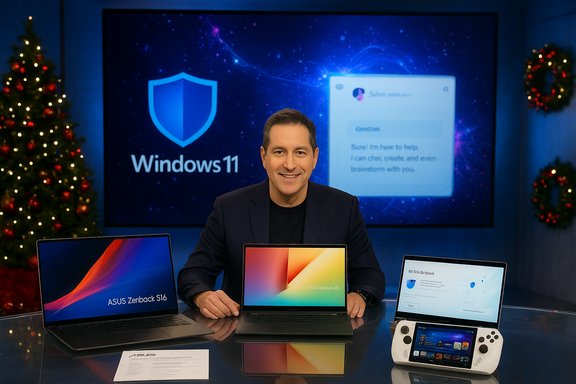
Marc Saltzman — the long‑running host of “Tech It Out” and a familiar face on syndicated radio and local TV — has teamed with News Media Group, Inc. and ASUS in a coordinated holiday‑season push that frames this year’s gift guide around three concrete themes: upgrade to Windows 11 for security, shop AI‑capable and Copilot+‑ready PCs, and consider new form factors such as handheld gaming systems for gamers. The campaign uses a nationwide Satellite Media Tour (SMT) to place Saltzman’s segments on dozens of local morning and lifestyle shows, pairing product demos and holiday picks with on‑air advice designed for mainstream viewers and shoppers. This feature unpacks what the SMT means for holiday tech shoppers, verifies the load‑bearing technical claims tied to ASUS’s products, highlights the campaign’s strengths, and flags practical risks and verification steps consumers should take before buying. The reporting cross‑checks vendor claims and broadcast placements against manufacturer press materials and authoritative platform notices so readers can decide with facts, not just marketing.
Background / Overview
Marc Saltzman’s “Tech It Out” segments have long blended consumer advice with product demos tailored for broadcast TV and syndicated radio. For the 2025 holiday season, Saltzman’s on‑air toolkit includes ASUS hardware — from AI‑forward Zenbook and Vivobook laptops to the ROG Xbox Ally handheld — amplified through News Media Group’s SMT to reach local lifestyle shows and morning programs nationwide. Multiple local affiliates have carried the segments as sponsored content, and the campaign is part of a broader News Media Group playbook that pairs tech experts with brand partners to distribute short, resonant product roundups. Why this matters now: Microsoft formally ended mainstream support for Windows 10 on October 14, 2025, prompting a clear vendor narrative that upgrading to Windows 11 both reduces exposure to unpatched security flaws and unlocks new on‑device AI features (Copilot and Copilot+). ASUS’s 2025 product lines explicitly position several models as Copilot+‑ready and emphasize devices with on‑board NPUs or AMD/Intel AI silicon; the Saltzman SMT ropes those product claims into a consumer‑facing buying checklist. The combination of a platform lifecycle event (Windows 10 end of support) and a flood of AI‑branded hardware gives the campaign a timely hook and clear purchase rationale.What the SMT is pitching — the campaign’s core messages
The Satellite Media Tour format is simple and repeatable: short, TV‑friendly segments (2–4 minutes) placed across many local stations, each highlighting a handful of gift‑friendly devices and a practical consumer message. The Saltzman/ASUS slate centers on three practical sales points:- Security and platform currency: upgrade eligible PCs to Windows 11 to continue receiving security updates and to enable hardware‑backed protections and AI features.
- AI and Copilot+ hardware: buy laptops and PCs that include NPUs (Neural Processing Units) or Copilot+ certification so on‑device AI features run faster and keep data local when desired. ASUS advertises NPU TOPS numbers and Copilot+ badges across its 2025 Zenbook and Vivobook ranges.
- New form factors for entertainment: recommend handheld gaming hardware (the ROG Xbox Ally family), docking options, and value picks for different recipients — gamers, students, creators, and mainstream users.
Technical verification — what the campaign claims and what’s confirmed
When a national SMT points consumers toward specific hardware, the most important load‑bearing claims are device specs, OS compatibility, security posture, and availability. Those claims are verifiable and this section walks through them.Windows 10 end of support — the factual puncture point
Microsoft’s official notices state that Windows 10 reached the end of support on October 14, 2025. After that date, Microsoft no longer issues routine security updates, technical assistance, or feature updates for Windows 10, and the company recommends upgrading eligible devices to Windows 11 or enrolling in an Extended Security Updates (ESU) program as a short‑term bridge. This is a clear, verifiable reason for vendors and experts to advise an OS migration in 2025. What that means for buyers: a Windows 11‑capable PC obtains ongoing security patches and access to Copilot integrations that rely on more modern hardware features (TPM 2.0, Secure Boot, modern CPU microarchitectures). If your current machine fails the PC Health Check compatibility test, you still have options (ESU, new hardware), but the long‑term secure path is a Windows 11 device.ASUS product claims — Copilot+, NPUs, and the ROG handhelds
ASUS’s 2025 product portfolio explicitly markets devices as Copilot+ PCs, and technical press materials list concrete NPU TOPS, processor families, memory, and battery specs for key models.- Zenbook S16: ASUS lists an AMD Ryzen AI 7/9 family and up to 50 TOPS of NPU capability on higher‑end SKUs, alongside a 3K 120Hz ASUS Lumina OLED display and thin, light ceraluminum chassis. These claims are present on ASUS product pages and press releases. Independent reviews have validated many of the UX and display claims, while measuring real‑world battery life and performance that vary by configuration.
- Vivobook 14 Flip and similar Copilot+ models: ASUS product pages show Intel Core Ultra and AMD Ryzen AI options, with explicit NPU metrics (dozens of TOPS in marketing language), and a Copilot+ badge on qualifying SKUs. These technical specs (chip family, memory ceilings, and display types) are published on ASUS’s site.
- ROG Xbox Ally handhelds: ASUS and Xbox co‑announced two Ally models — the standard Ally and the Ally X — with detailed specs published by ASUS and Xbox, including AMD‑branded Z2 processors, LPDDR5X memory levels (16GB and 24GB), 7‑inch 120Hz FHD panels, and battery capacities (60Wh / 80Wh). The devices are shipped with Windows 11 Home and include features such as high‑refresh displays, Hall‑effect triggers, and ample connectivity for docking. Those technical claims are verifiable in manufacturer press releases and retail spec pages.
Strengths of the SMT approach — why this campaign works for mainstream buyers
- Local reach with a national message: Satellite media tours place short, watchable segments on dozens of local morning and lifestyle shows, meeting viewers where they already trust editorial content. This amplifies Saltzman’s credibility while letting ASUS reach consumers across many markets quickly.
- Timely narrative hook: The Windows 10 end‑of‑support deadline provides an unambiguous reason for users to consider upgrades or new hardware now — a stronger, more defensible message than generic “best gifts” copy. Expert advice about security and compatibility resonates and can prompt timely purchases.
- Product variety across budgets: The SMT bundles AI‑capable premium machines with accessible Vivobook / Vivobook Flip SKUs and a discrete gaming proposition (ROG Ally). That gives viewers options depending on budget and recipient needs — an effective holiday strategy.
- Actionable guidance: Saltzman’s segments reportedly include concrete steps (run PC Health Check, back up data, check SKU numbers before purchase) rather than pure product theater, which increases consumer utility and reduces buyer’s remorse risk.
Risks and limitations — what consumers should watch for
The SMT is a marketing channel with editorial flavor: the content is typically sponsor‑backed and designed to convert viewers into buyers. That creates several practical risks for shoppers that experts and reporters must highlight.1) Sponsor bias and placement labeling
Many segments are paid‑for content. Local station pages and replay pages often label these as sponsored, but viewers scanning video clips may miss that distinction. Treat SMT recommendations as promotional editorial and validate claims independently. Where possible, confirm SKU numbers and specs on manufacturer pages.2) SKU drift and configuration variance
Device names (Zenbook S16, Vivobook 14 Flip, ROG Ally) hide a plethora of SKUs with different CPUs, NPUs, memory, display panels, and storage. The SMT’s high‑level recommendations must be paired with a strict SKU checklist before purchase:- Confirm the exact model number (SKU) shown on the spec sheet.
- Verify CPU/APU family, NPU TOPS (if advertised), memory, and panel details on the manufacturer product page.
- Compare the advertised battery size and measured battery results from independent reviews for real‑world expectations.
3) Performance vs. marketing in AI claims
Marketing often leans on NPU TOPS as shorthand for “AI performance.” While TOPS offers a rough measure of theoretical inference throughput, real‑world utility depends on software optimization, thermal tuning, and driver support. Consumers should approach TOPS claims as directional — useful for separation between product tiers — but validate by reading hands‑on reviews that test the specific AI features (transcription, Auto SR upscaling, on‑device noise cancellation) in real tasks. If an SMT segment highlights an on‑device AI feature, confirm that the feature is present on the SKU you plan to buy and that the software to support it ships preinstalled or is available via a trusted update channel.4) Availability and regional price variance
SMT placements often imply widespread availability but real stock and pricing can vary by retailer, region, and holiday promotions. The ROG handhelds, for example, had staggered availability windows and selective retailer distribution for the premium Ally X model. Check with the retailer before relying on an SMT claim that a device is “in stores now.”A practical shopper’s checklist — how to use the SMT advice without getting burned
The SMT’s segments can save time if you use a measured verification routine. Follow these steps before hitting buy:- Run Microsoft’s PC Health Check and note whether your current machine is eligible for a free Windows 11 upgrade, or whether a new PC purchase is the safer path.
- Record the exact SKU or model number promoted in the segment (e.g., Zenbook S16 UM5606KA or ROG Xbox Ally RC73XA) and open the manufacturer’s spec page to confirm processor, NPU TOPS, RAM, and battery capacity.
- Read one or two independent hands‑on reviews for that exact SKU (not just the model family) to confirm display quality, battery life, thermal behavior, and whether the AI features are usable today or rely on future software.
- Check retailer return windows, holiday price protections, and extended warranty/accidental coverage — gift returns spike during the season and a decent return window reduces holiday friction.
- If you’re buying for a gamer, validate docking features and measured battery life for the games your recipient plays; for creators, prioritize display color gamut and SSD throughput over headline AI claims.
What the strategy means for ASUS, News Media Group, and Marc Saltzman
For ASUS, the SMT helps mainstream consumers see Copilot+ and NPU claims in context on local television — a channel that still reaches many older shoppers and holiday buyers. For News Media Group, the “expert + brand” model is a repeatable service that packages product demos for stations that prefer short, turnkey segments. For Saltzman, participation in an SMT is a trade‑off: it provides broad audience reach and tight editorial control over the demo narrative, but it also means recommendations will be seen as sponsored content and should be accompanied by explicit buyer‑verification steps. Multiple press filings and local station writeups show this is a standard News Media Group playbook deployed across home, workplace, and holiday verticals throughout 2025.Final analysis and verdict
The “Tech It Out” Holiday Gifts 2025 SMT with Marc Saltzman and ASUS is an effective, well‑timed consumer campaign that packages manufacturer claims into accessible holiday segments. It leverages a concrete platform deadline (Windows 10 end of support) and real, measurable hardware advancements (on‑device NPUs, Copilot+ certification, new handheld form factors) to make a compelling case for holiday upgrades. Manufacturer product claims — including NPU TOPS, memory and battery sizes, and display refresh rates — are backed by ASUS product pages and corroborated by trade press and retailer listings. That said, the campaign is fundamentally promotional. Buyers should follow a simple verification routine: confirm the SKU, read hands‑on reviews, validate availability and returns, and treat marketing metrics like TOPS as one input, not the entire decision. The SMT does a good job of raising awareness and prompting action, but the last mile — the buyer’s due diligence on SKU‑level specs and measured performance — remains essential.Quick takeaways for the holiday shopper
- If your PC is running Windows 10, treat October 14, 2025 as the practical deadline for planning an upgrade or enrolling in ESU. Confirm eligibility with PC Health Check and back up everything before you act.
- Use SMT segments as an inspiration list, not a shopping cart. Note model numbers from the broadcast and then verify specs on the manufacturer product pages before purchase.
- When evaluating AI claims, prioritize measured features over headline TOPS numbers. Look for demos and reviewer tests of the actual Copilot+ features you care about (transcription, Auto SR, noise suppression).
- For gamers, prioritize ergonomics and docked performance on handhelds. The ROG Xbox Ally family shows promise, but measured battery life and thermal behavior vary by title. Confirm the SKU and read docked performance tests.
The partnership between Marc Saltzman, News Media Group, Inc., and ASUS demonstrates how modern product launches — especially those tied to platform inflection points like Windows 10’s end of support — are communicated to mainstream audiences. The SMT format is efficient for reaching local TV viewers with crisp, actionable advice; the responsibility rests with consumers to verify exact SKUs, check independent reviews, and confirm retailer protections before buying. The campaign’s combination of timely messaging, verifiable specs, and mass distribution makes it a useful holiday guide — provided shoppers do the final due diligence the SMT encourages but cannot substitute for.
Source: StreetInsider Tech Expert Marc Saltzman and News Media Group, Inc. Partnered with ASUS for a “Tech it Out” Holiday Gifts 2025 Nationwide Satellite Media Tour (SMT)
