

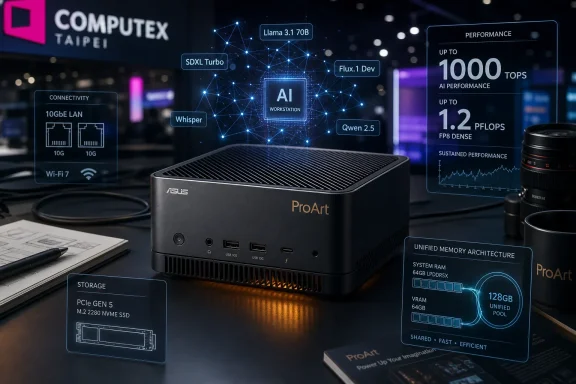
Asus unveiled the ProArt Mini PC at Computex 2026 in Taipei, a 150 mm square Windows workstation built around Nvidia’s RTX Spark platform with up to 128GB unified memory, 10GbE networking, PCIe Gen 5 storage expansion, and a claimed 1 petaflop of AI performance. The interesting part is not that another vendor has made a small fast box. It is that the Windows PC ecosystem is now trying to answer Apple’s Mac Studio with a different argument: not “creator desktop,” but local AI workstation. If Asus can turn the spec sheet into a stable, shippable, well-cooled product, this may be one of the clearest signs yet that the next high-end PC war is moving from GPU cards to tightly integrated AI appliances.
The ProArt Mini PC is small enough that its dimensions read more like a network appliance than a workstation: 150 x 150 x 51 mm. That puts it in the same broad visual category as Apple’s Mac Studio, but Asus is aiming the machine at a more explicitly developer-and-creator audience. The pitch is not simply that it can edit video, render scenes, or drive a monitor-heavy desk; the pitch is that it can host serious generative AI workloads locally.
That matters because the old workstation formula is under pressure. For years, a professional desktop meant a large tower, a high-wattage CPU, one or more discrete GPUs, and enough expansion headroom to survive the next three projects. Apple disrupted that expectation with the Mac Studio by proving that a compact, unified-memory workstation could be both quiet and credible. Nvidia and its partners now want to do something similar for Windows and Linux workflows, but with AI performance as the headline feature.
Asus’ entry is particularly revealing because ProArt has become the company’s shorthand for “serious creative hardware without the gaming costume.” The brand already carries an expectation of color workflows, render pipelines, Adobe and DaVinci Resolve use, and hardware that looks appropriate in a studio. Dropping RTX Spark into that chassis turns ProArt into something more ambitious: a local model box for developers who do not want every inference call, prototype, or confidential dataset leaving the building.
The risk is that the category is still being invented in public. A Mac Studio buyer knows broadly what they are getting: a polished workstation running macOS and Apple’s creative stack. A ProArt Mini PC buyer is being asked to buy into Nvidia’s emerging vision of the AI PC as a workstation-class node — not merely a laptop with an NPU, but a compact machine with enough memory and accelerator throughput to run models that ordinary client PCs cannot touch.
The unified-memory design is central to the argument. Instead of splitting system RAM and graphics memory into separate pools, RTX Spark supports up to 128GB of unified memory that can be dynamically shared between CPU and GPU workloads. That does not magically turn a desktop box into a data center, but it does change what is plausible on a desk. Large 3D scenes, local language models, image-generation pipelines, embeddings, retrieval systems, and agent-style workloads all benefit when memory capacity stops being the first wall users hit.
Nvidia’s 1 petaflop claim also needs to be read carefully. That figure is AI performance, and in this class it is tied to lower-precision tensor math rather than a general-purpose measure of everything the machine can do. For developers and IT buyers, the right question is not “is this really a petaflop workstation?” but “does this machine run the models and toolchains I care about at acceptable latency, power, noise, and cost?” The answer will depend on software maturity as much as silicon.
Still, the platform direction is obvious. Nvidia has spent years making CUDA the default acceleration layer for AI development. RTX Spark attempts to bring that gravitational pull into the client workstation market by giving developers a compact local target that looks and feels closer to their deployment environment than an ordinary consumer laptop. Asus is not merely announcing a mini PC; it is announcing a vehicle for Nvidia’s attempt to make the Windows workstation relevant again in an AI-first software cycle.
But the comparison breaks down once the workloads get specific. Apple’s Mac Studio is strongest when the whole Apple Silicon stack works as intended: media engines, high memory bandwidth, optimized creative apps, quiet cooling, and a tightly integrated operating system. Its value proposition is coherence. Buy the box, run Final Cut, Logic, Resolve, Adobe tools, Xcode, or a growing number of local AI utilities, and expect the system to behave like a Mac.
Asus and Nvidia are making a more modular, more developer-centric promise. The RTX Spark machine is less about a finished creative lifestyle and more about local acceleration for workflows that may still be experimental. It is a box for people who know what CUDA is, who care whether frameworks support Blackwell features properly, who may be running containers, custom inference servers, fine-tuning experiments, Unreal Engine scenes, Stable Diffusion derivatives, video AI tools, or internal prototypes that cannot be sent to a public cloud.
That distinction will shape the audience. The Mac Studio can be purchased by a photographer, editor, musician, or app developer who never thinks about the accelerator topology inside the machine. The ProArt Mini PC is more likely to attract buyers who want control over a local AI stack and are comfortable living closer to the metal. It may be a creator PC, but its most interesting customers may be software teams, research labs, small studios, and IT departments trying to provide AI horsepower without opening the cloud spending tap all the way.
A compact AI workstation offers a different bargain. It gives developers a place to experiment quickly, test prompts and agents, build retrieval-augmented systems, run private inference, and prototype models before moving workloads to larger infrastructure. For small teams, that can mean fewer credit-card surprises from cloud GPUs. For enterprises, it can mean a safer sandbox for data that should not be shipped to a third-party API.
The Asus ProArt Mini PC’s 128GB unified memory claim is especially important here. Many local AI enthusiasts have learned that raw compute is only half the story; memory capacity determines which models can be loaded, how much context can be used, and whether workloads must be aggressively quantized or split across machines. A system that can handle very large local models or massive scene data is materially different from an “AI PC” whose neural processor mostly accelerates background effects and consumer features.
That does not mean the ProArt Mini PC will replace cloud AI. It will not. The cloud still wins on scale, collaboration, centralized management, and access to the largest training clusters. But the workstation is reasserting itself as the place where ideas start, data stays local, and iteration happens without waiting for queue time or procurement approval. In that sense, RTX Spark is less a threat to the cloud than a way to make cloud-bound AI development less dependent on the cloud at every step.
Small PCs have always been vulnerable to the same trap. They look extraordinary on a product page, then arrive in the real world with fan noise, throttling, hot surfaces, awkward power bricks, or performance curves that only look impressive for the first few minutes of a benchmark. AI workloads make that problem worse because they can be sustained, memory-heavy, and brutally repetitive. A local model server does not care that a chassis is elegant; it cares whether the accelerator can stay fed and cool for hours.
Asus has experience here, but the ProArt Mini PC will be judged against a difficult standard. Apple set expectations for compact workstations that are quiet under creative loads. Traditional workstation vendors set expectations for systems that can run long jobs without drama. AI developers will add their own expectations: stable drivers, predictable thermals, and no sudden performance cliff when a model runs overnight.
The 140W figure suggests Asus is not pretending this is a casual office mini PC. That is good. But buyers should still wait for independent measurements of sustained performance, acoustics, surface temperatures, and power draw. In a box this small, cooling is not an implementation detail. It is the product.
RTX Spark gives the Windows ecosystem a different story. Instead of asking whether an NPU can blur backgrounds, summarize text, or accelerate a handful of OS features, this class of machine asks whether a desktop PC can run serious local models and development workflows. That is a much more compelling proposition for WindowsForum’s core audience: enthusiasts, sysadmins, developers, and IT professionals who care less about branding and more about what can actually be deployed.
There is also a subtle platform fight here. Apple owns the entire stack on Mac Studio, from silicon to OS to much of the developer experience. Nvidia owns the AI accelerator software gravity, but it needs OEMs, Microsoft, Linux distributions, driver teams, and application vendors to deliver the rest. Asus can build the hardware, but the value of the box will depend on whether the software ecosystem treats RTX Spark as a first-class target rather than an exotic one.
For Windows, that is both opportunity and risk. If RTX Spark systems work well, they could make Windows desktops newly relevant for AI development at the edge of the enterprise. If they ship with rough drivers, inconsistent app support, or marketing promises that outpace real workflows, they will reinforce the suspicion that “AI PC” is a label vendors apply before the use cases are ready.
The 10GbE networking is a meaningful inclusion because it acknowledges that local AI workstations do not live in isolation. Large datasets, model weights, render assets, and project files need fast movement across storage and compute environments. A compact system with slow networking would be a toy in many professional settings. A compact system with 10GbE at least has a credible path into studio NAS environments, lab networks, and developer infrastructure.
PCIe Gen 5 M.2 expansion also matters. AI and 3D workflows can be punishing on storage, and local models can consume hundreds of gigabytes once checkpoints, variants, datasets, caches, and containers pile up. Fast internal storage will not make a weak accelerator strong, but slow storage can make a strong local workstation feel clumsy. Asus appears to understand that the bottleneck story has moved beyond CPU and GPU alone.
Security will be the less flashy but more consequential discussion. Local AI is often sold as private by default, but local machines still need access controls, encryption, update hygiene, logging, and clear data-handling policies. A model running under a desk can be safer than a public cloud API for some data, but it can also become a blind spot if IT treats it as a glorified creator desktop instead of a local compute node with sensitive workloads.
HP’s OmniDesk Mini and related RTX Spark plans suggest that the market will not be limited to boutique creator hardware. MSI’s entry points in a similar direction. The more vendors adopt the platform, the more pressure there will be on software developers to test against it, on component suppliers to support it, and on Microsoft to ensure Windows can present these machines as more than oddities in Device Manager.
Competition should also help clarify pricing. Nvidia’s own DGX Spark concept already framed the idea of a personal AI supercomputer, but OEM systems will need to compete on thermals, storage, memory configurations, warranty, support, acoustics, and availability. Asus has design credibility in compact performance hardware, HP has enterprise procurement reach, and MSI has a strong foothold with performance-focused buyers. The category will be more interesting if these vendors make different trade-offs instead of shipping the same box in different clothes.
That said, early ecosystem enthusiasm can hide practical fragmentation. Naming, driver cadence, firmware updates, Linux support, Windows image support, and vendor utilities can all become annoyances when a supposedly standardized platform meets real OEM behavior. The promise of RTX Spark is coherence; the danger is that the market gets three or four almost-identical machines with just enough differences to complicate deployment.
This is where Apple’s advantage remains formidable. Mac Studio pricing may be painful, but Apple’s configurations, availability, and support path are legible. You can argue about value, but the buying experience is straightforward. Windows workstation buyers often face a more chaotic landscape of SKUs, reseller channels, driver packages, and regional variations.
Asus also needs to prove that the ProArt Mini PC is not trapped between markets. If it is priced like a professional workstation, it must deliver professional reliability and support. If it is priced like an enthusiast mini PC, it may become a cult object for local AI hobbyists and small studios. If it lands awkwardly in the middle, it could be admired by everyone and purchased by fewer people than the launch buzz suggests.
The most important unanswered question is whether RTX Spark’s software story will feel finished when these systems ship. Hardware launches can move faster than frameworks, drivers, and application optimization. Developers are patient when a platform gives them clear power and clear direction, but they are much less patient when expensive hardware requires workarounds for basic productivity.
That modularity is important for IT strategy. Not every team needs a rack of GPUs, and not every developer can justify a cloud GPU instance for continuous experimentation. A small local AI workstation gives organizations a middle tier between ordinary laptops and centralized infrastructure. It is the kind of machine that could live in departmental budgets rather than data-center plans.
There is a cultural shift here as well. The PC industry spent years teaching buyers to think of performance as either mobile convenience or tower-class expandability. Apple then made compact integrated workstations fashionable. Nvidia’s RTX Spark push now suggests a third model: a compact AI-native workstation where memory architecture and accelerator software matter more than the traditional CPU-versus-GPU shopping checklist.
For Windows enthusiasts, that is exciting because it gives the desktop a new reason to exist. The old desktop advantages — upgradeability, expansion, raw wattage — are still real, but they are not the whole story. The new advantage may be locality: the ability to run substantial AI workloads where the user, the data, and the development environment already are.
The concrete picture is already clear enough:
 Asus Shrinks the Workstation, but Not the Ambition
The ProArt Mini PC is small enough that its dimensions read more like a network appliance than a workstation: 150 x 150 x 51 mm. That puts it in the same broad visual category as Apple’s Mac Studio, but Asus is aiming the machine at a more explicitly developer-and-creator audience. The pitch is not simply that it can edit video, render scenes, or drive a monitor-heavy desk; the pitch is that it can host serious generative AI workloads locally.That matters because the old workstation formula is under pressure. For years, a professional desktop meant a large tower, a high-wattage CPU, one or more discrete GPUs, and enough expansion headroom to survive the next three projects. Apple disrupted that expectation with the Mac Studio by proving that a compact, unified-memory workstation could be both quiet and credible. Nvidia and its partners now want to do something similar for Windows and Linux workflows, but with AI performance as the headline feature.
Asus’ entry is particularly revealing because ProArt has become the company’s shorthand for “serious creative hardware without the gaming costume.” The brand already carries an expectation of color workflows, render pipelines, Adobe and DaVinci Resolve use, and hardware that looks appropriate in a studio. Dropping RTX Spark into that chassis turns ProArt into something more ambitious: a local model box for developers who do not want every inference call, prototype, or confidential dataset leaving the building.
The risk is that the category is still being invented in public. A Mac Studio buyer knows broadly what they are getting: a polished workstation running macOS and Apple’s creative stack. A ProArt Mini PC buyer is being asked to buy into Nvidia’s emerging vision of the AI PC as a workstation-class node — not merely a laptop with an NPU, but a compact machine with enough memory and accelerator throughput to run models that ordinary client PCs cannot touch.
RTX Spark Is the Real Product Asus Is Selling
The ProArt Mini PC’s most important component is not the chassis, the ports, or even the cooling system. It is Nvidia’s RTX Spark superchip platform, which combines a Blackwell-based RTX GPU with 6,144 CUDA cores, fifth-generation Tensor Cores, and a 20-core Nvidia Grace CPU. In practical terms, that makes the Asus machine less like a traditional mini PC with a graphics card and more like a packaged AI compute appliance.The unified-memory design is central to the argument. Instead of splitting system RAM and graphics memory into separate pools, RTX Spark supports up to 128GB of unified memory that can be dynamically shared between CPU and GPU workloads. That does not magically turn a desktop box into a data center, but it does change what is plausible on a desk. Large 3D scenes, local language models, image-generation pipelines, embeddings, retrieval systems, and agent-style workloads all benefit when memory capacity stops being the first wall users hit.
Nvidia’s 1 petaflop claim also needs to be read carefully. That figure is AI performance, and in this class it is tied to lower-precision tensor math rather than a general-purpose measure of everything the machine can do. For developers and IT buyers, the right question is not “is this really a petaflop workstation?” but “does this machine run the models and toolchains I care about at acceptable latency, power, noise, and cost?” The answer will depend on software maturity as much as silicon.
Still, the platform direction is obvious. Nvidia has spent years making CUDA the default acceleration layer for AI development. RTX Spark attempts to bring that gravitational pull into the client workstation market by giving developers a compact local target that looks and feels closer to their deployment environment than an ordinary consumer laptop. Asus is not merely announcing a mini PC; it is announcing a vehicle for Nvidia’s attempt to make the Windows workstation relevant again in an AI-first software cycle.
The Mac Studio Comparison Is Useful, but Also Misleading
Calling the ProArt Mini PC a Mac Studio rival is accurate enough for headline purposes. Both are compact, premium desktop workstations. Both lean on unified memory. Both are aimed at users who want serious performance without a tower under the desk. Both appeal to creators who have outgrown ordinary laptops but do not necessarily want the noise, footprint, or maintenance assumptions of a full workstation.But the comparison breaks down once the workloads get specific. Apple’s Mac Studio is strongest when the whole Apple Silicon stack works as intended: media engines, high memory bandwidth, optimized creative apps, quiet cooling, and a tightly integrated operating system. Its value proposition is coherence. Buy the box, run Final Cut, Logic, Resolve, Adobe tools, Xcode, or a growing number of local AI utilities, and expect the system to behave like a Mac.
Asus and Nvidia are making a more modular, more developer-centric promise. The RTX Spark machine is less about a finished creative lifestyle and more about local acceleration for workflows that may still be experimental. It is a box for people who know what CUDA is, who care whether frameworks support Blackwell features properly, who may be running containers, custom inference servers, fine-tuning experiments, Unreal Engine scenes, Stable Diffusion derivatives, video AI tools, or internal prototypes that cannot be sent to a public cloud.
That distinction will shape the audience. The Mac Studio can be purchased by a photographer, editor, musician, or app developer who never thinks about the accelerator topology inside the machine. The ProArt Mini PC is more likely to attract buyers who want control over a local AI stack and are comfortable living closer to the metal. It may be a creator PC, but its most interesting customers may be software teams, research labs, small studios, and IT departments trying to provide AI horsepower without opening the cloud spending tap all the way.
Local AI Has Become the New Workstation Workload
For most of the past decade, workstation marketing has revolved around rendering, simulation, video, CAD, and game development. Those workloads still matter, but AI has become the new justification for expensive desktop hardware. The reason is simple: cloud AI is powerful, but it is also metered, centralized, and often uncomfortable for sensitive data.A compact AI workstation offers a different bargain. It gives developers a place to experiment quickly, test prompts and agents, build retrieval-augmented systems, run private inference, and prototype models before moving workloads to larger infrastructure. For small teams, that can mean fewer credit-card surprises from cloud GPUs. For enterprises, it can mean a safer sandbox for data that should not be shipped to a third-party API.
The Asus ProArt Mini PC’s 128GB unified memory claim is especially important here. Many local AI enthusiasts have learned that raw compute is only half the story; memory capacity determines which models can be loaded, how much context can be used, and whether workloads must be aggressively quantized or split across machines. A system that can handle very large local models or massive scene data is materially different from an “AI PC” whose neural processor mostly accelerates background effects and consumer features.
That does not mean the ProArt Mini PC will replace cloud AI. It will not. The cloud still wins on scale, collaboration, centralized management, and access to the largest training clusters. But the workstation is reasserting itself as the place where ideas start, data stays local, and iteration happens without waiting for queue time or procurement approval. In that sense, RTX Spark is less a threat to the cloud than a way to make cloud-bound AI development less dependent on the cloud at every step.
The Cooling Claim Is Where the Spec Sheet Meets Reality
The most grounded part of Asus’ announcement may be the least glamorous: the cooling system. A 140W thermal design in a chassis barely larger than a stack of books is not a footnote. It is the difference between a workstation and a novelty.Small PCs have always been vulnerable to the same trap. They look extraordinary on a product page, then arrive in the real world with fan noise, throttling, hot surfaces, awkward power bricks, or performance curves that only look impressive for the first few minutes of a benchmark. AI workloads make that problem worse because they can be sustained, memory-heavy, and brutally repetitive. A local model server does not care that a chassis is elegant; it cares whether the accelerator can stay fed and cool for hours.
Asus has experience here, but the ProArt Mini PC will be judged against a difficult standard. Apple set expectations for compact workstations that are quiet under creative loads. Traditional workstation vendors set expectations for systems that can run long jobs without drama. AI developers will add their own expectations: stable drivers, predictable thermals, and no sudden performance cliff when a model runs overnight.
The 140W figure suggests Asus is not pretending this is a casual office mini PC. That is good. But buyers should still wait for independent measurements of sustained performance, acoustics, surface temperatures, and power draw. In a box this small, cooling is not an implementation detail. It is the product.
Windows Gets a Chance to Stop Looking Like the AI Client Afterthought
The ProArt Mini PC also lands at an awkward but important moment for Windows. Microsoft has spent the last few years pushing the Copilot+ PC concept, much of it centered on NPUs and client-side AI experiences. That effort has improved the language around local acceleration, but it has not yet convinced many power users that the Windows PC is the best place to do serious AI work.RTX Spark gives the Windows ecosystem a different story. Instead of asking whether an NPU can blur backgrounds, summarize text, or accelerate a handful of OS features, this class of machine asks whether a desktop PC can run serious local models and development workflows. That is a much more compelling proposition for WindowsForum’s core audience: enthusiasts, sysadmins, developers, and IT professionals who care less about branding and more about what can actually be deployed.
There is also a subtle platform fight here. Apple owns the entire stack on Mac Studio, from silicon to OS to much of the developer experience. Nvidia owns the AI accelerator software gravity, but it needs OEMs, Microsoft, Linux distributions, driver teams, and application vendors to deliver the rest. Asus can build the hardware, but the value of the box will depend on whether the software ecosystem treats RTX Spark as a first-class target rather than an exotic one.
For Windows, that is both opportunity and risk. If RTX Spark systems work well, they could make Windows desktops newly relevant for AI development at the edge of the enterprise. If they ship with rough drivers, inconsistent app support, or marketing promises that outpace real workflows, they will reinforce the suspicion that “AI PC” is a label vendors apply before the use cases are ready.
The Enterprise Buyer Will See a Small Box and a Long Checklist
For IT departments, the ProArt Mini PC is not just a sexy desk object. It is a procurement question. Can it be imaged, managed, secured, patched, monitored, and replaced at scale? Can its drivers be validated? Can its AI workloads be governed? Can developers use it without creating shadow infrastructure?The 10GbE networking is a meaningful inclusion because it acknowledges that local AI workstations do not live in isolation. Large datasets, model weights, render assets, and project files need fast movement across storage and compute environments. A compact system with slow networking would be a toy in many professional settings. A compact system with 10GbE at least has a credible path into studio NAS environments, lab networks, and developer infrastructure.
PCIe Gen 5 M.2 expansion also matters. AI and 3D workflows can be punishing on storage, and local models can consume hundreds of gigabytes once checkpoints, variants, datasets, caches, and containers pile up. Fast internal storage will not make a weak accelerator strong, but slow storage can make a strong local workstation feel clumsy. Asus appears to understand that the bottleneck story has moved beyond CPU and GPU alone.
Security will be the less flashy but more consequential discussion. Local AI is often sold as private by default, but local machines still need access controls, encryption, update hygiene, logging, and clear data-handling policies. A model running under a desk can be safer than a public cloud API for some data, but it can also become a blind spot if IT treats it as a glorified creator desktop instead of a local compute node with sensitive workloads.
Asus Is Not Alone, and That Is the Point
The ProArt Mini PC is arriving alongside a broader wave of RTX Spark announcements, including systems from HP and MSI. That is not incidental. Nvidia is trying to establish a category quickly, and OEM breadth is part of the strategy. One small AI workstation is an experiment; several vendors building around the same platform is an ecosystem play.HP’s OmniDesk Mini and related RTX Spark plans suggest that the market will not be limited to boutique creator hardware. MSI’s entry points in a similar direction. The more vendors adopt the platform, the more pressure there will be on software developers to test against it, on component suppliers to support it, and on Microsoft to ensure Windows can present these machines as more than oddities in Device Manager.
Competition should also help clarify pricing. Nvidia’s own DGX Spark concept already framed the idea of a personal AI supercomputer, but OEM systems will need to compete on thermals, storage, memory configurations, warranty, support, acoustics, and availability. Asus has design credibility in compact performance hardware, HP has enterprise procurement reach, and MSI has a strong foothold with performance-focused buyers. The category will be more interesting if these vendors make different trade-offs instead of shipping the same box in different clothes.
That said, early ecosystem enthusiasm can hide practical fragmentation. Naming, driver cadence, firmware updates, Linux support, Windows image support, and vendor utilities can all become annoyances when a supposedly standardized platform meets real OEM behavior. The promise of RTX Spark is coherence; the danger is that the market gets three or four almost-identical machines with just enough differences to complicate deployment.
The Spec That Matters Most Is the One Asus Has Not Given Yet
For all the impressive numbers, the missing numbers still matter. Pricing, configurations, shipping dates, storage options, warranty terms, operating system support, and regional availability will determine whether the ProArt Mini PC is a serious purchase or a Computex halo product. “Up to 128GB” is not the same as a widely available 128GB configuration at a tolerable price.This is where Apple’s advantage remains formidable. Mac Studio pricing may be painful, but Apple’s configurations, availability, and support path are legible. You can argue about value, but the buying experience is straightforward. Windows workstation buyers often face a more chaotic landscape of SKUs, reseller channels, driver packages, and regional variations.
Asus also needs to prove that the ProArt Mini PC is not trapped between markets. If it is priced like a professional workstation, it must deliver professional reliability and support. If it is priced like an enthusiast mini PC, it may become a cult object for local AI hobbyists and small studios. If it lands awkwardly in the middle, it could be admired by everyone and purchased by fewer people than the launch buzz suggests.
The most important unanswered question is whether RTX Spark’s software story will feel finished when these systems ship. Hardware launches can move faster than frameworks, drivers, and application optimization. Developers are patient when a platform gives them clear power and clear direction, but they are much less patient when expensive hardware requires workarounds for basic productivity.
The AI Workstation Moves From Tower to Tile
The broader significance of the ProArt Mini PC is that it makes the workstation feel less like a single machine and more like a deployable tile. A small RTX Spark box can sit on a creator’s desk, in a developer lab, beside a storage array, in a classroom, or on a test bench. It can be a personal system, a shared local inference node, or a prototype target before workloads move elsewhere.That modularity is important for IT strategy. Not every team needs a rack of GPUs, and not every developer can justify a cloud GPU instance for continuous experimentation. A small local AI workstation gives organizations a middle tier between ordinary laptops and centralized infrastructure. It is the kind of machine that could live in departmental budgets rather than data-center plans.
There is a cultural shift here as well. The PC industry spent years teaching buyers to think of performance as either mobile convenience or tower-class expandability. Apple then made compact integrated workstations fashionable. Nvidia’s RTX Spark push now suggests a third model: a compact AI-native workstation where memory architecture and accelerator software matter more than the traditional CPU-versus-GPU shopping checklist.
For Windows enthusiasts, that is exciting because it gives the desktop a new reason to exist. The old desktop advantages — upgradeability, expansion, raw wattage — are still real, but they are not the whole story. The new advantage may be locality: the ability to run substantial AI workloads where the user, the data, and the development environment already are.
The Tiny Asus Box Carries a Very Large Bet
The ProArt Mini PC should be read less as a one-off Mac Studio rival and more as a signal of where premium Windows hardware is going. Asus is putting workstation-class AI hardware into a chassis that looks domesticated enough for a desk but is clearly built for workloads beyond ordinary productivity. That combination will be attractive, but only if the ecosystem behind it matures quickly.The concrete picture is already clear enough:
- Asus’ ProArt Mini PC is a compact RTX Spark workstation aimed at creators, developers, and local AI workflows rather than mainstream office use.
- Nvidia’s RTX Spark platform is the defining feature, pairing a Grace CPU, Blackwell RTX GPU, and up to 128GB unified memory for large local AI and rendering workloads.
- The Mac Studio comparison is useful for size and audience, but the Asus machine is more explicitly aligned with CUDA-heavy AI development and Windows workstation use.
- The 140W cooling design will need independent testing because sustained thermals and acoustics will decide whether the machine behaves like a professional tool.
- Enterprise buyers should care as much about manageability, security, storage, networking, and software support as they do about the 1 petaflop marketing claim.
- Pricing, availability, and real-world framework support remain the biggest unknowns between a promising Computex reveal and a machine IT departments can recommend.
References
- Primary source: Notebookcheck
Published: Mon, 01 Jun 2026 13:06:00 GMT
Asus reveals pro-grade Mac Studio rival mini PC: Nvidia RTX Spark, 140W cooling, 128GB RAM - Notebookcheck News
Asus has introduced the ultra-compact ProArt Mini PC at Computex 2026, featuring the Nvidia RTX Spark superchip. Designed for developers and creators, this 150x150x51mm PC offers 1 petaflop of AI performance, 128GB of unified memory, 10GbE networking, and PCIe Gen 5 expansion, making it a... www.notebookcheck.net
- Related coverage: tomshardware.com
- Related coverage: windowscentral.com
ASUS ProArt P16 and P14 N1X bring workstation‑class power, RTX graphics, and AI‑PC performance for creators | Windows Central
Professional-grade performance meets the next generation of Windows on ARM.www.windowscentral.com - Related coverage: pcgamer.com
Nvidia sets out roadmap for RTX Spark, its new PC platform, which also gives us a better idea of when to expect next-gen RTX GPUs | PC Gamer
Rubin in 2028, Feynman in 2030.www.pcgamer.com - Related coverage: techradar.com
Nvidia Computex 2026 keynote as it happened: RTX Spark announced to take on Apple, Intel, and Qualcomm | TechRadar
CEO Jensen Huang takes to the stagewww.techradar.com - Related coverage: press.asus.com
ASUS Unveils Revolutionary ProArt PCs Powered by NVIDIA RTX Spark at Computex 2026 | ASUS Pressroom - Official Global News & Updates
ASUS unveils the new ProArt P16, P14 laptops and ProArt Mini PC powered by NVIDIA RTX Spark at Computex 2026. Discover 1 petaflop AI performance, 128GB unified memory, Lumina Pro OLED displays, all-day battery life, and local AI agents launching fall 2026. press.asus.com
- Related coverage: asus.com
ProArt GR1X Mini PC: RTX Spark Desktop & Agent Computer
Handle data-heavy agentic AI and creative tasks seamlessly. Discover the ProArt mini PC with RTX Spark, the ultimate agent computer for intensive workflows.www.asus.com - Related coverage: notebookcheck.com
Asus präsentiert neuen Mini-PC: Mit Nvidia RTX Spark, 140W-Kühlung und 128GB RAM gegen Mac Studio - Notebookcheck News
Asus hat auf der Computex 2026 den besonders kompakten ProArt Mini PC mit Nvidia RTX Spark Superchip vorgestellt. Der 150x150x51mm große PC richtet sich an Entwickler und Content Creator und bietet 1 Petaflop AI-Leistung, 128GB Unified Memory, 10GbE-Netzwerk und PCIe-Gen-5-Erweiterung. Damit... www.notebookcheck.com
- Related coverage: gadgets360.com
Asus ProArt P16, ProArt P14 and New ProArt Mini PC With Nvidia RTX Spark Unveiled at Computex 2026 | Technology News
Asus has announced the ProArt P16, ProArt P14 and ProArt Mini PC at Computex 2026. Powered by Nvidia RTX Spark, the new creator-focused devices offer up to 128GB of unified memory and 1 petaflop of AI performance. The laptops feature OLED displays, while the Mini PC brings AI computing...www.gadgets360.com - Related coverage: nvidia.com
NVIDIA DGX Spark: AI Supercomputer on Your Desk
Build and run autonomous AI agents securely and locally with up to 200 billion parameters. 128GB of unified system memory. Preloaded with the NVIDIA AI software stack. On your desktop.www.nvidia.com - Related coverage: notebookcheck.info
O novo Mini PC Nvidia RTX Spark da MSI rivaliza com o Mac Studio, o Mini PC Asus ProArt e o Mini PC HP OmniDesk - NotebookCheck.info News
A MSI apresentou o mini PC EdgeMesa N AI+, seu rival direto do novo Mini PC HP OmniDesk e do Mini PC Asus ProArt. Com a nova arquitetura NVIDIA RTX Spark, esse desktop compacto é otimizado para IA generativa local, desenvolvimento LLM e inferências de alto desempenho, oferecendo conectividade... www.notebookcheck.info
- Related coverage: ltec-biz.com
25R 0698 15AI Computer Nvidia GB10 Grace Blackwell in NVIDIA DGX Spark Package and Main PCB detailed analysis
PDF documentwww.ltec-biz.com
- Related coverage: nvidianews.nvidia.com
- Related coverage: amax.com
- Related coverage: tdsynnex.com
