

Asus’s 2026 ROG Zephyrus G14 replaces last year’s AMD silicon with Intel’s Panther Lake Core Ultra 9 386H, pairs it with up to Nvidia RTX 5070 Ti graphics, and lands as a $3,199 compact gaming laptop aimed at people who want one machine for work, travel, media, and play. The important part is not that Asus has reinvented the 14-inch performance laptop. It has not. The important part is that the G14’s old compromise — great power in a small body, but merely tolerable endurance — appears to have shifted in a way that matters.
The Notebookcheck verdict is unusually clear: the new Zephyrus G14 is a better all-rounder because Panther Lake improves efficiency more than it changes raw CPU performance. That distinction matters for Windows users because the PC industry has spent the last several years selling “AI PC,” “creator laptop,” and “gaming ultraportable” as separate identities. The 2026 G14 argues that the more useful category may be simpler: a premium Windows laptop that can be quiet at a desk, bright on a train, fast in a game, and not dead by midafternoon.
The Zephyrus G14 has always existed in a slightly awkward but attractive corner of the market. It is not a thin-and-light in the MacBook Air sense, and it is not a slab-like desktop replacement built to sit permanently beside a 330-watt power brick. It is the laptop you buy when you know you want a dedicated GPU, but also know that carrying a 16- or 18-inch gaming machine through an airport is an act of self-punishment.
That has made the G14 beloved and frustrating in roughly equal measure. Previous generations could deliver excellent gaming and creative performance, but the portability pitch always came with asterisks. You could take it anywhere, yes, but you still had to think about power profiles, charger access, display brightness, and whether a few hours away from the wall would turn into battery anxiety.
The 2026 model changes that balance less through spectacle than through efficiency. Notebookcheck’s summary says the new Intel Panther Lake processor does not dramatically outmuscle the previous Ryzen chip in raw CPU performance. Instead, it does the more useful thing for a compact laptop: it gets similar or better work done while drawing less power, and that translates into meaningfully longer runtimes.
That is the kind of upgrade that rarely dominates launch slides but actually changes how a laptop feels. A faster benchmark run is nice; a machine that stays quiet during routine work and lasts longer away from the wall changes daily behavior. The best portable computers are not the ones that make you admire their spec sheets. They are the ones that make you stop managing them.
The most interesting part is that Asus did not use Panther Lake to turn the G14 into a benchmark vanity project. Notebookcheck’s account suggests the CPU story is subtler: single-core and efficiency improvements matter, but the laptop’s overall appeal comes from how well the processor behaves inside the thermal and battery limits of a 14-inch chassis. In Silent mode, CPU performance reportedly remains strong enough for everyday work while keeping noise low.
That is exactly where modern Windows laptops have often struggled. Many can be fast when the fans spin up, the chassis warms, and the power adapter is connected. Far fewer feel consistently premium when doing the boring stuff: browser tabs, Office work, messaging apps, streaming video, light photo edits, and the constant background churn of Windows services.
A great all-rounder is defined by its low-drama modes. If Panther Lake lets the G14 spend more time acting like a quiet productivity laptop without giving up its gaming identity, then Intel’s win is not merely architectural. It is behavioral. The user experiences it as less noise, less heat, and less battery math.
That caveat is not a failure. It is the price of the category. A small performance laptop has to move heat out of a small space, and buyers who pretend otherwise are asking physics to provide customer support.
The more useful question is whether the machine gives users options. Asus’s answer appears to be yes. In full performance mode, the G14 offers excellent gaming performance for its size. In quieter modes, technologies such as DLSS and multi-frame generation can help deliver acceptable frame rates without always forcing the laptop into its loudest operating state.
That matters because the way people use gaming laptops has changed. The old gaming laptop was often a plugged-in substitute for a desktop. The new premium gaming ultraportable is more schizophrenic: one hour it is a meeting machine, the next it is a hotel-room gaming rig, and later it is a couch screen for a movie. The G14’s job is not to be silent under full GPU load. Its job is to make the transitions between those identities less annoying.
The 2026 G14’s display upgrade appears to land on the right side of that equation. Notebookcheck highlights the new 120Hz OLED panel’s much higher brightness compared with the previous version, along with superb image quality. Asus’s own positioning around the machine emphasizes a 3K-class ROG Nebula HDR OLED panel with high peak brightness, full DCI-P3 coverage, and fast response.
The brightness improvement is the key point. A great OLED that only looks great in a dim room is less useful on the road than its marketing suggests. A brighter OLED makes the multimedia pitch more credible, improves HDR video and gaming, and makes the laptop feel less compromised in the uncontrolled lighting conditions where portable machines actually live.
For Windows users, this also intersects with a broader platform issue. Windows has improved its HDR handling over time, but HDR on laptops remains a messy combination of panel capability, app behavior, GPU drivers, content format, and user settings. A brighter, higher-quality panel does not solve all of that, but it gives the system more room to work. Bad HDR on a dim screen looks like a gimmick; good HDR on a capable OLED can finally feel like a reason to care.
That matters because the G14’s “all-rounder” claim collapses if the input devices are second-rate. A laptop meant for work and play must be judged not only by how many frames it can render, but by how willingly someone would type a long document on it. A bad keyboard turns a portable workstation into a portable compromise.
The clickpad also receives praise, which is not incidental. Windows laptops have spent years narrowing the gap with Apple on trackpad quality, but inconsistency remains common, especially in machines built around gaming first. A precise, comfortable clickpad gives the G14 credibility in the hours when the GPU is idle and the machine is simply being a computer.
This is where Asus’s design discipline shows. The G14 does not need to look like an office laptop, but it does need to survive office-laptop tasks without feeling like a costume change. Good input hardware is what lets a gaming machine pass as a serious daily driver.
That price changes the conversation. At $1,800 or $2,200, a compact gaming laptop with excellent performance, a great OLED display, and improved battery life is an easy recommendation for the right buyer. At $3,199, every imperfection becomes more visible. Fan noise under load is expected, but still real. Limited upgrade flexibility matters more. The existence of discounted previous-generation models becomes harder to ignore.
Notebookcheck notes that the 2026 machine is considerably more expensive than the prior version. That gap is crucial because the G14 is not being judged in a vacuum. It competes against last year’s G14, larger RTX-equipped laptops with more thermal headroom, premium productivity notebooks with better battery life, and desktop-plus-ultraportable combinations that may cost less together than this one machine.
The defense is that the G14 compresses several machines into one. For a student in engineering or media work, a developer who also games, a traveling creative, or a consultant who wants a single Windows system with real GPU horsepower, consolidation has value. The attack is equally simple: consolidation is only worth so much, and Asus is charging as if the buyer has already accepted the premise.
Its appeal is that it refuses to specialize too much. It has the GPU power to play demanding games and accelerate creative workloads. It has the CPU efficiency to behave better away from the wall. It has the display and speakers to work as a media machine. It has the keyboard and touchpad quality to be used seriously for writing, coding, and office work.
That makes it especially relevant to WindowsForum’s audience, because enthusiasts and IT pros often live across categories. The same person may need Hyper-V, Visual Studio Code, Steam, Teams, Lightroom, a dozen browser tabs, and a decent screen for travel. A machine that can handle all of that without feeling like a mistake in any one role is rare.
But there is also a warning here for buyers: all-rounder does not mean universal best choice. If gaming is the only priority, a larger chassis will usually offer better thermals per dollar. If battery life is the only priority, a lighter productivity laptop or Arm-based Windows machine may be more rational. If cost matters, previous G14 generations and competing 14- to 16-inch systems may be far more sensible. The 2026 G14 is best understood as a premium answer to a very specific desire: fewer devices, fewer compromises, higher price.
But laptops are systems, not CPU sockets. Battery life is shaped by the processor, yes, but also by firmware, panel behavior, GPU switching, cooling policy, battery capacity, Windows power management, and the manufacturer’s willingness to tune for real-world use rather than just headline performance. Asus deserves credit if the G14’s improved endurance is not merely a chip-level win but a system-level one.
This is also why buyers should be cautious about generalizing too quickly. Panther Lake may be efficient, but not every Panther Lake laptop will be a G14. A cheaper chassis with a worse display, poor firmware, or aggressive fan curves can turn a good platform into a mediocre product. Conversely, AMD and Qualcomm systems will continue to compete hard, especially in designs optimized around their strengths.
Still, the G14 provides an important proof point. Intel does not need every laptop to win every benchmark. It needs premium Windows machines that feel better because Intel is inside them. If the 2026 G14 really does deliver the mix of quiet daily performance, stronger battery life, and high-end gaming that Notebookcheck describes, then Panther Lake has cleared a more meaningful bar than a chart-topping score.
That is the difference between a clever enthusiast machine and a genuinely great daily driver. The former impresses you when you test it. The latter disappears into your routine.
The Notebookcheck verdict is unusually clear: the new Zephyrus G14 is a better all-rounder because Panther Lake improves efficiency more than it changes raw CPU performance. That distinction matters for Windows users because the PC industry has spent the last several years selling “AI PC,” “creator laptop,” and “gaming ultraportable” as separate identities. The 2026 G14 argues that the more useful category may be simpler: a premium Windows laptop that can be quiet at a desk, bright on a train, fast in a game, and not dead by midafternoon.
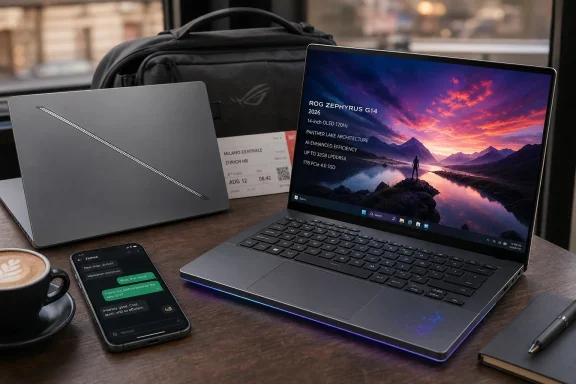 Asus Stops Treating Battery Life as the Tax on Performance
The Zephyrus G14 has always existed in a slightly awkward but attractive corner of the market. It is not a thin-and-light in the MacBook Air sense, and it is not a slab-like desktop replacement built to sit permanently beside a 330-watt power brick. It is the laptop you buy when you know you want a dedicated GPU, but also know that carrying a 16- or 18-inch gaming machine through an airport is an act of self-punishment.That has made the G14 beloved and frustrating in roughly equal measure. Previous generations could deliver excellent gaming and creative performance, but the portability pitch always came with asterisks. You could take it anywhere, yes, but you still had to think about power profiles, charger access, display brightness, and whether a few hours away from the wall would turn into battery anxiety.
The 2026 model changes that balance less through spectacle than through efficiency. Notebookcheck’s summary says the new Intel Panther Lake processor does not dramatically outmuscle the previous Ryzen chip in raw CPU performance. Instead, it does the more useful thing for a compact laptop: it gets similar or better work done while drawing less power, and that translates into meaningfully longer runtimes.
That is the kind of upgrade that rarely dominates launch slides but actually changes how a laptop feels. A faster benchmark run is nice; a machine that stays quiet during routine work and lasts longer away from the wall changes daily behavior. The best portable computers are not the ones that make you admire their spec sheets. They are the ones that make you stop managing them.
Panther Lake Wins by Not Needing to Shout
Intel’s Panther Lake arrives with more baggage than most mobile CPU launches. It follows years in which Intel has been trying to restore credibility in mobile efficiency, while AMD gained a reputation for strong laptop performance and Qualcomm pushed Windows-on-Arm as the future of unplugged computing. Against that backdrop, the Zephyrus G14 is not just another design win. It is a public test of whether Intel can reclaim the high-end portable Windows laptop from the inside out.The most interesting part is that Asus did not use Panther Lake to turn the G14 into a benchmark vanity project. Notebookcheck’s account suggests the CPU story is subtler: single-core and efficiency improvements matter, but the laptop’s overall appeal comes from how well the processor behaves inside the thermal and battery limits of a 14-inch chassis. In Silent mode, CPU performance reportedly remains strong enough for everyday work while keeping noise low.
That is exactly where modern Windows laptops have often struggled. Many can be fast when the fans spin up, the chassis warms, and the power adapter is connected. Far fewer feel consistently premium when doing the boring stuff: browser tabs, Office work, messaging apps, streaming video, light photo edits, and the constant background churn of Windows services.
A great all-rounder is defined by its low-drama modes. If Panther Lake lets the G14 spend more time acting like a quiet productivity laptop without giving up its gaming identity, then Intel’s win is not merely architectural. It is behavioral. The user experiences it as less noise, less heat, and less battery math.
The RTX 5070 Ti Keeps the G14 Honest About What It Is
There is no magic in a 14-inch gaming laptop. Put a powerful Nvidia GPU into a compact aluminum body, ask it to render modern games at high settings, and the fans are going to become part of the experience. Notebookcheck makes that clear: the Zephyrus G14 remains very audible when the RTX 5070 Ti is allowed to stretch its legs.That caveat is not a failure. It is the price of the category. A small performance laptop has to move heat out of a small space, and buyers who pretend otherwise are asking physics to provide customer support.
The more useful question is whether the machine gives users options. Asus’s answer appears to be yes. In full performance mode, the G14 offers excellent gaming performance for its size. In quieter modes, technologies such as DLSS and multi-frame generation can help deliver acceptable frame rates without always forcing the laptop into its loudest operating state.
That matters because the way people use gaming laptops has changed. The old gaming laptop was often a plugged-in substitute for a desktop. The new premium gaming ultraportable is more schizophrenic: one hour it is a meeting machine, the next it is a hotel-room gaming rig, and later it is a couch screen for a movie. The G14’s job is not to be silent under full GPU load. Its job is to make the transitions between those identities less annoying.
The Display Upgrade Is More Than Spec-Sheet Decoration
OLED has become the premium laptop industry’s favorite shortcut to instant showroom appeal. Deep blacks, vivid colors, fast response times, and glossy contrast all help a machine look expensive in a retail demo. But in portable systems, OLED has also brought tradeoffs around brightness, power draw, burn-in anxiety, and outdoor usability.The 2026 G14’s display upgrade appears to land on the right side of that equation. Notebookcheck highlights the new 120Hz OLED panel’s much higher brightness compared with the previous version, along with superb image quality. Asus’s own positioning around the machine emphasizes a 3K-class ROG Nebula HDR OLED panel with high peak brightness, full DCI-P3 coverage, and fast response.
The brightness improvement is the key point. A great OLED that only looks great in a dim room is less useful on the road than its marketing suggests. A brighter OLED makes the multimedia pitch more credible, improves HDR video and gaming, and makes the laptop feel less compromised in the uncontrolled lighting conditions where portable machines actually live.
For Windows users, this also intersects with a broader platform issue. Windows has improved its HDR handling over time, but HDR on laptops remains a messy combination of panel capability, app behavior, GPU drivers, content format, and user settings. A brighter, higher-quality panel does not solve all of that, but it gives the system more room to work. Bad HDR on a dim screen looks like a gimmick; good HDR on a capable OLED can finally feel like a reason to care.
Asus Understands That the Keyboard Is Not a Legacy Feature
Gaming laptop makers often obsess over refresh rates, GPU wattage, vapor chambers, RGB lighting, and benchmark charts while treating the keyboard as a place where keys happen to be. Asus deserves credit for not falling into that trap here. Notebookcheck calls out the Zephyrus G14’s keyboard as one of the best available on a laptop, with a generous 1.7 mm of travel and a feel that can stand beside expensive business notebooks.That matters because the G14’s “all-rounder” claim collapses if the input devices are second-rate. A laptop meant for work and play must be judged not only by how many frames it can render, but by how willingly someone would type a long document on it. A bad keyboard turns a portable workstation into a portable compromise.
The clickpad also receives praise, which is not incidental. Windows laptops have spent years narrowing the gap with Apple on trackpad quality, but inconsistency remains common, especially in machines built around gaming first. A precise, comfortable clickpad gives the G14 credibility in the hours when the GPU is idle and the machine is simply being a computer.
This is where Asus’s design discipline shows. The G14 does not need to look like an office laptop, but it does need to survive office-laptop tasks without feeling like a costume change. Good input hardware is what lets a gaming machine pass as a serious daily driver.
The $3,199 Price Turns a Great Laptop Into a Hard Argument
The biggest problem with the 2026 Zephyrus G14 is not technical. It is economic. At $3,199 for the reviewed RTX 5070 Ti configuration, Asus is asking buyers to treat the G14 not as a clever compromise, but as a luxury instrument.That price changes the conversation. At $1,800 or $2,200, a compact gaming laptop with excellent performance, a great OLED display, and improved battery life is an easy recommendation for the right buyer. At $3,199, every imperfection becomes more visible. Fan noise under load is expected, but still real. Limited upgrade flexibility matters more. The existence of discounted previous-generation models becomes harder to ignore.
Notebookcheck notes that the 2026 machine is considerably more expensive than the prior version. That gap is crucial because the G14 is not being judged in a vacuum. It competes against last year’s G14, larger RTX-equipped laptops with more thermal headroom, premium productivity notebooks with better battery life, and desktop-plus-ultraportable combinations that may cost less together than this one machine.
The defense is that the G14 compresses several machines into one. For a student in engineering or media work, a developer who also games, a traveling creative, or a consultant who wants a single Windows system with real GPU horsepower, consolidation has value. The attack is equally simple: consolidation is only worth so much, and Asus is charging as if the buyer has already accepted the premise.
The New G14 Is a Windows Laptop for the Post-Specialization Era
The PC market has spent years slicing laptops into narrower categories. Gaming laptops are for gamers. Creator laptops are for creators. Business laptops are for managed fleets. AI PCs are for whatever vendors currently need AI PCs to mean. The Zephyrus G14 pushes in the opposite direction.Its appeal is that it refuses to specialize too much. It has the GPU power to play demanding games and accelerate creative workloads. It has the CPU efficiency to behave better away from the wall. It has the display and speakers to work as a media machine. It has the keyboard and touchpad quality to be used seriously for writing, coding, and office work.
That makes it especially relevant to WindowsForum’s audience, because enthusiasts and IT pros often live across categories. The same person may need Hyper-V, Visual Studio Code, Steam, Teams, Lightroom, a dozen browser tabs, and a decent screen for travel. A machine that can handle all of that without feeling like a mistake in any one role is rare.
But there is also a warning here for buyers: all-rounder does not mean universal best choice. If gaming is the only priority, a larger chassis will usually offer better thermals per dollar. If battery life is the only priority, a lighter productivity laptop or Arm-based Windows machine may be more rational. If cost matters, previous G14 generations and competing 14- to 16-inch systems may be far more sensible. The 2026 G14 is best understood as a premium answer to a very specific desire: fewer devices, fewer compromises, higher price.
Intel Gets a Showcase, but Asus Gets the Credit
It would be easy to frame the 2026 G14 primarily as a Panther Lake story. Intel certainly benefits from that interpretation. A respected compact performance laptop moving from AMD to Intel and gaining battery life is exactly the kind of narrative Intel wants in 2026.But laptops are systems, not CPU sockets. Battery life is shaped by the processor, yes, but also by firmware, panel behavior, GPU switching, cooling policy, battery capacity, Windows power management, and the manufacturer’s willingness to tune for real-world use rather than just headline performance. Asus deserves credit if the G14’s improved endurance is not merely a chip-level win but a system-level one.
This is also why buyers should be cautious about generalizing too quickly. Panther Lake may be efficient, but not every Panther Lake laptop will be a G14. A cheaper chassis with a worse display, poor firmware, or aggressive fan curves can turn a good platform into a mediocre product. Conversely, AMD and Qualcomm systems will continue to compete hard, especially in designs optimized around their strengths.
Still, the G14 provides an important proof point. Intel does not need every laptop to win every benchmark. It needs premium Windows machines that feel better because Intel is inside them. If the 2026 G14 really does deliver the mix of quiet daily performance, stronger battery life, and high-end gaming that Notebookcheck describes, then Panther Lake has cleared a more meaningful bar than a chart-topping score.
The Compact Gaming Laptop Finally Learns to Behave Like a Laptop
The most concrete lesson from the 2026 Zephyrus G14 is that the category is maturing. For years, compact gaming laptops were defined by their exceptions: excellent, except for battery life; portable, except for the charger; powerful, except when unplugged; premium, except for fan noise and heat. The new G14 does not erase those tradeoffs, but it appears to move several of them from deal-breaking to manageable.That is the difference between a clever enthusiast machine and a genuinely great daily driver. The former impresses you when you test it. The latter disappears into your routine.
- The 2026 ROG Zephyrus G14’s most important upgrade is improved efficiency and battery life, not a dramatic leap in raw CPU performance.
- The switch from AMD to Intel Panther Lake is significant because it changes how the laptop behaves in quiet and portable use, not just how it benchmarks.
- The RTX 5070 Ti keeps the G14 among the most capable compact gaming laptops, but fan noise under heavy gaming remains part of the deal.
- The brighter 120Hz OLED display strengthens the machine’s case as a travel media and HDR gaming laptop.
- The keyboard and clickpad help the G14 succeed as a work machine, which is essential to its all-rounder claim.
- The $3,199 price is the central obstacle, especially when older G14 models and larger gaming laptops may offer better value.
References
- Primary source: Notebookcheck
Published: Sun, 28 Jun 2026 15:57:00 GMT
The 2026 Asus ROG Zepyhrus G14 is a better allrounder with Intel's Panther Lake CPU - Notebookcheck News
Asus updated its compact gaming/multimedia laptop ROG Zephyrus G14 for 2026 at some areas including the switch to a new Panther Lake mobile processor from Intel. Thanks to improved efficiency numbers, the battery runtimes are much better than before. www.notebookcheck.net
- Related coverage: rog.asus.com
ROG Zephyrus G14 (2026) | Lightweight, AI Gaming Laptop
2026 ASUS ROG Zephyrus G14: Work, game, and create smarter with this Copilot+ PC. Featuring a 3K OLED display, RTX 5080 graphics, and Intel Core Ultra.rog.asus.com - Related coverage: pcworld.com
Intel's 'Panther Lake' laptop CPU explained: all the details | PCWorld
Intel's Panther Lake chip for laptops includes more cores and powerful new AI technologies for graphics and wireless as it readies its flagship processor for early 2026. This is a deep dive on what the next Core Ultra chip contains.www.pcworld.com - Related coverage: pcper.com
CES 2026: Intel Launches Core Ultra 3 Series "Panther Lake" Processors - PC Perspective
CES 2026: Intel Launches Core Ultra 3 Series "Panther Lake" Processors Intel officially launched its Core Ultra 3 series of mobile processors dubbed "Pantherpcper.com - Related coverage: arstechnica.com
Intel Panther Lake Core Ultra review: Intel's best laptop CPU in a very long time - Ars Technica
Intel manages big boosts to CPU and GPU speed without blowing up battery life.arstechnica.com - Related coverage: techspot.com
Intel demos Panther Lake chips, promises Arrow Lake performance with Lunar Lake efficiency | TechSpot
Intel did not share performance benchmarks for the new chips but claimed they will deliver Arrow Lake-level performance with Lunar Lake-level efficiency. The company also confirmed that...www.techspot.com
- Related coverage: ultrabookreview.com
The complete list of Intel Panther Lake laptops (Core Ultra X9 388H, Core Ultra 9 386H, Core Ultra 7 365)
In this article we're discussing laptops built on the Intel Panther Lake (Intel Core Ultra Series 3) hardware, the latest Intel mobile platform available forwww.ultrabookreview.com - Related coverage: asus.com

ASUS ROG Zephyrus G14 and G16 Arrive in the US with Intel Core Ultra Series 3 and RTX 50 Series | News|ASUS USA
a:link { color: blue; background-color: transparent; text-decoration: none; } a:visited { color: purple; background-color: transparent; text-decoration: none; } a:hover { color: b
www.asus.com
- Related coverage: tomshardware.com
Intel mobile CPUs have achieved up to 95x performance uplift over the past two decades — benchmarking the gains from 45nm Penryn to 18A Panther Lake | Tom's Hardware
15 Intel CPUs, spanning generations, spotlight 18 years of relentless innovation.www.tomshardware.com - Related coverage: windowscentral.com
"An unmatched upgrade opportunity": Intel's new Core Series 3 mobile CPUs target "value buyers" as PC prices rise | Windows Central
Intel just unveiled new Core Series 3 mobile chips, and I'm optimistic that they'll help more Windows users upgrade their aging PCs.www.windowscentral.com - Related coverage: gamesradar.com
The 2026 Asus ROG Zephyrus G14 makes some spicy choices around its AMD configurations | GamesRadar+
The 2026 Asus ROG Zephyrus G14 menu has been unveiled, and things are looking a lot more Intel-friendly this year.www.gamesradar.com - Related coverage: t3.com
Intel’s newest Panther Lake chips are official – but what does that actually mean for 2026 laptops? | T3
Panther Lake slinks into viewwww.t3.com - Related coverage: d1io3yog0oux5.cloudfront.net
Intel Unveils Panther Lake Architecture: First AI PC Platform Built on 18A
PDF documentd1io3yog0oux5.cloudfront.net
- Related coverage: builders.intel.com
- Related coverage: ashgabattimes.com
