

COMMELL announced the LV-6718 on July 2, 2026, a standard 170 mm Mini-ITX motherboard that brings Intel’s Panther Lake-H mobile silicon, including a Core Ultra 7 366H option, into desktop-style industrial and enthusiast systems. VideoCardz amplified the launch this week, and the interesting part is not simply that another compact board exists. It is that Panther Lake’s first credible desktop-ish appearance is arriving through the side door: soldered, mobile, industrial, and slightly awkward in exactly the ways that make modern PC platform strategy worth watching.
Intel’s newest client silicon is not being introduced to small-form-factor tinkerers as a clean socketed upgrade path. It is being packaged as Mobile on Desktop, a category that has always lived between practicality and compromise. For Windows users and administrators, the LV-6718 is a reminder that the next PC platform shift may not begin with gaming towers or retail motherboards, but with industrial boards, edge deployments, signage boxes, labs, kiosks, and the kind of systems that quietly run Windows for years without anyone bragging about them.
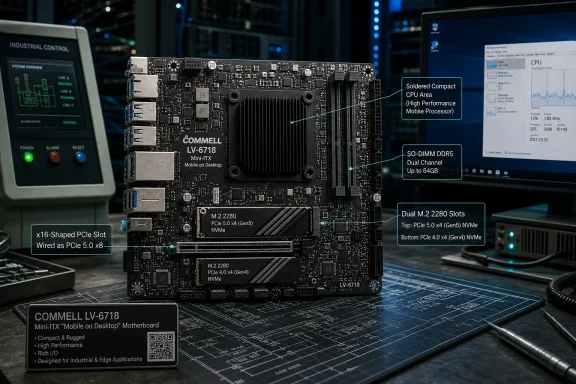
The LV-6718 is not a consumer motherboard in the familiar sense. COMMELL calls it a Mini-ITX mobile motherboard for Intel Core Ultra Series 3 processors, using the PTL-H platform — Intel’s Panther Lake-H family. VideoCardz describes the configuration as one of the first Core Ultra 300-era MoDT boards, and that framing is right because the board is physically desktop-compatible while architecturally still very much a mobile platform.
That distinction matters. A Mini-ITX board with a soldered mobile processor can fit inside many desktop cases, but it does not behave like a normal desktop platform. The CPU is not swappable, the memory is SO-DIMM rather than full-size DIMM, the PCIe lane budget reflects mobile silicon, and the cooling hardware appears to be custom enough that ordinary LGA mounting assumptions may not apply.
This is the kind of product that makes PC taxonomy look less useful than it used to be. The LV-6718 is neither a laptop motherboard nor a normal retail desktop board. It is a compact industrial platform with enough familiar connectors to tempt enthusiasts and enough embedded-system DNA to make them slow down before clicking “buy.”
For Intel, that ambiguity is useful. Panther Lake-H can enter desktops without Intel having to offer a socketed Panther Lake desktop family in the old model. For COMMELL and similar board makers, the ambiguity is a market opportunity: use mobile silicon where customers need compact, efficient, long-lived systems, but expose it through a motherboard form factor the rest of the PC ecosystem already understands.
On paper, that makes the LV-6718 far more interesting than the typical low-power embedded board. A 16-core mobile processor with modern integrated graphics, an NPU-era platform identity, DDR5-7200 SO-DIMM support, and PCIe 5.0 connectivity is not a Raspberry Pi-class appliance board. It is a real PC platform wearing industrial clothes.
But the processor should not distract from the broader platform signal. COMMELL is not selling a CPU; it is selling a board-level answer to the question of how Panther Lake can be deployed outside laptops. The answer, at least here, is soldered silicon, laptop memory, compact I/O, and enough expansion to let system builders treat the board as a foundation rather than an appliance.
That matters because Intel’s mobile processors increasingly contain the features many desktop users care about first: efficient CPU cores, capable integrated graphics, AI acceleration, modern media blocks, and idle behavior tuned for battery-class constraints. A compact Windows box that never needs a battery can still benefit from those characteristics if the board vendor exposes them sensibly.
That does not mean the board is a drop-in equivalent to a conventional enthusiast Mini-ITX motherboard. VideoCardz notes that the 24-pin ATX power connector sits at the top of the board, a placement that may be harmless in some enclosures and annoying in others. The memory slots are SO-DIMM, which is normal for mobile-derived boards but still changes the upgrade and parts-bin math for desktop builders.
The bigger question is cooling. VideoCardz could not confirm the cooler mounting hole spacing and observed that it does not appear to match common LGA-1200 or LGA-1700 layouts. COMMELL says the board is bundled with a cooler fan, which should make the system workable, but it also suggests buyers should not assume they can install a favorite low-profile Noctua cooler or repurpose an existing desktop heatsink.
That is where MoDT boards often reveal their real personality. They promise desktop convenience, but the closer you get to the CPU package, firmware, and thermals, the more the mobile platform asserts itself. The LV-6718 may fit in an ATX case, but that does not mean it belongs to the same upgrade culture as a socketed desktop board.
This is not necessarily a problem. PCIe 5.0 x8 offers the same nominal bandwidth class as PCIe 4.0 x16, and many workloads will not care. For a compact workstation, AI edge box, firewall with specialized adapters, or industrial controller with a high-bandwidth card, the trade-off may be entirely rational.
Storage gets a similarly modern but bounded arrangement. The board includes one M.2 2280 slot with PCIe Gen5 support and another M.2 2280 slot with PCIe Gen4 support. That is a strong storage layout for a Mini-ITX mobile-derived board, especially for Windows deployments that need a fast OS drive and a second SSD for data, logging, capture, or application workloads.
Still, the lane budget is the hidden architecture of every small system. A desktop chipset can make expansion feel abundant, even if shared and multiplexed. A mobile SoC platform tends to make every lane feel deliberate. The LV-6718 is not starved, but it is designed around prioritization rather than abundance.
Serial ports are the giveaway. Enthusiasts may joke about DB9 connectors in 2026, but industrial Windows systems still live among barcode scanners, lab equipment, point-of-sale gear, CNC controllers, medical devices, access systems, and specialized hardware that does not care what consumer laptop designers removed this year. A board like this can look quaint only if you forget where many Windows PCs actually work.
The display mix also makes sense. HDMI, DisplayPort++, and USB-C DisplayPort Alt Mode give builders flexibility for signage, control rooms, embedded displays, and multi-monitor operator stations. COMMELL’s product positioning is less about a desk PC for one person and more about a compact computer that can be standardized across deployments.
That is why the LV-6718 may matter more to sysadmins than to hobbyists. A board with modern CPU features, legacy-friendly I/O, and a conventional mounting format can reduce weirdness in the field. Windows administrators do not always need glamorous hardware; they need machines that can be imaged, serviced, replaced, and understood.
For many uses, that is fine. SO-DIMMs are widely available, high-capacity kits exist, and the smaller form factor helps keep the board compact. A 64 GB or 128 GB Windows system in Mini-ITX with Panther Lake-H could be very attractive for development machines, edge analytics, virtualization labs, and appliance-like deployments.
But SO-DIMM support changes the enthusiast equation. Desktop users who already own DDR5 UDIMMs cannot reuse them. Memory tuning culture may be less relevant. Availability of high-speed, high-capacity SO-DIMM kits can vary more than mainstream desktop kits, and buyers will need to pay closer attention to validated modules if reliability matters.
That is not a flaw so much as a declaration of intent. COMMELL is not designing around the Newegg weekend-upgrade crowd. It is designing around integrators who specify a board, RAM, storage, enclosure, and operating image as a system. The fact that enthusiasts can participate is a bonus, not the center of gravity.
The desktop market is no longer one clean category. A “desktop PC” can be a 350-watt gaming tower, a 6-liter workstation, a fanless signage box, a rack-mounted edge server, a classroom lab machine, a home NAS with a Windows VM, or a wall-mounted industrial controller. Socketed CPUs still matter, but they are no longer the only credible way to build something that stays on a desk, under a counter, or inside a cabinet.
Intel’s own product segmentation has encouraged this. Mobile chips receive major platform innovations early because laptops are the volume battlefield. Desktop platforms often emphasize peak performance, socket compatibility, and discrete GPU pairing, while mobile platforms emphasize efficiency, integrated accelerators, media capabilities, and idle power. MoDT boards exploit the gap.
The LV-6718 is therefore not an eccentric one-off. It is part of a broader shift in which board vendors package laptop-class silicon for desktop-class deployments because that is where the practical demand sits. If a mobile processor can satisfy the workload while cutting power, heat, and board complexity, many buyers will take the soldered CPU and move on.
That does not mean fleet deployment is frictionless. A board like the LV-6718 may land in long-life systems where administrators care less about benchmark leadership and more about driver stability, firmware updates, imaging, and supportability. The CPU architecture is only one part of the operational story.
Industrial systems also tend to run odd mixes of software. A machine may host a modern Windows 11 image, a legacy control application, a vendor driver that nobody wants to touch, and a monitoring agent designed around old assumptions. Hybrid cores, NPUs, and new graphics blocks are exciting, but administrators will still ask the oldest questions first: does the driver stack behave, can the image be reproduced, and will the vendor support this board long enough?
That is why the LV-6718’s industrial pedigree matters. COMMELL is not a lifestyle PC brand. It operates in a world where product pages, manuals, availability windows, and configuration consistency often matter more than launch-day performance claims. For WindowsForum readers, that makes the board more interesting than a disposable mini PC with similar silicon and no real service story.
Edge computing has always suffered from inflated language. Not every kiosk needs AI, and not every factory controller wants a neural accelerator. But there are real cases where local processing beats cloud dependency: camera inspection, speech interfaces, anomaly detection, low-latency UI, privacy-sensitive analytics, and systems that must keep working when the network is unreliable.
A Mini-ITX Panther Lake-H board gives integrators a familiar way to experiment with those workloads. They can add fast NVMe storage, a PCIe card, multiple displays, and standard Windows management tools without moving to a fully proprietary appliance. That is less flashy than a keynote demo, but it is closer to how new compute capabilities spread through businesses.
The risk is that AI branding can obscure mundane requirements. If the cooler is proprietary, if firmware updates are slow, if drivers are awkward, or if long-term availability is unclear, no NPU will save the deployment. The LV-6718’s success will depend on boring execution as much as silicon novelty.
But the enthusiast should approach it as an industrial board first. Pricing may not follow consumer motherboard expectations. BIOS options may be functional rather than overclocker-friendly. Cooler compatibility may be limited. Retail availability may be patchy outside distributor channels. Documentation may be good in the industrial sense while still leaving hobbyists wanting the kind of hand-holding found in mainstream motherboard ecosystems.
For integrators, those same traits look different. A bundled cooler is one less variable. SO-DIMMs are easy to qualify. A soldered CPU prevents field mismatch. Serial ports avoid adapters. Mini-ITX mounting keeps chassis options open. The absence of socketed upgradeability is not a disaster when the system is specified as a fixed appliance.
This split audience is what makes the LV-6718 compelling. It is a product enthusiasts will discover because it looks like forbidden desktop fruit, but it is a product industrial buyers will evaluate because it solves packaging problems. Those are related markets, not identical ones.
Cooling is where that rejection becomes physical. If the board does not use common LGA mounting holes, builders cannot assume normal desktop cooler compatibility. If the included cooler is adequate but specialized, replacement and noise tuning become vendor-dependent. If the system is deployed in a cramped industrial enclosure, airflow may matter more than the CPU’s nominal efficiency.
None of this makes the LV-6718 a bad product. It simply means the “desktop” part of Mobile on Desktop should be read carefully. The board can live in a desktop-shaped ecosystem, but the thermal design is closer to an embedded platform than a consumer motherboard.
That may be a perfectly good trade. Many systems are built once and left alone. But for hobbyists, reviewers, and IT shops that standardize on replaceable parts, the cooler deserves scrutiny before the purchase order. The difference between “fits Mini-ITX” and “uses standard desktop cooling” is the difference between a neat build and a procurement surprise.
The traditional desktop launch still matters for gamers, workstation buyers, OEM towers, and DIY builders. But much of the growth in interesting PC hardware is happening around the edges: mini PCs, handhelds, embedded systems, AI boxes, network appliances, and small workstations that use laptop-class silicon because it is efficient and highly integrated. Panther Lake-H fits that world naturally.
COMMELL’s board also suggests that the boundary between “mobile” and “desktop” is becoming a business decision rather than a technical law. If the board has ATX power, Mini-ITX mounting, PCIe expansion, and Windows compatibility, many customers will call it a desktop regardless of the CPU package. The silicon’s origin matters less than the system’s deployability.
That is a subtle but important change. PC categories used to describe hardware architecture. Increasingly, they describe where the machine is installed and how it is managed. The LV-6718 is mobile silicon for stationary work, and that phrase may define more PCs over the next few years than Intel’s old socket charts do.
Intel’s newest client silicon is not being introduced to small-form-factor tinkerers as a clean socketed upgrade path. It is being packaged as Mobile on Desktop, a category that has always lived between practicality and compromise. For Windows users and administrators, the LV-6718 is a reminder that the next PC platform shift may not begin with gaming towers or retail motherboards, but with industrial boards, edge deployments, signage boxes, labs, kiosks, and the kind of systems that quietly run Windows for years without anyone bragging about them.
 Panther Lake Reaches the Desktop by Pretending Not to Be Desktop
The LV-6718 is not a consumer motherboard in the familiar sense. COMMELL calls it a Mini-ITX mobile motherboard for Intel Core Ultra Series 3 processors, using the PTL-H platform — Intel’s Panther Lake-H family. VideoCardz describes the configuration as one of the first Core Ultra 300-era MoDT boards, and that framing is right because the board is physically desktop-compatible while architecturally still very much a mobile platform.That distinction matters. A Mini-ITX board with a soldered mobile processor can fit inside many desktop cases, but it does not behave like a normal desktop platform. The CPU is not swappable, the memory is SO-DIMM rather than full-size DIMM, the PCIe lane budget reflects mobile silicon, and the cooling hardware appears to be custom enough that ordinary LGA mounting assumptions may not apply.
This is the kind of product that makes PC taxonomy look less useful than it used to be. The LV-6718 is neither a laptop motherboard nor a normal retail desktop board. It is a compact industrial platform with enough familiar connectors to tempt enthusiasts and enough embedded-system DNA to make them slow down before clicking “buy.”
For Intel, that ambiguity is useful. Panther Lake-H can enter desktops without Intel having to offer a socketed Panther Lake desktop family in the old model. For COMMELL and similar board makers, the ambiguity is a market opportunity: use mobile silicon where customers need compact, efficient, long-lived systems, but expose it through a motherboard form factor the rest of the PC ecosystem already understands.
The Core Ultra 7 366H Is the Headline, but the Board Is the Story
According to COMMELL’s own product material and VideoCardz’s report, the LV-6718 can be configured with Intel’s Core Ultra 7 366H. That chip is a 16-core Panther Lake-H part arranged as four Performance cores, eight Efficient cores, and four low-power Efficient cores. It is the sort of hybrid design Intel has spent years teaching Windows, developers, and users to understand.On paper, that makes the LV-6718 far more interesting than the typical low-power embedded board. A 16-core mobile processor with modern integrated graphics, an NPU-era platform identity, DDR5-7200 SO-DIMM support, and PCIe 5.0 connectivity is not a Raspberry Pi-class appliance board. It is a real PC platform wearing industrial clothes.
But the processor should not distract from the broader platform signal. COMMELL is not selling a CPU; it is selling a board-level answer to the question of how Panther Lake can be deployed outside laptops. The answer, at least here, is soldered silicon, laptop memory, compact I/O, and enough expansion to let system builders treat the board as a foundation rather than an appliance.
That matters because Intel’s mobile processors increasingly contain the features many desktop users care about first: efficient CPU cores, capable integrated graphics, AI acceleration, modern media blocks, and idle behavior tuned for battery-class constraints. A compact Windows box that never needs a battery can still benefit from those characteristics if the board vendor exposes them sensibly.
Mini-ITX Makes the Compromise Look Smaller Than It Is
The LV-6718 uses the standard Mini-ITX footprint, which is the smartest part of the design. A 170 mm square motherboard is boring in the best possible way: cases exist, power supplies exist, mounting points are known, and system integrators do not need to reinvent the chassis. In an industry that loves exotic small systems, Mini-ITX remains valuable because it is small without being proprietary.That does not mean the board is a drop-in equivalent to a conventional enthusiast Mini-ITX motherboard. VideoCardz notes that the 24-pin ATX power connector sits at the top of the board, a placement that may be harmless in some enclosures and annoying in others. The memory slots are SO-DIMM, which is normal for mobile-derived boards but still changes the upgrade and parts-bin math for desktop builders.
The bigger question is cooling. VideoCardz could not confirm the cooler mounting hole spacing and observed that it does not appear to match common LGA-1200 or LGA-1700 layouts. COMMELL says the board is bundled with a cooler fan, which should make the system workable, but it also suggests buyers should not assume they can install a favorite low-profile Noctua cooler or repurpose an existing desktop heatsink.
That is where MoDT boards often reveal their real personality. They promise desktop convenience, but the closer you get to the CPU package, firmware, and thermals, the more the mobile platform asserts itself. The LV-6718 may fit in an ATX case, but that does not mean it belongs to the same upgrade culture as a socketed desktop board.
PCIe 5.0 Arrives, but Mobile Lane Economics Still Rule
COMMELL’s specification sheet gives the LV-6718 a PCIe x16 physical slot running at PCIe 5.0 x8. VideoCardz notes that this reflects the maximum bandwidth available from Panther Lake in this configuration. In practical terms, that is likely enough for many GPUs, capture cards, accelerators, and industrial add-in cards, but it is also a reminder that the slot shape is not the same as the lane count.This is not necessarily a problem. PCIe 5.0 x8 offers the same nominal bandwidth class as PCIe 4.0 x16, and many workloads will not care. For a compact workstation, AI edge box, firewall with specialized adapters, or industrial controller with a high-bandwidth card, the trade-off may be entirely rational.
Storage gets a similarly modern but bounded arrangement. The board includes one M.2 2280 slot with PCIe Gen5 support and another M.2 2280 slot with PCIe Gen4 support. That is a strong storage layout for a Mini-ITX mobile-derived board, especially for Windows deployments that need a fast OS drive and a second SSD for data, logging, capture, or application workloads.
Still, the lane budget is the hidden architecture of every small system. A desktop chipset can make expansion feel abundant, even if shared and multiplexed. A mobile SoC platform tends to make every lane feel deliberate. The LV-6718 is not starved, but it is designed around prioritization rather than abundance.
The Rear I/O Reads Like Industrial Windows, Not Gaming Desktop
The LV-6718’s rear I/O is a useful tell. COMMELL lists three USB 3.2 Gen2 ports, one USB 2.0 port, HDMI, DisplayPort++, USB-C with DisplayPort Alt Mode, audio, and serial connectivity. That mixture is not aimed primarily at RGB-heavy gaming builds; it is aimed at machines that need to talk to displays, peripherals, legacy equipment, and predictable management environments.Serial ports are the giveaway. Enthusiasts may joke about DB9 connectors in 2026, but industrial Windows systems still live among barcode scanners, lab equipment, point-of-sale gear, CNC controllers, medical devices, access systems, and specialized hardware that does not care what consumer laptop designers removed this year. A board like this can look quaint only if you forget where many Windows PCs actually work.
The display mix also makes sense. HDMI, DisplayPort++, and USB-C DisplayPort Alt Mode give builders flexibility for signage, control rooms, embedded displays, and multi-monitor operator stations. COMMELL’s product positioning is less about a desk PC for one person and more about a compact computer that can be standardized across deployments.
That is why the LV-6718 may matter more to sysadmins than to hobbyists. A board with modern CPU features, legacy-friendly I/O, and a conventional mounting format can reduce weirdness in the field. Windows administrators do not always need glamorous hardware; they need machines that can be imaged, serviced, replaced, and understood.
SO-DIMM DDR5-7200 Is a Laptop Choice with Desktop Consequences
The board supports two DDR5 SO-DIMM modules up to 7200 MHz, with a maximum capacity of 128 GB. That is an impressive ceiling for a compact mobile-derived Mini-ITX system. It also makes clear that this platform inherits laptop memory economics rather than desktop memory habits.For many uses, that is fine. SO-DIMMs are widely available, high-capacity kits exist, and the smaller form factor helps keep the board compact. A 64 GB or 128 GB Windows system in Mini-ITX with Panther Lake-H could be very attractive for development machines, edge analytics, virtualization labs, and appliance-like deployments.
But SO-DIMM support changes the enthusiast equation. Desktop users who already own DDR5 UDIMMs cannot reuse them. Memory tuning culture may be less relevant. Availability of high-speed, high-capacity SO-DIMM kits can vary more than mainstream desktop kits, and buyers will need to pay closer attention to validated modules if reliability matters.
That is not a flaw so much as a declaration of intent. COMMELL is not designing around the Newegg weekend-upgrade crowd. It is designing around integrators who specify a board, RAM, storage, enclosure, and operating image as a system. The fact that enthusiasts can participate is a bonus, not the center of gravity.
MoDT Is Back Because the Desktop Has Stopped Being One Thing
Mobile-on-desktop boards have appeared in different forms for years, sometimes as clever industrial designs and sometimes as odd enthusiast curiosities. Their appeal rises whenever mobile CPUs offer a better balance of performance, power, graphics, and integration than the low-end desktop stack. Panther Lake-H gives that old idea a new reason to exist.The desktop market is no longer one clean category. A “desktop PC” can be a 350-watt gaming tower, a 6-liter workstation, a fanless signage box, a rack-mounted edge server, a classroom lab machine, a home NAS with a Windows VM, or a wall-mounted industrial controller. Socketed CPUs still matter, but they are no longer the only credible way to build something that stays on a desk, under a counter, or inside a cabinet.
Intel’s own product segmentation has encouraged this. Mobile chips receive major platform innovations early because laptops are the volume battlefield. Desktop platforms often emphasize peak performance, socket compatibility, and discrete GPU pairing, while mobile platforms emphasize efficiency, integrated accelerators, media capabilities, and idle power. MoDT boards exploit the gap.
The LV-6718 is therefore not an eccentric one-off. It is part of a broader shift in which board vendors package laptop-class silicon for desktop-class deployments because that is where the practical demand sits. If a mobile processor can satisfy the workload while cutting power, heat, and board complexity, many buyers will take the soldered CPU and move on.
Windows Is Ready for the Hybrid CPU, but Fleet Reality Is Messier
From a Windows perspective, Panther Lake-H is not arriving in a vacuum. Microsoft and Intel have spent years refining scheduling behavior for hybrid architectures, Thread Director-style hints, efficiency cores, and foreground-background prioritization. Windows 11 is far more comfortable with mixed-core CPUs than Windows was when Intel first pushed hybrid client designs into mainstream PCs.That does not mean fleet deployment is frictionless. A board like the LV-6718 may land in long-life systems where administrators care less about benchmark leadership and more about driver stability, firmware updates, imaging, and supportability. The CPU architecture is only one part of the operational story.
Industrial systems also tend to run odd mixes of software. A machine may host a modern Windows 11 image, a legacy control application, a vendor driver that nobody wants to touch, and a monitoring agent designed around old assumptions. Hybrid cores, NPUs, and new graphics blocks are exciting, but administrators will still ask the oldest questions first: does the driver stack behave, can the image be reproduced, and will the vendor support this board long enough?
That is why the LV-6718’s industrial pedigree matters. COMMELL is not a lifestyle PC brand. It operates in a world where product pages, manuals, availability windows, and configuration consistency often matter more than launch-day performance claims. For WindowsForum readers, that makes the board more interesting than a disposable mini PC with similar silicon and no real service story.
The AI PC Branding Is Less Important Than the Edge Use Case
Panther Lake belongs to Intel’s AI PC era, and the Core Ultra branding inevitably carries NPU implications. But the LV-6718 should not be judged primarily by whether it satisfies a marketing definition of an AI PC. Its more concrete value is that it puts a modern heterogeneous processor into a board that can be embedded in places where local inference, media processing, and sensor-adjacent compute may actually be useful.Edge computing has always suffered from inflated language. Not every kiosk needs AI, and not every factory controller wants a neural accelerator. But there are real cases where local processing beats cloud dependency: camera inspection, speech interfaces, anomaly detection, low-latency UI, privacy-sensitive analytics, and systems that must keep working when the network is unreliable.
A Mini-ITX Panther Lake-H board gives integrators a familiar way to experiment with those workloads. They can add fast NVMe storage, a PCIe card, multiple displays, and standard Windows management tools without moving to a fully proprietary appliance. That is less flashy than a keynote demo, but it is closer to how new compute capabilities spread through businesses.
The risk is that AI branding can obscure mundane requirements. If the cooler is proprietary, if firmware updates are slow, if drivers are awkward, or if long-term availability is unclear, no NPU will save the deployment. The LV-6718’s success will depend on boring execution as much as silicon novelty.
Enthusiasts Will See a Tiny Workstation; Integrators Will See a Parts Contract
For small-form-factor enthusiasts, the LV-6718 has obvious charm. A compact board with a modern Intel mobile CPU, DDR5-7200 support, PCIe 5.0 storage, and a physical x16 slot invites mental builds immediately. It could become a quiet desktop, a compact developer box, a home lab node, or a strange little GPU-capable system.But the enthusiast should approach it as an industrial board first. Pricing may not follow consumer motherboard expectations. BIOS options may be functional rather than overclocker-friendly. Cooler compatibility may be limited. Retail availability may be patchy outside distributor channels. Documentation may be good in the industrial sense while still leaving hobbyists wanting the kind of hand-holding found in mainstream motherboard ecosystems.
For integrators, those same traits look different. A bundled cooler is one less variable. SO-DIMMs are easy to qualify. A soldered CPU prevents field mismatch. Serial ports avoid adapters. Mini-ITX mounting keeps chassis options open. The absence of socketed upgradeability is not a disaster when the system is specified as a fixed appliance.
This split audience is what makes the LV-6718 compelling. It is a product enthusiasts will discover because it looks like forbidden desktop fruit, but it is a product industrial buyers will evaluate because it solves packaging problems. Those are related markets, not identical ones.
The Cooler Question Is the Whole Platform Philosophy in Miniature
VideoCardz’s uncertainty about cooler mounting may sound like a minor footnote, but it captures the platform’s central tension. A standard Mini-ITX board invites standard desktop expectations. A mobile soldered CPU rejects some of them immediately.Cooling is where that rejection becomes physical. If the board does not use common LGA mounting holes, builders cannot assume normal desktop cooler compatibility. If the included cooler is adequate but specialized, replacement and noise tuning become vendor-dependent. If the system is deployed in a cramped industrial enclosure, airflow may matter more than the CPU’s nominal efficiency.
None of this makes the LV-6718 a bad product. It simply means the “desktop” part of Mobile on Desktop should be read carefully. The board can live in a desktop-shaped ecosystem, but the thermal design is closer to an embedded platform than a consumer motherboard.
That may be a perfectly good trade. Many systems are built once and left alone. But for hobbyists, reviewers, and IT shops that standardize on replaceable parts, the cooler deserves scrutiny before the purchase order. The difference between “fits Mini-ITX” and “uses standard desktop cooling” is the difference between a neat build and a procurement surprise.
Panther Lake’s First Desktop Footprints May Be Quiet Ones
If Intel eventually offers a broader desktop Panther Lake story, boards like the LV-6718 may look like early curiosities. If it does not, they may become the most visible way Panther Lake appears in desktop-like systems. Either outcome tells us something about where the PC market is going.The traditional desktop launch still matters for gamers, workstation buyers, OEM towers, and DIY builders. But much of the growth in interesting PC hardware is happening around the edges: mini PCs, handhelds, embedded systems, AI boxes, network appliances, and small workstations that use laptop-class silicon because it is efficient and highly integrated. Panther Lake-H fits that world naturally.
COMMELL’s board also suggests that the boundary between “mobile” and “desktop” is becoming a business decision rather than a technical law. If the board has ATX power, Mini-ITX mounting, PCIe expansion, and Windows compatibility, many customers will call it a desktop regardless of the CPU package. The silicon’s origin matters less than the system’s deployability.
That is a subtle but important change. PC categories used to describe hardware architecture. Increasingly, they describe where the machine is installed and how it is managed. The LV-6718 is mobile silicon for stationary work, and that phrase may define more PCs over the next few years than Intel’s old socket charts do.
The LV-6718 Tells Buyers to Read the Fine Print Before Chasing Panther Lake
COMMELL’s Panther Lake Mini-ITX board is exciting because it is specific, not because it is universal. It gives Windows builders access to modern Intel mobile silicon in a standard motherboard footprint, but it also asks them to accept the consequences of that choice.- The LV-6718 is a Mini-ITX industrial motherboard built around Intel’s Panther Lake-H mobile platform, not a conventional socketed desktop board.
- The Core Ultra 7 366H option brings a 16-core hybrid CPU configuration into compact stationary systems.
- The board supports two DDR5 SO-DIMM modules up to 128 GB and speeds up to DDR5-7200, which is strong for compact systems but not compatible with desktop DIMMs.
- Expansion is modern but mobile-bounded, with a PCIe 5.0 x8 electrical slot, one PCIe 5.0 M.2 2280 slot, and one PCIe 4.0 M.2 2280 slot.
- Cooler compatibility should be treated as a purchasing question, because standard desktop mounting support has not been confirmed and COMMELL bundles its own cooler fan.
- The most natural buyers are industrial integrators, edge-system builders, and Windows administrators who value compact standardization more than socketed upgrade paths.
References
- Primary source: videocardz.com
Published: Mon, 06 Jul 2026 08:30:57 GMT
- Related coverage: techtimes.com
Panther Lake Hits Mini-ITX: COMMELL LV-6718 Brings Intel 18A Compute to Industrial Edge
COMMELL LV-6718 Mini-ITX motherboard houses Intel’s Panther Lake Core Ultra 7 366H — a three-fab, 18A-process chip with a 50 TOPS NPU — on a 170mm board aimed at industrial edge deployments, machinewww.techtimes.com - Related coverage: pausehardware.com
Panther Lake Sur Mini-ITX Avec Core Ultra 7 366H
Panther Lake arrive en Mini-ITX chez COMMELL avec un Core Ultra 7 366H, 128 Go de DDR5-7200, un slot PCIe 5.0 x8 et deux M.2 2280.pausehardware.com - Related coverage: 4pda.to
Commell выпустила Mini-ITX материнскую плату LV-3718 с интегрированным Intel Core Ultra 7 - 4PDA
Commell выпустила Mini-ITX материнскую плату LV-3718 с интегрированным Intel Core Ultra 74pda.to - Related coverage: pcnews.ru
Новейший энергоэффективный мобильный процессор Intel, но в настольном формате. Выпущена плата Commell LV-6718 с Core Ultra 7 366H - PCNEWS.RU
Все компьютерные новости на PCNews.ru. Вся новая информация, о компьютерах и информационных технологиях. Синдикация новостей, статей, пресс-релизов со всех сайтов компьютерной (ИТ или IT) тематики.pcnews.ru
- Related coverage: tomshardware.com
World's Smallest Tiger Lake: A Pico-ITX with Quad-Core CPU & Iris Xe | Tom's Hardware
Commell's LP-179 comes with Tiger Lake-UP3.www.tomshardware.com
- Related coverage: dfi.com
