

Australian channel partners are being urged to accelerate PC, meeting-room and connectivity refreshes in mid-2026 because Windows 10 support ended on October 14, 2025, AI-capable PCs now require newer silicon, and memory-driven device price rises are tightening the economics of waiting. The sales pitch is obvious, but the more interesting story is strategic. The channel is not merely being handed another upgrade cycle; it is being handed a rare moment when compliance, capability and scarcity all point in the same direction. For resellers and managed service providers, the danger is not overselling the refresh — it is underestimating how quickly the refresh will become someone else’s relationship.
Windows 10’s end of support was never going to arrive as a single dramatic outage. Microsoft did not flip a switch that bricked laptops, froze desktops or forced every small business owner into a same-day procurement panic. Instead, the old operating system crossed a quieter line: after October 14, 2025, standard support ended, and the burden shifted from Microsoft’s patch pipeline to the customer’s risk register.
That distinction matters because many organizations are structurally bad at acting on risks that do not immediately break something. A Windows 10 device can still boot, print, browse, authenticate and run line-of-business software. To a finance manager, a classroom administrator or a clinic operator, that can make the unsupported status feel theoretical.
For the channel, however, theoretical risk is exactly where the opportunity lives. Unsupported endpoints are not just aging assets; they are audit findings waiting to be written, cyber insurance exceptions waiting to be discovered, and incident-response costs waiting to be assigned. The longer a fleet remains in that state, the less the conversation is about “nice new laptops” and the more it is about governance.
That is why the Leader Expo 2026 message in Sydney lands with more force than a normal hardware sales campaign. The event’s argument, as framed by Leader Business Manager Symon Ten, was that millions of Australian devices remain on the wrong side of Microsoft’s support boundary. Even if some organizations have Extended Security Updates or narrow exceptions in place, the broader commercial fact is unchanged: a significant share of the installed base must move.
The channel has been here before with Windows 7, but this cycle has a sharper edge. Windows 11’s hardware requirements already filtered out many older systems, and the emerging Copilot+ PC category raises the bar again. A machine that can technically survive one more budget cycle may still fail the next strategic test: whether it can participate in a workplace increasingly organized around local AI acceleration, richer conferencing, and cloud-managed endpoint telemetry.
The defining component is the neural processing unit, or NPU, a dedicated accelerator for AI workloads that can run locally rather than sending every request to a cloud service. Microsoft’s Copilot+ PC branding sets a high enough threshold to make this more than a sticker exercise: systems need an NPU capable of at least 40 trillion operations per second, alongside modern memory and storage expectations. That requirement immediately separates current-generation AI PCs from much of the Windows 10-era installed base.
This does not mean every office worker suddenly needs local generative AI running all day. Many of today’s Copilot workflows still depend heavily on cloud services, Microsoft 365 data, tenant configuration and licensing. But it does mean the hardware baseline is shifting underneath the software roadmap.
That is the channel’s opening. A customer who asks for “Windows 11 laptops” may be thinking about compliance. A reseller that responds only with compliance misses the higher-value conversation about endpoint lifecycle, AI readiness, device management, meeting productivity and security posture. The OS migration is the door; the workplace modernization discussion is the room behind it.
The risk is that channel partners treat Copilot+ PCs as a premium SKU rather than as the new center of gravity. The average selling price uplift cited at Leader Expo — 15 to 25 percent over conventional hardware — is attractive, but it is not the whole prize. The larger opportunity sits in deployment planning, user enablement, device policy, data governance, endpoint protection, collaboration hardware and managed services.
In other words, the hardware margin is the visible transaction. The services relationship is the defensible business.
Ten’s claim that DRAM contract prices rose 90 to 95 percent in the first quarter, with SSD prices up 70 to 75 percent, should make procurement teams sit up straight. Even allowing for the volatility and opacity of component pricing, the direction of travel is clear: memory and storage are no longer quiet background commodities in the PC bill of materials. They are becoming the forcing function.
The explanation is not the familiar pandemic-era story of ports, containers and factories out of sync. This time, the pressure is more structural. Hyperscalers and AI infrastructure builders are consuming high-density memory at extraordinary rates, and PC makers are competing for capacity in a market where the richest buyers are building data centers, not school laptop fleets.
That changes the psychology of waiting. In a normal refresh cycle, a customer can assume that delaying a purchase may produce a cheaper, faster machine six months later. In a memory-constrained cycle, delay can mean higher prices, longer lead times and fewer configuration choices.
The channel should be careful here. Panic selling corrodes trust, especially among customers who remember past supply-chain alarm bells. But pretending the pricing environment is benign would be just as irresponsible.
The more mature argument is that the refresh decision now has a timing component. Organizations that already know they must replace unsupported Windows 10 hardware are not choosing between buying and not buying. They are choosing whether to buy into a tightening market with some control over specification and deployment schedule, or to buy later under more pressure.
That is a procurement conversation, not a marketing slogan. It belongs with CFOs, operations leaders, school boards and clinical administrators, not just IT managers.
The headline claims are strong. Intel has talked up major gains in multithreaded performance, graphics performance and battery life, with some configurations reaching up to 27 hours. At Leader Expo, Intel Australia and New Zealand country manager Glen Boatwright framed the jump as one of the largest he had seen in a long career at the company.
Performance claims always deserve caution until they are tested across shipping devices, thermals, firmware and real workloads. A reference design is not the same as a fleet of business laptops after six months of conferencing, browser tabs, endpoint agents and background sync. But the broader point is credible: Intel, AMD and Qualcomm are all pushing the Windows PC market toward systems where AI acceleration, GPU capability and power efficiency are default competitive battlegrounds.
Boatwright’s Cyberpunk example was telling because it was less about gaming than about graphics seriousness. If a sub-kilogram device can run a demanding game at respectable settings, the message to business buyers is that integrated graphics are no longer an afterthought. That matters because many AI and media workloads still lean heavily on GPU resources, even as NPUs become more central to efficient local inference.
The deeper implication is that the thin-and-light category is being redefined. Battery life, thermal headroom and AI acceleration are no longer separate checkboxes; they are converging into a single product story. For mobile workers, that means lighter devices that can do more away from power. For IT teams, it means fewer excuses to keep old hardware on the books.
The channel’s job is to translate that silicon story into business outcomes without drowning customers in acronyms. A customer does not need a lecture on TOPS, tiles and process nodes. They need to understand that a device bought in 2026 may sit in the fleet through 2029 or 2030, and the wrong baseline now could become tomorrow’s bottleneck.
This is where good channel partners can differentiate themselves from box movers. The question is not “Should every employee get the most expensive AI PC?” The question is how to segment the fleet intelligently.
Executives, analysts, developers, designers, consultants and heavy Microsoft 365 users may benefit earlier from premium AI-capable machines. Frontline staff, kiosk users and task workers may need durability, manageability and security far more than peak local AI performance. Education and healthcare customers may have accessibility, privacy and lifecycle requirements that complicate the procurement calculus.
The channel should resist the temptation to flatten all of that into a universal refresh bundle. The strongest sales motion is consultative: map roles, application dependencies, security requirements, warranty expectations, peripherals, docking, display needs and collaboration patterns. Then decide where Copilot+ capability is essential, where it is prudent future-proofing, and where it is unnecessary cost.
That nuance matters because AI PC adoption will be judged not only by unit sales but by whether users actually experience useful improvements. If organizations buy premium hardware and then fail to configure Copilot, train staff, secure data access or modernize meeting rooms, the devices will be blamed for a software and process failure.
The industry has seen this movie before. Tablets, VDI, ultrabooks and collaboration suites were all oversold at various points as singular solutions to messy organizational problems. AI PCs will fare better if the channel sells them as part of a stack rather than as magic objects.
Nicolas Fraenkel, product manager for Unified Communications at Leader’s Yealink division, put the issue plainly: if the audio and video entering a meeting are poor, the AI output will be poor. This is the unglamorous truth behind every Copilot demo. Summaries, action items, speaker attribution and meeting intelligence depend on the quality of the captured signal.
Many organizations have licensed Microsoft 365 Copilot or Teams Premium capabilities while leaving their meeting rooms equipped like it is still 2018. A single USB camera, a bargain speakerphone and inconsistent room acoustics may be tolerable for basic video calls. They are not a solid foundation for accurate transcription, speaker identification or AI-generated meeting records.
This creates a second refresh cycle hiding inside the first. The PC estate is visible because every unsupported Windows 10 endpoint is an obvious asset problem. Meeting rooms are less visible because they are shared spaces, often funded inconsistently, and frequently treated as facilities-adjacent rather than IT-critical.
But Microsoft’s collaboration roadmap makes the room an endpoint. Speaker recognition, intelligent recap and facilitator-style meeting assistance all assume that the system can tell who said what with reasonable fidelity. If three people in a conference room are collapsed into “Conference Room 1” in the transcript, the AI layer loses context just when the organization expects it to create value.
For the channel, this is a high-value wedge. A Copilot conversation that begins with licenses can expand naturally into Teams Rooms, certified cameras, speaker systems, displays, room scheduling, network quality, device management and support contracts. The customer may think they bought AI productivity software; the channel can show them the physical environment required to make it work.
The opportunity is especially strong because meeting-room pain is easy to demonstrate. Unlike abstract endpoint risk, bad room audio is instantly recognizable. Anyone who has sat through a hybrid meeting where remote staff cannot hear the table conversation understands the problem without needing a technical brief.
That distinction matters in a market where device margins are often thin and competition is fierce. A channel partner that sells a fleet of laptops and walks away is exposed to the next procurement cycle, the next discounting battle and the next vendor promotion. A partner that attaches voice, Teams integration, network services and support becomes harder to displace.
Operator Connect is a particularly channel-friendly concept because it turns Teams into a more complete communications platform without forcing every customer through a bespoke telephony migration. For organizations already standardizing on Microsoft 365, the logic is straightforward: collapse more communications into the environment users already inhabit, while leaving the service provider and partner to handle calling plans, numbers, routing and support.
The catch is that communications projects expose operational weaknesses quickly. Poor network quality, bad handset planning, unclear number ownership, weak change management and insufficient user training can turn a tidy recurring-revenue opportunity into a support headache. The channel partners that win here will be the ones that treat connectivity as infrastructure, not as an add-on SKU.
There is also a strategic reason to care. AI meeting features, cloud-managed endpoints and collaboration services all assume dependable connectivity. A modern PC estate connected to a fragile network is not a modern workplace. It is a shiny fleet waiting for Teams calls to stutter.
That creates a natural role for the channel, but also a responsibility. Customers need more than a warning that Windows 10 is unsupported. They need practical migration paths that account for budget windows, application testing, procurement lead times, user disruption and data protection.
Schools may have fleets bought in waves during earlier digital learning pushes. Clinics may have specialized peripherals and software tied to patient workflows. Small professional-services firms may have a handful of aging but business-critical machines that nobody has touched because “they still work.” Local government and community organizations may have formal procurement rules that slow even obvious decisions.
The best channel partners will convert the refresh into a staged program. Assess the fleet, identify unsupported or non-upgradable devices, classify roles, prioritize high-risk users, validate Windows 11 compatibility, test applications, plan device enrollment, and schedule deployment around operational calendars. That work is not glamorous, but it is where trust is built.
The worst channel partners will send a price list and a countdown clock. That may work for a few urgent deals, but it will not produce the long services relationships that Leader’s presenters were pointing toward. In a constrained, AI-inflected market, customers need an advisor more than they need a brochure.
A refresh done under pressure still needs discipline. Standardized configurations matter. Warranty terms matter. Docking and display compatibility matter. Autopilot or equivalent provisioning workflows matter. Security baselines, encryption, identity integration and endpoint detection matter.
This is especially true for AI PCs because memory and storage decisions are harder to reverse later. A machine bought with insufficient RAM because the procurement team was chasing a unit-price target may become a productivity drag long before its chassis wears out. Conversely, overbuying premium devices for users who will never use the capability wastes money that could have modernized meeting rooms or improved network resilience.
The channel should also be honest about uncertainty. Memory markets can move, vendor supply can improve, and benchmark claims can look different once devices ship at scale. The right argument is not that customers must buy everything today because tomorrow is doom. The right argument is that known refresh demand should be planned now, before pricing and supply remove options.
That is a more credible message, and it is more likely to survive scrutiny from experienced procurement teams.
That lifecycle includes readiness assessment, procurement, imaging or cloud provisioning, deployment, data migration, user onboarding, policy configuration, security hardening, monitoring, warranty handling, lifecycle reporting and eventual retirement. Add Copilot readiness and meeting-room modernization, and the scope expands further into licensing, information architecture, voice profiles, room standards, audio testing, change management and adoption metrics.
For channel partners, the services attach is not just extra revenue. It is insulation against commoditization. Anyone can quote a laptop. Fewer partners can orchestrate a hardware, Windows 11, Copilot, Teams Rooms and connectivity transition while keeping the customer’s business running.
For customers, the same services attach can be either a cost center or a risk reducer, depending on how it is structured. Managed services that merely wrap a margin around routine tasks will be challenged. Managed services that measurably reduce deployment time, support tickets, security exposure and meeting friction are easier to defend.
This is where the channel must prove that it has moved beyond the old reseller model. The product catalog matters, but the operating model matters more.
There will be customers for whom a phased Windows 11 migration with conventional business laptops is the correct first step. There will be others where Copilot+ PCs make immediate sense for power users but not for the whole fleet. Some meeting rooms will justify certified intelligent audio and camera systems; others may only need basic remediation.
The point is not to dampen the refresh opportunity. The point is to make it durable. If the channel sells AI hardware as a cure-all, disappointment will follow. If it sells modernization as a sequence of practical, measurable upgrades, the market can sustain a multi-year services cycle.
That distinction will separate serious partners from opportunists. The latter will chase the Windows 10 cliff until the obvious deals are gone. The former will use the cliff to begin broader conversations about endpoint strategy, collaboration quality and operational resilience.
That combination will not remain perfectly aligned indefinitely. Some customers will move quickly and lock in partner relationships. Others will wait until compliance, pricing or supply constraints force a rushed decision. The channel’s task is to find the first group, educate the second, and avoid letting both drift into commodity procurement.
For Australian businesses, the most practical move is to stop treating the Windows 10 deadline as a past event and start treating it as the beginning of a modernization backlog. The security risk is already present. The capability gap is widening. The pricing risk is no longer abstract.
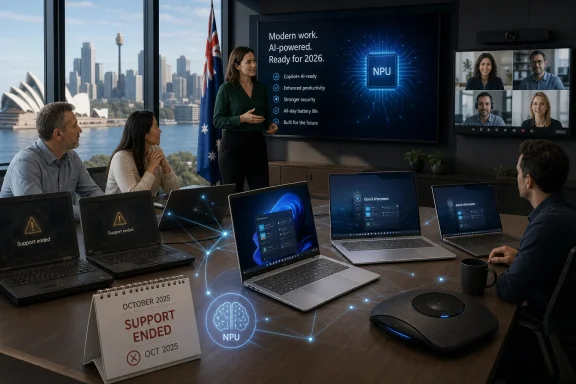 The Windows 10 Cliff Has Become a Channel Sorting Event
Windows 10’s end of support was never going to arrive as a single dramatic outage. Microsoft did not flip a switch that bricked laptops, froze desktops or forced every small business owner into a same-day procurement panic. Instead, the old operating system crossed a quieter line: after October 14, 2025, standard support ended, and the burden shifted from Microsoft’s patch pipeline to the customer’s risk register.That distinction matters because many organizations are structurally bad at acting on risks that do not immediately break something. A Windows 10 device can still boot, print, browse, authenticate and run line-of-business software. To a finance manager, a classroom administrator or a clinic operator, that can make the unsupported status feel theoretical.
For the channel, however, theoretical risk is exactly where the opportunity lives. Unsupported endpoints are not just aging assets; they are audit findings waiting to be written, cyber insurance exceptions waiting to be discovered, and incident-response costs waiting to be assigned. The longer a fleet remains in that state, the less the conversation is about “nice new laptops” and the more it is about governance.
That is why the Leader Expo 2026 message in Sydney lands with more force than a normal hardware sales campaign. The event’s argument, as framed by Leader Business Manager Symon Ten, was that millions of Australian devices remain on the wrong side of Microsoft’s support boundary. Even if some organizations have Extended Security Updates or narrow exceptions in place, the broader commercial fact is unchanged: a significant share of the installed base must move.
The channel has been here before with Windows 7, but this cycle has a sharper edge. Windows 11’s hardware requirements already filtered out many older systems, and the emerging Copilot+ PC category raises the bar again. A machine that can technically survive one more budget cycle may still fail the next strategic test: whether it can participate in a workplace increasingly organized around local AI acceleration, richer conferencing, and cloud-managed endpoint telemetry.
The Upgrade Is No Longer Just an Operating System Decision
For years, PC refreshes were sold with the same weary triad: better performance, better battery life, better security. Those arguments were true, but they were also familiar enough to fade into background noise. The AI PC introduces a different claim, one that is both more compelling and more vulnerable to hype.The defining component is the neural processing unit, or NPU, a dedicated accelerator for AI workloads that can run locally rather than sending every request to a cloud service. Microsoft’s Copilot+ PC branding sets a high enough threshold to make this more than a sticker exercise: systems need an NPU capable of at least 40 trillion operations per second, alongside modern memory and storage expectations. That requirement immediately separates current-generation AI PCs from much of the Windows 10-era installed base.
This does not mean every office worker suddenly needs local generative AI running all day. Many of today’s Copilot workflows still depend heavily on cloud services, Microsoft 365 data, tenant configuration and licensing. But it does mean the hardware baseline is shifting underneath the software roadmap.
That is the channel’s opening. A customer who asks for “Windows 11 laptops” may be thinking about compliance. A reseller that responds only with compliance misses the higher-value conversation about endpoint lifecycle, AI readiness, device management, meeting productivity and security posture. The OS migration is the door; the workplace modernization discussion is the room behind it.
The risk is that channel partners treat Copilot+ PCs as a premium SKU rather than as the new center of gravity. The average selling price uplift cited at Leader Expo — 15 to 25 percent over conventional hardware — is attractive, but it is not the whole prize. The larger opportunity sits in deployment planning, user enablement, device policy, data governance, endpoint protection, collaboration hardware and managed services.
In other words, the hardware margin is the visible transaction. The services relationship is the defensible business.
Memory Pricing Turns Delay Into a Procurement Gamble
The most urgent part of the Leader Expo pitch was not Microsoft’s calendar or Intel’s benchmark slide. It was memory.Ten’s claim that DRAM contract prices rose 90 to 95 percent in the first quarter, with SSD prices up 70 to 75 percent, should make procurement teams sit up straight. Even allowing for the volatility and opacity of component pricing, the direction of travel is clear: memory and storage are no longer quiet background commodities in the PC bill of materials. They are becoming the forcing function.
The explanation is not the familiar pandemic-era story of ports, containers and factories out of sync. This time, the pressure is more structural. Hyperscalers and AI infrastructure builders are consuming high-density memory at extraordinary rates, and PC makers are competing for capacity in a market where the richest buyers are building data centers, not school laptop fleets.
That changes the psychology of waiting. In a normal refresh cycle, a customer can assume that delaying a purchase may produce a cheaper, faster machine six months later. In a memory-constrained cycle, delay can mean higher prices, longer lead times and fewer configuration choices.
The channel should be careful here. Panic selling corrodes trust, especially among customers who remember past supply-chain alarm bells. But pretending the pricing environment is benign would be just as irresponsible.
The more mature argument is that the refresh decision now has a timing component. Organizations that already know they must replace unsupported Windows 10 hardware are not choosing between buying and not buying. They are choosing whether to buy into a tightening market with some control over specification and deployment schedule, or to buy later under more pressure.
That is a procurement conversation, not a marketing slogan. It belongs with CFOs, operations leaders, school boards and clinical administrators, not just IT managers.
Intel’s Panther Lake Moment Gives the Channel a Cleaner Story
Intel’s Core Ultra Series 3, the Panther Lake generation launched in 2026, gives resellers a convenient technology milestone around which to build the refresh narrative. The platform is notable not simply because it is faster, but because it represents Intel’s first client processors built on the company’s 18A process technology. For Intel, that is a manufacturing comeback story; for the channel, it is a way to make “new PC” sound less like inventory churn and more like a platform shift.The headline claims are strong. Intel has talked up major gains in multithreaded performance, graphics performance and battery life, with some configurations reaching up to 27 hours. At Leader Expo, Intel Australia and New Zealand country manager Glen Boatwright framed the jump as one of the largest he had seen in a long career at the company.
Performance claims always deserve caution until they are tested across shipping devices, thermals, firmware and real workloads. A reference design is not the same as a fleet of business laptops after six months of conferencing, browser tabs, endpoint agents and background sync. But the broader point is credible: Intel, AMD and Qualcomm are all pushing the Windows PC market toward systems where AI acceleration, GPU capability and power efficiency are default competitive battlegrounds.
Boatwright’s Cyberpunk example was telling because it was less about gaming than about graphics seriousness. If a sub-kilogram device can run a demanding game at respectable settings, the message to business buyers is that integrated graphics are no longer an afterthought. That matters because many AI and media workloads still lean heavily on GPU resources, even as NPUs become more central to efficient local inference.
The deeper implication is that the thin-and-light category is being redefined. Battery life, thermal headroom and AI acceleration are no longer separate checkboxes; they are converging into a single product story. For mobile workers, that means lighter devices that can do more away from power. For IT teams, it means fewer excuses to keep old hardware on the books.
The channel’s job is to translate that silicon story into business outcomes without drowning customers in acronyms. A customer does not need a lecture on TOPS, tiles and process nodes. They need to understand that a device bought in 2026 may sit in the fleet through 2029 or 2030, and the wrong baseline now could become tomorrow’s bottleneck.
Copilot+ Raises the Floor, But It Does Not Remove the Need for Judgment
The Copilot+ PC label is useful because it gives buyers a minimum hardware signal. It is also dangerous because labels can create a false sense of completeness. A certified machine is not automatically a productive AI endpoint, and an AI endpoint is not automatically appropriate for every user.This is where good channel partners can differentiate themselves from box movers. The question is not “Should every employee get the most expensive AI PC?” The question is how to segment the fleet intelligently.
Executives, analysts, developers, designers, consultants and heavy Microsoft 365 users may benefit earlier from premium AI-capable machines. Frontline staff, kiosk users and task workers may need durability, manageability and security far more than peak local AI performance. Education and healthcare customers may have accessibility, privacy and lifecycle requirements that complicate the procurement calculus.
The channel should resist the temptation to flatten all of that into a universal refresh bundle. The strongest sales motion is consultative: map roles, application dependencies, security requirements, warranty expectations, peripherals, docking, display needs and collaboration patterns. Then decide where Copilot+ capability is essential, where it is prudent future-proofing, and where it is unnecessary cost.
That nuance matters because AI PC adoption will be judged not only by unit sales but by whether users actually experience useful improvements. If organizations buy premium hardware and then fail to configure Copilot, train staff, secure data access or modernize meeting rooms, the devices will be blamed for a software and process failure.
The industry has seen this movie before. Tablets, VDI, ultrabooks and collaboration suites were all oversold at various points as singular solutions to messy organizational problems. AI PCs will fare better if the channel sells them as part of a stack rather than as magic objects.
The Meeting Room Is the Hidden Refresh Budget
One of the more interesting threads from Leader Expo was not about laptops at all. It was about rooms.Nicolas Fraenkel, product manager for Unified Communications at Leader’s Yealink division, put the issue plainly: if the audio and video entering a meeting are poor, the AI output will be poor. This is the unglamorous truth behind every Copilot demo. Summaries, action items, speaker attribution and meeting intelligence depend on the quality of the captured signal.
Many organizations have licensed Microsoft 365 Copilot or Teams Premium capabilities while leaving their meeting rooms equipped like it is still 2018. A single USB camera, a bargain speakerphone and inconsistent room acoustics may be tolerable for basic video calls. They are not a solid foundation for accurate transcription, speaker identification or AI-generated meeting records.
This creates a second refresh cycle hiding inside the first. The PC estate is visible because every unsupported Windows 10 endpoint is an obvious asset problem. Meeting rooms are less visible because they are shared spaces, often funded inconsistently, and frequently treated as facilities-adjacent rather than IT-critical.
But Microsoft’s collaboration roadmap makes the room an endpoint. Speaker recognition, intelligent recap and facilitator-style meeting assistance all assume that the system can tell who said what with reasonable fidelity. If three people in a conference room are collapsed into “Conference Room 1” in the transcript, the AI layer loses context just when the organization expects it to create value.
For the channel, this is a high-value wedge. A Copilot conversation that begins with licenses can expand naturally into Teams Rooms, certified cameras, speaker systems, displays, room scheduling, network quality, device management and support contracts. The customer may think they bought AI productivity software; the channel can show them the physical environment required to make it work.
The opportunity is especially strong because meeting-room pain is easy to demonstrate. Unlike abstract endpoint risk, bad room audio is instantly recognizable. Anyone who has sat through a hybrid meeting where remote staff cannot hear the table conversation understands the problem without needing a technical brief.
Connectivity Makes the Refresh Stickier Than Hardware Alone
Leader Connect’s presence at the event rounded out the commercial picture. VoIP, SIP trunking, NBN services and Operator Connect integration with Microsoft Teams are not as attention-grabbing as AI laptops, but they can be more important to channel economics. Hardware refreshes spike revenue; connectivity and managed communications create recurring revenue.That distinction matters in a market where device margins are often thin and competition is fierce. A channel partner that sells a fleet of laptops and walks away is exposed to the next procurement cycle, the next discounting battle and the next vendor promotion. A partner that attaches voice, Teams integration, network services and support becomes harder to displace.
Operator Connect is a particularly channel-friendly concept because it turns Teams into a more complete communications platform without forcing every customer through a bespoke telephony migration. For organizations already standardizing on Microsoft 365, the logic is straightforward: collapse more communications into the environment users already inhabit, while leaving the service provider and partner to handle calling plans, numbers, routing and support.
The catch is that communications projects expose operational weaknesses quickly. Poor network quality, bad handset planning, unclear number ownership, weak change management and insufficient user training can turn a tidy recurring-revenue opportunity into a support headache. The channel partners that win here will be the ones that treat connectivity as infrastructure, not as an add-on SKU.
There is also a strategic reason to care. AI meeting features, cloud-managed endpoints and collaboration services all assume dependable connectivity. A modern PC estate connected to a fragile network is not a modern workplace. It is a shiny fleet waiting for Teams calls to stutter.
The Australian Market Has a Particularly Sharp Version of the Problem
Australia adds its own texture to the refresh story. The market has a dense mix of small and mid-sized businesses, distributed workforces, education fleets, healthcare providers, regional sites and compliance-sensitive industries. Many of these organizations do not have the internal IT depth to run a large endpoint modernization program alone.That creates a natural role for the channel, but also a responsibility. Customers need more than a warning that Windows 10 is unsupported. They need practical migration paths that account for budget windows, application testing, procurement lead times, user disruption and data protection.
Schools may have fleets bought in waves during earlier digital learning pushes. Clinics may have specialized peripherals and software tied to patient workflows. Small professional-services firms may have a handful of aging but business-critical machines that nobody has touched because “they still work.” Local government and community organizations may have formal procurement rules that slow even obvious decisions.
The best channel partners will convert the refresh into a staged program. Assess the fleet, identify unsupported or non-upgradable devices, classify roles, prioritize high-risk users, validate Windows 11 compatibility, test applications, plan device enrollment, and schedule deployment around operational calendars. That work is not glamorous, but it is where trust is built.
The worst channel partners will send a price list and a countdown clock. That may work for a few urgent deals, but it will not produce the long services relationships that Leader’s presenters were pointing toward. In a constrained, AI-inflected market, customers need an advisor more than they need a brochure.
Scarcity Should Not Become an Excuse for Sloppy Buying
The memory pricing spike gives the channel a powerful urgency message, but it also raises the risk of bad procurement. When customers believe prices are rising, they may rush into poorly matched devices, under-specified configurations or fragmented purchasing. That is how organizations end up with a fleet that is new but inconsistent, expensive but not future-ready.A refresh done under pressure still needs discipline. Standardized configurations matter. Warranty terms matter. Docking and display compatibility matter. Autopilot or equivalent provisioning workflows matter. Security baselines, encryption, identity integration and endpoint detection matter.
This is especially true for AI PCs because memory and storage decisions are harder to reverse later. A machine bought with insufficient RAM because the procurement team was chasing a unit-price target may become a productivity drag long before its chassis wears out. Conversely, overbuying premium devices for users who will never use the capability wastes money that could have modernized meeting rooms or improved network resilience.
The channel should also be honest about uncertainty. Memory markets can move, vendor supply can improve, and benchmark claims can look different once devices ship at scale. The right argument is not that customers must buy everything today because tomorrow is doom. The right argument is that known refresh demand should be planned now, before pricing and supply remove options.
That is a more credible message, and it is more likely to survive scrutiny from experienced procurement teams.
The Services Attach Is the Real Margin Story
Leader’s estimate that service attach can reach three to five times the value of the hardware deal is the kind of number that gets a reseller’s attention. It should also make customers alert. A refresh is not a one-off event if it is done properly; it is the beginning of a managed lifecycle.That lifecycle includes readiness assessment, procurement, imaging or cloud provisioning, deployment, data migration, user onboarding, policy configuration, security hardening, monitoring, warranty handling, lifecycle reporting and eventual retirement. Add Copilot readiness and meeting-room modernization, and the scope expands further into licensing, information architecture, voice profiles, room standards, audio testing, change management and adoption metrics.
For channel partners, the services attach is not just extra revenue. It is insulation against commoditization. Anyone can quote a laptop. Fewer partners can orchestrate a hardware, Windows 11, Copilot, Teams Rooms and connectivity transition while keeping the customer’s business running.
For customers, the same services attach can be either a cost center or a risk reducer, depending on how it is structured. Managed services that merely wrap a margin around routine tasks will be challenged. Managed services that measurably reduce deployment time, support tickets, security exposure and meeting friction are easier to defend.
This is where the channel must prove that it has moved beyond the old reseller model. The product catalog matters, but the operating model matters more.
The Refresh Will Reward Partners Who Can Say No
A mature channel partner should be willing to tell a customer that not every system needs the same specification, not every room needs the most expensive kit, and not every AI promise is ready to deliver value on day one. That restraint is not bad selling. It is how a partner earns the right to be invited back.There will be customers for whom a phased Windows 11 migration with conventional business laptops is the correct first step. There will be others where Copilot+ PCs make immediate sense for power users but not for the whole fleet. Some meeting rooms will justify certified intelligent audio and camera systems; others may only need basic remediation.
The point is not to dampen the refresh opportunity. The point is to make it durable. If the channel sells AI hardware as a cure-all, disappointment will follow. If it sells modernization as a sequence of practical, measurable upgrades, the market can sustain a multi-year services cycle.
That distinction will separate serious partners from opportunists. The latter will chase the Windows 10 cliff until the obvious deals are gone. The former will use the cliff to begin broader conversations about endpoint strategy, collaboration quality and operational resilience.
The Window Is Open, But It Will Not Stay Open Forever
The clearest lesson from Leader Expo is that timing has become the product. Windows 10 support has ended. Copilot+ PCs have created a new hardware baseline. Intel and its competitors are turning AI acceleration and battery life into mainstream laptop features. Memory and storage costs are pressuring device prices. Meeting rooms are under-equipped for the AI features customers are already licensing. Connectivity can turn a refresh from a transaction into a recurring relationship.That combination will not remain perfectly aligned indefinitely. Some customers will move quickly and lock in partner relationships. Others will wait until compliance, pricing or supply constraints force a rushed decision. The channel’s task is to find the first group, educate the second, and avoid letting both drift into commodity procurement.
For Australian businesses, the most practical move is to stop treating the Windows 10 deadline as a past event and start treating it as the beginning of a modernization backlog. The security risk is already present. The capability gap is widening. The pricing risk is no longer abstract.
The Refresh Playbook Is Narrower Than the Sales Deck Suggests
The opportunity is large, but it is not complicated if partners keep the sequence straight. The winning motion is to start with risk, move to capability, and end with a managed lifecycle that customers can actually operate.- Unsupported Windows 10 devices should be identified, prioritized and removed from normal production use unless they are covered by a deliberate, documented exception.
- Copilot+ PCs should be positioned as the new AI-ready baseline for appropriate roles, not as a universal luxury upgrade for every employee.
- Memory and SSD price pressure should be used to support disciplined planning, not to scare customers into rushed or mismatched purchases.
- Meeting-room hardware should be assessed alongside Copilot licensing because poor audio and weak speaker attribution can undermine AI meeting features.
- Connectivity, Teams voice integration and managed services should be attached where they improve reliability and accountability, not merely where they inflate the deal.
- The channel partners most likely to win are the ones that can translate silicon, software and supply-chain pressure into a staged plan customers can defend internally.
References
- Primary source: iTnews
Published: 2026-06-08T23:20:08.267822
- Official source: techcommunity.microsoft.com

Windows Hardware Compatibility Program - Windows 10 Certification Deprecation Plan | Microsoft Community Hub
As part of our ongoing commitment to transparency and ecosystem readiness, we are sharing the Windows Hardware Compatibility Program (WHCP) and Hardware Lab...
techcommunity.microsoft.com
- Related coverage: pcgamer.com
New report claims Intel is 'struggling' to supply laptop CPUs based on its latest 18A node after speaking to Computex sources | PC Gamer
But it might not be because there's a problem with 18A itself.www.pcgamer.com - Related coverage: tomshardware.com
Intel will reportedly upgrade its Wildcat Lake refresh to an 8-core config next year, leak claims — top-end silicon tipped to feature 4 P-cores and 4 LP-E cores as part of 'Core 400' series | Tom's Hardware
Wildcat Lake is seemingly due for a big upgrade next year.www.tomshardware.com - Related coverage: windowscentral.com
"An unmatched upgrade opportunity": Intel's new Core Series 3 mobile CPUs target "value buyers" as PC prices rise | Windows Central
Intel just unveiled new Core Series 3 mobile chips, and I'm optimistic that they'll help more Windows users upgrade their aging PCs.www.windowscentral.com
