

Amazon Web Services and NVIDIA expanded their production AI partnership on June 25, 2026, tying new EC2 G7 GPU instances, GPU-accelerated OpenSearch vector indexing, and NVIDIA GB300 cloud validation into a single pitch for enterprises moving AI systems from experiments into live service. The news is less about one more cloud instance family than about where the AI stack is hardening: compute, retrieval, and operational trust are being packaged together. For WindowsForum readers, the practical story is that AI infrastructure is becoming less exotic, more rented, and more deeply embedded in the same cloud services many organizations already use. That is good news for teams that need capacity; it is also another reminder that “production AI” increasingly means accepting the architecture choices of a few hyperscale vendors.
The glamorous part of generative AI is still the model demo: the fluent answer, the generated image, the agent that appears to navigate work on a user’s behalf. The expensive part is everything underneath it. Production AI requires inference that does not buckle under user load, vector databases that can be rebuilt without turning into all-night jobs, networking that keeps GPUs fed, and enough automation that the platform team does not become the help desk for every machine-learning experiment in the company.
That is the frame NVIDIA and AWS are using for this announcement. The companies are not merely saying that AWS will rent out another NVIDIA GPU. They are saying that the path from training to inference to retrieval-augmented generation can be made more predictable if the pieces are co-engineered and exposed through familiar AWS services.
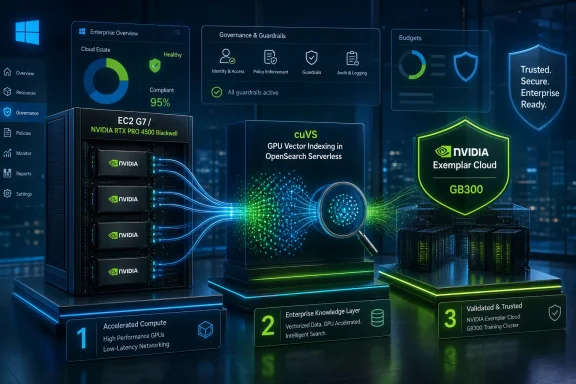
The center of the news is Amazon EC2 G7, a new accelerated computing instance family powered by NVIDIA RTX PRO 4500 Blackwell Server Edition GPUs. Around that sits NVIDIA cuVS in Amazon OpenSearch Serverless, where GPU-accelerated vector indexing is being positioned as the default compute path for vector collections. At the top end, AWS has also achieved NVIDIA Exemplar Cloud status for GB300 training workloads, a certification-style signal that its infrastructure can meet NVIDIA’s reference expectations for large-scale AI training.
It is a tidy story because it covers three pain points at once. G7 addresses inference and multi-workload GPU capacity. OpenSearch acceleration addresses retrieval infrastructure, the unglamorous but essential layer behind many enterprise AI systems. Exemplar Cloud status addresses buyer anxiety, especially among customers who know that “available in the cloud” and “runs like the vendor benchmark” are not always the same thing.
EC2 G7 appears aimed at that wide middle. AWS says the instances support up to eight GPUs, 256GB of total GPU memory, up to 700Gbps of Elastic Fabric Adapter networking, and up to 7.6TB of local NVMe SSD storage. Configurations include one, two, four, and eight GPUs, with bare metal coming soon. In plain English, AWS is giving customers a way to rent Blackwell-era GPU capacity without committing to the premium training-class end of the NVIDIA catalog.
That matters because production AI infrastructure is often constrained less by theoretical peak performance than by fit. A team serving a recommendation model, running a visual inspection pipeline, or accelerating a Spark workload may not need a giant training pod. It may need a predictable GPU instance with enough memory, fast local storage, and managed access through the tooling it already uses.
The comparison AWS and NVIDIA want buyers to remember is against G6. The companies claim G7 delivers up to 4.6 times the AI inference performance, up to 2.1 times the graphics performance, and materially faster GPU-accelerated analytics using NVIDIA cuDF with Apache Spark on Amazon EMR. Vendor benchmarks always deserve scrutiny, but the direction is credible: Blackwell-generation GPUs, newer CPUs, faster networking, and tighter software integration should move the performance envelope.
For Windows shops, the graphics angle should not be missed. The same instance family is being pitched for virtual desktop infrastructure, spatial computing, rendering, gaming, video workflows, and CAD-adjacent workloads. Cloud GPU has never been only about AI, and the RTX branding is a clue that AWS and NVIDIA want this instance family to straddle both AI and visual computing.
The implementation is less straightforward. Vector search at scale is not just a feature checkbox. Teams have to build and update indexes, manage latency, control cost, and keep data pipelines from becoming so brittle that nobody trusts the system. If the index takes too long to build, or if updates lag too far behind the business, the AI layer becomes stale.
That is why NVIDIA cuVS inside Amazon OpenSearch Serverless is strategically important. AWS says GPU-accelerated vector indexing, powered by cuVS, is now the default compute choice for vector collections in the next generation of OpenSearch Serverless. NVIDIA and AWS claim vector indexing can be up to 10 times faster at a quarter of the cost compared with CPU-only builds, making billion-scale vector databases feasible to construct in under an hour.
The immediate implication is speed. A workload that previously required careful capacity planning or a tolerance for slow index builds can move closer to an elastic service model. But the deeper implication is architectural: GPU acceleration is being folded into a managed database-like experience rather than left as a specialized optimization for teams with CUDA expertise.
That is the pattern to watch. AI infrastructure is moving from “bring your own cluster and wire the pieces together” to “select the managed service tier that hides the cluster.” That makes life easier for application teams, but it also shifts control upward to cloud providers. The more serverless the retrieval layer becomes, the more the performance model, billing model, and operational failure modes are defined by AWS.
But “serverless” does not mean “decisionless.” Teams still need to understand when GPU acceleration is triggered, how indexing costs are metered, what happens during spikes, and whether data freshness requirements fit the service model. They also need to understand the line between indexing acceleration and query-time behavior, because users experience the full retrieval path, not just the benchmarked piece of it.
The same caution applies to cost. A claim of one-quarter the cost compared with CPU-only builds is attractive, especially for billion-scale vector indexes. Yet real-world savings depend on data shape, update frequency, dimensionality, retention policies, and query patterns. A team that rebuilds indexes constantly, stores redundant embeddings, or fails to govern data ingestion can still create a large monthly bill.
That is not a knock on the technology. It is a reminder that production AI is as much an operations discipline as a model-selection exercise. The value of GPU-accelerated OpenSearch is that it can remove a large amount of infrastructure friction. The risk is that removing friction makes it easier to build systems whose costs and dependencies are discovered only after they are already business-critical.
NVIDIA’s Exemplar Cloud program is essentially a validation framework. The point is to show that a cloud provider’s deployment can meet performance thresholds aligned with NVIDIA’s reference architecture. For enterprise AI leaders, that matters because high-end training is full of unpleasant surprises: networking bottlenecks, storage constraints, underfed GPUs, inconsistent scaling, and expensive time spent diagnosing where performance disappeared.
AWS achieving that status for GB300 is therefore a confidence play. It tells customers that AWS and NVIDIA have done enough co-engineering to make the environment credible for demanding training workloads. It also helps AWS compete in a market where every hyperscaler wants to be seen not merely as a reseller of GPUs, but as a first-class AI supercomputing platform.
Still, validation is not the same as business fit. A certified environment may perform well under reference conditions, but customers still have to evaluate data gravity, compliance requirements, software stack compatibility, and total cost of ownership. The largest AI training clusters are not impulse purchases; they are strategic infrastructure bets.
The more subtle message is that NVIDIA is becoming a standards body for its own ecosystem. When cloud providers seek NVIDIA validation, NVIDIA’s role extends beyond chip supplier into arbiter of what “proper” AI infrastructure looks like. That strengthens the company’s platform power, and it gives customers a shorthand for quality. It also tightens the gravitational pull around NVIDIA’s preferred hardware and software stack.
Consider VDI, rendering, high-resolution video workflows, remote engineering desktops, and GPU-accelerated analytics tools accessed from Windows clients. Organizations that once had to provision expensive local workstations can increasingly centralize GPU resources in the cloud and deliver access through managed images, remote display protocols, or application streaming. G7 gives AWS another option for those workloads, particularly where customers want a blend of graphics and AI acceleration.
That does not make the local PC irrelevant. In fact, the opposite may happen. As AI workflows spread, organizations will have to decide which work belongs on the endpoint, which belongs on a nearby edge system, and which belongs in a hyperscale region. Windows PCs with NPUs and local GPUs will handle some interactive tasks, while cloud GPUs handle heavier inference, batch processing, rendering, and shared services.
The administrative challenge is policy. Once users discover that a cloud GPU can turn an impossible workload into a morning’s work, demand tends to spread. IT teams will need guardrails around identity, network access, data movement, approved images, budget controls, and logging. A GPU instance is still a server; it just happens to be a very expensive one when left running unnecessarily.
There is also a security dimension. AI retrieval systems often ingest sensitive internal documents, source code, tickets, chats, and operational runbooks. If OpenSearch Serverless becomes the default place where that knowledge is indexed, administrators need to treat it as a high-value data store, not as a harmless search accessory. The embedding pipeline can become a shadow copy of the business.
That has benefits. Developers do not want to become GPU systems engineers just to build a production search index. Data teams do not want to rewrite analytics pipelines by hand to exploit acceleration. Infrastructure teams do not want to validate every driver, container, and library combination before an application team can begin testing. Integrated software lowers the tax.
But it also increases lock-in. A workload built around OpenSearch Serverless with NVIDIA cuVS acceleration may be portable at the API level only in theory. Performance expectations, cost assumptions, and operational habits become tied to a specific managed implementation. The same is true for AMIs, containers, orchestration templates, and accelerator-specific optimizations.
This is the trade that enterprise IT has made many times before. Managed platforms reduce toil and compress delivery timelines. They also make future migration more complex. In AI, the lock-in pressure is stronger because the infrastructure is expensive, the software stack is specialized, and the pace of change rewards teams that pick a lane and move quickly.
The competitive question is whether AMD, Intel, and cloud providers’ in-house silicon can create enough pressure to keep pricing and portability in check. AWS has its own AI chips, including Trainium and Inferentia, and it has every incentive to avoid total dependence on NVIDIA. Yet customer demand for NVIDIA-compatible tooling remains powerful, especially when teams want to hire from the broadest talent pool and run the largest collection of existing AI software.
EC2 G7 is part of that translation. It takes a Blackwell-generation server GPU and exposes it through the familiar EC2 pattern: instance types, AMIs, containers, EKS, ECS, EMR, and eventually SageMaker AI. OpenSearch Serverless does the same for vector indexing, hiding specialized acceleration behind a service interface. Exemplar Cloud status does it for training credibility, giving procurement and technical evaluators a badge that says the high-end environment has been tested against vendor expectations.
This is exactly what cloud providers are good at. They absorb complexity, standardize access, and monetize consumption. For customers, that can be transformative. A team that could never buy, rack, cool, secure, and operate a GPU cluster can now deploy against one. A small group can test a retrieval architecture without building a vector database operations practice from scratch.
The danger is that AI becomes deceptively easy to start and deceptively hard to govern. The first prototype is cheap enough to approve. The first production deployment is important enough to keep. The second and third teams copy the pattern. Six months later, the organization has a sprawling set of AI services, duplicated embeddings, inconsistent retention rules, and GPU spend that nobody fully owns.
That is where experienced Windows and enterprise administrators have an advantage. They have seen this movie with virtual machines, SaaS apps, file shares, mobile devices, and cloud storage. The AI stack is new, but the governance problem is familiar: identity first, data classification second, cost controls early, logging always.
That is rational. Most enterprises do not want to differentiate on vector-index plumbing. They want search to be fast, inference to be affordable, and training capacity to be available when needed. If a cloud service can deliver that with a credible performance claim and a familiar operational model, many buyers will accept the abstraction.
Yet the abstraction can blur important distinctions. A graphics-capable GPU instance used for virtual workstations is not the same thing as a training cluster built around GB300. A vector indexing acceleration feature is not the same thing as a fully optimized end-to-end RAG system. A vendor benchmark is not the same thing as your workload under your latency, security, and budget constraints.
The best reading of the AWS-NVIDIA news is therefore neither hype nor dismissal. It is an indicator that the production AI market is maturing. The conversation is shifting from “Can we get GPUs?” to “Can we get the right GPUs, attached to the right services, with the right operating model?” That is a healthier question, and a more difficult one.
For OpenSearch Serverless, the critical questions are billing transparency and operational predictability. Teams need to know when GPU acceleration is used, how failures fall back, how data ingestion behaves at scale, and whether index-building speed translates into a better user-facing application. The phrase “default compute choice” is powerful, but defaults are only helpful when they are observable and controllable.
For GB300 training, Exemplar Cloud status is useful shorthand, but customers still need proof with their own models and data pipelines. Training performance is a systems problem. Networking, storage, scheduling, checkpointing, framework versions, and cluster utilization can matter as much as the accelerator name on the invoice.
There is also a procurement reality. NVIDIA GPUs remain in intense demand, and cloud access does not magically eliminate scarcity. It changes the unit of scarcity from “Can I buy the hardware?” to “Can I get the quota, region, and price I need when the project is ready?” That can be an improvement, but it is not the same as abundance.
The organizations that benefit most will be the ones that treat these services as part of a platform strategy. They will standardize approved instance families, define tagging and shutdown policies, require data classification before embedding, and measure application-level latency rather than celebrating isolated benchmark wins. They will also separate experimentation accounts from production environments, because AI prototypes have a way of becoming permanent when nobody is looking.
The less disciplined organizations will do what they always do with powerful cloud primitives. They will let every team build its own stack, discover overlapping costs late, and then ask central IT to rationalize the mess. In AI, that mess may include not just compute waste but duplicated sensitive data, opaque model behavior, and brittle dependencies on services nobody documented.
This is where the AWS-NVIDIA collaboration is both a solution and a test. It gives enterprises better tools for production AI. It also raises the bar for governance because the tools are now good enough to be used widely.
 AWS and NVIDIA Are Selling the Boring Part of AI
The glamorous part of generative AI is still the model demo: the fluent answer, the generated image, the agent that appears to navigate work on a user’s behalf. The expensive part is everything underneath it. Production AI requires inference that does not buckle under user load, vector databases that can be rebuilt without turning into all-night jobs, networking that keeps GPUs fed, and enough automation that the platform team does not become the help desk for every machine-learning experiment in the company.That is the frame NVIDIA and AWS are using for this announcement. The companies are not merely saying that AWS will rent out another NVIDIA GPU. They are saying that the path from training to inference to retrieval-augmented generation can be made more predictable if the pieces are co-engineered and exposed through familiar AWS services.
The center of the news is Amazon EC2 G7, a new accelerated computing instance family powered by NVIDIA RTX PRO 4500 Blackwell Server Edition GPUs. Around that sits NVIDIA cuVS in Amazon OpenSearch Serverless, where GPU-accelerated vector indexing is being positioned as the default compute path for vector collections. At the top end, AWS has also achieved NVIDIA Exemplar Cloud status for GB300 training workloads, a certification-style signal that its infrastructure can meet NVIDIA’s reference expectations for large-scale AI training.
It is a tidy story because it covers three pain points at once. G7 addresses inference and multi-workload GPU capacity. OpenSearch acceleration addresses retrieval infrastructure, the unglamorous but essential layer behind many enterprise AI systems. Exemplar Cloud status addresses buyer anxiety, especially among customers who know that “available in the cloud” and “runs like the vendor benchmark” are not always the same thing.
The G7 Instance Is a Middle-Class GPU Cloud Play
The RTX PRO 4500 Blackwell Server Edition is not NVIDIA’s most imposing AI accelerator, and that is precisely why its arrival on EC2 matters. The AI market tends to talk in terms of the biggest chips, the most dramatic training clusters, and the most eye-watering power envelopes. But a huge amount of enterprise AI work sits below that tier: inference, computer vision, media processing, virtual workstations, analytics acceleration, simulation, rendering, and internal retrieval systems.EC2 G7 appears aimed at that wide middle. AWS says the instances support up to eight GPUs, 256GB of total GPU memory, up to 700Gbps of Elastic Fabric Adapter networking, and up to 7.6TB of local NVMe SSD storage. Configurations include one, two, four, and eight GPUs, with bare metal coming soon. In plain English, AWS is giving customers a way to rent Blackwell-era GPU capacity without committing to the premium training-class end of the NVIDIA catalog.
That matters because production AI infrastructure is often constrained less by theoretical peak performance than by fit. A team serving a recommendation model, running a visual inspection pipeline, or accelerating a Spark workload may not need a giant training pod. It may need a predictable GPU instance with enough memory, fast local storage, and managed access through the tooling it already uses.
The comparison AWS and NVIDIA want buyers to remember is against G6. The companies claim G7 delivers up to 4.6 times the AI inference performance, up to 2.1 times the graphics performance, and materially faster GPU-accelerated analytics using NVIDIA cuDF with Apache Spark on Amazon EMR. Vendor benchmarks always deserve scrutiny, but the direction is credible: Blackwell-generation GPUs, newer CPUs, faster networking, and tighter software integration should move the performance envelope.
For Windows shops, the graphics angle should not be missed. The same instance family is being pitched for virtual desktop infrastructure, spatial computing, rendering, gaming, video workflows, and CAD-adjacent workloads. Cloud GPU has never been only about AI, and the RTX branding is a clue that AWS and NVIDIA want this instance family to straddle both AI and visual computing.
Production AI Is Becoming a Retrieval Problem
The more interesting part of the announcement may be OpenSearch, not EC2. For the last two years, enterprises have been told that retrieval-augmented generation, or RAG, is the practical way to make AI useful with private data. The idea is straightforward: embed documents or records as vectors, search for the most relevant context, and feed that context into a model so the output is grounded in organizational knowledge.The implementation is less straightforward. Vector search at scale is not just a feature checkbox. Teams have to build and update indexes, manage latency, control cost, and keep data pipelines from becoming so brittle that nobody trusts the system. If the index takes too long to build, or if updates lag too far behind the business, the AI layer becomes stale.
That is why NVIDIA cuVS inside Amazon OpenSearch Serverless is strategically important. AWS says GPU-accelerated vector indexing, powered by cuVS, is now the default compute choice for vector collections in the next generation of OpenSearch Serverless. NVIDIA and AWS claim vector indexing can be up to 10 times faster at a quarter of the cost compared with CPU-only builds, making billion-scale vector databases feasible to construct in under an hour.
The immediate implication is speed. A workload that previously required careful capacity planning or a tolerance for slow index builds can move closer to an elastic service model. But the deeper implication is architectural: GPU acceleration is being folded into a managed database-like experience rather than left as a specialized optimization for teams with CUDA expertise.
That is the pattern to watch. AI infrastructure is moving from “bring your own cluster and wire the pieces together” to “select the managed service tier that hides the cluster.” That makes life easier for application teams, but it also shifts control upward to cloud providers. The more serverless the retrieval layer becomes, the more the performance model, billing model, and operational failure modes are defined by AWS.
Serverless AI Reduces Toil, Not Responsibility
AWS is leaning hard into the idea that OpenSearch Serverless can scale vector workloads without infrastructure management. That is a compelling proposition for organizations that do not want to size clusters, tune indexing pipelines, or pay for idle capacity. It also maps neatly to the way many AI projects begin: uncertain traffic, fast iteration, and pressure from executives to show production progress quickly.But “serverless” does not mean “decisionless.” Teams still need to understand when GPU acceleration is triggered, how indexing costs are metered, what happens during spikes, and whether data freshness requirements fit the service model. They also need to understand the line between indexing acceleration and query-time behavior, because users experience the full retrieval path, not just the benchmarked piece of it.
The same caution applies to cost. A claim of one-quarter the cost compared with CPU-only builds is attractive, especially for billion-scale vector indexes. Yet real-world savings depend on data shape, update frequency, dimensionality, retention policies, and query patterns. A team that rebuilds indexes constantly, stores redundant embeddings, or fails to govern data ingestion can still create a large monthly bill.
That is not a knock on the technology. It is a reminder that production AI is as much an operations discipline as a model-selection exercise. The value of GPU-accelerated OpenSearch is that it can remove a large amount of infrastructure friction. The risk is that removing friction makes it easier to build systems whose costs and dependencies are discovered only after they are already business-critical.
Exemplar Cloud Status Is a Trust Signal for Nervous Buyers
The GB300 portion of the announcement is aimed at a different audience. EC2 G7 and OpenSearch Serverless target teams deploying inference, retrieval, and mixed GPU workloads. NVIDIA Exemplar Cloud status for GB300 speaks to organizations evaluating large-scale training infrastructure and trying to determine whether a cloud environment will deliver predictable performance.NVIDIA’s Exemplar Cloud program is essentially a validation framework. The point is to show that a cloud provider’s deployment can meet performance thresholds aligned with NVIDIA’s reference architecture. For enterprise AI leaders, that matters because high-end training is full of unpleasant surprises: networking bottlenecks, storage constraints, underfed GPUs, inconsistent scaling, and expensive time spent diagnosing where performance disappeared.
AWS achieving that status for GB300 is therefore a confidence play. It tells customers that AWS and NVIDIA have done enough co-engineering to make the environment credible for demanding training workloads. It also helps AWS compete in a market where every hyperscaler wants to be seen not merely as a reseller of GPUs, but as a first-class AI supercomputing platform.
Still, validation is not the same as business fit. A certified environment may perform well under reference conditions, but customers still have to evaluate data gravity, compliance requirements, software stack compatibility, and total cost of ownership. The largest AI training clusters are not impulse purchases; they are strategic infrastructure bets.
The more subtle message is that NVIDIA is becoming a standards body for its own ecosystem. When cloud providers seek NVIDIA validation, NVIDIA’s role extends beyond chip supplier into arbiter of what “proper” AI infrastructure looks like. That strengthens the company’s platform power, and it gives customers a shorthand for quality. It also tightens the gravitational pull around NVIDIA’s preferred hardware and software stack.
The Windows Angle Is Cloud Workstations, Not Just Chatbots
For many WindowsForum readers, the obvious question is how this affects Windows users and administrators. The answer is not that every desktop will suddenly need an EC2 G7 instance. The more realistic answer is that GPU-backed cloud infrastructure is becoming a normal extension of Windows-centric enterprise environments.Consider VDI, rendering, high-resolution video workflows, remote engineering desktops, and GPU-accelerated analytics tools accessed from Windows clients. Organizations that once had to provision expensive local workstations can increasingly centralize GPU resources in the cloud and deliver access through managed images, remote display protocols, or application streaming. G7 gives AWS another option for those workloads, particularly where customers want a blend of graphics and AI acceleration.
That does not make the local PC irrelevant. In fact, the opposite may happen. As AI workflows spread, organizations will have to decide which work belongs on the endpoint, which belongs on a nearby edge system, and which belongs in a hyperscale region. Windows PCs with NPUs and local GPUs will handle some interactive tasks, while cloud GPUs handle heavier inference, batch processing, rendering, and shared services.
The administrative challenge is policy. Once users discover that a cloud GPU can turn an impossible workload into a morning’s work, demand tends to spread. IT teams will need guardrails around identity, network access, data movement, approved images, budget controls, and logging. A GPU instance is still a server; it just happens to be a very expensive one when left running unnecessarily.
There is also a security dimension. AI retrieval systems often ingest sensitive internal documents, source code, tickets, chats, and operational runbooks. If OpenSearch Serverless becomes the default place where that knowledge is indexed, administrators need to treat it as a high-value data store, not as a harmless search accessory. The embedding pipeline can become a shadow copy of the business.
NVIDIA’s Software Moat Keeps Getting Wider
NVIDIA’s advantage in AI is often described as a hardware story, but this announcement is another reminder that the hardware is only half the moat. cuVS, cuDF, CUDA, deep learning containers, optimized AMIs, and validated cloud architectures all turn NVIDIA GPUs into a platform. The more AWS integrates those pieces into first-party services, the less visible the boundary becomes between cloud feature and NVIDIA feature.That has benefits. Developers do not want to become GPU systems engineers just to build a production search index. Data teams do not want to rewrite analytics pipelines by hand to exploit acceleration. Infrastructure teams do not want to validate every driver, container, and library combination before an application team can begin testing. Integrated software lowers the tax.
But it also increases lock-in. A workload built around OpenSearch Serverless with NVIDIA cuVS acceleration may be portable at the API level only in theory. Performance expectations, cost assumptions, and operational habits become tied to a specific managed implementation. The same is true for AMIs, containers, orchestration templates, and accelerator-specific optimizations.
This is the trade that enterprise IT has made many times before. Managed platforms reduce toil and compress delivery timelines. They also make future migration more complex. In AI, the lock-in pressure is stronger because the infrastructure is expensive, the software stack is specialized, and the pace of change rewards teams that pick a lane and move quickly.
The competitive question is whether AMD, Intel, and cloud providers’ in-house silicon can create enough pressure to keep pricing and portability in check. AWS has its own AI chips, including Trainium and Inferentia, and it has every incentive to avoid total dependence on NVIDIA. Yet customer demand for NVIDIA-compatible tooling remains powerful, especially when teams want to hire from the broadest talent pool and run the largest collection of existing AI software.
AWS Wants AI to Look Like an Ordinary Cloud Workload
The strategic arc here is AWS trying to make AI less exceptional. In the early cloud era, the winning move was turning servers, disks, databases, and networks into programmable services. In the AI era, the equivalent move is turning GPUs, vector indexes, training clusters, and model-serving paths into managed primitives that developers can consume without negotiating with a data center.EC2 G7 is part of that translation. It takes a Blackwell-generation server GPU and exposes it through the familiar EC2 pattern: instance types, AMIs, containers, EKS, ECS, EMR, and eventually SageMaker AI. OpenSearch Serverless does the same for vector indexing, hiding specialized acceleration behind a service interface. Exemplar Cloud status does it for training credibility, giving procurement and technical evaluators a badge that says the high-end environment has been tested against vendor expectations.
This is exactly what cloud providers are good at. They absorb complexity, standardize access, and monetize consumption. For customers, that can be transformative. A team that could never buy, rack, cool, secure, and operate a GPU cluster can now deploy against one. A small group can test a retrieval architecture without building a vector database operations practice from scratch.
The danger is that AI becomes deceptively easy to start and deceptively hard to govern. The first prototype is cheap enough to approve. The first production deployment is important enough to keep. The second and third teams copy the pattern. Six months later, the organization has a sprawling set of AI services, duplicated embeddings, inconsistent retention rules, and GPU spend that nobody fully owns.
That is where experienced Windows and enterprise administrators have an advantage. They have seen this movie with virtual machines, SaaS apps, file shares, mobile devices, and cloud storage. The AI stack is new, but the governance problem is familiar: identity first, data classification second, cost controls early, logging always.
The AI Stack Is Consolidating Around Fewer Decision Points
There is a consolidation story behind the announcement. The components of production AI are not disappearing, but the number of places where customers make architectural decisions is shrinking. Instead of choosing hardware, drivers, libraries, vector-index algorithms, orchestration layers, scaling rules, and validation methods separately, AWS and NVIDIA are bundling more of that into higher-level service choices.That is rational. Most enterprises do not want to differentiate on vector-index plumbing. They want search to be fast, inference to be affordable, and training capacity to be available when needed. If a cloud service can deliver that with a credible performance claim and a familiar operational model, many buyers will accept the abstraction.
Yet the abstraction can blur important distinctions. A graphics-capable GPU instance used for virtual workstations is not the same thing as a training cluster built around GB300. A vector indexing acceleration feature is not the same thing as a fully optimized end-to-end RAG system. A vendor benchmark is not the same thing as your workload under your latency, security, and budget constraints.
The best reading of the AWS-NVIDIA news is therefore neither hype nor dismissal. It is an indicator that the production AI market is maturing. The conversation is shifting from “Can we get GPUs?” to “Can we get the right GPUs, attached to the right services, with the right operating model?” That is a healthier question, and a more difficult one.
The Fine Print Will Decide the Real Winners
The practical value of EC2 G7 will depend on availability, regional footprint, pricing, quotas, and the shape of actual workloads. A new instance family can be impressive on paper and still be constrained by capacity in the regions customers need. Administrators should also watch the details around bare metal availability, supported AMIs, driver versions, and integration timing with SageMaker AI.For OpenSearch Serverless, the critical questions are billing transparency and operational predictability. Teams need to know when GPU acceleration is used, how failures fall back, how data ingestion behaves at scale, and whether index-building speed translates into a better user-facing application. The phrase “default compute choice” is powerful, but defaults are only helpful when they are observable and controllable.
For GB300 training, Exemplar Cloud status is useful shorthand, but customers still need proof with their own models and data pipelines. Training performance is a systems problem. Networking, storage, scheduling, checkpointing, framework versions, and cluster utilization can matter as much as the accelerator name on the invoice.
There is also a procurement reality. NVIDIA GPUs remain in intense demand, and cloud access does not magically eliminate scarcity. It changes the unit of scarcity from “Can I buy the hardware?” to “Can I get the quota, region, and price I need when the project is ready?” That can be an improvement, but it is not the same as abundance.
The Production AI Bill Comes Due in Architecture
The concrete message for IT teams is that AI infrastructure decisions are becoming architecture decisions, not lab decisions. EC2 G7 may be the right fit for inference, visual computing, and analytics acceleration. OpenSearch Serverless with cuVS may be the right fit for large vector indexing jobs. GB300-backed validated cloud environments may be the right fit for large-scale training. But each choice implies a long tail of security, cost, and operational commitments.The organizations that benefit most will be the ones that treat these services as part of a platform strategy. They will standardize approved instance families, define tagging and shutdown policies, require data classification before embedding, and measure application-level latency rather than celebrating isolated benchmark wins. They will also separate experimentation accounts from production environments, because AI prototypes have a way of becoming permanent when nobody is looking.
The less disciplined organizations will do what they always do with powerful cloud primitives. They will let every team build its own stack, discover overlapping costs late, and then ask central IT to rationalize the mess. In AI, that mess may include not just compute waste but duplicated sensitive data, opaque model behavior, and brittle dependencies on services nobody documented.
This is where the AWS-NVIDIA collaboration is both a solution and a test. It gives enterprises better tools for production AI. It also raises the bar for governance because the tools are now good enough to be used widely.
The Cloud GPU Era Is Moving From Scarcity to Selection
The most useful way to read this announcement is not as a single product launch, but as a sign of where enterprise AI infrastructure is heading.- EC2 G7 gives AWS customers a Blackwell-generation GPU option aimed at inference, graphics, analytics, and other production workloads that do not necessarily require the largest training-class accelerators.
- NVIDIA cuVS in OpenSearch Serverless moves GPU-accelerated vector indexing closer to a managed default, which could make large RAG and semantic-search systems faster to build and easier to operate.
- AWS’s NVIDIA Exemplar Cloud status for GB300 is a trust signal for customers evaluating high-end training environments, but it does not replace workload-specific testing.
- Windows-heavy organizations should view G7 as relevant to cloud workstations, rendering, VDI, media workflows, and GPU-backed enterprise applications, not only chatbot infrastructure.
- The operational risks are familiar but amplified: quota management, runaway spend, sensitive data indexing, observability gaps, and lock-in to managed service behavior.
- The winners will be teams that pair faster cloud AI primitives with boring but essential controls around identity, cost, data governance, and lifecycle management.
References
- Primary source: HPCwire
Published: Thu, 25 Jun 2026 17:18:49 GMT
HPCwire - Since 1987 – Covering the Fastest Computers in the World and the People Who Run Them
June 25, 2026 — Building AI systems at scale is demanding, requiring low-latency inference, fast vector search, strong GPU price-performance and infrastructure that can grow without multiplying operational complexity. NVIDIA’s latest work with Amazon Web Services (AWS) addresses...www.hpcwire.com - Related coverage: hawkdive.com
- Related coverage: aws.amazon.com
AWS and NVIDIA deepen strategic collaboration to accelerate AI from pilot to production | Artificial Intelligence
Today at NVIDIA GTC 2026, AWS and NVIDIA announced an expanded collaboration with new technology integrations to support growing AI compute demand and help you build and run AI solutions that are production-ready.aws.amazon.com - Related coverage: windowsforum.com
AWS EC2 G7: RTX PRO 4500 Blackwell GPUs Bring “Middle Class” GPU Cloud to Windows | Windows Forum
Amazon Web Services made Amazon EC2 G7 instances generally available on June 18, 2026, in the US East (Ohio) and US West (Oregon) regions, pairing NVIDIA...windowsforum.com - Related coverage: tomshardware.com
Nvidia unveils 2U RTX Pro 6000 servers at SIGGRAPH — double shot of Blackwell power comes to smaller rackmount form factors | Tom's Hardware
Enterprise customers will be able to purchase and deploy Blackwell AI-powered servers in a 2U form factor.www.tomshardware.com - Related coverage: nvidianews.nvidia.com
