

Over the past few months a compact but practical study package for the Microsoft Azure Administrator Associate exam (AZ‑104) has been republished as a free Q&A and practice‑question set, and it’s worth taking seriously — not because it replaces hands‑on lab work, but because it clarifies exam intent, highlights the real skills the test measures, and warns candidates away from risky shortcuts. The writeup condenses representative sample questions with clear explanations and a study roadmap, and it delivers one central message: practice deliberately, prioritize Microsoft Learn and hands‑on labs, and avoid “exam dump” shortcuts that can cost you your certification.
The AZ‑104 certification — Microsoft Certified: Azure Administrator Associate — assesses whether a candidate can implement, manage, and monitor Azure solutions, covering identities, storage, compute, networking, governance, and monitoring. Microsoft’s official study guide lists the skill domains and current weighting and was updated in April 2025; those objectives are the single authoritative reference for what the exam measures. Community writeups such as the Server Side Q&A and related forum analyses have two practical purposes. First, they illustrate how questions are structured: scenario‑based prompts that reward trade‑off reasoning (for example, when to choose a particular Azure service or SDK, or how to configure a backup/failover). Second, they supply actionable clarifications that translate question rationale into real operational practice — for instance, when an SDK object is preferable to a REST call for low‑latency streaming or why Form Recognizer (Document Intelligence) is better for structured invoices while Computer Vision Read is better for photographic OCR. These clarifications are useful study signposts and mirror the exam’s role‑based intent.
Week 1–2: Foundations and mapping
Microsoft’s exam security policy explicitly forbids the use, sharing, or distribution of confidential exam content (including brain dumps). Violations can lead to revoked credentials, bans from future exams, and other sanctions. Certification bodies use forensics and pattern analysis to detect suspicious answer patterns and unusual performance. The guidance is unambiguous: don’t do it. Third‑party analysis and community reporting reinforce the consequences: the use of dumps can permanently damage employability, and organizations increasingly verify candidate results and require hands‑on demonstrations in interviews. In short, a short‑cut that wins an exam question today may cost a career signal tomorrow. Practical reasons to avoid dumps:
Source: The Server Side Free Azure Administrator Questions and Answers | AZ-104 Study Guide
 Background / Overview
The AZ‑104 certification — Microsoft Certified: Azure Administrator Associate — assesses whether a candidate can implement, manage, and monitor Azure solutions, covering identities, storage, compute, networking, governance, and monitoring. Microsoft’s official study guide lists the skill domains and current weighting and was updated in April 2025; those objectives are the single authoritative reference for what the exam measures. Community writeups such as the Server Side Q&A and related forum analyses have two practical purposes. First, they illustrate how questions are structured: scenario‑based prompts that reward trade‑off reasoning (for example, when to choose a particular Azure service or SDK, or how to configure a backup/failover). Second, they supply actionable clarifications that translate question rationale into real operational practice — for instance, when an SDK object is preferable to a REST call for low‑latency streaming or why Form Recognizer (Document Intelligence) is better for structured invoices while Computer Vision Read is better for photographic OCR. These clarifications are useful study signposts and mirror the exam’s role‑based intent.What the Server Side Q&A actually offers
Clear scope, not a shortcut
The Server Side collection provides:- A representative cross‑section of domain topics that appear in the AZ‑104 exam.
- Explanations that connect why an answer is correct to the practical behavior of Azure services and SDKs.
- A study roadmap that prioritizes Microsoft Learn, hands‑on labs, and reputable timed practice tests over memorization.
Representative technical clarifications included
The Q&A set focuses on practical distinctions candidates often find confusing:- Use the Speech SDK’s SpeechRecognizer for live streaming transcription because it supports continuous recognition and event callbacks, which are simpler and more robust than custom streaming via raw HTTP.
- Azure OpenAI (and many managed Azure AI services) require a resource endpoint, an API key (or managed identity token), and the deployment identifier when calling a deployed model through the Azure control plane — a detail candidates must get right in SDK or REST call examples.
- For OCR: Computer Vision Read for photographic text, and Form Recognizer / Document Intelligence for structured forms and key‑value extraction; when a new contract layout appears, retraining an existing Document Intelligence model with representative samples is often preferable to creating a separate model because it preserves runtime routing and extraction logic.
AZ‑104: Official structure and what to expect (verified)
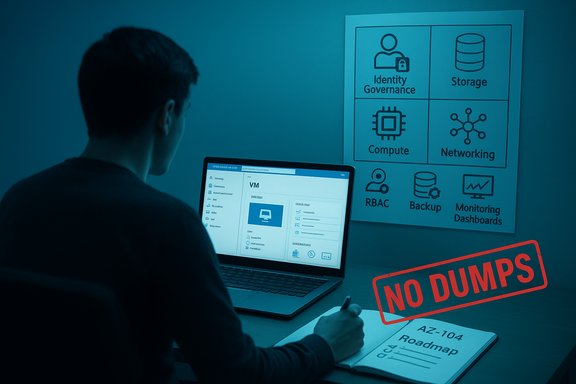
Microsoft’s published skills outline (April 18, 2025) gives the authoritative breakdown of what you must know for AZ‑104. The high‑level domain weightings are:- Manage Azure identities and governance — 20–25%
- Implement and manage storage — 15–20%
- Deploy and manage Azure compute resources — 20–25%
- Implement and manage virtual networking — 15–20%
- Monitor and maintain Azure resources — 10–15%
- Identity and governance carry the largest single slice. Be prepared to manage Entra ID (formerly Azure AD) users/groups, role assignments and RBAC scopes, and subscription governance (policy, blueprints, cost controls).
- Compute and storage together form roughly half the exam; expect deep VM lifecycle, scale sets, app service basics, managed disks, and storage account configuration questions.
- Networking questions test virtual network fundamentals, subnets, NSGs, peering, and basic hybrid connectivity patterns.
- Monitoring and backup questions are shorter in weight but require solid, practical knowledge: Azure Monitor, alerts, backup vaults, and Site Recovery operations.
Why sample questions and explanations matter — and how to use them
Sample Q&A sets are most valuable when used to sharpen applied skills, not to shortcut learning. Use them this way:- Start with Microsoft Learn modules that correspond to each domain (identity, storage, compute, networking, monitoring).
- Use a small, inexpensive Azure sandbox (free tier / student / trial credits) to perform the tasks you study: create VMs, attach disks, configure RBAC, create a Recovery Services vault and run a backup.
- After hands‑on practice, use sample questions to test whether you can reason through a scenario instead of simply recalling a command or button location.
- Treat every wrong practice answer as a remediation ticket: find the Microsoft Learn module or documentation page that explains the underlying concept, then repeat the lab.
A practical 10‑week study plan for busy admins
Use the official skills outline as your map, and allocate time based on domain weights and your background.Week 1–2: Foundations and mapping
- Read the AZ‑104 skills outline on Microsoft Learn and map topics to modules.
- Set up a lab subscription or trial and confirm you can create and manage basic resources.
- Hands‑on: create Entra users, groups, SSPR, and test RBAC at multiple scopes.
- Build storage accounts, configure blobs vs file shares, test tiering and access keys/managed identities.
- Deploy VMs, use managed disks, backup/restore VMs, and test scale sets.
- Configure VNets, subnets, NSGs, peering, and a site‑to‑site or point‑to‑site VPN example.
- Configure Azure Monitor, alerts, Log Analytics, and a Recovery Services vault; run a Site Recovery failover drill.
- Use reputable timed practice providers; treat each failed question as a research item and fix the underlying concept.
- Revisit weak areas with deeper labs.
- Re‑read the skills outline, re-run a full timed practice exam, and polish a short GitHub repo that demonstrates a small end‑to‑end deployment (VM + disk + backup + monitor + RBAC).
Practice tests: pick providers carefully
Practice tests are legitimate and helpful, but quality varies widely. Use providers that:- Explicitly state their content is vendor‑aligned and original, not leaked.
- Provide detailed explanations for wrong answers and remediation guidance.
- Offer domain‑level analytics so you can focus study time where it matters.
The exam‑dump problem: legal, ethical, and practical risks
The market for “real exam” question banks — commonly called exam dumps or brain dumps — is pervasive and seductive, but it carries concrete and escalating risks.Microsoft’s exam security policy explicitly forbids the use, sharing, or distribution of confidential exam content (including brain dumps). Violations can lead to revoked credentials, bans from future exams, and other sanctions. Certification bodies use forensics and pattern analysis to detect suspicious answer patterns and unusual performance. The guidance is unambiguous: don’t do it. Third‑party analysis and community reporting reinforce the consequences: the use of dumps can permanently damage employability, and organizations increasingly verify candidate results and require hands‑on demonstrations in interviews. In short, a short‑cut that wins an exam question today may cost a career signal tomorrow. Practical reasons to avoid dumps:
- Dumps are often outdated or incorrect and may cover retired objectives.
- Memorizing leaked questions does not produce operational competence; it produces brittle candidates who fail in interviews and on the job.
- Using dumps violates NDAs and Microsoft’s Candidate Agreement; consequences include revocation and permanent bans.
Recommended toolset and resources
- Microsoft Learn — canonical study modules, practice assessments, and the official AZ‑104 skills outline. Start here and make it your schedule anchor.
- Hands‑on sandbox — free tier, student account, or low‑cost subscription to run real labs.
- Vendor practice tests — choose vendors that publish methodology and produce original content (practice with remediation and analytics).
- Books and guided labs — pick an exam‑aligned text for deep dives and a PowerShell cookbook for automation patterns. Community reviews help pick current editions.
- Project artifacts — publish a short GitHub repo or runbook that documents a small end‑to‑end admin task to demonstrate applied competence to interviewers.
Critical analysis — strengths and areas of caution
Strengths of the Server Side approach
- Applied reasoning over memorization. The Q&A emphasizes scenario choice and trade‑offs, aligning with Microsoft’s role‑based testing philosophy.
- Practical clarifications. The writeup decodes common confusions (SDK vs REST, OCR vs Form Recognizer) into operational guidance candidates can apply in labs and real jobs.
- Ethical stance. Strong warnings about exam dumps and guidance to use vendor‑aligned practice tests protect candidates from revocation risk and encourage durable learning.
Risks and limitations
- Not a substitute for hands‑on experience. Q&A explains what answer fits and why, but it cannot emulate the muscle memory of repeatedly performing the tasks in a live Azure subscription. Use it as a complement, not a replacement.
- Potential staleness of third‑party practice material. Blogs and practice providers may lag Microsoft’s change log; always double‑check the skills outline when mapping practice questions to topics.
- Overreliance on question banks. Even the best question sets must be paired with labs and documented remediation work to ensure the credential reflects operational capability.
Final recommendations: how to prepare smart and pass ethically
- Begin at Microsoft Learn. Map the official AZ‑104 skills outline to hands‑on modules and track progress against the domain weights.
- Build a small lab and run the scenarios. Don’t read passively; create VMs, configure RBAC, provision storage, test failover, and instrument monitoring.
- Use high‑quality practice tests as diagnostics. Pick providers that publish methodology and remediation content; treat every incorrect answer as a learning ticket.
- Avoid dumps and leaked banks. They’re unethical, risky, and often outdated. Microsoft enforces exam integrity and will revoke credentials for misuse.
- Publish a small project. A simple GitHub repo or architecture writeup showing a VM + backup + monitoring configuration is valuable evidence to employers and helps you anchor knowledge.
Conclusion
The free AZ‑104 Q&A and study guide discussed by Server Side is a useful, pragmatic complement to formal Microsoft Learn materials: it clarifies typical question reasoning, highlights practical distinctions candidates often miss, and pushes learners toward hands‑on labs rather than shortcuts. But the single most important rule remains unchanged: prepare by doing, validate your knowledge against the official AZ‑104 skills outline, and refuse the siren song of exam dumps. Microsoft’s published objectives and security policies are the final word on what the exam measures and what behavior it prohibits — and responsible preparation is the surest path to a sustainable certification and a stronger career.Source: The Server Side Free Azure Administrator Questions and Answers | AZ-104 Study Guide
