

Microsoft Azure learners in 2026 face a certification map that still begins sensibly with AZ-900 but now forks quickly into role-specific tracks for administration, development, security, architecture, AI, and data, while some third-party “path” articles continue to blur current Microsoft guidance with outdated exam references and exam-prep marketing. The problem is not that Azure certifications are useless; it is that the market around them has become noisy enough to make a beginner’s first decision harder than it should be. For WindowsForum readers, the useful question is no longer whether Microsoft credentials can help a cloud career, but how to separate a credible learning path from recycled certification content dressed up as career advice.
The most persuasive thing about Microsoft’s certification program is also the thing many articles flatten into a cliché: Azure credentials are role-based. AZ-900 is not “level one” in the same way a video game tutorial unlocks the next mandatory stage. It is a fundamentals exam meant to prove broad knowledge of cloud concepts, Azure services, governance, identity, pricing, and management.
That makes AZ-900 a useful starting point for students, help-desk technicians, sales engineers, junior admins, and developers who have never worked in Azure. It is also optional for many experienced professionals. A Windows Server administrator who already manages Entra ID, virtual networks, storage accounts, and subscriptions may learn more by moving directly toward AZ-104 than by spending weeks polishing terminology they already use at work.
This is where the familiar “AZ-900, then something harder” advice is both right and incomplete. The jump after AZ-900 should be determined by the job you want to do, not by the nearest exam code in a search-optimized article. Azure Administrator, Azure Developer, Azure Security Engineer, Azure Solutions Architect, and Azure AI or data roles are adjacent disciplines, not interchangeable rungs on one staircase.
The distinction matters because certifications shape study behavior. If learners think the objective is to “collect Azure exams,” they tend to chase acronyms. If they think the objective is to prove job competence, they spend more time building resources, breaking deployments, reading logs, and understanding why a seemingly correct configuration fails in the real world.
For Windows administrators, AZ-900 often feels deceptively easy because parts of Azure map onto familiar enterprise concepts. Virtual machines are still virtual machines, directories still govern identity, and monitoring still matters when something catches fire at 2 a.m. But the cloud changes the control plane. Instead of racking hardware and filing firewall tickets, the admin is now dealing with subscriptions, role assignments, policy inheritance, regions, resource groups, and consumption-based billing.
That is why fundamentals training is most useful when it is treated as orientation rather than exam trivia. The person who can define Infrastructure as a Service, Platform as a Service, and Software as a Service has learned the words. The person who can explain why a managed database shifts patching responsibility but not data modeling responsibility has started to think like a cloud professional.
The better AZ-900 study plan, then, is not to memorize enough answers to pass. It is to build a small mental model of Azure as a management fabric: identity at the center, governance above it, resources below it, costs surrounding it, and security crossing every boundary. That model becomes the difference between passing a fundamentals exam and understanding why the rest of the certification catalog exists.
For non-developers, AI-900 can be especially useful because it lowers the intimidation barrier around machine learning terminology. A support engineer, analyst, product manager, or infrastructure admin may not need to train models, but they may need to understand computer vision, language processing, responsible AI concepts, and the service categories Microsoft sells under the Azure AI umbrella. That is practical literacy in a market where every enterprise roadmap now seems to contain an AI slide.
The mistake is to confuse AI-900 with proof that someone can build AI systems. It is closer to knowing the difference between speech recognition, document intelligence, image analysis, and generative AI than to designing a production inference pipeline. That distinction is not a knock on the exam; it is the exam doing what it says on the tin.
For a WindowsForum audience, AI-900 makes the most sense as an add-on credential for people whose work intersects with automation, Copilot-style features, support workflows, content processing, or AI governance. It is less compelling as a mandatory stop between AZ-900 and an administrator or developer path. A junior admin who wants to manage Azure infrastructure should not feel guilty for skipping it.
This is the point where hands-on experience stops being a recommendation and becomes the exam’s operating system. You can read about role-based access control, but the lesson lands differently when a deployment fails because a managed identity lacks permission. You can study virtual networks, but the concept becomes real when name resolution, route tables, private endpoints, and network security groups conspire to make a simple workload unreachable.
AZ-104 also carries a cultural shift. On-prem administration often rewards deep knowledge of a bounded environment: the servers in the rack, the domain controllers in the forest, the storage array in the data center. Azure administration rewards understanding dependencies across a distributed control plane. A cost problem may begin as an architecture problem; an availability issue may be an identity issue; a security policy may break a deployment pipeline that was working yesterday.
That is why AZ-104 is often the best second step for systems administrators, support engineers, and cloud operations staff. It forces the learner to move from “what is Azure?” to “how do I keep Azure from becoming expensive, insecure, and chaotic?” In the real world, that is the job.
The Azure developer path is about building and maintaining cloud applications. That means compute choices, storage integration, authentication and authorization, APIs, messaging, event-driven architecture, monitoring, troubleshooting, and deployment patterns. A candidate who can click around the Azure portal but cannot reason about application behavior under load, failure, and identity constraints is not really the target audience.
For Windows developers who have lived mostly in .NET, IIS, SQL Server, and internal line-of-business applications, AZ-204 can be a productive modernization path. It pushes the developer toward managed services, app hosting models, queues, secrets management, telemetry, and the practical reality that cloud applications are stitched together from services rather than installed on a single blessed server.
But it also exposes the limits of certification-only learning. A developer who studies AZ-204 without building anything will miss the exam’s deeper point. Cloud development is not just knowing that a service exists; it is knowing when the service creates coupling, cost, latency, operational burden, or security exposure. The exam can validate part of that knowledge, but only practice makes it durable.
The exam’s subject matter reflects the security reality of Azure environments. Identity and access management are not just one topic among many; they are the hinge on which most cloud security decisions swing. Microsoft Entra ID, conditional access, privileged roles, managed identities, key management, Defender services, network controls, logging, and security operations all become part of the same risk conversation.
That makes AZ-500 valuable for security analysts, infrastructure engineers, and administrators moving toward cloud security roles. It also makes it a poor first specialist exam for someone who has never deployed a workload. Security without operational context can become policy theater: lots of controls, little understanding of what they break or protect.
For enterprises, AZ-500 is useful because it validates awareness of the control surfaces that attackers and auditors both care about. For individuals, it is most useful after the learner has enough Azure muscle memory to recognize why a permission, endpoint, key vault, diagnostic setting, or network rule matters. Security credentials are strongest when they sit on top of operational fluency.
That means AZ-305 is not only about knowing Azure services. It is about deciding among them. The architect needs to understand identity design, governance, monitoring, data storage, business continuity, compute, networking, hybrid connectivity, and security architecture. More importantly, the architect needs to know how a decision in one domain affects the others.
This is where the best architecture learning becomes uncomfortably practical. A design that is secure but unusable will be bypassed. A design that is highly available but financially reckless will be challenged. A design that uses the newest platform feature without operational readiness becomes tomorrow’s incident report. AZ-305 points learners toward those trade-offs, even if no exam can fully reproduce them.
For Windows veterans, the architect path can be compelling because it rewards the accumulated intuition of years spent watching systems fail. The cloud does not abolish that experience. It reframes it around service-level objectives, regional design, identity boundaries, automation, and governance at scale.
This is exactly why certification articles age badly. A guide that says DP-203 is a live target for new candidates may have been reasonable before retirement. After retirement, it becomes misleading unless it clearly explains the date, the status of existing credentials, and the closest current replacement path. In Microsoft’s data portfolio, the direction has shifted toward Microsoft Fabric, with DP-700 positioned as the more relevant data engineering credential for many learners.
That shift is more than branding. Microsoft has spent the last few years folding analytics, lakehouse concepts, data engineering, business intelligence, and AI-adjacent workflows into a Fabric-centered story. Azure data services still matter, and real environments do not migrate their architecture just because a certification changes names. But learners choosing an exam need the current credential, not nostalgia for a retired one.
The practical lesson is blunt: always verify the certification page before committing money or months of study. Exam codes are not permanent landmarks. They are productized snapshots of what Microsoft believes a role should know at a particular moment.
The articles repeatedly pair general certification advice with “additional resource,” “reference,” or “read more” links to third-party exam-prep sites. Some of those links appear mismatched to the surrounding exam discussion. One section about AZ-900 points to an AZ-500 page; an AZ-500 section points to an AZ-900 page. That kind of slippage is a warning sign, not because a typo disproves the whole article, but because it reveals the content’s likely purpose: ranking for exam codes and sending readers toward prep vendors.
There is a larger ethics problem around the certification-prep industry. Legitimate training exists, including books, labs, courses, practice tests, community notes, and instructor-led classes. But there is also a long-running gray market of brain dumps, “guaranteed pass” claims, scraped questions, and answer memorization. Those products do not build cloud professionals. They build brittle test-takers and, in some cases, put candidates at odds with exam policies.
For employers, that matters because certifications are only useful if they carry trust. If a hiring manager believes an Azure badge might represent memorized leaked questions rather than hands-on competence, the signal weakens for everyone. For candidates, it matters because passing the exam is a poor bargain if the first production incident exposes that nothing was learned.
The better rule is simple: use Microsoft Learn, official exam objectives, sandbox environments, reputable labs, product documentation, and practice assessments that teach reasoning. Avoid anything that promises verified real questions or treats the exam as an obstacle to bypass rather than a skill framework to master.
Hands-on practice does not have to mean running up a large cloud bill or building a production-grade architecture at home. It can start with a controlled subscription, a budget alert, a resource group, a virtual network, a storage account, a web app, a key vault, a managed identity, and logs. The point is to see how Azure behaves when settings collide.
A learner preparing for AZ-104 should create users and groups, assign roles, deploy virtual machines, configure storage, build virtual networks, test backup, inspect Monitor, and clean up resources. A learner preparing for AZ-204 should deploy applications, wire up managed identities, use queues or events, store secrets properly, and instrument code. A security candidate should test conditional access, least privilege, Defender recommendations, key management, and log investigation. An architect candidate should compare design options and explain trade-offs rather than merely naming services.
This is also where Windows professionals have an advantage. Years of troubleshooting printers, Group Policy, DNS, patching, certificates, and authentication failures produce a useful instinct: systems fail at the boundaries. Azure has different boundaries, but the discipline transfers. The portal is not the platform; the platform is the behavior underneath.
What a certification cannot do is replace experience. Employers hiring for cloud roles usually want evidence that the candidate can operate safely, communicate clearly, troubleshoot under pressure, and understand trade-offs. A badge helps most when it is paired with projects, labs, documentation, GitHub repositories, internal migration work, support tickets, or war stories from real environments.
The strongest candidates treat certifications as scaffolding. They use AZ-900 to learn the vocabulary, AZ-104 to operate the environment, AZ-204 to build applications, AZ-500 to secure workloads, AZ-305 to design systems, and AI or data credentials where those roles actually apply. They do not treat the entire catalog as a shopping list.
For IT teams, certifications work best as part of workforce planning rather than trophy collection. If an organization is moving Windows Server workloads into Azure, AZ-104 may be a sensible baseline. If it is building cloud-native applications, AZ-204 matters. If it is facing audit pressure, AZ-500 becomes more relevant. If it is redesigning platforms across regions and hybrid networks, AZ-305 earns its keep.
But for learners, that creates friction. Study guides expire. Courses lag. Blog posts remain online long after their advice has gone stale. A candidate may spend weeks following a path only to discover that an exam’s skills outline changed, a certification retired, or a product area moved under a different Microsoft branding umbrella.
This is especially visible in data and AI. The industry’s center of gravity has moved quickly from classic cloud data engineering and machine learning terminology toward generative AI, Fabric, Copilot integrations, and unified analytics platforms. Microsoft’s credential portfolio is trying to keep up with that commercial and technical shift. Learners need to understand that a certification path is not a constitution; it is a current map.
The burden falls hardest on beginners because they are least equipped to know which advice is stale. That is why any article recommending certification paths should state retirement status, exam role, and intended audience clearly. “Start with AZ-900” is fine. “Then take DP-203” in 2026, without explaining retirement, is not.
If the goal is cloud security, AZ-500 makes sense after the learner has enough Azure administration context to understand what is being secured. If the goal is architecture, AZ-104 experience before AZ-305 remains a strong pattern because architects who have never administered anything tend to design systems other people suffer through. If the goal is AI literacy, AI-900 is a useful fundamentals credential; if the goal is building AI solutions, learners need a more advanced path and real implementation practice.
For data engineering, the path requires extra care because older DP-203 advice is now dated. The skills behind data engineering remain valuable: storage design, pipelines, transformation, monitoring, optimization, and security. But candidates should look to current Microsoft credentials and Fabric-aligned training rather than assuming a retired Azure exam is still available.
This approach is less tidy than a single universal sequence, but it is more honest. Cloud careers are not linear. A help-desk technician, a Windows admin, a .NET developer, a SOC analyst, and a business intelligence engineer may all begin with Azure fundamentals and then immediately need different next steps.
A certification has value when it changes what the learner can see. After AZ-900, a candidate should understand why cloud cost and governance are not afterthoughts. After AZ-104, an administrator should see how identity, networking, storage, and monitoring interact. After AZ-204, a developer should understand the operational consequences of architecture choices. After AZ-500, a security professional should see Azure as a living attack surface and control plane. After AZ-305, an architect should be better at defending trade-offs.
If the certification does not produce that shift, the learner may still pass, but the credential has not done its deeper job. That is why practice exams should be diagnostic, not devotional. A wrong answer should send the candidate back to the service, the documentation, and the lab environment until the underlying concept is clear.
The same standard should apply to employers. Do not ask for certifications as decorative HR filters and then ignore whether the job uses those skills. Use them to define learning goals, mentoring plans, lab environments, and operational responsibilities. A badge should open the door to work that reinforces it.
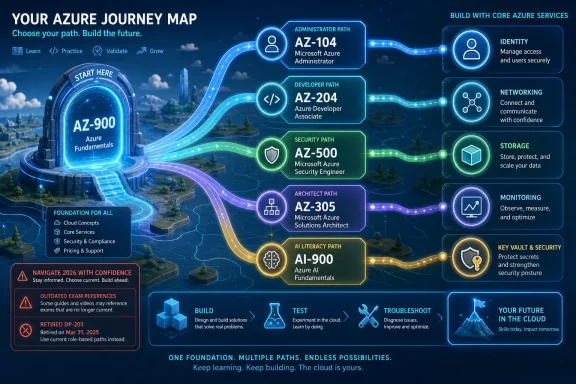 The Azure Certification Ladder Is Real, but It Is Not a Ladder for Everyone
The most persuasive thing about Microsoft’s certification program is also the thing many articles flatten into a cliché: Azure credentials are role-based. AZ-900 is not “level one” in the same way a video game tutorial unlocks the next mandatory stage. It is a fundamentals exam meant to prove broad knowledge of cloud concepts, Azure services, governance, identity, pricing, and management.That makes AZ-900 a useful starting point for students, help-desk technicians, sales engineers, junior admins, and developers who have never worked in Azure. It is also optional for many experienced professionals. A Windows Server administrator who already manages Entra ID, virtual networks, storage accounts, and subscriptions may learn more by moving directly toward AZ-104 than by spending weeks polishing terminology they already use at work.
This is where the familiar “AZ-900, then something harder” advice is both right and incomplete. The jump after AZ-900 should be determined by the job you want to do, not by the nearest exam code in a search-optimized article. Azure Administrator, Azure Developer, Azure Security Engineer, Azure Solutions Architect, and Azure AI or data roles are adjacent disciplines, not interchangeable rungs on one staircase.
The distinction matters because certifications shape study behavior. If learners think the objective is to “collect Azure exams,” they tend to chase acronyms. If they think the objective is to prove job competence, they spend more time building resources, breaking deployments, reading logs, and understanding why a seemingly correct configuration fails in the real world.
AZ-900 Remains the Sensible On-Ramp Because It Teaches the Cloud Grammar
AZ-900’s continuing value is not that it makes someone employable on its own. It is that it teaches the vocabulary of the platform before the platform begins punishing assumptions. Compute, storage, networking, identity, cost management, governance, availability zones, service models, and shared responsibility are basic ideas, but they are also the ideas that show up later in every serious Azure decision.For Windows administrators, AZ-900 often feels deceptively easy because parts of Azure map onto familiar enterprise concepts. Virtual machines are still virtual machines, directories still govern identity, and monitoring still matters when something catches fire at 2 a.m. But the cloud changes the control plane. Instead of racking hardware and filing firewall tickets, the admin is now dealing with subscriptions, role assignments, policy inheritance, regions, resource groups, and consumption-based billing.
That is why fundamentals training is most useful when it is treated as orientation rather than exam trivia. The person who can define Infrastructure as a Service, Platform as a Service, and Software as a Service has learned the words. The person who can explain why a managed database shifts patching responsibility but not data modeling responsibility has started to think like a cloud professional.
The better AZ-900 study plan, then, is not to memorize enough answers to pass. It is to build a small mental model of Azure as a management fabric: identity at the center, governance above it, resources below it, costs surrounding it, and security crossing every boundary. That model becomes the difference between passing a fundamentals exam and understanding why the rest of the certification catalog exists.
AI-900 Is a Detour That Makes Sense Only If AI Is Part of the Job
AI-900 belongs in the same introductory family as AZ-900, but it is not simply “the next Azure exam.” It validates foundational knowledge of artificial intelligence and machine learning concepts, including common AI workloads and Azure AI services. In the current industry climate, that sounds broadly useful, and it can be. But it is still a fundamentals exam, not a developer credential and not a data science credential.For non-developers, AI-900 can be especially useful because it lowers the intimidation barrier around machine learning terminology. A support engineer, analyst, product manager, or infrastructure admin may not need to train models, but they may need to understand computer vision, language processing, responsible AI concepts, and the service categories Microsoft sells under the Azure AI umbrella. That is practical literacy in a market where every enterprise roadmap now seems to contain an AI slide.
The mistake is to confuse AI-900 with proof that someone can build AI systems. It is closer to knowing the difference between speech recognition, document intelligence, image analysis, and generative AI than to designing a production inference pipeline. That distinction is not a knock on the exam; it is the exam doing what it says on the tin.
For a WindowsForum audience, AI-900 makes the most sense as an add-on credential for people whose work intersects with automation, Copilot-style features, support workflows, content processing, or AI governance. It is less compelling as a mandatory stop between AZ-900 and an administrator or developer path. A junior admin who wants to manage Azure infrastructure should not feel guilty for skipping it.
AZ-104 Is Where the Cloud Stops Being Theoretical
If AZ-900 teaches the grammar, AZ-104 starts asking whether you can run the place. Azure Administrator is the certification track that most closely maps to the traditional Windows infrastructure professional moving into cloud operations. It covers identity, governance, storage, compute, virtual networking, monitoring, backup, and the daily mechanics of keeping Azure resources usable and controlled.This is the point where hands-on experience stops being a recommendation and becomes the exam’s operating system. You can read about role-based access control, but the lesson lands differently when a deployment fails because a managed identity lacks permission. You can study virtual networks, but the concept becomes real when name resolution, route tables, private endpoints, and network security groups conspire to make a simple workload unreachable.
AZ-104 also carries a cultural shift. On-prem administration often rewards deep knowledge of a bounded environment: the servers in the rack, the domain controllers in the forest, the storage array in the data center. Azure administration rewards understanding dependencies across a distributed control plane. A cost problem may begin as an architecture problem; an availability issue may be an identity issue; a security policy may break a deployment pipeline that was working yesterday.
That is why AZ-104 is often the best second step for systems administrators, support engineers, and cloud operations staff. It forces the learner to move from “what is Azure?” to “how do I keep Azure from becoming expensive, insecure, and chaotic?” In the real world, that is the job.
AZ-204 Is Not AZ-104 for People Who Like Code
AZ-204, the Azure Developer Associate exam, is sometimes presented as the natural next step after AZ-900. For developers, it can be. But it is not a general-purpose intermediate Azure credential, and it is not an easier alternative to administration. It tests a different muscle.The Azure developer path is about building and maintaining cloud applications. That means compute choices, storage integration, authentication and authorization, APIs, messaging, event-driven architecture, monitoring, troubleshooting, and deployment patterns. A candidate who can click around the Azure portal but cannot reason about application behavior under load, failure, and identity constraints is not really the target audience.
For Windows developers who have lived mostly in .NET, IIS, SQL Server, and internal line-of-business applications, AZ-204 can be a productive modernization path. It pushes the developer toward managed services, app hosting models, queues, secrets management, telemetry, and the practical reality that cloud applications are stitched together from services rather than installed on a single blessed server.
But it also exposes the limits of certification-only learning. A developer who studies AZ-204 without building anything will miss the exam’s deeper point. Cloud development is not just knowing that a service exists; it is knowing when the service creates coupling, cost, latency, operational burden, or security exposure. The exam can validate part of that knowledge, but only practice makes it durable.
AZ-500 Is the Security Exam That Assumes You Already Know the House
AZ-500 is attractive because “cloud security” is attractive. It is also one of the places where beginners can get themselves into trouble. Azure Security Engineer is not a fundamentals credential with a scarier name. It expects familiarity with Azure administration, identity, networking, monitoring, data protection, and workload security.The exam’s subject matter reflects the security reality of Azure environments. Identity and access management are not just one topic among many; they are the hinge on which most cloud security decisions swing. Microsoft Entra ID, conditional access, privileged roles, managed identities, key management, Defender services, network controls, logging, and security operations all become part of the same risk conversation.
That makes AZ-500 valuable for security analysts, infrastructure engineers, and administrators moving toward cloud security roles. It also makes it a poor first specialist exam for someone who has never deployed a workload. Security without operational context can become policy theater: lots of controls, little understanding of what they break or protect.
For enterprises, AZ-500 is useful because it validates awareness of the control surfaces that attackers and auditors both care about. For individuals, it is most useful after the learner has enough Azure muscle memory to recognize why a permission, endpoint, key vault, diagnostic setting, or network rule matters. Security credentials are strongest when they sit on top of operational fluency.
AZ-305 Belongs to Architects Who Have Already Been Burned by Trade-Offs
AZ-305, the Azure Solutions Architect Expert exam, is often described as the destination after AZ-104. That framing is broadly fair, but it can still understate the role change. Administrators implement and manage environments. Architects translate business and technical requirements into designs that survive cost pressure, security constraints, governance demands, recovery objectives, and the inevitable messiness of enterprise reality.That means AZ-305 is not only about knowing Azure services. It is about deciding among them. The architect needs to understand identity design, governance, monitoring, data storage, business continuity, compute, networking, hybrid connectivity, and security architecture. More importantly, the architect needs to know how a decision in one domain affects the others.
This is where the best architecture learning becomes uncomfortably practical. A design that is secure but unusable will be bypassed. A design that is highly available but financially reckless will be challenged. A design that uses the newest platform feature without operational readiness becomes tomorrow’s incident report. AZ-305 points learners toward those trade-offs, even if no exam can fully reproduce them.
For Windows veterans, the architect path can be compelling because it rewards the accumulated intuition of years spent watching systems fail. The cloud does not abolish that experience. It reframes it around service-level objectives, regional design, identity boundaries, automation, and governance at scale.
DP-203 Shows Why Certification Advice Has an Expiration Date
The most important correction to many casual Azure certification guides is DP-203. Microsoft’s Azure Data Engineer Associate certification and its DP-203 exam were retired on March 31, 2025. That does not erase the value of the skills it covered, but it does change the advice a learner should follow in mid-2026.This is exactly why certification articles age badly. A guide that says DP-203 is a live target for new candidates may have been reasonable before retirement. After retirement, it becomes misleading unless it clearly explains the date, the status of existing credentials, and the closest current replacement path. In Microsoft’s data portfolio, the direction has shifted toward Microsoft Fabric, with DP-700 positioned as the more relevant data engineering credential for many learners.
That shift is more than branding. Microsoft has spent the last few years folding analytics, lakehouse concepts, data engineering, business intelligence, and AI-adjacent workflows into a Fabric-centered story. Azure data services still matter, and real environments do not migrate their architecture just because a certification changes names. But learners choosing an exam need the current credential, not nostalgia for a retired one.
The practical lesson is blunt: always verify the certification page before committing money or months of study. Exam codes are not permanent landmarks. They are productized snapshots of what Microsoft believes a role should know at a particular moment.
The Exam-Prep Economy Turns Career Guidance Into SEO Paste
The Business News Nigeria articles have the shape of helpful beginner guidance: explain cloud demand, introduce Microsoft Azure, list popular exams, recommend hands-on practice, and conclude that certifications support career growth. Much of that broad advice is unobjectionable. The trouble begins in the seams.The articles repeatedly pair general certification advice with “additional resource,” “reference,” or “read more” links to third-party exam-prep sites. Some of those links appear mismatched to the surrounding exam discussion. One section about AZ-900 points to an AZ-500 page; an AZ-500 section points to an AZ-900 page. That kind of slippage is a warning sign, not because a typo disproves the whole article, but because it reveals the content’s likely purpose: ranking for exam codes and sending readers toward prep vendors.
There is a larger ethics problem around the certification-prep industry. Legitimate training exists, including books, labs, courses, practice tests, community notes, and instructor-led classes. But there is also a long-running gray market of brain dumps, “guaranteed pass” claims, scraped questions, and answer memorization. Those products do not build cloud professionals. They build brittle test-takers and, in some cases, put candidates at odds with exam policies.
For employers, that matters because certifications are only useful if they carry trust. If a hiring manager believes an Azure badge might represent memorized leaked questions rather than hands-on competence, the signal weakens for everyone. For candidates, it matters because passing the exam is a poor bargain if the first production incident exposes that nothing was learned.
The better rule is simple: use Microsoft Learn, official exam objectives, sandbox environments, reputable labs, product documentation, and practice assessments that teach reasoning. Avoid anything that promises verified real questions or treats the exam as an obstacle to bypass rather than a skill framework to master.
Hands-On Practice Is Not a Study Tip; It Is the Product
Every credible Azure certification path eventually says the same thing: get hands-on experience. The phrase is so common that it risks becoming wallpaper. But for Azure, it is the difference between recognition and competence.Hands-on practice does not have to mean running up a large cloud bill or building a production-grade architecture at home. It can start with a controlled subscription, a budget alert, a resource group, a virtual network, a storage account, a web app, a key vault, a managed identity, and logs. The point is to see how Azure behaves when settings collide.
A learner preparing for AZ-104 should create users and groups, assign roles, deploy virtual machines, configure storage, build virtual networks, test backup, inspect Monitor, and clean up resources. A learner preparing for AZ-204 should deploy applications, wire up managed identities, use queues or events, store secrets properly, and instrument code. A security candidate should test conditional access, least privilege, Defender recommendations, key management, and log investigation. An architect candidate should compare design options and explain trade-offs rather than merely naming services.
This is also where Windows professionals have an advantage. Years of troubleshooting printers, Group Policy, DNS, patching, certificates, and authentication failures produce a useful instinct: systems fail at the boundaries. Azure has different boundaries, but the discipline transfers. The portal is not the platform; the platform is the behavior underneath.
Employers Still Care About Proof, but They Care More About Useful Proof
The labor-market case for Azure certifications is real but often overstated. A certification can help a resume survive filtering, signal motivation, support a promotion case, satisfy partner requirements, or reassure a manager that a candidate has at least studied the platform. It can also help career switchers impose structure on an intimidating field.What a certification cannot do is replace experience. Employers hiring for cloud roles usually want evidence that the candidate can operate safely, communicate clearly, troubleshoot under pressure, and understand trade-offs. A badge helps most when it is paired with projects, labs, documentation, GitHub repositories, internal migration work, support tickets, or war stories from real environments.
The strongest candidates treat certifications as scaffolding. They use AZ-900 to learn the vocabulary, AZ-104 to operate the environment, AZ-204 to build applications, AZ-500 to secure workloads, AZ-305 to design systems, and AI or data credentials where those roles actually apply. They do not treat the entire catalog as a shopping list.
For IT teams, certifications work best as part of workforce planning rather than trophy collection. If an organization is moving Windows Server workloads into Azure, AZ-104 may be a sensible baseline. If it is building cloud-native applications, AZ-204 matters. If it is facing audit pressure, AZ-500 becomes more relevant. If it is redesigning platforms across regions and hybrid networks, AZ-305 earns its keep.
Microsoft’s Constant Exam Updates Are a Feature and a Burden
Microsoft updates exams because Azure changes. That is the charitable interpretation, and it is mostly correct. Cloud roles evolve as services mature, product names shift, security assumptions change, and new platform capabilities become mainstream.But for learners, that creates friction. Study guides expire. Courses lag. Blog posts remain online long after their advice has gone stale. A candidate may spend weeks following a path only to discover that an exam’s skills outline changed, a certification retired, or a product area moved under a different Microsoft branding umbrella.
This is especially visible in data and AI. The industry’s center of gravity has moved quickly from classic cloud data engineering and machine learning terminology toward generative AI, Fabric, Copilot integrations, and unified analytics platforms. Microsoft’s credential portfolio is trying to keep up with that commercial and technical shift. Learners need to understand that a certification path is not a constitution; it is a current map.
The burden falls hardest on beginners because they are least equipped to know which advice is stale. That is why any article recommending certification paths should state retirement status, exam role, and intended audience clearly. “Start with AZ-900” is fine. “Then take DP-203” in 2026, without explaining retirement, is not.
The Better Azure Path Starts With the Job, Not the Exam Code
A practical Azure certification strategy in 2026 begins by naming the target role. If the goal is cloud administration, AZ-900 followed by AZ-104 is the cleanest route for many learners. If the goal is application development, AZ-900 can be followed by AZ-204, provided the candidate is writing and deploying code rather than merely studying service names.If the goal is cloud security, AZ-500 makes sense after the learner has enough Azure administration context to understand what is being secured. If the goal is architecture, AZ-104 experience before AZ-305 remains a strong pattern because architects who have never administered anything tend to design systems other people suffer through. If the goal is AI literacy, AI-900 is a useful fundamentals credential; if the goal is building AI solutions, learners need a more advanced path and real implementation practice.
For data engineering, the path requires extra care because older DP-203 advice is now dated. The skills behind data engineering remain valuable: storage design, pipelines, transformation, monitoring, optimization, and security. But candidates should look to current Microsoft credentials and Fabric-aligned training rather than assuming a retired Azure exam is still available.
This approach is less tidy than a single universal sequence, but it is more honest. Cloud careers are not linear. A help-desk technician, a Windows admin, a .NET developer, a SOC analyst, and a business intelligence engineer may all begin with Azure fundamentals and then immediately need different next steps.
The Azure Badge Only Matters If It Changes How You Work
The certification debate often gets trapped between two lazy positions. One side says certifications are the key to cloud jobs. The other says certifications are meaningless paper. Both are wrong in the way slogans usually are.A certification has value when it changes what the learner can see. After AZ-900, a candidate should understand why cloud cost and governance are not afterthoughts. After AZ-104, an administrator should see how identity, networking, storage, and monitoring interact. After AZ-204, a developer should understand the operational consequences of architecture choices. After AZ-500, a security professional should see Azure as a living attack surface and control plane. After AZ-305, an architect should be better at defending trade-offs.
If the certification does not produce that shift, the learner may still pass, but the credential has not done its deeper job. That is why practice exams should be diagnostic, not devotional. A wrong answer should send the candidate back to the service, the documentation, and the lab environment until the underlying concept is clear.
The same standard should apply to employers. Do not ask for certifications as decorative HR filters and then ignore whether the job uses those skills. Use them to define learning goals, mentoring plans, lab environments, and operational responsibilities. A badge should open the door to work that reinforces it.
The Real Azure Roadmap Hides Beneath the Acronyms
The useful version of the Azure certification path is narrower, more current, and more role-aware than the generic articles suggest.- AZ-900 remains the best introductory Azure credential for learners who need cloud vocabulary, platform orientation, and a low-risk starting point.
- AI-900 is useful for AI literacy, but it should not be treated as a mandatory bridge into administration, development, or architecture.
- AZ-104 is the practical next step for many Windows administrators and cloud operations candidates because it tests the mechanics of managing Azure environments.
- AZ-204 is the developer path, and it only pays off when paired with real application deployment, identity integration, monitoring, and service design.
- AZ-500 and AZ-305 are stronger after operational experience because security and architecture both require context, not just terminology.
- DP-203 advice should be treated carefully in 2026 because the exam and Azure Data Engineer Associate certification retired on March 31, 2025.
References
- Primary source: Business News Nigeria
Published: 2026-06-30T14:30:11.296967
Microsoft Azure Certification Path: From Fundamentals to Cloud Development - Businessday NG
Cloud computing has become one of the most important technologies in modern business. Organizations across the world rely on cloudbusinessday.ng - Official source: learn.microsoft.com
Study guide for Exam AZ-900: Microsoft Azure Fundamentals | Microsoft Learn
Study guide for Exam AZ-900: Microsoft Azure Fundamentals | Microsoft Docslearn.microsoft.com - Related coverage: course.careers
Microsoft Certified Azure Fundamentals (AZ-900) Review
Microsoft Certified Azure Fundamentals (AZ-900): what it tests, whether it's worth it, exam cost, and the highest-rated prep courses for 2026.course.careers - Related coverage: azurelessons.com
What Is Azure Fundamentals AZ-900 - Azure Lessons
Learn, what is Azure Fundamentals AZ-900azurelessons.com - Related coverage: techexamlexicon.com
Azure AZ-900 Guide: Fundamentals
Azure AZ-900 exam guide covering cloud concepts, Azure services, governance, pricing, and support decisions. techexamlexicon.com
- Related coverage: robustittraining.com
- Related coverage: kornerstone.com
microsoft-certification-path
</rdf:Alt> </dc:description> <dc:creator> <rdf:Seq> <rdf:li/> </rdf:Seq> </dc:creator> <dc:title> <rdf:Alt> <rdf:li xml:lang="x-default">microsoft-certification-pathwww.kornerstone.com
- Related coverage: assets.ascendientlearning.com
- Related coverage: authoring.globalknowledge.com
