

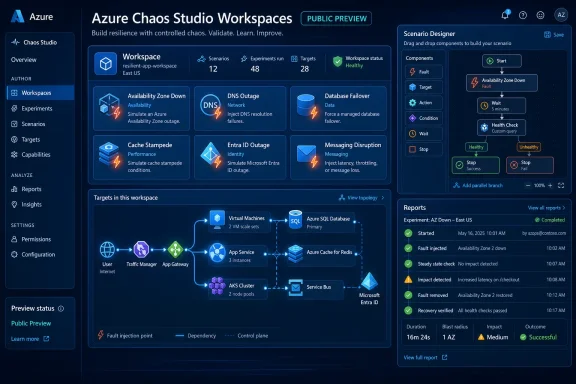
Microsoft announced on July 1, 2026 that Azure Chaos Studio Workspaces is entering public preview, adding scenario-driven resilience testing for Azure workloads through managed simulations of zone failures, DNS outages, database failovers, cache stampedes, identity disruption, and messaging interruptions. The move matters because Microsoft is trying to turn chaos engineering from an expert-only discipline into a repeatable operational habit. The promise is not that Azure can make failure disappear; it is that customers can rehearse failure before the pager, the customer, or the regulator discovers the weak link. That is a more honest pitch than most cloud reliability marketing, and a more useful one.
Chaos engineering has always had a slightly theatrical name for a very practical idea: systems that are expected to survive failure should be tested under failure. The discipline emerged because distributed systems fail in ways that design reviews rarely predict, especially when the problem crosses infrastructure, application code, identity, networking, and human operations.
Azure Chaos Studio was already Microsoft’s managed service for injecting controlled faults into Azure resources. What Workspaces changes is the starting point. Instead of asking teams to assemble experiments from granular faults, Microsoft is packaging common outage patterns as named scenarios that map more closely to what customers actually experience.
That distinction matters. A virtual machine shutdown test is useful, but it is not the same thing as a production incident. Real incidents tend to combine layers: a zone goes dark, a database fails over, DNS behaves badly, cached assumptions collapse, and the application’s retry logic either saves the day or accelerates the fire.
Workspaces are Microsoft’s attempt to make that multi-layer reality easier to test. The new top-level Workspace resource can be scoped to a subscription or resource group, use a managed identity to discover what is in scope, and recommend scenarios that fit the deployed resources. In other words, the product is trying to move the first question from “Which fault should I inject?” to “Which production failure mode should I rehearse?”
That is a subtle but important shift. Cloud reliability is no longer mainly a matter of checking whether a service has availability zones, geo-replication, or automatic failover. The more uncomfortable question is whether the customer’s actual workload uses those features correctly when the sky turns black.
That is the problem Chaos Studio Workspaces is meant to expose. A multi-zone deployment can fail if the load balancer’s health checks do not reflect application health. A database configured for automatic failover can strand an application if connection handling assumes a single primary. Geo-redundant storage can behave exactly as documented while application code mishandles stale reads or delayed consistency.
These are not exotic edge cases. They are the normal rough edges of cloud applications that grow over years, pass through multiple teams, and accumulate configuration drift. Architecture diagrams are snapshots of intent; production systems are living organisms with scars.
The shared-responsibility model makes this especially important on Azure. Microsoft can operate the platform and provide resilient service primitives, but the customer still has to configure them, wire them together, and write code that behaves sanely when dependencies degrade. No platform feature can compensate for application logic that retries indefinitely, authentication flows that fail closed in the wrong place, or operational runbooks that assume a clean failure mode.
That is why a managed chaos service is more than a developer convenience. It is a governance tool. It lets teams replace hope with evidence, and it gives leaders something better than a slide deck when they ask whether a business-critical workload can actually survive the outage pattern it was supposedly designed to withstand.
Those names are not marketing garnish. They describe the difference between fault injection as a low-level testing primitive and resilience testing as an operational exercise. A DNS outage scenario, for example, is not simply a networking trick. It tests whether applications can handle name resolution failure, whether cached endpoints buy enough time, whether retry behavior is bounded, and whether telemetry makes the problem visible before users turn into the monitoring system.
The Cache Stampede scenario is similarly revealing. Microsoft describes it as combining a Redis flush with a database restart and an App Service process crash, with the App Service crash variant currently supporting Windows App Service plans. That combination matters because cache failures often do not look dramatic at first. The real incident begins when every request falls through to the database at once, turning a recoverable cache miss into a back-end surge.
Event-driven systems get their own failure rehearsal through scenarios involving Azure Service Bus and Event Hubs disablement. That is a sensible inclusion because queues and streams are often sold internally as resilience mechanisms, but they can also hide trouble until downstream consumers fall behind, dead-letter policies misfire, or backpressure moves from an implementation detail to a business outage.
The point is not that these scenarios cover every serious failure. They do not. The point is that Microsoft is encoding a useful operational opinion: test recognizable outage patterns first, then customize from there. For many teams, that is exactly the push needed to get beyond theoretical resilience discussions.
Chaos engineering often stalls not because engineers doubt the concept, but because the activation energy is high. Someone has to choose the failure mode, identify target resources, secure permissions, write or configure the experiment, coordinate with observability owners, warn stakeholders, and define what success means. Every bit of friction makes it easier to postpone the exercise until after the next incident.
Workspaces try to shrink that gap. Discovery recommends applicable scenarios. Curated templates provide a starting point. The designer gives teams a path to customize without immediately dropping into scripts or APIs. Reports provide a post-drill artifact that looks more like operational evidence than a raw experiment log.
This does not eliminate the need for engineering judgment. In fact, it makes judgment more important. A chaos drill without a hypothesis is just vandalism with a change ticket. Teams still need to define expected recovery time, acceptable data loss, application behavior under partial failure, and the telemetry that will prove whether the system behaved correctly.
But better tooling can change who participates. A site reliability engineer may still design the deeper tests, but an application team, platform team, or operations lead can now approach resilience testing through scenarios that map to business risk. That is how a niche practice starts becoming part of release readiness.
That is the right starting point. Much of the industry talks about AI reliability as though it were entirely about model behavior, hallucination, prompt injection, or token limits. Those problems are real, but they sit on top of conventional distributed systems that can still lose DNS, fail over a database, exhaust a cache, or break authentication.
Chaos Studio Workspaces can test that foundation today. A retrieval system can be evaluated under database failover. An agentic workflow can be tested when Service Bus or Event Hubs disruption changes the shape of work queues. A copilot can be observed when identity is degraded and token refresh paths matter more than the model’s answer quality.
Microsoft also points toward possible future AI-specific scenarios, including retrieval drift, token throttling, and model behavior shifts under load. Those are still framed as exploratory rather than finished product capabilities, which is appropriate. The field is moving too quickly for anyone to pretend the definitive AI resilience checklist already exists.
The broader implication is that AI operations will converge with reliability engineering faster than many organizations expect. If a customer-facing agent becomes part of a business workflow, its failure modes are no longer an innovation-team problem. They are production incidents, and they need the same discipline as any other critical service.
This is easy to dismiss as the inevitable “add Copilot to everything” phase of Microsoft product strategy. But in this case, the integration has a more defensible purpose. The hardest part of resilience testing is often not the mechanics of injecting a fault; it is the decision to run the drill, interpret the signals, and do it regularly enough that the results mean something.
If engineers increasingly work inside chat-driven development and operations tools, then putting controlled resilience testing into those tools could reduce delay. A developer investigating a suspected failover weakness could ask an assistant to identify relevant Chaos Studio scenarios. An SRE could run a scheduled drill and have the assistant correlate Azure Monitor signals with the injected fault. A platform team could use the MCP server to expose approved resilience operations to internal automation.
There is risk here as well. Automating failure injection demands careful permissions, guardrails, and cultural maturity. A poorly scoped autonomous agent that can disrupt infrastructure is not a toy, even if the disruption is time-bounded and intentional. Microsoft’s use of Azure sign-in, managed identities, and typed tools is the right direction, but enterprises will still need to decide where human approval belongs.
The more interesting question is whether AI assistants become a front door for operational validation. Microsoft clearly wants that answer to be yes. If the assistant that helps write code can also help prove the code survives a zone failure, the line between development tooling and reliability tooling gets much thinner.
That is precisely the artifact many organizations lack. Teams often perform resilience work informally, learn something valuable, fix a few issues, and then struggle to prove to leadership, auditors, or incident-review boards that the testing happened and produced evidence. A structured report gives the exercise a paper trail.
The comparison to an internal post-incident review is apt. A good drill report should not simply say that a scenario succeeded or failed. It should show timelines, symptoms, telemetry, affected dependencies, recovery behavior, and the assumptions that were validated or disproved. That is the difference between checking a compliance box and improving the system.
There is also a cultural effect. Once a report exists, resilience testing can become part of change management, service reviews, and operational readiness gates. Teams can attach evidence to release approvals, track recurring weaknesses, and compare expected recovery objectives with measured behavior.
That will not make chaos engineering painless. It may even make it more uncomfortable, because evidence has a way of exposing optimistic planning. But uncomfortable evidence is the point. The cheapest serious outage is the one that happens inside a controlled drill.
The initial supported scenarios are useful but selective. Microsoft says the catalog will continue growing through public preview and into general availability, with possible future areas including storage account failover, Azure SQL Managed Instance failover, Front Door and Application Gateway scenarios, partial zone degradation, AKS-native pod chaos, and customer-observed region down. Those additions would broaden the service from a strong starting set into something closer to a full resilience rehearsal platform.
AKS-native pod chaos is particularly important. Kubernetes workloads already have a rich ecosystem of chaos tools, but Azure-native integration could appeal to enterprises that want identity, reporting, and governance tied into the Azure control plane. The challenge will be satisfying Kubernetes operators who expect flexibility while keeping the managed-service simplicity that Workspaces is trying to provide.
Partial zone degradation may be even harder and more valuable. Total failure is often easier to handle than slowness, packet loss, intermittent dependency errors, or brownout behavior. Many real incidents do not announce themselves as clean outages; they degrade just enough to confuse health checks, overload retries, and split the room between “the platform is fine” and “the app is broken.”
The preview period will show whether Microsoft can keep the product opinionated without making it rigid. Scenario templates are helpful when they mirror reality. They become dangerous if teams mistake them for a complete resilience program.
Windows administrators have lived through this shift repeatedly. Backup validation became restore testing. Patch management became rings and deployment health. Security moved from perimeter assumptions to continuous verification. Resilience is following the same path.
The practical consequence is that uptime claims will increasingly need proof. It will not be enough to say a workload is zone redundant. Someone will ask when the last zone-down drill ran, what failed, and whether the application recovered inside its stated objective. That conversation is coming to more Azure shops, especially those running customer-facing, regulated, or AI-assisted services.
There is also a training effect. Running a controlled DNS outage or database failover teaches teams how their systems actually behave under pressure. It reveals which dashboards matter, which alerts are noisy, which runbooks are stale, and which owners need to be in the room. Those lessons are hard to acquire during a live incident because everyone is too busy trying to stop the bleeding.
For smaller teams, the risk is that chaos engineering sounds like an enterprise luxury. Workspaces appear designed to fight that perception. If Microsoft can make the first drill as straightforward as creating a Workspace, accepting a recommended scenario, and reviewing a report, the practice becomes accessible to teams that would never build a custom fault-injection framework.
A zone-down test might show that traffic routing works but database reconnection does not. A DNS outage might reveal that retries are too aggressive and logs are too sparse. A cache stampede might show that the database tier was sized for the happy path, not for the day the cache evaporates. Those are useful findings only if the team has permission and time to fix them.
This is where leadership matters. Chaos testing should not be treated as an occasional stunt by the most adventurous SRE in the group. It should be connected to service objectives, incident history, release gates, and capacity planning. If the business depends on a workload, the business should want evidence that the workload can fail gracefully.
Microsoft’s scenario-driven approach helps because it speaks the language of risk. “DNS Outage” and “Zone Down” are easier to explain to executives than a chain of low-level fault actions. That makes the results easier to socialize, fund, and revisit.
The mature organization will not ask whether a drill “passed” in a simplistic sense. It will ask what assumption was tested, what evidence was gathered, what broke, what changed afterward, and when the scenario will be run again. Resilience is not a state; it is a recurring argument with entropy.
 Microsoft Turns Chaos Engineering Into a Product Workflow
Chaos engineering has always had a slightly theatrical name for a very practical idea: systems that are expected to survive failure should be tested under failure. The discipline emerged because distributed systems fail in ways that design reviews rarely predict, especially when the problem crosses infrastructure, application code, identity, networking, and human operations.Azure Chaos Studio was already Microsoft’s managed service for injecting controlled faults into Azure resources. What Workspaces changes is the starting point. Instead of asking teams to assemble experiments from granular faults, Microsoft is packaging common outage patterns as named scenarios that map more closely to what customers actually experience.
That distinction matters. A virtual machine shutdown test is useful, but it is not the same thing as a production incident. Real incidents tend to combine layers: a zone goes dark, a database fails over, DNS behaves badly, cached assumptions collapse, and the application’s retry logic either saves the day or accelerates the fire.
Workspaces are Microsoft’s attempt to make that multi-layer reality easier to test. The new top-level Workspace resource can be scoped to a subscription or resource group, use a managed identity to discover what is in scope, and recommend scenarios that fit the deployed resources. In other words, the product is trying to move the first question from “Which fault should I inject?” to “Which production failure mode should I rehearse?”
That is a subtle but important shift. Cloud reliability is no longer mainly a matter of checking whether a service has availability zones, geo-replication, or automatic failover. The more uncomfortable question is whether the customer’s actual workload uses those features correctly when the sky turns black.
Resilience Diagrams Do Not Survive Contact With Production
Microsoft’s framing is blunt: resilient design is not proof of resilience. A system can be beautifully drawn, expensively replicated, and still fall over because one old health probe, one hard-coded endpoint, or one stale assumption quietly undermines the architecture.That is the problem Chaos Studio Workspaces is meant to expose. A multi-zone deployment can fail if the load balancer’s health checks do not reflect application health. A database configured for automatic failover can strand an application if connection handling assumes a single primary. Geo-redundant storage can behave exactly as documented while application code mishandles stale reads or delayed consistency.
These are not exotic edge cases. They are the normal rough edges of cloud applications that grow over years, pass through multiple teams, and accumulate configuration drift. Architecture diagrams are snapshots of intent; production systems are living organisms with scars.
The shared-responsibility model makes this especially important on Azure. Microsoft can operate the platform and provide resilient service primitives, but the customer still has to configure them, wire them together, and write code that behaves sanely when dependencies degrade. No platform feature can compensate for application logic that retries indefinitely, authentication flows that fail closed in the wrong place, or operational runbooks that assume a clean failure mode.
That is why a managed chaos service is more than a developer convenience. It is a governance tool. It lets teams replace hope with evidence, and it gives leaders something better than a slide deck when they ask whether a business-critical workload can actually survive the outage pattern it was supposedly designed to withstand.
Workspaces Make the Outage the Unit of Testing
The most interesting part of Workspaces is the scenario catalog. Microsoft says the initial public preview includes curated scenarios such as Availability Zone Down, Availability Zone Down and Database Failover, DNS Outage, Microsoft Entra ID Outage, Cache Stampede, and Event-Driven Messaging Disruption.Those names are not marketing garnish. They describe the difference between fault injection as a low-level testing primitive and resilience testing as an operational exercise. A DNS outage scenario, for example, is not simply a networking trick. It tests whether applications can handle name resolution failure, whether cached endpoints buy enough time, whether retry behavior is bounded, and whether telemetry makes the problem visible before users turn into the monitoring system.
The Cache Stampede scenario is similarly revealing. Microsoft describes it as combining a Redis flush with a database restart and an App Service process crash, with the App Service crash variant currently supporting Windows App Service plans. That combination matters because cache failures often do not look dramatic at first. The real incident begins when every request falls through to the database at once, turning a recoverable cache miss into a back-end surge.
Event-driven systems get their own failure rehearsal through scenarios involving Azure Service Bus and Event Hubs disablement. That is a sensible inclusion because queues and streams are often sold internally as resilience mechanisms, but they can also hide trouble until downstream consumers fall behind, dead-letter policies misfire, or backpressure moves from an implementation detail to a business outage.
The point is not that these scenarios cover every serious failure. They do not. The point is that Microsoft is encoding a useful operational opinion: test recognizable outage patterns first, then customize from there. For many teams, that is exactly the push needed to get beyond theoretical resilience discussions.
The Drag-and-Drop Designer Is Really About Reducing Organizational Friction
Microsoft is also introducing a Scenario Designer inside the Azure portal, described as a drag-and-drop environment for composing faults, steps, and branches. That may sound like a usability feature, and it is. But the deeper value is that it lowers the organizational cost of running resilience drills.Chaos engineering often stalls not because engineers doubt the concept, but because the activation energy is high. Someone has to choose the failure mode, identify target resources, secure permissions, write or configure the experiment, coordinate with observability owners, warn stakeholders, and define what success means. Every bit of friction makes it easier to postpone the exercise until after the next incident.
Workspaces try to shrink that gap. Discovery recommends applicable scenarios. Curated templates provide a starting point. The designer gives teams a path to customize without immediately dropping into scripts or APIs. Reports provide a post-drill artifact that looks more like operational evidence than a raw experiment log.
This does not eliminate the need for engineering judgment. In fact, it makes judgment more important. A chaos drill without a hypothesis is just vandalism with a change ticket. Teams still need to define expected recovery time, acceptable data loss, application behavior under partial failure, and the telemetry that will prove whether the system behaved correctly.
But better tooling can change who participates. A site reliability engineer may still design the deeper tests, but an application team, platform team, or operations lead can now approach resilience testing through scenarios that map to business risk. That is how a niche practice starts becoming part of release readiness.
Microsoft Is Quietly Reframing AI Operations as Reliability Work
The AI angle in Microsoft’s announcement is not the loudest part, but it may be the most revealing. Microsoft argues that copilots, agents, retrieval-augmented generation systems, and inference endpoints still depend on ordinary Azure building blocks: compute, storage, networking, identity, databases, caches, messaging, and search.That is the right starting point. Much of the industry talks about AI reliability as though it were entirely about model behavior, hallucination, prompt injection, or token limits. Those problems are real, but they sit on top of conventional distributed systems that can still lose DNS, fail over a database, exhaust a cache, or break authentication.
Chaos Studio Workspaces can test that foundation today. A retrieval system can be evaluated under database failover. An agentic workflow can be tested when Service Bus or Event Hubs disruption changes the shape of work queues. A copilot can be observed when identity is degraded and token refresh paths matter more than the model’s answer quality.
Microsoft also points toward possible future AI-specific scenarios, including retrieval drift, token throttling, and model behavior shifts under load. Those are still framed as exploratory rather than finished product capabilities, which is appropriate. The field is moving too quickly for anyone to pretend the definitive AI resilience checklist already exists.
The broader implication is that AI operations will converge with reliability engineering faster than many organizations expect. If a customer-facing agent becomes part of a business workflow, its failure modes are no longer an innovation-team problem. They are production incidents, and they need the same discipline as any other critical service.
Copilot and MCP Put the Drill Inside the Tools Engineers Already Use
Microsoft is pairing Workspaces with two automation surfaces: a Chaos Studio Skill for GitHub Copilot and a Model Context Protocol server. Both are meant to let engineers or agents create workspaces, inspect recommended scenarios, run drills, and analyze results through familiar tools rather than only through the Azure portal.This is easy to dismiss as the inevitable “add Copilot to everything” phase of Microsoft product strategy. But in this case, the integration has a more defensible purpose. The hardest part of resilience testing is often not the mechanics of injecting a fault; it is the decision to run the drill, interpret the signals, and do it regularly enough that the results mean something.
If engineers increasingly work inside chat-driven development and operations tools, then putting controlled resilience testing into those tools could reduce delay. A developer investigating a suspected failover weakness could ask an assistant to identify relevant Chaos Studio scenarios. An SRE could run a scheduled drill and have the assistant correlate Azure Monitor signals with the injected fault. A platform team could use the MCP server to expose approved resilience operations to internal automation.
There is risk here as well. Automating failure injection demands careful permissions, guardrails, and cultural maturity. A poorly scoped autonomous agent that can disrupt infrastructure is not a toy, even if the disruption is time-bounded and intentional. Microsoft’s use of Azure sign-in, managed identities, and typed tools is the right direction, but enterprises will still need to decide where human approval belongs.
The more interesting question is whether AI assistants become a front door for operational validation. Microsoft clearly wants that answer to be yes. If the assistant that helps write code can also help prove the code survives a zone failure, the line between development tooling and reliability tooling gets much thinner.
Reports Turn Chaos From Experiment Into Evidence
The reporting feature may be less flashy than Copilot integration, but it is likely to matter more to enterprises. Microsoft says Workspaces generate structured drill reports showing what was injected, which resources were affected, how recovery unfolded, which signals correlated with the drill, and where behavior diverged from expectations.That is precisely the artifact many organizations lack. Teams often perform resilience work informally, learn something valuable, fix a few issues, and then struggle to prove to leadership, auditors, or incident-review boards that the testing happened and produced evidence. A structured report gives the exercise a paper trail.
The comparison to an internal post-incident review is apt. A good drill report should not simply say that a scenario succeeded or failed. It should show timelines, symptoms, telemetry, affected dependencies, recovery behavior, and the assumptions that were validated or disproved. That is the difference between checking a compliance box and improving the system.
There is also a cultural effect. Once a report exists, resilience testing can become part of change management, service reviews, and operational readiness gates. Teams can attach evidence to release approvals, track recurring weaknesses, and compare expected recovery objectives with measured behavior.
That will not make chaos engineering painless. It may even make it more uncomfortable, because evidence has a way of exposing optimistic planning. But uncomfortable evidence is the point. The cheapest serious outage is the one that happens inside a controlled drill.
Public Preview Means Useful, Not Finished
The preview label deserves attention. Azure Chaos Studio Workspaces is available now in public preview, while general availability is targeted for late 2026 and remains subject to change. That means organizations should evaluate it seriously, but not pretend the scenario catalog, automation surfaces, or operational patterns are final.The initial supported scenarios are useful but selective. Microsoft says the catalog will continue growing through public preview and into general availability, with possible future areas including storage account failover, Azure SQL Managed Instance failover, Front Door and Application Gateway scenarios, partial zone degradation, AKS-native pod chaos, and customer-observed region down. Those additions would broaden the service from a strong starting set into something closer to a full resilience rehearsal platform.
AKS-native pod chaos is particularly important. Kubernetes workloads already have a rich ecosystem of chaos tools, but Azure-native integration could appeal to enterprises that want identity, reporting, and governance tied into the Azure control plane. The challenge will be satisfying Kubernetes operators who expect flexibility while keeping the managed-service simplicity that Workspaces is trying to provide.
Partial zone degradation may be even harder and more valuable. Total failure is often easier to handle than slowness, packet loss, intermittent dependency errors, or brownout behavior. Many real incidents do not announce themselves as clean outages; they degrade just enough to confuse health checks, overload retries, and split the room between “the platform is fine” and “the app is broken.”
The preview period will show whether Microsoft can keep the product opinionated without making it rigid. Scenario templates are helpful when they mirror reality. They become dangerous if teams mistake them for a complete resilience program.
The Windows and Admin Angle Is Bigger Than It Looks
For WindowsForum readers, the most obvious hook is Azure App Service on Windows, Windows VMs, VM Scale Sets, and the operational world around them. But the more important connection is administrative: Chaos Studio Workspaces are another sign that cloud operations are absorbing practices once reserved for hyperscale engineering teams.Windows administrators have lived through this shift repeatedly. Backup validation became restore testing. Patch management became rings and deployment health. Security moved from perimeter assumptions to continuous verification. Resilience is following the same path.
The practical consequence is that uptime claims will increasingly need proof. It will not be enough to say a workload is zone redundant. Someone will ask when the last zone-down drill ran, what failed, and whether the application recovered inside its stated objective. That conversation is coming to more Azure shops, especially those running customer-facing, regulated, or AI-assisted services.
There is also a training effect. Running a controlled DNS outage or database failover teaches teams how their systems actually behave under pressure. It reveals which dashboards matter, which alerts are noisy, which runbooks are stale, and which owners need to be in the room. Those lessons are hard to acquire during a live incident because everyone is too busy trying to stop the bleeding.
For smaller teams, the risk is that chaos engineering sounds like an enterprise luxury. Workspaces appear designed to fight that perception. If Microsoft can make the first drill as straightforward as creating a Workspace, accepting a recommended scenario, and reviewing a report, the practice becomes accessible to teams that would never build a custom fault-injection framework.
The First Drill Is a Test of the Organization, Not Just the App
The right way to read this announcement is not as a promise that Chaos Studio Workspaces will make workloads resilient. It will not. The service can inject faults, recommend scenarios, and produce reports, but it cannot decide whether an organization is willing to confront what the drill reveals.A zone-down test might show that traffic routing works but database reconnection does not. A DNS outage might reveal that retries are too aggressive and logs are too sparse. A cache stampede might show that the database tier was sized for the happy path, not for the day the cache evaporates. Those are useful findings only if the team has permission and time to fix them.
This is where leadership matters. Chaos testing should not be treated as an occasional stunt by the most adventurous SRE in the group. It should be connected to service objectives, incident history, release gates, and capacity planning. If the business depends on a workload, the business should want evidence that the workload can fail gracefully.
Microsoft’s scenario-driven approach helps because it speaks the language of risk. “DNS Outage” and “Zone Down” are easier to explain to executives than a chain of low-level fault actions. That makes the results easier to socialize, fund, and revisit.
The mature organization will not ask whether a drill “passed” in a simplistic sense. It will ask what assumption was tested, what evidence was gathered, what broke, what changed afterward, and when the scenario will be run again. Resilience is not a state; it is a recurring argument with entropy.
The Azure Failure Rehearsal Comes With a Practical Checklist
The immediate value of Chaos Studio Workspaces is that it gives Azure teams a concrete place to begin. The preview will evolve, but the operational lesson is already clear: rehearsed failure is better than improvised recovery.- Azure Chaos Studio Workspaces enters public preview as a scenario-focused layer over Microsoft’s managed chaos engineering service.
- The initial scenario catalog targets recognizable outage patterns, including zone failure, DNS disruption, Entra ID disruption, PostgreSQL failover, cache stampede, and messaging interruption.
- Workspaces use discovery and managed identity to recommend applicable scenarios across a scoped subscription or resource group.
- The Scenario Designer lets teams customize drills without starting from raw fault primitives or writing everything from scratch.
- GitHub Copilot Skill and MCP support point toward resilience testing being driven from developer and operations assistants, not only the Azure portal.
- Structured drill reports may become the most enterprise-friendly feature because they turn resilience testing into evidence that can be reviewed, audited, and improved.
References
- Primary source: Microsoft Azure
Published: 2026-07-01T16:30:13.696429
- Official source: cdn-dynmedia-1.microsoft.com
