

Microsoft’s Azure Kubernetes Service announcements at Build 2026 make one point unmistakable: AKS is being positioned as the operational foundation for distributed AI, from large-scale Ray jobs to production model endpoints. The important change is not that Kubernetes can now run AI workloads—it has for years—but that Microsoft is packaging more of the hard scheduling, capacity, runtime, and cluster-management work into Azure-managed layers.
Microsoft detailed the updates on June 2 at Build 2026, while the later report from Zoom Bangla correctly identified the broader direction but overstated a few elements. AI Runway is primarily about model deployment and inference operations on Kubernetes; Anyscale on Azure is the component that extends AKS further into distributed data preparation, training, fine-tuning, evaluation, and serving through managed Ray. Both are significant, but they solve different parts of the AI platform problem.
For Windows-focused IT teams, the practical consequence is clear. The management plane may be Azure-native and familiar to organizations already using Entra ID, Azure Policy, Azure Container Registry, GitHub, and Visual Studio Code, but the AI workloads themselves remain fundamentally Linux-and-GPU-centric. This is Azure making Kubernetes more approachable for AI teams, not making Windows containers the preferred substrate for model training.
The most concrete Build announcement is Anyscale on Azure, now in public preview. Microsoft and Anyscale are offering a managed Ray environment that runs on Azure Kubernetes Service, combining Kubernetes cluster lifecycle and infrastructure scheduling with Ray’s distributed execution model.
That division of labor matters. Kubernetes is good at placing containers, maintaining desired state, exposing services, and integrating policy and identity. Ray is designed for Python-driven distributed tasks: data preprocessing, hyperparameter work, reinforcement-learning jobs, batch inference, model training, and pipelines that need CPUs and GPUs to work together. In a conventional deployment, organizations must operate and tune both the AKS environment and the Ray clusters layered on top of it.
Microsoft’s Azure announcement says Anyscale on Azure provides managed cluster provisioning, autoscaling, scheduling, and fault tolerance, with queue management aimed at improving GPU utilization. Its Azure portal integration also means the service is intended to fit into a customer’s existing subscription, billing, private-networking, Entra RBAC, and governance model rather than becoming a disconnected AI platform.
This is especially relevant to organizations that have already discovered that a GPU cluster is not synonymous with an AI platform. A training job can stall on data access, leave expensive accelerators idle, struggle with mixed hardware, or fail late in a run because the surrounding distributed software is fragile. Managed Ray does not remove those engineering realities, but it can remove the burden of maintaining Ray infrastructure as a separate production system.
Microsoft’s AKS team described Anyscale on Azure as a way to coordinate heterogeneous and fractional GPU allocations dynamically. The real test will be availability: GPU capacity remains regional, constrained, and expensive, and no orchestration layer can schedule hardware that a chosen Azure region does not have.
According to Microsoft’s AKS Build post, the workflow starts with selecting a model, checking whether it fits available GPU memory, reviewing cost estimates, and deploying it. That request becomes a Kubernetes resource rather than a one-off sequence of console actions or handcrafted manifests tied to a single inference engine.
The model-serving layer can work with multiple providers, including KAITO, NVIDIA Dynamo, and KubeRay. It also supports a range of inference engines: vLLM, SGLang, TensorRT-LLM, and llama.cpp. That flexibility is more consequential than a polished deployment screen. Different model formats, accelerator generations, batch sizes, latency targets, and request patterns can make one runtime a poor fit for another workload.
Microsoft’s documentation is careful about the architecture. AI Runway is not replacing Kubernetes primitives; it is organizing them. KAITO can handle model deployment and GPU-node provisioning, KEDA can react to workload metrics for autoscaling, and Kubernetes Gateway API can route traffic. The goal is to let a platform team establish a consistent deployment contract while preserving the underlying objects, events, observability, and policy controls administrators expect from Kubernetes.
That is a better fit for enterprise IT than an opaque “deploy AI” button. A
In a conventional AKS setup, customers create and manage system node pools that host components such as CoreDNS, metrics-server, KEDA, Azure Monitor agents, workload-identity controllers, and other cluster services. Microsoft’s managed-pool model provisions, scales, upgrades, and maintains that infrastructure on the customer’s behalf. Microsoft also says the virtual machines used for those managed system pools are not billed to the customer subscription.
The operational gain is obvious: application workloads can be isolated from the infrastructure responsible for keeping the cluster usable. That can improve reliability and avoid the recurring question of whether a system pool is oversized, undersized, patched, or scheduled too aggressively alongside business workloads.
There is a trade-off. Managed system node pools are deliberately restricted. Customers cannot create, update, or delete resources on those nodes, cannot attach to or execute into pods there, cannot upgrade or delete the pool directly, and cannot stop a cluster using one of these managed pools. That is appropriate for a more opinionated AKS Automatic operating model, but it is not a universal replacement for AKS Standard.
Teams with strict component-level requirements, complex networking, specialized maintenance windows, or compliance processes that demand direct validation of every cluster layer should examine those constraints before treating AKS Automatic as a default. Automation is valuable when it removes undifferentiated labor; it is less attractive when it removes a control an organization genuinely needs.
The distinction between this and GPU infrastructure is important. Cobalt 200 is not a replacement for accelerators used in large model training or high-throughput GPU inference. Microsoft is positioning it for the CPU-heavy surrounding work that agentic systems generate: API tiers, orchestration, data pipelines, retrieval services, tool execution, and other distributed components that may run continuously at substantial scale.
For platform architects, the implication is that AI infrastructure is becoming more heterogeneous. GPU clusters will remain central to many training and inference jobs, but CPU selection, network design, storage throughput, scheduling policy, and control-plane overhead increasingly determine whether the complete application is economical. A Kubernetes deployment that feeds an expensive model endpoint inefficiently can waste more money outside the GPU pods than inside them.
Windows administrators should also note the Linux emphasis. AKS still supports Windows Server node pools for Windows container workloads, but core Kubernetes system pools are Linux-only, and Microsoft’s Cobalt 200 announcement explicitly targets Linux-based workloads. The Windows role here is strongest at the management and enterprise-integration layers, not as the host operating system for the AI runtime stack.
Its presence at Build reinforces Microsoft’s larger strategy: offer AI applications, agent frameworks, model platforms, data services, and purpose-built infrastructure as a connected Azure portfolio. But Discovery is not a Kubernetes management feature, nor is it a general-purpose replacement for application teams’ existing AI workflow tools.
That distinction matters because Build announcements can easily become one broad “AI-native cloud” narrative. The actual purchasing and operating decisions are more granular. An enterprise may adopt AI Runway without Anyscale, use AKS Standard rather than AKS Automatic, or need Cobalt-based CPU capacity for services around an inference deployment while retaining NVIDIA GPU nodes for the model itself.
Microsoft has made AKS more central to that menu of choices. The next milestone is whether the preview services—especially Anyscale on Azure, managed system node pools, and Cobalt 200 access—arrive with enough regional capacity, operational transparency, and pricing clarity to make that architecture practical beyond Build demonstrations.
Microsoft detailed the updates on June 2 at Build 2026, while the later report from Zoom Bangla correctly identified the broader direction but overstated a few elements. AI Runway is primarily about model deployment and inference operations on Kubernetes; Anyscale on Azure is the component that extends AKS further into distributed data preparation, training, fine-tuning, evaluation, and serving through managed Ray. Both are significant, but they solve different parts of the AI platform problem.
For Windows-focused IT teams, the practical consequence is clear. The management plane may be Azure-native and familiar to organizations already using Entra ID, Azure Policy, Azure Container Registry, GitHub, and Visual Studio Code, but the AI workloads themselves remain fundamentally Linux-and-GPU-centric. This is Azure making Kubernetes more approachable for AI teams, not making Windows containers the preferred substrate for model training.
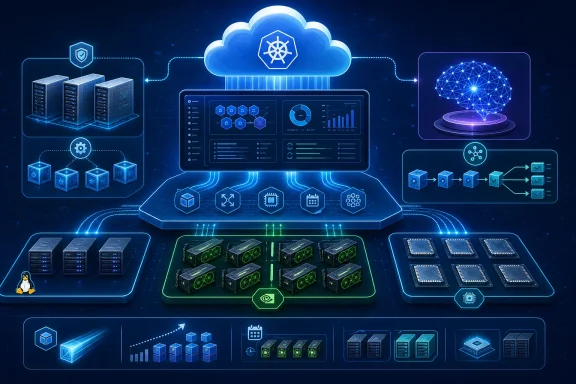 AKS Becomes the Control Plane Around AI Compute
The most concrete Build announcement is Anyscale on Azure, now in public preview. Microsoft and Anyscale are offering a managed Ray environment that runs on Azure Kubernetes Service, combining Kubernetes cluster lifecycle and infrastructure scheduling with Ray’s distributed execution model.That division of labor matters. Kubernetes is good at placing containers, maintaining desired state, exposing services, and integrating policy and identity. Ray is designed for Python-driven distributed tasks: data preprocessing, hyperparameter work, reinforcement-learning jobs, batch inference, model training, and pipelines that need CPUs and GPUs to work together. In a conventional deployment, organizations must operate and tune both the AKS environment and the Ray clusters layered on top of it.
Microsoft’s Azure announcement says Anyscale on Azure provides managed cluster provisioning, autoscaling, scheduling, and fault tolerance, with queue management aimed at improving GPU utilization. Its Azure portal integration also means the service is intended to fit into a customer’s existing subscription, billing, private-networking, Entra RBAC, and governance model rather than becoming a disconnected AI platform.
This is especially relevant to organizations that have already discovered that a GPU cluster is not synonymous with an AI platform. A training job can stall on data access, leave expensive accelerators idle, struggle with mixed hardware, or fail late in a run because the surrounding distributed software is fragile. Managed Ray does not remove those engineering realities, but it can remove the burden of maintaining Ray infrastructure as a separate production system.
Microsoft’s AKS team described Anyscale on Azure as a way to coordinate heterogeneous and fractional GPU allocations dynamically. The real test will be availability: GPU capacity remains regional, constrained, and expensive, and no orchestration layer can schedule hardware that a chosen Azure region does not have.
AI Runway Targets the Inference Gap Between YAML and Production
AI Runway is the more Kubernetes-native part of the announcement. The project uses a custom resource calledModelDeployment to describe a model-serving intent, with the AI Runway controller selecting or delegating to a compatible provider and runtime.According to Microsoft’s AKS Build post, the workflow starts with selecting a model, checking whether it fits available GPU memory, reviewing cost estimates, and deploying it. That request becomes a Kubernetes resource rather than a one-off sequence of console actions or handcrafted manifests tied to a single inference engine.
The model-serving layer can work with multiple providers, including KAITO, NVIDIA Dynamo, and KubeRay. It also supports a range of inference engines: vLLM, SGLang, TensorRT-LLM, and llama.cpp. That flexibility is more consequential than a polished deployment screen. Different model formats, accelerator generations, batch sizes, latency targets, and request patterns can make one runtime a poor fit for another workload.
Microsoft’s documentation is careful about the architecture. AI Runway is not replacing Kubernetes primitives; it is organizing them. KAITO can handle model deployment and GPU-node provisioning, KEDA can react to workload metrics for autoscaling, and Kubernetes Gateway API can route traffic. The goal is to let a platform team establish a consistent deployment contract while preserving the underlying objects, events, observability, and policy controls administrators expect from Kubernetes.
That is a better fit for enterprise IT than an opaque “deploy AI” button. A
ModelDeployment stuck in Pending still needs a diagnosis: insufficient GPU capacity, a provider that failed to initialize, a missing image, a role assignment issue, or an incompatible precision setting. Microsoft’s own AI Runway setup guidance calls out problems such as unavailable GPU hardware and bfloat16 incompatibility on older NVIDIA T4 and V100 accelerators. The abstraction reduces repetitive setup; it does not repeal production troubleshooting.Managed System Node Pools Remove a Less Glamorous Source of Work
The quieter AKS update may prove more broadly useful than the AI tooling. Managed system node pools, still in preview for AKS Automatic clusters, move the nodes running core Kubernetes services into Azure-managed infrastructure.In a conventional AKS setup, customers create and manage system node pools that host components such as CoreDNS, metrics-server, KEDA, Azure Monitor agents, workload-identity controllers, and other cluster services. Microsoft’s managed-pool model provisions, scales, upgrades, and maintains that infrastructure on the customer’s behalf. Microsoft also says the virtual machines used for those managed system pools are not billed to the customer subscription.
The operational gain is obvious: application workloads can be isolated from the infrastructure responsible for keeping the cluster usable. That can improve reliability and avoid the recurring question of whether a system pool is oversized, undersized, patched, or scheduled too aggressively alongside business workloads.
There is a trade-off. Managed system node pools are deliberately restricted. Customers cannot create, update, or delete resources on those nodes, cannot attach to or execute into pods there, cannot upgrade or delete the pool directly, and cannot stop a cluster using one of these managed pools. That is appropriate for a more opinionated AKS Automatic operating model, but it is not a universal replacement for AKS Standard.
Teams with strict component-level requirements, complex networking, specialized maintenance windows, or compliance processes that demand direct validation of every cluster layer should examine those constraints before treating AKS Automatic as a default. Automation is valuable when it removes undifferentiated labor; it is less attractive when it removes a control an organization genuinely needs.
Cobalt 200 Is a Signal About Inference Economics, Not a GPU Substitute
Microsoft also used Build to announce early access for Azure Cobalt 200 Arm-based virtual machines. The company claims up to 50% better generational performance than Cobalt 100 and is targeting scale-out, cloud-native, Linux-based agentic AI workloads.The distinction between this and GPU infrastructure is important. Cobalt 200 is not a replacement for accelerators used in large model training or high-throughput GPU inference. Microsoft is positioning it for the CPU-heavy surrounding work that agentic systems generate: API tiers, orchestration, data pipelines, retrieval services, tool execution, and other distributed components that may run continuously at substantial scale.
For platform architects, the implication is that AI infrastructure is becoming more heterogeneous. GPU clusters will remain central to many training and inference jobs, but CPU selection, network design, storage throughput, scheduling policy, and control-plane overhead increasingly determine whether the complete application is economical. A Kubernetes deployment that feeds an expensive model endpoint inefficiently can waste more money outside the GPU pods than inside them.
Windows administrators should also note the Linux emphasis. AKS still supports Windows Server node pools for Windows container workloads, but core Kubernetes system pools are Linux-only, and Microsoft’s Cobalt 200 announcement explicitly targets Linux-based workloads. The Windows role here is strongest at the management and enterprise-integration layers, not as the host operating system for the AI runtime stack.
Microsoft Discovery Belongs Beside This Story, Not Inside It
Microsoft Discovery reached general availability at Build 2026, but it should not be confused with the AKS product updates. Microsoft describes Discovery as an enterprise agentic AI platform for scientific and engineering research and development, with a separate desktop app in preview.Its presence at Build reinforces Microsoft’s larger strategy: offer AI applications, agent frameworks, model platforms, data services, and purpose-built infrastructure as a connected Azure portfolio. But Discovery is not a Kubernetes management feature, nor is it a general-purpose replacement for application teams’ existing AI workflow tools.
That distinction matters because Build announcements can easily become one broad “AI-native cloud” narrative. The actual purchasing and operating decisions are more granular. An enterprise may adopt AI Runway without Anyscale, use AKS Standard rather than AKS Automatic, or need Cobalt-based CPU capacity for services around an inference deployment while retaining NVIDIA GPU nodes for the model itself.
Microsoft has made AKS more central to that menu of choices. The next milestone is whether the preview services—especially Anyscale on Azure, managed system node pools, and Cobalt 200 access—arrive with enough regional capacity, operational transparency, and pricing clarity to make that architecture practical beyond Build demonstrations.
References
- Primary source: iNews Zoombangla
Published: 2026-07-16T12:24:08+00:00
Microsoft Azure Redesigns Kubernetes for AI Training and Inference
Microsoft announces AI-focused Kubernetes enhancements at Build 2026, including Anyscale on Azure and AI Runway for model deployment.inews.zoombangla.com - Official source: learn.microsoft.com
Overview of AKS Automatic Clusters with Managed System Node Pools - Azure Kubernetes Service | Microsoft Learn
Learn about the managed system node pools feature for Azure Kubernetes Service (AKS) Automatic clusters, including its key features, benefits, and restrictions.learn.microsoft.com - Official source: techcommunity.microsoft.com
- Official source: azure.microsoft.com
