

A researcher says Microsoft’s Security Response Center closed a January 28, 2026 report about an Azure Portal dependency confusion flaw after Microsoft-controlled infrastructure allegedly fetched and executed a public npm package named
The reported vulnerability begins with an old lesson in modern clothing: package names are infrastructure. While reviewing bundled JavaScript served by
That is the classic dependency confusion setup. If internal build or tooling systems ever fall back to a public registry for a package name that was meant to be private, the first person to claim the public name can potentially put code where the victim expected only trusted internal code. The technique is not theoretical; dependency confusion has been a known software supply-chain failure mode for years precisely because package managers are very good at doing what they are told and very bad at guessing organizational intent.
Fayad’s proof-of-concept was reportedly benign but unmistakably active. He registered the unclaimed namespace and published a placeholder package with an out-of-band HTTP callback. Shortly after publication, he says, the package produced a callback from Microsoft-owned network space, including an installation path, a local hostname pattern, and the username of the account executing the process.
That matters because dependency confusion disputes often collapse into semantics. A vendor can say the affected system was not production, not customer-facing, not exploitable under realistic conditions, or not reachable by an attacker with a meaningful objective. But if a Microsoft-controlled environment installed and executed code from a public package namespace Microsoft did not own, the security question is no longer whether the researcher guessed correctly. The question is why the platform’s machinery was willing to run that code at all.
The decisive moment came later. On March 24, Microsoft reportedly closed the case, saying the callback was not from a production build or runtime pipeline and denying that dependency injection was possible. A formal appeal filed the same day was refused on April 21, with Microsoft maintaining that the package was always loaded from an internal source.
That explanation may be technically meaningful inside Microsoft. Big cloud providers have vast internal staging systems, test harnesses, developer workstations, build sandboxes, telemetry collectors, and automated analysis tools. Not every system that reaches the internet is part of a production service, and not every execution event has the same blast radius.
But that is also exactly why this case is important. If the defense is that the callback came from “automated security tooling,” then the next question is whether that tooling was intentionally executing newly published packages, whether it did so in a sandbox, what credentials or network routes were available, and why it emitted local forensic details to a package author’s server. A security scanner that blindly runs attacker-controlled install scripts is not a rebuttal to dependency confusion. It is another system that has to be threat-modeled.
Microsoft may ultimately be right that Azure Portal customers were not exposed through a production build path. The public record does not prove otherwise. But the reported evidence does suggest that some Microsoft-controlled environment pulled and executed code from a namespace that should have been reserved, and that is enough to make a flat dismissal look institutionally brittle.
In the npm world, scoped packages look like a namespace, and namespaces look like ownership. But a namespace that exists only in internal convention is not ownership. If a company refers to
The normal mitigations are not exotic. Organizations can claim public namespaces defensively, pin registries, block public fallback for private scopes, require lockfiles and integrity checks, and ensure install scripts do not run in privileged contexts. Enterprises can also monitor outbound package resolution and treat unexpected registry access as a security event rather than a build nuisance.
That is why the Azure Portal allegation is uncomfortable. Microsoft is not a small software shop discovering npm hygiene for the first time. It operates Azure, GitHub, Defender, Visual Studio Code, and much of the enterprise software ecosystem’s identity and development infrastructure. When Microsoft’s own public-facing cloud portal assets appear to reference an unclaimed internal package name, it is fair for researchers and customers to expect a less procedural response than “not production.”
The danger is not that every dependency confusion callback equals a catastrophic breach. The danger is that defenders become trained to ignore the moment before catastrophe, when the evidence is still small, contained, and cheap to fix.
This distinction matters. Threat-intelligence platforms do not know whether a callback came from a production Azure Portal pipeline, a test VM, or a security scanner. They know a public package associated with a plausible internal Microsoft namespace contained code that phoned home when installed. From an ecosystem perspective, that is enough to warn downstream users not to run it.
MSRC’s reported position and the wider ecosystem’s reaction therefore describe two different risk models. Microsoft appears to have focused on whether the specific execution path mapped to a production exploitable condition. External scanners focused on the package as an artifact that, if installed anywhere, should be treated as hostile. Both models can be internally coherent, but they produce very different outcomes for defenders.
For customers, the narrower vendor view is often unsatisfying. Enterprises do not merely care whether a bug qualifies for a bounty or a CVE. They care whether a cloud provider’s internal controls would have stopped the same pattern if the package had been malicious, whether secrets could have been reached, and whether the provider’s telemetry would have caught the event before a researcher’s callback did.
That is the trust gap. Vendors classify; attackers compose. A dismissed bug can still become an input to an attacker’s playbook, especially when the public artifact and the internal naming convention are already visible.
Microsoft reportedly argued that the AKS issue required pre-existing administrative privileges or did not meet its vulnerability bar. O’Leary disputed that characterization and escalated to CERT/CC, which opened VU#284781. The case then ran into the complicated hierarchy of CVE Numbering Authorities, where Microsoft’s role as CNA for its own products gives it substantial influence over whether a CVE is ultimately assigned.
These are not the same vulnerability. One concerns dependency resolution and package execution; the other concerns Azure Backup, AKS permissions, and trusted access. Treating them as technically interchangeable would be lazy.
But from the outside, the governance pattern rhymes. A researcher claims real impact, Microsoft disputes the framing, the case is closed without the public artifact defenders expect, and then the community is left trying to infer risk from blog posts, screenshots, partial timelines, and third-party reporting. In cloud security, that is a dangerous place to leave customers because the evidence often cannot be independently reproduced after the service changes.
The cloud model asks customers to accept opacity in exchange for managed safety. That bargain only works if the vendor’s disclosure process is seen as more rigorous than the public’s ability to inspect the system. When researchers begin to argue that the process itself is the weak link, Microsoft has a reputation problem even in cases where its engineers may have a defensible technical position.
For a company like Microsoft, the difference is enormous. If an automated scanner installed the package inside a hardened sandbox with no credentials, no internal network access, no persistence, and no customer data, then the security consequence may indeed be limited. If a developer workstation, build helper, or internal diagnostic pipeline executed it with ambient identity, the risk calculus changes.
The public report’s details are suggestive but not complete. A hostname pattern and username can demonstrate code execution, but they do not alone establish privilege level, reachable assets, secret exposure, or persistence. A callback from AS8075 proves Microsoft network involvement; it does not prove Azure Portal production compromise.
Yet MSRC’s reported language appears to have leaned toward categorical denial: internally resolved, not dependency injection, always loaded from an internal source. That is hard to square with a public package execution event unless the event was caused by something else that intentionally loads suspect packages. If that is the explanation, Microsoft could say so in broad terms without exposing sensitive implementation details.
A better vendor response would separate three claims: whether code execution occurred, what environment executed it, and whether that environment created customer risk. Collapsing those questions into a closure notice invites exactly the backlash now unfolding.
No responsible defender should romanticize public zero-day releases. Publishing working exploit code before a fix is available can put ordinary users, hospitals, schools, and small businesses in the blast radius. Grievance is not a patching strategy.
But neither should vendors treat researcher anger as mere noise. The vulnerability market has alternatives: public disclosure, private brokers, exploit buyers, criminal forums, government intermediaries, and silence. A vendor response program is supposed to make the responsible path the easiest and most credible one. If researchers conclude that reports disappear into process, that impact is minimized, or that public pressure is the only way to obtain recognition, the ecosystem becomes less safe.
Microsoft is uniquely exposed here because Windows and Azure sit at the intersection of consumer devices, enterprise identity, cloud workloads, developer tooling, and national infrastructure. MSRC is not just a bug intake desk. It is a pressure valve for a massive software estate that the world depends on.
The dependency confusion case may be small in direct blast radius. Its symbolic radius is larger. It asks whether a researcher who demonstrates code execution inside Microsoft’s environment will receive a transparent technical explanation or a classification outcome.
Azure administrators cannot diff yesterday’s Azure Portal internals against today’s in any meaningful way. They cannot verify Microsoft’s internal package resolution controls. They cannot inspect the sandbox boundaries of Microsoft’s automated tooling. They can only read the public dispute and decide whether it changes their own posture.
The answer should be yes, but not in a panicked way. The lesson is not that Azure Portal is compromised or that every Microsoft internal package reference is exploitable. The lesson is that enterprises should assume dependency confusion remains a live supply-chain risk even for sophisticated vendors, and they should evaluate their own package governance accordingly.
That means claiming internal namespaces on public registries before someone else does. It means enforcing registry scopes so private packages cannot resolve publicly by accident. It means disabling lifecycle scripts where possible, isolating builds, rotating credentials exposed to build environments, and alerting on package installations that originate outside approved sources.
It also means treating cloud-provider silence as a data point, not a guarantee. If a vendor rejects a vulnerability report but later changes service behavior, defenders should prefer observable controls over reassurance. In cloud security, trust is necessary; blind trust is optional.
That would not satisfy everyone. Researchers might still object to the bounty decision. Critics might still argue that any execution from a public lookalike namespace is a vulnerability. But it would move the discussion from institutional authority to technical assurance.
The most important sentence Microsoft could offer is not “customers are protected.” It is the chain of reasoning behind that claim. Cloud providers routinely ask customers to accept that they have seen the logs, inspected the architecture, and made the right call. When the allegation involves the provider’s own supply-chain hygiene, the standard for explanation should be higher.
This is especially true because the reported package reference was embedded in public-facing Azure Portal JavaScript assets. Even if Microsoft’s internal resolution path was safe, public artifacts can influence developers, partners, scrapers, tooling, and automated systems outside Microsoft’s intended boundary. Public references to private names are not automatically vulnerabilities, but they are reconnaissance gifts.
Obscurity was never the control. Ownership, isolation, and deterministic resolution are the controls. If Microsoft had claimed the namespace, pinned the source, or prevented public fallback, there would be no story.
Microsoft can still turn this episode into a useful precedent. It can show that MSRC is capable of saying, in effect, “the researcher observed real execution, here is why it did not cross a customer boundary, and here is what we changed so the same signal cannot recur.” That would be a stronger answer than dismissal, and a healthier one for an ecosystem where the next unclaimed namespace may not be registered by someone trying to prove a point.
@fxinternal/netdiagnostics. The claim is not just another bug-bounty dispute over severity. It is a test of whether cloud vendors can dismiss supply-chain execution evidence as “not production” while still asking customers to treat their platforms as the authoritative trust boundary. In Microsoft’s telling, at least as reported, the dependency was internally resolved and the observed callback did not prove a reachable production attack path; in the researcher’s telling, the callback was the attack path.
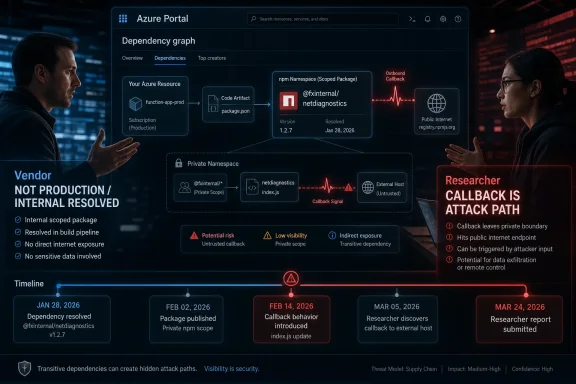 The Azure Portal Case Turns on a Name Microsoft Did Not Own
The reported vulnerability begins with an old lesson in modern clothing: package names are infrastructure. While reviewing bundled JavaScript served by portal.azure.com, researcher Wahid Fayad reportedly found a require reference to an internal package, @FxInternal/NetDiagnostics. The public npm registry, according to the report, had no Microsoft-owned @fxinternal namespace and no registered netdiagnostics package under it.That is the classic dependency confusion setup. If internal build or tooling systems ever fall back to a public registry for a package name that was meant to be private, the first person to claim the public name can potentially put code where the victim expected only trusted internal code. The technique is not theoretical; dependency confusion has been a known software supply-chain failure mode for years precisely because package managers are very good at doing what they are told and very bad at guessing organizational intent.
Fayad’s proof-of-concept was reportedly benign but unmistakably active. He registered the unclaimed namespace and published a placeholder package with an out-of-band HTTP callback. Shortly after publication, he says, the package produced a callback from Microsoft-owned network space, including an installation path, a local hostname pattern, and the username of the account executing the process.
That matters because dependency confusion disputes often collapse into semantics. A vendor can say the affected system was not production, not customer-facing, not exploitable under realistic conditions, or not reachable by an attacker with a meaningful objective. But if a Microsoft-controlled environment installed and executed code from a public package namespace Microsoft did not own, the security question is no longer whether the researcher guessed correctly. The question is why the platform’s machinery was willing to run that code at all.
MSRC Appears to Have Treated Execution as Context, Not Consequence
According to the timeline now circulating, Fayad submitted the report to MSRC on January 28, 2026. Microsoft’s initial response reportedly acknowledged the behavior but characterized exploitation as difficult and said the dependency was resolved internally. After Fayad provided payload details, install paths, and IP attribution, MSRC escalated the case to a service team on February 7.The decisive moment came later. On March 24, Microsoft reportedly closed the case, saying the callback was not from a production build or runtime pipeline and denying that dependency injection was possible. A formal appeal filed the same day was refused on April 21, with Microsoft maintaining that the package was always loaded from an internal source.
That explanation may be technically meaningful inside Microsoft. Big cloud providers have vast internal staging systems, test harnesses, developer workstations, build sandboxes, telemetry collectors, and automated analysis tools. Not every system that reaches the internet is part of a production service, and not every execution event has the same blast radius.
But that is also exactly why this case is important. If the defense is that the callback came from “automated security tooling,” then the next question is whether that tooling was intentionally executing newly published packages, whether it did so in a sandbox, what credentials or network routes were available, and why it emitted local forensic details to a package author’s server. A security scanner that blindly runs attacker-controlled install scripts is not a rebuttal to dependency confusion. It is another system that has to be threat-modeled.
Microsoft may ultimately be right that Azure Portal customers were not exposed through a production build path. The public record does not prove otherwise. But the reported evidence does suggest that some Microsoft-controlled environment pulled and executed code from a namespace that should have been reserved, and that is enough to make a flat dismissal look institutionally brittle.
Dependency Confusion Is Boring Until It Works
Dependency confusion has a cruel elegance. It does not require a memory corruption primitive, a cryptographic break, or a novel cloud escape. It abuses the assumptions organizations make when private package names, public registries, and automated build systems all coexist.In the npm world, scoped packages look like a namespace, and namespaces look like ownership. But a namespace that exists only in internal convention is not ownership. If a company refers to
@CompanyInternal/toolkit across scripts, bundles, documentation, or build artifacts without claiming the corresponding public scope, it has created a race. The attacker does not have to breach the company to participate in the race; they only need to register the name first.The normal mitigations are not exotic. Organizations can claim public namespaces defensively, pin registries, block public fallback for private scopes, require lockfiles and integrity checks, and ensure install scripts do not run in privileged contexts. Enterprises can also monitor outbound package resolution and treat unexpected registry access as a security event rather than a build nuisance.
That is why the Azure Portal allegation is uncomfortable. Microsoft is not a small software shop discovering npm hygiene for the first time. It operates Azure, GitHub, Defender, Visual Studio Code, and much of the enterprise software ecosystem’s identity and development infrastructure. When Microsoft’s own public-facing cloud portal assets appear to reference an unclaimed internal package name, it is fair for researchers and customers to expect a less procedural response than “not production.”
The danger is not that every dependency confusion callback equals a catastrophic breach. The danger is that defenders become trained to ignore the moment before catastrophe, when the evidence is still small, contained, and cheap to fix.
The Public Advisory Ecosystem Did Not Read the Case as Harmless
The story also took on a life outside MSRC. The package was reportedly flagged by automated threat-intelligence systems and indexed as malicious or critical by vulnerability databases, including a GitHub Advisory Database entry and Mondoo’s cataloging as a high-severity supply-chain threat. Those systems were responding to the public package behavior, not adjudicating Microsoft’s internal architecture.This distinction matters. Threat-intelligence platforms do not know whether a callback came from a production Azure Portal pipeline, a test VM, or a security scanner. They know a public package associated with a plausible internal Microsoft namespace contained code that phoned home when installed. From an ecosystem perspective, that is enough to warn downstream users not to run it.
MSRC’s reported position and the wider ecosystem’s reaction therefore describe two different risk models. Microsoft appears to have focused on whether the specific execution path mapped to a production exploitable condition. External scanners focused on the package as an artifact that, if installed anywhere, should be treated as hostile. Both models can be internally coherent, but they produce very different outcomes for defenders.
For customers, the narrower vendor view is often unsatisfying. Enterprises do not merely care whether a bug qualifies for a bounty or a CVE. They care whether a cloud provider’s internal controls would have stopped the same pattern if the package had been malicious, whether secrets could have been reached, and whether the provider’s telemetry would have caught the event before a researcher’s callback did.
That is the trust gap. Vendors classify; attackers compose. A dismissed bug can still become an input to an attacker’s playbook, especially when the public artifact and the internal naming convention are already visible.
The AKS Dispute Makes This Look Like a Pattern, Even If the Bugs Differ
The dependency confusion report lands in a month when MSRC’s handling of cloud vulnerability reports is already under scrutiny. In a separate case, researcher Justin O’Leary alleged that Microsoft rejected a critical Azure Backup for AKS privilege-escalation report, only to later change the service behavior without issuing a CVE or advisory. That bug was described as a confused-deputy problem in which a user with Backup Contributor permissions could obtain cluster-admin access under the disputed design.Microsoft reportedly argued that the AKS issue required pre-existing administrative privileges or did not meet its vulnerability bar. O’Leary disputed that characterization and escalated to CERT/CC, which opened VU#284781. The case then ran into the complicated hierarchy of CVE Numbering Authorities, where Microsoft’s role as CNA for its own products gives it substantial influence over whether a CVE is ultimately assigned.
These are not the same vulnerability. One concerns dependency resolution and package execution; the other concerns Azure Backup, AKS permissions, and trusted access. Treating them as technically interchangeable would be lazy.
But from the outside, the governance pattern rhymes. A researcher claims real impact, Microsoft disputes the framing, the case is closed without the public artifact defenders expect, and then the community is left trying to infer risk from blog posts, screenshots, partial timelines, and third-party reporting. In cloud security, that is a dangerous place to leave customers because the evidence often cannot be independently reproduced after the service changes.
The cloud model asks customers to accept opacity in exchange for managed safety. That bargain only works if the vendor’s disclosure process is seen as more rigorous than the public’s ability to inspect the system. When researchers begin to argue that the process itself is the weak link, Microsoft has a reputation problem even in cases where its engineers may have a defensible technical position.
“Not Production” Is Not the Same as “No Security Boundary”
The phrase “not production” does a lot of work in vulnerability response. It can mean the affected system is isolated, ephemeral, synthetic, non-customer-impacting, or deliberately hostile to untrusted inputs. It can also mean a machine somewhere inside the company did something embarrassing, and the service owner would prefer not to classify it as a vulnerability.For a company like Microsoft, the difference is enormous. If an automated scanner installed the package inside a hardened sandbox with no credentials, no internal network access, no persistence, and no customer data, then the security consequence may indeed be limited. If a developer workstation, build helper, or internal diagnostic pipeline executed it with ambient identity, the risk calculus changes.
The public report’s details are suggestive but not complete. A hostname pattern and username can demonstrate code execution, but they do not alone establish privilege level, reachable assets, secret exposure, or persistence. A callback from AS8075 proves Microsoft network involvement; it does not prove Azure Portal production compromise.
Yet MSRC’s reported language appears to have leaned toward categorical denial: internally resolved, not dependency injection, always loaded from an internal source. That is hard to square with a public package execution event unless the event was caused by something else that intentionally loads suspect packages. If that is the explanation, Microsoft could say so in broad terms without exposing sensitive implementation details.
A better vendor response would separate three claims: whether code execution occurred, what environment executed it, and whether that environment created customer risk. Collapsing those questions into a closure notice invites exactly the backlash now unfolding.
The Researcher Relationship Is Becoming Part of the Attack Surface
The more combustible backdrop is Microsoft’s deteriorating public relationship with some parts of the vulnerability research community. Since early April 2026, the actor known as Nightmare-Eclipse or Chaotic Eclipse has released multiple Windows zero-day exploits, citing grievances with MSRC over attribution, handling, or bounty outcomes. Some reports say several of those bugs have been observed in active exploitation, while Microsoft has emphasized coordinated vulnerability disclosure and reportedly taken a harder line against public exploit drops.No responsible defender should romanticize public zero-day releases. Publishing working exploit code before a fix is available can put ordinary users, hospitals, schools, and small businesses in the blast radius. Grievance is not a patching strategy.
But neither should vendors treat researcher anger as mere noise. The vulnerability market has alternatives: public disclosure, private brokers, exploit buyers, criminal forums, government intermediaries, and silence. A vendor response program is supposed to make the responsible path the easiest and most credible one. If researchers conclude that reports disappear into process, that impact is minimized, or that public pressure is the only way to obtain recognition, the ecosystem becomes less safe.
Microsoft is uniquely exposed here because Windows and Azure sit at the intersection of consumer devices, enterprise identity, cloud workloads, developer tooling, and national infrastructure. MSRC is not just a bug intake desk. It is a pressure valve for a massive software estate that the world depends on.
The dependency confusion case may be small in direct blast radius. Its symbolic radius is larger. It asks whether a researcher who demonstrates code execution inside Microsoft’s environment will receive a transparent technical explanation or a classification outcome.
Defenders Cannot Patch a Process They Cannot See
For WindowsForum’s audience, the practical problem is not whether to take every researcher claim at face value. It is how to operate when the vendor and the researcher disagree, the affected service is cloud-hosted, and there may never be a conventional advisory. In on-premises software, defenders can often test versions, inspect patches, reverse binaries, or apply compensating controls. In cloud services, the evidence is more perishable.Azure administrators cannot diff yesterday’s Azure Portal internals against today’s in any meaningful way. They cannot verify Microsoft’s internal package resolution controls. They cannot inspect the sandbox boundaries of Microsoft’s automated tooling. They can only read the public dispute and decide whether it changes their own posture.
The answer should be yes, but not in a panicked way. The lesson is not that Azure Portal is compromised or that every Microsoft internal package reference is exploitable. The lesson is that enterprises should assume dependency confusion remains a live supply-chain risk even for sophisticated vendors, and they should evaluate their own package governance accordingly.
That means claiming internal namespaces on public registries before someone else does. It means enforcing registry scopes so private packages cannot resolve publicly by accident. It means disabling lifecycle scripts where possible, isolating builds, rotating credentials exposed to build environments, and alerting on package installations that originate outside approved sources.
It also means treating cloud-provider silence as a data point, not a guarantee. If a vendor rejects a vulnerability report but later changes service behavior, defenders should prefer observable controls over reassurance. In cloud security, trust is necessary; blind trust is optional.
Microsoft Should Publish the Boundary It Says Was Never Crossed
Microsoft does not need to disclose sensitive internal build diagrams to improve this situation. It could publish a narrow statement explaining whether the@fxinternal/netdiagnostics public package was ever installed by Microsoft-controlled systems, what class of system installed it, whether that system had access to production secrets or customer data, and what controls now prevent unclaimed internal namespaces from resolving publicly.That would not satisfy everyone. Researchers might still object to the bounty decision. Critics might still argue that any execution from a public lookalike namespace is a vulnerability. But it would move the discussion from institutional authority to technical assurance.
The most important sentence Microsoft could offer is not “customers are protected.” It is the chain of reasoning behind that claim. Cloud providers routinely ask customers to accept that they have seen the logs, inspected the architecture, and made the right call. When the allegation involves the provider’s own supply-chain hygiene, the standard for explanation should be higher.
This is especially true because the reported package reference was embedded in public-facing Azure Portal JavaScript assets. Even if Microsoft’s internal resolution path was safe, public artifacts can influence developers, partners, scrapers, tooling, and automated systems outside Microsoft’s intended boundary. Public references to private names are not automatically vulnerabilities, but they are reconnaissance gifts.
Obscurity was never the control. Ownership, isolation, and deterministic resolution are the controls. If Microsoft had claimed the namespace, pinned the source, or prevented public fallback, there would be no story.
The Concrete Lessons Hide Under the Drama
The public fight over MSRC will draw the heat, but administrators should not let the drama obscure the engineering takeaways. Dependency confusion is one of those flaws that feels too simple to survive in mature environments, which is exactly why it keeps reappearing. It lives in the seams between teams, registries, defaults, and assumptions.- Organizations should defensively register public package scopes that match internal naming conventions, even when they believe internal registries are already authoritative.
- Build and diagnostic systems should fail closed when private packages cannot be resolved from approved internal sources.
- Package lifecycle scripts should be disabled or sandboxed wherever possible, because installation is often execution by another name.
- Cloud customers should document which vendor-managed services can create privileged access paths inside Kubernetes, identity, backup, and monitoring workflows.
- Security teams should treat vendor disputes over CVE assignment as incomplete risk signals, especially when independent researchers or CERT coordinators describe plausible impact.
- Microsoft should explain disputed cloud vulnerability closures in terms of observed execution, affected environment, and customer blast radius, rather than relying on severity labels alone.
Microsoft can still turn this episode into a useful precedent. It can show that MSRC is capable of saying, in effect, “the researcher observed real execution, here is why it did not cross a customer boundary, and here is what we changed so the same signal cannot recur.” That would be a stronger answer than dismissal, and a healthier one for an ecosystem where the next unclaimed namespace may not be registered by someone trying to prove a point.
References
- Primary source: cyberpress.org
Published: 2026-06-03T05:30:14.232807
Researcher Claims Microsoft MSRC Dismissed Dependency Confusion Flaw
A dependency confusion vulnerability against Microsoft's Azure Portal (portal.azure.com), alleging that the Microsoft Security Response Center (MSRC) dismissed confirmed remote code execution (RCE) evidence as "automated security tooling". cyberpress.org
- Security advisory: msrc.microsoft.com
- Related coverage: aviatrix.ai
Microsoft Azure AKS Privilege Escalation Vulnerability 2026
A critical privilege escalation vulnerability in Microsoft Azure AKS allowed unauthorized cluster-admin access, raising concerns over vulnerability disclosure practices.aviatrix.ai - Related coverage: teamwin.in
Microsoft MSRC Allegedly Dismissed Dependency Confusion Vulnerability,
The cybersecurity landscape often brings to light disagreements between security researchers and vendor response teams. A recent incident involving Microsoft's Azure Portal and a reported teamwin.in
- Related coverage: windowsreport.com
Researcher Claims Microsoft Silently Patched Azure Backup for AKS Vulnerability
A CVE dispute emerged after Microsoft reportedly rejected an Azure Backup for AKS privilege escalation report. windowsreport.com
- Related coverage: bleepingcomputer.com
Microsoft rejects critical Azure vulnerability report, no CVE issued
A security researcher claims Microsoft quietly fixed an Azure Backup for AKS vulnerability after rejecting his report, and without issuing a CVE. Microsoft disputes the claim, telling BleepingComputer the behavior was expected and thatwww.bleepingcomputer.com
- Related coverage: windowscentral.com
"Microsoft fired the skilled people, leaving flowchart followers": Microsoft's Security Response Center is being blamed for the zero-day BlueHammer exploit leak, but I can't tell who's right | Windows Central
A zero-day BlueHammer exploit was recently published on GitHub in response to alleged MSRC failures, and although Microsoft has released a patch, it was live for two weeks.www.windowscentral.com - Related coverage: app.daily.dev
Microsoft rejects critical Azure vulnerability report,...
Security researcher Justin O'Leary discovered a critical privilege escalation vulnerability in Azure Backup for AKS that allowed a user with only the Backup... app.daily.dev
- Official source: microsoft.com
- Official source: cdn-dynmedia-1.microsoft.com
- Related coverage: syssrc.com
