

Microsoft’s acquisition of Beam and the planned winter launch of its realtime streaming tools on Xbox One and Windows 10 mark a deliberate push to make watching games as interactive and immediate as playing them, promising sub‑second latency and viewer-driven controls that could redraw the lines between streamer and audience.
Beam launched as a small Seattle startup in early 2016 with a clear technical distinction from incumbents: an architecture aimed at ultra‑low latency and built‑in interactivity so viewers could meaningfully affect gameplay. The platform won attention on the startup circuit and at events like TechCrunch Disrupt, and by August 2016 Microsoft announced it had acquired the team and technology to fold into Xbox’s ecosystem. Microsoft positioned Beam as a strategic addition to the Windows/Xbox stack: not just another streaming destination, but native streaming and interactivity integrated into Xbox Live and Windows 10’s Game Bar. The plan—announced publicly as Beam expanded—was to bring Beam’s realtime features directly to console and PC users during the Windows 10 Creators Update and subsequent Xbox One updates. That integration promised one‑button streaming, viewer interactions surfaced in the overlay, and an experience built around engagement rather than passive consumption.
Source: VideoGamer Realtime streaming platform Beam is coming to Xbox One & Windows 10 - VideoGamer
 Background
Beam launched as a small Seattle startup in early 2016 with a clear technical distinction from incumbents: an architecture aimed at ultra‑low latency and built‑in interactivity so viewers could meaningfully affect gameplay. The platform won attention on the startup circuit and at events like TechCrunch Disrupt, and by August 2016 Microsoft announced it had acquired the team and technology to fold into Xbox’s ecosystem. Microsoft positioned Beam as a strategic addition to the Windows/Xbox stack: not just another streaming destination, but native streaming and interactivity integrated into Xbox Live and Windows 10’s Game Bar. The plan—announced publicly as Beam expanded—was to bring Beam’s realtime features directly to console and PC users during the Windows 10 Creators Update and subsequent Xbox One updates. That integration promised one‑button streaming, viewer interactions surfaced in the overlay, and an experience built around engagement rather than passive consumption. What made Beam different: FTL, interactivity, and the sub‑second promise
The technical play: FTL (Faster‑Than‑Light) streaming
Beam’s headline technology was an ingest and delivery approach it marketed as “FTL” or Faster‑Than‑Light streaming. FTL was designed to bypass the chunked, multi‑second buffering models used by traditional HLS/DASH pipelines and instead use protocols and pipeline tuning that reduce glass‑to‑glass latency into the sub‑second or single‑second range when conditions allow. That allowed near‑instantaneous feedback loops between streamer and viewer—critical for the interactive controls Beam offered. Multiple partners in the streaming ecosystem integrated FTL support (for example, capture software vendors added Beam/FTL support in beta builds), confirming that the platform’s low‑latency orientation was real and not merely marketing. At the same time, FTL relied on favorable network and endpoint conditions; sub‑second latency was achievable under the right combination of encoder settings, connection stability, and viewer proximity to ingest/egress points.Viewer controls and SDKs: more than chat
Beam’s interactivity model went beyond chat overlays. The platform provided an SDK and channel tools so streamers and game developers could expose buttons, events, and control hooks that let viewers trigger changes in the streamer’s session. Examples included weapon swaps, spawning events, soundboard triggers, and even real‑world device activation. These mechanics were designed to let audiences participate directly in the live experience instead of merely reacting to it. Tech reporting and Beam’s own documentation described these features as a core differentiator versus Twitch and other streaming platforms.Why latency matters for interactivity
Traditional streaming (HLS/DASH chunking) routinely introduces 5–30 seconds of delay; in that world, “control” from chat is slow and unsynchronized. Beam’s lower latency meant the streamer could respond and the game could react in near real time—making collective decisions, timed events, and fast feedback possible. Industry commentary on low‑latency engineering (and later WebRTC and tuned CMAF approaches) supports that sub‑second or single‑second latency fundamentally changes what developers can build on top of a livestream.Windows 10 and Xbox One integration: what Microsoft announced
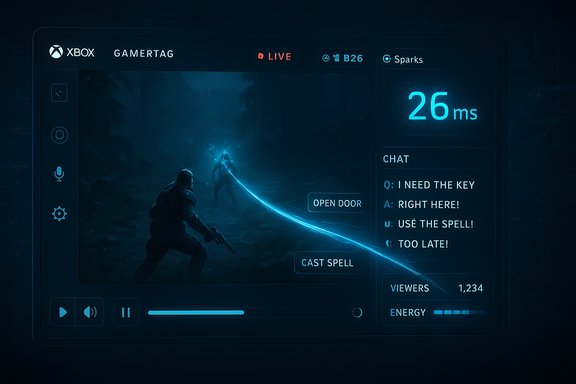
Microsoft’s public rollout plan tied Beam into two places many gamers already use: the Windows 10 Game Bar and the Xbox One Guide. The idea was straightforward: stream directly from the system UI without additional software, allow viewers to interact through overlays, and make the entire system feel integrated with Xbox Live identities and friend lists. Early announcements placed Beam’s integration into the Windows 10 Creators Update pipeline and flagged an Xbox One update to bring the Beam viewing app and broadcasting controls to the console. Practically, integration meant streamers could:- Start a broadcast from the Game Bar (Windows + G) or from the Xbox Guide with minimal setup;
- Link a Beam account to Xbox Live for identity and social features;
- Let viewers interact through buttons and the Sparks currency model the platform used to reward engagement.
Immediate implications for streamers and game developers
For grassroots and hobby streamers: lower friction, higher engagement
Built‑in streaming in Windows and Xbox removed a major barrier for casual broadcasters: the need to install and configure third‑party capture and encoding tools. With Beam integration, a user could broadcast with a few button presses. That broad access promised more discoverable, faster streaming sessions and a deeper pool of community‑driven content. When combined with interactive features, even small streamers could design viewer‑participation mechanics that previously required custom integrations.For professional streamers: new formats and monetization levers
Professional broadcasters were presented with fresh engagement mechanics. Real‑time interactivity lets creators design sponsored events, gamified engagement loops, and direct viewer participation that could be monetized through platform currencies, donations, or affiliate programs. That opportunity—if executed well—could increase average watch time and viewer loyalty, which are the core value drivers for any streaming economy.For game developers: tools to close the loop between player and viewer
Game studios gained an avenue to make audience participation a game design primitive. Developers could implement SDK hooks that let viewers alter NPC behavior, change level parameters, or vote on events. Those kinds of features require precise synchronization and low latency to be fun and fair—Beam’s technical architecture was designed specifically to enable that kind of design space.Competitive context: Twitch, YouTube, and the low‑latency arms race
Twitch and YouTube Live were (and remain) dominant in hours watched and creator ecosystems, but both historically relied on architectures that favored scale over single‑digit seconds of latency. Over time, the industry responded with LL‑HLS, CMAF, and WebRTC workarounds to reduce delays, but Beam’s early emphasis on interactivity pushed Microsoft to treat latency as a first‑class engineering problem rather than an optimization afterthought. Independent reporting and vendor integrations (capture software and platform partners adopting FTL) corroborated that Beam held a real technical edge for interactive use cases at launch. That technical edge suggested two strategic plays:- Give Xbox and Windows users a differentiated streaming story that matched Microsoft’s ecosystem strengths; and
- Compete on a feature Twitch didn’t prioritize—viewer control—rather than attempting to copy Twitch’s massive social and monetization channels outright.
Strengths: what Beam’s model actually buys Microsoft
- Differentiated user experience: Sub‑second latency plus viewer controls create new interactive formats that can’t be reasonably duplicated on slower platforms.
- Deep product integration: Native Game Bar and Xbox Guide streaming reduces friction and increases the probability of mainstream adoption among casual gamers.
- Developer opportunity: SDK hooks let studios bake audience participation into gameplay without complex custom plumbing.
- Ecosystem leverage: Tying Beam to Xbox Live and Windows gave Microsoft a social graph and identity layer already used by millions of gamers.
Risks and unanswered questions
1. Scalability and global latency variance
Sub‑second latency is technically feasible in controlled conditions and regional deployments, but scaling that experience globally is hard. The technologies that achieve sub‑second latency (WebRTC‑style transports, stateful edge routing) are more complex to operate at massive scale than standard CDN chunking. Network variability, mobile last‑mile issues, and cross‑continent routing can quickly erode latency gains. Vendor analyses and CDN case studies warn that achieving consistently low latency at global scale is non‑trivial and requires major edge investments.2. Moderation, griefing, and control abuse
Opening a stream up to viewer‑driven controls creates a new moderation surface. What happens when large swaths of viewers conspire to troll a streamer by repeatedly triggering hostile in‑game events? Who is responsible for preventing abuse—the streamer, the game developer, or the platform? Effective moderation tooling and rate‑limiting for interactive controls must accompany any such system; otherwise, the same interactivity that makes the platform compelling will also make it fragile for creators. This problem presages many policy and tooling decisions platform operators must get right.3. Monetization and creator economics
Getting streamers onto a platform is only half the battle; keeping them there requires competitive monetization models. Microsoft’s ecosystem advantages (Xbox Live, Game Pass cross‑promotion) help, but building sustainable creator revenue—subscriptions, ads, tips, and platform incentives—requires time and capital. The streaming market is winner‑take‑most, and incumbents have entrenched revenue systems and third‑party ecosystems (extensions, bots, sponsorship channels) that are hard to replicate quickly.4. Developer adoption and platform fragmentation
For truly innovative interactive gameplay, developers need to adopt SDKs and design for viewer inputs. Not every studio will prioritize this, and fragmentation of interactive APIs across platforms could slow developer uptake. A clear, robust, and easy‑to‑use SDK is necessary; otherwise, interactivity risks becoming a niche feature reserved for a few bespoke experiences.5. Proprietary versus standards debate
Beam’s FTL protocol solved a latency problem, but markets tend to favor interoperable standards (WebRTC, LL‑HLS, CMAF) for browser reach and third‑party support. Platforms that rely on proprietary protocols must balance that short‑term advantage with long‑term maintainability and third‑party adoption. External analyses show that WebRTC and improved HTTP chunking approaches have closed some of the latency gap for mainstream use cases—meaning Beam’s FTL advantage might be eroded as industry standards evolve.Real‑world outcome (what happened next)
Microsoft continued to develop Beam after the acquisition, and in May 2017 the service was rebranded as Mixer, expanding features like co‑streaming and deeper Xbox integration. Mixer continued to emphasize low latency and interactive mechanics as core differentiators. However, despite technical advantages and even marquee streamer signings, the service struggled to achieve the scale of Twitch and YouTube, and in June 2020 Microsoft announced Mixer would shut down operations and transition its community to Facebook Gaming. This arc—rapid acquisition, platform integration, rebrand, and eventual shutdown and partner migration—highlights how technical differentiation alone is rarely enough to cement market leadership in live streaming. This sequence underscores several lessons: timing and scale matter; network effects in creator economies are powerful; and platform sustainability depends on more than technology—it requires consistent product/creator incentives and deep community trust.Practical guidance for streamers and developers (what to do if you want to build for realtime interactivity)
- Instrument latency metrics end‑to‑end. Measure glass‑to‑glass latency from capture to viewer and log p99 latencies so that interactions are accurately timed and potential mismatches are diagnosable.
- Design for grace under load. Implement rate limits, cooldowns, and permissions to prevent mass abuse of interactive controls.
- Use idempotent event handling. Interactive hooks should be safe to retry and must tolerate duplicate commands without breaking game state.
- Provide clear UX affordances. Make it obvious to viewers when inputs are available, what currency or permission model governs them, and how outcomes are resolved.
- Localize edge logic. When possible, push event arbitration and fast control decisions to regional edges to reduce central round‑trip times.
Strategic takeaways for Microsoft and platform operators
- Prioritizing ultra‑low latency can create new categories of interactive entertainment, but the business model must follow (and often precede) technical wins. Differentiated features attract curiosity but not necessarily long‑term devotion.
- Native OS and console integration is a strong move to lower friction, but ecosystem lock‑in must be balanced with cross‑platform reach; streaming success is often platform‑agnostic because audiences follow creators.
- Invest early in moderation, billing, and partner programs. Creators need predictable incentives and robust safety tools to commit to new platforms.
- Promote standards alignment where possible. Proprietary protocols can seed innovation, but standards (WebRTC, CMAF/LL‑HLS) enable broader adoption and easier third‑party integration.
Final analysis: promise versus reality
Beam’s entry into Microsoft’s product stack represented a believable technical and experiential advantage: sub‑second latency and viewer control genuinely enable new formats of live content. Integration into Windows 10 and Xbox One reduced discovery and broadcasting friction, making interactive streaming accessible to a broader audience. Those strengths were not hypothetical—they were implemented, tested by partners, and rolled into system UI experiences. Yet the post‑acquisition history also shows how fragile platform bets can be. Technical differentiation must pair with creator economics, scale, and community trust to survive in a market dominated by entrenched social graphs and network effects. Beam’s FTL, while powerful, was only one piece of a larger puzzle that required sustained investment across business, product, and community channels. The platform’s later rebrand to Mixer, and subsequent shutdown, underline that technical novelty must be matched by long‑term strategy and creator incentives to win the streaming wars. In short: Beam’s low‑latency vision reshaped expectations about what live game streaming could be, and the integration into Xbox One and Windows 10 made that future tangible for many users. The broader lesson for platform makers is clear—turning technical advantage into lasting market position requires more than engineering: it demands creators, monetization, moderation, and relentless scale execution.Source: VideoGamer Realtime streaming platform Beam is coming to Xbox One & Windows 10 - VideoGamer
