

Enterprises reviewing the crowded field of data governance tools in early 2026 face a clear strategic choice: prioritize AI-native velocity, proven regulatory rigor, or cloud-platform alignment — and the current market leaders map to those orientations. Analytics Insight’s roundup places Atlan, Collibra, and Microsoft Purview at the top of enterprise shortlists this year, calling out Atlan for active metadata and speed-to-value, Collibra for deep governance across regulated estates, and Microsoft Purview for tight Azure/Microsoft ecosystem integration.
Data governance has shifted from checkbox compliance to an operational control plane that enables trustworthy analytics and production AI. Modern governance stacks combine metadata management, lineage, data quality, access policy enforcement, and — increasingly — AI-assisted automation for discovery and policy mapping. Vendors position their products differently along these axes: some emphasize an active metadata approach (catalog + event-driven automation), others offer a comprehensive, policy-first platform for large regulated enterprises, and hyperscaler-aligned products focus on integration, telemetry, and native security controls.
Market recognition and industry momentum reflect that split. Atlan has been widely promoted as an active metadata and AI-ready platform following rapid expansion and analyst placements in 2025, while Collibra continues to be referenced as a proven enterprise governance standard in analyst waves. Microsoft has continued to fold governance into a broader security/compliance stack as Microsoft Purview, with deep connectors into Fabric, Copilot, and OneLake.
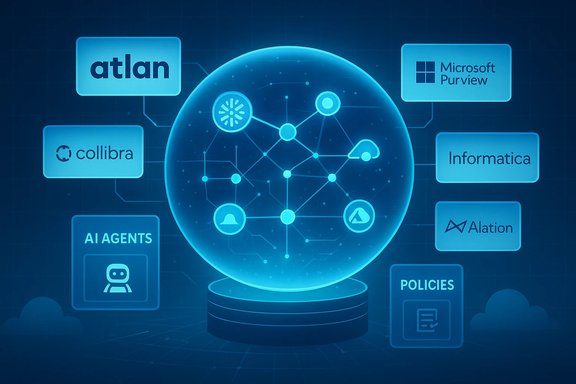
Choosing a data governance platform in 2026 requires balancing immediate tactical needs (speed, discovery, pilot ROI) with long-term strategic constraints (compliance, portability, operational scale). The current field — exemplified by Atlan, Collibra, Microsoft Purview, Informatica, and Alation — offers clear specialization points: speed and active metadata, enterprise governance rigor, platform-native integration, hybrid control planes, and data-literacy-first catalogs respectively. Successful programs pair the right product to the organization’s technical gravity, then invest equally in people, processes, and measurable pilots that validate vendor claims before enterprise-scale adoption.
Source: Analytics Insight Best Data Governance Software for Enterprises in 2026
 Background / Overview
Data governance has shifted from checkbox compliance to an operational control plane that enables trustworthy analytics and production AI. Modern governance stacks combine metadata management, lineage, data quality, access policy enforcement, and — increasingly — AI-assisted automation for discovery and policy mapping. Vendors position their products differently along these axes: some emphasize an active metadata approach (catalog + event-driven automation), others offer a comprehensive, policy-first platform for large regulated enterprises, and hyperscaler-aligned products focus on integration, telemetry, and native security controls.Market recognition and industry momentum reflect that split. Atlan has been widely promoted as an active metadata and AI-ready platform following rapid expansion and analyst placements in 2025, while Collibra continues to be referenced as a proven enterprise governance standard in analyst waves. Microsoft has continued to fold governance into a broader security/compliance stack as Microsoft Purview, with deep connectors into Fabric, Copilot, and OneLake.
Atlan — AI-native metadata and fast time-to-value
What Atlan claims and why it matters
Atlan markets itself as an active metadata platform: a metadata lakehouse that treats metadata as queryable and actionable, enabling automated lineage capture, semantic layers, and rapid discovery across modern data stacks such as Snowflake and Databricks. That approach is optimized for teams building AI-driven data products and wanting quick ROI on governance pilots. Analyst and vendor announcements in 2025–2026 underline Atlan’s momentum and ecosystem partnerships.Strengths
- Active metadata: Atlan’s architecture is built to surface lineage, column-level context, and transform metadata into a control plane that can feed automation and agents.
- Developer and business adoption: UX and collaboration features are designed to get both engineers and business users contributing to the catalog, lowering friction for stewardship.
- Cloud-native, open-format orientation: Integrations with Snowflake and native support for open table formats (Iceberg/Delta) reduce friction for modern lakehouse architectures.
Typical fit / Best for
- Fast-growing, cloud-first organizations that want to bootstrap governance around Snowflake, Databricks, or data-lake-first architectures.
- Teams that want to build governance-led AI quickly (RAG, model training datasets) and need lineage and data quality to be discoverable in weeks rather than months.
Practical caveats and risks
- Maturity for extremely large legacy estates: While Atlan scales, very complex multi-decade legacy estates (mainframe lineage, thousands of ETL jobs) often still require a heavy integration and professional services lift.
- Operational dependency on upstream metadata quality: Active metadata helps, but it cannot fully substitute for disciplined source-side change controls and MDM work.
- Vendor claims vs. proof: Rapid vendor growth and marketing positioning are persuasive, but procurement teams should validate scale and SLA claims with reference site visits and proof-of-value tests.
Collibra — enterprise-grade governance and compliance focus
What Collibra claims and why it matters
Collibra positions itself as the mature, enterprise-grade data intelligence platform built for complex governance programs across regulated industries. Collibra’s emphasis is on federated governance models, policy orchestration, lineage, and bridging data governance with AI governance constructs — a posture reinforced by recent analyst recognition.Strengths
- Comprehensive governance capabilities: Strong lineage, business glossary mapping, policy engines, and workflow automation designed to support Global 2000 governance needs.
- Federation and scale: Collibra supports distributed stewardship models that allow business units to operate semi-autonomously under corporate guardrails.
- Analyst recognition and partner ecosystem: Frequent placement as a Leader in analyst evaluations underlines a mature partner and implementation ecosystem.
Typical fit / Best for
- Highly regulated industries (banking, insurance, healthcare, utilities) where auditability, segregation of duties, and strict SLAs are non-negotiable.
- Organizations that plan multi-year governance transformations and will invest in professional services to integrate legacy systems.
Practical caveats and risks
- Implementation complexity and cost: Collibra’s breadth often implies larger implementation timelines and a need for strong program governance, including a staffed data stewardship organization.
- Potential for customization lock-in: Extensive custom workflows and integrations can make future migrations or decompositions more expensive.
- Change management overhead: The platform requires processes and human roles to be effective; Collibra is a toolset, not a turnkey cultural change.
Microsoft Purview — single-pane governance for Microsoft-centric estates
What Purview brings to the table
Microsoft rebranded and consolidated Azure Purview and Microsoft 365 compliance features into Microsoft Purview, an integrated portfolio that unifies cataloging, classification, DLP, sensitivity labeling, and compliance telemetry. Purview’s selling point is unified integration across Microsoft 365, Fabric/OneLake, Azure, and third-party platforms, paired with growing AI-assisted capabilities to scale discovery and classification. Microsoft’s recent Purview innovations explicitly target the governance needs of production AI and Copilot/agent scenarios.Strengths
- Seamless Microsoft ecosystem integration: Native ties to Entra ID (Azure AD), Power BI, Fabric, and Copilot make policy application and telemetry straightforward for Microsoft-first shops.
- Broad product family: Purview covers DLP, sensitivity labeling, eDiscovery, and Unified Catalog capabilities under a single administrative model.
- Cost and operational simplicity: For customers already on Azure and Microsoft licensing, Purview reduces integration overhead and simplifies audit trails.
Typical fit / Best for
- Large enterprises with substantial Microsoft investments (Azure, Microsoft 365, Power BI) that want a single vendor to manage discovery, DLP, and cataloging.
- Organizations pursuing rapid integration between governance and agent/Copilot workflows, where policy enforcement must be directly visible to low-code/no-code developers and analytics consumers.
Practical caveats and risks
- Platform lock-in: Deep Purview adoption with Fabric/OneLake artifacts can increase future migration costs to multi-cloud architectures; design for portability where needed.
- Feature parity and migration: Some classic Purview features have been retired or reworked during consolidation, necessitating migration planning for legacy customers.
Other noteworthy platforms: Informatica, Alation, and the metadata landscape
- Informatica (IDMC): Positioned for hybrid environments with a large enterprise install base and an AI engine (CLAIRE) focused on automating data management tasks. Best when a hybrid on-prem + multi-cloud strategy and mature professional services are required. Analyst placements in 2025–2026 confirm its leadership for broad enterprise use cases.
- Alation: Emphasizes data literacy, catalog-driven culture, and search/discovery that enables business self-service. Alation’s strengths are in adoption and metadata-driven analytics; it’s often chosen by teams that prioritize discovery and collaboration.
- Emerging and specialized vendors: A crowded set of vendors (including cloud-native catalog providers, observability and data quality specialists, and niche metadata platforms) fill specific gaps — from automated classification to MDM, data observability, and AI governance overlays.
How to evaluate and choose: a practical procurement checklist
Selecting the right governance platform requires aligning capability to organizational constraints. Use this checklist as a procurement playbook:- Define the primary objective(s):
- Compliance and auditability? (Prioritize Collibra/Informatica)
- Fast data discovery for AI projects? (Prioritize Atlan/Alation)
- Microsoft ecosystem consolidation? (Prioritize Microsoft Purview)
- Map data gravity and technical estate:
- Inventory where most data lives (Azure, AWS, GCP, on-prem, Snowflake).
- Prefer vendors that natively integrate with your dominant platforms.
- Validate openness and portability:
- Require support for open table formats (Apache Iceberg, Delta) and exportable semantic artifacts.
- Ask vendors for migration/export capabilities and documented exit scenarios.
- Proof-of-value (60–90 days):
- Scope a concrete pilot with 1–3 high-value datasets, targeted KPIs (time-to-insight, lineage completeness, data-quality score), and measurable success criteria.
- Include realistic workloads and security configurations during the pilot.
- Operational readiness:
- Ensure staffing plans for data stewardship, catalog owners, and FinOps.
- Include runbooks, training, and knowledge transfer in the contract.
- Legal and compliance gating:
- Validate where model inference happens for any GenAI features, and demand contractual assurances about telemetry, non-training clauses, and data residency.
- Commercial clarity:
- Request sample metering and predictable pricing for add-ons (Copilot/AI features, connector tiers).
- Negotiate SLAs for availability and support response times.
Technical, operational, and regulatory risks — and mitigations
- Hallucination and AI trust: GenAI features in governance tools accelerate discovery but can produce incorrect classifications or mappings. Mitigation: require evidence-backed outputs (RAG with provenance), human-in-the-loop attestation for policy enforcement, and continuous validation of automated rules.
- Vendor lock-in and portability risk: Deep semantic layers and proprietary connectors reduce migration friction short-term but increase exit cost long-term. Mitigation: insist on open formats and exportable metadata models; stage multi-cloud proofs-of-concept.
- Hidden migration and integration costs: Legacy ETL, report dependencies, and embedded transforms are often uncovered only during implementation. Mitigation: conduct a discovery sprint focused on the largest data products, and include contingency engineering time in budgets.
- Operationalizing governance (people + process): Tools alone won’t deliver outcomes. Mitigation: create a Center of Excellence, assign stewards, publish runbooks, and invest in training.
- Regulatory and data residency exposures: Especially relevant for EU/UK and sector-specific regulations (financial, healthcare). Mitigation: verify hosting regions, data residency controls, and audit evidence trails early in procurement.
Implementation playbook: a practical 6-step path to operational governance
- Quick discovery sprint (0–4 weeks): inventory 3–5 mission-critical datasets, capture owners, and perform manual lineage and classification to build baseline.
- Pilot implementation (1–3 months): deploy chosen governance product in a sandbox, connect 1–2 key data sources, and configure lineage capture, glossary, and a basic policy (e.g., PII access rule).
- Validate outputs and KPIs: measure time-to-find, lineage completeness, and data-quality improvements. Run an audit lite to test evidence capture.
- Governance operating model (3–6 months): define steward roles, policy lifecycle, attestation cadence, and escalation procedures.
- Phase in enforcement (6–12 months): move from monitor-only to automated enforcement for selected policies; require human approval gates for high-impact actions.
- Scale and iterate (12+ months): expand to additional domains, automate policy-as-code integrations, and incorporate ML/agent governance into the pipeline. Internal guidance emphasizes observation-mode first for any automation to limit accidental disruptions.
Critical analysis: strengths, trade-offs, and honest verdict
- Atlan’s active metadata approach is a strong fit when speed, openness, and AI-readiness are top priorities. It shortens discovery cycles and provides a metadata control plane that meshes well with Snowflake/Databricks-led estates. The trade-off is that very complex legacy integration work still requires significant engineering and governance maturity to sustain.
- Collibra presents the most complete governance feature set for regulated enterprises, with mature compliance workflows and analyst backing. The trade-off is cost, time-to-production, and the need for a robust internal stewarding organization to extract long-term value.
- Microsoft Purview is compelling for Microsoft-centric organizations because it reduces integration toil and provides cohesive DLP and compliance tooling with cataloging and lineage. The trade-off is platform dependency and potential challenges in multi-cloud portability — organizations must explicitly design for openness if they plan multi-cloud strategies.
Final recommendations for enterprise buyers (practical, actionable)
- If your estate is Microsoft-first and you need the least integration overhead: evaluate Microsoft Purview with a Fabric/OneLake pilot and enforce portability via open table formats. Focus early on Purview’s Unified Catalog and DLP integrations.
- If your roadmap centers on building AI products quickly on Snowflake/Databricks: prioritize Atlan for an active metadata pilot, proving lineage and dataset fitness for model training before wider rollout. Demand measurable lineage completeness and explainability KPIs from the pilot.
- If you operate in highly regulated industries with complex legacy systems: shortlist Collibra and Informatica, and plan for longer implementation timelines and dedicated stewardship staffing. Secure commitments for integration SLAs and professional services deliverables in the contract.
- Always run a 60–90 day proof-of-value that includes realistic workloads, security posture tests, and billing projections. Require vendors to demonstrate export/migration capabilities and non-training assurances for any GenAI features that process sensitive data.
Choosing a data governance platform in 2026 requires balancing immediate tactical needs (speed, discovery, pilot ROI) with long-term strategic constraints (compliance, portability, operational scale). The current field — exemplified by Atlan, Collibra, Microsoft Purview, Informatica, and Alation — offers clear specialization points: speed and active metadata, enterprise governance rigor, platform-native integration, hybrid control planes, and data-literacy-first catalogs respectively. Successful programs pair the right product to the organization’s technical gravity, then invest equally in people, processes, and measurable pilots that validate vendor claims before enterprise-scale adoption.
Source: Analytics Insight Best Data Governance Software for Enterprises in 2026
