

Gaming forums remain useful in 2026 because they preserve searchable, threaded discussion for PC players, console fans, retro collectors, achievement hunters, and gaming culture obsessives who need more than a fast-moving social feed can provide. The best ones are not trying to recreate the message-board internet of 2004. They survive because Discord, Reddit, TikTok, and YouTube comments have never fully replaced the patient, searchable, argumentative architecture of a good forum. The trick is knowing which communities still have enough life, focus, and institutional memory to be worth your login.
The old gaming internet was built around forums because there was not much else. If you wanted to argue about a console launch, troubleshoot a PC port, trade strategies for a difficult boss, or follow rumors about the next handheld, you went to a message board and stayed there for years. Those places were messy, tribal, occasionally brilliant, and often infuriating, but they gave communities a shape.
That world did not disappear so much as fragment. Discord absorbed real-time chat. Reddit absorbed mass participation. YouTube absorbed reactions. Social platforms absorbed outrage. What forums kept was the thing those systems are still bad at: a durable conversation that can be searched, revived, moderated, and followed without requiring you to be online at the exact moment the discussion happened.
That durability matters more in gaming than people admit. A fix for a broken PC game, a compatibility note for a handheld, a trophy workaround, or a strategy debate for a 20-year-old RPG can remain useful long after the launch-day noise has burned off. A good gaming forum is not just a place to talk. It is a long-term memory system maintained by people who care enough to keep posting.
The list below is not a nostalgia tour. Some famous forums are shadows of themselves, and some modern communities that look informal function better than old boards ever did. The strongest gaming forums now tend to fall into three camps: broad news discussion, platform-specific community, and practical help.
Its strength is velocity. ResetEra is useful if you want to see how a highly engaged gaming audience processes announcements in real time. It also remains a common reference point for industry chatter, which gives it an influence larger than a normal community board would have.
That same intensity is also the caveat. ResetEra’s moderation style and community norms are not neutral furniture; they are part of the product. Some readers will value the attempt to keep discussions controlled and less chaotic than the average comment section. Others will find the culture restrictive, combative, or too ideologically narrow for relaxed gaming talk.
For readers who want a classic forum interface with current industry energy, ResetEra is still one of the strongest options. It is not the right home for everyone, but it remains a place where gaming news feels alive.
The reason is simple: the conversation is attached directly to the game. If a patch breaks controller support, a graphics setting causes crashes, a launcher update fails, or a mod conflicts with a new build, players usually go to that game’s Steam discussion hub before writing a polished guide anywhere else. Developers may also appear there, especially for smaller and mid-sized games, making Steam one of the few places where complaint, diagnosis, and response can sit in the same thread.
This is especially valuable for older PC games. Search engines increasingly surface thin AI-written advice pages and recycled troubleshooting articles. Steam discussions, by contrast, often contain ugly but real reports from people trying to make the same executable work on the same hardware or operating system.
The downside is that Steam is not one community. It is thousands of micro-communities sharing a platform. A beloved indie game may have thoughtful support threads; a controversial blockbuster may have a front page that looks like a digital food fight. Still, if the goal is solving a specific game problem, Steam is often the first stop.
r/Games is the clearest example. It offers a higher-signal alternative to broader meme-heavy gaming spaces, with news posts, trailers, AMAs, announcements, and industry discussion. It is not immune to repetition or reactionary pile-ons, but it is often easier to browse casually than a dense old-school forum.
r/truegaming serves a different role. It is slower, more essay-like, and more interested in design, player behavior, genre conventions, and the meaning of games than in the news cycle. When it is good, it feels less like a comments section and more like a seminar where everyone still has a backlog and strong feelings about difficulty curves.
These communities are useful precisely because they are not trying to be everything. r/Games is where you go to follow the current conversation. r/truegaming is where you go when you are tired of the current conversation and want to argue about what games are doing to us.
For niche and older games, GameFAQs can still be surprisingly valuable. You may not find a vibrant crowd discussing every retro title in real time, but you can often find the exact kind of thread that modern platforms bury: boss strategies, route debates, party compositions, obscure unlock conditions, and arguments that somehow continued across multiple console generations.
The site also carries a distinctive old-internet tone. That can be comforting or off-putting, depending on your tolerance for legacy forum culture. Some boards are active, some are sleepy, and some feel like preserved rooms in a museum where someone occasionally turns the lights on.
But a dead-simple truth keeps GameFAQs relevant: old games do not stop producing questions. As long as players keep returning to back catalogs, emulators, remasters, handhelds, and forgotten RPGs, a searchable archive attached to individual titles remains useful.
Its value today is cultural as much as practical. NeoGAF still has the cadence of classic gaming forums: threads about platform rivalry, sales numbers, reviews, leaks, impressions, and industry behavior. It is faster and more confrontational than calmer publication-attached communities, and that is part of its appeal for users who find newer moderation-heavy spaces too sanitized.
That tone also limits its audience. Readers looking for gentle onboarding or tightly controlled discourse may bounce off quickly. NeoGAF works best for people who already like old-school forum combat and understand that a lively thread can also be an exhausting one.
Still, it deserves a place on any serious list because it represents a surviving branch of gaming forum history. The community may not be what it was at its peak, but it remains part of the map.
The forum’s appeal is not raw size. Its appeal is pace. PC gaming is sprawling enough to need dedicated spaces for hardware-adjacent talk, genre discussion, game recommendations, troubleshooting, and community threads. A slower forum can be better than a massive one when you want a conversation you can actually follow.
For WindowsForum readers, this kind of PC-focused community has obvious relevance. PC gaming is no longer just about graphics cards and frame rates; it is about launchers, anti-cheat drivers, Windows updates, handheld compatibility, controller layers, HDR, upscalers, and shader compilation stutter. The best PC forums are valuable because they treat the platform as an ecosystem, not just a box that runs games.
PC Gamer Forums are not the busiest destination on this list, but they have a useful role. They are a good place for players who want PC talk without immediately being swallowed by platform wars or launch-day outrage.
Famiboards has become one of the more important modern homes for that conversation. It has a strong community identity and an active focus on Nintendo hardware, software, rumors, announcements, and wider gaming. For users who miss old-school forum culture but want a current Nintendo-heavy crowd, Famiboards is one of the best options.
Nintendo Life Forums fill a slightly different role. Because they are attached to a Nintendo-focused publication, they naturally connect with news, reviews, guides, and platform coverage. That makes them approachable for casual Switch owners as well as longtime Nintendo fans who want dedicated categories rather than a single chaotic megathread.
The usual warning applies: rumor-heavy Nintendo communities require skepticism. Nintendo speculation is a renewable resource, and not all of it deserves oxygen. But for platform-focused discussion, Famiboards and Nintendo Life are far more useful than trying to extract coherent long-form conversation from a fast social feed.
DayOne Forums, connected with the XboxEra community shift, fits that role. It is not strictly Xbox-only, but it has enough Xbox-aware culture to give platform discussion a home. Its smaller scale can be an advantage for users who want recurring community threads, backlog challenges, and ongoing conversation rather than the overwhelming churn of giant communities.
TrueAchievements is even more focused. It is not simply an Xbox forum; it is an achievement infrastructure with forums attached to a very specific player behavior. If you care about Gamerscore, completion percentages, broken achievements, DLC requirements, leaderboard competition, and 100-percent routes, TrueAchievements is more practical than almost any broad gaming forum.
That specificity is the lesson. The best Xbox communities are not necessarily the loudest. They are the ones that understand what Xbox players are actually trying to do.
This is where specialized completion communities outperform larger forums. A general board may tell you whether a game is worth playing. A trophy or achievement-focused community will tell you whether the online mode is dead, whether the grind is tolerable, and whether a patch quietly changed the route.
For readers choosing among forums, this distinction matters. If your main goal is community debate, use a broad forum. If your main goal is completion, use a completion-focused site. Gaming forums are most powerful when their structure matches the job.
That is where AVForums’ video gaming area has a distinct advantage. It attracts users who think about gaming as part of a home entertainment system. If you are trying to understand TV settings for a console, latency tradeoffs, soundbar behavior, projector limitations, or how a handheld fits into a larger setup, a general gaming board may not be technical enough.
This category will only become more important. As consoles, PCs, and handhelds support more advanced display features, players need communities that can translate spec sheets into lived experience. HDR that looks good in a marketing slide can still look wrong in your room. A forum full of display obsessives may be the best place to find out why.
The tradeoff is obvious: AVForums is not where most players will go to debate narrative design or review scores. But if your gaming problem involves cables, panels, audio formats, or input lag, it may be more useful than any pure gaming site.
Personality-led communities are easy to underestimate. A forum attached to a media site can provide something broader platforms often lack: shared context. Users are not only reacting to games; they are reacting to coverage, commentary, recurring shows, and the tone of the site itself. That creates a different kind of conversation from a neutral platform forum.
Giant Bomb has changed over time, and longtime readers know that community identity can shift as staff, ownership, and editorial focus change. But the community layer remains part of what makes the site distinct. It is best for readers who already enjoy Giant Bomb’s sensibility and want discussion that extends beyond release dates and patch notes.
It is not the best first stop for troubleshooting a PC port or comparing console settings. It is, however, a reminder that gaming forums are not only databases. They are social worlds built around taste.
Smaller forums can be better if they have the right shape. A Nintendo-focused board, an achievement site, a PC publication forum, or an AV community may answer a particular question better than a massive general forum. The question is not “Where are the most gamers?” but “Where are the right gamers for this discussion?”
Searchability is the second underrated factor. Discord may be faster in the moment, but it is poor at preserving useful public knowledge. Social feeds are good at distributing takes, not maintaining threads. A forum that looks old-fashioned may still be more valuable because its discussions remain findable months or years later.
Moderation is the third factor, and it cuts both ways. Good moderation keeps spam, abuse, and low-effort noise from destroying a community. Bad or excessive moderation can make a forum feel brittle, ideological, or sterile. The best communities set expectations without turning every disagreement into a procedural event.
One broad forum gives you the news cycle. ResetEra, NeoGAF, r/Games, or a similar community can show how engaged players are reacting to announcements, reviews, controversies, and industry shifts. You do not have to agree with the consensus to find the signal useful.
One platform or identity forum gives you belonging. Nintendo fans may choose Famiboards or Nintendo Life. Xbox players may prefer DayOne or TrueAchievements. PC players may lean on Steam discussions and PC Gamer Forums. This is where recurring users, familiar debates, and platform-specific context matter.
One practical support space gives you answers. Steam, GameFAQs, TrueAchievements, and AVForums are good examples because they are organized around problems: a broken game, an old strategy question, a completion route, or a hardware setup. These are the places you bookmark not for entertainment, but because someday they will save you an hour.
That combination is more realistic than hunting for the one perfect community. Gaming itself has become too broad for a single forum to handle well.
For PC gamers, forums remain essential because technical problems are specific and search engines are getting noisier. For console players, platform communities help separate useful discussion from brand-war sludge. For retro players, archives preserve knowledge that no algorithm has a financial incentive to maintain. For achievement hunters, the forum is not nostalgia at all; it is infrastructure.
The risk is that many communities will continue to hollow out as real-time chat and algorithmic platforms absorb casual participation. A forum needs enough active users to feel alive, enough moderation to remain usable, and enough identity to justify returning. History alone is not enough. A forum can have legendary archives and still be socially dead.
But the strongest gaming forums have adapted by becoming more clearly themselves. ResetEra is fast and current. Steam is practical and game-specific. GameFAQs is archival. Famiboards is Nintendo-minded. TrueAchievements is completion-driven. AVForums is technical. r/truegaming is reflective. None of those communities has to be the whole internet to matter.
The best gaming forums in 2026 are not replacements for Discord, Reddit, YouTube, or social media; they are the antidote to their worst habits. They slow conversations down, keep useful threads visible, and reward people who return with knowledge instead of just volume. As gaming grows more fragmented across platforms, launchers, devices, subscriptions, remasters, handhelds, and live-service ecosystems, the humble forum may remain the place where the most useful conversations quietly outlive the noise.
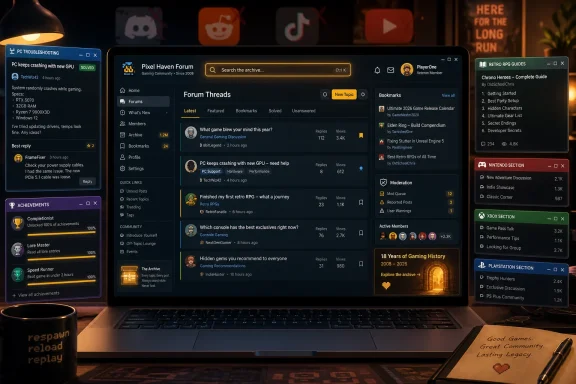 The Forum Never Died; It Just Got More Specific
The old gaming internet was built around forums because there was not much else. If you wanted to argue about a console launch, troubleshoot a PC port, trade strategies for a difficult boss, or follow rumors about the next handheld, you went to a message board and stayed there for years. Those places were messy, tribal, occasionally brilliant, and often infuriating, but they gave communities a shape.That world did not disappear so much as fragment. Discord absorbed real-time chat. Reddit absorbed mass participation. YouTube absorbed reactions. Social platforms absorbed outrage. What forums kept was the thing those systems are still bad at: a durable conversation that can be searched, revived, moderated, and followed without requiring you to be online at the exact moment the discussion happened.
That durability matters more in gaming than people admit. A fix for a broken PC game, a compatibility note for a handheld, a trophy workaround, or a strategy debate for a 20-year-old RPG can remain useful long after the launch-day noise has burned off. A good gaming forum is not just a place to talk. It is a long-term memory system maintained by people who care enough to keep posting.
The list below is not a nostalgia tour. Some famous forums are shadows of themselves, and some modern communities that look informal function better than old boards ever did. The strongest gaming forums now tend to fall into three camps: broad news discussion, platform-specific community, and practical help.
ResetEra Still Sets the Pace for the Traditional Gaming Forum
ResetEra remains one of the most visible examples of the modern traditional gaming forum: fast-moving, heavily moderated, news-driven, and intensely aware of the wider games industry. It is the sort of place where a trailer, review embargo, acquisition rumor, sales estimate, or studio controversy can generate pages of reaction before slower communities have even framed the topic.Its strength is velocity. ResetEra is useful if you want to see how a highly engaged gaming audience processes announcements in real time. It also remains a common reference point for industry chatter, which gives it an influence larger than a normal community board would have.
That same intensity is also the caveat. ResetEra’s moderation style and community norms are not neutral furniture; they are part of the product. Some readers will value the attempt to keep discussions controlled and less chaotic than the average comment section. Others will find the culture restrictive, combative, or too ideologically narrow for relaxed gaming talk.
For readers who want a classic forum interface with current industry energy, ResetEra is still one of the strongest options. It is not the right home for everyone, but it remains a place where gaming news feels alive.
Steam Community Discussions Are the Internet’s Most Useful Mess
Steam’s forums are not glamorous, and nobody should pretend otherwise. They can be repetitive, angry, under-moderated, overrun after bad launches, and wildly inconsistent from one game hub to the next. Yet for practical PC gaming help, Steam Community Discussions are often unbeatable.The reason is simple: the conversation is attached directly to the game. If a patch breaks controller support, a graphics setting causes crashes, a launcher update fails, or a mod conflicts with a new build, players usually go to that game’s Steam discussion hub before writing a polished guide anywhere else. Developers may also appear there, especially for smaller and mid-sized games, making Steam one of the few places where complaint, diagnosis, and response can sit in the same thread.
This is especially valuable for older PC games. Search engines increasingly surface thin AI-written advice pages and recycled troubleshooting articles. Steam discussions, by contrast, often contain ugly but real reports from people trying to make the same executable work on the same hardware or operating system.
The downside is that Steam is not one community. It is thousands of micro-communities sharing a platform. A beloved indie game may have thoughtful support threads; a controversial blockbuster may have a front page that looks like a digital food fight. Still, if the goal is solving a specific game problem, Steam is often the first stop.
Reddit’s Best Gaming Communities Became Forums by Accident
Reddit is not a traditional forum, but some subreddits now function as the de facto message boards of modern gaming. The distinction matters less to users than it does to purists. If a community has structured threads, searchable archives, active moderation, and recurring discussion, it is doing forum work even if it lives inside Reddit’s platform.r/Games is the clearest example. It offers a higher-signal alternative to broader meme-heavy gaming spaces, with news posts, trailers, AMAs, announcements, and industry discussion. It is not immune to repetition or reactionary pile-ons, but it is often easier to browse casually than a dense old-school forum.
r/truegaming serves a different role. It is slower, more essay-like, and more interested in design, player behavior, genre conventions, and the meaning of games than in the news cycle. When it is good, it feels less like a comments section and more like a seminar where everyone still has a backlog and strong feelings about difficulty curves.
These communities are useful precisely because they are not trying to be everything. r/Games is where you go to follow the current conversation. r/truegaming is where you go when you are tired of the current conversation and want to argue about what games are doing to us.
GameFAQs Remains the Dusty Archive That Still Answers the Question
GameFAQs is one of the great survivors of the gaming web. It no longer dominates the way it once did, but its message boards still have one enormous advantage: they are tied to specific games, platforms, and long-standing guide culture. That structure gives GameFAQs an archival usefulness many newer communities lack.For niche and older games, GameFAQs can still be surprisingly valuable. You may not find a vibrant crowd discussing every retro title in real time, but you can often find the exact kind of thread that modern platforms bury: boss strategies, route debates, party compositions, obscure unlock conditions, and arguments that somehow continued across multiple console generations.
The site also carries a distinctive old-internet tone. That can be comforting or off-putting, depending on your tolerance for legacy forum culture. Some boards are active, some are sleepy, and some feel like preserved rooms in a museum where someone occasionally turns the lights on.
But a dead-simple truth keeps GameFAQs relevant: old games do not stop producing questions. As long as players keep returning to back catalogs, emulators, remasters, handhelds, and forgotten RPGs, a searchable archive attached to individual titles remains useful.
NeoGAF Proves That Old Forum Energy Still Has an Audience
NeoGAF has lived several lives, and its history is too complicated to reduce to nostalgia. It began as an influential gaming forum with strong ties to industry discussion, went through major community upheaval, and still exists as an active traditional message board for people who prefer direct, often sharp conversation.Its value today is cultural as much as practical. NeoGAF still has the cadence of classic gaming forums: threads about platform rivalry, sales numbers, reviews, leaks, impressions, and industry behavior. It is faster and more confrontational than calmer publication-attached communities, and that is part of its appeal for users who find newer moderation-heavy spaces too sanitized.
That tone also limits its audience. Readers looking for gentle onboarding or tightly controlled discourse may bounce off quickly. NeoGAF works best for people who already like old-school forum combat and understand that a lively thread can also be an exhausting one.
Still, it deserves a place on any serious list because it represents a surviving branch of gaming forum history. The community may not be what it was at its peak, but it remains part of the map.
PC Gamer Forums Offer the Calmer PC Room
PC Gamer Forums occupy a quieter corner of the ecosystem. Attached to a major gaming publication, they provide a more structured space for PC gaming discussion without the scale and noise of Reddit or Steam. That makes them useful for readers who want a board that still feels readable.The forum’s appeal is not raw size. Its appeal is pace. PC gaming is sprawling enough to need dedicated spaces for hardware-adjacent talk, genre discussion, game recommendations, troubleshooting, and community threads. A slower forum can be better than a massive one when you want a conversation you can actually follow.
For WindowsForum readers, this kind of PC-focused community has obvious relevance. PC gaming is no longer just about graphics cards and frame rates; it is about launchers, anti-cheat drivers, Windows updates, handheld compatibility, controller layers, HDR, upscalers, and shader compilation stutter. The best PC forums are valuable because they treat the platform as an ecosystem, not just a box that runs games.
PC Gamer Forums are not the busiest destination on this list, but they have a useful role. They are a good place for players who want PC talk without immediately being swallowed by platform wars or launch-day outrage.
Nintendo Fans Have Built Their Own Parallel Forum World
Nintendo discussion has always needed specialized communities because Nintendo fandom operates on its own weather system. Hardware speculation, Direct reactions, first-party release calendars, retro collecting, handheld rumors, amiibo, eShop discoveries, and platform quirks all produce threads that make more sense inside Nintendo-focused spaces than on broad gaming boards.Famiboards has become one of the more important modern homes for that conversation. It has a strong community identity and an active focus on Nintendo hardware, software, rumors, announcements, and wider gaming. For users who miss old-school forum culture but want a current Nintendo-heavy crowd, Famiboards is one of the best options.
Nintendo Life Forums fill a slightly different role. Because they are attached to a Nintendo-focused publication, they naturally connect with news, reviews, guides, and platform coverage. That makes them approachable for casual Switch owners as well as longtime Nintendo fans who want dedicated categories rather than a single chaotic megathread.
The usual warning applies: rumor-heavy Nintendo communities require skepticism. Nintendo speculation is a renewable resource, and not all of it deserves oxygen. But for platform-focused discussion, Famiboards and Nintendo Life are far more useful than trying to extract coherent long-form conversation from a fast social feed.
Xbox Players Get More from Communities With a Purpose
Xbox discussion can struggle on broad gaming forums because it is often absorbed into larger console-war narratives. That is why Xbox-leaning communities with a clearer identity can be more useful than general boards, especially for players who want to discuss Game Pass, first-party strategy, platform features, backward compatibility, achievements, and ecosystem changes without every thread becoming a referendum on brand loyalty.DayOne Forums, connected with the XboxEra community shift, fits that role. It is not strictly Xbox-only, but it has enough Xbox-aware culture to give platform discussion a home. Its smaller scale can be an advantage for users who want recurring community threads, backlog challenges, and ongoing conversation rather than the overwhelming churn of giant communities.
TrueAchievements is even more focused. It is not simply an Xbox forum; it is an achievement infrastructure with forums attached to a very specific player behavior. If you care about Gamerscore, completion percentages, broken achievements, DLC requirements, leaderboard competition, and 100-percent routes, TrueAchievements is more practical than almost any broad gaming forum.
That specificity is the lesson. The best Xbox communities are not necessarily the loudest. They are the ones that understand what Xbox players are actually trying to do.
PlayStation Trophy Hunters Should Think Beyond General Forums
The submitted list leans heavily into Xbox achievement culture through TrueAchievements, but the broader lesson applies just as strongly to PlayStation players. Trophy hunters rarely get the best help from general gaming discussion, because their questions are too specific. They need communities that care about unlock conditions, missable objectives, region stacks, platinum difficulty, server closures, and whether a trophy is bugged or merely cruel.This is where specialized completion communities outperform larger forums. A general board may tell you whether a game is worth playing. A trophy or achievement-focused community will tell you whether the online mode is dead, whether the grind is tolerable, and whether a patch quietly changed the route.
For readers choosing among forums, this distinction matters. If your main goal is community debate, use a broad forum. If your main goal is completion, use a completion-focused site. Gaming forums are most powerful when their structure matches the job.
AVForums Reminds Us That Gaming Is Also a Hardware Problem
AVForums is not a pure gaming forum, and that is precisely why it belongs in this conversation. Modern gaming is inseparable from displays, audio, receivers, capture devices, handheld docks, HDMI standards, HDR implementation, VRR behavior, and living-room setup decisions. A console or PC does not exist in isolation; it runs through a chain of hardware that can make the experience better, worse, or maddeningly inconsistent.That is where AVForums’ video gaming area has a distinct advantage. It attracts users who think about gaming as part of a home entertainment system. If you are trying to understand TV settings for a console, latency tradeoffs, soundbar behavior, projector limitations, or how a handheld fits into a larger setup, a general gaming board may not be technical enough.
This category will only become more important. As consoles, PCs, and handhelds support more advanced display features, players need communities that can translate spec sheets into lived experience. HDR that looks good in a marketing slide can still look wrong in your room. A forum full of display obsessives may be the best place to find out why.
The tradeoff is obvious: AVForums is not where most players will go to debate narrative design or review scores. But if your gaming problem involves cables, panels, audio formats, or input lag, it may be more useful than any pure gaming site.
Giant Bomb Shows the Value of Personality-Led Community
Giant Bomb’s forums are inseparable from the site’s broader identity. This is not just a place for generic game discussion; it is a community shaped by years of videos, podcasts, reviews, personalities, in-jokes, and a particular style of games media. That makes it less universal than some entries on this list but more meaningful for the people it fits.Personality-led communities are easy to underestimate. A forum attached to a media site can provide something broader platforms often lack: shared context. Users are not only reacting to games; they are reacting to coverage, commentary, recurring shows, and the tone of the site itself. That creates a different kind of conversation from a neutral platform forum.
Giant Bomb has changed over time, and longtime readers know that community identity can shift as staff, ownership, and editorial focus change. But the community layer remains part of what makes the site distinct. It is best for readers who already enjoy Giant Bomb’s sensibility and want discussion that extends beyond release dates and patch notes.
It is not the best first stop for troubleshooting a PC port or comparing console settings. It is, however, a reminder that gaming forums are not only databases. They are social worlds built around taste.
The Best Gaming Forum Is Usually Not the Biggest One
The biggest mistake readers make is treating forum selection like a popularity contest. Activity matters, but scale can be a liability. A huge forum can produce fast answers and broad reactions, but it can also bury nuance under repetition, moderation disputes, and performative posting.Smaller forums can be better if they have the right shape. A Nintendo-focused board, an achievement site, a PC publication forum, or an AV community may answer a particular question better than a massive general forum. The question is not “Where are the most gamers?” but “Where are the right gamers for this discussion?”
Searchability is the second underrated factor. Discord may be faster in the moment, but it is poor at preserving useful public knowledge. Social feeds are good at distributing takes, not maintaining threads. A forum that looks old-fashioned may still be more valuable because its discussions remain findable months or years later.
Moderation is the third factor, and it cuts both ways. Good moderation keeps spam, abuse, and low-effort noise from destroying a community. Bad or excessive moderation can make a forum feel brittle, ideological, or sterile. The best communities set expectations without turning every disagreement into a procedural event.
The New Forum Strategy Is to Combine Three Homes
No single forum can serve every gaming need anymore. The golden-age dream of one central board for all players has been replaced by a more modular reality. Smart users build a small rotation.One broad forum gives you the news cycle. ResetEra, NeoGAF, r/Games, or a similar community can show how engaged players are reacting to announcements, reviews, controversies, and industry shifts. You do not have to agree with the consensus to find the signal useful.
One platform or identity forum gives you belonging. Nintendo fans may choose Famiboards or Nintendo Life. Xbox players may prefer DayOne or TrueAchievements. PC players may lean on Steam discussions and PC Gamer Forums. This is where recurring users, familiar debates, and platform-specific context matter.
One practical support space gives you answers. Steam, GameFAQs, TrueAchievements, and AVForums are good examples because they are organized around problems: a broken game, an old strategy question, a completion route, or a hardware setup. These are the places you bookmark not for entertainment, but because someday they will save you an hour.
That combination is more realistic than hunting for the one perfect community. Gaming itself has become too broad for a single forum to handle well.
Thirteen Communities, One Lesson About Where the Good Threads Live
The best forum choice depends on the kind of conversation you want, not on which site has the most recognizable name. A fast news board, a game-specific troubleshooting hub, and a thoughtful analysis community are all “gaming forums” in practice, but they solve different problems.- ResetEra remains one of the strongest traditional forums for fast-moving gaming news, industry reaction, and heavily moderated current discussion.
- Steam Community Discussions are often the most practical first stop for PC game troubleshooting, patch reactions, technical complaints, and developer-facing feedback.
- GameFAQs still matters because its game-specific archives are unusually valuable for older titles, niche questions, and long-tail strategy discussion.
- Famiboards and Nintendo Life Forums give Nintendo fans dedicated spaces for platform discussion, rumor tracking, retro talk, and community reaction.
- TrueAchievements is the clearest pick for Xbox achievement hunters who need completion advice, tracking culture, and game-specific unlock discussion.
- r/Games and r/truegaming show how Reddit communities can function like modern forums when moderation, structure, and user expectations are strong enough.
Forums Survive by Doing What Feeds Refuse to Do
The forum’s future is not mass-market dominance. That era is gone. The next version of the gaming forum is smaller, more specialized, and more intentional, which may actually make it better for the people who still need it.For PC gamers, forums remain essential because technical problems are specific and search engines are getting noisier. For console players, platform communities help separate useful discussion from brand-war sludge. For retro players, archives preserve knowledge that no algorithm has a financial incentive to maintain. For achievement hunters, the forum is not nostalgia at all; it is infrastructure.
The risk is that many communities will continue to hollow out as real-time chat and algorithmic platforms absorb casual participation. A forum needs enough active users to feel alive, enough moderation to remain usable, and enough identity to justify returning. History alone is not enough. A forum can have legendary archives and still be socially dead.
But the strongest gaming forums have adapted by becoming more clearly themselves. ResetEra is fast and current. Steam is practical and game-specific. GameFAQs is archival. Famiboards is Nintendo-minded. TrueAchievements is completion-driven. AVForums is technical. r/truegaming is reflective. None of those communities has to be the whole internet to matter.
The best gaming forums in 2026 are not replacements for Discord, Reddit, YouTube, or social media; they are the antidote to their worst habits. They slow conversations down, keep useful threads visible, and reward people who return with knowledge instead of just volume. As gaming grows more fragmented across platforms, launchers, devices, subscriptions, remasters, handhelds, and live-service ecosystems, the humble forum may remain the place where the most useful conversations quietly outlive the noise.
References
- Primary source: Editorialge
Published: 2026-06-20T11:30:11.322038
- Related coverage: nintendolife.com
- Related coverage: makeuseof.com
13 Big Gaming Forums to Talk About Video Games
Here are the biggest gaming forums where you can talk about video games to your heart's content. www.makeuseof.com
- Related coverage: giantbomb.com
