

The best server backup software in 2026 depends on operating model: Datto SIRIS best fits MSP-led business continuity, Unitrends suits self-managed SMB and mid-market infrastructure, Veeam remains strongest for complex virtualization, and Cohesity, Rubrik, Commvault, and NetBackup target enterprise-scale recovery estates.
That answer is less satisfying than a ranked list, but it is more honest. Backup software is not bought in a vacuum; it is operated at 2 a.m., under stress, while users are locked out, executives are watching, and attackers may still be inside the network. The winners in 2026 are not merely the platforms with the most checkboxes, but the ones that make recovery repeatable for the team that actually has to perform it.
For years, server backup software was discussed as a storage problem. The language was capacity, deduplication ratios, retention windows, tape rotation, replication targets, and whether a nightly job completed before the morning shift arrived. That world has not disappeared, but it is no longer the center of gravity.
The modern backup buyer is really buying recovery confidence. Ransomware changed the conversation because it exposed a brutal weakness in many legacy backup strategies: a backup that exists but cannot be trusted, isolated, verified, or restored quickly is not a recovery plan. It is a hope with a retention policy.
That distinction matters because downtime has become financially violent. ITIC’s 2024 research found that more than 90 percent of midsize and large enterprises now put the cost of a single hour of downtime above $300,000. Even if a smaller company’s exposure is far lower, the lesson scales down cleanly: recovery delay is not an inconvenience, it is a business event.
This is why the most important server backup features in 2026 are not the same ones that led comparison charts a decade ago. Instant virtualization, immutable storage, automated boot verification, ransomware anomaly detection, role-based administration, and clean-room recovery now sit beside traditional backup mechanics. The question is no longer “Did the backup run?” It is “Can we prove this system will come back cleanly, quickly, and without making the incident worse?”
The appeal starts with integration. Datto SIRIS combines local appliance-based backup, cloud replication, centralized partner management, instant local virtualization, and cloud failover into a single commercial and operational package. For an MSP, that matters more than it might for an internal IT department because standardization is the difference between margin and chaos.
Its technical pitch is also strong. Datto’s Inverse Chain Technology is designed so incremental backups produce independent recovery points rather than fragile chains where one bad link can poison a restore path. The platform can take snapshots as frequently as every five minutes, which makes it plausible to sell recovery point objectives that feel aggressive without requiring a bespoke architecture for every customer.
The more important story is recovery. Datto’s Instant Virtualization allows a protected server to be started as a virtual machine either locally on the SIRIS appliance or in the Datto Cloud. Kaseya claims average recovery time objectives under six minutes, with a meaningful share of recoveries completing in under two. Those numbers should always be treated as vendor figures rather than universal guarantees, but the design goal is the right one: get the workload running before the postmortem begins.
SIRIS also reflects how ransomware has rewritten backup requirements. AI-powered screenshot verification checks that backups boot successfully after jobs complete, while Cloud Deletion Defense is designed to protect cloud snapshots from accidental or malicious deletion, even by administrators. In an era when attackers often target backup infrastructure before detonating ransomware, administrative deletion protection is not a luxury feature.
The limitation is just as important as the strength. SIRIS is built for MSP delivery, not for every business that wants to run its own infrastructure. A company with a capable internal IT team may not want an MSP-first portal, partner-centric packaging, or the operating assumptions baked into Datto’s model. For those organizations, Kaseya’s other major backup line, Unitrends, is often the more natural fit.
The appeal is operational simplicity. Unitrends is available as a physical backup appliance or as a virtual appliance running on VMware ESXi or Microsoft Hyper-V. That choice gives buyers two familiar patterns: deploy a self-contained box that combines software and storage, or run the protection platform on existing virtualization infrastructure.
Coverage is broad enough for the typical SMB and mid-market server room. Unitrends protects physical Windows and Linux servers, VMware and Hyper-V virtual machines, SQL Server, Exchange, and Active Directory. That may not excite an enterprise architect responsible for exotic databases and multiple clouds, but it matches the real estate many WindowsForum readers actually have to protect.
The recovery story is also practical. Instant recovery can boot protected systems as virtual machines while failed hardware is repaired or replaced, and bare-metal restore supports recovery to new or dissimilar hardware. Automated backup verification after every job helps reduce one of the oldest backup risks: discovering during an outage that the backups were technically present but functionally useless.
Unitrends’ main trade-off is disaster recovery testing architecture. If an organization relies on a single appliance for both primary protection and DR expectations, it may find realistic failover testing constrained. The product becomes more convincing when paired with cloud replication or a secondary appliance, but that raises the same budget and planning questions that every serious DR strategy eventually confronts.
That is not a weakness unique to Unitrends. It is the unavoidable truth of recovery planning. A backup appliance in the same room as the failed system may save you from a disk crash or ransomware event, but it does not magically become a full disaster recovery site.
Veeam protects VMware vSphere, Microsoft Hyper-V, physical Windows and Linux machines, cloud workloads, and key applications such as SQL Server, Exchange, and Active Directory. Its feature set is formidable: image-level backup, instant recovery, replication, application-item recovery, bare-metal restore, immutable repositories, and isolated recovery testing. For teams that know what they are doing, it can be shaped into a serious recovery architecture.
Version 13 sharpened Veeam’s security posture with a Linux-native direction, hardened repositories, granular role-based access control, four-eyes authorization for sensitive operations, and better support for isolated verification before restoration. That is exactly where the market is going. Backup platforms have become privileged control planes, and privileged control planes need security models that assume compromise is possible.
But Veeam’s strength is also its problem. It is a toolkit as much as it is a product, and toolkits reward expertise. A well-designed Veeam environment can be excellent; a casually assembled one can become a maze of repositories, proxies, permissions, jobs, and assumptions that only one administrator fully understands.
For MSPs, this distinction matters even more. Veeam can be used in service provider contexts, but it is not as naturally MSP-native as Datto SIRIS. Multitenant visibility, repeatable client onboarding, and standardized recovery workflows require more design discipline. For an internal IT department with virtualization depth, Veeam may be the better instrument; for an MSP trying to scale backup as a managed service, the operational overhead can become the product’s hidden cost.
This consolidation can be attractive for smaller IT teams. One agent means fewer deployments, fewer consoles, fewer renewal cycles, and less coordination between backup and endpoint tooling. For an organization that is drowning in point products, Acronis offers a sensible promise: reduce tool sprawl while keeping image-based recovery close to security telemetry.
The backup fundamentals are credible. Acronis supports full image backup, incremental-forever approaches, bare-metal restore to dissimilar hardware through Universal Restore, cloud replication, encryption, ransomware rollback, and integrity verification. Acronis Cyber Protect Cloud also gives MSPs a multitenant management layer, which makes it more channel-friendly than many traditional backup tools.
The risk is the familiar one with bundled platforms. Acronis can be good at several things without being the deepest at any single one. Veeam is more specialized for complex virtualization. Dedicated EDR products often provide richer endpoint detection and response. Security teams may dislike backup-driven endpoint protection, while infrastructure teams may distrust security features inside their backup platform.
That does not make Acronis a bad choice. It makes it a particular choice. If your organization values consolidation and good-enough breadth over specialist depth, Acronis deserves attention. If your security and infrastructure teams already run mature best-of-breed stacks, it may feel like an overlap rather than a simplification.
That model is attractive when storage economics matter. Some MSPs want to control margins by choosing their own object storage provider. Some businesses already have cloud commitments and prefer not to pay another vendor for bundled storage. Others want the flexibility to move or diversify storage targets over time.
MSP360 covers Windows Server, SQL Server, Exchange, VMware, Hyper-V, and Linux, with file-level and image-based backup options. It supports immutable storage through compatible object-lock mechanisms, restore verification, consistency checks, role-based access, audit logging, and multitenant management. For the price-conscious and storage-savvy buyer, that is a strong package.
The catch is that flexibility transfers responsibility back to the customer. MSP360 does not provide the same integrated disaster recovery cloud experience as Datto SIRIS or some enterprise platforms. Storage costs, egress behavior, immutability configuration, retention design, and recovery workflows must be understood and managed.
This is not necessarily bad. For teams that know object storage and want cost control, MSP360 is liberating. For teams that want one throat to choke during an outage, the bring-your-own-storage model can become a coordination burden at the worst possible time.
Coverage is a major advantage. NAKIVO protects VMware vSphere, Hyper-V, Nutanix AHV, Proxmox, and physical Windows and Linux servers. The inclusion of Proxmox is especially notable as more organizations reconsider virtualization licensing and look beyond traditional VMware estates. Support for application-consistent backup of SQL Server, Exchange, and Active Directory rounds out the Windows Server story.
The recovery features are stronger than the product’s price positioning might suggest. NAKIVO supports instant VM recovery, bare-metal restore, granular application-object recovery, immutable backups across supported local and cloud repositories, automated backup testing, and disaster recovery orchestration through Site Recovery Jobs. That last feature matters because failover plans built during calm periods are usually better than improvisation during an incident.
NAKIVO’s limitation is not capability so much as scale model. It is not purpose-built for MSPs managing a large fleet of unrelated clients. It can work well for a small business, a school, a branch-heavy organization, or an internal IT team with a defined estate. It is less convincing when the job is centralized service delivery across dozens or hundreds of tenants.
For WindowsForum readers running modest but important infrastructure, NAKIVO may be one of the most rational options on the board. Not every server room needs enterprise cyber vaulting. Some need affordable, verified, restorable backups that a small team can understand.
Cohesity DataProtect uses a scale-out architecture to consolidate backup, recovery, file services, analytics, and data management across large environments. It supports virtual machines, physical servers, NAS, SQL Server, Oracle, SAP HANA, Microsoft 365, and public cloud workloads. Its architecture emphasizes immutability, zero-trust security, ransomware detection, and large-scale recovery.
Rubrik Security Cloud takes a similarly security-forward stance, with immutable backup storage, air-gap-style protection concepts, threat monitoring, sensitive-data visibility, and guided ransomware recovery workflows. The goal is not just to restore data, but to help determine which recovery points are clean and which systems can be trusted after compromise.
These platforms are compelling because ransomware recovery is no longer a simple matter of selecting last night’s backup. If attackers were present for days or weeks, the most recent restore point may contain encrypted files, malware, stolen credentials, persistence mechanisms, or corrupted application states. Enterprises need tools that can help investigate the backup estate, identify clean recovery points, and avoid restoring the attack along with the data.
The trade-off is obvious: cost and complexity. Cohesity and Rubrik are enterprise products with enterprise economics. They make sense for large organizations with broad data estates, security operations maturity, and the budget to treat backup as part of cyber resilience. They are overkill for most SMBs, and they are rarely the right fit for a lean IT shop that simply needs to protect a dozen Windows and Linux servers.
Commvault’s strength is breadth. It supports hundreds of platforms, operating systems, applications, and workload types under a policy-driven model. It can protect physical systems, virtual machines, public cloud workloads, Kubernetes environments, major databases, and long-retention archives. For organizations that need one control plane across a deeply heterogeneous estate, Commvault remains hard to dismiss.
Its newer security and recovery features, including immutable and air-gapped storage options and clean-room recovery concepts, show how even the most established enterprise backup vendors have been forced to adapt to ransomware-era requirements. Deduplication, retention, and reporting are still important, but they are no longer enough.
NetBackup, now part of Cohesity’s broader portfolio after the Veritas data protection acquisition completed in 2024, occupies similar territory. It has a long history in petabyte-scale environments and supports physical servers, VMware, Hyper-V, Nutanix, Oracle, SAP HANA, SQL Server, and major public clouds. Its strengths are scale, platform breadth, mature storage tiering, and geographically distributed replication.
The drawbacks are equally mature. Commvault and NetBackup require dedicated expertise. Licensing can be complex, architecture choices matter, and administration is not casual work. These are not products to buy because they appear high on a list; they are products to buy because the environment is large and complicated enough to justify them.
That is why application-aware backup remains important. File-level recovery is useful, but it is insufficient when the workload has transactional state. SQL Server and Exchange need consistent snapshots. Active Directory recovery needs care to avoid replication problems or restoring bad directory state. A backup product that treats every server as a generic block device may be cheaper, but Windows infrastructure is rarely generic in practice.
The cloud has also changed the failure model. Many businesses now run hybrid estates where on-premises Windows Server workloads depend on Microsoft 365, Entra ID, Azure services, cloud storage, SaaS applications, and remote users. Server backup still matters, but it no longer covers the whole continuity story.
That makes management integration more valuable. MSPs care about PSA and RMM workflows because backup alerts that live outside the normal service desk process are easy to miss. Internal IT teams care about RBAC, audit logs, SSO, and approval workflows because backup systems now have enough power to become attractive attacker targets.
The uncomfortable truth is that many organizations still underinvest in restore testing. They buy software, configure jobs, see green checkmarks, and assume protection exists. The best platforms in 2026 are the ones that make verification routine instead of heroic.
The real cost question is not subscription line item versus subscription line item. It is total recovery cost. How many people are required to administer the platform? How often do jobs fail? How quickly can a new server be protected? How easy is it to test a restore? Does the product require a senior engineer for every meaningful recovery, or can trained generalists execute the runbook?
This is where the market segmentation becomes useful. MSPs should bias toward MSP-native platforms because multitenant management is not a nice-to-have at scale. SMBs should avoid enterprise platforms unless their complexity genuinely demands them. Enterprises should avoid underbuying, because a cheap tool that cannot model a sprawling hybrid estate will eventually become expensive in a crisis.
There is also a human factor. Backup software often becomes the responsibility of whoever inherited it, not whoever designed it. If only one administrator understands the system, the organization does not have a backup strategy; it has a dependency.
Server backup has become one of the clearest tests of IT maturity because failure exposes every lazy assumption at once: undocumented dependencies, untested restores, excessive permissions, fragile storage, and tools too complex for the team that owns them. The best products now point toward a future where backup is not an archive of yesterday’s data, but an active recovery fabric built into security, identity, cloud operations, and business continuity.
That answer is less satisfying than a ranked list, but it is more honest. Backup software is not bought in a vacuum; it is operated at 2 a.m., under stress, while users are locked out, executives are watching, and attackers may still be inside the network. The winners in 2026 are not merely the platforms with the most checkboxes, but the ones that make recovery repeatable for the team that actually has to perform it.
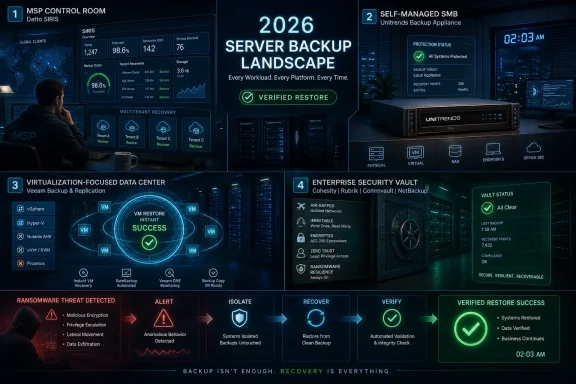 The Backup Market Has Stopped Selling Insurance and Started Selling Recovery
For years, server backup software was discussed as a storage problem. The language was capacity, deduplication ratios, retention windows, tape rotation, replication targets, and whether a nightly job completed before the morning shift arrived. That world has not disappeared, but it is no longer the center of gravity.The modern backup buyer is really buying recovery confidence. Ransomware changed the conversation because it exposed a brutal weakness in many legacy backup strategies: a backup that exists but cannot be trusted, isolated, verified, or restored quickly is not a recovery plan. It is a hope with a retention policy.
That distinction matters because downtime has become financially violent. ITIC’s 2024 research found that more than 90 percent of midsize and large enterprises now put the cost of a single hour of downtime above $300,000. Even if a smaller company’s exposure is far lower, the lesson scales down cleanly: recovery delay is not an inconvenience, it is a business event.
This is why the most important server backup features in 2026 are not the same ones that led comparison charts a decade ago. Instant virtualization, immutable storage, automated boot verification, ransomware anomaly detection, role-based administration, and clean-room recovery now sit beside traditional backup mechanics. The question is no longer “Did the backup run?” It is “Can we prove this system will come back cleanly, quickly, and without making the incident worse?”
Datto SIRIS Shows Why MSP Backup Is Its Own Category
Datto SIRIS is the strongest choice for managed service providers that need to deliver backup and disaster recovery across many small and midsize client environments from a central operating model. That last phrase is the key. SIRIS is not simply a backup appliance; it is a service delivery system built around the realities of MSP work.The appeal starts with integration. Datto SIRIS combines local appliance-based backup, cloud replication, centralized partner management, instant local virtualization, and cloud failover into a single commercial and operational package. For an MSP, that matters more than it might for an internal IT department because standardization is the difference between margin and chaos.
Its technical pitch is also strong. Datto’s Inverse Chain Technology is designed so incremental backups produce independent recovery points rather than fragile chains where one bad link can poison a restore path. The platform can take snapshots as frequently as every five minutes, which makes it plausible to sell recovery point objectives that feel aggressive without requiring a bespoke architecture for every customer.
The more important story is recovery. Datto’s Instant Virtualization allows a protected server to be started as a virtual machine either locally on the SIRIS appliance or in the Datto Cloud. Kaseya claims average recovery time objectives under six minutes, with a meaningful share of recoveries completing in under two. Those numbers should always be treated as vendor figures rather than universal guarantees, but the design goal is the right one: get the workload running before the postmortem begins.
SIRIS also reflects how ransomware has rewritten backup requirements. AI-powered screenshot verification checks that backups boot successfully after jobs complete, while Cloud Deletion Defense is designed to protect cloud snapshots from accidental or malicious deletion, even by administrators. In an era when attackers often target backup infrastructure before detonating ransomware, administrative deletion protection is not a luxury feature.
The limitation is just as important as the strength. SIRIS is built for MSP delivery, not for every business that wants to run its own infrastructure. A company with a capable internal IT team may not want an MSP-first portal, partner-centric packaging, or the operating assumptions baked into Datto’s model. For those organizations, Kaseya’s other major backup line, Unitrends, is often the more natural fit.
Unitrends Is the Appliance Answer for Companies That Do Their Own Recovery
Unitrends Backup occupies a useful middle ground: more integrated than a build-your-own backup stack, but less MSP-specific than Datto SIRIS. It is best suited to businesses that manage their own servers and want an all-in-one recovery platform rather than a collection of backup software, storage repositories, cloud replication services, and scripts.The appeal is operational simplicity. Unitrends is available as a physical backup appliance or as a virtual appliance running on VMware ESXi or Microsoft Hyper-V. That choice gives buyers two familiar patterns: deploy a self-contained box that combines software and storage, or run the protection platform on existing virtualization infrastructure.
Coverage is broad enough for the typical SMB and mid-market server room. Unitrends protects physical Windows and Linux servers, VMware and Hyper-V virtual machines, SQL Server, Exchange, and Active Directory. That may not excite an enterprise architect responsible for exotic databases and multiple clouds, but it matches the real estate many WindowsForum readers actually have to protect.
The recovery story is also practical. Instant recovery can boot protected systems as virtual machines while failed hardware is repaired or replaced, and bare-metal restore supports recovery to new or dissimilar hardware. Automated backup verification after every job helps reduce one of the oldest backup risks: discovering during an outage that the backups were technically present but functionally useless.
Unitrends’ main trade-off is disaster recovery testing architecture. If an organization relies on a single appliance for both primary protection and DR expectations, it may find realistic failover testing constrained. The product becomes more convincing when paired with cloud replication or a secondary appliance, but that raises the same budget and planning questions that every serious DR strategy eventually confronts.
That is not a weakness unique to Unitrends. It is the unavoidable truth of recovery planning. A backup appliance in the same room as the failed system may save you from a disk crash or ransomware event, but it does not magically become a full disaster recovery site.
Veeam Remains the Virtualization Powerhouse, but Power Still Has a Price
Veeam Backup & Replication remains one of the most capable platforms for organizations with sophisticated virtualized infrastructure. Its reputation was built in VMware-heavy environments, and although the product has expanded far beyond that origin, its center of gravity is still deep VM protection with flexible recovery options.Veeam protects VMware vSphere, Microsoft Hyper-V, physical Windows and Linux machines, cloud workloads, and key applications such as SQL Server, Exchange, and Active Directory. Its feature set is formidable: image-level backup, instant recovery, replication, application-item recovery, bare-metal restore, immutable repositories, and isolated recovery testing. For teams that know what they are doing, it can be shaped into a serious recovery architecture.
Version 13 sharpened Veeam’s security posture with a Linux-native direction, hardened repositories, granular role-based access control, four-eyes authorization for sensitive operations, and better support for isolated verification before restoration. That is exactly where the market is going. Backup platforms have become privileged control planes, and privileged control planes need security models that assume compromise is possible.
But Veeam’s strength is also its problem. It is a toolkit as much as it is a product, and toolkits reward expertise. A well-designed Veeam environment can be excellent; a casually assembled one can become a maze of repositories, proxies, permissions, jobs, and assumptions that only one administrator fully understands.
For MSPs, this distinction matters even more. Veeam can be used in service provider contexts, but it is not as naturally MSP-native as Datto SIRIS. Multitenant visibility, repeatable client onboarding, and standardized recovery workflows require more design discipline. For an internal IT department with virtualization depth, Veeam may be the better instrument; for an MSP trying to scale backup as a managed service, the operational overhead can become the product’s hidden cost.
Acronis Bets That Backup and Security Belong in the Same Agent
Acronis Cyber Protect takes a different path: it combines backup with endpoint security, anti-malware, patch management, vulnerability assessment, URL filtering, and recovery features under one agent and console. The logic is easy to understand. If ransomware is the dominant backup threat, then the boundary between protection and security response becomes blurry.This consolidation can be attractive for smaller IT teams. One agent means fewer deployments, fewer consoles, fewer renewal cycles, and less coordination between backup and endpoint tooling. For an organization that is drowning in point products, Acronis offers a sensible promise: reduce tool sprawl while keeping image-based recovery close to security telemetry.
The backup fundamentals are credible. Acronis supports full image backup, incremental-forever approaches, bare-metal restore to dissimilar hardware through Universal Restore, cloud replication, encryption, ransomware rollback, and integrity verification. Acronis Cyber Protect Cloud also gives MSPs a multitenant management layer, which makes it more channel-friendly than many traditional backup tools.
The risk is the familiar one with bundled platforms. Acronis can be good at several things without being the deepest at any single one. Veeam is more specialized for complex virtualization. Dedicated EDR products often provide richer endpoint detection and response. Security teams may dislike backup-driven endpoint protection, while infrastructure teams may distrust security features inside their backup platform.
That does not make Acronis a bad choice. It makes it a particular choice. If your organization values consolidation and good-enough breadth over specialist depth, Acronis deserves attention. If your security and infrastructure teams already run mature best-of-breed stacks, it may feel like an overlap rather than a simplification.
MSP360 Makes Storage Choice the Product
MSP360 Managed Backup is best understood as the anti-appliance option. Instead of selling a tightly coupled backup cloud and recovery platform, MSP360 gives organizations and service providers a management console and lets them bring their own storage across providers such as Amazon S3, Microsoft Azure, Wasabi, Backblaze B2, IDrive e2, and others.That model is attractive when storage economics matter. Some MSPs want to control margins by choosing their own object storage provider. Some businesses already have cloud commitments and prefer not to pay another vendor for bundled storage. Others want the flexibility to move or diversify storage targets over time.
MSP360 covers Windows Server, SQL Server, Exchange, VMware, Hyper-V, and Linux, with file-level and image-based backup options. It supports immutable storage through compatible object-lock mechanisms, restore verification, consistency checks, role-based access, audit logging, and multitenant management. For the price-conscious and storage-savvy buyer, that is a strong package.
The catch is that flexibility transfers responsibility back to the customer. MSP360 does not provide the same integrated disaster recovery cloud experience as Datto SIRIS or some enterprise platforms. Storage costs, egress behavior, immutability configuration, retention design, and recovery workflows must be understood and managed.
This is not necessarily bad. For teams that know object storage and want cost control, MSP360 is liberating. For teams that want one throat to choke during an outage, the bring-your-own-storage model can become a coordination burden at the worst possible time.
NAKIVO Is the Value Play for Lean Virtualization Teams
NAKIVO Backup & Replication has become one of the more compelling choices for SMBs and lean IT teams that want strong VM backup without enterprise-level complexity or pricing. Its pitch is refreshingly direct: broad hypervisor coverage, straightforward management, useful recovery features, and transparent per-workload pricing.Coverage is a major advantage. NAKIVO protects VMware vSphere, Hyper-V, Nutanix AHV, Proxmox, and physical Windows and Linux servers. The inclusion of Proxmox is especially notable as more organizations reconsider virtualization licensing and look beyond traditional VMware estates. Support for application-consistent backup of SQL Server, Exchange, and Active Directory rounds out the Windows Server story.
The recovery features are stronger than the product’s price positioning might suggest. NAKIVO supports instant VM recovery, bare-metal restore, granular application-object recovery, immutable backups across supported local and cloud repositories, automated backup testing, and disaster recovery orchestration through Site Recovery Jobs. That last feature matters because failover plans built during calm periods are usually better than improvisation during an incident.
NAKIVO’s limitation is not capability so much as scale model. It is not purpose-built for MSPs managing a large fleet of unrelated clients. It can work well for a small business, a school, a branch-heavy organization, or an internal IT team with a defined estate. It is less convincing when the job is centralized service delivery across dozens or hundreds of tenants.
For WindowsForum readers running modest but important infrastructure, NAKIVO may be one of the most rational options on the board. Not every server room needs enterprise cyber vaulting. Some need affordable, verified, restorable backups that a small team can understand.
Cohesity and Rubrik Turn Backup Into a Security Platform
At the enterprise tier, Cohesity DataProtect and Rubrik Security Cloud represent a broader shift: backup vendors are no longer content to be recovery tools. They are positioning themselves as data security platforms. That is partly marketing, but it is not only marketing.Cohesity DataProtect uses a scale-out architecture to consolidate backup, recovery, file services, analytics, and data management across large environments. It supports virtual machines, physical servers, NAS, SQL Server, Oracle, SAP HANA, Microsoft 365, and public cloud workloads. Its architecture emphasizes immutability, zero-trust security, ransomware detection, and large-scale recovery.
Rubrik Security Cloud takes a similarly security-forward stance, with immutable backup storage, air-gap-style protection concepts, threat monitoring, sensitive-data visibility, and guided ransomware recovery workflows. The goal is not just to restore data, but to help determine which recovery points are clean and which systems can be trusted after compromise.
These platforms are compelling because ransomware recovery is no longer a simple matter of selecting last night’s backup. If attackers were present for days or weeks, the most recent restore point may contain encrypted files, malware, stolen credentials, persistence mechanisms, or corrupted application states. Enterprises need tools that can help investigate the backup estate, identify clean recovery points, and avoid restoring the attack along with the data.
The trade-off is obvious: cost and complexity. Cohesity and Rubrik are enterprise products with enterprise economics. They make sense for large organizations with broad data estates, security operations maturity, and the budget to treat backup as part of cyber resilience. They are overkill for most SMBs, and they are rarely the right fit for a lean IT shop that simply needs to protect a dozen Windows and Linux servers.
Commvault and NetBackup Still Own the Messiest Enterprise Estates
Commvault Complete Data Protection and Veritas NetBackup remain relevant for a simple reason: large enterprises are messy. They have legacy platforms, modern clouds, databases that predate half the IT staff, regulatory retention requirements, mainframe-adjacent processes, multiple business units, and political boundaries that do not care how elegant a newer platform looks in a demo.Commvault’s strength is breadth. It supports hundreds of platforms, operating systems, applications, and workload types under a policy-driven model. It can protect physical systems, virtual machines, public cloud workloads, Kubernetes environments, major databases, and long-retention archives. For organizations that need one control plane across a deeply heterogeneous estate, Commvault remains hard to dismiss.
Its newer security and recovery features, including immutable and air-gapped storage options and clean-room recovery concepts, show how even the most established enterprise backup vendors have been forced to adapt to ransomware-era requirements. Deduplication, retention, and reporting are still important, but they are no longer enough.
NetBackup, now part of Cohesity’s broader portfolio after the Veritas data protection acquisition completed in 2024, occupies similar territory. It has a long history in petabyte-scale environments and supports physical servers, VMware, Hyper-V, Nutanix, Oracle, SAP HANA, SQL Server, and major public clouds. Its strengths are scale, platform breadth, mature storage tiering, and geographically distributed replication.
The drawbacks are equally mature. Commvault and NetBackup require dedicated expertise. Licensing can be complex, architecture choices matter, and administration is not casual work. These are not products to buy because they appear high on a list; they are products to buy because the environment is large and complicated enough to justify them.
Windows Server Recovery Is Now an Identity, Security, and Cloud Problem
For Windows administrators, server backup selection increasingly overlaps with identity protection, endpoint security, cloud retention, and application recovery. A domain controller restore is not merely a server restore. An Exchange recovery is not simply a disk image. SQL Server, Active Directory, Entra ID dependencies, file permissions, certificates, service accounts, and application consistency all complicate the idea of “getting the server back.”That is why application-aware backup remains important. File-level recovery is useful, but it is insufficient when the workload has transactional state. SQL Server and Exchange need consistent snapshots. Active Directory recovery needs care to avoid replication problems or restoring bad directory state. A backup product that treats every server as a generic block device may be cheaper, but Windows infrastructure is rarely generic in practice.
The cloud has also changed the failure model. Many businesses now run hybrid estates where on-premises Windows Server workloads depend on Microsoft 365, Entra ID, Azure services, cloud storage, SaaS applications, and remote users. Server backup still matters, but it no longer covers the whole continuity story.
That makes management integration more valuable. MSPs care about PSA and RMM workflows because backup alerts that live outside the normal service desk process are easy to miss. Internal IT teams care about RBAC, audit logs, SSO, and approval workflows because backup systems now have enough power to become attractive attacker targets.
The uncomfortable truth is that many organizations still underinvest in restore testing. They buy software, configure jobs, see green checkmarks, and assume protection exists. The best platforms in 2026 are the ones that make verification routine instead of heroic.
The Cheapest Backup Product Is Often the One Your Team Can Actually Run
Price comparisons in backup software are notoriously misleading. A product may look cheap until cloud storage, egress, retention, support tiers, standby compute, appliance refreshes, per-workload licensing, or professional services are included. Another may look expensive but include integrated cloud recovery, verification, and predictable support that reduce operational risk.The real cost question is not subscription line item versus subscription line item. It is total recovery cost. How many people are required to administer the platform? How often do jobs fail? How quickly can a new server be protected? How easy is it to test a restore? Does the product require a senior engineer for every meaningful recovery, or can trained generalists execute the runbook?
This is where the market segmentation becomes useful. MSPs should bias toward MSP-native platforms because multitenant management is not a nice-to-have at scale. SMBs should avoid enterprise platforms unless their complexity genuinely demands them. Enterprises should avoid underbuying, because a cheap tool that cannot model a sprawling hybrid estate will eventually become expensive in a crisis.
There is also a human factor. Backup software often becomes the responsibility of whoever inherited it, not whoever designed it. If only one administrator understands the system, the organization does not have a backup strategy; it has a dependency.
The 2026 Shortlist Is Really a Map of Operating Models
The ranking only makes sense when matched to the environment. A small law firm, a regional manufacturer, a hospital system, an MSP with hundreds of endpoints, and a multinational bank do not have the same backup problem, even if all of them run Windows Server somewhere.- Datto SIRIS is the strongest fit for MSPs that need standardized, multitenant BCDR with fast local and cloud recovery.
- Unitrends Backup is the clearest fit for businesses that want integrated appliance-style protection while managing their own infrastructure.
- Veeam Backup & Replication remains a top choice for skilled IT teams with complex VMware, Hyper-V, physical, and cloud workloads.
- Acronis Cyber Protect is most attractive when backup consolidation and endpoint security consolidation are part of the same buying motion.
- MSP360 and NAKIVO are strong value options when storage flexibility, transparent pricing, or lean virtualization management matter more than enterprise breadth.
- Cohesity, Rubrik, Commvault, and NetBackup belong in enterprise conversations where scale, heterogeneity, ransomware investigation, and governance justify the overhead.
Server backup has become one of the clearest tests of IT maturity because failure exposes every lazy assumption at once: undocumented dependencies, untested restores, excessive permissions, fragile storage, and tools too complex for the team that owns them. The best products now point toward a future where backup is not an archive of yesterday’s data, but an active recovery fabric built into security, identity, cloud operations, and business continuity.
References
- Primary source: Kaseya
Published: 2026-06-18T09:40:08.176756
Best Server Backup Software in 2026 | Kaseya
Compare the best server backup solutions in 2026, ranked for MSPs and IT teams on recovery speed, ransomware protection, and ease of management.www.kaseya.com
- Related coverage: helpcenter.veeam.com
Linux Server - Veeam Backup & Replication User Guide
You can add a Linux server with local, directly attached storage or mounted NFS as a backup repository. The storage can be a local disk, directly attached disk-based storage (such as a USB hard drive), NFS share, or iSCSI/FC SAN LUN in case the...helpcenter.veeam.com - Related coverage: veeam.com
Data Backup & Replication | Veeam
Veeam Backup and Replication delivers secure and powerful data protection for all workloads, on-premises and in the cloud, ensuring seamless backup and instant recovery.www.veeam.com - Related coverage: itpro.com
Kaseya expands backup portfolio, acquires email security specialist INKY | ChannelPro
Software specialist announced its latest round of innovations at DattoCon 2025, including the new Datto SIRIS 6 and Datto Backup for Entra IDwww.itpro.com
