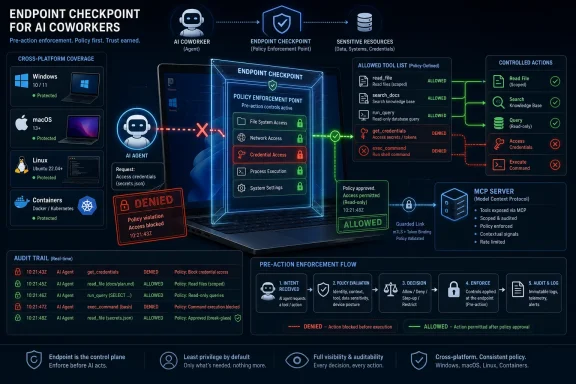
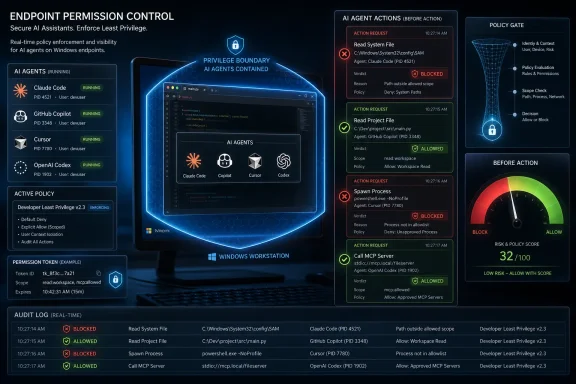
BeyondTrust announced AI Agent Security on June 30, 2026, in Atlanta, positioning the Pathfinder module as a real-time endpoint control layer that discovers enterprise AI agents, limits their privileges, and blocks unauthorized actions before tools such as Claude Code, Microsoft Copilot, Cursor, and OpenAI Codex act. The pitch is not subtle: the endpoint’s riskiest operator is increasingly software that can reason, connect, generate, and execute at machine speed. That makes the product less another AI-security add-on than a bet that privileged access management has to be rebuilt around autonomous action. For Windows shops, the practical question is no longer whether AI assistants are installed somewhere in the fleet; it is whether anyone knows what they are allowed to touch.
The important word in BeyondTrust’s announcement is not AI. It is before. Security products have spent years getting better at spotting suspicious behavior after something starts: a strange process tree, a burst of file deletion, a suspicious outbound connection, a command shell where one should not exist. AI agents make that model feel late.
BeyondTrust is arguing that autonomous tools should not merely be monitored like ordinary applications. They should be governed like privileged actors whose authority must be scoped before they perform a task. That is a meaningful shift, because coding agents, copilots, and automated assistants do not behave like static software with a predictable set of operations.
A traditional endpoint-control model asks whether an executable is trusted, whether it is known malicious, and whether a user is allowed to run it. But an AI coding assistant can be benign one minute and destructive the next, depending on its prompt, connected tools, credentials, files, plugins, and external services. The executable may be approved; the action may not be.
That is where BeyondTrust sees its opening. AI Agent Security is designed to sit at the privilege boundary and enforce what an agent can do in real time across Windows, macOS, Linux, and containers. The company says the module will discover AI assistants and autonomous agents across the fleet, block shadow AI, restrict approved tools to needed permissions, set policy boundaries around data and connections, and maintain audit records of actions taken under specific authority.
This is the endpoint version of a broader identity-security reckoning. Enterprises have spent the last decade trying to reduce human admin rights, vault privileged passwords, rotate secrets, and apply least privilege to service accounts. Now they are attaching AI systems to developer workstations, SaaS environments, cloud APIs, source repositories, ticketing systems, production databases, and messaging platforms. The old human-versus-machine distinction is starting to collapse.
AI agents intensify that collision. A coding assistant installed on a developer workstation may be able to read project files, invoke a shell, use local credentials, interact with source-control systems, and call out to model providers or tool servers. A productivity copilot may summarize data across email, chat, documents, tickets, and CRM records. A browser-based agent may operate through the same session cookies and delegated access the human user already has.
That inherited-user model is convenient, and that is exactly why it is dangerous. If an AI tool receives the same ambient authority as the user who launched it, administrators lose the clean line between “Alice did this” and “Alice’s assistant did this after interpreting a prompt, a tool response, and a context window.” In security terms, that is not a semantic debate. It is the difference between accountable human action and delegated automation with fuzzy intent.
BeyondTrust’s framing lands because it maps onto a familiar Windows problem: local admin rights were never merely about people being careless. They were about programs running with too much inherited authority. Endpoint privilege management became necessary because users needed to work, but their applications did not need unfettered power. AI agents are that pattern with a reasoning layer bolted on.
The product’s promise is that the agent does not automatically become as powerful as the user. Approved AI tools can receive narrower permissions, while unapproved tools can be blocked. More importantly, the control is meant to apply to the action, not just the application launch. That is the right architectural target, even if the real-world implementation will determine whether the product becomes a new control plane or just another console in the stack.
BeyondTrust’s Phantom Labs research earlier this year reported a 466.7 percent year-over-year increase in enterprise AI agents observed through its identity-security data. The exact number is less important than the shape of the trend. Organizations are not adopting one official assistant under one official policy; they are accumulating agents through developer tools, collaboration platforms, cloud services, CRM systems, IT service-management platforms, and individual employee experimentation.
That creates a discovery problem before it creates an enforcement problem. You cannot set policy around a tool you do not know exists. You cannot assess privilege if an AI workflow appears in one administrative report as a harmless integration while gaining expanded access through delegated user permissions, API keys, plugins, or model-context connections.
BeyondTrust is trying to make discovery part of the same control loop as enforcement. The company says AI Agent Security will identify AI assistants, copilots, and autonomous agents across managed and unmanaged endpoints, map what each can reach, and surface shadow AI installed outside IT approval. That matters because most enterprises are not starting from a clean slate. They are starting from a messy fleet where AI capabilities have already arrived through ordinary software updates and employee initiative.
The Windows angle is especially sharp. Microsoft has put Copilot across Windows, Microsoft 365, Edge, developer tools, and administrative workflows. That does not make Copilot equivalent to a rogue coding assistant installed from a GitHub page, but it does mean AI is becoming part of the default computing environment rather than a discrete application category. Security teams need a way to distinguish sanctioned AI use from unsanctioned AI use without pretending that “ban it all” is a sustainable policy.
Useful work is the problem. The moment an AI assistant can call a tool, query a database, read a repository, create a ticket, invoke a shell, or retrieve secrets, the security question changes. We are no longer asking whether the model generated a bad answer. We are asking whether the model-mediated workflow had permission to perform a real operation in a real environment.
This is where agentic AI differs from the chatbot wave that preceded it. A chatbot that produces a wrong answer is a quality and governance issue. An agent that produces a wrong command and executes it with inherited credentials is an operational-risk issue. The failure mode moves from misinformation to modification.
BeyondTrust is not alone in recognizing this. The broader security industry has been converging on the idea that AI agents should be treated as non-human identities, workload identities, or delegated actors with explicit permissions and lifecycle controls. What is notable here is the endpoint emphasis. Many AI security conversations begin in the cloud, with SaaS connectors, model gateways, and data-loss prevention. BeyondTrust is saying the endpoint is where agent privilege must also be governed, because that is where many agents run, invoke tools, and inherit user context.
The company’s own PathfinderAI and MCP Server work, announced earlier this spring, foreshadowed this direction. PathfinderAI brought natural-language investigation to BeyondTrust’s identity-security platform, while the MCP Server was positioned as a controlled way for AI agents to interact with BeyondTrust capabilities. AI Agent Security looks like the other half of that strategy: if AI tools can query the security platform, the security platform must also govern the AI tools.
The company’s claim to credibility is its endpoint privilege-management history. BeyondTrust has long sold tools that remove standing admin rights, elevate specific applications or tasks, and enforce least privilege across operating systems. That background gives it a plausible path into AI-agent control, because many AI risks are really privilege risks wearing a new interface.
Still, security buyers should read the announcement with the usual enterprise-software skepticism. “Single control point” is a powerful phrase, but endpoints are messy, AI tools update quickly, and agents can operate through browsers, shells, IDEs, SaaS connectors, local runtimes, remote APIs, containers, and extension frameworks. The hard part is not writing a policy that says “do not delete production.” The hard part is reliably identifying the agent, understanding its action before execution, mediating the relevant privilege boundary, and doing so without breaking legitimate workflows.
There is also the question of how deep the control goes. Blocking an executable is easy. Constraining child processes is harder. Interpreting intent is harder still. Preventing credential exfiltration may involve local file access, clipboard behavior, environment variables, browser storage, shell history, network destinations, API calls, and model-provider interactions. The product will be judged by how much of that it can actually govern across platforms.
That does not undermine the need. If anything, it clarifies why this market will not be solved by a single feature in an endpoint detection product or a checkbox in an AI platform. Enterprises will need overlapping controls: identity governance, endpoint privilege management, secrets management, browser isolation, DLP, model gateways, SaaS posture management, logging, and workflow approval. BeyondTrust is attempting to make privilege the organizing principle.
AI agents will test that discipline because they make exceptions feel productive. A developer asks an assistant to refactor code, update dependencies, run tests, open a pull request, and fix build errors. The assistant asks for shell access, repository access, package-manager access, and perhaps access to deployment logs. Each permission has a plausible justification. Together, they create a highly capable actor moving faster than a human reviewer can follow.
That is why the “before action” model matters. If a policy engine can decide that a coding assistant may read a repository but not delete production branches, may run tests but not export secrets, may connect to an approved MCP server but not an unknown plugin, it can preserve much of the productivity gain while limiting blast radius. That is the optimistic version.
The pessimistic version is policy sprawl. Security teams may find themselves writing brittle rules for dozens of tools, model providers, IDE integrations, shell commands, SaaS APIs, and edge cases. Developers may complain that the agent is useless if every action is blocked or delayed. Administrators may discover that the boundary between a human-initiated action and an agent-initiated action is not always easy to prove.
This is where BeyondTrust’s existing endpoint privilege-management customer base becomes strategically important. Organizations that already model privilege at the task and application level are better positioned to extend that thinking to AI agents. Shops that still rely on broad local admin rights, shared secrets, and informal approval channels will find agent security much harder, regardless of vendor.
The lesson for WindowsForum readers is uncomfortable but useful: AI security will expose the quality of your existing identity hygiene. If service accounts are unmanaged, local admin rights are common, secrets live in environment files, and developers have broad production reach from their laptops, an AI agent does not create the weakness. It accelerates it.
That means inventory first. Which AI tools are installed? Which are browser-based? Which run inside IDEs? Which connect to Microsoft 365, GitHub, Azure, AWS, Salesforce, ServiceNow, Jira, Confluence, internal databases, or ticketing systems? Which use local credentials, personal tokens, OAuth grants, service principals, or API keys? Which can spawn processes or modify files?
Then comes privilege design. An AI assistant used to summarize documents does not need the same authority as a coding agent used to modify infrastructure-as-code. A helpdesk copilot that drafts responses does not need the same permissions as an autonomous remediation workflow. A tool that can read logs should not automatically be able to restart services, change firewall rules, rotate credentials, or alter production configuration.
BeyondTrust’s announcement is useful because it makes this distinction explicit. It treats AI agents as a class of endpoint actor requiring discovery, approval, scoped authority, runtime blocking, and auditability. That is the same mental model administrators already apply to remote tools and privileged utilities. The new part is that the software can decide what to try next.
Audit will matter more than many buyers initially assume. When an AI-assisted workflow breaks something, organizations will need to know not only which user launched the tool, but what authority the tool had, what it attempted, what was blocked, what was allowed, and which data or systems it reached. Without that record, incident response becomes theater.
Microsoft will be central simply because of Windows, Entra, Defender, Intune, GitHub, Azure, Visual Studio Code, and Microsoft 365 Copilot. The company controls many of the surfaces where enterprise AI work will happen. But Microsoft’s breadth is also why third-party control planes remain attractive: not every enterprise AI tool will be Microsoft’s, and not every customer wants one platform vendor to define all policy.
BeyondTrust’s advantage is its privilege-centric story. It does not need to claim that it secures the model, evaluates the prompt, filters every output, or replaces endpoint detection. It can make the narrower, more defensible claim that agents should not inherit unlimited authority and that privileged actions should be controlled consistently across tools. In a noisy AI-security market, a narrower thesis can be a strength.
The risk is that “AI Agent Security” becomes a label attached to controls that enterprises already half-own elsewhere. If the product mostly inventories known executables and blocks obvious actions, buyers will view it as incremental. If it can actually mediate agent privilege at runtime across heterogeneous tools, shells, child processes, MCP connections, and containerized workflows, it becomes much more interesting.
The fall 2026 general-availability target gives BeyondTrust a few months to prove which version it has built. Private beta customers will be the ones testing the messy realities: developer objections, performance overhead, policy tuning, false positives, cross-platform parity, and integration with existing SIEM, EDR, PAM, and IAM stacks.
That is a design problem as much as a security problem. Developers and IT operators will not accept a system that interrupts every command with an approval prompt. Security teams will not accept autonomous tools that can delete files, exfiltrate credentials, or modify production systems because “the user could have done it anyway.” The middle ground requires context-aware policy that is understandable, enforceable, and auditable.
BeyondTrust’s language about “decide before the action” is therefore both the promise and the burden. Pre-action control must be fast enough not to ruin workflows and precise enough not to become a blunt denylist. It also has to adapt as AI tools change. Claude Code, Copilot, Cursor, Codex, and their rivals are not static applications; they are evolving interfaces to local and remote capability.
There is a cultural issue, too. Many organizations still treat AI adoption as a productivity program owned by business units or engineering leaders, with security invited after the tool is popular. That approach was risky with SaaS. With agents, it is worse, because the value proposition often depends on connecting the tool to exactly the systems security teams worry about.
The better model is to treat AI-agent rollout like privileged-access rollout. Start with narrow use cases. Define allowed actions. Separate read from write. Separate staging from production. Record decisions. Revisit permissions as workflows mature. The product announcement is new; the operational discipline is not.
AI agents are exciting because they compress intent into action. That compression is also what makes them dangerous. A human might take minutes to translate a mistaken instruction into shell commands and API calls. An agent can do it in seconds, across connected systems, with confidence-shaped prose explaining why the step is reasonable.
That is why security-minded administrators should focus less on whether an AI tool is “smart” and more on whether it is bounded. Can it access secrets? Can it write to repositories? Can it deploy? Can it delete? Can it call unapproved tools? Can it send data outside the organization? Can it impersonate the user in ways the user does not understand?
BeyondTrust is betting that these questions belong in the privilege layer. That is a sensible bet. The agent may be new, the model may be probabilistic, and the workflow may be novel, but the damage usually occurs through old-fashioned authority: credentials, tokens, file permissions, process rights, API scopes, and administrative access.
 BeyondTrust Moves the Fight From Detection to Permission
The important word in BeyondTrust’s announcement is not AI. It is before. Security products have spent years getting better at spotting suspicious behavior after something starts: a strange process tree, a burst of file deletion, a suspicious outbound connection, a command shell where one should not exist. AI agents make that model feel late.BeyondTrust is arguing that autonomous tools should not merely be monitored like ordinary applications. They should be governed like privileged actors whose authority must be scoped before they perform a task. That is a meaningful shift, because coding agents, copilots, and automated assistants do not behave like static software with a predictable set of operations.
A traditional endpoint-control model asks whether an executable is trusted, whether it is known malicious, and whether a user is allowed to run it. But an AI coding assistant can be benign one minute and destructive the next, depending on its prompt, connected tools, credentials, files, plugins, and external services. The executable may be approved; the action may not be.
That is where BeyondTrust sees its opening. AI Agent Security is designed to sit at the privilege boundary and enforce what an agent can do in real time across Windows, macOS, Linux, and containers. The company says the module will discover AI assistants and autonomous agents across the fleet, block shadow AI, restrict approved tools to needed permissions, set policy boundaries around data and connections, and maintain audit records of actions taken under specific authority.
This is the endpoint version of a broader identity-security reckoning. Enterprises have spent the last decade trying to reduce human admin rights, vault privileged passwords, rotate secrets, and apply least privilege to service accounts. Now they are attaching AI systems to developer workstations, SaaS environments, cloud APIs, source repositories, ticketing systems, production databases, and messaging platforms. The old human-versus-machine distinction is starting to collapse.
The Endpoint Has Become the Agent’s Launchpad
For Windows administrators, the endpoint is still where bad ideas become operational incidents. A user installs a tool. A browser extension grabs too much access. A script runs with inherited rights. A local credential gets reused against a remote service. The machine is not the whole attack surface, but it remains the place where identity, files, tokens, and user intent collide.AI agents intensify that collision. A coding assistant installed on a developer workstation may be able to read project files, invoke a shell, use local credentials, interact with source-control systems, and call out to model providers or tool servers. A productivity copilot may summarize data across email, chat, documents, tickets, and CRM records. A browser-based agent may operate through the same session cookies and delegated access the human user already has.
That inherited-user model is convenient, and that is exactly why it is dangerous. If an AI tool receives the same ambient authority as the user who launched it, administrators lose the clean line between “Alice did this” and “Alice’s assistant did this after interpreting a prompt, a tool response, and a context window.” In security terms, that is not a semantic debate. It is the difference between accountable human action and delegated automation with fuzzy intent.
BeyondTrust’s framing lands because it maps onto a familiar Windows problem: local admin rights were never merely about people being careless. They were about programs running with too much inherited authority. Endpoint privilege management became necessary because users needed to work, but their applications did not need unfettered power. AI agents are that pattern with a reasoning layer bolted on.
The product’s promise is that the agent does not automatically become as powerful as the user. Approved AI tools can receive narrower permissions, while unapproved tools can be blocked. More importantly, the control is meant to apply to the action, not just the application launch. That is the right architectural target, even if the real-world implementation will determine whether the product becomes a new control plane or just another console in the stack.
Shadow AI Is the New Shadow IT, With Better Tooling
Every security generation gets its version of shadow IT. First it was unsanctioned laptops and home routers. Then it was Dropbox folders, SaaS apps bought on corporate cards, browser extensions, personal GitHub repositories, automation bots, and low-code workflows. AI agents are the next iteration, but with one uncomfortable twist: they are often explicitly designed to connect things together.BeyondTrust’s Phantom Labs research earlier this year reported a 466.7 percent year-over-year increase in enterprise AI agents observed through its identity-security data. The exact number is less important than the shape of the trend. Organizations are not adopting one official assistant under one official policy; they are accumulating agents through developer tools, collaboration platforms, cloud services, CRM systems, IT service-management platforms, and individual employee experimentation.
That creates a discovery problem before it creates an enforcement problem. You cannot set policy around a tool you do not know exists. You cannot assess privilege if an AI workflow appears in one administrative report as a harmless integration while gaining expanded access through delegated user permissions, API keys, plugins, or model-context connections.
BeyondTrust is trying to make discovery part of the same control loop as enforcement. The company says AI Agent Security will identify AI assistants, copilots, and autonomous agents across managed and unmanaged endpoints, map what each can reach, and surface shadow AI installed outside IT approval. That matters because most enterprises are not starting from a clean slate. They are starting from a messy fleet where AI capabilities have already arrived through ordinary software updates and employee initiative.
The Windows angle is especially sharp. Microsoft has put Copilot across Windows, Microsoft 365, Edge, developer tools, and administrative workflows. That does not make Copilot equivalent to a rogue coding assistant installed from a GitHub page, but it does mean AI is becoming part of the default computing environment rather than a discrete application category. Security teams need a way to distinguish sanctioned AI use from unsanctioned AI use without pretending that “ban it all” is a sustainable policy.
MCP Turns Integration Into an Attack Surface
BeyondTrust’s announcement mentions enforcement around MCP servers, plugins, and external services. That detail may sound like vendor plumbing, but it is one of the more important parts of the story. The Model Context Protocol, or MCP, has become a common way to connect AI systems to tools, data, and actions. In plain terms, it helps agents reach beyond chat and do useful work.Useful work is the problem. The moment an AI assistant can call a tool, query a database, read a repository, create a ticket, invoke a shell, or retrieve secrets, the security question changes. We are no longer asking whether the model generated a bad answer. We are asking whether the model-mediated workflow had permission to perform a real operation in a real environment.
This is where agentic AI differs from the chatbot wave that preceded it. A chatbot that produces a wrong answer is a quality and governance issue. An agent that produces a wrong command and executes it with inherited credentials is an operational-risk issue. The failure mode moves from misinformation to modification.
BeyondTrust is not alone in recognizing this. The broader security industry has been converging on the idea that AI agents should be treated as non-human identities, workload identities, or delegated actors with explicit permissions and lifecycle controls. What is notable here is the endpoint emphasis. Many AI security conversations begin in the cloud, with SaaS connectors, model gateways, and data-loss prevention. BeyondTrust is saying the endpoint is where agent privilege must also be governed, because that is where many agents run, invoke tools, and inherit user context.
The company’s own PathfinderAI and MCP Server work, announced earlier this spring, foreshadowed this direction. PathfinderAI brought natural-language investigation to BeyondTrust’s identity-security platform, while the MCP Server was positioned as a controlled way for AI agents to interact with BeyondTrust capabilities. AI Agent Security looks like the other half of that strategy: if AI tools can query the security platform, the security platform must also govern the AI tools.
The Vendor Pitch Is Big Because the Category Is Still Soft
BeyondTrust calls AI Agent Security a Pathfinder module and says it will be the first of several planned modules built natively on the platform. It is in private beta now, with general availability planned for fall 2026, initially as an add-on to Endpoint Privilege Management. That timeline matters. This is not a mature control category with years of deployment patterns behind it. It is an early product aimed at a fast-moving risk.The company’s claim to credibility is its endpoint privilege-management history. BeyondTrust has long sold tools that remove standing admin rights, elevate specific applications or tasks, and enforce least privilege across operating systems. That background gives it a plausible path into AI-agent control, because many AI risks are really privilege risks wearing a new interface.
Still, security buyers should read the announcement with the usual enterprise-software skepticism. “Single control point” is a powerful phrase, but endpoints are messy, AI tools update quickly, and agents can operate through browsers, shells, IDEs, SaaS connectors, local runtimes, remote APIs, containers, and extension frameworks. The hard part is not writing a policy that says “do not delete production.” The hard part is reliably identifying the agent, understanding its action before execution, mediating the relevant privilege boundary, and doing so without breaking legitimate workflows.
There is also the question of how deep the control goes. Blocking an executable is easy. Constraining child processes is harder. Interpreting intent is harder still. Preventing credential exfiltration may involve local file access, clipboard behavior, environment variables, browser storage, shell history, network destinations, API calls, and model-provider interactions. The product will be judged by how much of that it can actually govern across platforms.
That does not undermine the need. If anything, it clarifies why this market will not be solved by a single feature in an endpoint detection product or a checkbox in an AI platform. Enterprises will need overlapping controls: identity governance, endpoint privilege management, secrets management, browser isolation, DLP, model gateways, SaaS posture management, logging, and workflow approval. BeyondTrust is attempting to make privilege the organizing principle.
AI Turns Least Privilege From Policy Slogan Into Runtime Discipline
Least privilege has always sounded simple in conference slides and brutal in production. Give users only what they need. Remove standing admin rights. Elevate specific tasks. Log everything. Rotate credentials. In the real world, exceptions multiply because work has to get done.AI agents will test that discipline because they make exceptions feel productive. A developer asks an assistant to refactor code, update dependencies, run tests, open a pull request, and fix build errors. The assistant asks for shell access, repository access, package-manager access, and perhaps access to deployment logs. Each permission has a plausible justification. Together, they create a highly capable actor moving faster than a human reviewer can follow.
That is why the “before action” model matters. If a policy engine can decide that a coding assistant may read a repository but not delete production branches, may run tests but not export secrets, may connect to an approved MCP server but not an unknown plugin, it can preserve much of the productivity gain while limiting blast radius. That is the optimistic version.
The pessimistic version is policy sprawl. Security teams may find themselves writing brittle rules for dozens of tools, model providers, IDE integrations, shell commands, SaaS APIs, and edge cases. Developers may complain that the agent is useless if every action is blocked or delayed. Administrators may discover that the boundary between a human-initiated action and an agent-initiated action is not always easy to prove.
This is where BeyondTrust’s existing endpoint privilege-management customer base becomes strategically important. Organizations that already model privilege at the task and application level are better positioned to extend that thinking to AI agents. Shops that still rely on broad local admin rights, shared secrets, and informal approval channels will find agent security much harder, regardless of vendor.
The lesson for WindowsForum readers is uncomfortable but useful: AI security will expose the quality of your existing identity hygiene. If service accounts are unmanaged, local admin rights are common, secrets live in environment files, and developers have broad production reach from their laptops, an AI agent does not create the weakness. It accelerates it.
Windows Admins Should Treat AI Tools Like Privileged Software, Not Office Macros
The enterprise Windows estate has absorbed waves of new software before. Antivirus agents, EDR sensors, VPN clients, remote-management tools, browser extensions, password managers, collaboration apps, and developer environments all arrived with security consequences. AI assistants should be evaluated in that same operational tradition, not treated as magical productivity widgets outside normal controls.That means inventory first. Which AI tools are installed? Which are browser-based? Which run inside IDEs? Which connect to Microsoft 365, GitHub, Azure, AWS, Salesforce, ServiceNow, Jira, Confluence, internal databases, or ticketing systems? Which use local credentials, personal tokens, OAuth grants, service principals, or API keys? Which can spawn processes or modify files?
Then comes privilege design. An AI assistant used to summarize documents does not need the same authority as a coding agent used to modify infrastructure-as-code. A helpdesk copilot that drafts responses does not need the same permissions as an autonomous remediation workflow. A tool that can read logs should not automatically be able to restart services, change firewall rules, rotate credentials, or alter production configuration.
BeyondTrust’s announcement is useful because it makes this distinction explicit. It treats AI agents as a class of endpoint actor requiring discovery, approval, scoped authority, runtime blocking, and auditability. That is the same mental model administrators already apply to remote tools and privileged utilities. The new part is that the software can decide what to try next.
Audit will matter more than many buyers initially assume. When an AI-assisted workflow breaks something, organizations will need to know not only which user launched the tool, but what authority the tool had, what it attempted, what was blocked, what was allowed, and which data or systems it reached. Without that record, incident response becomes theater.
The Competitive Field Will Crowd Quickly
BeyondTrust is moving early, but it will not have the field to itself. Endpoint security vendors will add AI-agent behavioral controls. Identity providers will frame agents as non-human identities requiring governance. Cloud providers will build controls around their own agent runtimes. Browser-security vendors will target AI tools operating through web sessions. DLP companies will extend content inspection to prompts, context windows, and tool responses.Microsoft will be central simply because of Windows, Entra, Defender, Intune, GitHub, Azure, Visual Studio Code, and Microsoft 365 Copilot. The company controls many of the surfaces where enterprise AI work will happen. But Microsoft’s breadth is also why third-party control planes remain attractive: not every enterprise AI tool will be Microsoft’s, and not every customer wants one platform vendor to define all policy.
BeyondTrust’s advantage is its privilege-centric story. It does not need to claim that it secures the model, evaluates the prompt, filters every output, or replaces endpoint detection. It can make the narrower, more defensible claim that agents should not inherit unlimited authority and that privileged actions should be controlled consistently across tools. In a noisy AI-security market, a narrower thesis can be a strength.
The risk is that “AI Agent Security” becomes a label attached to controls that enterprises already half-own elsewhere. If the product mostly inventories known executables and blocks obvious actions, buyers will view it as incremental. If it can actually mediate agent privilege at runtime across heterogeneous tools, shells, child processes, MCP connections, and containerized workflows, it becomes much more interesting.
The fall 2026 general-availability target gives BeyondTrust a few months to prove which version it has built. Private beta customers will be the ones testing the messy realities: developer objections, performance overhead, policy tuning, false positives, cross-platform parity, and integration with existing SIEM, EDR, PAM, and IAM stacks.
The Real Test Is Whether Security Can Keep the Agent Useful
Every control in this space will face the same trade-off. If it is too permissive, it becomes a logging tool with marketing language. If it is too restrictive, users route around it. The product that wins will not be the one that blocks the most AI actions; it will be the one that lets organizations approve useful agent work without granting broad ambient power.That is a design problem as much as a security problem. Developers and IT operators will not accept a system that interrupts every command with an approval prompt. Security teams will not accept autonomous tools that can delete files, exfiltrate credentials, or modify production systems because “the user could have done it anyway.” The middle ground requires context-aware policy that is understandable, enforceable, and auditable.
BeyondTrust’s language about “decide before the action” is therefore both the promise and the burden. Pre-action control must be fast enough not to ruin workflows and precise enough not to become a blunt denylist. It also has to adapt as AI tools change. Claude Code, Copilot, Cursor, Codex, and their rivals are not static applications; they are evolving interfaces to local and remote capability.
There is a cultural issue, too. Many organizations still treat AI adoption as a productivity program owned by business units or engineering leaders, with security invited after the tool is popular. That approach was risky with SaaS. With agents, it is worse, because the value proposition often depends on connecting the tool to exactly the systems security teams worry about.
The better model is to treat AI-agent rollout like privileged-access rollout. Start with narrow use cases. Define allowed actions. Separate read from write. Separate staging from production. Record decisions. Revisit permissions as workflows mature. The product announcement is new; the operational discipline is not.
The Agent Era Rewards Boring Controls
The most useful lesson from BeyondTrust’s launch is not that every enterprise should immediately buy a new module. It is that the fundamentals have caught up with the hype. Agentic AI does not abolish identity security, endpoint hardening, secrets management, or least privilege. It makes them more important.AI agents are exciting because they compress intent into action. That compression is also what makes them dangerous. A human might take minutes to translate a mistaken instruction into shell commands and API calls. An agent can do it in seconds, across connected systems, with confidence-shaped prose explaining why the step is reasonable.
That is why security-minded administrators should focus less on whether an AI tool is “smart” and more on whether it is bounded. Can it access secrets? Can it write to repositories? Can it deploy? Can it delete? Can it call unapproved tools? Can it send data outside the organization? Can it impersonate the user in ways the user does not understand?
BeyondTrust is betting that these questions belong in the privilege layer. That is a sensible bet. The agent may be new, the model may be probabilistic, and the workflow may be novel, but the damage usually occurs through old-fashioned authority: credentials, tokens, file permissions, process rights, API scopes, and administrative access.
BeyondTrust’s Launch Draws a Line Administrators Can Actually Use
The cleanest way to read this announcement is as a marker in the normalization of AI agents. They are no longer just experimental assistants or developer toys. They are endpoint actors with enough power to deserve their own privilege model.- BeyondTrust AI Agent Security is in private beta now and is planned for general availability on the Pathfinder platform in fall 2026.
- The module is initially being offered as an add-on to BeyondTrust Endpoint Privilege Management.
- The product is designed to discover approved and shadow AI agents across endpoints, including Windows, macOS, Linux, and containers.
- BeyondTrust says the control plane will enforce policy before agent actions occur, rather than relying only on after-the-fact detection.
- The company is positioning MCP servers, plugins, external services, and inherited user credentials as core parts of the AI-agent privilege problem.
- For enterprise IT teams, the immediate work is inventory, scoping, and auditability, not waiting for a single vendor feature to make agent risk disappear.
References
- Primary source: markets.businessinsider.com
Published: 2026-06-30T14:50:15.459404
The Most Powerful Actor on the Endpoint Is No Longer Human. BeyondTrust Secures It | Markets Insider
BeyondTrust launches AI Agent Security to enforce what AI coworkers and autonomous agents are allowed to do, in real time, before they actNew Beyo...markets.businessinsider.com - Related coverage: beyondtrust.com
Phantom Labs Analysis of BeyondTrust’s Identity Security Insights Data Finds Enterprise AI Agents Growing 466.7% Year Over Year | BeyondTrust
New research from the BeyondTrust Phantom Labs™ team reveals a 466.7% (56x) year-over-year increase in AI agents operating inside enterprise environments.www.beyondtrust.com - Related coverage: globenewswire.com
The Most Powerful Actor on the Endpoint Is No Longer Human.
BeyondTrust launches AI Agent Security to enforce what AI coworkers and autonomous agents are allowed to do, in real time, before they act...www.globenewswire.com - Related coverage: docs.beyondtrust.com

BeyondTrust
docs.beyondtrust.com
- Related coverage: helpnetsecurity.com
BeyondTrust advances AI-native identity security with PathfinderAI and MCP Server - Help Net Security
BeyondTrust announced new AI for Pathfinder, introducing PathfinderAI and an MCP Server for secure AI agent interaction systems.www.helpnetsecurity.com - Related coverage: techradar.com
BeyondTrust RCE flaw lets hackers run code without logging in | TechRadar
A 9.9/10 bug was found in multiple BeyondTrust productswww.techradar.com
- Related coverage: assets.beyondtrust.com