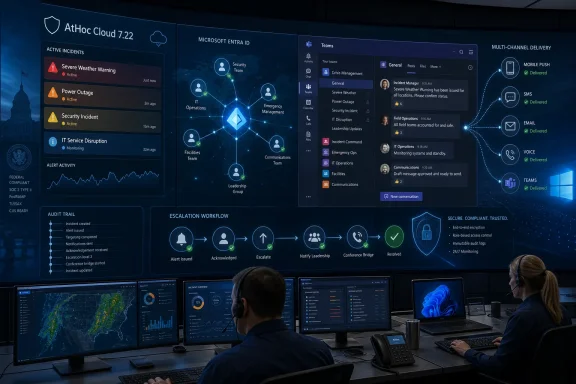
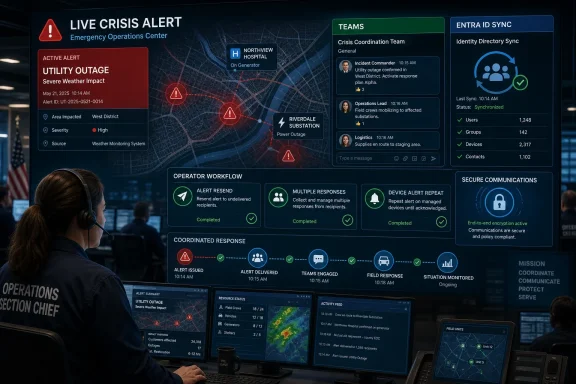
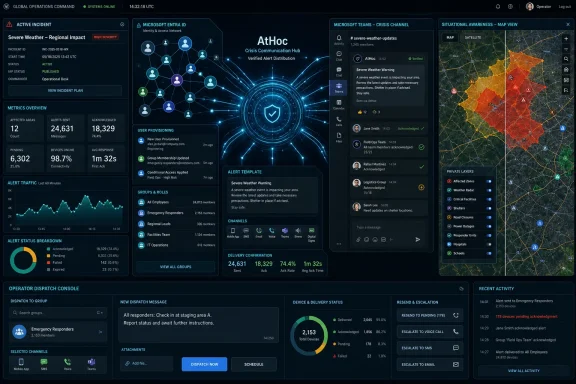
BlackBerry announced on June 30, 2026, that its AtHoc mission orchestration platform now integrates with Microsoft Teams and Microsoft Entra ID, extending crisis alerting, user provisioning, mapping, response comments, and operator dispatch controls for enterprise, government, and critical-infrastructure customers. The announcement is not just another SaaS integration note dressed up as resilience marketing. It is a sign that crisis management is being pulled into the same identity and collaboration fabric that already governs daily work. The interesting question is not whether BlackBerry can send an alert into Teams; it is whether the emergency stack can finally stop pretending it lives outside the enterprise stack.
The most important sentence in BlackBerry’s announcement is not the one about cyber, climate, or geopolitics. It is the claim that under pressure, people reach for the tools they use every day. That is both obvious and damning, because much of enterprise continuity planning still assumes that users will calmly pivot into a specialized workflow at exactly the moment confusion is highest.
AtHoc’s new Microsoft Teams integration is therefore a practical concession to human behavior. If Teams is where staff already triage outages, ask managers for instructions, and discover that half the company is also confused, then a crisis platform that refuses to appear there is voluntarily giving up the first few minutes of the incident. BlackBerry’s bet is that emergency communications should not depend on users remembering where the emergency communications portal lives.
That does not make Teams itself a crisis-management system. Microsoft’s collaboration hub is optimized for meetings, messages, files, and the ambient noise of modern work, not for verified accountability during a physical evacuation, cyber intrusion, or regional disruption. The case for AtHoc is that it can use Teams as a front door without inheriting Teams’ informality as its operating model.
This is the narrow path BlackBerry is trying to walk: meet workers in their daily collaboration layer, but keep the command-and-control semantics somewhere more disciplined. In crisis software, that distinction matters. A message read in a chat thread is not the same thing as an auditable acknowledgement, and a reply emoji is not the same thing as structured response capture.
BlackBerry says the Entra ID integration lets administrators provision and update AtHoc users from the identity source they already maintain. That is vendor language, but the operational point is straightforward: emergency reachability depends on identity hygiene. If the wrong people are in the wrong groups, or if departed employees remain reachable while new hires are not, the alerting system becomes a liability with a polished dashboard.
The timing also fits a broader Microsoft identity reality. Entra ID has become the administrative center of gravity for Microsoft 365 and a growing amount of third-party SaaS access. For WindowsForum readers who live in hybrid environments, the appeal is obvious: another system that can inherit user state from Entra is one fewer silo to reconcile during onboarding, offboarding, reorgs, and incident response.
But this also tightens the dependency chain. If identity synchronization breaks, if group design is sloppy, or if emergency roles are modeled as an afterthought, AtHoc will not magically repair the organization’s directory discipline. Integrating with Entra makes readiness more automatable; it does not make it automatic.
That is the hidden bargain in this release. BlackBerry is telling customers they can bring AtHoc closer to the systems they already trust. In exchange, customers have to admit that their crisis posture is only as clean as their collaboration and identity architecture.
It also fails in predictable ways. Email is bad at urgency and worse at accountability. Group chats move fast but bury decisions, mix rumor with instruction, and leave responders hunting for the latest truth. Spreadsheets offer structure until five people edit five different copies while the situation changes beneath them.
BlackBerry’s 2026 secure communications research leans into this gap between confidence and capability. Security leaders often believe their communications are more resilient and more secure than their actual tools justify. The pattern is familiar across IT: an organization treats the presence of a tool as evidence of a process, then discovers during an incident that the tool was only a container for improvisation.
That is why the AtHoc enhancements around response comments, map layers, alert resend behavior, and mass device repeat are more than feature-padding. They target the failure modes of improvisation. Can the operator see not just who acknowledged, but what they are seeing? Can the alert be scoped to operational geography rather than an abstract mailing list? Can dispatch be repeated without losing track of accountability?
The release is designed to make the patchwork look irresponsible, not merely inefficient. That is a sharper argument than “we have a better notification system.” BlackBerry is saying that in the current threat and disruption environment, the informal stack is no longer a charming example of organizational flexibility. It is a risk surface.
That distinction is important because crisis coordination has requirements that general collaboration tools usually do not enforce by default. Emergency operators need clean recipient targeting, acknowledgement tracking, escalation logic, message repeat, auditability, and often out-of-band delivery beyond the main productivity suite. A Teams message can be useful; a Teams-only emergency plan is fragile.
The 2024 global IT outage made that fragility painfully concrete. When Windows endpoints blue-screened at scale after a faulty CrowdStrike update, many organizations discovered that their normal channels were themselves part of the affected environment. BlackBerry has since used that outage as a showcase for AtHoc’s out-of-band communications value, and the lesson remains uncomfortable: the tool you use every day may be the tool that is down.
That makes the Teams integration both useful and potentially misleading. It is useful because it reduces friction for employees who are already inside Microsoft 365. It is misleading if executives conclude that surfacing alerts in Teams removes the need for redundant channels, mobile delivery, voice, SMS, or other fallback paths.
The stronger version of BlackBerry’s story is not “crises now happen in Teams.” It is that crisis systems must be able to enter Teams while retaining the ability to leave it. In a serious incident, the collaboration layer is a channel, not the architecture.
A regional utility outage, a contaminated facility zone, a blocked transit route, or a data center isolation event cannot be managed well if geography is represented only as text in a message. Operators need to understand which people, assets, buildings, and service areas are affected. Recipients need instructions that reflect where they are, not just who they are.
Private map layers are especially relevant for organizations whose operational geography is not public or generic. A port authority, energy provider, hospital network, military installation, or multinational manufacturer may have maps that reflect restricted zones, internal routes, asset locations, or jurisdictional boundaries. Pulling that context into the crisis platform makes the alerting decision less abstract.
There is also a Windows and Microsoft angle here that should not be overlooked. Many enterprises already use Microsoft tools for identity, collaboration, endpoint management, and security operations, while relying on specialized GIS platforms for spatial intelligence. AtHoc is positioning itself between those worlds: identity tells it who matters, Teams tells it where users work digitally, and maps tell it where the incident actually is.
That triangulation is the difference between alerting and orchestration. Alerting says something happened. Orchestration says who needs to act, where the impact is, how the response is progressing, and what still has not been accounted for.
This release reflects that strategy. There is no attempt to create a shiny new destination app for crisis work. Instead, BlackBerry is plugging into Teams, Entra ID, ArcGIS, and the administrative systems its customers already operate. The pitch is not disruption; it is institutional compatibility.
That matters in government and critical infrastructure, where replacement cycles are long, procurement is slow, and trust is hard-earned. A platform that requires agencies to reorganize around it may look elegant in a demo and fail in deployment. A platform that accepts the messiness of existing identity, collaboration, mapping, and operational workflows has a better chance of becoming part of the furniture.
The risk is that “mission orchestration” becomes yet another inflated category label. Enterprise software vendors love to rename mature functions when they need fresh budget justification, and crisis management is not immune to that habit. But beneath the branding, the problem BlackBerry is describing is real: signals arrive from too many systems, decisions happen across too many channels, and the window for coordinated response is shrinking.
The most persuasive thing about this announcement is therefore its lack of glamour. Provisioning users from Entra, sending alerts into Teams, adding response comments, repeating device alerts, and layering private maps are not futuristic features. They are the plumbing that determines whether a plan survives contact with a Tuesday morning outage.
Still, it would be a mistake to make AI the sole villain in this story. The same operational weaknesses show up during storms, power failures, civil emergencies, supply-chain interruptions, and plain old software mistakes. The 2024 outage was not a cyberattack, but it behaved like a crisis because systems failed at scale and organizations had to coordinate through uncertainty.
That is why the cyber-climate-geopolitics framing is more than a press-release bundle of scary nouns. These risk categories differ in cause, but they converge in operational effect. People need to be reached, status must be captured, instructions must be issued, and leaders need a live picture of what is happening.
The common enemy is not AI, weather, or geopolitics. It is the lag between signal and coordinated action. BlackBerry’s release is best understood as an attempt to reduce that lag by removing directory drift, channel switching, geographic ambiguity, and response opacity.
For IT pros, that should sound familiar. Most outages are not extended by the original failure alone. They are extended by uncertainty: who owns the next step, who has acknowledged the instruction, which systems are affected, which sites are exposed, which users are safe, and whether the last update is still true.
That gives Microsoft enormous gravitational pull. Third-party vendors want to integrate because customers demand it. Customers demand it because their users already live there. The result is a resilience stack where Microsoft is both infrastructure and dependency.
This is not automatically bad. Centralized identity and familiar collaboration can improve speed, governance, and adoption. For administrators, Entra integration can reduce duplicate work and make emergency targeting reflect real organizational state. For users, Teams delivery can make an alert feel native rather than alien.
But concentration has consequences. If the Microsoft tenant is degraded, misconfigured, compromised, or unreachable, crisis workflows that lean too heavily on it can suffer. The strongest architectures will treat Microsoft integration as a powerful path, not the only path.
This is where BlackBerry has to be careful in its own messaging. If AtHoc becomes perceived merely as an app inside Teams, it loses the argument for a dedicated crisis platform. If it can show that Teams and Entra are extensions of a broader, redundant, auditable orchestration model, the integration becomes a strength rather than a dependency trap.
That creates a governance challenge. Emergency groups cannot be treated like ordinary distribution lists that accumulate members and exceptions over years. They need owners, review cycles, naming discipline, and testing. If a role is critical during an incident, it should not be hidden inside a nested group no one understands.
Teams integration brings its own administrative questions. Which users can receive what kinds of alerts in Teams? How are alerts distinguished from routine messages? What happens if Teams notification settings suppress urgency? How does the organization train employees to recognize an AtHoc alert without encouraging them to trust every urgent-looking message?
The response-comment feature also deserves careful policy design. Free-text situational input can be extremely valuable, but it can also introduce noise, speculation, sensitive personal data, or legally discoverable material. Operators need context, yet organizations need to decide how that context is retained, reviewed, and protected.
In other words, BlackBerry is giving administrators fewer excuses and more responsibilities. The integrations reduce manual upkeep, but they also expose whether the underlying operational model is mature enough to benefit from automation.
The problem is that serious incidents demand a record. Who received the alert? Who acknowledged it? What did they report? Which population was targeted? Which device channels were used? Which map layer defined the affected zone? Which operator resent the message, and why?
AtHoc’s enhancements point toward crisis management as an audit discipline, not just a communications function. That is especially relevant for regulated industries, public-sector bodies, and critical infrastructure operators. After a major disruption, the question is rarely just whether the organization responded. It is whether the organization can prove that it responded appropriately.
The accountability angle is also why Teams alone cannot carry the full burden. Chat history is not the same as incident evidence structured around recipients, responses, geography, escalation, and dispatch. A crisis platform that integrates with Teams can capture user attention; a crisis platform that records the response can satisfy the after-action review.
This is where BlackBerry’s heritage helps. The company’s best remaining brand asset is not coolness; it is seriousness. In markets where auditability, certification, controlled communications, and government-grade posture matter, seriousness still sells.
That balance is the real lesson. Bring crisis alerts to the collaboration layer, but do not confuse collaboration with command. Automate user provisioning from identity, but do not confuse synchronization with governance. Use maps to target impact, but do not assume a map is accurate unless someone owns the data beneath it.
The arrival of AtHoc inside familiar Microsoft workflows also raises an uncomfortable training issue. Users are already overloaded with notifications, phishing warnings, meeting nudges, compliance prompts, and security banners. A crisis alert has to cut through that noise without looking like yet another urgent spoof. Technical integration must be paired with organizational conditioning.
Testing becomes non-negotiable. A quarterly tabletop exercise that never touches Teams, Entra groups, mobile delivery, map targeting, and response capture is not testing the system BlackBerry is now selling. It is testing a slide deck.
 BlackBerry Is Chasing the Crisis Where Workers Already Are
The most important sentence in BlackBerry’s announcement is not the one about cyber, climate, or geopolitics. It is the claim that under pressure, people reach for the tools they use every day. That is both obvious and damning, because much of enterprise continuity planning still assumes that users will calmly pivot into a specialized workflow at exactly the moment confusion is highest.AtHoc’s new Microsoft Teams integration is therefore a practical concession to human behavior. If Teams is where staff already triage outages, ask managers for instructions, and discover that half the company is also confused, then a crisis platform that refuses to appear there is voluntarily giving up the first few minutes of the incident. BlackBerry’s bet is that emergency communications should not depend on users remembering where the emergency communications portal lives.
That does not make Teams itself a crisis-management system. Microsoft’s collaboration hub is optimized for meetings, messages, files, and the ambient noise of modern work, not for verified accountability during a physical evacuation, cyber intrusion, or regional disruption. The case for AtHoc is that it can use Teams as a front door without inheriting Teams’ informality as its operating model.
This is the narrow path BlackBerry is trying to walk: meet workers in their daily collaboration layer, but keep the command-and-control semantics somewhere more disciplined. In crisis software, that distinction matters. A message read in a chat thread is not the same thing as an auditable acknowledgement, and a reply emoji is not the same thing as structured response capture.
Identity Is the Real Emergency Channel
The Entra ID integration may sound less exciting than Teams alerting, but it is the more consequential move for administrators. In a modern enterprise, identity is the map of who exists, what they can access, which groups they belong to, and how quickly their privileges should change. If a crisis platform’s user directory drifts away from that map, it becomes stale precisely when accuracy matters.BlackBerry says the Entra ID integration lets administrators provision and update AtHoc users from the identity source they already maintain. That is vendor language, but the operational point is straightforward: emergency reachability depends on identity hygiene. If the wrong people are in the wrong groups, or if departed employees remain reachable while new hires are not, the alerting system becomes a liability with a polished dashboard.
The timing also fits a broader Microsoft identity reality. Entra ID has become the administrative center of gravity for Microsoft 365 and a growing amount of third-party SaaS access. For WindowsForum readers who live in hybrid environments, the appeal is obvious: another system that can inherit user state from Entra is one fewer silo to reconcile during onboarding, offboarding, reorgs, and incident response.
But this also tightens the dependency chain. If identity synchronization breaks, if group design is sloppy, or if emergency roles are modeled as an afterthought, AtHoc will not magically repair the organization’s directory discipline. Integrating with Entra makes readiness more automatable; it does not make it automatic.
That is the hidden bargain in this release. BlackBerry is telling customers they can bring AtHoc closer to the systems they already trust. In exchange, customers have to admit that their crisis posture is only as clean as their collaboration and identity architecture.
The Patchwork Has Become the Competitor
BlackBerry’s real rival here is not just Everbridge, OnSolve, Microsoft, or any other named vendor. It is the ugly-but-familiar bundle of email threads, phone trees, spreadsheets, chat groups, conference bridges, and heroic middle managers that still carries many organizations through incidents. That patchwork persists because it is cheap, legible, and already available.It also fails in predictable ways. Email is bad at urgency and worse at accountability. Group chats move fast but bury decisions, mix rumor with instruction, and leave responders hunting for the latest truth. Spreadsheets offer structure until five people edit five different copies while the situation changes beneath them.
BlackBerry’s 2026 secure communications research leans into this gap between confidence and capability. Security leaders often believe their communications are more resilient and more secure than their actual tools justify. The pattern is familiar across IT: an organization treats the presence of a tool as evidence of a process, then discovers during an incident that the tool was only a container for improvisation.
That is why the AtHoc enhancements around response comments, map layers, alert resend behavior, and mass device repeat are more than feature-padding. They target the failure modes of improvisation. Can the operator see not just who acknowledged, but what they are seeing? Can the alert be scoped to operational geography rather than an abstract mailing list? Can dispatch be repeated without losing track of accountability?
The release is designed to make the patchwork look irresponsible, not merely inefficient. That is a sharper argument than “we have a better notification system.” BlackBerry is saying that in the current threat and disruption environment, the informal stack is no longer a charming example of organizational flexibility. It is a risk surface.
Teams Integration Does Not Make Teams a War Room
There is a temptation to interpret every Teams integration as another step toward Microsoft swallowing all enterprise workflows. That is only partly true here. Teams is increasingly the user interface of work, but AtHoc is attempting to preserve a specialized control plane behind that interface.That distinction is important because crisis coordination has requirements that general collaboration tools usually do not enforce by default. Emergency operators need clean recipient targeting, acknowledgement tracking, escalation logic, message repeat, auditability, and often out-of-band delivery beyond the main productivity suite. A Teams message can be useful; a Teams-only emergency plan is fragile.
The 2024 global IT outage made that fragility painfully concrete. When Windows endpoints blue-screened at scale after a faulty CrowdStrike update, many organizations discovered that their normal channels were themselves part of the affected environment. BlackBerry has since used that outage as a showcase for AtHoc’s out-of-band communications value, and the lesson remains uncomfortable: the tool you use every day may be the tool that is down.
That makes the Teams integration both useful and potentially misleading. It is useful because it reduces friction for employees who are already inside Microsoft 365. It is misleading if executives conclude that surfacing alerts in Teams removes the need for redundant channels, mobile delivery, voice, SMS, or other fallback paths.
The stronger version of BlackBerry’s story is not “crises now happen in Teams.” It is that crisis systems must be able to enter Teams while retaining the ability to leave it. In a serious incident, the collaboration layer is a channel, not the architecture.
The Map Is Becoming Part of the Message
The additions around ArcGIS private map layers and custom map creation point to another shift: crisis communication is becoming more spatial. That is obvious in weather events, wildfires, campus safety, and public-sector emergencies, but it also matters in cyber and infrastructure incidents. Location is often the difference between a useful alert and an expensive broadcast.A regional utility outage, a contaminated facility zone, a blocked transit route, or a data center isolation event cannot be managed well if geography is represented only as text in a message. Operators need to understand which people, assets, buildings, and service areas are affected. Recipients need instructions that reflect where they are, not just who they are.
Private map layers are especially relevant for organizations whose operational geography is not public or generic. A port authority, energy provider, hospital network, military installation, or multinational manufacturer may have maps that reflect restricted zones, internal routes, asset locations, or jurisdictional boundaries. Pulling that context into the crisis platform makes the alerting decision less abstract.
There is also a Windows and Microsoft angle here that should not be overlooked. Many enterprises already use Microsoft tools for identity, collaboration, endpoint management, and security operations, while relying on specialized GIS platforms for spatial intelligence. AtHoc is positioning itself between those worlds: identity tells it who matters, Teams tells it where users work digitally, and maps tell it where the incident actually is.
That triangulation is the difference between alerting and orchestration. Alerting says something happened. Orchestration says who needs to act, where the impact is, how the response is progressing, and what still has not been accounted for.
BlackBerry’s Reinvention Runs Through Boring Infrastructure
For a certain generation of users, BlackBerry still evokes thumb keyboards, red notification lights, and the lost kingdom of mobile email. That consumer nostalgia obscures what the company has become: a vendor trying to monetize trust, embedded software, secure communications, and operational resilience. AtHoc sits squarely in that less glamorous but more durable version of BlackBerry.This release reflects that strategy. There is no attempt to create a shiny new destination app for crisis work. Instead, BlackBerry is plugging into Teams, Entra ID, ArcGIS, and the administrative systems its customers already operate. The pitch is not disruption; it is institutional compatibility.
That matters in government and critical infrastructure, where replacement cycles are long, procurement is slow, and trust is hard-earned. A platform that requires agencies to reorganize around it may look elegant in a demo and fail in deployment. A platform that accepts the messiness of existing identity, collaboration, mapping, and operational workflows has a better chance of becoming part of the furniture.
The risk is that “mission orchestration” becomes yet another inflated category label. Enterprise software vendors love to rename mature functions when they need fresh budget justification, and crisis management is not immune to that habit. But beneath the branding, the problem BlackBerry is describing is real: signals arrive from too many systems, decisions happen across too many channels, and the window for coordinated response is shrinking.
The most persuasive thing about this announcement is therefore its lack of glamour. Provisioning users from Entra, sending alerts into Teams, adding response comments, repeating device alerts, and layering private maps are not futuristic features. They are the plumbing that determines whether a plan survives contact with a Tuesday morning outage.
The AI Threat Framing Is Convenient, but Not Wrong
BlackBerry’s announcement invokes what it calls a “Mythos-era” AI cyber environment, arguing that the gap between vulnerability disclosure and exploitation is compressing from weeks to hours. The phrase is doing marketing work, but the underlying concern is shared widely across security teams. Automation, exploit chaining, credential abuse, and faster reconnaissance have made response latency more expensive.Still, it would be a mistake to make AI the sole villain in this story. The same operational weaknesses show up during storms, power failures, civil emergencies, supply-chain interruptions, and plain old software mistakes. The 2024 outage was not a cyberattack, but it behaved like a crisis because systems failed at scale and organizations had to coordinate through uncertainty.
That is why the cyber-climate-geopolitics framing is more than a press-release bundle of scary nouns. These risk categories differ in cause, but they converge in operational effect. People need to be reached, status must be captured, instructions must be issued, and leaders need a live picture of what is happening.
The common enemy is not AI, weather, or geopolitics. It is the lag between signal and coordinated action. BlackBerry’s release is best understood as an attempt to reduce that lag by removing directory drift, channel switching, geographic ambiguity, and response opacity.
For IT pros, that should sound familiar. Most outages are not extended by the original failure alone. They are extended by uncertainty: who owns the next step, who has acknowledged the instruction, which systems are affected, which sites are exposed, which users are safe, and whether the last update is still true.
Microsoft Gains Another Role in the Resilience Stack
The announcement is also a reminder of how much enterprise resilience now orbits Microsoft’s ecosystem. Teams is where many organizations communicate. Entra ID is where they model access and identity. Microsoft 365 is where much of the administrative and collaborative muscle memory lives. Even when the crisis platform is not Microsoft’s, the workflow often has to pass through Microsoft territory.That gives Microsoft enormous gravitational pull. Third-party vendors want to integrate because customers demand it. Customers demand it because their users already live there. The result is a resilience stack where Microsoft is both infrastructure and dependency.
This is not automatically bad. Centralized identity and familiar collaboration can improve speed, governance, and adoption. For administrators, Entra integration can reduce duplicate work and make emergency targeting reflect real organizational state. For users, Teams delivery can make an alert feel native rather than alien.
But concentration has consequences. If the Microsoft tenant is degraded, misconfigured, compromised, or unreachable, crisis workflows that lean too heavily on it can suffer. The strongest architectures will treat Microsoft integration as a powerful path, not the only path.
This is where BlackBerry has to be careful in its own messaging. If AtHoc becomes perceived merely as an app inside Teams, it loses the argument for a dedicated crisis platform. If it can show that Teams and Entra are extensions of a broader, redundant, auditable orchestration model, the integration becomes a strength rather than a dependency trap.
The Administrator’s Burden Moves Upstream
For sysadmins, the practical impact of this release begins before anyone sends an alert. Entra-connected provisioning means directory structure, group membership, lifecycle workflows, and emergency roles become part of crisis readiness. The boring identity decisions made during normal operations will shape who gets reached when normal operations fail.That creates a governance challenge. Emergency groups cannot be treated like ordinary distribution lists that accumulate members and exceptions over years. They need owners, review cycles, naming discipline, and testing. If a role is critical during an incident, it should not be hidden inside a nested group no one understands.
Teams integration brings its own administrative questions. Which users can receive what kinds of alerts in Teams? How are alerts distinguished from routine messages? What happens if Teams notification settings suppress urgency? How does the organization train employees to recognize an AtHoc alert without encouraging them to trust every urgent-looking message?
The response-comment feature also deserves careful policy design. Free-text situational input can be extremely valuable, but it can also introduce noise, speculation, sensitive personal data, or legally discoverable material. Operators need context, yet organizations need to decide how that context is retained, reviewed, and protected.
In other words, BlackBerry is giving administrators fewer excuses and more responsibilities. The integrations reduce manual upkeep, but they also expose whether the underlying operational model is mature enough to benefit from automation.
Crisis Software Is Becoming an Audit Trail
One reason informal tools endure is that they are socially comfortable. People like chats because they feel immediate and human. Managers like spreadsheets because they can be bent into whatever shape the moment requires. Phone calls persist because sometimes the fastest way to resolve ambiguity is still a voice.The problem is that serious incidents demand a record. Who received the alert? Who acknowledged it? What did they report? Which population was targeted? Which device channels were used? Which map layer defined the affected zone? Which operator resent the message, and why?
AtHoc’s enhancements point toward crisis management as an audit discipline, not just a communications function. That is especially relevant for regulated industries, public-sector bodies, and critical infrastructure operators. After a major disruption, the question is rarely just whether the organization responded. It is whether the organization can prove that it responded appropriately.
The accountability angle is also why Teams alone cannot carry the full burden. Chat history is not the same as incident evidence structured around recipients, responses, geography, escalation, and dispatch. A crisis platform that integrates with Teams can capture user attention; a crisis platform that records the response can satisfy the after-action review.
This is where BlackBerry’s heritage helps. The company’s best remaining brand asset is not coolness; it is seriousness. In markets where auditability, certification, controlled communications, and government-grade posture matter, seriousness still sells.
The Message for Windows Shops Is Integration Without Complacency
For Windows-heavy organizations, this release should feel less like a new product category and more like a prompt to reassess continuity assumptions. If Teams is your default communications surface and Entra ID is your identity backbone, then emergency tooling that ignores both is probably creating avoidable friction. But emergency tooling that depends on both without redundancy is creating a different kind of risk.That balance is the real lesson. Bring crisis alerts to the collaboration layer, but do not confuse collaboration with command. Automate user provisioning from identity, but do not confuse synchronization with governance. Use maps to target impact, but do not assume a map is accurate unless someone owns the data beneath it.
The arrival of AtHoc inside familiar Microsoft workflows also raises an uncomfortable training issue. Users are already overloaded with notifications, phishing warnings, meeting nudges, compliance prompts, and security banners. A crisis alert has to cut through that noise without looking like yet another urgent spoof. Technical integration must be paired with organizational conditioning.
Testing becomes non-negotiable. A quarterly tabletop exercise that never touches Teams, Entra groups, mobile delivery, map targeting, and response capture is not testing the system BlackBerry is now selling. It is testing a slide deck.
The New AtHoc Release Makes Crisis Readiness a Directory Problem
BlackBerry’s announcement is strongest when stripped of its market phrasing and read as a set of operational claims. The company is arguing that the next incident will arrive faster than the organization’s manual coordination habits can handle, and that the only realistic response is to embed emergency workflows into the systems people already use.- BlackBerry AtHoc now extends alerting and response into Microsoft Teams, reducing the need for workers to switch into a separate system during an incident.
- The Microsoft Entra ID integration makes identity synchronization part of crisis readiness, which should reduce stale user records but increases the importance of clean group governance.
- New response-comment capabilities turn acknowledgements into situational inputs, giving operators more context than a simple headcount can provide.
- Private ArcGIS layers and custom map creation make geography a more active part of alert targeting, impact assessment, and operational decision-making.
- Alert resend controls and mass device alert repeat features are aimed at large, distributed populations where one missed message can become a serious operational gap.
- The release is available now to existing customers, making it less a future roadmap promise than an immediate test of whether customers’ identity and collaboration foundations are ready.
References
- Primary source: Stock Titan
Published: 2026-06-30T13:00:07.237449
BlackBerry AtHoc plugs into Teams as crises move faster
New Teams and Entra ID links keep alerts, users, comments, maps and dispatch in sync for enterprises and governments using AtHoc.www.stocktitan.net - Related coverage: blackberry.com
Blue Screens, BlackBerry AtHoc, and Business Continuity: A Global Outage Story
During the recent IT outage, BlackBerry AtHoc customers sent millions of alerts and created a business continuity success story worth reading about.www.blackberry.com - Related coverage: docs.blackberry.com
7.22 | BlackBerry Documentation Center
docs.blackberry.com