

Broadcom’s BCM57454 is a NetXtreme E-Series Ethernet controller announced on April 18, 2017, for 100GbE server networking in cloud, storage, machine-learning, NFV, and enterprise data-center systems. The part is not new, and that is exactly why it matters: it belongs to the class of infrastructure silicon that disappears into server bills of materials, firmware bundles, and OEM adapter cards while quietly carrying real production traffic. The recent ad hoc news write-up frames the BCM57454 as a “classics and longsellers” product for Broadcom investors, but the more interesting story is operational, not promotional. In 2026, 100GbE is no longer exotic; it is the boring middle of modern data-center networking, and boring hardware is often the hardware that matters most.
The temptation with any NIC story is to treat the headline number as the product. A 100GbE controller sounds like a marker in a bandwidth race: faster than 25GbE, older than 200GbE and 400GbE, destined to be superseded. That view misses the way data centers actually buy, qualify, and operate network hardware.
Broadcom announced the BCM57454 NetXtreme E-Series family in 2017, when 25GbE and 100GbE were moving from hyperscale novelty into broader enterprise and cloud deployments. The company positioned the controller for high-performance computing, storage, machine learning, network-function virtualization, and cloud-scale infrastructure. Those categories now read like a checklist of workloads that became mainstream over the following decade.
That chronology matters. A chip like this is not a consumer GPU with a launch spike and a rapid fade. It becomes useful when server OEMs validate it, hypervisor vendors support it, Linux distributions carry mature drivers, and operations teams stop treating it as a science project. By that measure, the BCM57454’s relevance comes from age as much as from specification.
The ad hoc news article’s investor framing is clumsy but not entirely wrong. Broadcom’s data-center franchise is built not only on headline-grabbing switching ASICs and AI networking narratives, but also on controllers, adapters, firmware, and platform relationships that persist across multiple server generations. The BCM57454 sits in that less glamorous layer: close enough to the workload to matter, standardized enough to be taken for granted.
That flexibility is not a footnote. Data-center networks are rarely upgraded in one clean motion. A rack may have 25GbE server access, 100GbE uplinks, and a spine layer moving toward 400GbE, all while legacy storage or appliance networks continue to run at older speeds. A controller that can participate in multiple Ethernet generations gives OEMs and operators more ways to reuse the same silicon family across different server SKUs.
The PCIe side is just as important. BCM57454-era adapters typically live in the world of PCIe 3.0 servers, where the network card has to balance throughput, lane count, power, thermals, and driver stability. That makes the NIC a platform design choice, not merely a networking accessory. In a dense 1U or 2U server, every watt and every firmware dependency matters.
Supermicro’s documentation for a BCM57454-based 100GbE adapter, for example, identifies a single QSFP28 port and a PCIe 3.0 interface. Lenovo’s ThinkSystem product guide identifies 57454-based adapters in 10/25GbE SFP28 configurations. XenServer’s hardware compatibility listing describes the BCM57454 NetXtreme-E as spanning 10Gb, 25Gb, 40Gb, 50Gb, and 100Gb Ethernet identities. The pattern is clear: this controller is less a single retail product than a silicon building block that shows up under different OEM labels.
In enterprise infrastructure, the visible brand on the server often matters less than the support matrix behind it. A Broadcom-based NIC becomes acceptable when it appears in the server vendor’s compatibility list, has firmware packaged for that platform, and is covered by the same update process administrators already use. The silicon may be Broadcom’s, but the operational experience is mediated through the OEM.
That is also why a chip can remain relevant long after its launch date. Server fleets do not age out uniformly. A financial firm, university cluster, hosting provider, or regional cloud operator may run several generations of servers side by side. A mature 100GbE NIC that is well understood by the support team may be preferable to a newer adapter that offers more bandwidth but introduces qualification risk.
This is the unromantic reality behind “longseller” hardware. It persists because it fits into procurement habits, spare-parts inventories, OS images, hypervisor templates, and cabling plans. The BCM57454’s job is not to dazzle a benchmark slide; it is to keep appearing as an acceptable answer when infrastructure teams ask what NIC they can safely deploy.
These features are easy to dismiss because they sound like old networking boilerplate. In virtualized and cloud environments, they are anything but. VXLAN, NVGRE, and other overlay technologies add encapsulation overhead; multi-tenant networking increases the number of logical endpoints; storage traffic may be latency-sensitive; and east-west traffic inside the data center can dwarf traffic entering from the Internet.
The practical value of the NIC is therefore not just the port speed. It is the amount of network housekeeping the adapter can absorb while leaving host cores available for virtual machines, containers, storage services, or application code. A server running dozens of tenants or storage processes does not have spare CPU cycles to waste on avoidable packet work.
This is where Broadcom’s position has historically been strong. The company sells into systems where performance is measured not merely by peak throughput, but by predictable behavior under ugly, mixed workloads. A 100GbE NIC that handles overlays, queues, interrupts, and offloads reliably can be more valuable than a faster card whose firmware has not yet earned trust.
But SR-IOV is also where theory often collides with administration. It depends on firmware, BIOS settings, OS support, hypervisor support, driver versions, and sometimes vendor-specific caveats. On Windows Server with Hyper-V, Linux KVM environments, VMware estates, and XenServer deployments, the question is not simply whether the silicon supports a feature. The question is whether the whole stack supports it reliably enough to turn on in production.
That is why the ecosystem around the BCM57454 matters more than a spec sheet. Broadcom’s bnxt_en driver stack in Linux, OEM-packaged Windows Server drivers, and hypervisor compatibility listings are part of the product in practice. A NIC without a mature driver is just a heat source with a port on the back.
For Windows administrators, this is especially important because NIC behavior can affect Hyper-V virtual switches, storage networking, live migration, VMQ, RSS, and failover behavior. The wrong combination of firmware and driver can turn a supposedly high-end adapter into a troubleshooting sinkhole. The right combination can make 100GbE feel uneventful, which is exactly what administrators want.
That does not make the BCM57454 unusual. It makes it normal. Modern NICs are no longer simple Ethernet cards; they are programmable devices with embedded firmware, management interfaces, virtualization features, boot capabilities, and telemetry. Updating them is closer to maintaining a small subsystem than replacing a commodity peripheral.
The ad hoc news article gestures at this reality when it notes that driver headaches often decide whether a NIC is adopted or avoided. That observation is more important than the article’s market gloss. A sysadmin choosing between Intel, Broadcom, and Marvell is often choosing between known failure modes, not abstract brand reputations.
In Windows Server environments, the lesson is familiar: use the server vendor’s validated driver and firmware bundle unless there is a very specific reason not to. In Linux, distribution kernels and vendor packages may diverge, and administrators need to understand which bnxt_en version they are actually running. In VMware and other hypervisors, hardware compatibility lists and vendor add-ons can be the difference between supported and merely possible.
This shift explains why 100GbE NICs remain useful even as 200GbE and 400GbE products advance. The network hierarchy does not upgrade at one speed. Higher-bandwidth links may appear first in spine and aggregation layers, while server access remains at 25GbE or 100GbE depending on workload density. A mature 100GbE controller still fits neatly into that architecture.
It also fits the economics. Many workloads do not need 200GbE to the host, and many server platforms cannot exploit it without creating bottlenecks elsewhere. CPU generation, PCIe bandwidth, memory bandwidth, storage design, and application behavior all influence whether a faster NIC changes real-world performance. A cheaper, cooler, better-understood 100GbE adapter can be the rational choice.
That is why the BCM57454’s market is not defined by being the fastest thing Broadcom sells. Broadcom itself now markets newer 100GbE PCIe 4.0 controllers and higher-speed 200GbE and 400GbE solutions. The BCM57454 persists because access-layer networking has a long middle age.
Private clouds now use overlay networks. Storage clusters push replication traffic across Ethernet. Kubernetes environments create dense service-to-service communication. Backup, analytics, and security tooling copy and inspect more data than older networks were designed to carry. Even mid-sized organizations can hit problems that once belonged mostly to hyperscalers.
This downstream migration is good for Broadcom. The company’s Ethernet business benefits when data-center design patterns standardize around high-speed fabrics. The more ordinary 25GbE and 100GbE become, the more valuable mature controller families become to OEMs building predictable platforms.
It is also good for administrators, at least in theory. Hyperscale-driven hardware eventually becomes affordable and well supported. The caveat is that enterprises inherit hyperscale complexity without always inheriting hyperscale staffing. A 100GbE NIC is only as good as the team’s ability to monitor, patch, and configure it.
Broadcom’s NetXtreme-E ecosystem, like competing enterprise NIC families, exposes statistics that help administrators diagnose link problems, packet drops, offload behavior, and hardware errors. In practice, these counters are not luxuries. They are how teams distinguish a bad optic from a switch configuration issue, a driver bug from a cabling problem, or oversubscription from a failing adapter.
This is especially important at 100GbE because failures can be subtle. A link may stay up while dropping enough packets to damage storage performance. A firmware mismatch may appear only under virtualization load. An optic may pass casual inspection while generating errors under heat. The faster the network, the less useful intuition becomes.
For Windows environments, that means NIC telemetry should be part of normal operations, not a last resort. Performance Monitor, PowerShell, vendor utilities, switch counters, and centralized monitoring all need to tell the same story. A BCM57454-based adapter that disappears into the server is doing its job; a BCM57454-based adapter that disappears from monitoring is a risk.
That does not make every Ethernet controller a security processor. It does mean that administrators should treat NIC firmware as part of the attack surface. Signed images, vendor update channels, inventory reporting, and controlled rollout procedures matter because the network adapter is privileged hardware sitting directly on the system bus.
The industry has learned this lesson repeatedly. Baseboard management controllers, storage controllers, UEFI firmware, and NICs all complicate the old model where security patching meant operating systems and applications. The deeper the device sits in the system, the more painful it is to patch and the more consequential it becomes when ignored.
For Broadcom, the upside is that large customers value suppliers that can support long-lived firmware maintenance across OEM channels. The downside is that every bug report, compatibility issue, or update regression becomes part of the silicon’s reputation. In enterprise infrastructure, trust is cumulative and fragile.
For Hyper-V, the familiar pain points are predictable. Administrators need stable drivers, functioning offloads, sane SR-IOV behavior, reliable firmware updates, and clear guidance on features such as VMQ, RSS, SET teaming, and RDMA where applicable. A high-speed adapter can expose poor defaults quickly because 100GbE magnifies configuration mistakes.
There is also a homelab angle, though it comes with warnings. As 100GbE adapters age out of enterprise fleets, they become more available on secondary markets. That can tempt enthusiasts into cheap high-speed networking experiments. The catch is that optics, DACs, switch compatibility, airflow, firmware provenance, and driver support can erase the apparent bargain.
WindowsForum readers should therefore see the BCM57454 as a reminder of a broader rule: enterprise NICs are ecosystems, not components. Buying the card is the easy part. Running it well means understanding the server platform, switch environment, operating system, and update chain.
Ethernet silicon is sticky. Once a vendor’s controller family is qualified across major OEM platforms and deployed in production fleets, replacement is slow. Customers do not casually swap NIC silicon across thousands of servers unless there is a cost, performance, supply, or support reason. That gives incumbents a structural advantage.
Broadcom has also benefited from selling across multiple layers of the data-center stack: NICs, switching silicon, optical components, and related connectivity products. The BCM57454 is only one tile in that mosaic, but it reflects the broader strategy. Ethernet becomes more valuable as compute becomes more distributed.
The caution is that maturity cuts both ways. A long-lived 100GbE controller is evidence of product durability, not explosive growth. The growth story now leans toward AI networking, higher-speed switching, PCIe 5.0-class controllers, co-packaged optics, and the broader acceleration of data-center buildouts. BCM57454 is part of the installed-base argument, not the frontier argument.
That competition is healthy for buyers. It forces vendors to improve driver quality, support modern offloads, maintain compatibility with hypervisors, and document issues. It also gives large customers leverage when negotiating server configurations. In a world where every rack is a bundle of dependencies, vendor diversity is a form of operational insurance.
The trade-off is complexity. Multi-vendor NIC fleets require broader driver knowledge, more firmware catalogs, and more test coverage. A standardized Broadcom fleet may be easier to operate; a mixed fleet may be more resilient commercially. There is no universal answer.
For many organizations, the practical compromise is workload segmentation. Storage clusters may standardize on one NIC family, virtualization hosts on another, and edge appliances on whatever the OEM validates. The BCM57454’s value is strongest where it fits an already-supported Broadcom operational model.
The right question is not whether 100GbE is “current” in the abstract. The right question is whether it matches the workload, server bus, switching fabric, cabling plan, and refresh cycle. Many organizations still have abundant room to benefit from 25GbE and 100GbE before higher-speed host networking becomes necessary.
Breakout support adds to that flexibility. QSFP28-based 100GbE infrastructure can often participate in 4x25GbE designs, allowing operators to bridge generations of network design. That makes the technology useful during transitions, not only at the destination.
The harder part is planning the operational transition. Higher speed can expose weak switch buffers, poor traffic engineering, insufficient monitoring, and outdated troubleshooting habits. A 100GbE NIC upgrade is not just a card swap; it is a test of the whole network culture.
Where it overreaches is in the texture. Claims about named architects, lab scenes, and precise street-pricing ranges should be treated cautiously unless independently verified. Product journalism is strongest when it separates what the vendor documents, what OEMs validate, what users report, and what the writer infers.
That distinction matters because enterprise hardware coverage can easily become brochure prose. A NIC is not important because a press release says it targets machine learning or cloud storage. It is important if it survives qualification, performs predictably, and remains supportable through years of firmware and operating-system churn.
The BCM57454 passes the relevance test not because every marketing claim is exciting, but because the product appears across real OEM documentation and compatibility ecosystems. That is the evidence administrators should care about. In infrastructure, paper launches are cheap; validated adapters are the currency.
That is a humbling idea for the industry’s launch-cycle obsession. The most consequential hardware is often not the newest product on the roadmap, but the one that has spent years being integrated, patched, documented, and normalized. For administrators, that is not cynicism. It is survival.
The same lesson applies to Windows Server shops evaluating high-speed networking today. A newer NIC may offer better headline bandwidth or PCIe efficiency, but the mature choice may offer fewer surprises. The correct answer depends on workload and lifecycle, not on spec-sheet vanity.
For Broadcom, this is precisely the kind of product that strengthens a platform business. It gives OEMs a known quantity, customers a supportable path, and the company a foothold in fleets that refresh slowly. The BCM57454 may not define Broadcom’s future, but it helps explain the foundation on which that future is being sold.
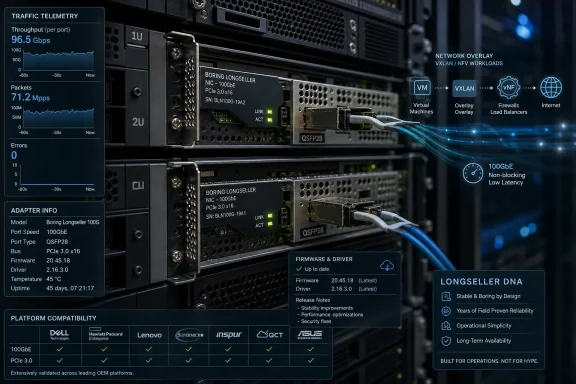 The BCM57454 Story Is Less About Speed Than Staying Power
The temptation with any NIC story is to treat the headline number as the product. A 100GbE controller sounds like a marker in a bandwidth race: faster than 25GbE, older than 200GbE and 400GbE, destined to be superseded. That view misses the way data centers actually buy, qualify, and operate network hardware.Broadcom announced the BCM57454 NetXtreme E-Series family in 2017, when 25GbE and 100GbE were moving from hyperscale novelty into broader enterprise and cloud deployments. The company positioned the controller for high-performance computing, storage, machine learning, network-function virtualization, and cloud-scale infrastructure. Those categories now read like a checklist of workloads that became mainstream over the following decade.
That chronology matters. A chip like this is not a consumer GPU with a launch spike and a rapid fade. It becomes useful when server OEMs validate it, hypervisor vendors support it, Linux distributions carry mature drivers, and operations teams stop treating it as a science project. By that measure, the BCM57454’s relevance comes from age as much as from specification.
The ad hoc news article’s investor framing is clumsy but not entirely wrong. Broadcom’s data-center franchise is built not only on headline-grabbing switching ASICs and AI networking narratives, but also on controllers, adapters, firmware, and platform relationships that persist across multiple server generations. The BCM57454 sits in that less glamorous layer: close enough to the workload to matter, standardized enough to be taken for granted.
Broadcom Built a Workhorse for the PCIe Server Era
At its core, the BCM57454 belongs to Broadcom’s NetXtreme E-Series controller line, built for high-speed Ethernet connectivity inside servers. Public Broadcom material and OEM data sheets describe BCM57454-based designs as supporting 10GbE, 25GbE, 40GbE, 50GbE, and 100GbE configurations depending on board implementation, cabling, and port presentation. In the most visible 100GbE adapter form, that usually means a QSFP28 interface on a PCIe card.That flexibility is not a footnote. Data-center networks are rarely upgraded in one clean motion. A rack may have 25GbE server access, 100GbE uplinks, and a spine layer moving toward 400GbE, all while legacy storage or appliance networks continue to run at older speeds. A controller that can participate in multiple Ethernet generations gives OEMs and operators more ways to reuse the same silicon family across different server SKUs.
The PCIe side is just as important. BCM57454-era adapters typically live in the world of PCIe 3.0 servers, where the network card has to balance throughput, lane count, power, thermals, and driver stability. That makes the NIC a platform design choice, not merely a networking accessory. In a dense 1U or 2U server, every watt and every firmware dependency matters.
Supermicro’s documentation for a BCM57454-based 100GbE adapter, for example, identifies a single QSFP28 port and a PCIe 3.0 interface. Lenovo’s ThinkSystem product guide identifies 57454-based adapters in 10/25GbE SFP28 configurations. XenServer’s hardware compatibility listing describes the BCM57454 NetXtreme-E as spanning 10Gb, 25Gb, 40Gb, 50Gb, and 100Gb Ethernet identities. The pattern is clear: this controller is less a single retail product than a silicon building block that shows up under different OEM labels.
The NIC Became Infrastructure by Vanishing Into OEM Catalogs
Most WindowsForum readers will not buy a “BCM57454” in a shrink-wrapped box. They will encounter it as a Dell, Lenovo, HPE, Supermicro, or other OEM-qualified adapter, or as an OCP NIC option in a server configurator. That distinction changes how the product should be judged.In enterprise infrastructure, the visible brand on the server often matters less than the support matrix behind it. A Broadcom-based NIC becomes acceptable when it appears in the server vendor’s compatibility list, has firmware packaged for that platform, and is covered by the same update process administrators already use. The silicon may be Broadcom’s, but the operational experience is mediated through the OEM.
That is also why a chip can remain relevant long after its launch date. Server fleets do not age out uniformly. A financial firm, university cluster, hosting provider, or regional cloud operator may run several generations of servers side by side. A mature 100GbE NIC that is well understood by the support team may be preferable to a newer adapter that offers more bandwidth but introduces qualification risk.
This is the unromantic reality behind “longseller” hardware. It persists because it fits into procurement habits, spare-parts inventories, OS images, hypervisor templates, and cabling plans. The BCM57454’s job is not to dazzle a benchmark slide; it is to keep appearing as an acceptable answer when infrastructure teams ask what NIC they can safely deploy.
Offload Features Are the Difference Between Line Rate and Real Work
A 100GbE port is only useful if the host can move packets without turning the CPU into a packet tax collector. That is where the usual alphabet soup of NIC offloads becomes central. Broadcom’s NetXtreme-E family documentation and OEM materials refer to features such as checksum offload, TCP segmentation offload, receive-side scaling, virtualization support, tunneling offloads, and RDMA-related capabilities depending on model, driver, and configuration.These features are easy to dismiss because they sound like old networking boilerplate. In virtualized and cloud environments, they are anything but. VXLAN, NVGRE, and other overlay technologies add encapsulation overhead; multi-tenant networking increases the number of logical endpoints; storage traffic may be latency-sensitive; and east-west traffic inside the data center can dwarf traffic entering from the Internet.
The practical value of the NIC is therefore not just the port speed. It is the amount of network housekeeping the adapter can absorb while leaving host cores available for virtual machines, containers, storage services, or application code. A server running dozens of tenants or storage processes does not have spare CPU cycles to waste on avoidable packet work.
This is where Broadcom’s position has historically been strong. The company sells into systems where performance is measured not merely by peak throughput, but by predictable behavior under ugly, mixed workloads. A 100GbE NIC that handles overlays, queues, interrupts, and offloads reliably can be more valuable than a faster card whose firmware has not yet earned trust.
Virtualization Made the NIC a Shared Resource, Not a Peripheral
The BCM57454’s relevance also tracks the rise of virtualization-heavy networking. Technologies such as SR-IOV allow physical NIC resources to be exposed more directly to virtual machines, reducing overhead compared with purely software-mediated networking. For NFV, storage appliances, virtual routers, and high-throughput tenant workloads, that can make the difference between acceptable and disappointing performance.But SR-IOV is also where theory often collides with administration. It depends on firmware, BIOS settings, OS support, hypervisor support, driver versions, and sometimes vendor-specific caveats. On Windows Server with Hyper-V, Linux KVM environments, VMware estates, and XenServer deployments, the question is not simply whether the silicon supports a feature. The question is whether the whole stack supports it reliably enough to turn on in production.
That is why the ecosystem around the BCM57454 matters more than a spec sheet. Broadcom’s bnxt_en driver stack in Linux, OEM-packaged Windows Server drivers, and hypervisor compatibility listings are part of the product in practice. A NIC without a mature driver is just a heat source with a port on the back.
For Windows administrators, this is especially important because NIC behavior can affect Hyper-V virtual switches, storage networking, live migration, VMQ, RSS, and failover behavior. The wrong combination of firmware and driver can turn a supposedly high-end adapter into a troubleshooting sinkhole. The right combination can make 100GbE feel uneventful, which is exactly what administrators want.
The Driver Stack Is Where Data-Center Hardware Earns Trust
No one enjoys talking about NIC firmware until it breaks. Then it becomes the whole story. Dell driver pages, Lenovo support notes, Broadcom release notes, and community reports all show the same recurring pattern across enterprise NICs: firmware and driver alignment is a permanent operational concern.That does not make the BCM57454 unusual. It makes it normal. Modern NICs are no longer simple Ethernet cards; they are programmable devices with embedded firmware, management interfaces, virtualization features, boot capabilities, and telemetry. Updating them is closer to maintaining a small subsystem than replacing a commodity peripheral.
The ad hoc news article gestures at this reality when it notes that driver headaches often decide whether a NIC is adopted or avoided. That observation is more important than the article’s market gloss. A sysadmin choosing between Intel, Broadcom, and Marvell is often choosing between known failure modes, not abstract brand reputations.
In Windows Server environments, the lesson is familiar: use the server vendor’s validated driver and firmware bundle unless there is a very specific reason not to. In Linux, distribution kernels and vendor packages may diverge, and administrators need to understand which bnxt_en version they are actually running. In VMware and other hypervisors, hardware compatibility lists and vendor add-ons can be the difference between supported and merely possible.
100GbE Won Because the Rest of the Data Center Caught Up
When 100GbE first entered the server conversation, it looked excessive for many enterprise workloads. Ten years later, the network has become the backplane for almost everything. Storage is disaggregated, application tiers are distributed, logs are streamed, telemetry is continuous, and AI inference pipelines can generate serious east-west traffic even outside hyperscale labs.This shift explains why 100GbE NICs remain useful even as 200GbE and 400GbE products advance. The network hierarchy does not upgrade at one speed. Higher-bandwidth links may appear first in spine and aggregation layers, while server access remains at 25GbE or 100GbE depending on workload density. A mature 100GbE controller still fits neatly into that architecture.
It also fits the economics. Many workloads do not need 200GbE to the host, and many server platforms cannot exploit it without creating bottlenecks elsewhere. CPU generation, PCIe bandwidth, memory bandwidth, storage design, and application behavior all influence whether a faster NIC changes real-world performance. A cheaper, cooler, better-understood 100GbE adapter can be the rational choice.
That is why the BCM57454’s market is not defined by being the fastest thing Broadcom sells. Broadcom itself now markets newer 100GbE PCIe 4.0 controllers and higher-speed 200GbE and 400GbE solutions. The BCM57454 persists because access-layer networking has a long middle age.
Hyperscale Influence Traveled Downstream
The BCM57454 was announced for workloads that were already becoming common in hyperscale infrastructure: machine learning, cloud storage, NFV, and high-performance computing. Over time, those requirements moved into smaller environments. Enterprise IT did not become Google or Microsoft, but it inherited many of the same architectural pressures.Private clouds now use overlay networks. Storage clusters push replication traffic across Ethernet. Kubernetes environments create dense service-to-service communication. Backup, analytics, and security tooling copy and inspect more data than older networks were designed to carry. Even mid-sized organizations can hit problems that once belonged mostly to hyperscalers.
This downstream migration is good for Broadcom. The company’s Ethernet business benefits when data-center design patterns standardize around high-speed fabrics. The more ordinary 25GbE and 100GbE become, the more valuable mature controller families become to OEMs building predictable platforms.
It is also good for administrators, at least in theory. Hyperscale-driven hardware eventually becomes affordable and well supported. The caveat is that enterprises inherit hyperscale complexity without always inheriting hyperscale staffing. A 100GbE NIC is only as good as the team’s ability to monitor, patch, and configure it.
Telemetry Has Become Part of the NIC’s Job Description
Network cards used to be judged largely by throughput, latency, and driver availability. Those still matter, but observability now belongs on the list. Operators need counters, error reporting, queue visibility, congestion signals, firmware inventory, and integration with fleet management tools.Broadcom’s NetXtreme-E ecosystem, like competing enterprise NIC families, exposes statistics that help administrators diagnose link problems, packet drops, offload behavior, and hardware errors. In practice, these counters are not luxuries. They are how teams distinguish a bad optic from a switch configuration issue, a driver bug from a cabling problem, or oversubscription from a failing adapter.
This is especially important at 100GbE because failures can be subtle. A link may stay up while dropping enough packets to damage storage performance. A firmware mismatch may appear only under virtualization load. An optic may pass casual inspection while generating errors under heat. The faster the network, the less useful intuition becomes.
For Windows environments, that means NIC telemetry should be part of normal operations, not a last resort. Performance Monitor, PowerShell, vendor utilities, switch counters, and centralized monitoring all need to tell the same story. A BCM57454-based adapter that disappears into the server is doing its job; a BCM57454-based adapter that disappears from monitoring is a risk.
Security Is Firmware, Supply Chain, and Update Discipline
The ad hoc news write-up mentions secure boot and signed firmware in the broader NetXtreme-E context, and that is the right direction of travel even if product-specific claims should be handled carefully. Modern NICs are part of the platform trust story. They contain firmware, expose management surfaces, and often participate in boot or pre-boot environments.That does not make every Ethernet controller a security processor. It does mean that administrators should treat NIC firmware as part of the attack surface. Signed images, vendor update channels, inventory reporting, and controlled rollout procedures matter because the network adapter is privileged hardware sitting directly on the system bus.
The industry has learned this lesson repeatedly. Baseboard management controllers, storage controllers, UEFI firmware, and NICs all complicate the old model where security patching meant operating systems and applications. The deeper the device sits in the system, the more painful it is to patch and the more consequential it becomes when ignored.
For Broadcom, the upside is that large customers value suppliers that can support long-lived firmware maintenance across OEM channels. The downside is that every bug report, compatibility issue, or update regression becomes part of the silicon’s reputation. In enterprise infrastructure, trust is cumulative and fragile.
The Windows Angle Is Supportability, Not Desktop Relevance
A 100GbE BCM57454 adapter is not a Windows enthusiast upgrade in the gaming-PC sense. It is a Windows Server and Hyper-V story. The users who care are building virtualization hosts, storage networks, lab clusters, backup targets, or high-speed test environments where Windows has to coexist with enterprise NIC assumptions.For Hyper-V, the familiar pain points are predictable. Administrators need stable drivers, functioning offloads, sane SR-IOV behavior, reliable firmware updates, and clear guidance on features such as VMQ, RSS, SET teaming, and RDMA where applicable. A high-speed adapter can expose poor defaults quickly because 100GbE magnifies configuration mistakes.
There is also a homelab angle, though it comes with warnings. As 100GbE adapters age out of enterprise fleets, they become more available on secondary markets. That can tempt enthusiasts into cheap high-speed networking experiments. The catch is that optics, DACs, switch compatibility, airflow, firmware provenance, and driver support can erase the apparent bargain.
WindowsForum readers should therefore see the BCM57454 as a reminder of a broader rule: enterprise NICs are ecosystems, not components. Buying the card is the easy part. Running it well means understanding the server platform, switch environment, operating system, and update chain.
Broadcom’s Investor Story Runs Through Boring Infrastructure
The original article’s stock-market language is awkwardly bolted onto a product note, but the underlying investor point deserves a better treatment. Broadcom’s strength in data-center networking is not dependent on one controller, and no serious investor should treat the BCM57454 alone as a buy-or-sell signal. Still, products like this explain why Broadcom’s infrastructure business has durable appeal.Ethernet silicon is sticky. Once a vendor’s controller family is qualified across major OEM platforms and deployed in production fleets, replacement is slow. Customers do not casually swap NIC silicon across thousands of servers unless there is a cost, performance, supply, or support reason. That gives incumbents a structural advantage.
Broadcom has also benefited from selling across multiple layers of the data-center stack: NICs, switching silicon, optical components, and related connectivity products. The BCM57454 is only one tile in that mosaic, but it reflects the broader strategy. Ethernet becomes more valuable as compute becomes more distributed.
The caution is that maturity cuts both ways. A long-lived 100GbE controller is evidence of product durability, not explosive growth. The growth story now leans toward AI networking, higher-speed switching, PCIe 5.0-class controllers, co-packaged optics, and the broader acceleration of data-center buildouts. BCM57454 is part of the installed-base argument, not the frontier argument.
Competition Keeps the NIC Market Honest
Broadcom does not own this space uncontested. Intel, Marvell, NVIDIA through its Mellanox lineage, and other vendors all shape the high-speed Ethernet and data-center adapter market. Enterprises often qualify multiple NIC vendors to reduce supply-chain risk and avoid being trapped by a single firmware ecosystem.That competition is healthy for buyers. It forces vendors to improve driver quality, support modern offloads, maintain compatibility with hypervisors, and document issues. It also gives large customers leverage when negotiating server configurations. In a world where every rack is a bundle of dependencies, vendor diversity is a form of operational insurance.
The trade-off is complexity. Multi-vendor NIC fleets require broader driver knowledge, more firmware catalogs, and more test coverage. A standardized Broadcom fleet may be easier to operate; a mixed fleet may be more resilient commercially. There is no universal answer.
For many organizations, the practical compromise is workload segmentation. Storage clusters may standardize on one NIC family, virtualization hosts on another, and edge appliances on whatever the OEM validates. The BCM57454’s value is strongest where it fits an already-supported Broadcom operational model.
The Upgrade Path Is Incremental, Not Revolutionary
For a server team moving from 10GbE or 40GbE, a BCM57454-based 100GbE adapter can still feel like a major leap. For a hyperscaler deploying the latest AI fabrics, it is yesterday’s access technology. Both views are true, which is why infrastructure discussions often become confused.The right question is not whether 100GbE is “current” in the abstract. The right question is whether it matches the workload, server bus, switching fabric, cabling plan, and refresh cycle. Many organizations still have abundant room to benefit from 25GbE and 100GbE before higher-speed host networking becomes necessary.
Breakout support adds to that flexibility. QSFP28-based 100GbE infrastructure can often participate in 4x25GbE designs, allowing operators to bridge generations of network design. That makes the technology useful during transitions, not only at the destination.
The harder part is planning the operational transition. Higher speed can expose weak switch buffers, poor traffic engineering, insufficient monitoring, and outdated troubleshooting habits. A 100GbE NIC upgrade is not just a card swap; it is a test of the whole network culture.
The Ad Hoc Framing Gets the Product Right and the Stakes Half Right
The supplied ad hoc news piece correctly treats the BCM57454 as a data-center NIC rather than a consumer product. It also correctly emphasizes OEM integration, cloud and enterprise workloads, offloads, virtualization, and Broadcom’s broader data-center portfolio. Those are the right ingredients.Where it overreaches is in the texture. Claims about named architects, lab scenes, and precise street-pricing ranges should be treated cautiously unless independently verified. Product journalism is strongest when it separates what the vendor documents, what OEMs validate, what users report, and what the writer infers.
That distinction matters because enterprise hardware coverage can easily become brochure prose. A NIC is not important because a press release says it targets machine learning or cloud storage. It is important if it survives qualification, performs predictably, and remains supportable through years of firmware and operating-system churn.
The BCM57454 passes the relevance test not because every marketing claim is exciting, but because the product appears across real OEM documentation and compatibility ecosystems. That is the evidence administrators should care about. In infrastructure, paper launches are cheap; validated adapters are the currency.
The Practical Lesson Hidden in a 2017 Controller
The BCM57454’s most useful lesson is that data-center modernization is not a sequence of clean replacements. It is a layered accumulation of technologies that become dependable at different speeds. By the time a controller feels uninteresting, it may finally be ready for broad deployment.That is a humbling idea for the industry’s launch-cycle obsession. The most consequential hardware is often not the newest product on the roadmap, but the one that has spent years being integrated, patched, documented, and normalized. For administrators, that is not cynicism. It is survival.
The same lesson applies to Windows Server shops evaluating high-speed networking today. A newer NIC may offer better headline bandwidth or PCIe efficiency, but the mature choice may offer fewer surprises. The correct answer depends on workload and lifecycle, not on spec-sheet vanity.
For Broadcom, this is precisely the kind of product that strengthens a platform business. It gives OEMs a known quantity, customers a supportable path, and the company a foothold in fleets that refresh slowly. The BCM57454 may not define Broadcom’s future, but it helps explain the foundation on which that future is being sold.
The Rack-Level Reality Behind Broadcom’s 100GbE Longseller
The main point for IT buyers is simple: the BCM57454 is mature infrastructure silicon, not breaking news. That makes it less exciting for launch coverage and more relevant for anyone maintaining real server estates.- The BCM57454 was announced by Broadcom in April 2017 as part of the NetXtreme E-Series 100GbE controller family for cloud, storage, machine-learning, NFV, and enterprise workloads.
- The controller commonly appears through OEM-qualified adapters and server configurations rather than as a consumer-facing retail product.
- Its practical value comes from 25GbE/50GbE/100GbE flexibility, virtualization support, offload capabilities, and a mature driver ecosystem.
- Windows Server and Hyper-V administrators should focus on OEM-validated firmware and drivers rather than generic silicon-level claims.
- The product’s longevity supports Broadcom’s broader data-center networking story, but it is not by itself an investment thesis.
- 100GbE remains highly relevant at the server access layer even as newer 200GbE and 400GbE technologies advance elsewhere in the data center.
References
- Primary source: AD HOC NEWS
Published: 2026-07-05T10:27:14.680709
Loading…
www.ad-hoc-news.de - Related coverage: broadcom.com
Loading…
www.broadcom.com - Related coverage: device.report
Loading…
device.report - Related coverage: raidshop.ru
Loading…
www.raidshop.ru - Related coverage: manuals.plus
Loading…
manuals.plus - Related coverage: docs.broadcom.com
Loading…
docs.broadcom.com
