

Microsoft ended support for Windows Phone 8.1 on July 11, 2017, moving the mobile operating system into end-of-support status and stopping all updates, including security fixes, for the platform that once represented Redmond’s most credible attempt to challenge iOS and Android. That date did not kill Windows Phone so much as certify a death that users, developers, carriers, and Microsoft itself had already begun to accept. The real story is not that one more obsolete OS fell off a lifecycle page. It is that Microsoft’s mobile defeat became a case study in how late strategy, weak ecosystem incentives, and corporate hesitation can overwhelm genuinely good product design.
By the time Windows Phone 8.1 reached the end of support, the market had already rendered its verdict. The platform’s share had collapsed to a rounding error, app developers had mostly moved on, and Microsoft’s own public enthusiasm had shifted toward getting its services onto iPhones and Android devices rather than persuading customers to buy Windows handsets.
That distinction matters because end-of-support dates often sound administrative, almost clerical. A product leaves support, a lifecycle table changes, and a vendor recommends migration. But for operating systems, particularly connected ones carried in pockets, support is not a courtesy. It is the minimum condition for safe use.
Once security updates stop, a phone becomes a frozen target. It may still boot, still place calls, still open photos, and still feel perfectly familiar in the hand. But the trust relationship has changed. Users are no longer holding a platform that Microsoft is defending; they are holding a relic with radios, accounts, stored credentials, and an increasingly stale browser engine.
Windows Phone fans understandably bristled at the word “dead” because the device in their pocket did not immediately stop working. Yet in platform terms, death is not when the screen goes black. It is when the vendor stops maintaining the bargain that modern computing depends on: you keep using the system, and the system’s maker keeps patching the holes.
Live Tiles made the home screen feel alive without turning it into a cluttered grid of badges. The Metro design language, later renamed and diffused across Microsoft products, gave Windows Phone a sense of identity that Android often lacked in its fragmented early years. Even critics who had no intention of buying one could see that Microsoft had produced something with taste.
But beautiful interfaces do not become platforms by themselves. In mobile, the operating system is only one layer of the product. The real platform is the sum of hardware availability, carrier support, developer attention, service compatibility, accessory ecosystems, payment systems, enterprise management, and user habit. Microsoft had some of those pieces. Apple and Google had more, and they had them earlier.
The app gap became the shorthand, but the problem was broader than raw app counts. The issue was confidence. Developers did not want to invest heavily in Windows Phone until users arrived. Users did not want to buy Windows Phones until apps arrived. Carriers did not want to promote devices that customers were not asking for. The loop fed on itself, and Microsoft never broke it.
Even when major services did show up, their Windows Phone versions often lagged behind their iOS and Android counterparts. A second-class app can be worse than no app at all because it reminds users every day that they chose the platform on the outside of the party. In consumer technology, social proof is not vanity. It is infrastructure.
Microsoft’s deeper problem was timing. The iPhone arrived in 2007, Android followed quickly, and by the time Windows Phone 7 appeared in 2010, the new smartphone market had already begun to consolidate around Apple’s premium model and Google’s licensing model. Microsoft entered with a third model that needed both hardware partners and developer enthusiasm, but it no longer had the leverage it enjoyed in the PC era.
On desktop Windows, developers came because users were there. OEMs shipped Windows because applications were there. Enterprises standardized on Windows because the hardware, software, and support ecosystem reinforced itself. Microsoft’s mobile bet assumed that some version of this flywheel could be rebuilt on phones.
But smartphones did not behave like PCs. Consumers replaced them faster, carriers mediated distribution, app stores centralized discovery, and touch-first software rewarded new design patterns. Microsoft could not simply bring the Windows gravitational field to mobile. It had to earn a new one.
The company also faced the awkward burden of its own history. Windows Mobile had existed for years before Windows Phone, but it belonged to the stylus-and-menu era. Microsoft had a mobile business before the iPhone, yet that legacy did not give it a head start when the definition of a smartphone changed. In some ways, it slowed the company down because it made the new world look like an extension of the old one.
By the time Microsoft understood that mobile was not a peripheral category but the center of personal computing, Apple and Google were already shaping the expectations of users and developers. The app gap was therefore not merely a catalog problem. It was the visible scar of a strategic delay.
For a while, that mattered. The Lumia 520 became a beloved budget device, and higher-end Lumias proved that Windows Phone could be fast, fluid, and visually differentiated on hardware that did not always need flagship specifications. In a market where Android’s low-end experience could still be rough, Windows Phone often felt remarkably polished.
But Nokia’s commitment also exposed the weakness of the broader ecosystem. As Samsung, HTC, and LG focused overwhelmingly on Android, Windows Phone became increasingly synonymous with Lumia. That made the platform more coherent, but also more fragile. If Lumia did not win, Windows Phone did not have many other paths to victory.
Microsoft’s later acquisition of Nokia’s devices business was supposed to solve the alignment problem. Instead, it confirmed how narrow the runway had become. Owning the handset maker gave Microsoft control, but control was not the missing ingredient. Demand was.
The acquisition also placed Microsoft in a difficult relationship with its remaining hardware partners. The company wanted an ecosystem, but it now competed with the companies it needed to populate that ecosystem. Google had Nexus and later Pixel devices, but Android’s scale gave partners a reason to tolerate Google’s first-party ambitions. Windows Phone did not have that luxury.
When Microsoft eventually wrote down the Nokia deal and cut deep into its phone division, it was not simply reversing a bad acquisition. It was admitting that hardware control could not compensate for platform weakness. Lumia gave Windows Phone its best face. It could not give it a future on its own.
On paper, that was exactly the kind of ecosystem lever Microsoft should have been able to pull. In practice, the mobile side of the equation was too small to make the math compelling. Developers might target Windows PCs, but that did not automatically mean they would design rich phone experiences for a shrinking handset base.
The upgrade path also diluted the rescue. Only some Windows Phone 8.1 devices could move to Windows 10 Mobile, leaving many users stranded on the older platform. That fragmentation undercut one of Microsoft’s strongest arguments: that Windows could offer a more orderly, predictable experience than Android’s scattered update landscape.
There was also the problem of attention. Microsoft could say it still supported mobile, and technically it did. But the company’s strategic center had shifted. Office on iOS mattered. Outlook on Android mattered. Azure Active Directory, Intune, OneDrive, Teams, and Microsoft’s identity layer mattered across every device a customer already owned. Winning the phone OS mattered less with every passing quarter.
That was a rational pivot under Satya Nadella’s Microsoft. The company’s future was cloud, subscriptions, enterprise services, developer tooling, and cross-platform productivity. But for Windows Phone users, it felt like watching the platform become a bargaining chip in someone else’s strategy. Microsoft no longer needed to sell you a Windows phone to keep you in Microsoft’s world.
The end of Windows Phone 8.1 support made that shift plain. Windows 10 Mobile would linger for a while longer, but the center of gravity had moved. Microsoft’s mobile future would live on other companies’ operating systems.
For many enthusiasts, the immediate risk may have seemed abstract. Windows Phone was never the malware magnet that Android became in some markets, and its tiny user base made it a less attractive target. But obscurity is not a security model. Unsupported software is unsupported software, whether it runs on a billion devices or a few forgotten handsets in drawers.
The danger was amplified by the nature of phones. A smartphone is not just a browser and a dialer. It is a password vault, a two-factor authentication endpoint, a photo archive, a location recorder, a messaging hub, a work email device, and often a payment-adjacent identity token. Running all of that on an abandoned OS asks users to carry personal risk for the sake of nostalgia.
For IT administrators, the answer was clearer. Unsupported mobile operating systems should not be allowed anywhere near corporate data. Mobile device management policies exist precisely because endpoints age out, vendors change support terms, and security baselines move. A Windows Phone 8.1 handset after July 11, 2017, belonged outside the trusted fleet.
That is the cold arithmetic of lifecycle management. Sentiment does not patch vulnerabilities. Elegance does not update certificate stores. A stable device can still be an unsafe device if the ecosystem around it has moved on.
That outcome was not inevitable in 2010. The post-BlackBerry era still had room for imagination. Carriers wanted leverage against Apple. OEMs wanted differentiation from one another. Developers were still learning what mobile software could become. Microsoft had money, brand recognition, enterprise reach, and a massive developer base.
But platform markets tip when the incentives align around the leaders. Once developers prioritize iOS and Android first, users follow. Once users follow, accessory makers, banks, automakers, media companies, game studios, and employers follow. Once all of them follow, a third platform is not merely behind; it is asking the entire market to do extra work for uncertain return.
Windows Phone’s failure therefore narrowed more than Microsoft’s options. It narrowed the industry’s imagination. A two-platform world is simpler for developers and buyers, but it also concentrates power over app distribution, payments, privacy defaults, browser engines, messaging standards, and device policy. Microsoft’s loss helped Apple and Google become the mobile gatekeepers of the next decade.
There is irony in that. Microsoft spent the 1990s as the company regulators and competitors feared would control the platform layer forever. In mobile, it became the outsider arguing for a chance to compete. The former monopolist discovered what it felt like to be on the wrong side of network effects.
Outlook, Office, OneDrive, Authenticator, Teams, Edge, Copilot, Microsoft Launcher, and enterprise management tools all made iOS and Android more useful for Microsoft customers. The company stopped treating rival platforms as enemy territory and started treating them as distribution channels. That was less romantic than building a third ecosystem, but it was much better business.
For users, this meant the practical loss was softened. A former Windows Phone owner could move to Android or iPhone and still carry much of Microsoft’s software life along. Mail, documents, cloud storage, identity, and workplace collaboration could survive the OS migration. The tiles were gone, but the account remained.
For Microsoft, this was the strategic escape hatch. The company no longer needed Windows everywhere to make money everywhere. Azure did not require Windows Phone. Microsoft 365 did not require Windows Phone. Enterprise identity did not require Windows Phone. In a cloud-first company, the endpoint could be someone else’s problem.
That makes Windows Phone feel less like a simple failure and more like a transitional casualty. It belonged to a version of Microsoft that still believed owning the client operating system was the central condition of power. The Microsoft that emerged afterward learned to rent space on every client and own the services behind them.
Still, something was lost. Cross-platform pragmatism is good business, but it rarely produces the kind of end-user delight that Windows Phone briefly offered. Microsoft became more successful on mobile by becoming less distinctive there.
But the affection was real because the product had virtues that survived the business failure. It was fast on modest hardware. It had a design language that did not feel like a clone. It integrated contacts and communications in ways that tried to put people before apps. It offered a home screen that was glanceable without becoming chaotic.
Those ideas have echoed elsewhere, sometimes indirectly. Widgets, dynamic app icons, notification summaries, and ambient information all reflect the same broad desire Live Tiles pursued: make the phone useful before the user dives into an app. Microsoft did not win that design argument commercially, but it was asking a question the industry kept revisiting.
The platform also mattered to users who did not want the Apple-Google binary. Some preferred Microsoft’s ecosystem. Some liked Lumia cameras. Some wanted a phone that felt different. Some simply enjoyed rooting for the underdog when the underdog happened to be one of the largest software companies in history.
That emotional residue is why the phrase “officially dead” had power. It marked the end of a product, but also the end of a possibility. For a brief period, the smartphone future looked as though it might have three major operating systems with three genuinely different design philosophies. After Windows Phone, that future closed.
Microsoft still manages those forces around Windows on the PC. The company has enormous advantages there: installed base, backward compatibility, enterprise dependency, gaming, developer tools, and decades of institutional inertia. But those advantages are not magic. They must be maintained.
Windows Phone shows what happens when users and developers stop believing that a platform is where the future will happen. Once that belief breaks, technical quality alone cannot repair it. A good interface, a clever SDK, or a promising hardware partner cannot substitute for momentum.
The comparison is especially relevant as Microsoft pushes Windows deeper into AI-assisted computing, cloud identity, subscription services, and stricter hardware requirements. The company is again asking users and administrators to trust its roadmap. It is again balancing legacy support against forward motion. It is again trying to make developers believe that the next Windows bet is worth their time.
The difference is that desktop Windows remains too important to abandon casually. But importance is not the same as invulnerability. The lesson of Windows Phone is that platform owners must keep earning participation from every side of the market. When they do not, the decline can look gradual for years and then sudden on a lifecycle page.
It also explains why Microsoft’s Android work, from Surface Duo to mobile app integration in Windows, has always carried a faint sense of unfinished business. The company knows mobile is too important to ignore, but it no longer controls the dominant mobile platforms. Its influence flows through apps, cloud services, developer frameworks, management tools, and AI assistants rather than through the base OS.
For enterprise IT, this is not necessarily bad. Microsoft’s cross-platform management posture is more realistic than a Windows-only fantasy would be. Organizations need to manage iPhones, Android devices, Macs, Windows PCs, browsers, and cloud identities together. Microsoft’s post-Windows Phone strategy fits that world.
For consumers, the tradeoff is subtler. Microsoft is everywhere on phones now, but rarely as the author of the experience. It can shape workflows, not the whole device. It can provide the keyboard, launcher, browser, storage, mail client, and assistant, but Apple and Google still set the rules of the road.
That is why Windows Phone remains more than a nostalgic footnote. It was Microsoft’s last serious attempt to own the personal mobile computing experience end to end. Everything since has been adaptation.
Windows Phone deserved a better fate than becoming a punchline, but technology history is not a museum of deserved outcomes. Microsoft built a mobile OS with personality, squandered too much time finding its footing, and then discovered that ecosystems do not wait for late arrivals to become ready. The phones are now artifacts, the tiles are memories, and the mobile Microsoft that survived is a services company living inside Apple’s and Google’s houses; the next platform shift will test whether Redmond remembers that even giants can arrive too late.
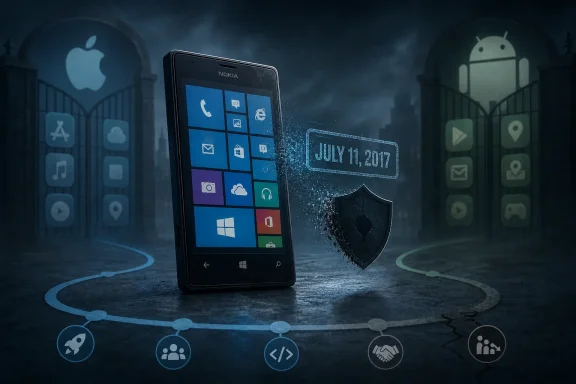 The Death Certificate Arrived After the Funeral
By the time Windows Phone 8.1 reached the end of support, the market had already rendered its verdict. The platform’s share had collapsed to a rounding error, app developers had mostly moved on, and Microsoft’s own public enthusiasm had shifted toward getting its services onto iPhones and Android devices rather than persuading customers to buy Windows handsets.That distinction matters because end-of-support dates often sound administrative, almost clerical. A product leaves support, a lifecycle table changes, and a vendor recommends migration. But for operating systems, particularly connected ones carried in pockets, support is not a courtesy. It is the minimum condition for safe use.
Once security updates stop, a phone becomes a frozen target. It may still boot, still place calls, still open photos, and still feel perfectly familiar in the hand. But the trust relationship has changed. Users are no longer holding a platform that Microsoft is defending; they are holding a relic with radios, accounts, stored credentials, and an increasingly stale browser engine.
Windows Phone fans understandably bristled at the word “dead” because the device in their pocket did not immediately stop working. Yet in platform terms, death is not when the screen goes black. It is when the vendor stops maintaining the bargain that modern computing depends on: you keep using the system, and the system’s maker keeps patching the holes.
Microsoft Had the Better Interface and the Worse Ecosystem
The tragedy of Windows Phone is that it was not a bad idea. In some ways, it was the most visually coherent smartphone operating system of its era. The tile-based interface was not merely a skin over iPhone conventions; it was a distinct philosophy about glancable information, typography, motion, and hierarchy.Live Tiles made the home screen feel alive without turning it into a cluttered grid of badges. The Metro design language, later renamed and diffused across Microsoft products, gave Windows Phone a sense of identity that Android often lacked in its fragmented early years. Even critics who had no intention of buying one could see that Microsoft had produced something with taste.
But beautiful interfaces do not become platforms by themselves. In mobile, the operating system is only one layer of the product. The real platform is the sum of hardware availability, carrier support, developer attention, service compatibility, accessory ecosystems, payment systems, enterprise management, and user habit. Microsoft had some of those pieces. Apple and Google had more, and they had them earlier.
The app gap became the shorthand, but the problem was broader than raw app counts. The issue was confidence. Developers did not want to invest heavily in Windows Phone until users arrived. Users did not want to buy Windows Phones until apps arrived. Carriers did not want to promote devices that customers were not asking for. The loop fed on itself, and Microsoft never broke it.
Even when major services did show up, their Windows Phone versions often lagged behind their iOS and Android counterparts. A second-class app can be worse than no app at all because it reminds users every day that they chose the platform on the outside of the party. In consumer technology, social proof is not vanity. It is infrastructure.
The App Gap Was a Symptom, Not the Disease
It is tempting to say Windows Phone failed because it lacked apps. That is true in the same way a patient dies because the heart stops. It describes the final condition, not the full pathology.Microsoft’s deeper problem was timing. The iPhone arrived in 2007, Android followed quickly, and by the time Windows Phone 7 appeared in 2010, the new smartphone market had already begun to consolidate around Apple’s premium model and Google’s licensing model. Microsoft entered with a third model that needed both hardware partners and developer enthusiasm, but it no longer had the leverage it enjoyed in the PC era.
On desktop Windows, developers came because users were there. OEMs shipped Windows because applications were there. Enterprises standardized on Windows because the hardware, software, and support ecosystem reinforced itself. Microsoft’s mobile bet assumed that some version of this flywheel could be rebuilt on phones.
But smartphones did not behave like PCs. Consumers replaced them faster, carriers mediated distribution, app stores centralized discovery, and touch-first software rewarded new design patterns. Microsoft could not simply bring the Windows gravitational field to mobile. It had to earn a new one.
The company also faced the awkward burden of its own history. Windows Mobile had existed for years before Windows Phone, but it belonged to the stylus-and-menu era. Microsoft had a mobile business before the iPhone, yet that legacy did not give it a head start when the definition of a smartphone changed. In some ways, it slowed the company down because it made the new world look like an extension of the old one.
By the time Microsoft understood that mobile was not a peripheral category but the center of personal computing, Apple and Google were already shaping the expectations of users and developers. The app gap was therefore not merely a catalog problem. It was the visible scar of a strategic delay.
Nokia Gave Windows Phone a Body, but Not Enough Blood
The Nokia partnership gave Windows Phone its most memorable hardware and its most persuasive story. Lumia devices brought color, strong cameras, distinctive industrial design, and a sense that someone was building phones specifically for Microsoft’s vision rather than treating Windows Phone as an experiment on the side.For a while, that mattered. The Lumia 520 became a beloved budget device, and higher-end Lumias proved that Windows Phone could be fast, fluid, and visually differentiated on hardware that did not always need flagship specifications. In a market where Android’s low-end experience could still be rough, Windows Phone often felt remarkably polished.
But Nokia’s commitment also exposed the weakness of the broader ecosystem. As Samsung, HTC, and LG focused overwhelmingly on Android, Windows Phone became increasingly synonymous with Lumia. That made the platform more coherent, but also more fragile. If Lumia did not win, Windows Phone did not have many other paths to victory.
Microsoft’s later acquisition of Nokia’s devices business was supposed to solve the alignment problem. Instead, it confirmed how narrow the runway had become. Owning the handset maker gave Microsoft control, but control was not the missing ingredient. Demand was.
The acquisition also placed Microsoft in a difficult relationship with its remaining hardware partners. The company wanted an ecosystem, but it now competed with the companies it needed to populate that ecosystem. Google had Nexus and later Pixel devices, but Android’s scale gave partners a reason to tolerate Google’s first-party ambitions. Windows Phone did not have that luxury.
When Microsoft eventually wrote down the Nokia deal and cut deep into its phone division, it was not simply reversing a bad acquisition. It was admitting that hardware control could not compensate for platform weakness. Lumia gave Windows Phone its best face. It could not give it a future on its own.
Windows 10 Mobile Was a Bridge to a Shore Microsoft Had Already Left
Windows 10 Mobile was supposed to clarify the strategy. The promise of one Windows family across PCs, tablets, Xbox, and phones sounded elegant, especially to Windows loyalists and IT departments tired of fragmented device management. Universal Windows Platform apps were pitched as a way to let developers target multiple device classes with shared code.On paper, that was exactly the kind of ecosystem lever Microsoft should have been able to pull. In practice, the mobile side of the equation was too small to make the math compelling. Developers might target Windows PCs, but that did not automatically mean they would design rich phone experiences for a shrinking handset base.
The upgrade path also diluted the rescue. Only some Windows Phone 8.1 devices could move to Windows 10 Mobile, leaving many users stranded on the older platform. That fragmentation undercut one of Microsoft’s strongest arguments: that Windows could offer a more orderly, predictable experience than Android’s scattered update landscape.
There was also the problem of attention. Microsoft could say it still supported mobile, and technically it did. But the company’s strategic center had shifted. Office on iOS mattered. Outlook on Android mattered. Azure Active Directory, Intune, OneDrive, Teams, and Microsoft’s identity layer mattered across every device a customer already owned. Winning the phone OS mattered less with every passing quarter.
That was a rational pivot under Satya Nadella’s Microsoft. The company’s future was cloud, subscriptions, enterprise services, developer tooling, and cross-platform productivity. But for Windows Phone users, it felt like watching the platform become a bargaining chip in someone else’s strategy. Microsoft no longer needed to sell you a Windows phone to keep you in Microsoft’s world.
The end of Windows Phone 8.1 support made that shift plain. Windows 10 Mobile would linger for a while longer, but the center of gravity had moved. Microsoft’s mobile future would live on other companies’ operating systems.
The Security Warning Was the Most Honest Part of the Obituary
The most practical consequence of the Windows Phone 8.1 support cutoff was security. No more updates meant no more fixes for newly discovered vulnerabilities, no more platform-level hardening, and no assurance that Microsoft would respond if something broke in a way that exposed users.For many enthusiasts, the immediate risk may have seemed abstract. Windows Phone was never the malware magnet that Android became in some markets, and its tiny user base made it a less attractive target. But obscurity is not a security model. Unsupported software is unsupported software, whether it runs on a billion devices or a few forgotten handsets in drawers.
The danger was amplified by the nature of phones. A smartphone is not just a browser and a dialer. It is a password vault, a two-factor authentication endpoint, a photo archive, a location recorder, a messaging hub, a work email device, and often a payment-adjacent identity token. Running all of that on an abandoned OS asks users to carry personal risk for the sake of nostalgia.
For IT administrators, the answer was clearer. Unsupported mobile operating systems should not be allowed anywhere near corporate data. Mobile device management policies exist precisely because endpoints age out, vendors change support terms, and security baselines move. A Windows Phone 8.1 handset after July 11, 2017, belonged outside the trusted fleet.
That is the cold arithmetic of lifecycle management. Sentiment does not patch vulnerabilities. Elegance does not update certificate stores. A stable device can still be an unsafe device if the ecosystem around it has moved on.
The Duopoly Won Because It Became Boringly Inevitable
The end of Windows Phone hardened the smartphone market into the two-platform structure that still defines it: iOS for Apple’s integrated hardware and services stack, Android for everyone else. There are alternative mobile operating systems, and there are regional variants, privacy-focused builds, and enthusiast projects. None has meaningfully displaced the duopoly for mainstream consumers.That outcome was not inevitable in 2010. The post-BlackBerry era still had room for imagination. Carriers wanted leverage against Apple. OEMs wanted differentiation from one another. Developers were still learning what mobile software could become. Microsoft had money, brand recognition, enterprise reach, and a massive developer base.
But platform markets tip when the incentives align around the leaders. Once developers prioritize iOS and Android first, users follow. Once users follow, accessory makers, banks, automakers, media companies, game studios, and employers follow. Once all of them follow, a third platform is not merely behind; it is asking the entire market to do extra work for uncertain return.
Windows Phone’s failure therefore narrowed more than Microsoft’s options. It narrowed the industry’s imagination. A two-platform world is simpler for developers and buyers, but it also concentrates power over app distribution, payments, privacy defaults, browser engines, messaging standards, and device policy. Microsoft’s loss helped Apple and Google become the mobile gatekeepers of the next decade.
There is irony in that. Microsoft spent the 1990s as the company regulators and competitors feared would control the platform layer forever. In mobile, it became the outsider arguing for a chance to compete. The former monopolist discovered what it felt like to be on the wrong side of network effects.
Microsoft Lost the Phone and Won the User Anyway
The strangest part of the Windows Phone story is that Microsoft’s retreat from mobile operating systems did not produce a retreat from mobile computing. If anything, Microsoft became more present on phones after it stopped trying to make the phone itself.Outlook, Office, OneDrive, Authenticator, Teams, Edge, Copilot, Microsoft Launcher, and enterprise management tools all made iOS and Android more useful for Microsoft customers. The company stopped treating rival platforms as enemy territory and started treating them as distribution channels. That was less romantic than building a third ecosystem, but it was much better business.
For users, this meant the practical loss was softened. A former Windows Phone owner could move to Android or iPhone and still carry much of Microsoft’s software life along. Mail, documents, cloud storage, identity, and workplace collaboration could survive the OS migration. The tiles were gone, but the account remained.
For Microsoft, this was the strategic escape hatch. The company no longer needed Windows everywhere to make money everywhere. Azure did not require Windows Phone. Microsoft 365 did not require Windows Phone. Enterprise identity did not require Windows Phone. In a cloud-first company, the endpoint could be someone else’s problem.
That makes Windows Phone feel less like a simple failure and more like a transitional casualty. It belonged to a version of Microsoft that still believed owning the client operating system was the central condition of power. The Microsoft that emerged afterward learned to rent space on every client and own the services behind them.
Still, something was lost. Cross-platform pragmatism is good business, but it rarely produces the kind of end-user delight that Windows Phone briefly offered. Microsoft became more successful on mobile by becoming less distinctive there.
The Fans Were Not Wrong to Mourn It
Windows Phone nostalgia can be easy to mock, especially when it drifts into alternate-history certainty. Yes, the app catalog was thin. Yes, Microsoft rebooted its mobile strategy too many times. Yes, the platform missed features that users expected, and yes, the market did not owe Microsoft a third chance.But the affection was real because the product had virtues that survived the business failure. It was fast on modest hardware. It had a design language that did not feel like a clone. It integrated contacts and communications in ways that tried to put people before apps. It offered a home screen that was glanceable without becoming chaotic.
Those ideas have echoed elsewhere, sometimes indirectly. Widgets, dynamic app icons, notification summaries, and ambient information all reflect the same broad desire Live Tiles pursued: make the phone useful before the user dives into an app. Microsoft did not win that design argument commercially, but it was asking a question the industry kept revisiting.
The platform also mattered to users who did not want the Apple-Google binary. Some preferred Microsoft’s ecosystem. Some liked Lumia cameras. Some wanted a phone that felt different. Some simply enjoyed rooting for the underdog when the underdog happened to be one of the largest software companies in history.
That emotional residue is why the phrase “officially dead” had power. It marked the end of a product, but also the end of a possibility. For a brief period, the smartphone future looked as though it might have three major operating systems with three genuinely different design philosophies. After Windows Phone, that future closed.
The Lesson for Windows Is Not Comforting
Windows enthusiasts should resist the temptation to file this away as a mobile-only cautionary tale. The forces that killed Windows Phone are not confined to phones. They appear wherever platforms depend on developers, user trust, hardware alignment, and credible long-term commitment.Microsoft still manages those forces around Windows on the PC. The company has enormous advantages there: installed base, backward compatibility, enterprise dependency, gaming, developer tools, and decades of institutional inertia. But those advantages are not magic. They must be maintained.
Windows Phone shows what happens when users and developers stop believing that a platform is where the future will happen. Once that belief breaks, technical quality alone cannot repair it. A good interface, a clever SDK, or a promising hardware partner cannot substitute for momentum.
The comparison is especially relevant as Microsoft pushes Windows deeper into AI-assisted computing, cloud identity, subscription services, and stricter hardware requirements. The company is again asking users and administrators to trust its roadmap. It is again balancing legacy support against forward motion. It is again trying to make developers believe that the next Windows bet is worth their time.
The difference is that desktop Windows remains too important to abandon casually. But importance is not the same as invulnerability. The lesson of Windows Phone is that platform owners must keep earning participation from every side of the market. When they do not, the decline can look gradual for years and then sudden on a lifecycle page.
Redmond’s Mobile Misfire Still Explains the Modern Microsoft
Windows Phone’s demise helped define the Microsoft we know now. The company that once tried to bring Windows to every screen now brings Microsoft services to every screen. That strategic humility has been enormously successful, but it was learned the hard way.It also explains why Microsoft’s Android work, from Surface Duo to mobile app integration in Windows, has always carried a faint sense of unfinished business. The company knows mobile is too important to ignore, but it no longer controls the dominant mobile platforms. Its influence flows through apps, cloud services, developer frameworks, management tools, and AI assistants rather than through the base OS.
For enterprise IT, this is not necessarily bad. Microsoft’s cross-platform management posture is more realistic than a Windows-only fantasy would be. Organizations need to manage iPhones, Android devices, Macs, Windows PCs, browsers, and cloud identities together. Microsoft’s post-Windows Phone strategy fits that world.
For consumers, the tradeoff is subtler. Microsoft is everywhere on phones now, but rarely as the author of the experience. It can shape workflows, not the whole device. It can provide the keyboard, launcher, browser, storage, mail client, and assistant, but Apple and Google still set the rules of the road.
That is why Windows Phone remains more than a nostalgic footnote. It was Microsoft’s last serious attempt to own the personal mobile computing experience end to end. Everything since has been adaptation.
The Coffin Nail Was Small, but the Platform Lesson Was Huge
The end of Windows Phone 8.1 support was a lifecycle event with consequences far beyond a single version number. It clarified what users should do, what administrators should block, and what Microsoft had already decided about its future.- Windows Phone 8.1 devices should be treated as unsupported endpoints because they no longer receive security fixes from Microsoft.
- Windows 10 Mobile extended the story for some handsets, but it did not reverse the platform’s decline or restore developer confidence.
- The app gap mattered because it reflected a deeper failure to build durable incentives for users, developers, carriers, and hardware partners.
- Lumia hardware gave Windows Phone identity and credibility, but it could not compensate for weak market momentum.
- Microsoft’s mobile strategy survived by moving its apps and services onto iOS and Android instead of continuing to fight for its own phone OS.
- The collapse remains relevant to Windows because platform trust depends on visible commitment, not just technical merit.
Windows Phone deserved a better fate than becoming a punchline, but technology history is not a museum of deserved outcomes. Microsoft built a mobile OS with personality, squandered too much time finding its footing, and then discovered that ecosystems do not wait for late arrivals to become ready. The phones are now artifacts, the tiles are memories, and the mobile Microsoft that survived is a services company living inside Apple’s and Google’s houses; the next platform shift will test whether Redmond remembers that even giants can arrive too late.
References
- Primary source: Mashable
Published: 2026-06-13T19:20:11.364527
Windows Phone is officially dead as Microsoft ends support | Mashable
Microsoft ended support for Windows Phone 8.1, including security updates, essentially abandoning its mobile platform.mashable.com - Official source: learn.microsoft.com
Windows 10 Mobile End of Support - Microsoft Lifecycle | Microsoft Learn
Announcing the end of support for Windows 10 Mobile.learn.microsoft.com - Related coverage: windowscentral.com
Microsoft outlines end of support plans for Windows 10 Mobile | Windows Central
Microsoft confirms that Windows 10 Mobile support for all devices will come to an end later this year, and has outlined what will happen next for those who do not move from their devices.www.windowscentral.com - Related coverage: windowslatest.com
Windows Phone is officially dead today
Windows Phone dies today as Microsoft ends the mainstream support for the operating system. Microsoft announced Windows Phone 8.1 at the Build 2014 Conference in San Francisco on April 2. Windows Phone 8.1 is the successor of Windows Phone 8 with some new features and improvements. Microsoft... www.windowslatest.com
- Related coverage: techradar.com
Death date: Microsoft will stop supporting Windows 10 Mobile in December 2019 | TechRadar
Yes, people still have Windows 10 Mobile smartphoneswww.techradar.com - Related coverage: appleinsider.com
Microsoft ends support for its ill-fated iPhone competitor, Windows Phone | AppleInsider
Microsoft on Tuesday terminated support for Windows Phone 8.1, marking the end of an era in which the company tried to directly compete against Android devices and Apple's iPhone.appleinsider.com
- Related coverage: engadget.com
Microsoft officially ends support for Windows Phone
It's official: for all intents and purposes, the Windows Phone era is over. Microsoft has ended support for Windows Phone 8.1 just over 3 years after its April 2014 debut. From now on, your WP8.1-toting device won't get software updates or technical help. This doesn't mark the end of Microsoft's...www.engadget.com - Related coverage: mobilesyrup.com
Microsoft officially ends support for Windows Phone 8.1
Updates and technical support for Windows Phone 8.1 has officially ended, according to Microsoft.mobilesyrup.com - Related coverage: digitaltrends.com
Windows Phone 8.1 is officially dead as Microsoft ends support - Digital Trends
Microsoft has officially ended support for Windows Phone 8.1, the third iteration of the company's operating system built specifically for mobile that arrived on the scene in 2014.www.digitaltrends.com - Related coverage: allaboutwindowsphone.com
Windows 10 Mobile receives its very last(?) OS update (Dec 2019)
All About Windows Phone provides news, reviews, features and apps for Windows Phone and Microsoft mobile devices.allaboutwindowsphone.com - Related coverage: techweez.com
Microsoft Has Officially Pulled The Plug On Windows Phone 8.1 Support
Windows Phone users will have to upgradetechweez.com - Related coverage: gadgets360.com
- Official source: microsoft.com
- Related coverage: mobilechannels.eu
Vendor News
MobileChannels.eu - Smartphones. Smart Devices. Smart Accessories.www.mobilechannels.eu
- Official source: download.microsoft.com
