

Microsoft said Windows XP support would end on April 8, 2014, and initially paired that deadline with the removal of Microsoft Security Essentials for XP downloads, before later extending antimalware engine and signature updates for existing XP users until July 14, 2015. The distinction mattered then, and it still matters now: Microsoft was not merely ending a product lifecycle, it was withdrawing the ecosystem guarantees that made XP survivable for ordinary users. The operating system could keep booting, but the bargain around it had changed. After April 2014, every XP machine became less a supported PC than a tolerated liability.
Windows XP did not die because users stopped liking it. It died because Microsoft could no longer pretend that affection, familiarity, and backward compatibility were substitutes for a modern security model.
By early 2014, XP was still a giant. It had survived Vista’s reputation damage, the slow enterprise move to Windows 7, and the lukewarm early reception to Windows 8. For many homes, schools, small businesses, kiosks, point-of-sale terminals, and industrial PCs, XP was not nostalgia; it was infrastructure.
That is what made the Security Essentials decision so sharp. Microsoft was not only telling users that Windows XP would stop receiving operating system patches. It was also making clear that the free Microsoft-branded safety net many consumers associated with “good enough” protection was no longer a future path for the platform.
The company later softened the immediate blow by continuing antimalware signatures and engine updates for a limited period, but that reprieve did not change the strategic message. Antivirus could buy time. It could not turn an unsupported operating system into a defensible one.
That feeling was partly earned. Security Essentials provided baseline protection against common malware families, and it integrated cleanly with Windows in a way that many third-party packages did not. On XP, Vista, and Windows 7, it lowered the barrier to running at least some antimalware protection.
But the mythology around it became dangerous. Security Essentials was never a substitute for a patched OS, least of all on XP. Antivirus works best as one layer in a defensive stack; it is much weaker when the platform underneath it is no longer being repaired.
This was the uncomfortable point Microsoft tried to make as XP’s support clock ran out. Once the company stopped shipping security updates for the operating system, every newly discovered XP vulnerability became structurally different from a normal bug. There would be no ordinary Patch Tuesday fix for mainstream XP users. There would be detection signatures, mitigations, workarounds, and perhaps third-party tools, but not the thing that actually closed the hole.
That distinction is easy to blur in consumer messaging. “My antivirus is up to date” sounds reassuring. On an unsupported operating system, it is closer to saying the smoke alarm still has batteries while the building’s fire doors have been removed.
That is because XP shared enough architectural DNA with later Windows releases that future updates for supported versions could become a kind of roadmap for attackers. When Microsoft patched a vulnerability in Windows 7 or Windows 8, researchers and criminals alike could inspect the change, compare code paths, and ask whether XP had a similar flaw. If it did, XP users were stuck with a permanent exposure.
Microsoft officials were unusually blunt about this problem before the deadline. The company warned that vulnerabilities fixed in supported Windows versions could effectively become forever-zero-days for XP. That was not marketing spin so much as the logic of unsupported software.
The practical risk was uneven. A carefully firewalled industrial controller running a narrow workload was not the same as a home XP machine browsing the open web with an elderly version of Internet Explorer. But the direction of travel was the same for both. Every month after April 2014 widened the gap between the threat environment and XP’s ability to withstand it.
This is why the debate over Security Essentials sometimes missed the deeper point. Continuing signatures until July 2015 helped users who could not migrate immediately. It gave administrators a little runway and spared consumers an abrupt cliff. But it did not restart XP support, and Microsoft was careful not to say otherwise.
That scale complicated Microsoft’s decision. If XP had been a curiosity running on a few hobbyist machines, the end of support would have been a tidy lifecycle event. Instead, it was a mass migration problem disguised as a calendar date.
Consumers held on for familiar reasons. XP ran acceptably on old hardware, supported old peripherals, and avoided the learning curve introduced by newer Windows releases. Businesses had harder constraints: line-of-business applications, hardware certification, budget cycles, regulatory testing, and vendor abandonment.
There were also less defensible reasons. Some organizations had simply deferred the work. XP’s long life encouraged a belief that Microsoft would always find a way to keep it limping along, especially because the company had extended deadlines and made exceptions in the past.
That belief was understandable, but corrosive. The longer Microsoft allowed XP to remain culturally normal, the harder it became to persuade users that the risk had changed. By ending support and limiting Security Essentials’ future on the platform, Microsoft was trying to break that illusion.
Windows 7 was the natural landing zone for many XP users, especially businesses, but Microsoft’s consumer messaging in the early 2010s leaned heavily toward Windows 8 and then Windows 8.1. That created a mismatch between what Microsoft wanted to sell and what many users wanted to buy.
For XP holdouts, Windows 8 often looked like too much change at once. The Start screen, touch-first design language, and split personality between desktop and modern apps made the operating system feel alien to users who wanted continuity. Even if Windows 8 had real security improvements under the hood, its interface became the story.
That mattered because security migrations are also emotional migrations. Users are more likely to leave an old platform when the new one feels like a safer version of what they already know. Windows 8 sometimes felt like a different computing philosophy.
In hindsight, Microsoft’s problem was not that it ended XP support. The company’s problem was that the replacement narrative was muddled. Windows 7 was mature and trusted, Windows 8 was current but controversial, and Windows 10 was still over a year away.
This gave XP loyalists room to rationalize delay. They were not only resisting security advice; they were resisting a product transition they did not believe in.
That “something” might have been a bespoke accounting program, a medical device console, a manufacturing system, a lab instrument, or a browser-based app written for an ancient Internet Explorer stack. In many cases, the original vendor was gone, the source code was unavailable, or the certification process was expensive enough to delay replacement for years.
This is where Microsoft’s lifecycle policy collided with the real world. A 10-year support window sounds generous until a factory floor has a 20-year equipment cycle. A desktop OS can be obsolete long before the machine it controls is financially replaceable.
Still, the XP episode exposed a failure of planning. Organizations that treated operating systems as permanent fixtures eventually discovered that software support is a supply chain. When one link expires, everything built around it becomes more fragile.
The best-run enterprises responded with segmentation, virtualization, application remediation, and accelerated hardware refreshes. The worst-run ones put XP behind a firewall, hoped nobody noticed, and called it risk acceptance.
That machine might have been a family desktop, a parent’s email PC, or a hand-me-down laptop that still worked well enough for web browsing and documents. Replacing it cost money. Upgrading it required confidence. Migrating files, printers, cameras, and old software created anxiety.
Security Essentials had been valuable precisely because it reduced that burden. It was free, simple, and official. When Microsoft said it would no longer offer it for download on XP, the message to ordinary users was stark: the safe default was gone.
Third-party antivirus vendors did continue to support XP for varying periods, and some did a respectable job. But that pushed users into a confusing marketplace of trials, subscriptions, scareware-adjacent advertising, and uneven protection quality. The Microsoft badge had served as a trust anchor.
The lesson was not that Microsoft should have supported XP forever. It was that end-of-life events hit least technical users hardest. The people most likely to misunderstand the risk are often the people with the least capacity to respond quickly.
By 2014, the threat model had transformed. Malware was no longer just a nuisance that slowed a machine or displayed pop-ups. It was tied to credential theft, botnets, ransomware, banking fraud, espionage, and targeted exploitation.
XP was designed before many of those pressures became routine. Service Pack 2 and later hardening efforts improved the situation substantially, but they could not make XP equivalent to newer Windows versions built with more modern assumptions about memory protection, privilege boundaries, driver models, browser isolation, and exploit mitigation.
This is why Microsoft’s claim that XP systems had much higher infection rates than newer Windows versions carried weight even if users debated the exact numbers. The point was not that Windows 8 was magically invulnerable. The point was that platform architecture matters.
An old OS can run today’s software only up to a point. Beyond that point, it becomes a compatibility shell around yesterday’s assumptions.
That is why the Security Essentials announcement landed so strongly. It translated an abstract lifecycle event into something concrete: the free Microsoft security tool associated with XP would no longer be offered to XP users after the cutoff, while existing users would only receive a temporary extension of antimalware updates.
The nuance was important but messy. Microsoft stopped offering Security Essentials as a download for XP when XP support ended, yet continued definitions and engine updates for existing installations until July 2015. That was a compromise between policy and reality.
It also illustrates the awkward politics of end-of-life security. If Microsoft cut everything off at once, it would be accused of abandoning users. If it extended protection too generously, it would weaken the incentive to migrate. The company chose a middle path that still made clear the platform was finished.
Security Essentials became the public face of XP’s decline because it was the part of the security stack people could name. But the real withdrawal was broader: updates, assisted support, new technical content, and the presumption that Microsoft would keep absorbing the cost of XP’s continued presence on the Internet.
Microsoft framed the extension as help for organizations completing migrations. That was sensible. Many enterprises were already in motion by 2014, but migrations at scale are operationally ugly. They involve testing, procurement, imaging, user training, application compatibility, and sometimes political fights over budget.
The extension bought those organizations time without pretending that XP had a future. It also protected Microsoft’s broader ecosystem. A sudden explosion of compromised XP machines would not have stayed neatly confined to users who ignored upgrade advice; infected systems participate in spam, credential theft, lateral movement, and attacks on everyone else.
That is the public-health dimension of operating-system support. Unsupported machines are not merely private risks. They become part of the background radiation of the Internet.
Seen that way, Microsoft’s extension was pragmatic. It reduced immediate harm while preserving the central message: the cure was migration, not indefinite malware signatures.
Windows 7’s end of support in 2020 replayed much of the same drama, though with a more mature enterprise patch-extension model. Windows 10’s approaching lifecycle deadlines have revived it again, this time complicated by Windows 11 hardware requirements and the exclusion of many otherwise usable PCs.
The underlying tension has not changed. Microsoft wants Windows to be a continuously secured platform, not a museum of indefinitely maintained releases. Users and businesses want control over replacement timing, especially when new requirements feel arbitrary or economically wasteful.
XP taught Microsoft that lifecycle enforcement is both technical and theatrical. Dates matter, but so do pop-ups, download pages, support documents, telemetry claims, and the availability of transitional tools. The company must persuade, pressure, and sometimes inconvenience users into leaving old platforms behind.
It also taught users a harder lesson. If a system depends on a particular Windows release, the migration plan has to exist long before the deadline. Otherwise, the deadline becomes a crisis manufactured years earlier.
There was nothing inherently wrong with that. Third-party vendors had expertise, and layered security could reduce risk. For certain locked-down systems, specialized protection and network isolation were part of a rational containment strategy.
But the commercial incentives were complicated. Selling protection for an obsolete OS can help users in the short term while normalizing a bad long-term choice. The more comfortable XP felt after support ended, the easier it was for organizations to defer the real fix.
This is a recurring problem in security markets. Mitigation products often become excuses for avoiding remediation. A tool that should be a bridge turns into a campsite.
The honest message was boring but correct: if an XP system had to remain, isolate it, minimize its role, restrict network access, monitor it closely, and plan its retirement. Antivirus alone was not a strategy.
This matters because public discussions often treated XP holdouts as irresponsible. Some were. But others were trapped by procurement cycles, vendor negligence, compliance requirements, or physical hardware that could not be replaced quickly.
A fair reading of the 2014 cutoff has to hold two ideas at once. Microsoft was right that XP could not be safely maintained forever as a mass-market operating system. Many users were also right that migration was more expensive and disruptive than Microsoft’s upgrade messaging admitted.
The gap between those truths is where real IT work lives. It is easy to say “upgrade.” It is harder to inventory every dependency, test every workflow, train every user, and pay every invoice required to make that instruction real.
XP’s end of support was therefore less a single Microsoft decision than a stress test of the entire Windows ecosystem. Some passed. Many improvised.
XP strained that arrangement because it was too successful for too long. Its longevity created habits that outlived its safety. The better it served users in its prime, the more painful it became to remove.
Security Essentials sharpened the trust issue. For years, Microsoft had encouraged users to see its free antimalware product as a responsible baseline. When that baseline no longer extended to XP as a supported future, users had to confront the difference between using a Microsoft product and being protected by Microsoft’s platform commitment.
That difference remains relevant. A device may still boot. A browser may still launch. A security tool may still update for a while. None of that means the system is receiving the full security promises that modern computing requires.
The XP cutoff was Microsoft drawing a boundary around those promises. It looked harsh because boundaries often do when they are finally enforced.
Here is the practical legacy of Microsoft’s Security Essentials decision and the broader XP cutoff:
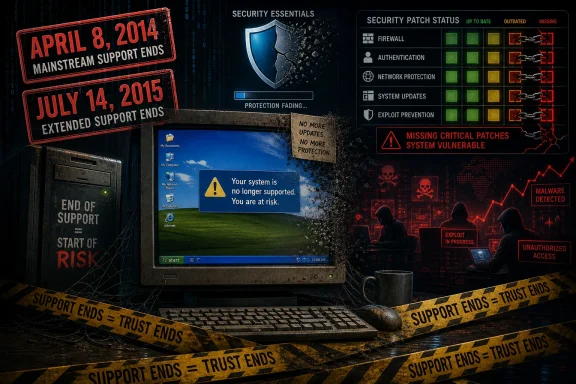 Microsoft Turned XP From Product Into Risk
Windows XP did not die because users stopped liking it. It died because Microsoft could no longer pretend that affection, familiarity, and backward compatibility were substitutes for a modern security model.By early 2014, XP was still a giant. It had survived Vista’s reputation damage, the slow enterprise move to Windows 7, and the lukewarm early reception to Windows 8. For many homes, schools, small businesses, kiosks, point-of-sale terminals, and industrial PCs, XP was not nostalgia; it was infrastructure.
That is what made the Security Essentials decision so sharp. Microsoft was not only telling users that Windows XP would stop receiving operating system patches. It was also making clear that the free Microsoft-branded safety net many consumers associated with “good enough” protection was no longer a future path for the platform.
The company later softened the immediate blow by continuing antimalware signatures and engine updates for a limited period, but that reprieve did not change the strategic message. Antivirus could buy time. It could not turn an unsupported operating system into a defensible one.
Security Essentials Was Never the Wall Users Thought It Was
Microsoft Security Essentials occupied a peculiar place in Windows history. It was free, quiet, and largely unobtrusive, which made it a welcome contrast to the nagware-heavy security suites that dominated consumer PCs in the 2000s. For users who did not want to think about malware defense, it felt like the sensible default.That feeling was partly earned. Security Essentials provided baseline protection against common malware families, and it integrated cleanly with Windows in a way that many third-party packages did not. On XP, Vista, and Windows 7, it lowered the barrier to running at least some antimalware protection.
But the mythology around it became dangerous. Security Essentials was never a substitute for a patched OS, least of all on XP. Antivirus works best as one layer in a defensive stack; it is much weaker when the platform underneath it is no longer being repaired.
This was the uncomfortable point Microsoft tried to make as XP’s support clock ran out. Once the company stopped shipping security updates for the operating system, every newly discovered XP vulnerability became structurally different from a normal bug. There would be no ordinary Patch Tuesday fix for mainstream XP users. There would be detection signatures, mitigations, workarounds, and perhaps third-party tools, but not the thing that actually closed the hole.
That distinction is easy to blur in consumer messaging. “My antivirus is up to date” sounds reassuring. On an unsupported operating system, it is closer to saying the smoke alarm still has batteries while the building’s fire doors have been removed.
The Patch Gap Was the Real Deadline
The most important date was not the day Security Essentials disappeared from the XP download page. It was the day Windows XP stopped receiving security patches.That is because XP shared enough architectural DNA with later Windows releases that future updates for supported versions could become a kind of roadmap for attackers. When Microsoft patched a vulnerability in Windows 7 or Windows 8, researchers and criminals alike could inspect the change, compare code paths, and ask whether XP had a similar flaw. If it did, XP users were stuck with a permanent exposure.
Microsoft officials were unusually blunt about this problem before the deadline. The company warned that vulnerabilities fixed in supported Windows versions could effectively become forever-zero-days for XP. That was not marketing spin so much as the logic of unsupported software.
The practical risk was uneven. A carefully firewalled industrial controller running a narrow workload was not the same as a home XP machine browsing the open web with an elderly version of Internet Explorer. But the direction of travel was the same for both. Every month after April 2014 widened the gap between the threat environment and XP’s ability to withstand it.
This is why the debate over Security Essentials sometimes missed the deeper point. Continuing signatures until July 2015 helped users who could not migrate immediately. It gave administrators a little runway and spared consumers an abrupt cliff. But it did not restart XP support, and Microsoft was careful not to say otherwise.
XP’s Popularity Made the Cutoff More Painful, Not Less Necessary
The uncomfortable fact in 2014 was that Windows XP still had enormous share. Depending on the measurement service, it remained one of the most widely used desktop operating systems in the world. Windows 7 had overtaken it, but XP was nowhere near statistical irrelevance.That scale complicated Microsoft’s decision. If XP had been a curiosity running on a few hobbyist machines, the end of support would have been a tidy lifecycle event. Instead, it was a mass migration problem disguised as a calendar date.
Consumers held on for familiar reasons. XP ran acceptably on old hardware, supported old peripherals, and avoided the learning curve introduced by newer Windows releases. Businesses had harder constraints: line-of-business applications, hardware certification, budget cycles, regulatory testing, and vendor abandonment.
There were also less defensible reasons. Some organizations had simply deferred the work. XP’s long life encouraged a belief that Microsoft would always find a way to keep it limping along, especially because the company had extended deadlines and made exceptions in the past.
That belief was understandable, but corrosive. The longer Microsoft allowed XP to remain culturally normal, the harder it became to persuade users that the risk had changed. By ending support and limiting Security Essentials’ future on the platform, Microsoft was trying to break that illusion.
Windows 8 Did Microsoft No Favors
The migration pitch would have been easier if Windows 8 had been a universally loved successor. It was not.Windows 7 was the natural landing zone for many XP users, especially businesses, but Microsoft’s consumer messaging in the early 2010s leaned heavily toward Windows 8 and then Windows 8.1. That created a mismatch between what Microsoft wanted to sell and what many users wanted to buy.
For XP holdouts, Windows 8 often looked like too much change at once. The Start screen, touch-first design language, and split personality between desktop and modern apps made the operating system feel alien to users who wanted continuity. Even if Windows 8 had real security improvements under the hood, its interface became the story.
That mattered because security migrations are also emotional migrations. Users are more likely to leave an old platform when the new one feels like a safer version of what they already know. Windows 8 sometimes felt like a different computing philosophy.
In hindsight, Microsoft’s problem was not that it ended XP support. The company’s problem was that the replacement narrative was muddled. Windows 7 was mature and trusted, Windows 8 was current but controversial, and Windows 10 was still over a year away.
This gave XP loyalists room to rationalize delay. They were not only resisting security advice; they were resisting a product transition they did not believe in.
The Enterprise Lesson Was Written in Custom Apps
For IT departments, the XP cutoff became a case study in technical debt. The machines that were hardest to migrate were rarely difficult because Windows itself could not be upgraded. They were difficult because something else depended on XP staying frozen.That “something” might have been a bespoke accounting program, a medical device console, a manufacturing system, a lab instrument, or a browser-based app written for an ancient Internet Explorer stack. In many cases, the original vendor was gone, the source code was unavailable, or the certification process was expensive enough to delay replacement for years.
This is where Microsoft’s lifecycle policy collided with the real world. A 10-year support window sounds generous until a factory floor has a 20-year equipment cycle. A desktop OS can be obsolete long before the machine it controls is financially replaceable.
Still, the XP episode exposed a failure of planning. Organizations that treated operating systems as permanent fixtures eventually discovered that software support is a supply chain. When one link expires, everything built around it becomes more fragile.
The best-run enterprises responded with segmentation, virtualization, application remediation, and accelerated hardware refreshes. The worst-run ones put XP behind a firewall, hoped nobody noticed, and called it risk acceptance.
The Consumer Lesson Was Crueler
For home users, the story was less about governance and more about abandonment. Many XP users were not clinging to the OS out of ideology. They were using the computer they had.That machine might have been a family desktop, a parent’s email PC, or a hand-me-down laptop that still worked well enough for web browsing and documents. Replacing it cost money. Upgrading it required confidence. Migrating files, printers, cameras, and old software created anxiety.
Security Essentials had been valuable precisely because it reduced that burden. It was free, simple, and official. When Microsoft said it would no longer offer it for download on XP, the message to ordinary users was stark: the safe default was gone.
Third-party antivirus vendors did continue to support XP for varying periods, and some did a respectable job. But that pushed users into a confusing marketplace of trials, subscriptions, scareware-adjacent advertising, and uneven protection quality. The Microsoft badge had served as a trust anchor.
The lesson was not that Microsoft should have supported XP forever. It was that end-of-life events hit least technical users hardest. The people most likely to misunderstand the risk are often the people with the least capacity to respond quickly.
The Malware Economy Had Changed Around XP
When Windows XP launched in 2001, the consumer Internet was a different place. Broadband was spreading, but the modern web platform had not yet become the application runtime for everyday life. Online banking, cloud email, social media, streaming, and web-delivered productivity were either primitive or nonexistent.By 2014, the threat model had transformed. Malware was no longer just a nuisance that slowed a machine or displayed pop-ups. It was tied to credential theft, botnets, ransomware, banking fraud, espionage, and targeted exploitation.
XP was designed before many of those pressures became routine. Service Pack 2 and later hardening efforts improved the situation substantially, but they could not make XP equivalent to newer Windows versions built with more modern assumptions about memory protection, privilege boundaries, driver models, browser isolation, and exploit mitigation.
This is why Microsoft’s claim that XP systems had much higher infection rates than newer Windows versions carried weight even if users debated the exact numbers. The point was not that Windows 8 was magically invulnerable. The point was that platform architecture matters.
An old OS can run today’s software only up to a point. Beyond that point, it becomes a compatibility shell around yesterday’s assumptions.
Antivirus Became the Symbol Because It Was Visible
Most users do not see kernel mitigations, address-space layout improvements, or exploit chains. They see an antivirus icon.That is why the Security Essentials announcement landed so strongly. It translated an abstract lifecycle event into something concrete: the free Microsoft security tool associated with XP would no longer be offered to XP users after the cutoff, while existing users would only receive a temporary extension of antimalware updates.
The nuance was important but messy. Microsoft stopped offering Security Essentials as a download for XP when XP support ended, yet continued definitions and engine updates for existing installations until July 2015. That was a compromise between policy and reality.
It also illustrates the awkward politics of end-of-life security. If Microsoft cut everything off at once, it would be accused of abandoning users. If it extended protection too generously, it would weaken the incentive to migrate. The company chose a middle path that still made clear the platform was finished.
Security Essentials became the public face of XP’s decline because it was the part of the security stack people could name. But the real withdrawal was broader: updates, assisted support, new technical content, and the presumption that Microsoft would keep absorbing the cost of XP’s continued presence on the Internet.
The Reprieve Proved Microsoft Knew the Cliff Was Too Steep
The later extension of antimalware signatures to July 14, 2015 was not a reversal of the XP decision. It was an admission that installed bases do not move at press-release speed.Microsoft framed the extension as help for organizations completing migrations. That was sensible. Many enterprises were already in motion by 2014, but migrations at scale are operationally ugly. They involve testing, procurement, imaging, user training, application compatibility, and sometimes political fights over budget.
The extension bought those organizations time without pretending that XP had a future. It also protected Microsoft’s broader ecosystem. A sudden explosion of compromised XP machines would not have stayed neatly confined to users who ignored upgrade advice; infected systems participate in spam, credential theft, lateral movement, and attacks on everyone else.
That is the public-health dimension of operating-system support. Unsupported machines are not merely private risks. They become part of the background radiation of the Internet.
Seen that way, Microsoft’s extension was pragmatic. It reduced immediate harm while preserving the central message: the cure was migration, not indefinite malware signatures.
XP’s Long Goodbye Foreshadowed Every Windows Lifecycle Fight Since
The XP cutoff now looks like a prototype for later Windows lifecycle controversies. Every major end-of-support deadline since has carried the same themes: users satisfied with what they have, hardware that still functions, organizations with legacy dependencies, and Microsoft insisting that security requires forward motion.Windows 7’s end of support in 2020 replayed much of the same drama, though with a more mature enterprise patch-extension model. Windows 10’s approaching lifecycle deadlines have revived it again, this time complicated by Windows 11 hardware requirements and the exclusion of many otherwise usable PCs.
The underlying tension has not changed. Microsoft wants Windows to be a continuously secured platform, not a museum of indefinitely maintained releases. Users and businesses want control over replacement timing, especially when new requirements feel arbitrary or economically wasteful.
XP taught Microsoft that lifecycle enforcement is both technical and theatrical. Dates matter, but so do pop-ups, download pages, support documents, telemetry claims, and the availability of transitional tools. The company must persuade, pressure, and sometimes inconvenience users into leaving old platforms behind.
It also taught users a harder lesson. If a system depends on a particular Windows release, the migration plan has to exist long before the deadline. Otherwise, the deadline becomes a crisis manufactured years earlier.
The Security Industry Was Happy to Fill the Vacuum
Microsoft’s retreat from XP created an opening for third-party security vendors. Many continued XP support after Microsoft’s mainstream security posture had shifted, and some marketed themselves directly to users who could not or would not upgrade.There was nothing inherently wrong with that. Third-party vendors had expertise, and layered security could reduce risk. For certain locked-down systems, specialized protection and network isolation were part of a rational containment strategy.
But the commercial incentives were complicated. Selling protection for an obsolete OS can help users in the short term while normalizing a bad long-term choice. The more comfortable XP felt after support ended, the easier it was for organizations to defer the real fix.
This is a recurring problem in security markets. Mitigation products often become excuses for avoiding remediation. A tool that should be a bridge turns into a campsite.
The honest message was boring but correct: if an XP system had to remain, isolate it, minimize its role, restrict network access, monitor it closely, and plan its retirement. Antivirus alone was not a strategy.
The Numbers Hid Different Kinds of Holdouts
Market-share figures made XP’s persistence look like a single phenomenon, but it was really several. A home user with an aging desktop, a hospital with certified equipment, a retailer with point-of-sale terminals, and a government office with custom forms software all counted as XP usage. Their risks and options were not the same.This matters because public discussions often treated XP holdouts as irresponsible. Some were. But others were trapped by procurement cycles, vendor negligence, compliance requirements, or physical hardware that could not be replaced quickly.
A fair reading of the 2014 cutoff has to hold two ideas at once. Microsoft was right that XP could not be safely maintained forever as a mass-market operating system. Many users were also right that migration was more expensive and disruptive than Microsoft’s upgrade messaging admitted.
The gap between those truths is where real IT work lives. It is easy to say “upgrade.” It is harder to inventory every dependency, test every workflow, train every user, and pay every invoice required to make that instruction real.
XP’s end of support was therefore less a single Microsoft decision than a stress test of the entire Windows ecosystem. Some passed. Many improvised.
The April Deadline Was a Warning About Trust
Operating systems are trust arrangements. Users trust the vendor to patch flaws, developers trust APIs to remain stable, businesses trust lifecycles to be predictable, and vendors trust customers to move before support becomes untenable.XP strained that arrangement because it was too successful for too long. Its longevity created habits that outlived its safety. The better it served users in its prime, the more painful it became to remove.
Security Essentials sharpened the trust issue. For years, Microsoft had encouraged users to see its free antimalware product as a responsible baseline. When that baseline no longer extended to XP as a supported future, users had to confront the difference between using a Microsoft product and being protected by Microsoft’s platform commitment.
That difference remains relevant. A device may still boot. A browser may still launch. A security tool may still update for a while. None of that means the system is receiving the full security promises that modern computing requires.
The XP cutoff was Microsoft drawing a boundary around those promises. It looked harsh because boundaries often do when they are finally enforced.
The Lesson Written in an XP Warning Dialog
The XP era did not end with a bang. It ended with warnings, lifecycle pages, upgrade campaigns, market-share charts, and millions of machines that kept running after the official deadline. That anticlimax is exactly why it remains instructive.Here is the practical legacy of Microsoft’s Security Essentials decision and the broader XP cutoff:
- Microsoft ended Windows XP security updates and mainstream support commitments on April 8, 2014, making continued use a growing security risk rather than a normal support scenario.
- Microsoft stopped offering Security Essentials for download on Windows XP after the cutoff, even though it later continued antimalware engine and signature updates for existing XP users until July 14, 2015.
- Antivirus protection could reduce exposure on XP, but it could not compensate for missing operating-system patches or architectural security improvements in later Windows versions.
- XP’s large remaining market share made the end-of-support deadline a public Internet security issue, not merely a private upgrade choice.
- Organizations that were slow to migrate often struggled less with Windows itself than with old applications, hardware dependencies, certification requirements, and years of deferred modernization.
- The XP cutoff became the template for later Windows lifecycle battles, where Microsoft’s security arguments collide with user attachment, hardware economics, and enterprise inertia.
References
- Primary source: Silicon UK
Published: 2026-06-05T08:22:10.634648
Microsoft To End Security Essentials With XP Support Cutoff
Microsoft warns that Security Essentials for Windows XP is also set to end in three months time All IT news on Silicon.co.ukwww.silicon.co.uk - Official source: blogs.microsoft.com
Support for Windows XP Set to End in April 2014 - The Official Microsoft Blog
A year from now will mark the final milestone for Windows XP – that of its end of support date. Starting April 8, 2014, Microsoft will no longer provide support for Windows XP users. This means that customers and partners will no longer receive security updates to the operating system or...blogs.microsoft.com - Official source: learn.microsoft.com
Microsoft antimalware support for Windows XP - Microsoft Lifecycle | Microsoft Learn
Announcing Microsoft antimalware support for Windows XP.learn.microsoft.com - Official source: news.microsoft.com
Farewell Windows XP - Microsoft Stories Asia
We know it’s hard to say goodbye, but all good things must come to an end. Microsoft Asia marks the end of support for Windows XP and Office 2003 today, and if you are still on the ageing platform – we are here to help.news.microsoft.com - Related coverage: windowscentral.com
Microsoft extends Security Essentials support to 2015, but is still ending XP updates this April | Windows Central
The latest News,/news,,news, breaking news, comment, reviews and features from the experts at Windows Centralwww.windowscentral.com - Related coverage: security.nl
- Related coverage: thenextweb.com
Microsoft Security Essentials for Windows XP Updates Until July 2015
Microsoft today announced it will continue to provide updates to its security products (antimalware engine and signatures) for Windows XP users through July 14, 2015. Previously, the company said it would halt all updates on the same day asthenextweb.com - Related coverage: arstechnica.com
Security Essentials for Windows XP will die when the OS does - Ars Technica
The antivirus software will stop getting updates, and you won't be able to install it.arstechnica.com - Related coverage: computerworld.com
Microsoft kicks elderly Windows XP when it’s down – Computerworld
The company is stopping delivery of, or support for, multiple security products that enterprises use to stay safe. www.computerworld.com
- Related coverage: gigazine.net
"Microsoft Security Essentials" free security software also ended distribution for XP as soon as "Windows XP" is terminated - GIGAZINE
Even since it was released in 2001Persistent popularityWindows XP, which boasts of Windows XP, has decided to terminate support as of April 8, 2014, but Microsoft also announced that it will terminate distribution of Microsoft Security Essentials at the same time as Windows XP.gigazine.net - Related coverage: exigent.net
- Official source: download.microsoft.com
