

Microsoft Turns AI Security Into a Lifecycle Argument
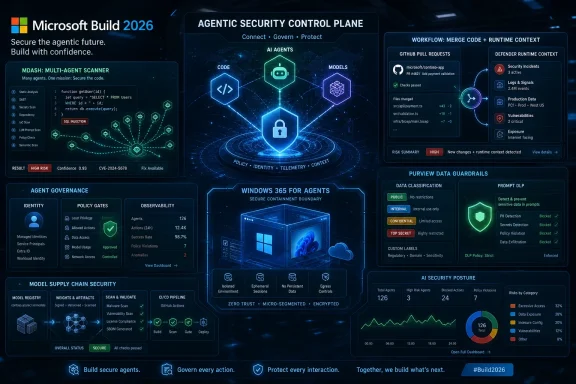
The most important thing about Microsoft’s Build 2026 security announcements is not any single product name, though there are plenty of those. It is the way Microsoft has stitched together vulnerability discovery, developer remediation, agent governance, data-loss prevention, and model inspection into one story. The company is arguing that AI security cannot live as a checkpoint at the end of delivery anymore.
That argument reflects a genuine shift in how software is being built. Developers are not merely using AI to autocomplete code; they are increasingly asking agents to inspect repositories, open pull requests, run tests, interact with SaaS tools, and reason across business data. A security model built around human-written code and static deployment gates does not map neatly onto systems that can act, adapt, and call tools.
Microsoft’s answer is to pull more of that lifecycle into its own platforms: GitHub, Defender, Entra, Intune, Purview, Foundry, Copilot Studio, Windows, and Windows 365. The company is not just saying it can help developers write safer code. It is saying that the enterprise needs a fabric that can observe and constrain AI work from the first prompt to the running workload.
That is a powerful claim, but it also carries a familiar Microsoft trade-off. The more complete the lifecycle story becomes, the more attractive it is for organizations already living inside Microsoft’s stack — and the more it risks becoming another gravitational pull toward a tightly coupled ecosystem.
MDASH Is Microsoft’s Bet That Vulnerability Discovery Has Become an Agent Problem
The headline-grabbing piece is the Microsoft Security multi-model agentic scanning harness, codenamed MDASH. Microsoft describes it as an agentic security system that orchestrates more than 100 specialized AI agents across a configurable ensemble of models to discover, validate, and prove exploitability in codebases written in popular programming languages. The expanded preview is available to eligible organizations and now includes integration with Microsoft Defender.
This is not conventional static analysis with an AI badge attached. Microsoft is positioning MDASH as a system that can reason across code, test hypotheses, and distinguish exploitable issues from theoretical noise. That last phrase matters because security teams are already drowning in findings that are technically valid but operationally unhelpful.
The promise of MDASH is that the scanner becomes more like a tireless security researcher than a linting engine. It can use heavyweight state-of-the-art models where deeper reasoning is needed and cheaper models for high-volume work. Microsoft says this design lets it trade off speed, recall, and cost while reducing dependence on a single model provider or architecture.
That is the right architectural instinct. In enterprise security, single-model magic is brittle. The durable advantage is not merely which model performs best on a benchmark this month, but whether the surrounding system can decompose tasks, verify results, manage cost, and produce findings that developers and security teams can actually act on.
Microsoft also says MDASH recently reached a CyberGym benchmark score of 96.55 percent after improving roughly 10 percent in less than three weeks. Benchmarks in AI security should always be treated as directional rather than definitive, but the trajectory is still notable. Microsoft is trying to show not only that agentic vulnerability discovery works, but that it can improve quickly under production-like pressure.
The Scanner Is Becoming the Proof Engine
The old vulnerability-management bargain was unsatisfying but familiar. A scanner found something, a ticket was created, a developer disputed whether it mattered, a security engineer tried to prove impact, and the backlog grew. In many organizations, the argument over exploitability consumed more time than the fix.
MDASH is Microsoft’s attempt to collapse that argument. By emphasizing validation and proof of exploitability, Microsoft is targeting the handoff problem between AppSec and engineering. A finding that arrives with context, reproduction, and exploitability evidence has a better chance of being treated as urgent work rather than compliance noise.
That matters because AI changes the economics of both attack and defense. If attackers can use models to sift through code and chain weaknesses faster, defenders need tools that can do more than flag suspicious patterns. They need tools that can prioritize under uncertainty and scale the judgment of experienced researchers.
Microsoft’s partner quotes from Accenture, PwC, and Insight follow the expected vendor-event choreography, but the substance is still revealing. The partners are talking less about scan coverage and more about moving from reactive detection to proactive discovery of exploitable risk. That is where enterprise security budgets are heading: toward systems that reduce the time between knowing something is wrong and knowing what to do about it.
The uncomfortable question is whether the same kind of agentic tooling will become equally available to attackers. Microsoft’s framing implicitly answers yes. The company is not selling MDASH as a nice-to-have developer assistant; it is selling it as part of an arms race in which vulnerability discovery itself has been industrialized.
GitHub Code Security Brings Production Reality Into the Pull Request
If MDASH is the advanced discovery engine, the Defender and GitHub Code Security integration is the workflow play. Microsoft says the integration is now generally available and enriches code vulnerabilities with runtime context from production, such as internet exposure and data sensitivity. Developers can then remediate issues using AI-assisted fixes generated, assigned, and validated through GitHub Copilot Autofix and the GitHub Copilot cloud agent.
This is the part of the announcement that many security teams will find more immediately practical. A vulnerability in a dead code path is not the same as a vulnerability in an internet-facing service handling sensitive data. Yet too many organizations still prioritize based on severity labels that know little about the environment in which code actually runs.
Bringing Defender context into GitHub is Microsoft’s attempt to make the pull request aware of the blast radius. That is the right direction. Security work competes with feature work, reliability work, operational incidents, and customer commitments. The more accurately a tool can explain why a fix matters now, the more likely it is to survive the sprint-planning knife fight.
The remediation loop is also changing. Copilot Autofix and the cloud agent are meant to turn a finding into a proposed patch, not merely a warning. That does not remove the need for review, tests, or ownership. But it does change the expected shape of AppSec work from “file a ticket and wait” to “generate a fix and validate it inside the same development system.”
Role-based access controls for vulnerability findings are an important detail. Once tools start proving exploitability, the output becomes sensitive. A vague warning about a potential flaw is one thing; a reproducible exploit path is another. Microsoft is acknowledging that better security findings can themselves become dangerous artifacts if too broadly exposed.
The Developer Experience Is the Battleground
Microsoft has learned from years of security-tool friction that developers do not want another dashboard. They want the tools they already use to tell them what matters, propose fixes, and get out of the way. That is why GitHub is the natural anchor for this part of the story.
The risk, as always, is automation bias. If Copilot-generated fixes become routine, teams may start treating them as presumptively correct. A generated patch can close a vulnerability while introducing a logic bug, weakening validation, or shifting risk elsewhere. The workflow must make review easier without making judgment optional.
Still, the direction is hard to argue with. The traditional split between “code security” and “runtime security” has always been somewhat artificial. Attackers do not care which organizational team owns a weakness. Microsoft’s integration is a sign that the tooling is catching up to the reality that source, pipeline, workload, identity, and data are one connected attack surface.
For WindowsForum readers who live in the practical world of mixed environments, the lesson is clear: Microsoft is making GitHub and Defender more valuable together than apart. That may be good news for Microsoft-centric shops. It may also sharpen procurement debates in organizations that want best-of-breed security tooling without giving one vendor the whole map.
Agents Are Now an Application Layer, and Microsoft Wants the Kernel Seat
The agent announcements are where Build 2026 becomes more than an AppSec story. Microsoft says agents are quickly becoming a new layer of the application stack, and it is building controls for identity, governance, observability, access, and runtime isolation. That statement sounds like marketing until you consider what agents actually do.
An agent is not just a chatbot with a nicer name. In production, an agent may call APIs, retrieve documents, modify records, write code, open tickets, access calendars, run shell commands, or operate a graphical interface. The security model must account not only for what the agent knows, but what it can do.
Microsoft’s Agent 365 SDK is now generally available, giving developers a way to integrate controls such as observability, access policies, and compliance enforcement directly into agent development workflows. Microsoft is pitching it as a way to build custom agents for any AI platform while still composing with Agent 365. That “any AI platform” phrasing matters because Microsoft knows customers will not use only Microsoft-authored agents.
The more interesting Windows-specific piece is the Microsoft Execution Container SDK, or MXC. Microsoft describes it as an OS-level control mechanism for agent execution, with containment and policy enforced through isolation technologies such as process and session isolation. In plain English, Microsoft wants Windows to provide a sandbox spectrum for agents that need to perform tasks without being granted open-ended access to the user’s machine.
Windows 365 for Agents, now generally available, extends that logic into the cloud. Instead of letting an agent loose on a user’s real desktop or a production server, an organization can run it inside an isolated, policy-governed Cloud PC. For agents that need to click through interfaces, run legacy apps, or complete multi-step workflows across software, that could be a meaningful containment model.
The Return of the Managed Desktop, This Time for Robots
There is an irony here that longtime Windows administrators will appreciate. After years of pushing users toward browser apps, SaaS workflows, and cloud-native abstraction, the industry has rediscovered the value of a managed Windows environment — only now the “user” might be an AI agent. The Cloud PC becomes a blast chamber for automation.
That may sound inelegant, but it is often how enterprise technology actually advances. Organizations have decades of software that does not expose clean APIs or behave nicely in modern automation frameworks. If an agent must use a line-of-business app the way a human does, a policy-governed Windows session is a more realistic control boundary than wishful thinking.
This also puts Windows back into the AI infrastructure conversation in an unexpected way. The past few years have framed AI infrastructure mostly as GPUs, model endpoints, vector databases, and orchestration frameworks. Microsoft is arguing that the endpoint and the operating system still matter because agents need somewhere controlled to act.
The danger is complexity. Agent 365, MXC, Intune, Entra, Defender, Purview, Windows 365, and Foundry can sound like a coherent fabric in a keynote and like a licensing and configuration maze on Monday morning. Microsoft’s enterprise advantage is integration. Its enterprise weakness is that integration often arrives with a thick administrative surface area.
Shadow AI Is the New Shadow IT, Except It Can Act
Microsoft’s Agent 365 registry is aimed squarely at agent sprawl. The company says the registry can surface unmanaged local agents discovered by Microsoft Defender, Microsoft Entra, and Microsoft Intune, including more than 20 types of local agents such as coding agents, AI desktop applications, and local or remote Model Context Protocol servers. Intune policies can then be used to block common execution methods for OpenClaw agents.
This is Microsoft translating an old enterprise fear into a new era. Shadow IT used to mean unsanctioned SaaS apps, consumer file-sharing, or rogue virtual machines. Shadow AI includes tools that may not merely store data but act on it, transform it, move it, and connect it to other systems.
Model Context Protocol servers deserve special attention because they are becoming a connective tissue for agent tooling. They can give models structured access to files, databases, services, and development environments. That makes them useful, but it also makes unmanaged MCP infrastructure a tempting place for permissions to accumulate quietly.
Microsoft’s approach is to discover, register, observe, and govern. Defender supplies investigation and advanced hunting. Entra supplies identity context. Intune supplies endpoint policy. Purview supplies data controls and audit. The story is unsurprising, but the target has changed: the thing being managed is no longer only a device, an app, or a user. It is a semi-autonomous actor.
Security teams will welcome visibility, but developers may see another layer of friction if policies are heavy-handed. The hard part will be distinguishing a legitimate local coding agent from a risky automation path without forcing every experiment through a committee. Microsoft says the goal is to manage risk without slowing developer productivity. That has been the aspiration of every security platform for twenty years, and the implementation will matter more than the slogan.
Purview Moves From Compliance Archive to Runtime Guardrail
Purview’s role in the announcement is also telling. Microsoft is embedding Purview data risk signals in the Foundry Control Plane, generally available, so developers can see data-security guidance while building agents. The example Microsoft gives is a system flagging sensitive financial data during testing and guiding developers to mask or restrict access before deployment.
That is a more active version of Purview than many administrators are used to. Historically, data-governance tooling has often felt like a compliance archive: classify, label, retain, audit, report. In the agent era, Microsoft wants Purview to become a runtime and design-time guardrail.
The preview of runtime data loss prevention for agent prompts in Foundry with Agent 365 is especially important. If sensitive information can be detected, blocked, and audited before it reaches an AI model, organizations get a stronger control point than after-the-fact logging. That matters for regulated data, trade secrets, customer records, and any environment where prompts themselves may become a leakage path.
Microsoft also says Purview will provide agentic risk detection for coding agents including Claude Code, GitHub Copilot, OpenAI Codex, and OpenClaw. That cross-agent posture is necessary because enterprises will not standardize on a single coding assistant. Developers will use what works, what is trendy, what is embedded in their IDE, and what a team lead quietly approved with a corporate card.
The challenge is coverage. Detecting and governing agents across local machines, cloud services, browser sessions, remote MCP servers, and developer tools is an enormous surface. Microsoft can plausibly cover much of the Microsoft-managed estate. The messier question is how well it will see the edges where experimentation usually happens first.
Model Scanning Brings Supply-Chain Logic to AI Artifacts
Defender AI model scanning, now in preview, extends Microsoft’s lifecycle argument to the model artifact itself. Microsoft says it can inspect platform-native and bring-your-own models across registries, workspaces, and CI/CD pipelines, detecting and blocking potentially vulnerable or compromised models before deployment. That may sound niche today, but it is a logical extension of software supply-chain security.
A model is not just a file. It is an executable dependency of sorts, shaped by training data, fine-tuning, weights, configuration, tooling, and the environment in which it runs. If organizations treat models as opaque blobs that arrive from somewhere and get wired into production, they are repeating old dependency-management mistakes at a higher level of abstraction.
The software industry spent years learning that containers, packages, and build pipelines needed provenance, scanning, signing, policy, and runtime monitoring. AI models will need analogous controls. The details differ, but the governance instinct is the same: know what you are deploying, where it came from, whether it has been tampered with, and whether it violates policy.
Microsoft’s scanning announcement is still a preview, and the industry does not yet have universally mature norms for what “safe model artifact” should mean in every context. A model can be vulnerable in ways that do not resemble a CVE in a library. It can be backdoored, misconfigured, susceptible to unsafe tool use, or inappropriate for the data domain in which it is deployed.
That uncertainty is precisely why this matters. Enterprises are moving faster than the standards bodies, and vendors are racing to define the operational defaults. Microsoft would very much like Defender to become one of those defaults.
The Security Platform Is Also the Distribution Strategy
There is a business strategy underneath the security architecture. Microsoft’s announcements make the most sense when viewed as a bid to own the governance layer for AI work. If agents are the new apps, Agent 365 is the management plane. If AI-generated code is the new development workflow, GitHub and Defender become the remediation loop. If models are the new dependencies, Defender becomes the scanner. If prompts and context are the new data boundary, Purview becomes the guardrail.
That is coherent, and coherence has value. Security teams do not want to assemble twenty disconnected point products every time the development model changes. They want identity, endpoint, code, cloud, data, and audit systems to share context. Microsoft is one of the few vendors with credible pieces across all of those domains.
But coherence is not neutrality. The more Microsoft security value depends on Microsoft platforms talking to other Microsoft platforms, the harder it becomes for customers to evaluate each component independently. GitHub becomes more attractive if you already use Defender. Defender becomes more attractive if you already use GitHub. Agent 365 becomes more attractive if you already use Entra, Intune, Purview, and Windows 365.
For some enterprises, that is a feature. For others, it is a procurement warning light. The best version of Microsoft’s AI security strategy will support heterogeneous environments without punishing customers for using competing clouds, models, repositories, or developer tools. The weaker version will technically support them while reserving the richest experience for Microsoft’s own stack.
The company’s language around custom agents, open-source frameworks, bring-your-own models, and third-party coding agents suggests Microsoft understands the need for openness. The proof will be in the depth of telemetry, policy enforcement, and remediation available outside the Microsoft comfort zone.
The Build 2026 Security Story Is Really About Control
Microsoft’s Build 2026 announcements are framed around trust, but the operational word is control. Control over which vulnerabilities matter. Control over how agents run. Control over what data reaches models. Control over which AI artifacts enter production. Control over who can see exploitability findings.
That framing may irritate the more libertarian corners of the developer world, but it will resonate with CISOs. Enterprises do not fear AI only because it might hallucinate. They fear it because it can create unreviewed code, move sensitive data, automate mistakes, and expand the number of actors inside already complicated systems.
Microsoft’s strongest point is that security needs to move into the developer’s flow of work. If the control plane exists only in the SOC, it will always arrive late. If it exists only in the IDE, it will lack production context. If it exists only in the cloud, it may miss local agents and endpoint behavior. The lifecycle pitch works because the lifecycle really is the attack surface.
The weakest point is that enterprises may not be ready to operate this machinery well. Agent registries, runtime policies, model scanning, prompt DLP, exploitability validation, and AI-generated remediation all require governance decisions that many organizations have not made. A tool can surface unmanaged agents; it cannot decide the organization’s risk appetite. A scanner can propose a fix; it cannot own the service.
That is where the next phase of AI security will get messy. The technology will outpace the operating model. Security teams will ask for lockdowns, developers will ask for exceptions, executives will ask why productivity gains are delayed, and auditors will ask who approved the agent that touched customer data at 2:13 a.m.
Microsoft’s New AI Security Map Gives Admins a Checklist With Teeth
For Windows administrators, security engineers, and development leads, the practical reading of Build 2026 is less about the brand names and more about the control points Microsoft is making normal. The announcements suggest a near future in which AI activity is inventoried, policy-bound, scanned, logged, and tied back to identity and data classification.
- Organizations using GitHub and Defender should expect vulnerability prioritization to become more runtime-aware, with production exposure and data sensitivity influencing what developers fix first.
- Teams experimenting with coding agents should assume those agents will soon be treated as managed enterprise actors rather than personal productivity tools.
- Windows 365 for Agents gives Microsoft-centric shops a containment model for agents that need to operate graphical software or legacy workflows.
- Purview is becoming more relevant to developers because data classification and prompt-level DLP are moving closer to agent design and runtime behavior.
- Model scanning is emerging as an AI supply-chain requirement, especially for teams bringing external or fine-tuned models into production.
- The administrative burden will shift from merely approving AI tools to continuously governing what those tools can access, execute, and expose.
This is the kind of checklist that can turn into budget requests quickly. It also gives IT a more concrete way to discuss AI risk with leadership. Instead of debating whether AI is safe in the abstract, teams can ask which agents exist, what identities they use, what data they touch, where they run, which models they depend on, and how their actions are audited.
Microsoft’s Build 2026 security announcements do not settle the argument over whether enterprises can safely move fast with AI, but they do clarify the battlefield. The company is betting that the winners will not be the organizations with the most agents or the flashiest models, but the ones that can bind autonomous software to identity, policy, data boundaries, and evidence. That is a sober vision of AI’s future, and probably a realistic one: the agent era will not be secured by hoping agents behave, but by making their freedom conditional, observable, and revocable from the start.