Microsoft used Build 2026 in San Francisco on June 2 to present an agent-first computing strategy spanning Windows, Surface hardware, Azure infrastructure, GitHub, Microsoft 365, Foundry, in-house MAI models, and new governance tools for enterprise AI. The point was not one more Copilot feature. It was Microsoft’s attempt to define the next computer as a managed environment where AI agents can see context, use tools, obey policy, and leave an audit trail. If Build 2023 was the year Microsoft put Copilot buttons everywhere, Build 2026 was the year it argued that buttons are not enough.
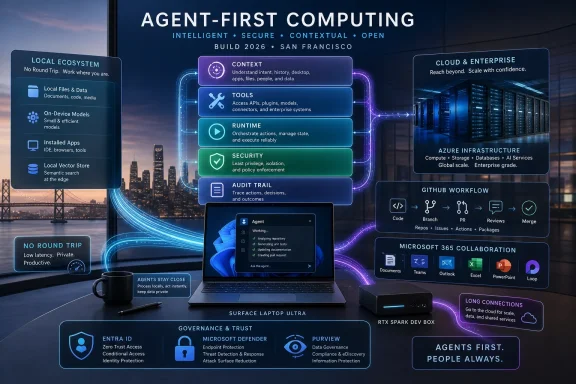
Satya Nadella framed the keynote around a new stack: compute, models, context, tools, runtime, and security wrapped around the whole thing. That sounds like architectural throat-clearing, but it was the most important sentence of the event. A chatbot can live in a window; an agent needs a workplace.
That distinction explains why Build 2026 felt like a product-name storm. Aion, Foundry, Agent 365, Microsoft IQ, Web IQ, Fabric IQ, Work IQ, MXC, Project Solara, Rayfin, MAI, Maia, Cobalt, HorizonDB, Scout, OpenClaw, Discovery, Majorana — the keynote had enough nouns to make even veteran Microsoft watchers reach for a dependency graph. But under the branding clutter, the argument was coherent.
Microsoft is trying to make Windows, Azure, GitHub, and Microsoft 365 the default operating environment for agents. Not merely the place where people ask AI to summarize a meeting, but the place where software workers are assigned tasks, run code, touch files, query business data, operate under identity, and can be inspected later by IT.
That is a very Microsoft bet. The company’s strongest products have rarely been the cleanest experiences on day one. They become powerful because enterprises need integration, governance, identity, compatibility, and boring operational trust. Build 2026 was Microsoft saying that the AI agent era will be won less by the prettiest demo than by the platform that compliance teams can grudgingly approve.
The new Aion models turn that into a platform story. Aion Instruct is Microsoft’s smaller on-device model for tasks like summarization, rewriting, intent detection, and accessibility. Aion Plan is the bigger swing: a 14-billion-parameter reasoning and tool-calling model with a 32K context window, shipping in-box as part of Windows on capable devices.
The phrase that mattered was “without a round trip to the cloud.” Local execution is not just a privacy talking point. It changes latency, cost, reliability, and the kinds of workflows developers can build. If an agent has to send every small reasoning step to a remote model, it becomes more expensive and more brittle. If Windows can run more of the loop locally, the PC starts to look less like a terminal for cloud AI and more like an agent workstation.
That is why Microsoft’s local AI push is more than Copilot+ PC marketing. It is an attempt to restore Windows as a serious developer and compute platform at a moment when much AI work has drifted toward cloud notebooks, Linux servers, and browser-based tools. Microsoft wants the next generation of AI apps to assume that a Windows PC can reason, plan, call tools, run containers, inspect logs, and coordinate agents locally.
Unified memory matters because local AI workloads are hungry. The more memory a system can share between CPU and GPU, the easier it becomes to run larger local models, keep more context resident, and avoid constant data shuffling. For developers, that can mean faster iteration and fewer compromises when testing agent workflows before moving them to the cloud.
The Surface RTX Spark Dev Box is the more interesting machine for WindowsForum readers. Microsoft describes it as a compact developer PC with one petaflop of AI compute, 20 CPU cores, 128GB of unified memory, a 100W thermal envelope, and a Windows 11 Pro environment preloaded with Visual Studio Code, GitHub Copilot, WSL, PowerShell 7, Coreutils for Windows, Defender, BitLocker, Entra ID, and Intune support.
This is the old Windows developer box reimagined for agents. Instead of “compile my app faster,” the pitch is “run a large model locally, spin up agents, pass GPU acceleration into WSL, test code, evaluate logs, and do it under enterprise controls.” Pricing and real-world thermals will matter, but the category is clear: Microsoft wants AI developers to have a local box that feels native to Windows rather than bolted onto it.
Nvidia’s role sharpened the thesis. Jensen Huang described the PC evolving from a personal computer into a personal AI — a machine an agent can use on your behalf, not just a machine you operate directly. That may be marketing, but it is also a real interface shift. The computer becomes less like a passive tool and more like a managed workspace where human and agent activity overlap.
The demo showed a Windows setup with no news feed, no widgets, no notifications, and dark mode enabled. It included a vertical taskbar in Insider builds, a public configuration repo for developer tooling, PowerToys Grab and Move, an End Task shortcut, Dev Drive with asynchronous Defender scanning, Git-aware File Explorer status, an intelligent terminal with an agent pane, GPU-enabled WSL containers, Microsoft Edit, Homebrew support, Starship, btop, and other Linux-style utilities.
That sounds like a grab bag until you put it in the agent frame. Agents need terminals, file access, containers, permissions, repositories, local models, and repeatable environments. If Windows is cluttered, unpredictable, or hostile to command-line work, it becomes a weak foundation for agentic development.
The most telling demo involved local agents working against a codebase, delegating subtasks to local models, using GPU memory heavily, and applying codebase-wide changes. That is not “AI sparkle” layered over Windows. It is Windows trying to become an orchestration surface for local model execution, agent sessions, containers, and developer tools.
Microsoft has tried to win developers back before. WSL was one major step. Dev Home and Dev Drive were smaller steps. Build 2026 suggests a more urgent motivation: if agents become a normal part of software work, the operating system that manages the agent workspace matters again.
Microsoft said Azure now spans more than 500 data centers and that the company added more data center capacity in the last 18 months than it added in Azure’s first decade. The company grouped the core AI workloads into training, inference, and agent runtime. That third category is the new one.
Training builds models. Inference runs models. Agent runtime keeps long-running workflows alive while models call tools, query systems, use files, and take actions. That is a different infrastructure profile from a single prompt-response exchange. It demands orchestration, state, low-latency tool calls, isolation, and monitoring.
The Fairwater data center design was presented as Microsoft’s AI super-factory model, built with Nvidia for high GPU density, faster networking, lower latency, and more bandwidth. Microsoft also leaned heavily on claims around responsible energy and water use, including the promise that some designs can operate with effectively zero water consumption for cooling.
This is where keynote architecture meets local politics. AI data centers are no longer abstract cloud regions; they are neighbors, power loads, water concerns, and tax-base arguments. Microsoft can promise community benefits, local jobs, responsible water use, and no electricity price increases. Communities will judge those promises by utility bills, permits, grid stress, and whether the economic benefits actually arrive.
The Cobalt 200 CPU platform matters because agents do not only stress GPUs. They constantly call tools, move data, wait on APIs, coordinate steps, and run orchestration logic. In other words, the CPU has to keep the circus moving while the model does the reasoning.
Microsoft said Cobalt 200 VMs showed lower latency, higher throughput, and better cloud-native performance than the previous generation in agent-related traces. Those numbers will need real-world validation, but the direction is believable. Agent workloads are not one giant matrix multiplication; they are a messy blend of model calls, retrieval, memory, application logic, network trips, and policy checks.
That has consequences for enterprise architecture. The winning agent platform may not be the one with the biggest single model benchmark. It may be the one that can make thousands of small, safe, low-latency actions economical. Microsoft’s stack story is built around that kind of workload.
Work IQ understands workplace context: people, meetings, files, chats, emails, permissions, and workflows. Fabric IQ gives agents a structured understanding of business data and relationships. Foundry IQ helps agents reason across enterprise knowledge and web information. Web IQ is Microsoft’s new internet grounding layer, built for fresh, high-quality web, news, image, and video data that agents can use.
This is the part of the agent stack where Microsoft’s installed base becomes a weapon. A generic model can write a plausible answer. A useful enterprise agent needs to know which SharePoint document is authoritative, which Teams thread matters, which customer record is current, what the policy says today, which data source has live telemetry, and who is allowed to see the answer.
The keynote’s utility-control-center demo made the point. An agent assembled an incident brief by combining external web data, live operational telemetry, internal procedures from SharePoint, and structured business relationships. The demo was idealized, as keynote demos always are, but the architecture is the enterprise dream: an agent that grounds its work in the outside world and the company’s actual systems without copying everything into a stale prompt dump.
That is also where risk concentrates. The more context an agent can see, the more damage it can do if permissions are wrong, retrieval is sloppy, or policy enforcement is weak. Microsoft’s advantage is that it already owns many of the identity, compliance, collaboration, and data systems involved. Its burden is proving that those layers work together under agent pressure.
The Build updates leaned into hosted agents, fast sandboxes, toolboxes, tracing, evaluations, rubrics, memory, state, guardrails, and publishing into Teams and Microsoft 365 Copilot. Microsoft also announced broader model choice through Foundry, including OpenAI, Anthropic, Microsoft’s own MAI models, and open-weight models through partners such as Fireworks AI.
That model pluralism is important. Microsoft no longer needs every customer to believe that one Microsoft model is best for every task. It needs customers to believe Foundry is the right place to choose, evaluate, govern, and deploy whichever model fits the job.
This is a platform move rather than a model leaderboard move. If Microsoft owns the place where enterprises compare models, attach tools, enforce policy, run evaluations, and publish agents into Teams, it can benefit even when the underlying model comes from someone else. Azure won by being infrastructure for other people’s software. Foundry is trying to do the same thing for agent behavior.
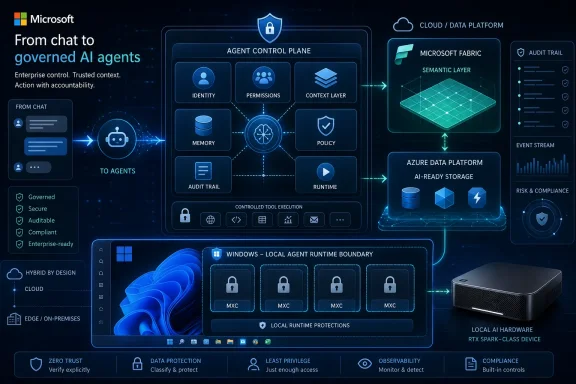
Microsoft says Agent 365 extends Entra, Defender, and Purview into a control plane for agents, including identity, access controls, real-time defense, data protection, compliance, and management. Crucially, Microsoft says this is meant to govern agents wherever they are hosted — Azure, AWS, Google Cloud, local Windows machines, or elsewhere — and whatever framework was used to build them.
That is exactly the sort of claim enterprise IT wants to hear, because agent sprawl is coming. Business units will build agents. Developers will run agents. Vendors will ship agents. Employees will connect agents to chat tools and line-of-business systems. Without a control plane, the agent era becomes shadow IT with API keys.
The demo showed a plausible governance loop: tools exposed through a single MCP endpoint, a guardrail blocking personally identifiable information, a hosted session running in an isolated microVM, traces and evaluations, rubric generation from production behavior, and an optimizer that tunes models, instructions, tool descriptions, and skills. The productized version will need to be less magical than the demo, but the shape is right.
Microsoft’s argument is that agents require their own identities and audit trails. That is the difference between “the user asked Copilot to do something” and “this named agent took this action with these permissions at this time against these systems.” For sysadmins, that distinction is everything.
That matters because useful agents are dangerous by design. An agent that cannot access files, run code, call tools, or use the network is safer, but much less useful. An agent that can do all those things without containment is a security incident waiting for a calendar invite.
The OpenClaw demo made the point in the simplest possible way. The agent was asked to delete files. It tried. MXC stopped it because the relevant folder was read-only. The files survived not because the model behaved, but because the operating system enforced the rule.
That is the right mental model. Prompt instructions are not security boundaries. OS-level containment, permissions, identity, logging, and policy are security boundaries. Microsoft has spent decades building these kinds of controls for human users, apps, processes, and devices. Build 2026 was the company extending that logic to agents.
For Windows admins, the question will be how manageable this becomes in practice. If MXC policy is cleanly exposed through Intune, Entra, Defender, and Windows management tooling, it could become a practical answer to local agent risk. If it becomes another half-documented maze of previews and overlapping settings, admins will default to blocking the whole category.
The new GitHub Copilot app is Microsoft’s answer to the practical mess created by coding agents. It is not just a chat window. It is a session manager that can launch separate agents for separate issues, run each in its own git worktree, track work, open pull requests, and help shepherd changes through review and CI.
That is the bottleneck no one can ignore. If AI can generate ten pull requests in the time a developer used to write one, the problem shifts from code creation to code judgment. Someone still has to inspect the diffs, understand the architecture, verify tests, enforce standards, and decide whether the change should exist.
Copilot’s model switching also matters. Microsoft showed access to models from OpenAI, Anthropic, and Google through a single Copilot subscription. That reinforces the platform strategy: GitHub does not need to be the only model provider if it becomes the place where coding agents coordinate actual software work.
Rayfin, Microsoft’s agent-first SDK for enterprise back ends, fits this same theme. Coding agents can generate front ends quickly, but real enterprise apps need identity, storage, schemas, deployment, governance, and managed data. Rayfin is Microsoft’s attempt to make “the app exists” less important than “the app can safely run inside an enterprise tenant.”
MAI-Thinking-1 is the centerpiece. Microsoft described it as its first reasoning model, a 35-billion-active-parameter system aimed at reasoning and coding tasks, trained from scratch without distillation and with clean, commercially licensed enterprise-grade data. Microsoft claimed strong performance against competing frontier systems on human preference and coding benchmarks.
The benchmark claims are less important than the positioning. Microsoft does not necessarily need to build the biggest general model in the world. It needs models that are efficient, legally comfortable for enterprise use, tuned for Microsoft products, and economical enough to run often. A medium-weight reasoning model deeply integrated into Foundry, GitHub, Office, Windows, and Azure could be more commercially useful than a giant model that wins headlines but is expensive to deploy.
MAI-Code-1-Flash makes that clearer. A small, efficient coding model tuned for VS Code and GitHub CLI is the kind of model Microsoft can sprinkle everywhere. Routine coding tasks do not always need the most expensive model available. They need a model that is fast, cheap, good enough, and already sitting where developers work.
Microsoft also said MAI models will be available beyond Foundry, including through platforms such as OpenRouter, Fireworks, and Baseten. That is a notable move. Microsoft wants Foundry to be the enterprise home, but it also wants developers to encounter MAI models in the broader ecosystem.
In practice, that means private evaluations, private reinforcement learning environments, private traces, company-specific workflows, internal knowledge, tools, rubrics, and tuned models. A generic foundation model can be broadly capable. A tuned enterprise model can learn the way a particular company writes reports, handles exceptions, follows policy, uses internal systems, and judges quality.
The Land O’Lakes demo made the concept less abstract. Microsoft showed how a task like butter report generation could be represented through skills, knowledge, tools, and rubrics, then improved through simulation and tuning. The goal was not a model that sounds impressive in a vacuum. It was a model that produces work that feels specific to Land O’Lakes.
That specificity is the enterprise prize. Every company believes it has tacit knowledge: processes, habits, exceptions, templates, customer context, compliance instincts, and institutional judgment that are not fully captured in a manual. Frontier Tuning is Microsoft telling customers that those internal patterns can become a defensible AI asset.
The Mayo Clinic partnership pushes the same idea into a much higher-stakes domain. A healthcare frontier model grounded in Mayo’s clinical expertise and longitudinal data could be powerful, but it also raises the bar for validation, safety, workflow integration, liability, and trust. In medicine, “agentic” cannot mean improvisational. It has to mean measurable, supervised, and accountable.
The demo around plastic recycling was ambitious: generate a scientific paper, search for candidate proteins, create a lab protocol, simulate millions of variations, select candidates, generate DNA sequences, and submit instructions to an automated lab with human supervision. That is not a feature most WindowsForum readers will deploy next quarter. But it shows Microsoft’s broader thesis that agentic workflows can compress cycles of search, simulation, testing, and iteration.
Majorana 2 is the deeper moonshot. Microsoft claimed major improvements in qubit stability and continued to argue that its topological approach can eventually scale toward practical quantum machines. Quantum remains a field where claims require patience and skepticism, but its placement at the end of Build was deliberate. Microsoft wants to connect today’s agent infrastructure with tomorrow’s scientific and computational breakthroughs.
There is a through line here. Whether the task is writing code, responding to a grid incident, generating a butter report, searching for proteins, or eventually running quantum simulations, Microsoft sees the future as a loop: define the goal, give agents context and tools, run safely, evaluate the output, and improve the next run.
The strongest version of the strategy is compelling: local Windows models for fast private loops, Surface and Nvidia hardware for serious edge compute, Azure for scale, Foundry for deployment, GitHub for code agents, Microsoft IQ for context, Agent 365 for governance, MXC for containment, and MAI models for efficient product-specific work. The worst version is a spaghetti bowl of overlapping previews, portals, SDKs, acronyms, and licensing gates.
That gap between architecture and usability will determine whether Build 2026 becomes a turning point or just a dense keynote. Enterprise customers do not need every agent feature at once. They need a safe first workflow, a clear admin model, predictable costs, and a path from pilot to production.
For Windows users and IT pros, the local angle may be the most immediate. If Aion models, Windows AI APIs, MXC, WSL GPU support, and RTX-class local hardware mature together, Windows could become a serious local AI workstation again. That would matter not only to developers, but to anyone who wants AI features that do not always depend on sending work to a remote service.
Microsoft’s Build 2026 message was that the AI agent is leaving the chat box and moving into the operating system, the codebase, the browser, the database, the data center, and eventually the badge on a worker’s shirt. That future will need more than clever models; it will need trust, containment, cost control, and interfaces that do not bury users under abstraction. If Microsoft can turn this sprawling stack into something legible, Build 2026 may be remembered as the moment the company stopped adding AI to the computer and started rebuilding the computer around AI.
 Microsoft Is No Longer Selling a Chatbot, It Is Selling the Agent Computer
Satya Nadella framed the keynote around a new stack: compute, models, context, tools, runtime, and security wrapped around the whole thing. That sounds like architectural throat-clearing, but it was the most important sentence of the event. A chatbot can live in a window; an agent needs a workplace.That distinction explains why Build 2026 felt like a product-name storm. Aion, Foundry, Agent 365, Microsoft IQ, Web IQ, Fabric IQ, Work IQ, MXC, Project Solara, Rayfin, MAI, Maia, Cobalt, HorizonDB, Scout, OpenClaw, Discovery, Majorana — the keynote had enough nouns to make even veteran Microsoft watchers reach for a dependency graph. But under the branding clutter, the argument was coherent.
Microsoft is trying to make Windows, Azure, GitHub, and Microsoft 365 the default operating environment for agents. Not merely the place where people ask AI to summarize a meeting, but the place where software workers are assigned tasks, run code, touch files, query business data, operate under identity, and can be inspected later by IT.
That is a very Microsoft bet. The company’s strongest products have rarely been the cleanest experiences on day one. They become powerful because enterprises need integration, governance, identity, compatibility, and boring operational trust. Build 2026 was Microsoft saying that the AI agent era will be won less by the prettiest demo than by the platform that compliance teams can grudgingly approve.
Windows Gets Recast as the Local Runtime for Agents
The most strategically revealing part of the keynote came early, when Microsoft put Windows at the edge of the AI stack. Nadella pointed to the “astounding” local compute already sitting in modern PCs and used familiar examples — Outlook summaries, PowerPoint alt text, Teams video improvement, Adobe creative tools — to argue that Windows machines are becoming AI hardware whether users think of them that way or not.The new Aion models turn that into a platform story. Aion Instruct is Microsoft’s smaller on-device model for tasks like summarization, rewriting, intent detection, and accessibility. Aion Plan is the bigger swing: a 14-billion-parameter reasoning and tool-calling model with a 32K context window, shipping in-box as part of Windows on capable devices.
The phrase that mattered was “without a round trip to the cloud.” Local execution is not just a privacy talking point. It changes latency, cost, reliability, and the kinds of workflows developers can build. If an agent has to send every small reasoning step to a remote model, it becomes more expensive and more brittle. If Windows can run more of the loop locally, the PC starts to look less like a terminal for cloud AI and more like an agent workstation.
That is why Microsoft’s local AI push is more than Copilot+ PC marketing. It is an attempt to restore Windows as a serious developer and compute platform at a moment when much AI work has drifted toward cloud notebooks, Linux servers, and browser-based tools. Microsoft wants the next generation of AI apps to assume that a Windows PC can reason, plan, call tools, run containers, inspect logs, and coordinate agents locally.
Surface Becomes the Hardware Proof Point
The Surface Laptop Ultra is the flagship client device for that argument. Microsoft positioned it as a premium AI PC built around Nvidia’s RTX Spark silicon, with up to 128GB of unified memory, a bright 2,000-nit display, all-day battery claims, and fall availability. The important part is not the Surface badge. It is the memory model.Unified memory matters because local AI workloads are hungry. The more memory a system can share between CPU and GPU, the easier it becomes to run larger local models, keep more context resident, and avoid constant data shuffling. For developers, that can mean faster iteration and fewer compromises when testing agent workflows before moving them to the cloud.
The Surface RTX Spark Dev Box is the more interesting machine for WindowsForum readers. Microsoft describes it as a compact developer PC with one petaflop of AI compute, 20 CPU cores, 128GB of unified memory, a 100W thermal envelope, and a Windows 11 Pro environment preloaded with Visual Studio Code, GitHub Copilot, WSL, PowerShell 7, Coreutils for Windows, Defender, BitLocker, Entra ID, and Intune support.
This is the old Windows developer box reimagined for agents. Instead of “compile my app faster,” the pitch is “run a large model locally, spin up agents, pass GPU acceleration into WSL, test code, evaluate logs, and do it under enterprise controls.” Pricing and real-world thermals will matter, but the category is clear: Microsoft wants AI developers to have a local box that feels native to Windows rather than bolted onto it.
Nvidia’s role sharpened the thesis. Jensen Huang described the PC evolving from a personal computer into a personal AI — a machine an agent can use on your behalf, not just a machine you operate directly. That may be marketing, but it is also a real interface shift. The computer becomes less like a passive tool and more like a managed workspace where human and agent activity overlap.
Microsoft’s Developer Pitch Is Also an Apology for Windows
Build also included a quieter but important concession: Windows has annoyed developers for years. Microsoft’s developer-optimized Windows experience looked like a peace offering to people who prefer macOS or Linux because those environments feel calmer, cleaner, and less consumer-adjacent.The demo showed a Windows setup with no news feed, no widgets, no notifications, and dark mode enabled. It included a vertical taskbar in Insider builds, a public configuration repo for developer tooling, PowerToys Grab and Move, an End Task shortcut, Dev Drive with asynchronous Defender scanning, Git-aware File Explorer status, an intelligent terminal with an agent pane, GPU-enabled WSL containers, Microsoft Edit, Homebrew support, Starship, btop, and other Linux-style utilities.
That sounds like a grab bag until you put it in the agent frame. Agents need terminals, file access, containers, permissions, repositories, local models, and repeatable environments. If Windows is cluttered, unpredictable, or hostile to command-line work, it becomes a weak foundation for agentic development.
The most telling demo involved local agents working against a codebase, delegating subtasks to local models, using GPU memory heavily, and applying codebase-wide changes. That is not “AI sparkle” layered over Windows. It is Windows trying to become an orchestration surface for local model execution, agent sessions, containers, and developer tools.
Microsoft has tried to win developers back before. WSL was one major step. Dev Home and Dev Drive were smaller steps. Build 2026 suggests a more urgent motivation: if agents become a normal part of software work, the operating system that manages the agent workspace matters again.
Azure Supplies the Industrial Back End
The local story only works because Microsoft is also making the opposite argument: agents need cloud scale. Nadella described Microsoft’s infrastructure equation as “tokens per dollar per watt,” which is a useful way to understand the AI data center race. The goal is not simply bigger clusters. It is more useful work per unit of electricity, silicon, cooling, and capital.Microsoft said Azure now spans more than 500 data centers and that the company added more data center capacity in the last 18 months than it added in Azure’s first decade. The company grouped the core AI workloads into training, inference, and agent runtime. That third category is the new one.
Training builds models. Inference runs models. Agent runtime keeps long-running workflows alive while models call tools, query systems, use files, and take actions. That is a different infrastructure profile from a single prompt-response exchange. It demands orchestration, state, low-latency tool calls, isolation, and monitoring.
The Fairwater data center design was presented as Microsoft’s AI super-factory model, built with Nvidia for high GPU density, faster networking, lower latency, and more bandwidth. Microsoft also leaned heavily on claims around responsible energy and water use, including the promise that some designs can operate with effectively zero water consumption for cooling.
This is where keynote architecture meets local politics. AI data centers are no longer abstract cloud regions; they are neighbors, power loads, water concerns, and tax-base arguments. Microsoft can promise community benefits, local jobs, responsible water use, and no electricity price increases. Communities will judge those promises by utility bills, permits, grid stress, and whether the economic benefits actually arrive.
Maia, Cobalt, and the Less Glamorous Work of Making Agents Cheap
Microsoft’s silicon announcements were less flashy than the Surface hardware but arguably more important. Maia 200, Microsoft’s AI accelerator, is now live in Arizona and is slated for broader deployment. Microsoft claimed it can deliver better tokens-per-dollar economics than leading GPUs and will help power Microsoft 365 Copilot.The Cobalt 200 CPU platform matters because agents do not only stress GPUs. They constantly call tools, move data, wait on APIs, coordinate steps, and run orchestration logic. In other words, the CPU has to keep the circus moving while the model does the reasoning.
Microsoft said Cobalt 200 VMs showed lower latency, higher throughput, and better cloud-native performance than the previous generation in agent-related traces. Those numbers will need real-world validation, but the direction is believable. Agent workloads are not one giant matrix multiplication; they are a messy blend of model calls, retrieval, memory, application logic, network trips, and policy checks.
That has consequences for enterprise architecture. The winning agent platform may not be the one with the biggest single model benchmark. It may be the one that can make thousands of small, safe, low-latency actions economical. Microsoft’s stack story is built around that kind of workload.
Context Becomes the Product
After compute and models, Microsoft turned to what may be the most valuable layer: context. The company introduced Microsoft IQ as a unifying intelligence layer across Microsoft 365, Fabric, Foundry, and the web. The names are clunky, but the idea is straightforward.Work IQ understands workplace context: people, meetings, files, chats, emails, permissions, and workflows. Fabric IQ gives agents a structured understanding of business data and relationships. Foundry IQ helps agents reason across enterprise knowledge and web information. Web IQ is Microsoft’s new internet grounding layer, built for fresh, high-quality web, news, image, and video data that agents can use.
This is the part of the agent stack where Microsoft’s installed base becomes a weapon. A generic model can write a plausible answer. A useful enterprise agent needs to know which SharePoint document is authoritative, which Teams thread matters, which customer record is current, what the policy says today, which data source has live telemetry, and who is allowed to see the answer.
The keynote’s utility-control-center demo made the point. An agent assembled an incident brief by combining external web data, live operational telemetry, internal procedures from SharePoint, and structured business relationships. The demo was idealized, as keynote demos always are, but the architecture is the enterprise dream: an agent that grounds its work in the outside world and the company’s actual systems without copying everything into a stale prompt dump.
That is also where risk concentrates. The more context an agent can see, the more damage it can do if permissions are wrong, retrieval is sloppy, or policy enforcement is weak. Microsoft’s advantage is that it already owns many of the identity, compliance, collaboration, and data systems involved. Its burden is proving that those layers work together under agent pressure.
Foundry Is Where the Demo Either Grows Up or Dies
Microsoft Foundry is being positioned as the application platform for that pressure. It is where developers build, test, evaluate, deploy, trace, govern, and improve agents. In plain English, Foundry is Microsoft’s answer to the problem every enterprise AI team hits after the impressive prototype: how do we make this thing reliable enough to run?The Build updates leaned into hosted agents, fast sandboxes, toolboxes, tracing, evaluations, rubrics, memory, state, guardrails, and publishing into Teams and Microsoft 365 Copilot. Microsoft also announced broader model choice through Foundry, including OpenAI, Anthropic, Microsoft’s own MAI models, and open-weight models through partners such as Fireworks AI.
That model pluralism is important. Microsoft no longer needs every customer to believe that one Microsoft model is best for every task. It needs customers to believe Foundry is the right place to choose, evaluate, govern, and deploy whichever model fits the job.
This is a platform move rather than a model leaderboard move. If Microsoft owns the place where enterprises compare models, attach tools, enforce policy, run evaluations, and publish agents into Teams, it can benefit even when the underlying model comes from someone else. Azure won by being infrastructure for other people’s software. Foundry is trying to do the same thing for agent behavior.
Agent 365 Is the Control Plane for the Robot Coworker Problem
Agent 365 is Microsoft’s governance answer to a problem that is easy to describe and hard to solve: what happens when companies have hundreds or thousands of agents acting like semi-autonomous workers?Microsoft says Agent 365 extends Entra, Defender, and Purview into a control plane for agents, including identity, access controls, real-time defense, data protection, compliance, and management. Crucially, Microsoft says this is meant to govern agents wherever they are hosted — Azure, AWS, Google Cloud, local Windows machines, or elsewhere — and whatever framework was used to build them.
That is exactly the sort of claim enterprise IT wants to hear, because agent sprawl is coming. Business units will build agents. Developers will run agents. Vendors will ship agents. Employees will connect agents to chat tools and line-of-business systems. Without a control plane, the agent era becomes shadow IT with API keys.
The demo showed a plausible governance loop: tools exposed through a single MCP endpoint, a guardrail blocking personally identifiable information, a hosted session running in an isolated microVM, traces and evaluations, rubric generation from production behavior, and an optimizer that tunes models, instructions, tool descriptions, and skills. The productized version will need to be less magical than the demo, but the shape is right.
Microsoft’s argument is that agents require their own identities and audit trails. That is the difference between “the user asked Copilot to do something” and “this named agent took this action with these permissions at this time against these systems.” For sysadmins, that distinction is everything.
Containment Is the Feature That Makes the Rest Possible
Microsoft Execution Containers, or MXC, may not be the sexiest Build announcement, but it is one of the most consequential for Windows. Microsoft is introducing a policy and isolation layer for agent activity that can operate at different levels of containment, from process isolation to session isolation to Windows or Linux environments and Windows 365 for Agents.That matters because useful agents are dangerous by design. An agent that cannot access files, run code, call tools, or use the network is safer, but much less useful. An agent that can do all those things without containment is a security incident waiting for a calendar invite.
The OpenClaw demo made the point in the simplest possible way. The agent was asked to delete files. It tried. MXC stopped it because the relevant folder was read-only. The files survived not because the model behaved, but because the operating system enforced the rule.
That is the right mental model. Prompt instructions are not security boundaries. OS-level containment, permissions, identity, logging, and policy are security boundaries. Microsoft has spent decades building these kinds of controls for human users, apps, processes, and devices. Build 2026 was the company extending that logic to agents.
For Windows admins, the question will be how manageable this becomes in practice. If MXC policy is cleanly exposed through Intune, Entra, Defender, and Windows management tooling, it could become a practical answer to local agent risk. If it becomes another half-documented maze of previews and overlapping settings, admins will default to blocking the whole category.
GitHub Becomes the Agent Dispatcher
GitHub’s role at Build 2026 was to become the control plane for coding agents. Nadella said GitHub activity is rising across repository creation, pull requests, API usage, and Actions, driven by agentic workflows. Nvidia’s Jensen Huang went further, arguing that GitHub commits have gone “parabolic” as agentic systems become useful enough to drive real work.The new GitHub Copilot app is Microsoft’s answer to the practical mess created by coding agents. It is not just a chat window. It is a session manager that can launch separate agents for separate issues, run each in its own git worktree, track work, open pull requests, and help shepherd changes through review and CI.
That is the bottleneck no one can ignore. If AI can generate ten pull requests in the time a developer used to write one, the problem shifts from code creation to code judgment. Someone still has to inspect the diffs, understand the architecture, verify tests, enforce standards, and decide whether the change should exist.
Copilot’s model switching also matters. Microsoft showed access to models from OpenAI, Anthropic, and Google through a single Copilot subscription. That reinforces the platform strategy: GitHub does not need to be the only model provider if it becomes the place where coding agents coordinate actual software work.
Rayfin, Microsoft’s agent-first SDK for enterprise back ends, fits this same theme. Coding agents can generate front ends quickly, but real enterprise apps need identity, storage, schemas, deployment, governance, and managed data. Rayfin is Microsoft’s attempt to make “the app exists” less important than “the app can safely run inside an enterprise tenant.”
Microsoft’s Own Models Step Out From OpenAI’s Shadow
Build 2026 also marked a more assertive phase for Microsoft’s in-house model work. The company announced seven MAI models across image generation, transcription, voice, reasoning, and coding. For years, Microsoft’s AI identity has been entangled with OpenAI. This keynote suggested Microsoft wants more independent leverage.MAI-Thinking-1 is the centerpiece. Microsoft described it as its first reasoning model, a 35-billion-active-parameter system aimed at reasoning and coding tasks, trained from scratch without distillation and with clean, commercially licensed enterprise-grade data. Microsoft claimed strong performance against competing frontier systems on human preference and coding benchmarks.
The benchmark claims are less important than the positioning. Microsoft does not necessarily need to build the biggest general model in the world. It needs models that are efficient, legally comfortable for enterprise use, tuned for Microsoft products, and economical enough to run often. A medium-weight reasoning model deeply integrated into Foundry, GitHub, Office, Windows, and Azure could be more commercially useful than a giant model that wins headlines but is expensive to deploy.
MAI-Code-1-Flash makes that clearer. A small, efficient coding model tuned for VS Code and GitHub CLI is the kind of model Microsoft can sprinkle everywhere. Routine coding tasks do not always need the most expensive model available. They need a model that is fast, cheap, good enough, and already sitting where developers work.
Microsoft also said MAI models will be available beyond Foundry, including through platforms such as OpenRouter, Fireworks, and Baseten. That is a notable move. Microsoft wants Foundry to be the enterprise home, but it also wants developers to encounter MAI models in the broader ecosystem.
Frontier Tuning Is the Enterprise Moat Pitch
Frontier Tuning may be the most strategically Microsoft-ish idea of the keynote. The pitch is that companies should not merely consume frontier models; they should build private improvement loops around their own work. Microsoft calls this a hill-climbing machine.In practice, that means private evaluations, private reinforcement learning environments, private traces, company-specific workflows, internal knowledge, tools, rubrics, and tuned models. A generic foundation model can be broadly capable. A tuned enterprise model can learn the way a particular company writes reports, handles exceptions, follows policy, uses internal systems, and judges quality.
The Land O’Lakes demo made the concept less abstract. Microsoft showed how a task like butter report generation could be represented through skills, knowledge, tools, and rubrics, then improved through simulation and tuning. The goal was not a model that sounds impressive in a vacuum. It was a model that produces work that feels specific to Land O’Lakes.
That specificity is the enterprise prize. Every company believes it has tacit knowledge: processes, habits, exceptions, templates, customer context, compliance instincts, and institutional judgment that are not fully captured in a manual. Frontier Tuning is Microsoft telling customers that those internal patterns can become a defensible AI asset.
The Mayo Clinic partnership pushes the same idea into a much higher-stakes domain. A healthcare frontier model grounded in Mayo’s clinical expertise and longitudinal data could be powerful, but it also raises the bar for validation, safety, workflow integration, liability, and trust. In medicine, “agentic” cannot mean improvisational. It has to mean measurable, supervised, and accountable.
Science and Quantum Remain the Long Bets
Microsoft Discovery and Majorana 2 sat at the edge of the keynote’s practical enterprise story, but they showed how far Microsoft wants the agent loop to extend. Discovery is now generally available and combines models, high-performance computing, knowledge graphs, scientific knowledge, simulation, automated labs, and specialized agents into a research workflow.The demo around plastic recycling was ambitious: generate a scientific paper, search for candidate proteins, create a lab protocol, simulate millions of variations, select candidates, generate DNA sequences, and submit instructions to an automated lab with human supervision. That is not a feature most WindowsForum readers will deploy next quarter. But it shows Microsoft’s broader thesis that agentic workflows can compress cycles of search, simulation, testing, and iteration.
Majorana 2 is the deeper moonshot. Microsoft claimed major improvements in qubit stability and continued to argue that its topological approach can eventually scale toward practical quantum machines. Quantum remains a field where claims require patience and skepticism, but its placement at the end of Build was deliberate. Microsoft wants to connect today’s agent infrastructure with tomorrow’s scientific and computational breakthroughs.
There is a through line here. Whether the task is writing code, responding to a grid incident, generating a butter report, searching for proteins, or eventually running quantum simulations, Microsoft sees the future as a loop: define the goal, give agents context and tools, run safely, evaluate the output, and improve the next run.
The Build 2026 Map Points to One Difficult Front Door
The clearest criticism of Microsoft’s Build 2026 strategy is that it may be too Microsoft. The company has a coherent architecture and a naming problem large enough to qualify as infrastructure. Even experienced developers could be forgiven for asking where to start.The strongest version of the strategy is compelling: local Windows models for fast private loops, Surface and Nvidia hardware for serious edge compute, Azure for scale, Foundry for deployment, GitHub for code agents, Microsoft IQ for context, Agent 365 for governance, MXC for containment, and MAI models for efficient product-specific work. The worst version is a spaghetti bowl of overlapping previews, portals, SDKs, acronyms, and licensing gates.
That gap between architecture and usability will determine whether Build 2026 becomes a turning point or just a dense keynote. Enterprise customers do not need every agent feature at once. They need a safe first workflow, a clear admin model, predictable costs, and a path from pilot to production.
For Windows users and IT pros, the local angle may be the most immediate. If Aion models, Windows AI APIs, MXC, WSL GPU support, and RTX-class local hardware mature together, Windows could become a serious local AI workstation again. That would matter not only to developers, but to anyone who wants AI features that do not always depend on sending work to a remote service.
The Agent Stack Finally Has Shape, Even If the Names Still Need Mercy
Build 2026’s practical takeaways are not hidden in any single announcement. They emerge from how the pieces fit together. Microsoft is betting that agents become useful only when they are given the same infrastructure humans and applications already require: identity, permissions, context, tools, compute, memory, containment, and management.- Microsoft is positioning Windows as a local agent runtime, not merely a client for cloud Copilot features.
- Surface Laptop Ultra and Surface RTX Spark Dev Box are meant to prove that serious local AI development can happen on Windows hardware.
- Foundry and Agent 365 are the enterprise rails for turning agent demos into managed, evaluated, governed systems.
- Microsoft IQ is the context layer that ties agents to workplace knowledge, business data, and fresh web information.
- GitHub Copilot is evolving from pair programmer into a dispatcher and reviewer for multiple coding-agent sessions.
- Microsoft’s in-house MAI models give the company more control over cost, integration, data lineage, and product-specific tuning.
Microsoft’s Build 2026 message was that the AI agent is leaving the chat box and moving into the operating system, the codebase, the browser, the database, the data center, and eventually the badge on a worker’s shirt. That future will need more than clever models; it will need trust, containment, cost control, and interfaces that do not bury users under abstraction. If Microsoft can turn this sprawling stack into something legible, Build 2026 may be remembered as the moment the company stopped adding AI to the computer and started rebuilding the computer around AI.
References
- Primary source: eWeek
Published: 2026-06-03T20:50:26.904621
Here’s Everything Announced at Microsoft Build 2026 | eWeek
Microsoft Build 2026 showed how Windows, Azure, GitHub, and Copilot are becoming the foundation for managed enterprise AI agents. www.eweek.com
- Related coverage: windowscentral.com
Microsoft is making a Surface mini PC for AI developers: Meet the Surface RTX Spark Dev Box, featuring 128GB RAM and one petaflop of AI compute power | Windows Central
Coming later this year, Microsoft is shipping its first Surface branded mini PC, aimed solely at AI developers looking to adopt NVIDIA's new RTX Spark platform.www.windowscentral.com - Related coverage: tomshardware.com
Microsoft debuts Surface RTX Spark Dev Box — Nvidia-powered mini-PC helps devs get ready for an agentic Windows | Tom's Hardware
It will have Visual Studio Code and GitHub Copilot preinstalled.www.tomshardware.com - Official source: blogs.microsoft.com
Microsoft Build 2026: Be yourself at work - The Official Microsoft Blog
Platforms shift when developers build. We explore, choose tools, dream, create. This platform shift comes with more information than ever, ready at your fingertips. This shift, it’s about building fast AND THEN: it’s about building, operating, optimizing and observing. Securing your...blogs.microsoft.com - Related coverage: techtimes.com
Microsoft Build 2026: MAI-Thinking-1 Is First In-House Reasoning Model, Trained Without OpenAI Data
Microsoft Build 2026 launched MAI-Thinking-1, the company’s first in-house reasoning model, trained without OpenAI data. MAI-Code-1-Flash rolls out to all GitHub Copilot plans today. Independentwww.techtimes.com - Official source: news.microsoft.com
Microsoft Build en directo
El lugar donde seguir en tiempo real las últimas noticias a medida que se anuncien desde el Microsoft Build, los días 2 y 3 de junio de 2026. news.microsoft.com
- Official source: devblogs.microsoft.com
What's new in Microsoft Foundry | Build Edition | Microsoft Foundry Blog
Microsoft Build 2026 brings a major set of Microsoft Foundry updates for developers building agents: hosted runtimes, Toolboxes, memory, Voice Live, Foundry IQ, new models, managed compute, and trust, evaluation, and observability tools.devblogs.microsoft.com - Related coverage: thetechportal.com
Microsoft introduces Surface RTX Spark Dev Box, GitHub Copilot app, Project Solara, and new AI models at Build 2026 - The Tech Portal
Microsoft unveiled a series of major AI-focused announcements at its Build 2026 developer conference, including the new Surface thetechportal.com
- Related coverage: tomsguide.com
Biggest Microsoft Build 2026 announcements — agentic AI, RTX Spark Dev Box, GitHub Copilot app, new MAI models, and more | Tom's Guide
All the big news from Microsoft's AI-focused eventwww.tomsguide.com - Related coverage: axios.com
Microsoft debuts Nvidia-powered Microsoft Surface Ultra laptop
Microsoft is trying again to redefine the PC for the AI era.www.axios.com
- Related coverage: siliconangle.com
Microsoft announces Surface RTX Spark AI supercomputer development box - SiliconANGLE
Microsoft announces Surface RTX Spark AI supercomputer development box - SiliconANGLE siliconangle.com
- Official source: cdn-dynmedia-1.microsoft.com
- Official source: adoption.microsoft.com