

Western Computer said on June 9, 2026, that it will hold “Navigate Forward: Business Central & The AI Advantage” with Microsoft on Wednesday, June 17, at Microsoft’s Downers Grove, Illinois office for manufacturing, distribution, finance, operations, and IT leaders. The announcement looks like a regional partner event, but it sits on top of a much larger Microsoft story: the steady retirement of legacy ERP thinking and the push to make AI a normal part of business software rather than an optional experiment. For companies still running Dynamics NAV or heavily customized on-premises systems, the pitch is not simply “move to the cloud.” It is that the old ERP bargain — stability in exchange for inertia — is becoming harder to defend.
On paper, this is a straightforward mid-market technology roadshow. Western Computer, a long-running Microsoft Dynamics partner, is inviting manufacturing and distribution executives to an afternoon session at Microsoft’s Downers Grove office, with Business Central demos, Copilot discussion, and modernization guidance for companies weighing their next ERP move.
That would be easy to dismiss as channel marketing, except ERP decisions are where Microsoft’s AI strategy becomes concrete. Nobody runs their factory, warehouse, purchasing, receivables, inventory, and month-end close on a keynote demo. If Microsoft wants Copilot to become more than a productivity add-on, it has to prove itself inside the operational systems where mistakes cost money.
That is why the Downers Grove event matters beyond Illinois. It targets the exact audience Microsoft and its partners need to persuade: organizations large enough to have complicated processes, but not always large enough to maintain bespoke ERP platforms indefinitely. These are the companies that have often stretched Dynamics NAV, GP, or older accounting-and-operations stacks far beyond their original design.
The message is also carefully timed. Microsoft has spent the past several years folding AI features into Dynamics 365, Power Platform, Microsoft 365, and Business Central, while also nudging customers away from legacy implementations and toward cloud-managed release cycles. The result is a buying conversation that mixes urgency with ambiguity: move now, but only after understanding what “AI-ready” actually means.
The old NAV world rewarded customization. Companies could bend the system around shop-floor realities, distribution quirks, industry-specific billing rules, and reporting demands that never fit neatly inside a generic product. Over time, those customizations became institutional memory written in code.
Business Central asks companies to accept a different bargain. Instead of owning every layer of the system, they gain cloud updates, Microsoft 365 integration, Power Platform extensibility, and a path into Copilot-driven automation. The tradeoff is that customers must decide which custom processes are still competitive advantages and which are simply technical debt with a sentimental name.
That distinction is not academic. A manufacturer with decades of workarounds may discover that the hardest part of an ERP modernization is not moving data. It is admitting that a “must-have” customization exists only because the business never revisited a process built around a 2009 limitation.
Western Computer’s event appears designed to put that uncomfortable conversation in a room with Microsoft experts. That matters because migration anxiety often grows in abstraction. Once executives see what Business Central can do natively, what Copilot can assist with, and what still requires partner-led design, the decision becomes less about fear of change and more about sequencing.
Business Central is a useful test case because ERP work is repetitive but unforgiving. Drafting a marketing paragraph is one thing; helping reconcile transactions, analyze inventory, assist with collections, or summarize sales orders is another. The more operational the workflow, the less tolerance there is for AI theater.
Microsoft’s recent Business Central plans emphasize Copilot and agent-style capabilities as part of the product’s direction, including assistance for users and opportunities for developers and partners to extend AI experiences. That is the right framing, because ERP AI should not be treated as a chatbot bolted onto a ledger. It has to understand permissions, business entities, workflows, and the difference between a suggestion and a posted transaction.
The event’s inclusion of live demonstrations is therefore more important than the press release language. AI in ERP has to be seen in the context of an actual process. A demo that shows how a user moves from customer request to sales order, or from vendor invoice to review, says more than a dozen claims about “transformation.”
Still, the danger is obvious. Vendors can make AI look effortless in a clean environment, while real companies run on messy item masters, inconsistent naming conventions, stale customer records, and reporting habits built over years. The gap between demo and deployment is where IT leaders should focus their questions.
Manufacturing also has a long tradition of pragmatic software adoption. Plant managers and operations leaders generally do not care whether a feature is fashionable. They care whether it reduces rework, improves visibility, shortens close, reduces stockouts, or helps employees make better decisions with less swivel-chair labor.
That makes them a useful audience for Microsoft’s AI pitch. If Copilot can help a distributor understand margin pressure, clean up routine communications, surface exceptions, or accelerate reporting, the value is easy to articulate. If it only produces generic summaries, the audience will notice.
Business Central’s appeal in this market has always been its position between lightweight accounting packages and heavier enterprise suites. It gives growing companies an integrated cloud ERP path without asking them to adopt the full complexity of larger Dynamics 365 Finance and Supply Chain implementations. That middle-market positioning is now being reframed around AI readiness.
But readiness is doing a lot of work in that sentence. A company cannot become AI-ready by buying a license. It needs data discipline, defined processes, security roles, governance, and a willingness to retire workflows that exist only because nobody wanted to disturb them.
The stronger argument now is release velocity. Microsoft can only deliver AI-assisted workflows, security improvements, and deep Microsoft 365 integration at speed when customers are on platforms designed for continuous evolution. Legacy ERP installations, especially heavily customized ones, turn every upgrade into a negotiation with the past.
That does not make cloud migration painless. It simply changes the cost comparison. The relevant question is not “What will it cost to move?” but “What is the cost of staying on a system that becomes harder to secure, harder to integrate, and harder to staff every year?”
This is where partners like Western Computer become central to Microsoft’s strategy. Microsoft can build the platform, but ERP migrations are won or lost in discovery workshops, data mapping, change management, training, integrations, and post-go-live support. The partner channel is where broad product strategy becomes survivable project execution.
For IT leaders, that means the partner conversation deserves as much scrutiny as the platform conversation. Business Central may be the destination, but the quality of the journey depends heavily on the team translating legacy reality into a cloud operating model.
That is why Microsoft’s ecosystem pitch is persuasive when it is grounded. Business Central connected to Microsoft 365, Power BI, Power Platform, Teams, and Copilot is more compelling than Business Central in isolation. The value is not one magical assistant; it is the gradual collapse of walls between documents, conversations, workflows, data, and business records.
Yet that same integration creates governance risk. If Copilot-style tools can reason across business data, then permissions, data boundaries, retention rules, and auditability become first-order concerns. The more useful the assistant, the more carefully it must be governed.
This is where many mid-market companies are underprepared. They may have survived for years with informal data ownership, shared mailboxes, manual exports, and spreadsheet-based controls because the old system made automation difficult. AI changes the risk profile because it can amplify both good structure and bad habits.
A serious Business Central modernization should therefore treat AI as a forcing function. Before asking what Copilot can automate, companies should ask whether their data model, roles, approval chains, and reporting logic are fit for automation in the first place.
The useful question is whether the sales motion aligns with customer need. In this case, it largely does. Companies running aging ERP systems need structured ways to compare options, understand Microsoft’s roadmap, and evaluate whether AI capabilities are mature enough to influence timing.
The best version of this event will not be a victory lap for Copilot. It will be a candid discussion of modernization constraints: custom code, integrations, reporting dependencies, master data, licensing, user adoption, and business disruption. Executives do not need another AI sermon. They need a credible map.
That credibility will hinge on specificity. A finance leader wants to know how close processes change. An operations leader wants to know what happens to inventory planning and warehouse workflows. An IT leader wants to know what breaks, what gets rebuilt, what gets retired, and what security model governs the new environment.
If Western Computer and Microsoft answer those questions with real examples rather than platform slogans, the event could be useful even for companies not ready to sign a statement of work. Sometimes the most valuable outcome of a modernization session is discovering the work that must happen before the project officially begins.
For Dynamics NAV customers, the first inventory should be internal rather than technical. Which customizations are still used? Which reports drive decisions? Which integrations are brittle? Which departments depend on undocumented workarounds? If the organization cannot answer those questions, it is not yet evaluating Business Central so much as confronting its own memory loss.
The second question is about process ownership. ERP modernization fails when it is treated as an IT replacement project rather than an operating-model decision. Business Central may be cloud software, but its success depends on finance, operations, sales, purchasing, warehouse teams, and leadership agreeing on how work should flow.
The third question is about AI boundaries. Companies should ask where Copilot can assist, where it can recommend, where it can draft, and where humans must remain explicitly accountable. The answer will vary by process, but the distinction must be made before automation becomes a governance headache.
Finally, leaders should ask how the roadmap changes after go-live. Cloud ERP is not a one-time renovation; it is a cadence. Companies that move to Business Central should expect ongoing release management, feature evaluation, training, and governance decisions as part of normal operations.
Microsoft’s platform increasingly assumes that business applications, productivity tools, automation layers, and AI assistants share context. That can be powerful, but it makes the boundary between ERP data and everyday work less distinct. A sales order is not just an ERP record; it may be discussed in Teams, summarized by Copilot, visualized in Power BI, and acted on through automated workflows.
For security-minded readers, this should sound both promising and alarming. The productivity upside is real, but so is the need for identity discipline, least-privilege access, data classification, and monitoring. AI does not eliminate the old rules of enterprise IT. It makes sloppy enforcement more visible.
This is one reason mid-market companies may find themselves rethinking roles they once considered adequate. The person who understands NAV customizations may not be the person who understands Microsoft 365 governance. The person who owns reporting may not own data quality. The person who approves ERP changes may not understand Copilot’s implications.
A mature migration plan has to bring those worlds together. Otherwise, the organization risks modernizing the interface while preserving the confusion underneath.
Business Central is one of Microsoft’s strongest vehicles for that pitch because it lives close to the daily realities of small and mid-sized companies. These firms do not usually have the appetite for speculative transformation programs. They want improvements that show up in cycle times, reporting accuracy, staff productivity, and decision quality.
The challenge is that ERP buyers are, by nature, conservative. They have been burned by overruns, brittle integrations, bad data migrations, and change fatigue. If Microsoft and its partners want them to embrace AI as part of ERP modernization, they must present it as governed capability rather than novelty.
That means the winning argument is not “Copilot will change everything.” It is more modest and more believable: Business Central can give organizations a cleaner, more current operating platform, and Copilot can begin to remove friction from the work that platform already organizes.
For many companies, that may be enough. The first wave of practical ERP AI will not replace finance teams or operations managers. It will help them navigate systems that have grown too complex for human attention alone.
There is a temptation in AI-era ERP sales to make modernization sound like a leap from old to autonomous. That framing is risky. The better model is staged adoption: clean the data, rationalize the processes, move the platform, train the users, then expand automation where governance and value are clear.
That approach may feel slower, but it is more likely to survive contact with the business. Manufacturers and distributors cannot pause operations while a transformation program searches for its thesis. They need continuity, then improvement.
This is where the event’s practical emphasis could matter. If attendees leave with a clearer sense of cost, timeline, risk, and sequencing, the session will have done more than market Microsoft’s cloud. It will have helped translate an industry-wide AI narrative into a project plan a CFO, CIO, and operations chief can debate.
The companies that get this right will not be the ones that buy the most AI. They will be the ones that modernize enough of the underlying business system for AI to have something trustworthy to work with.
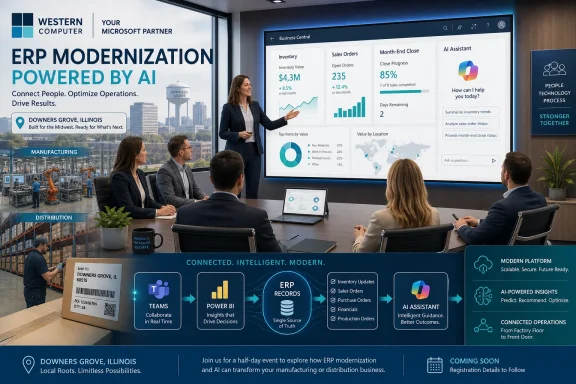 A Local ERP Event Carries a National Cloud Message
On paper, this is a straightforward mid-market technology roadshow. Western Computer, a long-running Microsoft Dynamics partner, is inviting manufacturing and distribution executives to an afternoon session at Microsoft’s Downers Grove office, with Business Central demos, Copilot discussion, and modernization guidance for companies weighing their next ERP move.That would be easy to dismiss as channel marketing, except ERP decisions are where Microsoft’s AI strategy becomes concrete. Nobody runs their factory, warehouse, purchasing, receivables, inventory, and month-end close on a keynote demo. If Microsoft wants Copilot to become more than a productivity add-on, it has to prove itself inside the operational systems where mistakes cost money.
That is why the Downers Grove event matters beyond Illinois. It targets the exact audience Microsoft and its partners need to persuade: organizations large enough to have complicated processes, but not always large enough to maintain bespoke ERP platforms indefinitely. These are the companies that have often stretched Dynamics NAV, GP, or older accounting-and-operations stacks far beyond their original design.
The message is also carefully timed. Microsoft has spent the past several years folding AI features into Dynamics 365, Power Platform, Microsoft 365, and Business Central, while also nudging customers away from legacy implementations and toward cloud-managed release cycles. The result is a buying conversation that mixes urgency with ambiguity: move now, but only after understanding what “AI-ready” actually means.
NAV’s Long Tail Is Now Microsoft’s Upgrade Problem
Dynamics NAV has always had a peculiar kind of staying power. For many mid-market businesses, it became less a software product than a business operating system — customized, localized, integrated, and quietly relied on by people who may not even call it ERP. That is precisely what makes migration hard.The old NAV world rewarded customization. Companies could bend the system around shop-floor realities, distribution quirks, industry-specific billing rules, and reporting demands that never fit neatly inside a generic product. Over time, those customizations became institutional memory written in code.
Business Central asks companies to accept a different bargain. Instead of owning every layer of the system, they gain cloud updates, Microsoft 365 integration, Power Platform extensibility, and a path into Copilot-driven automation. The tradeoff is that customers must decide which custom processes are still competitive advantages and which are simply technical debt with a sentimental name.
That distinction is not academic. A manufacturer with decades of workarounds may discover that the hardest part of an ERP modernization is not moving data. It is admitting that a “must-have” customization exists only because the business never revisited a process built around a 2009 limitation.
Western Computer’s event appears designed to put that uncomfortable conversation in a room with Microsoft experts. That matters because migration anxiety often grows in abstraction. Once executives see what Business Central can do natively, what Copilot can assist with, and what still requires partner-led design, the decision becomes less about fear of change and more about sequencing.
Copilot Is Becoming the New ERP Sales Language
Microsoft’s Copilot branding has become so broad that it can feel like a fog machine. There is Microsoft 365 Copilot, Copilot in Windows, Copilot Studio, Copilot in Dynamics 365, and AI-assisted features across Power Platform. For business leaders, the real question is not whether Copilot exists, but whether it can improve work that is structured, regulated, and financially material.Business Central is a useful test case because ERP work is repetitive but unforgiving. Drafting a marketing paragraph is one thing; helping reconcile transactions, analyze inventory, assist with collections, or summarize sales orders is another. The more operational the workflow, the less tolerance there is for AI theater.
Microsoft’s recent Business Central plans emphasize Copilot and agent-style capabilities as part of the product’s direction, including assistance for users and opportunities for developers and partners to extend AI experiences. That is the right framing, because ERP AI should not be treated as a chatbot bolted onto a ledger. It has to understand permissions, business entities, workflows, and the difference between a suggestion and a posted transaction.
The event’s inclusion of live demonstrations is therefore more important than the press release language. AI in ERP has to be seen in the context of an actual process. A demo that shows how a user moves from customer request to sales order, or from vendor invoice to review, says more than a dozen claims about “transformation.”
Still, the danger is obvious. Vendors can make AI look effortless in a clean environment, while real companies run on messy item masters, inconsistent naming conventions, stale customer records, and reporting habits built over years. The gap between demo and deployment is where IT leaders should focus their questions.
Manufacturing and Distribution Are the Right Pressure Test
Western Computer’s focus on manufacturing and distribution is not incidental. These sectors expose ERP weaknesses quickly because they combine physical constraints with financial consequences. If an AI assistant misreads a customer email, the problem is not theoretical; it can ripple into purchasing, fulfillment, inventory allocation, and customer service.Manufacturing also has a long tradition of pragmatic software adoption. Plant managers and operations leaders generally do not care whether a feature is fashionable. They care whether it reduces rework, improves visibility, shortens close, reduces stockouts, or helps employees make better decisions with less swivel-chair labor.
That makes them a useful audience for Microsoft’s AI pitch. If Copilot can help a distributor understand margin pressure, clean up routine communications, surface exceptions, or accelerate reporting, the value is easy to articulate. If it only produces generic summaries, the audience will notice.
Business Central’s appeal in this market has always been its position between lightweight accounting packages and heavier enterprise suites. It gives growing companies an integrated cloud ERP path without asking them to adopt the full complexity of larger Dynamics 365 Finance and Supply Chain implementations. That middle-market positioning is now being reframed around AI readiness.
But readiness is doing a lot of work in that sentence. A company cannot become AI-ready by buying a license. It needs data discipline, defined processes, security roles, governance, and a willingness to retire workflows that exist only because nobody wanted to disturb them.
The Cloud Argument Has Shifted From Hosting to Velocity
A decade ago, cloud ERP was often sold as a hosting decision. The appeal was lower infrastructure burden, remote access, resilience, and less server maintenance. Those benefits still matter, but they are no longer the center of the argument.The stronger argument now is release velocity. Microsoft can only deliver AI-assisted workflows, security improvements, and deep Microsoft 365 integration at speed when customers are on platforms designed for continuous evolution. Legacy ERP installations, especially heavily customized ones, turn every upgrade into a negotiation with the past.
That does not make cloud migration painless. It simply changes the cost comparison. The relevant question is not “What will it cost to move?” but “What is the cost of staying on a system that becomes harder to secure, harder to integrate, and harder to staff every year?”
This is where partners like Western Computer become central to Microsoft’s strategy. Microsoft can build the platform, but ERP migrations are won or lost in discovery workshops, data mapping, change management, training, integrations, and post-go-live support. The partner channel is where broad product strategy becomes survivable project execution.
For IT leaders, that means the partner conversation deserves as much scrutiny as the platform conversation. Business Central may be the destination, but the quality of the journey depends heavily on the team translating legacy reality into a cloud operating model.
Microsoft’s AI Advantage Depends on Boring Foundations
The phrase “AI advantage” is doing obvious marketing work in the event title. But in ERP, the actual advantage is usually not dramatic. It comes from shaving minutes from common tasks, reducing manual lookups, catching exceptions earlier, and giving nontechnical users better access to operational information.That is why Microsoft’s ecosystem pitch is persuasive when it is grounded. Business Central connected to Microsoft 365, Power BI, Power Platform, Teams, and Copilot is more compelling than Business Central in isolation. The value is not one magical assistant; it is the gradual collapse of walls between documents, conversations, workflows, data, and business records.
Yet that same integration creates governance risk. If Copilot-style tools can reason across business data, then permissions, data boundaries, retention rules, and auditability become first-order concerns. The more useful the assistant, the more carefully it must be governed.
This is where many mid-market companies are underprepared. They may have survived for years with informal data ownership, shared mailboxes, manual exports, and spreadsheet-based controls because the old system made automation difficult. AI changes the risk profile because it can amplify both good structure and bad habits.
A serious Business Central modernization should therefore treat AI as a forcing function. Before asking what Copilot can automate, companies should ask whether their data model, roles, approval chains, and reporting logic are fit for automation in the first place.
The Partner Event Is Also a Sales Funnel, and That Is Fine
It is worth saying plainly: this is a commercial event. Western Computer wants prospects in the room, Microsoft wants cloud ERP momentum, and the agenda is built to move organizations from curiosity toward pipeline. There is nothing scandalous about that.The useful question is whether the sales motion aligns with customer need. In this case, it largely does. Companies running aging ERP systems need structured ways to compare options, understand Microsoft’s roadmap, and evaluate whether AI capabilities are mature enough to influence timing.
The best version of this event will not be a victory lap for Copilot. It will be a candid discussion of modernization constraints: custom code, integrations, reporting dependencies, master data, licensing, user adoption, and business disruption. Executives do not need another AI sermon. They need a credible map.
That credibility will hinge on specificity. A finance leader wants to know how close processes change. An operations leader wants to know what happens to inventory planning and warehouse workflows. An IT leader wants to know what breaks, what gets rebuilt, what gets retired, and what security model governs the new environment.
If Western Computer and Microsoft answer those questions with real examples rather than platform slogans, the event could be useful even for companies not ready to sign a statement of work. Sometimes the most valuable outcome of a modernization session is discovering the work that must happen before the project officially begins.
The Questions IT Leaders Should Bring to Downers Grove
The companies most likely to benefit from a session like this are not the ones asking whether AI is important. That debate is over at the executive level, even if implementation remains uneven. The better question is whether AI belongs inside their ERP roadmap now, later, or only after foundational cleanup.For Dynamics NAV customers, the first inventory should be internal rather than technical. Which customizations are still used? Which reports drive decisions? Which integrations are brittle? Which departments depend on undocumented workarounds? If the organization cannot answer those questions, it is not yet evaluating Business Central so much as confronting its own memory loss.
The second question is about process ownership. ERP modernization fails when it is treated as an IT replacement project rather than an operating-model decision. Business Central may be cloud software, but its success depends on finance, operations, sales, purchasing, warehouse teams, and leadership agreeing on how work should flow.
The third question is about AI boundaries. Companies should ask where Copilot can assist, where it can recommend, where it can draft, and where humans must remain explicitly accountable. The answer will vary by process, but the distinction must be made before automation becomes a governance headache.
Finally, leaders should ask how the roadmap changes after go-live. Cloud ERP is not a one-time renovation; it is a cadence. Companies that move to Business Central should expect ongoing release management, feature evaluation, training, and governance decisions as part of normal operations.
The ERP Upgrade Is Becoming an AI Governance Project
The deeper story behind this announcement is that ERP modernization and AI governance are converging. In the past, a company could upgrade ERP for operational reasons and treat analytics or automation as follow-on initiatives. That sequencing is becoming less realistic.Microsoft’s platform increasingly assumes that business applications, productivity tools, automation layers, and AI assistants share context. That can be powerful, but it makes the boundary between ERP data and everyday work less distinct. A sales order is not just an ERP record; it may be discussed in Teams, summarized by Copilot, visualized in Power BI, and acted on through automated workflows.
For security-minded readers, this should sound both promising and alarming. The productivity upside is real, but so is the need for identity discipline, least-privilege access, data classification, and monitoring. AI does not eliminate the old rules of enterprise IT. It makes sloppy enforcement more visible.
This is one reason mid-market companies may find themselves rethinking roles they once considered adequate. The person who understands NAV customizations may not be the person who understands Microsoft 365 governance. The person who owns reporting may not own data quality. The person who approves ERP changes may not understand Copilot’s implications.
A mature migration plan has to bring those worlds together. Otherwise, the organization risks modernizing the interface while preserving the confusion underneath.
Downers Grove Is a Small Venue for a Big Microsoft Bet
Microsoft’s business applications strategy increasingly depends on getting customers to see cloud ERP as the foundation for AI-enabled operations. That is a more demanding pitch than selling better accounting screens. It asks customers to believe that Microsoft can be trusted with the systems of record and the intelligence layer above them.Business Central is one of Microsoft’s strongest vehicles for that pitch because it lives close to the daily realities of small and mid-sized companies. These firms do not usually have the appetite for speculative transformation programs. They want improvements that show up in cycle times, reporting accuracy, staff productivity, and decision quality.
The challenge is that ERP buyers are, by nature, conservative. They have been burned by overruns, brittle integrations, bad data migrations, and change fatigue. If Microsoft and its partners want them to embrace AI as part of ERP modernization, they must present it as governed capability rather than novelty.
That means the winning argument is not “Copilot will change everything.” It is more modest and more believable: Business Central can give organizations a cleaner, more current operating platform, and Copilot can begin to remove friction from the work that platform already organizes.
For many companies, that may be enough. The first wave of practical ERP AI will not replace finance teams or operations managers. It will help them navigate systems that have grown too complex for human attention alone.
The Real Advantage Is Knowing What Not to Automate Yet
The most useful modernization conversations will include restraint. Not every workflow deserves AI assistance on day one. Not every report should be rebuilt as an automated dashboard. Not every customization should be preserved, and not every manual step should be eliminated.There is a temptation in AI-era ERP sales to make modernization sound like a leap from old to autonomous. That framing is risky. The better model is staged adoption: clean the data, rationalize the processes, move the platform, train the users, then expand automation where governance and value are clear.
That approach may feel slower, but it is more likely to survive contact with the business. Manufacturers and distributors cannot pause operations while a transformation program searches for its thesis. They need continuity, then improvement.
This is where the event’s practical emphasis could matter. If attendees leave with a clearer sense of cost, timeline, risk, and sequencing, the session will have done more than market Microsoft’s cloud. It will have helped translate an industry-wide AI narrative into a project plan a CFO, CIO, and operations chief can debate.
The companies that get this right will not be the ones that buy the most AI. They will be the ones that modernize enough of the underlying business system for AI to have something trustworthy to work with.
What the Downers Grove Pitch Really Signals
The announcement is narrow, but the implications are broader for Microsoft customers weighing ERP decisions in 2026. The practical reading is that Microsoft and its partner ecosystem are moving the Business Central conversation from cloud migration toward AI-enabled operations.- Western Computer and Microsoft are holding the Business Central and AI-focused event on June 17, 2026, at Microsoft’s Downers Grove, Illinois office.
- The target audience is finance, operations, IT, and executive leadership in manufacturing and distribution organizations evaluating ERP modernization.
- Dynamics NAV customers are a central audience because legacy ERP environments are increasingly difficult to align with Microsoft’s cloud-first and AI-forward roadmap.
- Business Central’s value proposition now rests as much on integration with Microsoft 365, Power Platform, and Copilot as on traditional ERP functionality.
- Copilot should be evaluated as an assistant inside governed business processes, not as a substitute for data quality, role design, or operational accountability.
- The most important migration questions are likely to involve customizations, integrations, reporting dependencies, security, training, and post-go-live governance.
References
- Primary source: Weekly Voice
Published: 2026-06-09T15:50:15.209764
Western Computer and Microsoft to Host Navigate Forward: Business Central & The AI Advantage Event in Downers Grove, IL
Manufacturing and distribution leaders invited to explore ERP modernization, AI, and the future of Dynamics 365 Business Central at Microsoft's Downers Grove officeCHICAGO, June 9, 2026 /PRNewswire… weeklyvoice.com
- Independent coverage: Morningstar
Published: Tue, 09 Jun 2026 15:30:00 GMT
- Related coverage: windowscentral.com
Build 2026 only makes sense if you remember Build 2025: a look back at the groundwork of the "age of AI agents" | Windows Central
Microsoft’s latest announcements build directly on the architecture it introduced a year ago.www.windowscentral.com - Official source: learn.microsoft.com
Dynamics 365 Business Central - Copilot and agents | Microsoft Learn
Scale your business without the traditional friction that accompanies growth, and eliminate tedious tasks with powerful, generative AI. Business Central includes Copilot, built-in autonomous agents, and the flexibility to add custom AI.learn.microsoft.com - Related coverage: prnewswire.com
Western Computer and Microsoft to Host Navigate Forward: Business Central & The AI Advantage Event in Downers Grove, IL
/PRNewswire/ -- Western Computer, a leading Microsoft Dynamics partner specializing in manufacturing and distribution, today announced its upcoming onsite... www.prnewswire.com
- Official source: microsoft.com
2026 release wave 1 plans for Microsoft Dynamics 365, Microsoft Power Platform, and Copilot Studio offerings - Microsoft Dynamics 365 Blog
Discover what’s new in Microsoft Dynamics 365, Power Platform, and Copilot Studio in the 2026 release wave 1—AI agents, automation, and more.www.microsoft.com
- Official source: blogs.microsoft.com
Introducing the First Frontier Suite built on Intelligence + Trust - The Official Microsoft Blog
Today Microsoft is announcing: Wave 3 of Microsoft 365 Copilot Expanded model diversity with Claude and next-gen OpenAI models available today General availability of Agent 365 on May 1 for $15 per user General availability of the new Microsoft 365 E7: The Frontier Suite on May 1 for $99 per...blogs.microsoft.com - Related coverage: randgroup.com
Your Dynamics NAV to Business Central upgrade guide | Rand Group
Planning a Dynamics NAV to Business Central upgrade? Compare upgrade options, costs, timelines, AI capabilities, and key differences. www.randgroup.com
- Official source: news.microsoft.com
Microsoft presenta la primera suite pionera, construida sobre Inteligencia y Confianza - Source EMEA
La compañía presenta Microsoft 365 E7, una suite que unifica Microsoft 365 E5, Microsoft 365 Copilot y Agent 365 en una única soluciónnews.microsoft.com - Official source: test.playready.microsoft.com
Microsoft PlayReady - PlayReady | Microsoft Learn
Use PlayReady for defining, incorporating, and enforcing rights for digital media. The service provider and content provider can control the expiration date, the number of times a user can play the content file, the resolution of the content that can be played on a screen, the type of screen...test.playready.microsoft.com - Related coverage: navision.es
navisions-business-central-2026 - Navision Dynamics Business Central
Navision Business Central 2026 Release Wave 1: ERP Inteligente con IA | Navision.es Inicio / Noticias / Navision Business Central 2026 Release Wave 1 En este artículo Descripción general Áreas de inversión Copilot y Agentes Gestión Financiera Fabricación y Supply Chain Documentos Electrónicos... www.navision.es
- Official source: devblogs.microsoft.com
Build business understanding with Dataverse in Microsoft 365 Copilot - Microsoft 365 Developer Blog
Microsoft 365 Copilot is now embedded as an in-app sidecar within Power Apps, Dynamics 365 Sales, and Dynamics 365 Customer Service—removing the need to switch between apps to find context or complete steps.devblogs.microsoft.com - Related coverage: yesdynamic.com
