

Montague Company, a U.S. maker of commercial kitchen appliances, has replaced its 1990s PICK enterprise resource planning system with Microsoft Dynamics 365 Business Central in a modernization project implemented by Volt Technologies and spanning finance, supply chain, production, data migration, and cloud operations. The move is not just another ERP swap dressed up as digital transformation. It is a reminder that many manufacturers are still running strategic operations on systems old enough to predate the modern web. Montague’s bet is that a cloud ERP, tied into Azure, Microsoft 365, and Power Platform, can turn operational plumbing into a growth platform rather than a constraint.
Legacy ERP systems rarely fail in a single dramatic moment. They become a problem more quietly, through every manual reconciliation, every workaround spreadsheet, every production report that arrives too late to influence the day’s decisions. Montague’s old PICK system appears to have belonged to that familiar class of durable-but-limiting business software: stable enough to survive, but increasingly expensive in organizational drag.
That distinction matters because ERP modernization is often sold as a feature upgrade. In practice, the more important change is a shift in operating assumptions. A 1990s system assumes scarcity: scarce connectivity, scarce integration, scarce real-time visibility, and scarce user-friendly customization. A modern cloud ERP assumes the opposite, or at least promises it.
For a manufacturer, those assumptions live close to the money. Finance, purchasing, inventory, production scheduling, and reporting do not sit in clean departmental boxes. They form a chain of dependency, and the quality of the chain is determined by its weakest link. If production data lags, finance is late; if purchasing visibility is poor, inventory buffers grow; if reporting depends on manual extraction, management decisions become partly historical fiction.
Montague’s case is therefore less about leaving PICK behind than about leaving behind the business model that PICK represented. The company did not simply need a newer ledger. It needed a system that could align a U.S. manufacturing operation with the expectations of Ali Group, its parent company, while also giving the local business a more scalable foundation.
That middle is where many manufacturers live. They have bills of material, routings, production orders, inventory planning, work centers, purchasing workflows, customer commitments, compliance expectations, and finance teams that want clean numbers. They also tend to have lean IT departments and a deep reluctance to disrupt the plant.
Business Central’s pitch is that it brings core finance and operations into a single Microsoft-centered environment. Its manufacturing capabilities can handle production bills of material, routings, production orders, consumption, output, costing, and related operational tasks. Its real advantage, however, may be the surrounding ecosystem: Azure for infrastructure and identity, Microsoft 365 for the daily productivity layer, and Power Platform for workflows, reporting, and low-code extensions.
That combination explains why the Montague implementation is strategically interesting. The case study credits Volt Technologies not only with deploying Business Central but with building manufacturing integrations, automating workflows, and migrating historical data safely. That is the real implementation work. ERP projects succeed or fail in the seams between modules, departments, and data histories.
Microsoft’s advantage here is not that Business Central magically knows how every manufacturer works. It does not. The advantage is that enough pieces of the Microsoft stack are already familiar to users and administrators that the ERP can become part of a broader operating fabric rather than a separate island. For a WindowsForum audience, that matters: identity, access, reporting, collaboration, and automation are not peripheral details. They are the connective tissue.
A legacy system can be tolerable inside a single site if everyone knows the rituals. The finance team knows which reports to trust. The production office knows which fields are stale. The purchasing team knows which export to massage before sending it onward. Those tribal practices do not scale well into a parent-company environment.
That is why alignment is one of the quiet drivers of ERP modernization. It is not glamorous, but it is powerful. A parent company wants consistent data definitions, reliable financial visibility, security controls that can be audited, and operations that do not depend on a shrinking pool of people who understand an old platform’s quirks.
Montague’s move to Business Central should be read in that context. The value is not merely that employees get a cleaner interface or that managers get better dashboards. The value is that the company’s operating data can become more legible to the broader corporate structure. Once that happens, budgeting, inventory analysis, procurement planning, and performance measurement become less dependent on translation.
There is a tradeoff, of course. Standardization can feel like constraint to a business that has spent decades optimizing around its own system. But the old flexibility of legacy ERP is often misleading. It is flexibility achieved through custom code, manual workarounds, and institutional memory. Modern ERP asks companies to formalize those practices, which can be painful, but also makes them easier to secure, automate, and improve.
Moving from PICK to Business Central likely meant more than copying tables. Legacy ERP data often reflects years of shortcuts: obsolete item codes, inconsistent naming conventions, fields repurposed for local needs, duplicate vendor records, and historical transactions shaped by past accounting practices. The migration team must decide what to bring forward, what to archive, what to normalize, and what to leave behind.
Those decisions carry operational consequences. Bring too much dirty data into the new system and users lose confidence immediately. Bring too little and the business loses continuity. Transform data too aggressively and history becomes difficult to audit. Transform it too cautiously and the new ERP inherits the old system’s clutter.
This is where an implementation partner earns its fee. The public case study presents Volt Technologies as the firm that handled the migration and built the necessary integrations. For Montague, that probably meant preserving the data needed for financial reporting, customer service, purchasing history, production context, and management analysis without reproducing every legacy artifact in the new platform.
The lesson for other manufacturers is blunt: data migration is not a back-office chore. It is one of the central modernization acts. A cloud ERP with poor data discipline is just a faster, shinier way to make bad decisions.
That is why Montague’s manufacturing integrations stand out. Commercial kitchen appliance manufacturing is not the same as distributing finished goods or running a professional services firm. The company must manage components, production steps, inventory movement, and coordination between shop-floor activity and financial outcomes. If the ERP cannot represent those relationships accurately, users will route around it.
Business Central’s manufacturing model provides the framework: production BOMs define what goes into a product, routings define how production happens, production orders drive execution, and output and consumption postings connect shop-floor activity to inventory and costing. But framework is not implementation. The hard part is adapting that structure to the way a real factory works.
That is also where cloud ERP marketing can get ahead of itself. Real-time insight sounds obvious until the system has to capture meaningful real-time data from people and processes that were not designed around it. If production workers see ERP entry as clerical overhead, data quality suffers. If supervisors do not trust the schedule, they will maintain shadow systems. If finance cannot reconcile manufacturing costs, confidence erodes.
Montague’s reported outcome — reduced manual effort and better real-time insight — suggests the project addressed at least some of those practical frictions. The broader lesson is that manufacturing modernization must respect the shop floor. ERP is not modern because it runs in the cloud; it is modern when the business can use it without inventing a parallel reality in Excel.
That is a sensible architectural move, but it requires discipline. Power Automate can replace repetitive handoffs, approvals, notifications, and data-entry routines. Power Apps can create targeted interfaces for specific roles. Power BI can turn operational data into dashboards that managers actually use. But the same tools can also create a new generation of unmanaged sprawl if IT does not govern them properly.
For Montague, Power Platform likely helped close gaps between standard Business Central behavior and the company’s specific operating needs. That is exactly the right use case. A manufacturer should not have to commission heavyweight custom ERP code for every departmental workflow. It should be able to automate routine processes and expose data in context.
The catch is that low-code is still code in the ways that matter. It has dependencies, permissions, lifecycle concerns, ownership questions, and failure modes. If workflows become mission-critical, someone has to monitor them. If apps handle sensitive data, someone has to secure them. If reports drive executive decisions, someone has to validate the underlying model.
This is where the Microsoft stack creates both opportunity and risk. The opportunity is a unified environment where identity, data, collaboration, and automation can be governed under a common umbrella. The risk is that the ease of creation outruns the maturity of governance. Smart ERP modernization teams plan for both.
A cloud Business Central deployment changes that baseline. Authentication, permissions, update cadence, backup strategy, endpoint access, and integration security become part of a modern Microsoft environment. That does not eliminate risk, but it changes the security conversation from “How do we protect this aging bespoke thing?” to “How do we govern a known cloud platform properly?”
For administrators, that shift is meaningful. The security burden moves toward identity governance, role design, conditional access, tenant configuration, integration review, and user lifecycle management. In other words, it becomes more aligned with the work many Microsoft-oriented IT teams are already doing across Microsoft 365 and Azure.
Scalability carries a similar nuance. Cloud ERP does not automatically make a business scalable. Processes still have to be designed, master data still has to be maintained, and integrations still have to survive operational stress. But cloud ERP removes some familiar ceilings: aging infrastructure, fragile on-premises dependencies, limited remote access, and the difficulty of adding new reporting and automation capabilities around an old core.
For Montague, scalability also means future strategic optionality. A company that has modernized its ERP can more easily add analytics, integrate with related systems, standardize reporting to a parent company, support new business processes, and onboard new users or sites. The ERP stops being a museum piece and becomes part of the company’s planning horizon.
That has practical consequences. Users may interact with ERP data through Outlook, Excel, Teams, Power BI, or browser-based Business Central sessions. Administrators may think about access through Entra ID, governance through tenant policies, reporting through Power BI, and automation through Power Automate. The boundaries between “ERP admin,” “Microsoft 365 admin,” and “business analyst” become less clear.
This convergence is one reason Microsoft has been successful with midmarket business applications. It does not need every customer to fall in love with ERP as a category. It needs customers to see the ERP as another layer in a Microsoft environment they already know. For organizations standardized on Windows endpoints and Microsoft 365, that familiarity can reduce adoption friction.
But convergence also raises the stakes. A weak identity model can now affect ERP access. A poorly governed Power Platform environment can touch operational data. A reporting mistake can propagate through dashboards that executives trust. The more integrated the stack becomes, the less acceptable it is to manage each piece as a separate silo.
Montague’s modernization therefore points to a larger pattern. The future of Microsoft ERP is not just Business Central replacing legacy systems. It is Business Central becoming one workload in a cloud operations estate that includes security, productivity, analytics, automation, and identity. That is powerful, but it demands more mature administration.
That omission is not unusual. Case studies are marketing artifacts. They are useful because they identify real patterns and show what vendors and customers consider important enough to publicize. They are limited because they rarely dwell on the messy middle.
The most important unanswered question is how deeply Montague changed its processes to fit Business Central versus how much Business Central was extended to fit Montague. That balance determines long-term maintainability. A system that is too rigid may frustrate users. A system that is too customized may become the next legacy burden.
Another question is what “real-time insights” means operationally. Does management now see live production status, more timely financial performance, better inventory accuracy, or faster exception reporting? Each is valuable, but each depends on different data-capture habits. Real-time dashboards are only as trustworthy as the workflows beneath them.
The final question is organizational ownership. After Volt Technologies completes implementation work, who owns continuous improvement? ERP modernization is not finished at go-live. The first year usually reveals process gaps, training needs, reporting changes, and automation opportunities. Companies that treat go-live as the finish line often leave value on the table.
That longevity creates a modernization trap. If a system is catastrophically broken, replacement becomes urgent. If it mostly works, replacement becomes perpetually deferrable. The business absorbs inefficiency as normal operating friction, and the true cost hides in manual effort, delayed insight, fragile reporting, and constrained growth.
Montague’s move suggests the cost of waiting eventually exceeded the cost of change. That is the decision point many midmarket manufacturers face. They do not modernize because the old system stops booting. They modernize because the business can no longer afford the operating model around it.
There is a people dimension here too. Legacy systems concentrate knowledge in a small number of veteran users and technical specialists. That can be comforting until those people retire, leave, or become bottlenecks. Modern ERP does not eliminate the need for expertise, but it shifts expertise toward more transferable skills and more widely supported platforms.
The lesson is not that every legacy ERP must be ripped out immediately. The lesson is that companies should measure legacy cost honestly. If the old system slows finance, obscures supply chain visibility, complicates production, weakens security, and blocks parent-company alignment, its apparent stability is deceptive.
For other manufacturers, the checklist is not “buy Business Central.” The checklist is more demanding than that.
Montague’s shift from PICK to Business Central is a small case study with a large lesson: the next wave of ERP modernization will be less about flashy digital transformation slogans and more about whether manufacturers can finally connect finance, production, supply chain, security, and analytics without living inside decades-old compromises. For Microsoft, that is an opportunity to make Business Central the default modernization path for the midmarket. For IT leaders, it is a reminder that the systems nobody wants to touch are often the ones quietly defining how far the business can go.
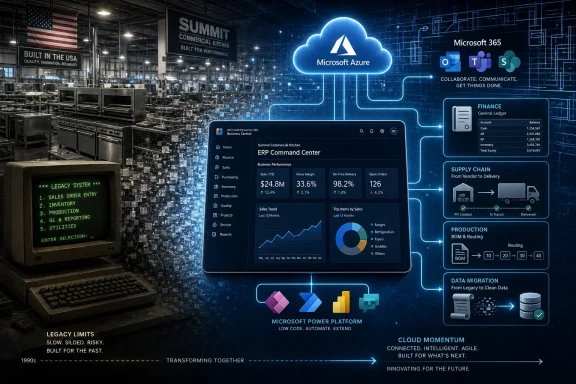 The Real Story Is Not the Software, but the Age of the Assumptions
Legacy ERP systems rarely fail in a single dramatic moment. They become a problem more quietly, through every manual reconciliation, every workaround spreadsheet, every production report that arrives too late to influence the day’s decisions. Montague’s old PICK system appears to have belonged to that familiar class of durable-but-limiting business software: stable enough to survive, but increasingly expensive in organizational drag.That distinction matters because ERP modernization is often sold as a feature upgrade. In practice, the more important change is a shift in operating assumptions. A 1990s system assumes scarcity: scarce connectivity, scarce integration, scarce real-time visibility, and scarce user-friendly customization. A modern cloud ERP assumes the opposite, or at least promises it.
For a manufacturer, those assumptions live close to the money. Finance, purchasing, inventory, production scheduling, and reporting do not sit in clean departmental boxes. They form a chain of dependency, and the quality of the chain is determined by its weakest link. If production data lags, finance is late; if purchasing visibility is poor, inventory buffers grow; if reporting depends on manual extraction, management decisions become partly historical fiction.
Montague’s case is therefore less about leaving PICK behind than about leaving behind the business model that PICK represented. The company did not simply need a newer ledger. It needed a system that could align a U.S. manufacturing operation with the expectations of Ali Group, its parent company, while also giving the local business a more scalable foundation.
Business Central Wins the Middle-Market Argument by Being Boring in the Right Places
Microsoft Dynamics 365 Business Central occupies a particular slot in the ERP market. It is not Dynamics 365 Finance and Supply Chain Management, the larger enterprise platform aimed at bigger global operations. It is also not a small-business accounting package with a few manufacturing extensions bolted on. Its appeal is that it sits in the uncomfortable middle, where companies are too complex for entry-level tools but not always ready for a multi-year enterprise ERP program.That middle is where many manufacturers live. They have bills of material, routings, production orders, inventory planning, work centers, purchasing workflows, customer commitments, compliance expectations, and finance teams that want clean numbers. They also tend to have lean IT departments and a deep reluctance to disrupt the plant.
Business Central’s pitch is that it brings core finance and operations into a single Microsoft-centered environment. Its manufacturing capabilities can handle production bills of material, routings, production orders, consumption, output, costing, and related operational tasks. Its real advantage, however, may be the surrounding ecosystem: Azure for infrastructure and identity, Microsoft 365 for the daily productivity layer, and Power Platform for workflows, reporting, and low-code extensions.
That combination explains why the Montague implementation is strategically interesting. The case study credits Volt Technologies not only with deploying Business Central but with building manufacturing integrations, automating workflows, and migrating historical data safely. That is the real implementation work. ERP projects succeed or fail in the seams between modules, departments, and data histories.
Microsoft’s advantage here is not that Business Central magically knows how every manufacturer works. It does not. The advantage is that enough pieces of the Microsoft stack are already familiar to users and administrators that the ERP can become part of a broader operating fabric rather than a separate island. For a WindowsForum audience, that matters: identity, access, reporting, collaboration, and automation are not peripheral details. They are the connective tissue.
The Parent-Company Problem Turns ERP into Governance
The Ali Group connection is more than corporate trivia. When a manufacturer belongs to a larger parent organization, ERP becomes a governance instrument. The local business may care about faster closes and smoother production workflows, while the parent company cares about comparability, control, reporting discipline, and scalability across business units.A legacy system can be tolerable inside a single site if everyone knows the rituals. The finance team knows which reports to trust. The production office knows which fields are stale. The purchasing team knows which export to massage before sending it onward. Those tribal practices do not scale well into a parent-company environment.
That is why alignment is one of the quiet drivers of ERP modernization. It is not glamorous, but it is powerful. A parent company wants consistent data definitions, reliable financial visibility, security controls that can be audited, and operations that do not depend on a shrinking pool of people who understand an old platform’s quirks.
Montague’s move to Business Central should be read in that context. The value is not merely that employees get a cleaner interface or that managers get better dashboards. The value is that the company’s operating data can become more legible to the broader corporate structure. Once that happens, budgeting, inventory analysis, procurement planning, and performance measurement become less dependent on translation.
There is a tradeoff, of course. Standardization can feel like constraint to a business that has spent decades optimizing around its own system. But the old flexibility of legacy ERP is often misleading. It is flexibility achieved through custom code, manual workarounds, and institutional memory. Modern ERP asks companies to formalize those practices, which can be painful, but also makes them easier to secure, automate, and improve.
Data Migration Is Where Modernization Meets the Archaeological Record
The phrase “migrated historical data safely” deserves more attention than it usually receives. In ERP projects, data migration is treated as a technical milestone, but it is really a confrontation with the company’s institutional history. Every old customer record, item number, vendor account, production artifact, and financial transaction carries assumptions from the old system.Moving from PICK to Business Central likely meant more than copying tables. Legacy ERP data often reflects years of shortcuts: obsolete item codes, inconsistent naming conventions, fields repurposed for local needs, duplicate vendor records, and historical transactions shaped by past accounting practices. The migration team must decide what to bring forward, what to archive, what to normalize, and what to leave behind.
Those decisions carry operational consequences. Bring too much dirty data into the new system and users lose confidence immediately. Bring too little and the business loses continuity. Transform data too aggressively and history becomes difficult to audit. Transform it too cautiously and the new ERP inherits the old system’s clutter.
This is where an implementation partner earns its fee. The public case study presents Volt Technologies as the firm that handled the migration and built the necessary integrations. For Montague, that probably meant preserving the data needed for financial reporting, customer service, purchasing history, production context, and management analysis without reproducing every legacy artifact in the new platform.
The lesson for other manufacturers is blunt: data migration is not a back-office chore. It is one of the central modernization acts. A cloud ERP with poor data discipline is just a faster, shinier way to make bad decisions.
Manufacturing Makes ERP Projects Less Forgiving
Manufacturing ERP is harder than office ERP because the system has to map onto physical reality. A finance workflow can be corrected after the fact, however unpleasantly. A production workflow collides with materials, machines, labor, capacity, scrap, lead times, shipping commitments, and customers waiting for finished goods.That is why Montague’s manufacturing integrations stand out. Commercial kitchen appliance manufacturing is not the same as distributing finished goods or running a professional services firm. The company must manage components, production steps, inventory movement, and coordination between shop-floor activity and financial outcomes. If the ERP cannot represent those relationships accurately, users will route around it.
Business Central’s manufacturing model provides the framework: production BOMs define what goes into a product, routings define how production happens, production orders drive execution, and output and consumption postings connect shop-floor activity to inventory and costing. But framework is not implementation. The hard part is adapting that structure to the way a real factory works.
That is also where cloud ERP marketing can get ahead of itself. Real-time insight sounds obvious until the system has to capture meaningful real-time data from people and processes that were not designed around it. If production workers see ERP entry as clerical overhead, data quality suffers. If supervisors do not trust the schedule, they will maintain shadow systems. If finance cannot reconcile manufacturing costs, confidence erodes.
Montague’s reported outcome — reduced manual effort and better real-time insight — suggests the project addressed at least some of those practical frictions. The broader lesson is that manufacturing modernization must respect the shop floor. ERP is not modern because it runs in the cloud; it is modern when the business can use it without inventing a parallel reality in Excel.
Power Platform Is the Escape Valve Microsoft Wants Customers to Use
The inclusion of Power Platform is not incidental. For years, ERP customization was a double-edged sword: companies could make the system fit their processes, but heavy customization made upgrades risky, expensive, and slow. Microsoft’s current strategy is to shift more of that adaptation into low-code workflows, apps, and analytics that sit around the core ERP rather than directly modifying it.That is a sensible architectural move, but it requires discipline. Power Automate can replace repetitive handoffs, approvals, notifications, and data-entry routines. Power Apps can create targeted interfaces for specific roles. Power BI can turn operational data into dashboards that managers actually use. But the same tools can also create a new generation of unmanaged sprawl if IT does not govern them properly.
For Montague, Power Platform likely helped close gaps between standard Business Central behavior and the company’s specific operating needs. That is exactly the right use case. A manufacturer should not have to commission heavyweight custom ERP code for every departmental workflow. It should be able to automate routine processes and expose data in context.
The catch is that low-code is still code in the ways that matter. It has dependencies, permissions, lifecycle concerns, ownership questions, and failure modes. If workflows become mission-critical, someone has to monitor them. If apps handle sensitive data, someone has to secure them. If reports drive executive decisions, someone has to validate the underlying model.
This is where the Microsoft stack creates both opportunity and risk. The opportunity is a unified environment where identity, data, collaboration, and automation can be governed under a common umbrella. The risk is that the ease of creation outruns the maturity of governance. Smart ERP modernization teams plan for both.
Security and Scalability Are Not Afterthoughts Anymore
The case study’s reference to stronger security and scalability may sound like standard cloud-era boilerplate, but for a manufacturer leaving a 1990s system, it is substantial. Legacy ERP platforms can become security liabilities not because they are inherently insecure, but because their operational model often predates modern identity, monitoring, patching, and access-control expectations.A cloud Business Central deployment changes that baseline. Authentication, permissions, update cadence, backup strategy, endpoint access, and integration security become part of a modern Microsoft environment. That does not eliminate risk, but it changes the security conversation from “How do we protect this aging bespoke thing?” to “How do we govern a known cloud platform properly?”
For administrators, that shift is meaningful. The security burden moves toward identity governance, role design, conditional access, tenant configuration, integration review, and user lifecycle management. In other words, it becomes more aligned with the work many Microsoft-oriented IT teams are already doing across Microsoft 365 and Azure.
Scalability carries a similar nuance. Cloud ERP does not automatically make a business scalable. Processes still have to be designed, master data still has to be maintained, and integrations still have to survive operational stress. But cloud ERP removes some familiar ceilings: aging infrastructure, fragile on-premises dependencies, limited remote access, and the difficulty of adding new reporting and automation capabilities around an old core.
For Montague, scalability also means future strategic optionality. A company that has modernized its ERP can more easily add analytics, integrate with related systems, standardize reporting to a parent company, support new business processes, and onboard new users or sites. The ERP stops being a museum piece and becomes part of the company’s planning horizon.
The Windows Angle Is the Administrative Center of Gravity
For WindowsForum readers, the most interesting part of this story may be that the ERP modernization lives inside a broader Microsoft administrative universe. Business Central is not a Windows desktop application in the old sense, but its adoption pulls the company deeper into Microsoft’s cloud identity, productivity, security, and automation model.That has practical consequences. Users may interact with ERP data through Outlook, Excel, Teams, Power BI, or browser-based Business Central sessions. Administrators may think about access through Entra ID, governance through tenant policies, reporting through Power BI, and automation through Power Automate. The boundaries between “ERP admin,” “Microsoft 365 admin,” and “business analyst” become less clear.
This convergence is one reason Microsoft has been successful with midmarket business applications. It does not need every customer to fall in love with ERP as a category. It needs customers to see the ERP as another layer in a Microsoft environment they already know. For organizations standardized on Windows endpoints and Microsoft 365, that familiarity can reduce adoption friction.
But convergence also raises the stakes. A weak identity model can now affect ERP access. A poorly governed Power Platform environment can touch operational data. A reporting mistake can propagate through dashboards that executives trust. The more integrated the stack becomes, the less acceptable it is to manage each piece as a separate silo.
Montague’s modernization therefore points to a larger pattern. The future of Microsoft ERP is not just Business Central replacing legacy systems. It is Business Central becoming one workload in a cloud operations estate that includes security, productivity, analytics, automation, and identity. That is powerful, but it demands more mature administration.
The Vendor Case Study Still Leaves the Hard Questions Unanswered
Because the source material is a vendor-published case study, it naturally emphasizes the win. That does not make it untrue, but it does shape the frame. We hear about reduced manual effort, real-time insights, stronger security, scalability, and a future-proof foundation. We do not hear much about the tradeoffs, disruptions, budget pressures, user resistance, or post-go-live cleanup that usually accompany ERP projects.That omission is not unusual. Case studies are marketing artifacts. They are useful because they identify real patterns and show what vendors and customers consider important enough to publicize. They are limited because they rarely dwell on the messy middle.
The most important unanswered question is how deeply Montague changed its processes to fit Business Central versus how much Business Central was extended to fit Montague. That balance determines long-term maintainability. A system that is too rigid may frustrate users. A system that is too customized may become the next legacy burden.
Another question is what “real-time insights” means operationally. Does management now see live production status, more timely financial performance, better inventory accuracy, or faster exception reporting? Each is valuable, but each depends on different data-capture habits. Real-time dashboards are only as trustworthy as the workflows beneath them.
The final question is organizational ownership. After Volt Technologies completes implementation work, who owns continuous improvement? ERP modernization is not finished at go-live. The first year usually reveals process gaps, training needs, reporting changes, and automation opportunities. Companies that treat go-live as the finish line often leave value on the table.
PICK’s Longevity Is a Warning, Not an Embarrassment
It is tempting to mock a 1990s ERP system, but that would miss the point. PICK and systems like it survived because they worked. They encoded business logic, supported transactions, and became familiar to employees. In many manufacturing companies, the old ERP is not a failure; it is a victim of its own usefulness.That longevity creates a modernization trap. If a system is catastrophically broken, replacement becomes urgent. If it mostly works, replacement becomes perpetually deferrable. The business absorbs inefficiency as normal operating friction, and the true cost hides in manual effort, delayed insight, fragile reporting, and constrained growth.
Montague’s move suggests the cost of waiting eventually exceeded the cost of change. That is the decision point many midmarket manufacturers face. They do not modernize because the old system stops booting. They modernize because the business can no longer afford the operating model around it.
There is a people dimension here too. Legacy systems concentrate knowledge in a small number of veteran users and technical specialists. That can be comforting until those people retire, leave, or become bottlenecks. Modern ERP does not eliminate the need for expertise, but it shifts expertise toward more transferable skills and more widely supported platforms.
The lesson is not that every legacy ERP must be ripped out immediately. The lesson is that companies should measure legacy cost honestly. If the old system slows finance, obscures supply chain visibility, complicates production, weakens security, and blocks parent-company alignment, its apparent stability is deceptive.
Montague’s Cloud Move Rewrites the Midmarket ERP Checklist
Montague’s project offers a compact version of the midmarket ERP modernization playbook. It starts with a legacy system that has outlived its strategic usefulness. It moves through a Microsoft stack decision that combines ERP, cloud infrastructure, productivity, and automation. It ends with a claim of reduced manual effort, better insight, stronger security, and room to grow.For other manufacturers, the checklist is not “buy Business Central.” The checklist is more demanding than that.
- The company must understand which legacy processes are genuinely valuable and which are just old habits preserved by the existing ERP.
- Historical data migration must be treated as a business design decision, not merely a technical conversion task.
- Manufacturing workflows must be validated against real production behavior, because shop-floor workarounds can undermine the cleanest ERP model.
- Power Platform should be governed from the start so automation does not become the next unmanaged customization layer.
- Security and identity design should be part of the ERP program rather than a post-go-live hardening exercise.
- Go-live should be treated as the beginning of optimization, because the first production months reveal what the project plan could not.
Montague’s shift from PICK to Business Central is a small case study with a large lesson: the next wave of ERP modernization will be less about flashy digital transformation slogans and more about whether manufacturers can finally connect finance, production, supply chain, security, and analytics without living inside decades-old compromises. For Microsoft, that is an opportunity to make Business Central the default modernization path for the midmarket. For IT leaders, it is a reminder that the systems nobody wants to touch are often the ones quietly defining how far the business can go.
References
- Primary source: msdynamicsworld.com
Published: 2026-06-19T06:50:08.683294
Montague Company Modernizes Operations with Business Central
Volt Technologies swaps a 1990s ERP for Microsoft Dynamics 365The Montague Company, a U.S. commercial kitchen appliance manufacturer, ran on a legacy ERP called "PICK" dating back to the 1990s. The system caused inefficiencies in finance, supply chain, and production, and couldn't support growth...msdynamicsworld.com
