

Microsoft Business Central and Copilot were pitched to shipping executives at Posidonia 2026 in Athens on June 2, 2026, during a Fortune Technologies session at Metropolitan Expo that framed AI as the next operating layer for maritime ERP. The event matters less as a standalone seminar than as a snapshot of where Microsoft wants enterprise software to go next: away from static systems of record and toward AI-mediated systems of action. For shipping companies, that promise lands in a sector where paperwork, compliance, maintenance, voyage data, safety reporting, and fragmented workflows still create enormous drag. The question is whether Copilot can become useful operational infrastructure, or whether it remains another polished demo orbiting around a complicated industry.
Posidonia is not a random stage for an ERP-and-AI pitch. The Athens exhibition is one of the shipping industry’s major gatherings, and the maritime sector has the kind of operational complexity that enterprise software vendors love to describe as ripe for transformation. A shipowner or manager may run fleets across jurisdictions, ports, insurers, classification societies, crew systems, environmental regimes, and customer contracts, all while maintaining documentation that can become as mission-critical as the vessel itself.
That makes the session’s focus on Microsoft Dynamics 365 Business Central and Copilot unsurprising. Business Central is Microsoft’s mid-market ERP platform, already used across finance, operations, inventory, purchasing, and reporting. Copilot is the layer Microsoft wants to insert into those workflows, not merely as a chatbot, but as a conversational and increasingly agentic interface over business data.
Fortune Technologies’ framing is especially telling because it speaks the language of maritime operations rather than generic productivity. The invitation emphasized AI use cases in shipping, Copilot support for HSQE, reporting, daily operational workflows, reduced manual effort, and productivity gains. Those are not abstract office-worker promises; they are the pain points of an industry where small administrative failures can become safety, compliance, or commercial problems.
Microsoft’s presence through George Aspiotis, identified as a Senior Sales Specialist, also signals the company’s current sales posture. Copilot is no longer being sold only as a clever assistant for Word, Excel, Teams, and Outlook. It is being positioned as a strategic layer for industry-specific transformation, with partners translating the platform into the local vocabulary of sectors such as shipping.
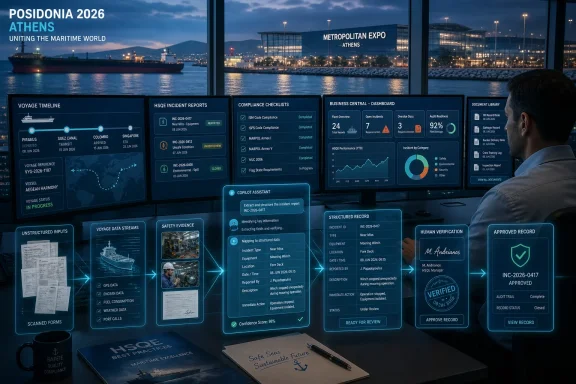
Copilot attacks that gap. Microsoft’s ambition is to make ERP less like a database that users must feed and more like a work surface that can summarize, draft, classify, reconcile, retrieve, and eventually execute. In maritime terms, that could mean turning incident reports into structured HSQE records, summarizing vessel performance, generating management reports, or helping operations teams find the right document without hunting through folders and inboxes.
That is why Business Central is an interesting platform for this discussion. It sits close enough to operational and financial workflows to matter, but it is not so monolithic that every customer requires a decade-long transformation program. For mid-sized shipping companies and service providers, a Business Central-based maritime solution can become the place where AI is introduced pragmatically: invoice matching here, compliance reporting there, procurement assistance somewhere else.
The danger is that “AI in ERP” becomes another umbrella phrase that obscures the hard work. ERP data is often messy, customized, incomplete, and politically sensitive. Copilot can only be as useful as the permissions, data architecture, process design, and governance around it. The assistant may speak fluently, but fluency is not the same thing as operational truth.
That is precisely where AI can look attractive. A model that can summarize a dense inspection report, extract obligations from a document, compare fields across forms, or draft a response to a routine operational query could save real time. In HSQE functions, the ability to move from narrative incident descriptions to structured follow-up actions is not merely clerical convenience; it can influence audit readiness and organizational learning.
But the same environment exposes the risk. A hallucinated safety summary, an incorrectly classified non-conformity, or a misleading compliance answer can create more work than it saves. In maritime operations, “close enough” is not good enough when the output affects inspections, claims, maintenance decisions, or regulatory filings.
This is the tension Microsoft and its partners must manage. Copilot’s value proposition is strongest when it reduces cognitive and administrative load. Its risk is highest when users begin treating generated output as authoritative without verification. In shipping, the dividing line between assistance and automation must be drawn carefully.
That distinction matters. Many companies are currently in the experimentation phase, where employees use Copilot or other assistants to summarize meetings, draft emails, or polish documents. Useful, yes, but limited. Microsoft’s Frontier Firm story is about moving from individual productivity hacks to coordinated business processes in which AI can reason across data, tools, roles, and handoffs.
In maritime ERP, that shift would be substantial. A shipping company might begin with Copilot-generated report drafts, but the deeper transformation would involve linking voyage data, maintenance logs, procurement workflows, safety events, finance, and compliance evidence. That is where AI begins to look less like an assistant and more like a connective tissue across the enterprise.
Still, the label risks overselling the maturity of the market. Most businesses are not “frontier” anything. They are wrestling with permissions, integration debt, change management, and users who already distrust the last major software rollout. Microsoft’s challenge is to make the frontier feel less like a keynote slogan and more like a sequence of deployable steps.
HSQE is a logical starting point because it is both document-rich and process-sensitive. Safety observations, incident reports, audit findings, corrective actions, and regulatory evidence all produce text that must be reviewed, categorized, assigned, tracked, and reported. Copilot can help draft, summarize, and structure that work, provided the organization keeps humans in the approval loop.
Reporting is another natural candidate. Shipping companies generate management reports from operational, financial, and compliance data, often through manual extraction and spreadsheet work. If Copilot can pull from governed ERP data, generate first drafts, explain variances, and surface anomalies, it can shorten reporting cycles without pretending to replace financial or operational judgment.
Daily workflows may be the broadest opportunity. Purchase requisitions, vendor correspondence, crew-related administrative tasks, maintenance coordination, and customer updates all involve routine language and structured data. The more Copilot can sit inside the applications users already depend on, the less it feels like another destination and the more it behaves like a tool.
Fortune Technologies’ role in the Posidonia session is therefore central. A maritime-focused Business Central implementation can give Copilot the vocabulary and workflows it needs to be useful. Without that domain layer, AI risks producing generic business prose that sounds competent but misses the practical context of fleet management, HSQE, chartering, procurement, and compliance.
This is the same pattern Microsoft has used across its enterprise business for decades. Windows, Office, Azure, Dynamics, and now Copilot all become more valuable when partners build specialized solutions on top of them. The difference is that AI raises the stakes: a poorly designed workflow does not just frustrate users; it can generate confident wrong answers at scale.
That means partners will need to sell more than features. They will need to sell governance, data readiness, role design, training, auditability, and support. The companies that treat Copilot as a plug-in will get plug-in results. The companies that treat it as a workflow redesign project may get something more durable.
Microsoft’s enterprise advantage is that it can argue from the security and identity stack outward. If a company already runs Microsoft 365, Entra ID, Purview, Defender, Dynamics, and Azure, Copilot can be positioned as part of a governed ecosystem rather than a rogue AI tool. That is a powerful sales argument for IT departments that are being asked to enable AI without losing control of sensitive data.
But governance is not automatic. Bad SharePoint permissions, sprawling Teams channels, poorly classified documents, and legacy ERP customizations can all become AI problems. Copilot may faithfully surface information that a user technically has access to but should never have been able to see in the first place. AI does not create every governance failure, but it makes existing failures more visible and more consequential.
For maritime firms, the practical message is blunt: before asking what Copilot can do, ask what it can see. If the answer is unclear, the implementation is not ready for broad operational use. The most valuable AI deployment may begin with the least glamorous work: cleaning permissions, classifying data, rationalizing document stores, and defining which workflows can tolerate automation.
Shipping companies are full of edge cases in the literal and figurative sense. Work happens in offices, ports, vessels, remote sites, and mobile environments. Users may move between desktops, rugged laptops, shared terminals, tablets, and phones. AI that only works in an idealized office environment will not meet the operational reality of maritime work.
That is why the endpoint still matters. If Copilot is to become part of daily operational workflows, Windows devices must remain manageable, secure, compliant, and performant. IT teams will need to think about update policies, identity enforcement, conditional access, browser security, data loss prevention, and endpoint protection as part of the AI rollout.
The irony is that the flashiest AI features push administrators back toward the fundamentals. Patch your systems. Fix identity. Audit permissions. Classify data. Secure endpoints. The AI layer may be new, but the foundation is classic enterprise IT.
A serious Copilot deployment in maritime ERP should measure outcomes before and after implementation. How long does it take to produce an HSQE report? How many fields are manually re-entered? How often are corrective actions overdue? How much time does finance spend reconciling operational and invoice data? How many support requests come from users unable to find documents?
Without those baselines, AI adoption becomes a vibes-based project. Leaders may feel that productivity has improved because demos look impressive and early adopters are enthusiastic. Skeptics may feel that nothing has changed because they still see manual work everywhere. Both impressions can be true in pockets, and both can mislead.
The best metric may not be raw time saved. In regulated and safety-sensitive environments, quality and consistency matter too. If Copilot helps standardize reports, reduce missing information, improve follow-up discipline, or make operational knowledge easier to retrieve, the value may show up as fewer exceptions and better decisions rather than dramatic headcount reductions.
The channel opportunity is obvious. Partners can package Copilot around industry-specific templates, workflows, connectors, dashboards, and governance models. For Business Central partners, AI becomes a reason to revisit existing customers who may not be ready for a full ERP replacement but are interested in incremental productivity gains.
The risk is channel inflation. Every ERP partner can now claim to offer AI transformation. Buyers will need to distinguish between demos that summarize a document and solutions that actually understand business rules, permissions, exceptions, and audit trails. In maritime, the difference between a feature and a workflow is especially important.
Microsoft benefits either way, because Copilot keeps the customer inside its ecosystem. The more business processes are mediated by Microsoft’s AI layer, the stickier the stack becomes. That is not inherently bad for customers, but it should be understood clearly: Copilot is a productivity tool, a platform strategy, and a competitive moat at the same time.
A good pilot should be narrow. Pick a workflow with clear inputs, clear outputs, measurable pain, and manageable risk. HSQE reporting, document summarization, procurement assistance, and management report drafting are plausible candidates. Avoid starting with workflows where a wrong answer could immediately create legal, safety, or financial exposure.
User training also matters more than vendors like to admit. Copilot changes how people ask for information, review drafts, and validate output. Employees must learn when to trust, when to verify, and when to escalate. Managers must learn not to treat AI-generated polish as proof of accuracy.
There is also a cultural question. If AI is introduced as a surveillance-adjacent cost-cutting mechanism, users will resist or perform compliance theater. If it is introduced as a tool to reduce low-value administrative drag while preserving professional judgment, adoption has a better chance. The technology may be Microsoft’s, but the outcome belongs to management.
For Windows and Microsoft-stack administrators, the implication is that AI projects will increasingly arrive through business applications rather than as standalone experiments. A Dynamics upgrade, a reporting modernization effort, or an HSQE workflow redesign may now include Copilot as a default expectation. IT will be asked to make it safe, measurable, and supportable.
For maritime leaders, the opportunity is real but conditional. AI can reduce manual effort, accelerate reporting, and improve access to operational knowledge. It can also amplify poor data hygiene, weak governance, and vague processes. The companies that benefit most will be those willing to do the organizational work around the tool.
 Microsoft’s AI Pitch Finds a Natural Harbor in Maritime ERP
Posidonia is not a random stage for an ERP-and-AI pitch. The Athens exhibition is one of the shipping industry’s major gatherings, and the maritime sector has the kind of operational complexity that enterprise software vendors love to describe as ripe for transformation. A shipowner or manager may run fleets across jurisdictions, ports, insurers, classification societies, crew systems, environmental regimes, and customer contracts, all while maintaining documentation that can become as mission-critical as the vessel itself.That makes the session’s focus on Microsoft Dynamics 365 Business Central and Copilot unsurprising. Business Central is Microsoft’s mid-market ERP platform, already used across finance, operations, inventory, purchasing, and reporting. Copilot is the layer Microsoft wants to insert into those workflows, not merely as a chatbot, but as a conversational and increasingly agentic interface over business data.
Fortune Technologies’ framing is especially telling because it speaks the language of maritime operations rather than generic productivity. The invitation emphasized AI use cases in shipping, Copilot support for HSQE, reporting, daily operational workflows, reduced manual effort, and productivity gains. Those are not abstract office-worker promises; they are the pain points of an industry where small administrative failures can become safety, compliance, or commercial problems.
Microsoft’s presence through George Aspiotis, identified as a Senior Sales Specialist, also signals the company’s current sales posture. Copilot is no longer being sold only as a clever assistant for Word, Excel, Teams, and Outlook. It is being positioned as a strategic layer for industry-specific transformation, with partners translating the platform into the local vocabulary of sectors such as shipping.
The ERP System Is Becoming the AI Battleground
For years, ERP vendors sold the same broad proposition: centralize business data, standardize processes, and produce better reporting. The problem is that many ERP deployments still leave users living in spreadsheets, email threads, scanned documents, PDFs, and side systems. The system of record may be technically authoritative, but the day-to-day work often happens somewhere else.Copilot attacks that gap. Microsoft’s ambition is to make ERP less like a database that users must feed and more like a work surface that can summarize, draft, classify, reconcile, retrieve, and eventually execute. In maritime terms, that could mean turning incident reports into structured HSQE records, summarizing vessel performance, generating management reports, or helping operations teams find the right document without hunting through folders and inboxes.
That is why Business Central is an interesting platform for this discussion. It sits close enough to operational and financial workflows to matter, but it is not so monolithic that every customer requires a decade-long transformation program. For mid-sized shipping companies and service providers, a Business Central-based maritime solution can become the place where AI is introduced pragmatically: invoice matching here, compliance reporting there, procurement assistance somewhere else.
The danger is that “AI in ERP” becomes another umbrella phrase that obscures the hard work. ERP data is often messy, customized, incomplete, and politically sensitive. Copilot can only be as useful as the permissions, data architecture, process design, and governance around it. The assistant may speak fluently, but fluency is not the same thing as operational truth.
Maritime Is a Brutal Test Case for Copilot’s Enterprise Claims
Shipping is a useful proving ground because it refuses to behave like a tidy software demo. Vessels operate in different time zones and regulatory environments. Crews rotate. Documents arrive from ports, agents, inspectors, suppliers, charterers, insurers, and authorities. Much of the work is urgent, multilingual, semi-structured, and exception-driven.That is precisely where AI can look attractive. A model that can summarize a dense inspection report, extract obligations from a document, compare fields across forms, or draft a response to a routine operational query could save real time. In HSQE functions, the ability to move from narrative incident descriptions to structured follow-up actions is not merely clerical convenience; it can influence audit readiness and organizational learning.
But the same environment exposes the risk. A hallucinated safety summary, an incorrectly classified non-conformity, or a misleading compliance answer can create more work than it saves. In maritime operations, “close enough” is not good enough when the output affects inspections, claims, maintenance decisions, or regulatory filings.
This is the tension Microsoft and its partners must manage. Copilot’s value proposition is strongest when it reduces cognitive and administrative load. Its risk is highest when users begin treating generated output as authoritative without verification. In shipping, the dividing line between assistance and automation must be drawn carefully.
The “Frontier Firm” Message Is Really a Rebrand of Operating Discipline
The phrase “Frontier Firms” is Microsoft’s current shorthand for organizations that put AI at the center of how work gets done. It is a marketing phrase, but not an empty one. Behind it is a recognizable enterprise software argument: the winners will not be the companies that merely buy AI licenses, but the ones that redesign workflows around AI, data access, and human oversight.That distinction matters. Many companies are currently in the experimentation phase, where employees use Copilot or other assistants to summarize meetings, draft emails, or polish documents. Useful, yes, but limited. Microsoft’s Frontier Firm story is about moving from individual productivity hacks to coordinated business processes in which AI can reason across data, tools, roles, and handoffs.
In maritime ERP, that shift would be substantial. A shipping company might begin with Copilot-generated report drafts, but the deeper transformation would involve linking voyage data, maintenance logs, procurement workflows, safety events, finance, and compliance evidence. That is where AI begins to look less like an assistant and more like a connective tissue across the enterprise.
Still, the label risks overselling the maturity of the market. Most businesses are not “frontier” anything. They are wrestling with permissions, integration debt, change management, and users who already distrust the last major software rollout. Microsoft’s challenge is to make the frontier feel less like a keynote slogan and more like a sequence of deployable steps.
Copilot’s Maritime Value Starts With Boring Work
The most credible AI use cases in shipping are not cinematic. They are boring, repetitive, document-heavy, and expensive in aggregate. That is good news for Copilot, because enterprise AI does not need to captain a vessel to create value. It needs to remove friction from the work that surrounds the vessel.HSQE is a logical starting point because it is both document-rich and process-sensitive. Safety observations, incident reports, audit findings, corrective actions, and regulatory evidence all produce text that must be reviewed, categorized, assigned, tracked, and reported. Copilot can help draft, summarize, and structure that work, provided the organization keeps humans in the approval loop.
Reporting is another natural candidate. Shipping companies generate management reports from operational, financial, and compliance data, often through manual extraction and spreadsheet work. If Copilot can pull from governed ERP data, generate first drafts, explain variances, and surface anomalies, it can shorten reporting cycles without pretending to replace financial or operational judgment.
Daily workflows may be the broadest opportunity. Purchase requisitions, vendor correspondence, crew-related administrative tasks, maintenance coordination, and customer updates all involve routine language and structured data. The more Copilot can sit inside the applications users already depend on, the less it feels like another destination and the more it behaves like a tool.
The Partner Layer Is Where the Strategy Either Works or Fails
Microsoft’s platform strategy depends heavily on partners. Redmond can build Copilot, Business Central, Azure AI services, security controls, and developer tooling, but it cannot encode every industry’s operational reality by itself. In a sector like shipping, the partner layer is not decorative; it is where the product becomes relevant.Fortune Technologies’ role in the Posidonia session is therefore central. A maritime-focused Business Central implementation can give Copilot the vocabulary and workflows it needs to be useful. Without that domain layer, AI risks producing generic business prose that sounds competent but misses the practical context of fleet management, HSQE, chartering, procurement, and compliance.
This is the same pattern Microsoft has used across its enterprise business for decades. Windows, Office, Azure, Dynamics, and now Copilot all become more valuable when partners build specialized solutions on top of them. The difference is that AI raises the stakes: a poorly designed workflow does not just frustrate users; it can generate confident wrong answers at scale.
That means partners will need to sell more than features. They will need to sell governance, data readiness, role design, training, auditability, and support. The companies that treat Copilot as a plug-in will get plug-in results. The companies that treat it as a workflow redesign project may get something more durable.
Data Governance Is the Unfashionable Core of the AI Story
Every Copilot discussion eventually becomes a data governance discussion, whether the marketing deck admits it or not. Enterprise AI needs access to data to be useful, but every additional permission boundary it crosses creates risk. In shipping, where contracts, vessel performance, crew information, incident details, financials, and customer data may sit in overlapping systems, this is not a theoretical concern.Microsoft’s enterprise advantage is that it can argue from the security and identity stack outward. If a company already runs Microsoft 365, Entra ID, Purview, Defender, Dynamics, and Azure, Copilot can be positioned as part of a governed ecosystem rather than a rogue AI tool. That is a powerful sales argument for IT departments that are being asked to enable AI without losing control of sensitive data.
But governance is not automatic. Bad SharePoint permissions, sprawling Teams channels, poorly classified documents, and legacy ERP customizations can all become AI problems. Copilot may faithfully surface information that a user technically has access to but should never have been able to see in the first place. AI does not create every governance failure, but it makes existing failures more visible and more consequential.
For maritime firms, the practical message is blunt: before asking what Copilot can do, ask what it can see. If the answer is unclear, the implementation is not ready for broad operational use. The most valuable AI deployment may begin with the least glamorous work: cleaning permissions, classifying data, rationalizing document stores, and defining which workflows can tolerate automation.
Windows Still Matters Because Work Still Happens at the Edge
For WindowsForum readers, the Business Central and Copilot story is not just a Dynamics story. It is part of Microsoft’s broader effort to make AI feel native across the Windows and Microsoft 365 estate. The operating system, the browser, Office apps, Teams, security tooling, and cloud identity are all being pulled into the same gravitational field.Shipping companies are full of edge cases in the literal and figurative sense. Work happens in offices, ports, vessels, remote sites, and mobile environments. Users may move between desktops, rugged laptops, shared terminals, tablets, and phones. AI that only works in an idealized office environment will not meet the operational reality of maritime work.
That is why the endpoint still matters. If Copilot is to become part of daily operational workflows, Windows devices must remain manageable, secure, compliant, and performant. IT teams will need to think about update policies, identity enforcement, conditional access, browser security, data loss prevention, and endpoint protection as part of the AI rollout.
The irony is that the flashiest AI features push administrators back toward the fundamentals. Patch your systems. Fix identity. Audit permissions. Classify data. Secure endpoints. The AI layer may be new, but the foundation is classic enterprise IT.
The Productivity Promise Needs a Measurement Plan
“Reduce manual effort” is the kind of phrase that appears in every enterprise software event because it is both true and vague. Nobody wants more manual effort. The harder question is which manual effort disappears, which work is merely shifted, and which new review obligations appear because AI is now part of the process.A serious Copilot deployment in maritime ERP should measure outcomes before and after implementation. How long does it take to produce an HSQE report? How many fields are manually re-entered? How often are corrective actions overdue? How much time does finance spend reconciling operational and invoice data? How many support requests come from users unable to find documents?
Without those baselines, AI adoption becomes a vibes-based project. Leaders may feel that productivity has improved because demos look impressive and early adopters are enthusiastic. Skeptics may feel that nothing has changed because they still see manual work everywhere. Both impressions can be true in pockets, and both can mislead.
The best metric may not be raw time saved. In regulated and safety-sensitive environments, quality and consistency matter too. If Copilot helps standardize reports, reduce missing information, improve follow-up discipline, or make operational knowledge easier to retrieve, the value may show up as fewer exceptions and better decisions rather than dramatic headcount reductions.
The Athens Session Shows Where Microsoft Wants the Channel to Move
The Posidonia event is small in the global Microsoft news cycle, but it is revealing. Microsoft’s AI strategy is now being localized into industry rooms where the conversation is less about model benchmarks and more about process bottlenecks. That is where the company has the best chance of turning Copilot from a brand into a budget line.The channel opportunity is obvious. Partners can package Copilot around industry-specific templates, workflows, connectors, dashboards, and governance models. For Business Central partners, AI becomes a reason to revisit existing customers who may not be ready for a full ERP replacement but are interested in incremental productivity gains.
The risk is channel inflation. Every ERP partner can now claim to offer AI transformation. Buyers will need to distinguish between demos that summarize a document and solutions that actually understand business rules, permissions, exceptions, and audit trails. In maritime, the difference between a feature and a workflow is especially important.
Microsoft benefits either way, because Copilot keeps the customer inside its ecosystem. The more business processes are mediated by Microsoft’s AI layer, the stickier the stack becomes. That is not inherently bad for customers, but it should be understood clearly: Copilot is a productivity tool, a platform strategy, and a competitive moat at the same time.
Buyers Should Demand Proof Before They Buy the Frontier
The most useful response from shipping executives is neither cynicism nor blind enthusiasm. Copilot is capable enough to deserve serious evaluation, but enterprise AI is still uneven enough to demand controlled deployment. The right question is not whether AI belongs in maritime ERP; it is where it belongs first, under what controls, and with what evidence of value.A good pilot should be narrow. Pick a workflow with clear inputs, clear outputs, measurable pain, and manageable risk. HSQE reporting, document summarization, procurement assistance, and management report drafting are plausible candidates. Avoid starting with workflows where a wrong answer could immediately create legal, safety, or financial exposure.
User training also matters more than vendors like to admit. Copilot changes how people ask for information, review drafts, and validate output. Employees must learn when to trust, when to verify, and when to escalate. Managers must learn not to treat AI-generated polish as proof of accuracy.
There is also a cultural question. If AI is introduced as a surveillance-adjacent cost-cutting mechanism, users will resist or perform compliance theater. If it is introduced as a tool to reduce low-value administrative drag while preserving professional judgment, adoption has a better chance. The technology may be Microsoft’s, but the outcome belongs to management.
The Practical Reading of Microsoft’s Posidonia Pitch
The concrete message from the Business Central and Copilot session is not that shipping ERP has suddenly been reinvented. It is that Microsoft and its partners are trying to move AI from general-purpose office assistance into industry-specific operational systems. That shift will be slower, messier, and more important than the early Copilot hype cycle suggested.For Windows and Microsoft-stack administrators, the implication is that AI projects will increasingly arrive through business applications rather than as standalone experiments. A Dynamics upgrade, a reporting modernization effort, or an HSQE workflow redesign may now include Copilot as a default expectation. IT will be asked to make it safe, measurable, and supportable.
For maritime leaders, the opportunity is real but conditional. AI can reduce manual effort, accelerate reporting, and improve access to operational knowledge. It can also amplify poor data hygiene, weak governance, and vague processes. The companies that benefit most will be those willing to do the organizational work around the tool.
- Microsoft and Fortune Technologies used Posidonia 2026 to position Business Central and Copilot as a maritime ERP productivity layer rather than a generic office assistant.
- The most credible early use cases are document-heavy workflows such as HSQE reporting, management reporting, procurement support, and daily operational administration.
- Copilot’s usefulness in shipping depends on clean permissions, reliable ERP data, well-designed workflows, and human review of AI-generated output.
- Microsoft’s “Frontier Firm” message is best read as a call to redesign work around AI, not merely to buy licenses or run isolated demos.
- Windows, identity, endpoint management, and data protection remain central because AI adoption exposes old IT weaknesses rather than replacing them.
- Shipping companies should start with narrow pilots, define measurable baselines, and expand only when the tool proves value under operational conditions.
References
- Primary source: maritimes.gr
Published: 2026-06-16T14:50:17.306059
Microsoft Business Central & Copilot Event at Posidonia 2026 - Maritimes
Join us for a session on how Microsoft Copilot and AI are shaping the next generation of shipping ERP, with Mr. George Aspiotis, Senior Salemaritimes.gr - Related coverage: lr.org
Posidonia 2026 | LR
Meet LR at Posidonia 2026 in Athens to explore new construction, operational efficiency, digital transformation and maritime expertise.www.lr.org - Related coverage: posidonia-events.com
- Official source: blogs.microsoft.com
How Frontier Firms are rebuilding the operating model for the age of AI - The Official Microsoft Blog
Updated May 11, 2026: The post was updated to reflect that third-party plugins will be available starting May 12, 2026. Spend time with any software engineering team right now and you’ll see something worth paying attention to. Over the last few years, the way software gets built has moved...blogs.microsoft.com - Related coverage: visitgreece.gr
- Official source: microsoft.com
2025: The year the Frontier Firm is born
Intelligence on tap will rewire business. Every leader needs a new blueprint. The time to act is now. The question is: how will you adapt?www.microsoft.com
- Related coverage: expotecgmbh.de
POSIDONIA 2026 - expotec gmbh
International Shipping Exhibition Date 1 – 5 June 2026 Venue ... Read morewww.expotecgmbh.de - Related coverage: grandpl.com
POSIDONIA 2026 Athens - The World’s Largest Maritime Exhibition · GR&PL
POSIDONIA 2026 (June 1-5) at the Metropolitan Expo in Athens: the world's leading B2B shipping exhibition. Over 2,000 exhibitors, green shipping tech, and the Posidonia Games.grandpl.com - Related coverage: news.gtp.gr
- Official source: partner.microsoft.com
Becoming Frontier: Insights, resources, and partner opportunities
partner.microsoft.com
- Official source: cdn-dynmedia-1.microsoft.com
- Related coverage: windowscentral.com
This is Microsoft's new "Copilot Cowork": An experiment with Anthropic's Claude AI models that plans and delegates your work | Windows Central
Microsoft ships Copilot Cowork to its Frontier program.www.windowscentral.com - Related coverage: techradar.com
'Every business leader knows the world is changing, but far fewer have a clear picture of what to do about it': Microsoft flags the changing world of AI at work, and why "Frontier Firms" are leading the way | TechRadar
Microsoft digs deep into how businesses are using AIwww.techradar.com - Related coverage: axios.com
Microsoft data shows Copilot is growing in use for health. relationships
Users are increasingly turning to Microsoft Copilot for non-work topics.www.axios.com
- Related coverage: pcgamer.com
Using 'trillions of anonymised productivity signals', Microsoft thinks nearly half of people like AI in their work | PC Gamer
There's dozens of us who don't!www.pcgamer.com - Related coverage: csc-cy.org
- Official source: adoption.microsoft.com

