

ByteDance is reportedly negotiating in June 2026 to buy at least 50,000 AI inference GPUs from Shanghai-based Iluvatar CoreX while also exploring Baidu’s Kunlunxin chips, according to reports citing people familiar with the talks. The immediate story is not that Nvidia has been replaced in China. It is that one of China’s most important AI buyers is treating Nvidia access as a variable, not a foundation. That shift matters far beyond TikTok, because the AI supply chain is being rebuilt around political risk as much as raw performance.
For years, the AI hardware story was easy to summarize: everyone wanted Nvidia, and anyone who could not get Nvidia wanted something close enough. ByteDance’s reported talks with Iluvatar CoreX and Baidu show how that sentence is beginning to fracture in China. The company is not merely shopping for cheaper accelerators; it is constructing a procurement map for an era in which advanced silicon can be throttled by export controls, licensing decisions, and Beijing’s own preference for domestic technology.
The reported Iluvatar order is aimed primarily at inference, the unglamorous but commercially decisive side of AI. Training large models attracts the headlines, but inference is where chatbots, recommendation systems, ad targeting, moderation tools, and enterprise copilots burn compute every hour of every day. For ByteDance, whose consumer platforms and Doubao chatbot depend on serving models at scale, inference hardware is not a research expense. It is operating infrastructure.
That distinction is important because domestic Chinese accelerators do not need to dethrone Nvidia’s highest-end training chips overnight to change the market. They need to become good enough, available enough, and politically safe enough for production inference workloads. If ByteDance can move a meaningful slice of its AI serving stack onto local GPUs, Nvidia’s China problem becomes less about a single blocked product and more about a customer base learning to live without certainty.
The language around the deal still deserves caution. The talks are reportedly early, terms are not confirmed, and the number of chips could change. But the strategic direction is harder to dismiss: ByteDance is looking at Iluvatar CoreX, Baidu’s Kunlunxin, existing domestic vendors, and its own custom silicon efforts in parallel.
ByteDance’s reported move suggests the more durable problem is customer behavior. Once a hyperscale AI buyer internalizes that foreign GPU supply is unstable, it starts redesigning its architecture, vendor qualification, procurement process, and software stack around alternatives. That work is expensive and imperfect, but once done, it does not simply disappear if a future Nvidia part becomes available.
This is the feedback loop Washington has created and Beijing has been eager to accelerate. Export controls are meant to slow China’s access to cutting-edge AI compute, especially for frontier training. They may do that. But they also give China’s largest technology firms a powerful incentive to fund domestic accelerators, tolerate short-term inefficiency, and build software layers that abstract away the pain of hardware fragmentation.
For Nvidia, the danger is not that Iluvatar CoreX suddenly matches the full CUDA ecosystem. It is that China’s biggest buyers separate their workloads by sensitivity and feasibility. Nvidia remains attractive for the jobs that absolutely require it, while domestic chips absorb workloads that are repetitive, scalable, and easier to optimize over time. Inference is exactly where that wedge can enter.
The phrase “China woes” undersells the structural nature of the issue. This is not a bad quarter, a missed shipment, or a product delay. It is the beginning of a parallel AI compute market in which geopolitical compatibility becomes a product feature.
ByteDance is a perfect example. TikTok’s recommendation engine, content systems, advertising machinery, and generative AI services all turn inference into a daily cost center. Doubao, the company’s flagship chatbot in China, only increases that pressure. A popular chatbot is not a demo; it is a standing promise to provide compute on demand.
That makes the reported focus on inference chips especially telling. ByteDance does not need every domestic GPU to win benchmark slides against Nvidia’s best products. It needs chips that can run specific models at predictable cost, in domestic data centers, with a supply line less exposed to U.S. licensing decisions. The performance bar is still high, but it is not the same as the bar for frontier training.
This is where software becomes the hidden battlefield. Nvidia’s lead is not just silicon; it is CUDA, libraries, developer muscle memory, operational tooling, and a decade of assumptions baked into AI frameworks. Chinese alternatives must fight their way into that stack through compatibility layers, custom kernels, model-specific optimization, and brute-force engineering. That is painful work, but hyperscalers have the staff and motivation to do it when the alternative is strategic vulnerability.
For WindowsForum readers, the lesson should sound familiar. Platforms win not just because they are technically elegant, but because developers and operators build around them. Nvidia’s moat is partly hardware and partly habit. ByteDance’s reported procurement strategy is an attempt to break the habit before the hardware gap fully closes.
The Shanghai-based company has developed general-purpose GPUs and AI accelerators, including chips associated with 7nm-class process technology. Its TianGai line has been described as targeting AI training and inference workloads, while later designs have focused more directly on inference. The specifics matter less than the trajectory: Iluvatar wants to be seen not as a laboratory experiment but as part of China’s production AI infrastructure.
A reported order of at least 50,000 chips would be meaningful for any domestic vendor. It would provide volume, feedback, deployment experience, and credibility with other buyers. In the AI accelerator market, hardware validation is not only a benchmark exercise; it is a matter of surviving real workloads, real failure rates, real thermal constraints, real scheduling software, and real customers who do not care how patriotic the chip is if the service goes down.
ByteDance’s interest also gives Iluvatar a powerful proof point. If one of China’s most demanding AI companies can use its chips for inference, other buyers may become more willing to test them. That is how ecosystems develop: not through a single miraculous breakthrough, but through deployments that make the next deployment less risky.
There is still a vast difference between being “considered by ByteDance” and becoming a long-term strategic supplier. The talks may not produce the reported scale, and performance may vary by workload. But even the negotiation itself is a signal that the Chinese AI accelerator market is becoming broader and more competitive.
That is not as strange as it first appears. In a constrained market, vertical integration gives way to selective cooperation. If the strategic priority is reducing dependence on Nvidia, then Chinese AI companies may buy from each other even while competing in applications, cloud services, advertising, and models. The same logic has long existed in other parts of tech, where fierce rivals still share foundries, standards bodies, and component suppliers.
Kunlunxin also reflects a broader Chinese pattern: the AI chip race is not one company against Nvidia, but many companies trying to cover different parts of the stack. Huawei has Ascend, Baidu has Kunlunxin, Alibaba has T-Head, Cambricon has its accelerator line, and startups such as Iluvatar, Biren, MetaX, Moore Threads, and others are trying to carve out roles. None individually replicates Nvidia’s global ecosystem. Together, they create a domestic menu.
For ByteDance, that menu is insurance. Multiple vendors mean more integration work, more driver complexity, more procurement negotiation, and more variability. But they also reduce single-point failure. In a world where both Washington and Beijing can alter the economics of a chip purchase, redundancy becomes a form of resilience.
The irony is that Nvidia’s success taught the market to prefer standardization, while geopolitics is teaching Chinese buyers to prefer optionality. That is bad for elegance and good for survival.
That changes how buyers think. If a Chinese company builds its entire AI roadmap around a foreign accelerator and that accelerator becomes unavailable, the technical debt is existential. If it splits workloads among foreign chips, local chips, custom ASICs, and cloud capacity, the system becomes messier but harder to disable. The result is a kind of compute federalism: less efficient than a single dominant architecture, but more politically robust.
Washington’s restrictions have been aimed at advanced AI capability, especially the most powerful chips and configurations. Nvidia has repeatedly tried to serve China with modified products that stay within the rules. But each revision teaches buyers that compliance is not permanence. A chip that is allowed today may be constrained tomorrow, and a data center design that assumes supply continuity may become stranded.
Beijing’s response has been predictable. It has pushed self-reliance, encouraged domestic procurement, and elevated local AI chips as part of national technology security. Chinese firms are not merely responding to market shortages; they are operating inside a policy environment that rewards localization and views dependence on U.S. silicon as a strategic weakness.
This is where the story becomes bigger than ByteDance. Every large AI buyer in China is watching the same movie. ByteDance may be one of the most visible protagonists, but the plot is industry-wide.
But markets do not flip all at once. They erode at the edges where alternatives are good enough. Inference, internal workloads, government-sensitive deployments, and cost-optimized services are the natural starting points. Once domestic chips prove themselves there, the software stack improves, engineers gain experience, and procurement teams become more comfortable with non-Nvidia architectures.
That creates an uncomfortable asymmetry for Nvidia. It must remain meaningfully ahead to justify the risk and cost of dependence, while domestic vendors need only become viable enough to capture protected or strategically sensitive workloads. The more China’s hyperscalers invest in that viability, the more credible the alternatives become.
The same dynamic has played out before in enterprise technology. A dominant vendor can keep the premium tier for years while losing volume in the middle. The loss does not always look dramatic at first. It shows up as fewer default purchases, longer qualification lists, more internal tooling for portability, and executives asking whether the expensive incumbent is truly necessary for every job.
Nvidia’s high ground remains valuable. The question is how much of the AI economy can be served from the low ground once customers are forced to build roads there.
Hyperscalers have learned that AI infrastructure cannot depend on one supplier, one architecture, or one country’s export policy. Google has TPUs, Amazon has Trainium and Inferentia, Microsoft has Maia, and Meta has pursued its own silicon efforts while still buying enormous numbers of Nvidia GPUs. ByteDance is following the same logic under more intense geopolitical pressure.
The difference is that Western hyperscalers usually frame custom silicon around cost, optimization, and supply leverage. For ByteDance, the calculation includes sovereignty. A custom chip is not just a way to lower inference cost; it is a way to keep critical AI services running if imported accelerators become inaccessible or politically toxic.
That does not make custom silicon easy. Designing chips is hard; building software ecosystems around them is harder; manufacturing them under geopolitical constraints is harder still. But ByteDance does not need to solve everything at once. It can use Nvidia where available, domestic GPUs where practical, Baidu or other vendors where useful, and internal chips where workloads are stable enough to justify specialization.
This is what mature AI infrastructure now looks like: heterogeneous, expensive, and strategically redundant. The clean story of “which chip is fastest” is being replaced by the harder question of which compute portfolio can survive contact with politics.
Still, the consequences will eventually reach Windows users and IT pros. AI features in Windows, Microsoft 365, developer tools, security products, search, content creation apps, and cloud management platforms all depend on back-end inference economics. If inference becomes cheaper, more localized, or more fragmented by region, the services layered on top of it will change too.
For administrators, the important lesson is architectural. The cloud services your organization consumes are becoming more hardware-diverse behind the scenes. That could improve resilience and cost control, but it also complicates performance consistency, compliance analysis, vendor claims, and regional feature parity. “AI-powered” will not mean the same thing in every geography if the underlying accelerators, model versions, and data-center policies differ.
Developers should watch the software layer. CUDA remains enormously important, but the industry’s incentive to make AI workloads portable is growing. Frameworks, compilers, runtimes, quantization tools, and model-serving systems will increasingly be judged by how well they span Nvidia GPUs, domestic Chinese accelerators, custom ASICs, NPUs, and CPU fallback paths. The winning abstraction may not eliminate hardware differences, but it will hide enough of them to make procurement more flexible.
Security-minded readers should also pay attention. Supply-chain trust is no longer just about firmware provenance or driver updates. It now includes export exposure, jurisdictional control, vendor survivability, and the political incentives shaping hardware deployment. AI infrastructure is becoming part of national security planning, and enterprise risk models will have to catch up.
China’s domestic chip push is a response to those pressure points, but it comes with costs. Fragmentation means more duplicated engineering, less uniform tooling, more difficult benchmarking, and more complex procurement. A model optimized for one accelerator may underperform on another. A driver bug may affect one cluster and not another. A security patch may arrive quickly from one vendor and slowly from a smaller one.
But fragmentation can also be rational. If the alternative is dependence on a supply chain controlled by geopolitical rivals, inefficiency becomes acceptable. ByteDance’s reported strategy is the logic of a company that would rather manage complexity than accept fragility.
This is one reason the “Nvidia versus China” framing is too simple. Nvidia is not fighting a single rival with a single chip. It is facing a state-backed ecosystem willing to sacrifice elegance for autonomy. That ecosystem may trail Nvidia technically in many areas and still reshape buying behavior inside China.
The same tension will appear elsewhere. Governments want sovereign AI capacity. Companies want lower inference costs. Cloud providers want leverage against Nvidia pricing. Developers want portability. Those incentives all point toward a more fragmented accelerator market, even outside China.
The concrete implications are already visible:
That does not mean the controls have failed. Slowing access to cutting-edge accelerators can still matter enormously, especially for frontier model training and military-sensitive applications. But the second-order effect is now impossible to ignore. China’s largest AI companies are being pushed to become better customers for domestic chipmakers.
There is a historical pattern here. When a technology becomes strategically contested, the buyer’s calculation changes from best-in-class to best-available-under-risk. That shift creates space for suppliers that would otherwise struggle against a dominant incumbent. It also gives those suppliers the one thing startups and domestic challengers need most: demanding customers with real workloads.
Iluvatar CoreX, Baidu Kunlunxin, Huawei Ascend, Cambricon, and the rest of China’s accelerator field do not need a clean win against Nvidia in 2026 to benefit. They need orders, deployments, feedback, and a policy environment that keeps buyers engaged. ByteDance’s reported negotiations offer exactly that kind of oxygen.
For Nvidia, the uncomfortable truth is that every workaround can become a habit. Every compliant chip variant sold into China may preserve revenue, but every restriction also teaches customers to qualify alternatives. The company can still sell into the market where permitted, but it no longer controls the strategic conversation there.
That reality will shape the next phase of AI competition. The most capable systems will still need elite hardware, and Nvidia will remain a central force in global AI computing. But the market around it will become less homogeneous. China will subsidize and pressure its way toward domestic stacks. Western clouds will expand custom silicon. Enterprises will ask harder questions about where AI workloads run and what dependencies sit underneath them.
ByteDance’s reported chip hunt is therefore best understood as a warning shot from the demand side. The customer is not waiting passively for the next Nvidia export-compliant part. It is testing suppliers, spreading risk, and preparing its software estate for a more fractured world. That world will be less efficient than the old Nvidia-centered dream, but it may be more durable for companies that expect politics to keep intruding on engineering.
The future of AI hardware will not be decided only by who builds the fastest accelerator. It will be decided by who can guarantee enough compute, in the right jurisdiction, at the right cost, with enough software support to keep the models running. ByteDance’s reported turn toward Iluvatar CoreX and Baidu does not end Nvidia’s China story, but it does mark the moment when dependence stopped looking like a strategy and started looking like a liability.
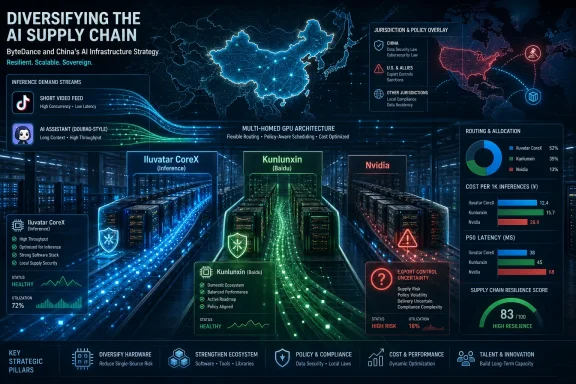 ByteDance Turns Chip Procurement Into Geopolitical Insurance
For years, the AI hardware story was easy to summarize: everyone wanted Nvidia, and anyone who could not get Nvidia wanted something close enough. ByteDance’s reported talks with Iluvatar CoreX and Baidu show how that sentence is beginning to fracture in China. The company is not merely shopping for cheaper accelerators; it is constructing a procurement map for an era in which advanced silicon can be throttled by export controls, licensing decisions, and Beijing’s own preference for domestic technology.The reported Iluvatar order is aimed primarily at inference, the unglamorous but commercially decisive side of AI. Training large models attracts the headlines, but inference is where chatbots, recommendation systems, ad targeting, moderation tools, and enterprise copilots burn compute every hour of every day. For ByteDance, whose consumer platforms and Doubao chatbot depend on serving models at scale, inference hardware is not a research expense. It is operating infrastructure.
That distinction is important because domestic Chinese accelerators do not need to dethrone Nvidia’s highest-end training chips overnight to change the market. They need to become good enough, available enough, and politically safe enough for production inference workloads. If ByteDance can move a meaningful slice of its AI serving stack onto local GPUs, Nvidia’s China problem becomes less about a single blocked product and more about a customer base learning to live without certainty.
The language around the deal still deserves caution. The talks are reportedly early, terms are not confirmed, and the number of chips could change. But the strategic direction is harder to dismiss: ByteDance is looking at Iluvatar CoreX, Baidu’s Kunlunxin, existing domestic vendors, and its own custom silicon efforts in parallel.
Nvidia’s China Business Is Being Pressed From Both Ends
Nvidia’s challenge in China has often been framed as a Washington problem. The United States tightens controls, Nvidia designs compliant variants, regulators adjust again, and the company tries to preserve as much of the market as possible. That cycle has been painful, but it still assumes Chinese customers are waiting on Nvidia’s next permissible SKU.ByteDance’s reported move suggests the more durable problem is customer behavior. Once a hyperscale AI buyer internalizes that foreign GPU supply is unstable, it starts redesigning its architecture, vendor qualification, procurement process, and software stack around alternatives. That work is expensive and imperfect, but once done, it does not simply disappear if a future Nvidia part becomes available.
This is the feedback loop Washington has created and Beijing has been eager to accelerate. Export controls are meant to slow China’s access to cutting-edge AI compute, especially for frontier training. They may do that. But they also give China’s largest technology firms a powerful incentive to fund domestic accelerators, tolerate short-term inefficiency, and build software layers that abstract away the pain of hardware fragmentation.
For Nvidia, the danger is not that Iluvatar CoreX suddenly matches the full CUDA ecosystem. It is that China’s biggest buyers separate their workloads by sensitivity and feasibility. Nvidia remains attractive for the jobs that absolutely require it, while domestic chips absorb workloads that are repetitive, scalable, and easier to optimize over time. Inference is exactly where that wedge can enter.
The phrase “China woes” undersells the structural nature of the issue. This is not a bad quarter, a missed shipment, or a product delay. It is the beginning of a parallel AI compute market in which geopolitical compatibility becomes a product feature.
Inference Is Where the AI War Gets Boring—and Expensive
The public imagination still treats AI chips as instruments of model creation. The reality is that serving models at scale is a brutal industrial process: tokens must be generated, recommendations ranked, images moderated, ads matched, and user sessions handled under unforgiving latency and cost constraints. The compute bill does not end when the model is trained. In many consumer AI businesses, that is when it begins.ByteDance is a perfect example. TikTok’s recommendation engine, content systems, advertising machinery, and generative AI services all turn inference into a daily cost center. Doubao, the company’s flagship chatbot in China, only increases that pressure. A popular chatbot is not a demo; it is a standing promise to provide compute on demand.
That makes the reported focus on inference chips especially telling. ByteDance does not need every domestic GPU to win benchmark slides against Nvidia’s best products. It needs chips that can run specific models at predictable cost, in domestic data centers, with a supply line less exposed to U.S. licensing decisions. The performance bar is still high, but it is not the same as the bar for frontier training.
This is where software becomes the hidden battlefield. Nvidia’s lead is not just silicon; it is CUDA, libraries, developer muscle memory, operational tooling, and a decade of assumptions baked into AI frameworks. Chinese alternatives must fight their way into that stack through compatibility layers, custom kernels, model-specific optimization, and brute-force engineering. That is painful work, but hyperscalers have the staff and motivation to do it when the alternative is strategic vulnerability.
For WindowsForum readers, the lesson should sound familiar. Platforms win not just because they are technically elegant, but because developers and operators build around them. Nvidia’s moat is partly hardware and partly habit. ByteDance’s reported procurement strategy is an attempt to break the habit before the hardware gap fully closes.
Iluvatar CoreX Is Not a Household Name, and That Is the Point
Iluvatar CoreX is not Huawei, Alibaba, or Baidu. That makes its appearance in ByteDance’s reported supply chain more interesting, not less. China’s AI chip push is no longer only about national champions with obvious cloud businesses. It is also about specialized GPU startups trying to become credible suppliers to the country’s largest AI platforms.The Shanghai-based company has developed general-purpose GPUs and AI accelerators, including chips associated with 7nm-class process technology. Its TianGai line has been described as targeting AI training and inference workloads, while later designs have focused more directly on inference. The specifics matter less than the trajectory: Iluvatar wants to be seen not as a laboratory experiment but as part of China’s production AI infrastructure.
A reported order of at least 50,000 chips would be meaningful for any domestic vendor. It would provide volume, feedback, deployment experience, and credibility with other buyers. In the AI accelerator market, hardware validation is not only a benchmark exercise; it is a matter of surviving real workloads, real failure rates, real thermal constraints, real scheduling software, and real customers who do not care how patriotic the chip is if the service goes down.
ByteDance’s interest also gives Iluvatar a powerful proof point. If one of China’s most demanding AI companies can use its chips for inference, other buyers may become more willing to test them. That is how ecosystems develop: not through a single miraculous breakthrough, but through deployments that make the next deployment less risky.
There is still a vast difference between being “considered by ByteDance” and becoming a long-term strategic supplier. The talks may not produce the reported scale, and performance may vary by workload. But even the negotiation itself is a signal that the Chinese AI accelerator market is becoming broader and more competitive.
Baidu’s Kunlunxin Gives ByteDance a Rival’s Silicon Option
The reported Baidu angle is almost as intriguing as the Iluvatar talks. Baidu is not merely a chip vendor; it is an AI platform company, cloud operator, search incumbent, autonomous driving player, and direct participant in China’s generative AI race. For ByteDance to consider Kunlunxin chips is to treat a rival’s hardware arm as a useful part of its own supply chain.That is not as strange as it first appears. In a constrained market, vertical integration gives way to selective cooperation. If the strategic priority is reducing dependence on Nvidia, then Chinese AI companies may buy from each other even while competing in applications, cloud services, advertising, and models. The same logic has long existed in other parts of tech, where fierce rivals still share foundries, standards bodies, and component suppliers.
Kunlunxin also reflects a broader Chinese pattern: the AI chip race is not one company against Nvidia, but many companies trying to cover different parts of the stack. Huawei has Ascend, Baidu has Kunlunxin, Alibaba has T-Head, Cambricon has its accelerator line, and startups such as Iluvatar, Biren, MetaX, Moore Threads, and others are trying to carve out roles. None individually replicates Nvidia’s global ecosystem. Together, they create a domestic menu.
For ByteDance, that menu is insurance. Multiple vendors mean more integration work, more driver complexity, more procurement negotiation, and more variability. But they also reduce single-point failure. In a world where both Washington and Beijing can alter the economics of a chip purchase, redundancy becomes a form of resilience.
The irony is that Nvidia’s success taught the market to prefer standardization, while geopolitics is teaching Chinese buyers to prefer optionality. That is bad for elegance and good for survival.
Export Controls Are Now Product Requirements
Export controls used to sit outside the product conversation, as a matter for lawyers, diplomats, and compliance departments. In AI infrastructure, they have moved directly into engineering strategy. A chip’s usefulness is no longer determined only by throughput, memory bandwidth, interconnect, software support, and power efficiency. It is also determined by whether it can legally be shipped, serviced, upgraded, and deployed at scale in a given jurisdiction.That changes how buyers think. If a Chinese company builds its entire AI roadmap around a foreign accelerator and that accelerator becomes unavailable, the technical debt is existential. If it splits workloads among foreign chips, local chips, custom ASICs, and cloud capacity, the system becomes messier but harder to disable. The result is a kind of compute federalism: less efficient than a single dominant architecture, but more politically robust.
Washington’s restrictions have been aimed at advanced AI capability, especially the most powerful chips and configurations. Nvidia has repeatedly tried to serve China with modified products that stay within the rules. But each revision teaches buyers that compliance is not permanence. A chip that is allowed today may be constrained tomorrow, and a data center design that assumes supply continuity may become stranded.
Beijing’s response has been predictable. It has pushed self-reliance, encouraged domestic procurement, and elevated local AI chips as part of national technology security. Chinese firms are not merely responding to market shortages; they are operating inside a policy environment that rewards localization and views dependence on U.S. silicon as a strategic weakness.
This is where the story becomes bigger than ByteDance. Every large AI buyer in China is watching the same movie. ByteDance may be one of the most visible protagonists, but the plot is industry-wide.
Nvidia Still Owns the High Ground, but the Low Ground Pays Rent
It would be a mistake to read ByteDance’s reported talks as proof that Nvidia has lost China’s AI market. Nvidia’s accelerators remain deeply desired, especially for demanding training workloads and mature software support. The company’s platform advantage is real, and domestic alternatives still face gaps in performance, developer tooling, interconnect, memory supply, and production scale.But markets do not flip all at once. They erode at the edges where alternatives are good enough. Inference, internal workloads, government-sensitive deployments, and cost-optimized services are the natural starting points. Once domestic chips prove themselves there, the software stack improves, engineers gain experience, and procurement teams become more comfortable with non-Nvidia architectures.
That creates an uncomfortable asymmetry for Nvidia. It must remain meaningfully ahead to justify the risk and cost of dependence, while domestic vendors need only become viable enough to capture protected or strategically sensitive workloads. The more China’s hyperscalers invest in that viability, the more credible the alternatives become.
The same dynamic has played out before in enterprise technology. A dominant vendor can keep the premium tier for years while losing volume in the middle. The loss does not always look dramatic at first. It shows up as fewer default purchases, longer qualification lists, more internal tooling for portability, and executives asking whether the expensive incumbent is truly necessary for every job.
Nvidia’s high ground remains valuable. The question is how much of the AI economy can be served from the low ground once customers are forced to build roads there.
ByteDance’s Three-Track Strategy Is the New Hyperscaler Playbook
The most revealing part of the reports is not simply the Iluvatar number. It is the combination of strategies around it. ByteDance is reportedly buying or testing domestic GPUs, looking at Baidu’s Kunlunxin, and developing custom AI silicon of its own. That is not indecision. It is a portfolio approach to compute risk.Hyperscalers have learned that AI infrastructure cannot depend on one supplier, one architecture, or one country’s export policy. Google has TPUs, Amazon has Trainium and Inferentia, Microsoft has Maia, and Meta has pursued its own silicon efforts while still buying enormous numbers of Nvidia GPUs. ByteDance is following the same logic under more intense geopolitical pressure.
The difference is that Western hyperscalers usually frame custom silicon around cost, optimization, and supply leverage. For ByteDance, the calculation includes sovereignty. A custom chip is not just a way to lower inference cost; it is a way to keep critical AI services running if imported accelerators become inaccessible or politically toxic.
That does not make custom silicon easy. Designing chips is hard; building software ecosystems around them is harder; manufacturing them under geopolitical constraints is harder still. But ByteDance does not need to solve everything at once. It can use Nvidia where available, domestic GPUs where practical, Baidu or other vendors where useful, and internal chips where workloads are stable enough to justify specialization.
This is what mature AI infrastructure now looks like: heterogeneous, expensive, and strategically redundant. The clean story of “which chip is fastest” is being replaced by the harder question of which compute portfolio can survive contact with politics.
The Windows Angle Is Not About Gaming GPUs
For a Windows enthusiast audience, the temptation is to translate every GPU story back into desktop graphics. That would miss the point. The AI accelerator race reshaping Nvidia’s China business is happening in data centers, cloud platforms, and model-serving clusters, not in the gaming aisle at Micro Center.Still, the consequences will eventually reach Windows users and IT pros. AI features in Windows, Microsoft 365, developer tools, security products, search, content creation apps, and cloud management platforms all depend on back-end inference economics. If inference becomes cheaper, more localized, or more fragmented by region, the services layered on top of it will change too.
For administrators, the important lesson is architectural. The cloud services your organization consumes are becoming more hardware-diverse behind the scenes. That could improve resilience and cost control, but it also complicates performance consistency, compliance analysis, vendor claims, and regional feature parity. “AI-powered” will not mean the same thing in every geography if the underlying accelerators, model versions, and data-center policies differ.
Developers should watch the software layer. CUDA remains enormously important, but the industry’s incentive to make AI workloads portable is growing. Frameworks, compilers, runtimes, quantization tools, and model-serving systems will increasingly be judged by how well they span Nvidia GPUs, domestic Chinese accelerators, custom ASICs, NPUs, and CPU fallback paths. The winning abstraction may not eliminate hardware differences, but it will hide enough of them to make procurement more flexible.
Security-minded readers should also pay attention. Supply-chain trust is no longer just about firmware provenance or driver updates. It now includes export exposure, jurisdictional control, vendor survivability, and the political incentives shaping hardware deployment. AI infrastructure is becoming part of national security planning, and enterprise risk models will have to catch up.
Fragmentation Is the Price of Strategic Independence
The global AI boom has been built on concentration. Nvidia concentrated the accelerator market, TSMC concentrated leading-edge manufacturing, a handful of hyperscalers concentrated cloud access, and a small set of model labs concentrated frontier AI development. That concentration delivered speed. It also created obvious pressure points.China’s domestic chip push is a response to those pressure points, but it comes with costs. Fragmentation means more duplicated engineering, less uniform tooling, more difficult benchmarking, and more complex procurement. A model optimized for one accelerator may underperform on another. A driver bug may affect one cluster and not another. A security patch may arrive quickly from one vendor and slowly from a smaller one.
But fragmentation can also be rational. If the alternative is dependence on a supply chain controlled by geopolitical rivals, inefficiency becomes acceptable. ByteDance’s reported strategy is the logic of a company that would rather manage complexity than accept fragility.
This is one reason the “Nvidia versus China” framing is too simple. Nvidia is not fighting a single rival with a single chip. It is facing a state-backed ecosystem willing to sacrifice elegance for autonomy. That ecosystem may trail Nvidia technically in many areas and still reshape buying behavior inside China.
The same tension will appear elsewhere. Governments want sovereign AI capacity. Companies want lower inference costs. Cloud providers want leverage against Nvidia pricing. Developers want portability. Those incentives all point toward a more fragmented accelerator market, even outside China.
ByteDance’s Reported Chip Hunt Makes Nvidia’s China Problem Concrete
The useful way to read this story is not as a victory lap for Chinese silicon or a eulogy for Nvidia. It is a snapshot of adaptation. ByteDance appears to be preparing for a world in which AI compute cannot be assumed, even by one of the world’s richest and most technically capable internet companies.The concrete implications are already visible:
- ByteDance is reportedly negotiating for at least 50,000 Iluvatar CoreX inference GPUs, a scale large enough to matter if the talks become a real deployment.
- The reported interest in Baidu’s Kunlunxin chips suggests ByteDance is building a multi-vendor domestic supply chain rather than betting on one replacement for Nvidia.
- The focus on inference shows where Chinese alternatives can gain traction first, because production serving workloads can be optimized around known models and cost targets.
- Nvidia remains technically and commercially central to AI, but export uncertainty is encouraging Chinese buyers to reduce default dependence on its platform.
- The broader consequence is a more fragmented AI hardware world, with performance, availability, compliance, and sovereignty all competing as procurement criteria.
Washington Wanted Leverage; Beijing Is Building Muscle
Export controls are often discussed as if they operate like a dimmer switch: turn down China’s access to advanced chips, and its AI progress slows proportionally. The ByteDance reports show the messier reality. Controls can reduce access to the best hardware while increasing the urgency, funding, and political cover for alternatives.That does not mean the controls have failed. Slowing access to cutting-edge accelerators can still matter enormously, especially for frontier model training and military-sensitive applications. But the second-order effect is now impossible to ignore. China’s largest AI companies are being pushed to become better customers for domestic chipmakers.
There is a historical pattern here. When a technology becomes strategically contested, the buyer’s calculation changes from best-in-class to best-available-under-risk. That shift creates space for suppliers that would otherwise struggle against a dominant incumbent. It also gives those suppliers the one thing startups and domestic challengers need most: demanding customers with real workloads.
Iluvatar CoreX, Baidu Kunlunxin, Huawei Ascend, Cambricon, and the rest of China’s accelerator field do not need a clean win against Nvidia in 2026 to benefit. They need orders, deployments, feedback, and a policy environment that keeps buyers engaged. ByteDance’s reported negotiations offer exactly that kind of oxygen.
For Nvidia, the uncomfortable truth is that every workaround can become a habit. Every compliant chip variant sold into China may preserve revenue, but every restriction also teaches customers to qualify alternatives. The company can still sell into the market where permitted, but it no longer controls the strategic conversation there.
The AI Supply Chain Is Becoming a Map of Political Trust
The ByteDance-Iluvatar story is not just another procurement rumor in the AI boom. It is a sign that the infrastructure beneath consumer AI is being reorganized around trust boundaries. The chip is no longer a neutral component. It carries the politics of its designer, the jurisdiction of its foundry, the export rules of its origin country, and the strategic anxieties of its buyer.That reality will shape the next phase of AI competition. The most capable systems will still need elite hardware, and Nvidia will remain a central force in global AI computing. But the market around it will become less homogeneous. China will subsidize and pressure its way toward domestic stacks. Western clouds will expand custom silicon. Enterprises will ask harder questions about where AI workloads run and what dependencies sit underneath them.
ByteDance’s reported chip hunt is therefore best understood as a warning shot from the demand side. The customer is not waiting passively for the next Nvidia export-compliant part. It is testing suppliers, spreading risk, and preparing its software estate for a more fractured world. That world will be less efficient than the old Nvidia-centered dream, but it may be more durable for companies that expect politics to keep intruding on engineering.
The future of AI hardware will not be decided only by who builds the fastest accelerator. It will be decided by who can guarantee enough compute, in the right jurisdiction, at the right cost, with enough software support to keep the models running. ByteDance’s reported turn toward Iluvatar CoreX and Baidu does not end Nvidia’s China story, but it does mark the moment when dependence stopped looking like a strategy and started looking like a liability.
References
- Primary source: Benzinga
Published: Mon, 15 Jun 2026 08:19:28 GMT
Nvidia's China Woes Deepen As TikTok Parent ByteDance Eyes AI Chips From Iluvatar CoreX, Baidu: Report - - Benzinga
ByteDance eyes AI chips from Iluvatar CoreX and Baidu, signaling growing demand for China's homegrown AI hardware.www.benzinga.com - Independent coverage: Crypto Briefing
Published: 2026-06-15T04:20:10.668625
ByteDance in talks to acquire AI chips from Iluvatar CoreX in push away from Nvidia
ByteDance is negotiating to buy at least 50,000 AI GPUs from Iluvatar CoreX as US export controls push Chinese tech giants toward domestic chip suppliers.cryptobriefing.com - Related coverage: au.investing.com
ByteDance explores AI chip supply deals with Iluvatar CoreX, Baidu - Reuters By Investing.com
ByteDance explores AI chip supply deals with Iluvatar CoreX, Baidu - Reutersau.investing.com - Related coverage: ciotechoutlook.com
ByteDance in Talks With China's Iluvatar CoreX for AI Chips
ByteDance is reportedly in talks with Iluvatar CoreX to purchase AI chips, highlighting China’s push to strengthen domestic semiconductor capabilities.www.ciotechoutlook.com
- Related coverage: thenextweb.com
ByteDance is in talks to buy AI chips from China’s Iluvatar CoreX
ByteDance is in talks to buy inference chips from Shanghai’s Iluvatar CoreX, which could become its third domestic GPU supplier after Huawei and Cambricon.thenextweb.com - Related coverage: theregister.com
Baidu says the quiet part out loud – you can’t build AI infrastructure, so clouds can cash in
CFO says GPU rentals are ‘structurally higher margin than CPU cloud’www.theregister.com
- Related coverage: tomshardware.com
TikTok owner ByteDance to reportedly purchase $14 billion worth of Nvidia AI GPUs in 2026 — Company betting on Beijing's approval following Trump admin's ease on AI export controls | Tom's Hardware
China firm to splash 100 billion yuan on H200 GPUs.www.tomshardware.com - Related coverage: ca.finance.yahoo.com
Exclusive-ByteDance in talks with China's Iluvatar CoreX to purchase AI chips, sources say
BEIJING, June 15 (Reuters) - Chinese technology company ByteDance is in talks with Shanghai-based Iluvatar CoreX to purchase AI chips for inference work and is also considering a similar deal withca.finance.yahoo.com - Related coverage: streetinsider.com
Bytedance In Talks With Chinese Chipmaker Iluvatar Corex To Purchase Ai Inference Chips, Sources Say - Reuters
Bytedance In Talks With Chinese Chipmaker Iluvatar Corex To Purchase Ai Inference Chips, Sources Say - Reuterswww.streetinsider.com - Related coverage: bloomberg.com
- Related coverage: es.marketscreener.com
- Related coverage: ir.baidu.com
