C3 AI Expands with Microsoft Copilot, Fabric and Foundry for Enterprise AI

  • Thread Author
C3 AI’s announcement of deeper native integrations with Microsoft Copilot, Microsoft Fabric (OneLake), and Azure AI Foundry is a clear signal that enterprise AI vendors and hyperscalers are moving past proof-of-concept experiments and into productized, platform-first deployments that aim to make agentic, generative AI part of everyday business operations. The update — which expands the ways C3 AI exposes its domain-specific applications and agents inside Microsoft Copilot, uses Fabric/OneLake as the governed data spine, and leverages Azure AI Foundry for model deployment and lifecycle management — promises to reduce integration friction for customers but also raises important questions about governance, cost, and vendor concentration.

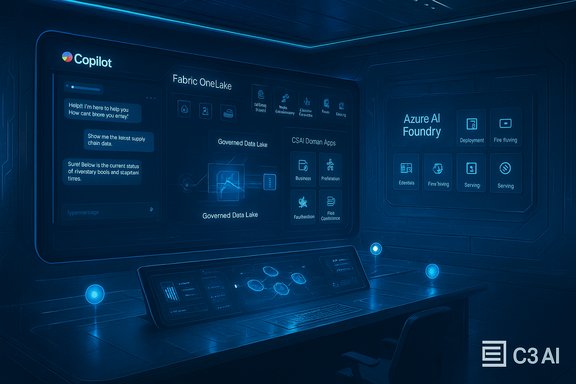
Blue-lit futuristic control room with screens labeled Copilot, Fabric OneLake, and Azure AI Foundry.Background / Overview​

C3 AI, a long-standing provider of enterprise AI applications and the C3 Agentic AI Platform, has iteratively aligned its stack with Microsoft Azure for several years. The company’s new messaging frames its software as “the intelligence layer” that can operate directly on data stored in Microsoft Fabric/OneLake, surface functionality inside Microsoft Copilot, and use Azure AI Foundry for model cataloging, fine-tuning, and serving. That combination is intended to let organizations run a single enterprise AI system — reasoning, data, and model operations — natively on Microsoft Cloud infrastructure. Microsoft’s platform story over the last 18–24 months has emphasized three linked pillars for enterprise AI: (1) a governed model and agent management layer (Azure AI Foundry / Microsoft Foundry), (2) a unified data foundation and governance plane (Microsoft Fabric and OneLake), and (3) productivity- and workflow-facing surfaces (Microsoft 365 Copilot, Copilot Studio and Copilot-in-Fabric experiences). These product investments are designed to make model hosting, observability, agent orchestration, and data grounding operationally tractable at enterprise scale.

What C3 AI is Announcing — The Core Claims​

  • Native exposure of C3 AI’s domain applications and agents inside Microsoft Copilot so users can ask natural-language questions and trigger end-to-end workflows backed by C3 domain logic.
  • Use of Microsoft Fabric / OneLake as the authoritative data plane so C3 applications can reason on trusted, governed datasets without requiring data movement or replication.
  • Integration with Azure AI Foundry so C3’s C3 Agentic AI Platform can deploy, fine-tune and serve foundation models from Microsoft’s model catalog alongside C3’s applications.
  • Commercial availability through Azure Marketplace and joint presence at Microsoft Ignite with demonstrations intended to show production-ready enterprise scenarios.
These are framed as practical, immediate benefits: agents that operate over governed data, Copilot as a consolidated conversational UX for domain apps, and Foundry as the model ops control plane.

Technical Anatomy: How the Pieces Fit Together​

Copilot as the conversational front end​

The core architectural pitch is that C3 AI’s vertical, domain-specific applications (supply chain, reliability, ESG, energy management, etc. become invocable within Microsoft Copilot. From a technical perspective, that means:
  • Copilot acts as a single conversational entry point for users to invoke C3 apps and trigger agentic workflows (RAG, API calls, or multi-step automations).
  • These interactions are expected to call into C3-managed services or agent endpoints that perform domain reasoning, orchestration, and stateful operations.
This design maps to Microsoft’s broader plan to let Copilot integrate packaged enterprise experiences while keeping control and observability in the customer’s tenancy. Copilot Studio and declarative agent tooling are explicitly designed to allow such connectors and custom assistants to be published across Microsoft 365 surfaces.

Fabric / OneLake as the governed data spine​

C3’s claim that its applications can operate “without data movement or replication” rests on the assumption that Fabric/OneLake will serve as the canonical, governed data plane. Practically, this requires:
  • Access to curated, labeled datasets in OneLake or Fabric lakehouses.
  • Fine-grained access control and propagation of sensitivity policies across compute endpoints (Direct Lake, SQL endpoints, Fabric engines).
  • Vector/semantic index layers (or Fabric indexes) to support retrieval-augmented generation (RAG) for grounding LLM responses.
Microsoft’s Fabric documentation and the Copilot-in-Fabric product pages confirm that Copilot and Fabric are designed to operate on attached lakehouses and governed datasets with tenant settings for data residency and conversation history retention. This is the technical foundation that makes the “no replication” claim workable — but only when proper access and governance patterns are implemented.

Azure AI Foundry as the model operations plane​

Azure AI Foundry (also referred to in Microsoft docs as Foundry or Microsoft Foundry) provides a catalog of models, deployment options, tooling for multi-agent orchestration, and observability features. C3’s integration premise is that customers can:
  • Choose Microsoft-hosted foundation models from Foundry’s catalog.
  • Fine-tune or customize models and then serve them via Foundry-managed endpoints.
  • Use Foundry’s agent orchestration features to run C3 agentic workflows that combine model reasoning with deterministic domain logic.
Microsoft’s Foundry documentation describes these capabilities — multi-agent orchestration, model routing, and enterprise-grade observability — and positions Foundry as the enterprise-grade control plane for model lifecycle operations. That validates the architectural claim that C3 can piggyback on Foundry’s model catalog and MLOps capabilities rather than hosting and instrumenting models entirely separately.

Strengths: What Makes This Attractive for Enterprises​

  • Friction reduction: Prebuilt connectors to Copilot, Fabric, and Foundry reduce engineering lift for integrating domain apps with conversational UX, governed data, and model hosting.
  • Operational alignment: Using Foundry for model hosting and Fabric for data governance aligns model ops and data governance under Microsoft’s management planes, which many enterprises already trust for compliance and identity integration.
  • Domain specificity without reworking data platforms: C3’s vertical applications bring domain logic and workflows that enterprises often lack internally; exposing those via Copilot means workers can access domain-grade AI without custom engineering.
  • Commercial convenience: Listing in Azure Marketplace and packaged co-sell GTM with Microsoft simplifies procurement and helps enterprises leverage existing Azure consumption commitments.
These strengths matter because enterprises routinely cite three blockers to operational AI: lack of trusted data foundations, missing governance/observability, and the engineering burden to glue models into workflows. C3-plus-Microsoft tries to tackle all three in a single platform story.

Risks, Trade-offs and What IT Leaders Should Watch​

While the integration is compelling, the commercial and operational realities introduce several risks that require explicit mitigation.

1. Vendor concentration and strategic lock-in​

Relying on a single hyperscaler for data (Fabric/OneLake), UX (Copilot), and model ops (Foundry) increases strategic exposure. If substantial parts of your AI stack — model hosting, data, and agent orchestration — reside under Microsoft’s control plane, moving away later becomes complex and expensive. Industry commentary has already flagged how Fabric’s integrated context layer could cannibalize independent ISVs’ opportunities in some scenarios; companies must evaluate contractual portability terms and data exportability as part of procurement.

2. Cost unpredictability and FinOps complexity​

Agentic workflows and model inference at scale can consume significant compute and token budgets. Azure Foundry, Copilot, and Fabric each have their pricing and capacity models; combining them without FinOps guardrails risks rapid cost escalation. Enterprises need predictable cost-simulation exercises (monthly/yearly forecasts, token/QPS and storage projections), quotas on inference usage, and automated alerts for runaway spend. Microsoft documentation suggests governance and billing controls exist, but the onus falls to customers to enforce them.

3. Data residency and sovereignty​

Fabric’s Copilot-in-Fabric and Foundry use tenant settings for data residency and conversation history, but some scenarios require strict onshore-only processing. The default behavior and available regions vary, and tenant admins must explicitly enable cross-geo processing where needed. Enterprises in regulated industries must validate where prompts, indexes, and conversation logs are processed and stored. Technical features exist to limit data movement, but operational discipline is required to ensure compliance.

4. Governance, explainability and auditing​

Agentic automations present novel failure modes — hallucinations, incorrect action execution, or unauthorized API-triggered side effects. Foundry and Fabric include observability and model cards, but enterprises should require contractual SLAs for audit logs, model provenance, and red-team/attack-surface testing. Model behavior must be auditable and revertible; action-triggering agents need tight role-based controls. These are areas where product capability exists but execution and integration are non-trivial.

5. Partner dynamics and business model exposure​

C3 AI benefits from Microsoft distribution, but the strategic balance between hyperscaler platform expansion and ISV viability is delicate. As Microsoft expands first-party features and vertical accelerators in Fabric and Foundry, third-party application vendors face pressure to differentiate or risk commoditization. Customers should demand clear product commitments and references showing real production deployments to validate vendor claims.

Practical Checklist: How to Evaluate a C3+Microsoft Integration Program​

  • Validate data lineage and exportability:
  • Ensure OneLake/ Fabric datasets used by C3 apps can be exported with metadata and lineage records.
  • Define measurable pilot KPIs:
  • Tie pilots to clear business outcomes (reduced cycle time, revenue lift, fewer outages), not just technical metrics.
  • Demand FinOps modeling:
  • Get token, inference, and storage cost estimates for 1, 3 and 12 months at expected scale.
  • Verify governance and audit controls:
  • Confirm access controls, model cards, red-team test reports, and retention policies for conversation history.
  • Ask for production references:
  • Request customers or public case studies where the integrated stack runs in production (not just PoCs).
  • Contract portability provisions:
  • Include clauses on data export, model weights or retraining artifacts, and transition assistance if moving away from the platform.
  • Define incident response and rollback plans:
  • Where agents can take actions, require runbooks and rollback mechanisms for erroneous actions.
This checklist turns marketing claims into verifiable contractual and technical commitments.

Competitive and Market Context​

Microsoft’s platformization of model catalogs, agent services, and Copilot surfaces is accelerating a broader industry shift: hyperscalers are packaging the full AI stack (data plane, model plane, UX) and offering it as an integrated product. For ISVs like C3 AI, the opportunity is faster access to enterprise customers via marketplace listings and co-sell channels. The threat is that the same hyperscaler could internalize features over time or favor competing first-party solutions. Analysts and market commentary have already highlighted this tension, describing both the commercial upside and the partner-risk downside for ISVs heavily dependent on a single cloud provider. Enterprises should factor this dynamic into vendor selection and procurement.

Security, Compliance and Responsible AI — Specific Considerations​

  • Data access controls: Use OneLake security features and Fabric’s role/row/column-level protections to minimize exposure. Implement least-privilege access for any agent or model that calls enterprise systems.
  • Conversation history management: Copilot and Fabric agents may store conversational context to preserve state. Make retention configurable and enforce deletion policies where legally required.
  • Model safety & explainability: Require model cards, output filtering and content-safety tooling for generative models; insist on red-teaming results for deployed agents. Foundry provides model-level metadata and evaluation tooling, but customers must require evidence.
  • Security telemetry: Ingest logs into existing SIEM (Microsoft Sentinel recommended in many Azure patterns) to correlate agent behavior with security events and detect anomalous or malicious prompt activity.

Enterprise Procurement and Contracting Advice​

  • Negotiate FinOps guardrails and caps on inference budgets.
  • Add SLAs and audit rights around data access, model provenance, and incident response.
  • Insist on transition support and export-friendly formats to preserve portability.
  • Make outcome-based payments part of the agreement where possible (tie partner fees to business metrics).
  • Require transparency on co-sell and marketplace fees so total-cost-of-ownership is clear.
These commercial measures reduce the operational and strategic risk of operating a tightly integrated hyperscaler/ISV stack.

Where This Likely Delivers Most Value — Use Cases That Fit​

  • Supply chain optimization and logistics: Domain logic + event-driven orchestration + Fabric streaming analytics can provide near-real-time decisioning.
  • Asset reliability and predictive maintenance: Sensor telemetry in OneLake feeding prebuilt C3 reliability models, surfaced through Copilot for maintenance teams.
  • Procurement and sourcing optimization: RAG + domain agents for generating RFPs, supplier evaluations, and anomaly detection in contracts.
  • Energy & ESG programs: Integrated telemetry, forecasting models, and policy-driven reporting workflows that require traceable outputs.
These are the scenarios where verticalized domain IP plus governed data and agentic automations can yield measurable ROI rapidly.

Final Analysis — Balanced View​

C3 AI’s deeper native integrations with Microsoft Copilot, Fabric/OneLake and Azure AI Foundry are a practical next step for enterprises that want packaged, domain-aware AI applications that don’t require stitching disparate pieces together. When executed carefully, this combination can shorten time-to-value by marrying C3’s domain IP (applications and agents) with Microsoft’s scale, governance tooling and distribution channels. However, the approach carries real strategic, financial, and governance trade-offs. Vendor concentration, cost unpredictability, portability concerns and the still-evolving nature of agentic risk management mean that CIOs and procurement teams must insist on measurable pilots, auditable governance, FinOps controls and contractual portability guarantees before adopting an integrated C3+Microsoft production strategy. Independent verification of production references and explicit runbooks for incident response are essential. For enterprises that pair disciplined procurement, cost governance and security-first deployment with these platform capabilities, the result can be accelerated adoption of trustworthy, production-scale AI that meaningfully changes business operations. For those that accept marketing claims without contractual and technical guardrails, the promise of quick wins could give way to unexpected costs, compliance exposure, and reduced strategic flexibility.

C3 AI’s applications are available via Microsoft’s commercial channels and the company demonstrated the joint capabilities at Microsoft Ignite; organizations evaluating the stack should run a short, governed pilot focused on a single measurable outcome, instrument both model and data lineage, and require evidence of production-grade governance before broadening the rollout. The enterprise AI battleground has shifted: integrations like this show how hyperscalers and specialized ISVs will co-evolve — sometimes cooperatively, sometimes competitively — to deliver the next generation of AI-enabled business applications. The winners will be the buyers who demand auditable outcomes, transparent economics and escape hatches when vendor strategies inevitably change.

Source: Business Wire https://www.businesswire.com/news/h...icrosoft-Copilot-Fabric-and-Azure-AI-Foundry/
 

C3 AI’s announcement that it has deepened native integrations with Microsoft Copilot, Microsoft Fabric (OneLake) and Azure AI Foundry marks a decisive step toward packaging enterprise-grade agentic AI as a first-class part of the Microsoft Cloud stack, and it reshapes important operational, governance, and sourcing choices for IT leaders running mission-critical systems on Azure.

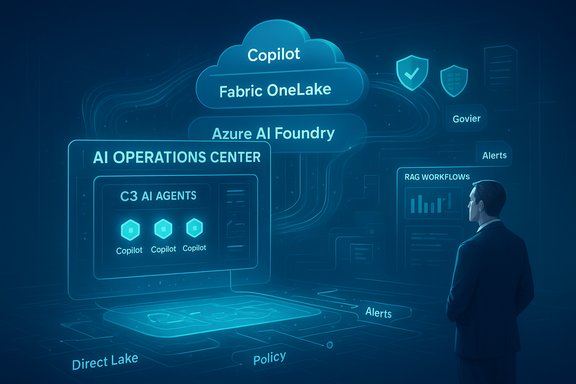
A person in a suit studies a blue holographic AI Operations Center interface.Background / Overview​

C3 AI, an enterprise AI application vendor, says its software — notably the C3 Agentic AI Platform and a portfolio of domain-specific applications (supply chain, reliability, ESG, energy, sourcing, etc. — is now more tightly “native” inside Microsoft’s enterprise AI surfaces. That means customers can invoke C3 apps and agents from Microsoft Copilot conversational surfaces, ground reasoning on governed data in Microsoft Fabric / OneLake, and use Azure AI Foundry as the model operations plane for deploying, fine‑tuning, and serving foundation models. The company also reiterates that C3 AI applications are available through the Azure Marketplace. This move builds on an existing strategic alliance between C3 AI and Microsoft that was formalized in 2024 and has already placed C3 AI products onto the Azure price list and marketplace. The renewed messaging positions C3 AI as an “intelligence layer” that runs on top of a Microsoft‑centric data and model control plane — a design increasingly favored by enterprises seeking a single governed stack for production AI.

Why this matters now​

The shift matters because major cloud providers, led by Microsoft, are now supplying not only raw compute and storage, but integrated primitives — data plane governance (Fabric / OneLake), model catalogs and MLOps (Foundry), and conversational/workflow front ends (Copilot) — that together can reduce the time, cost and risk of moving from pilots to production. C3 AI’s pitch is pragmatic: bring vertical domain logic (prebuilt apps and agents) into that stack so organizations don’t have to rebuild domain knowledge from scratch. From a procurement and operations perspective, this also opens fast lanes: listing on Azure Marketplace, co‑sell motions, and joint GTM programs let enterprises acquire and deploy C3 AI capabilities with Microsoft billing, commercial terms and potentially subsidized pilots — all of which shorten procurement cycles relative to traditional third‑party software purchases. C3’s prior alliance disclosures confirm these commercial levers.

Technical anatomy: how the pieces fit​

Copilot as the conversational front end​

  • C3 AI’s domain applications and agents are exposed as callable capabilities inside Microsoft Copilot. That lets users interact with domain logic through a single conversational UX across Microsoft 365 and Copilot surfaces.
  • In practice, Copilot becomes the invocation surface: users issue natural language requests (for example, “Which weather events could affect shipments in the Gulf?”) that route through Copilot to C3 agents which execute reasoning, retrieval or workflow automation and return structured outcomes. C3 positions this as an end‑to‑end UX that includes agentic automation.
Microsoft’s recent product narrative (Copilot Studio, Copilot in Fabric) supports this pattern: Copilot Studio and agent tooling are explicitly designed to publish connectors and assistants across Microsoft 365 surfaces, enabling partner integrations like C3’s. This is a recognizable, platform‑level pattern for enterprise copilots and business agents.

Fabric / OneLake as the governed data backbone​

  • C3 AI says its applications will reason directly on trusted datasets in Microsoft Fabric / OneLake “without data movement or replication.” That claim leverages Fabric features such as OneLake, Direct Lake access patterns and Data Governance that enable virtualized access to canonical lakehouse data.
  • Microsoft’s Direct Lake and OneLake design allow semantic models, Power BI reports and analytics engines to bind to Delta-formatted files without traditional import/replication, while OneLake security and Fabric governance propagate policies across engines — a technical foundation for retrieval‑grounded, auditable agent behavior. Enterprises should treat claims of “no replication” as contingent on architecture choices (Direct Lake, shortcuts, mirrored sources) and access/performance tradeoffs.

Azure AI Foundry as the model ops plane​

  • Azure AI Foundry provides a centralized catalog of models, tooling for fine‑tuning and a control plane for deploying and observing models and agents. C3 AI says it will use Foundry to deploy, fine‑tune and serve foundation models for its agents, enabling customers to combine Microsoft’s model catalog and Foundry’s agent runtime with C3’s vertical applications.
  • Microsoft’s public materials confirm Foundry exposes a large catalog (including first‑party and partner models), agent orchestration services and observability tooling intended for enterprise-scale model lifecycle management. This is the practical plumbing for running multi‑model, multi‑agent production systems.

Practical business and operational benefits​

C3 AI’s tighter Microsoft alignment promises several immediate, practical upsides for enterprises that are already invested in Azure:
  • Reduced integration work: prebuilt connectors and agent templates lower the engineering overhead to expose domain capabilities inside Copilot and Fabric.
  • Single control planes for data, identity and models: Fabric/OneLake for governed data, Entra for identity, and Foundry for model ops can centralize policy enforcement and audit trails.
  • Faster procurement and predictable commercial terms: C3 AI solutions being orderable on the Azure Marketplace and available on Microsoft paper streamlines purchasing and can accelerate enterprise rollouts. This was an explicit commercial element of the C3–Microsoft alliance signed in 2024.
  • Domain‑specific speed to value: customers get prebuilt vertical applications (e.g., predictive maintenance, energy management, sourcing optimization) that can be invoked inside Copilot without re‑engineering domain models.

Critical analysis — strengths and real risks​

Strengths​

  • Operational alignment with enterprise controls. Microsoft’s Foundry + Fabric + Copilot stack is explicitly engineered for identity binding, telemetry, and governance. Running C3’s domain apps on this foundation gives customers a coherent pathway to audited, production AI systems.
  • Reduced lift for horizontal and vertical integration. Prebuilt connectors, marketplace packaging and co‑sell arrangements materially shrink the friction that usually keeps pilots from becoming repeatable services. C3’s messaging and Microsoft’s partner programs back this up.
  • Model and deployment choice. Foundry’s multi‑model catalog and model routing let customers choose models (including third‑party providers) and centralize monitoring and safety tooling. This flexibility is critical where legal, safety, or behavior differences across models matter.

Risks and open questions​

  • Vendor concentration and lock‑in. Building an “enterprise AI system” that depends on Copilot, Fabric/OneLake and Foundry tightly couples operational, data and model layers to Microsoft. This can shorten time to value but increases migration complexity and negotiation leverage for the hyperscaler. Enterprises must weigh portability, exit strategy and contractual protections. Multiple independent analyses note that platformization reduces engineering costs but increases supplier concentration risk.
  • Governance complexity in practice. Microsoft exposes agent governance primitives (Agent 365, Entra Agent ID, Purview labels) and Fabric offers OneLake security, but the effectiveness of governance depends on the customer’s metadata, labeling, and operational maturity. Claims that agents will operate safely “without data movement” are technically plausible but depend heavily on correct access controls, index hygiene, and testing. Security teams should require concrete runbooks for RBAC, DLP and runtime monitoring.
  • Cost and TCO variability. Using Foundry for fine‑tuning and serving models, combining Azure consumption, C3 licensing and Copilot consumption models may create complex cost structures. While Microsoft and partners may provide consumption financing or marketplace offers, organizations must model long‑term inference costs, index storage, and operational overhead. Proven TCO reductions should be validated in customer pilots rather than assumed.
  • Operationalizing agentic workflows is nontrivial. Agents that take actions (e.g., request an RFP, trigger procurement workflows, or modify production schedules) introduce runbook and audit obligations. Ensuring safe, reversible actions requires strong human‑in‑the‑loop controls, thorough testing harnesses and a clear incident escalation path. Microsoft and partners provide tooling, but governance discipline remains the customer’s responsibility.

What’s provable — and what to treat cautiously​

  • C3 AI’s apps are available on the Azure Marketplace. This is a verifiable commercial fact, supported by C3 AI and Microsoft alliance communications and the BusinessWire release. Enterprises should confirm the exact SKU and licensing terms in the Azure Marketplace listing and their Microsoft contracting team.
  • The claim that C3 apps can “reason directly on trusted data workflows without data movement” is technically grounded in Fabric/OneLake features (Direct Lake, shortcuts, mirrored databases), which enable virtualized, non‑replicative access patterns. However, the practical reality depends on the chosen Fabric pattern (Direct Lake vs. mirrored DBs), dataset size, query latency requirements, and security posture. Treat the “no replication” phrase as architectural intent rather than a universal guarantee.
  • Using Azure AI Foundry as the model hosting and MLOps plane is consistent with Microsoft’s public product messaging — Foundry provides catalog, orchestration and observability. Enterprises should validate which models are available in their region/tenant and what SLAs apply before relying on Foundry for critical, low‑latency inference. Foundry’s catalog size and features (multi‑vendor support, fine‑tuning tiers) are documented by Microsoft.
  • Claims about immediate TCO reductions, performance improvements, or faster time to measurable impact are use‑case specific and require customer validation. Those are achievable in many scenarios, but performance and costs must be benchmarked on representative workloads. Flag any vendor-provided TCO numbers and ask for the assumptions and measurement methodology.

Deployment patterns and recommended validation steps​

For IT leaders evaluating a C3+Microsoft integrated stack, a disciplined migration and validation plan reduces risk and accelerates success:
  • Define the canonical data spine.
  • Inventory sources to be virtualized in OneLake and decide which datasets require Direct Lake, mirroring or shortcuts.
  • Map Purview labels, RLS and Entra policies to the data catalog upfront.
  • Build a non‑production agent test bed.
  • Use Foundry’s sandbox/agent playground and Copilot Studio to create representative agents.
  • Validate retrieval‑augmented generation (RAG), tool calls, and contingency flows with synthetic and subset production data.
  • Validate identity and action controls.
  • Create Entra Agent IDs for agents that act on systems, test conditional access, and verify audit trails.
  • Implement “monitor‑only” modes for risky automations before enabling autonomous execution.
  • Model and cost governance.
  • Establish the model catalog policy (which models are allowed for which data classes).
  • Measure inference cost per transaction and set budget guardrails and model routing policies in Foundry.
  • Run a production pilot with clear success metrics.
  • Define metric thresholds for accuracy, latency, action success rate, and business KPIs.
  • Require an independent verification of model outputs in early production phases and measure human override rates.
These patterns reflect standard enterprise AI operationalization best practices and map to the product primitives Microsoft offers for agent lifecycle and governance.

Commercial implications and procurement considerations​

  • The Azure Marketplace listing and C3–Microsoft alliance mean that procurement can use Microsoft billing and enterprise licensing paperwork, potentially simplifying contractual and compliance workflows. But IT procurement should negotiate:
  • Clear SLAs for model hosting and agent availability.
  • Data residency and export controls that align with enterprise compliance demands.
  • Portability clauses for models, pipelines and semantic indexes if a future migration is required.
  • Co‑sell motions and Azure consumption programs (e.g., Azure Consumption Commitment structures) can subsidize pilots. Treat those incentives as time‑bounded; validate the commercial runway and subsidy eligibility in contracting.

Ecosystem and competitive context​

Microsoft is deliberately positioning Copilot, Fabric and Foundry as an integrated stack for agentic enterprise AI. Major enterprise vendors (UiPath, system integrators like LTIMindtree and others) are building complementary integrations and delivery IP to help customers operationalize these primitives. C3 AI’s play is to supply domain‑mature applications that sit above these primitives — a sensible route for customers who want vertical expertise without building domain models from scratch. Multiple partners and GSIs are packaging similar offers, which benefits customers by increasing options but also raises the bar on procurement diligence and delivery quality.

Governance, safety and audit checklist (practical)​

  • Enforce identity‑based agent identity (Entra Agent ID) and conditional access for any agent with write or action privileges.
  • Require content safety, prompt shields and model cards for all Foundry-hosted models that access sensitive data.
  • Integrate agent telemetry with Sentinel/Defender SIEM playbooks for anomaly detection and automated containment.
  • Maintain provenance and lineage for all Vector indices and RAG datasets; require periodic re‑validation of index fidelity.
These items mirror Microsoft’s own guidance for agent governance and are essential controls before productionizing agentic workflows.

Conclusion​

C3 AI’s deeper integrations with Microsoft Copilot, Fabric/OneLake and Azure AI Foundry reflect the pragmatic next step in enterprise AI: combine vertical domain applications with hyperscaler‑provided data and model control planes to move from pilots to repeatable production use. The technical building blocks — Copilot invocation surfaces, OneLake/Direct Lake data virtualization, and Foundry model ops — make this architecture technically feasible and attractive for Microsoft‑centric IT estates. That said, the real work remains operational. Enterprise IT must validate performance, control cost, and harden governance. Vendor promises of “no data movement,” lower TCO, or immediate business impact are plausible but contingent on architecture, governance, and delivery quality. For organizations that approach the C3+Microsoft option with careful pilots, rigorous governance, and explicit portability and contractual protections, this integration can speed practical, auditable AI adoption. For those trading off vendor concentration and potential lock‑in, the decision requires explicit contractual and technical mitigations.


Source: Stock Titan C3 AI (NYSE: AI) Expands Integrations with Microsoft Copilot, Fabric and Azure AI
 

C3 AI’s announcement that its C3 Agentic AI Platform and vertical applications now surface natively inside Microsoft Copilot, run on Microsoft Fabric/OneLake as the governed data spine, and use Azure AI Foundry for model lifecycle management marks a clear attempt to package production-grade, domain-aware agentic AI as a first‑class part of the Microsoft Cloud stack.

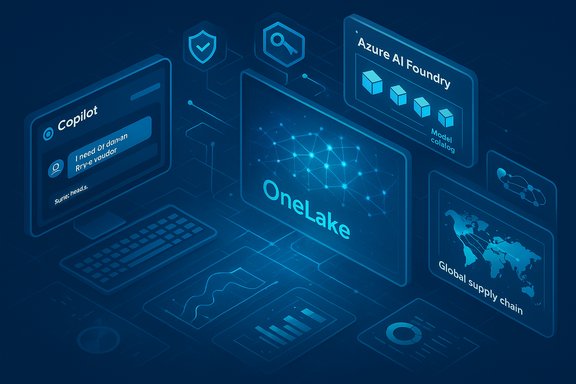
Futuristic dashboard centered on OneLake with Azure AI Foundry, Copilot chat, and global supply chain visuals.Background​

C3 AI, a long‑standing enterprise AI software vendor, revealed expanded integrations with Microsoft Copilot, Microsoft Fabric (OneLake), and Azure AI Foundry in a November 20, 2025 announcement that positions the company’s offerings as an “intelligence layer” on top of Microsoft’s data and model control planes. The company says this enables customers to invoke C3 domain applications and agents through Copilot, reason directly on governed Fabric datasets without replicating data, and deploy/fine‑tune foundation models through Azure AI Foundry. Independent industry briefings and partner materials published around Microsoft Ignite and subsequent coverage reinforce the essential elements of that message: Copilot is becoming the conversational entry point for enterprise copilots, Fabric/OneLake is being used as a governed single‑source data plane, and Azure AI Foundry provides a centralized model catalog and model‑ops surface for enterprise deployments. Microsoft’s own Foundry documentation describes a broad model catalog and tooling for model selection, routing and observability — the very primitives C3 cites as its model operations plane.

What C3 is claiming — the core product narrative​

C3 AI’s announcement centers on three tightly coupled claims:
  • Copilot integration: C3’s vertical applications and domain agents are callable from Microsoft Copilot, allowing users to ask domain questions and trigger end‑to‑end agentic workflows (for example, generate an RFP or assess weather‑related supply‑chain risk).
  • Fabric/OneLake grounding: C3 will use Microsoft Fabric/OneLake as the canonical data spine so its applications reason on trusted, governed data workflows without mandatory data replication.
  • Foundry model ops: C3’s platform will employ Azure AI Foundry for deploying, fine‑tuning and serving foundation models — combining Microsoft’s model catalog and runtime with C3’s domain applications.
These claims are consistent with C3 and Microsoft’s previous alliance announcements (the formalized partnership from 2024) and with the broader platform narrative Microsoft has been publicizing at Ignite and elsewhere: a managed, identity‑bound, multi‑model control plane (Foundry), a governed data fabric (Fabric/OneLake), and conversational/workflow surfaces (Copilot).

Technical anatomy — how the pieces fit together​

Copilot as the conversational front end​

C3’s approach makes Microsoft Copilot the invocation surface for domain intelligence. In practice, a Copilot user issues natural language prompts that route to C3 agents or apps which perform retrieval, reasoning, and workflow orchestration; the agent returns structured outcomes or executes side‑effects through preapproved APIs and actions. This pattern matches Microsoft’s Copilot Studio and tenant‑scoped assistant model, where partners publish connectors and assistants across Microsoft 365 surfaces while enforcement and observability remain within customer tenancy.
Key practical implications:
  • Copilot becomes the UX for both knowledge retrieval and action invocation.
  • Agents invoked from Copilot must be identity‑bound and tenant‑aware for auditability.
  • Conversation state, retention policies, and human‑in‑the‑loop gates must be configured per enterprise policy.

Fabric / OneLake as the governed data spine​

C3 states its domain applications will reason directly on datasets hosted in Microsoft Fabric/OneLake, minimizing data movement and duplication. Technically this is feasible using Fabric’s Direct Lake, lakehouse semantics, and OneLake access controls, which enable virtualized access to canonical Delta lake data and propagate governance and sensitivity labels across compute engines. However, “no replication” is an architectural promise, not a universal guarantee: performance, latency, and specific integration patterns (Direct Lake vs. shortcuts vs. mirrored stores) still dictate whether physical copies are needed. What enterprises should verify:
  • The data access pattern C3 will use (Direct Lake, SQL endpoints, or cached indices).
  • How Fabric’s Purview/labeling policies are consumed by the C3 agent runtime.
  • The location and lifecycle of vector indexes or semantic stores used for retrieval‑augmented generation (RAG).

Azure AI Foundry as the model ops plane​

Azure AI Foundry offers a catalog of first‑party and partner models, a model router for cost/performance tradeoffs, and orchestration/observability features for multi‑model deployments. C3’s claim that its agents can be deployed, fine‑tuned and served via Foundry aligns with Microsoft’s model‑catalog design and the Foundry SDKs. Microsoft’s public materials show Foundry exposes metrics, model cards, and routing controls — all necessary for enterprise SLA and safety obligations. Cross‑reference check:
  • C3 press materials assert the integration; Microsoft’s Foundry documentation independently shows model catalog and fine‑tuning tooling are standard Foundry features. That provides the two independent touchpoints required to validate the integration narrative.

Business and procurement implications​

C3’s tighter Microsoft alignment opens clear commercial pathways for Azure‑centric enterprises:
  • Listing on the Azure Marketplace simplifies procurement and billing: customers can buy C3 solutions with Microsoft billing and potentially through co‑sell GTM programs.
  • Using Foundry and Fabric centralizes model and data governance under Microsoft control planes, which many regulated customers prefer because it integrates with Entra (identity), Defender (runtime protections) and Sentinel (telemetry).
  • Prebuilt vertical apps reduce time‑to‑value compared to building domain models from scratch: C3’s domain IP (supply chain, predictive maintenance, energy/ESG) is intended to be invoked rather than rebuilt.
But the commercial benefits come with caveats:
  • Pricing complexity increases: Azure compute and Foundry inference costs combine with C3 licensing and Copilot consumption economics. Enterprises must model long‑term inference and index storage costs rather than assuming lower TCO.
  • Contract and exit terms matter: tighter integration reduces short‑term engineering cost but increases supplier concentration risk and potential lock‑in.

Security, governance and responsible AI — what to require​

Operating agentic AI systems that can take actions across enterprise systems elevates audit, legal and safety stakes. The public messaging from Microsoft and C3 highlights governance primitives (agent identity, model cards, content safety), but the real burdens fall to customers to implement and verify.
Minimum governance checklist:
  • Enforce least‑privilege access to any agent and model endpoints using Entra and RBAC.
  • Require model cards and benchmark metadata for every Foundry model used in production. Foundry supplies model cards, but customers must demand them in procurement.
  • Implement SIEM ingestion (Sentinel) for agent decision logs — including prompt inputs, retrieval sources, model IDs and output actions.
  • Define human‑in‑the‑loop (HITL) gates and rollback runbooks for any agent that issues enterprise side‑effects (procurement, scheduling, configuration changes).
  • Put explicit data retention and conversation history policies in place for Copilot interactions.
Flagging unverifiable claims:
  • Any vendor claim about immediate, universal “no replication” of data or fixed TCO reductions should be treated as directional until proven in a customer pilot and audited by the buying organization. These outcomes are architecture‑ and workload‑dependent.

Operational risks and mitigation​

Adopting an integrated C3 + Microsoft stack accelerates time to production but concentrates several operational risks:
  • Vendor concentration risk: tying data, model ops, and conversational UX to a single cloud provider increases migration complexity. Enterprises should negotiate portability and exportability clauses.
  • Governance complexity: Fabric/Foundry provide tools, but effectiveness depends on data quality (metadata, sensitivity labels), index hygiene, and operational runbooks. Expect nontrivial integration work.
  • FinOps volatility: model routing, multi‑model strategies and Copilot consumption can generate hard‑to‑predict monthly bills. Implement budget controls, quota caps and cost‑routing policies early.
  • Agent safety and drift: agents making automated or semi‑automated decisions require ongoing monitoring, red‑teaming, and regression tests for hallucinations and adversarial inputs.
Mitigation recommendations:
  • Start with pilot‑bounded outcomes and explicit metrics (e.g., MTTR reduction, time‑to‑process RFP).
  • Use Foundry’s model router to prototype with cheaper “mini” models before routing critical flows to pro models.
  • Require a third‑party security assessment of any agent before production, including prompt injection testing and retrieval source integrity checks.
  • Negotiate service credits and audit access in the contract to preserve leverage.

Use cases where this stack makes the most sense​

The combined C3 + Microsoft pattern is best suited for workloads that are both domain‑rich and data‑governed:
  • Supply chain operations: event‑driven orchestration, weather‑grounded risk analysis and near‑real‑time rerouting.
  • Asset reliability / predictive maintenance: time‑series telemetry in OneLake feeding C3 reliability models, with Copilot interfaces for field technicians.
  • Procurement and sourcing automation: RAG plus domain agents that generate RFPs and execute procurement workflows under HITL review.
  • Energy and ESG reporting: traceable forecasts and audit‑ready outputs grounded in governed telemetry.
These are the scenarios where prebuilt vertical IP plus governed data and model tooling can deliver measurable ROI faster than bespoke builds.

Implementation checklist — from pilot to production​

  • Define success metrics and bounded SOPs for a 90‑day pilot (measurable business KPIs).
  • Map data lineage and label sensitive datasets in Fabric/OneLake; test Direct Lake access patterns with realistic query loads.
  • Select Foundry models and set up a model‑router policy for cost/risk tiers.
  • Build agent flows in Copilot Studio that include explicit HITL approval points and audit logging.
  • Integrate telemetry with Sentinel and configure alert playbooks and rollback procedures.
  • Run red‑team tests for prompt injection, retrieval poisoning, and accidental exfiltration.
  • Execute a commercial negotiation that includes FinOps guardrails, audit rights and portability commitments.
  • Scale incrementally, instrumenting cost, accuracy and safety metrics at each stage.
These steps convert vendor promises into verifiable, auditable outcomes.

Cost and commercial modeling — practical tips​

  • Prioritize measurement: capture inference call volumes, token counts, and vector index storage as discrete metrics.
  • Use Foundry’s model router to route inexpensive mini‑models for high‑volume, low‑risk flows; route critical flows to higher‑quality models with SLA guarantees.
  • Negotiate marketplace / co‑sell discounts where possible and lock in consumption pricing tiers for predictable budgets.
  • Include contract terms for model and data portability (export of vector stores, model prompts, and policy metadata) to minimize long‑term lock‑in.

Competitive context and strategic tradeoffs​

The C3 + Microsoft play is emblematic of the broader industry move toward platformization — hyperscalers offering integrated stacks (data plane, model plane, UX) and ISVs packaging domain IP to run on those stacks. The commercial upside is clear: faster procurement, unified governance and easier path to scale. The systemic downside is concentrated dependency on the hyperscaler’s control planes and potential erosion of bargaining power over time. Enterprises must weigh short‑term speed against long‑term strategic flexibility.

Final analysis — pragmatic optimism with guardrails​

C3 AI’s expanded native integrations with Microsoft Copilot, Fabric/OneLake and Azure AI Foundry materially lower integration friction for Azure‑first enterprises that need domainized, production‑grade AI. The architecture C3 describes — Copilot as the UX, Fabric as the governed data spine, Foundry as the model ops plane — is coherent and operationally tractable when implemented with clear governance and finite scope. Microsoft’s Foundry and Fabric documentation independently confirm the presence of the model catalog, routing, and data governance primitives C3 intends to use, and C3’s Azure Marketplace presence plus Ignite demonstrations provide practical channels for discovery and procurement. That said, the announcement is not a plug‑and‑play panacea. Key claims around “no data replication” and implied TCO improvements depend heavily on architecture choices, index patterns, and workload profiles. Enterprises should run measurable pilots, insist on clear FinOps guardrails and contractual portability, and bake governance into every phase of deployment. The real value will show up where domain IP meets disciplined operations: supply chain, reliability, procurement and ESG programs look like the most promising early targets.

Practical takeaways for IT leaders​

  • Treat C3 + Microsoft as a high‑velocity path to production AI — if governance, FinOps and portability are negotiated up front.
  • Use Foundry’s model catalog and router to control costs and test multi‑model strategies before committing inference budgets.
  • Require audit‑grade logging, HITL runbooks and Sentinel integration for any agent that can execute side‑effects.
  • Pilot with specific, measurable business outcomes and scale only after third‑party validation of safety and performance.
C3’s move deepens the practical options for enterprises that are already committed to Azure. For IT teams seeking measurable impact rather than theoretical capability, the combination of domain applications, a governed Fabric data plane and Foundry model ops is compelling — provided the team approaches adoption with disciplined pilots, clear governance, and commercial guardrails. Conclusion
The C3 AI announcement amplifies a wider industry trend: platformization of enterprise AI where domain vendors and hyperscalers co‑deliver packaged, production‑focused solutions. This creates a faster route to impact for Azure‑centric enterprises, but it also intensifies the need for careful governance, cost management, and contractual protections. When these guardrails are in place, the blended stack of Copilot UX, Fabric data governance, and Foundry model operations can deliver the predictable, auditable, domain reasoning enterprises have been seeking — with the caveat that every customer must validate performance, cost and safety for their unique environment before scaling to mission‑critical workloads.
Source: C3 AI C3 AI Deepens Native Integrations Across Microsoft Copilot, Fabric, and Azure AI Foundry
 

Back
Top