

OpenAI is still not a normal public stock that ordinary investors can buy on an exchange in 2026, even after its restructuring into a public-benefit-corporation-style for-profit arm and its evolving Microsoft relationship. The practical answer is therefore less satisfying than the hype cycle wants: most investors can only buy exposure to OpenAI, not OpenAI itself. That distinction matters, because the best proxy for OpenAI in 2023 is no longer automatically the cleanest proxy in 2026. Microsoft remains central to the story, but the story has become messier, more expensive, and more competitive.
For years, the neat retail-investor answer was that the best way to invest in OpenAI was to buy Microsoft. That answer had logic behind it. Microsoft put $1 billion into OpenAI in 2019, tied OpenAI’s infrastructure to Azure, and later expanded the relationship as ChatGPT turned from a research curiosity into the fastest mainstream software phenomenon in recent memory.
The original pitch was elegant enough to fit in a brokerage app: OpenAI builds the models, Microsoft supplies the cloud, and investors buy the publicly traded company that owns the enterprise distribution channel. Azure gets the compute demand. Office gets the Copilot upsell. Windows gets the AI halo. Bing, for once, gets a reason to be discussed without irony.
But 2026 has made that shorthand feel dated. Microsoft is still OpenAI’s most important corporate partner, and it still has deep economic rights connected to OpenAI’s success. Yet the relationship has shifted from something that looked like a near-exclusive conduit into something closer to a major strategic alliance in a crowded infrastructure market.
That change does not make Microsoft a bad way to play OpenAI. It makes Microsoft a more complicated one. Buying Microsoft today is not buying OpenAI with a ticker symbol attached; it is buying a hyperscale software-and-cloud conglomerate that has one of the strongest seats at the OpenAI table, but not the whole table.
That matters because OpenAI now behaves like a public-market object in nearly every way except the one that counts for retail access. It moves Microsoft’s narrative. It influences Nvidia’s demand outlook. It changes the strategic posture of Amazon, Google, Oracle, Salesforce, Apple, and Meta. It sits at the center of the AI capital-expenditure boom, yet its shares remain outside the reach of most investors.
Private-company exposure is possible in theory, but only for certain investors. Secondary marketplaces sometimes offer access to shares of late-stage private companies, and funds may hold stakes in OpenAI directly or indirectly. These routes are usually limited to accredited investors, come with high minimums, carry restrictive transfer rules, and can be brutally illiquid.
The irony is that OpenAI has become one of the most economically visible private companies in the world while remaining structurally inaccessible to the average person who uses ChatGPT every day. The more important OpenAI becomes, the more tempting the proxy trades become. That temptation is precisely where investors need to slow down.
The original 2023-era analysis often emphasized Microsoft’s reported $10 billion investment and the idea that Microsoft would receive a large share of OpenAI profits until it recovered its investment, followed by a major stake in the company. Later restructuring changed the shape of that relationship. Microsoft now has a significant ownership position in OpenAI’s for-profit entity, but the clean “Microsoft owns the OpenAI trade” story has faded.
The biggest strategic change is cloud exclusivity. Earlier versions of the Microsoft-OpenAI relationship made Azure the critical infrastructure path for OpenAI’s APIs and services. By 2026, that exclusivity has been loosened. Microsoft remains OpenAI’s primary cloud partner, and Azure remains deeply embedded in the relationship, but OpenAI can now serve products across other cloud providers under the updated arrangement.
For Microsoft investors, this cuts both ways. The downside is obvious: Azure no longer captures every possible OpenAI workload by default. The upside is subtler: OpenAI’s growth may be too large for any one cloud provider to satisfy alone, and Microsoft may prefer a durable economic relationship over a brittle capacity bottleneck that constrains the company it helped scale.
That is why investors should be careful with old summaries of Microsoft’s OpenAI exposure. A 2023 explanation that treated Azure exclusivity as the foundation of the thesis may still be historically accurate, but it is not fully current. The Microsoft-OpenAI relationship in 2026 is broader, more formalized, and less exclusive than it once was.
This shift is especially important for WindowsForum readers because it mirrors what enterprise IT is seeing on the ground. AI deployments are not settling into a single-vendor world. A large organization may use Microsoft 365 Copilot for productivity, Azure OpenAI Service for internal apps, Amazon Bedrock for another workload, Google’s AI stack for data and analytics, and local models for sensitive use cases.
In that world, Microsoft’s advantage is not simply that it has OpenAI. Its advantage is that it can wrap AI into software customers already buy: Windows endpoints, Entra identity, Defender, Teams, Office, SharePoint, Power Platform, GitHub, and Azure. If OpenAI becomes more multi-cloud, Microsoft’s moat shifts from privileged infrastructure access to product integration, enterprise trust, and distribution.
Microsoft 365 Copilot is not just a chatbot bolted onto Office. It is Microsoft’s attempt to raise the average revenue per user of its most important productivity franchise. The promise is straightforward: summarize email threads, draft documents, build slide decks, analyze spreadsheets, extract action items from meetings, and connect corporate data through Microsoft Graph.
The risk is also straightforward. AI features must justify their price. Enterprises have spent the last two decades becoming more disciplined about SaaS seat sprawl, and Copilot is not immune from the same scrutiny. If workers use it heavily, Microsoft gets a new productivity tax on the enterprise. If usage is shallow, CIOs will treat it like another expensive add-on.
This is where Microsoft is both stronger and more exposed than OpenAI itself. OpenAI can sell excitement, API access, and consumer subscriptions. Microsoft has to sell measurable business productivity to procurement teams. That is a harder sale, but a more durable one if it works.
That diversification is a feature for conservative investors. If OpenAI stumbles, Microsoft still has Azure, Windows, Office, LinkedIn, GitHub, Xbox, Dynamics, and security. If AI adoption takes longer than expected, Microsoft has the balance sheet and installed base to wait. If models become commoditized, Microsoft can still profit by integrating them into workflows and charging for business outcomes.
The downside is that OpenAI success may not flow cleanly into Microsoft’s share price. Microsoft is already huge. Even a wildly successful OpenAI stake has to move through the math of a multi-trillion-dollar company. Investors buying Microsoft only for OpenAI may discover that they are also underwriting data-center spending, cloud-margin pressure, antitrust scrutiny, Windows cycles, gaming execution, and the broader enterprise IT budget.
Microsoft is therefore the obvious proxy, not the perfect one. It is the safest public-market bridge to OpenAI’s ecosystem, but safety and purity rarely travel together.
Meta’s AI strategy has leaned heavily on open-weight models, massive internal infrastructure, and integration across Facebook, Instagram, WhatsApp, Messenger, advertising tools, and consumer devices. The company’s Llama family gave developers and enterprises an alternative to fully closed model providers, and that matters because not every customer wants their AI future routed through OpenAI’s APIs.
For investors, Meta represents a different thesis. It says AI will improve ad targeting, content creation, recommendation systems, messaging assistants, and eventually glasses or other devices. It also says the open ecosystem can pressure the economics of closed AI models by making capable alternatives widely available.
That is a threat to OpenAI and an opportunity for Meta. If frontier models remain scarce and expensive, OpenAI benefits. If good-enough models become cheap, portable, and customizable, Meta benefits from owning attention, distribution, and infrastructure rather than charging directly for model access.
The appeal is obvious. If investors cannot know which AI application wins, they can buy the company selling the hardware that nearly every contender wants. Nvidia’s CUDA ecosystem, data-center GPUs, networking assets, and rapid platform cadence have made it central to the AI buildout.
The risk is valuation and cyclicality. Semiconductor demand can look structurally infinite right up until customers digest capacity, optimize inference, shift workloads to custom silicon, or hit power constraints. Nvidia may remain an extraordinary company and still deliver disappointing stock returns if expectations outrun reality.
For OpenAI-adjacent investors, Nvidia is not a claim on OpenAI’s profits. It is a claim on the continued expansion of AI compute demand. That is a broader and perhaps more durable thesis, but it is also one the market has already noticed.
Amazon’s case is that AWS remains the default cloud language for much of the developer and startup world. Its Bedrock platform gives customers access to multiple model providers, and its relationship with Anthropic gives it a major AI anchor. If OpenAI workloads become more portable across clouds, Amazon has the scale and customer base to compete aggressively.
Google’s case is more vertically integrated. It has world-class AI research, Gemini models, TPUs, Google Cloud, Android, Workspace, YouTube, Search, and DeepMind. Google does not need OpenAI to have an AI story, but a more open cloud market for frontier models increases pressure on every provider to support customer choice.
Oracle’s case is narrower but increasingly relevant. It has pursued large AI infrastructure deals and positioned its cloud as a high-performance option for massive compute workloads. Oracle is not the first company most consumers associate with AI, but enterprise infrastructure history is full of companies that made fortunes by being less glamorous than essential.
Private shares often come with restrictions. Availability is inconsistent. Pricing can be opaque. Minimum investments can be high. Settlement can be slow. Company approval may be required. Financial disclosures are limited compared with public companies. Liquidity can disappear precisely when investors want out.
There is also the problem of adverse selection. If a private company is one of the most desired assets in technology, the shares available to outsiders may not be cheap. Employees or early investors selling on secondary markets may have perfectly reasonable diversification motives, but buyers should not confuse access with value.
The average investor should treat private OpenAI access as a specialized transaction, not a casual alternative. If the investment requires accreditation, legal review, lockup tolerance, and comfort with limited information, it belongs in a different risk category from public equities.
Some closed-end funds, venture-style vehicles, or interval funds may offer late-stage private-company exposure. The investor gets professional sourcing and a familiar wrapper, but also fees, portfolio opacity, potential discounts or premiums to net asset value, and limited control over what is actually being purchased.
The key question is not “Does this fund own OpenAI?” It is “How much of my dollar actually behaves like OpenAI?” A 2 percent fund allocation to OpenAI will not give an investor much OpenAI upside, especially after fees and any public-market noise around the fund itself.
Funds can make sense for investors who want broad exposure to private AI leaders without trying to pick the winner. They make less sense for anyone who believes they are getting a direct line to ChatGPT’s economics.
The problem with waiting for an IPO is that the best private gains may already be captured before retail investors get access. That is not unique to OpenAI; it is the defining feature of late-stage technology investing. Companies now stay private longer, raise larger private rounds, and arrive on public markets with much of the early growth already priced in.
The problem with rushing into proxies is that proxies can disappoint before the IPO arrives. Microsoft may underperform because of cloud margins. Nvidia may correct because of chip-cycle fears. Meta may be punished for spending too much on AI infrastructure. Amazon and Google may spend heavily without proving returns quickly enough.
An OpenAI IPO would also force a sharper debate about governance, profit caps, mission commitments, compute costs, model commoditization, regulatory exposure, copyright litigation, safety obligations, and competition. The company’s brand is enormous. Its future margins are not guaranteed.
Microsoft’s involvement does not eliminate those risks. In some ways, it magnifies them. Regulators are more interested in arrangements where dominant cloud providers, dominant productivity platforms, and leading AI labs become economically intertwined. Even when a partnership stops short of full control, it can still draw scrutiny.
For investors, regulation acts like a discount rate on the AI story. The more powerful the models become, the more governments will ask who controls them, how they were trained, and what happens when they fail. That does not mean AI investing is doomed. It means the free-option phase is over.
This is especially relevant for enterprise buyers. A CIO does not only ask whether a model is smart. They ask where data goes, who indemnifies what, how logs are handled, whether outputs are auditable, and whether the vendor will still support the product after the next regulatory turn. Microsoft has advantages here because enterprise compliance is part of its muscle memory. OpenAI has had to build that muscle in public.
If frontier models stay scarce and differentiated, OpenAI-like companies should have pricing power. If models become cheaper and more interchangeable, the value shifts to distribution, data, workflow integration, and trust. If inference costs collapse, software margins may expand. If compute remains expensive, cloud and chip suppliers may keep extracting much of the profit pool.
Microsoft is a bet on the workflow layer and the cloud layer. Nvidia is a bet on the hardware and systems layer. Meta is a bet on consumer distribution and open-model leverage. Amazon and Google are bets on cloud scale and AI platforms. Oracle is a bet on infrastructure capacity. Venture funds are a bet on the private-company layer. None of these is the same as owning OpenAI.
That is the uncomfortable but useful truth. The AI boom is not one trade. It is a stack, and investors need to decide which layer they believe has the strongest bargaining power.
A conservative investor who wants OpenAI exposure with enterprise durability will naturally start with Microsoft. A more aggressive investor who believes compute demand will keep compounding may prefer Nvidia or a basket of semiconductor and infrastructure names. Someone who believes open models will pressure closed-model economics may look harder at Meta. A cloud-infrastructure investor may spread exposure across Microsoft, Amazon, Google, and Oracle.
The point is not to build an AI-themed collection for its own sake. It is to avoid mistaking a narrative for an allocation. OpenAI may be the star of the story, but the public markets offer supporting characters with very different risk profiles.
This is also where valuation discipline matters. Great companies can be poor investments at the wrong price. AI enthusiasm has already lifted many of the obvious beneficiaries. Buying a proxy after the market has priced in years of flawless execution can turn a correct thesis into a mediocre investment.
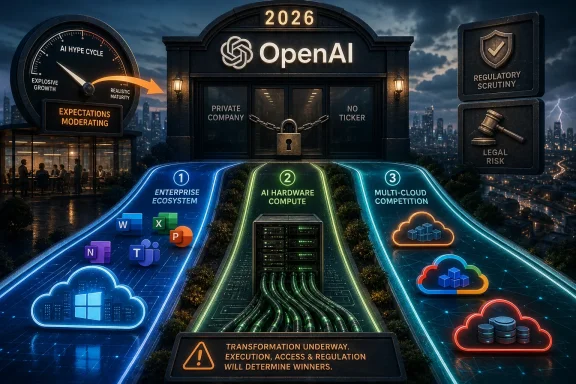 The OpenAI Trade Was Never as Simple as Buying Microsoft
For years, the neat retail-investor answer was that the best way to invest in OpenAI was to buy Microsoft. That answer had logic behind it. Microsoft put $1 billion into OpenAI in 2019, tied OpenAI’s infrastructure to Azure, and later expanded the relationship as ChatGPT turned from a research curiosity into the fastest mainstream software phenomenon in recent memory.The original pitch was elegant enough to fit in a brokerage app: OpenAI builds the models, Microsoft supplies the cloud, and investors buy the publicly traded company that owns the enterprise distribution channel. Azure gets the compute demand. Office gets the Copilot upsell. Windows gets the AI halo. Bing, for once, gets a reason to be discussed without irony.
But 2026 has made that shorthand feel dated. Microsoft is still OpenAI’s most important corporate partner, and it still has deep economic rights connected to OpenAI’s success. Yet the relationship has shifted from something that looked like a near-exclusive conduit into something closer to a major strategic alliance in a crowded infrastructure market.
That change does not make Microsoft a bad way to play OpenAI. It makes Microsoft a more complicated one. Buying Microsoft today is not buying OpenAI with a ticker symbol attached; it is buying a hyperscale software-and-cloud conglomerate that has one of the strongest seats at the OpenAI table, but not the whole table.
OpenAI Remains Private, Even as Its Economic Gravity Looks Public
The central fact for investors is unchanged: OpenAI is not listed on the Nasdaq, NYSE, or any other public exchange. There is no ordinary OpenAI ticker. There is no retail order ticket that gives the average investor direct ownership in the company behind ChatGPT.That matters because OpenAI now behaves like a public-market object in nearly every way except the one that counts for retail access. It moves Microsoft’s narrative. It influences Nvidia’s demand outlook. It changes the strategic posture of Amazon, Google, Oracle, Salesforce, Apple, and Meta. It sits at the center of the AI capital-expenditure boom, yet its shares remain outside the reach of most investors.
Private-company exposure is possible in theory, but only for certain investors. Secondary marketplaces sometimes offer access to shares of late-stage private companies, and funds may hold stakes in OpenAI directly or indirectly. These routes are usually limited to accredited investors, come with high minimums, carry restrictive transfer rules, and can be brutally illiquid.
The irony is that OpenAI has become one of the most economically visible private companies in the world while remaining structurally inaccessible to the average person who uses ChatGPT every day. The more important OpenAI becomes, the more tempting the proxy trades become. That temptation is precisely where investors need to slow down.
Microsoft Still Has the Strongest Claim, but Not a Monopoly on the Upside
Microsoft’s claim on the OpenAI story is real. It invested early, tied OpenAI deeply to Azure, integrated OpenAI models into Microsoft 365, GitHub, Windows, Dynamics, and security products, and turned Copilot into the banner under which much of its AI strategy now flies. It also retained major rights in OpenAI’s technology and economics through the companies’ revised partnership.The original 2023-era analysis often emphasized Microsoft’s reported $10 billion investment and the idea that Microsoft would receive a large share of OpenAI profits until it recovered its investment, followed by a major stake in the company. Later restructuring changed the shape of that relationship. Microsoft now has a significant ownership position in OpenAI’s for-profit entity, but the clean “Microsoft owns the OpenAI trade” story has faded.
The biggest strategic change is cloud exclusivity. Earlier versions of the Microsoft-OpenAI relationship made Azure the critical infrastructure path for OpenAI’s APIs and services. By 2026, that exclusivity has been loosened. Microsoft remains OpenAI’s primary cloud partner, and Azure remains deeply embedded in the relationship, but OpenAI can now serve products across other cloud providers under the updated arrangement.
For Microsoft investors, this cuts both ways. The downside is obvious: Azure no longer captures every possible OpenAI workload by default. The upside is subtler: OpenAI’s growth may be too large for any one cloud provider to satisfy alone, and Microsoft may prefer a durable economic relationship over a brittle capacity bottleneck that constrains the company it helped scale.
The Azure Exclusivity Shift Changes the Investment Math
The end of strict exclusivity is not a divorce. It is a recognition that frontier AI has become an infrastructure problem as much as a software problem. Training and serving modern models require chips, power, land, cooling, networking, and long-term data center commitments. The bottleneck is not merely who has the best contract; it is who can deliver enough capacity at the right time.That is why investors should be careful with old summaries of Microsoft’s OpenAI exposure. A 2023 explanation that treated Azure exclusivity as the foundation of the thesis may still be historically accurate, but it is not fully current. The Microsoft-OpenAI relationship in 2026 is broader, more formalized, and less exclusive than it once was.
This shift is especially important for WindowsForum readers because it mirrors what enterprise IT is seeing on the ground. AI deployments are not settling into a single-vendor world. A large organization may use Microsoft 365 Copilot for productivity, Azure OpenAI Service for internal apps, Amazon Bedrock for another workload, Google’s AI stack for data and analytics, and local models for sensitive use cases.
In that world, Microsoft’s advantage is not simply that it has OpenAI. Its advantage is that it can wrap AI into software customers already buy: Windows endpoints, Entra identity, Defender, Teams, Office, SharePoint, Power Platform, GitHub, and Azure. If OpenAI becomes more multi-cloud, Microsoft’s moat shifts from privileged infrastructure access to product integration, enterprise trust, and distribution.
Copilot Is the Real Retail Investor Product
If there is a public-market version of OpenAI that ordinary users can actually observe, it is Copilot. Microsoft has taken OpenAI-derived technology and converted it into features inside Word, Excel, PowerPoint, Outlook, Teams, GitHub, Edge, Windows, and security tooling. This is where the investor thesis stops being abstract and starts showing up in renewal conversations.Microsoft 365 Copilot is not just a chatbot bolted onto Office. It is Microsoft’s attempt to raise the average revenue per user of its most important productivity franchise. The promise is straightforward: summarize email threads, draft documents, build slide decks, analyze spreadsheets, extract action items from meetings, and connect corporate data through Microsoft Graph.
The risk is also straightforward. AI features must justify their price. Enterprises have spent the last two decades becoming more disciplined about SaaS seat sprawl, and Copilot is not immune from the same scrutiny. If workers use it heavily, Microsoft gets a new productivity tax on the enterprise. If usage is shallow, CIOs will treat it like another expensive add-on.
This is where Microsoft is both stronger and more exposed than OpenAI itself. OpenAI can sell excitement, API access, and consumer subscriptions. Microsoft has to sell measurable business productivity to procurement teams. That is a harder sale, but a more durable one if it works.
Buying Microsoft Means Buying the Whole Microsoft Machine
The cleanest public alternative to OpenAI remains Microsoft, but only if investors understand what they are actually buying. Microsoft is not a pure-play AI company. It is a cloud platform, enterprise software vendor, gaming company, security vendor, developer-tools provider, advertising business, operating-system steward, and capital-expenditure machine.That diversification is a feature for conservative investors. If OpenAI stumbles, Microsoft still has Azure, Windows, Office, LinkedIn, GitHub, Xbox, Dynamics, and security. If AI adoption takes longer than expected, Microsoft has the balance sheet and installed base to wait. If models become commoditized, Microsoft can still profit by integrating them into workflows and charging for business outcomes.
The downside is that OpenAI success may not flow cleanly into Microsoft’s share price. Microsoft is already huge. Even a wildly successful OpenAI stake has to move through the math of a multi-trillion-dollar company. Investors buying Microsoft only for OpenAI may discover that they are also underwriting data-center spending, cloud-margin pressure, antitrust scrutiny, Windows cycles, gaming execution, and the broader enterprise IT budget.
Microsoft is therefore the obvious proxy, not the perfect one. It is the safest public-market bridge to OpenAI’s ecosystem, but safety and purity rarely travel together.
Meta Is Not an OpenAI Proxy, and That Is the Point
The user-submitted article fragment jumps from Microsoft to Meta Platforms, which is telling. Meta is not a way to invest in OpenAI. It is a way to invest against the idea that OpenAI’s closed, premium-model strategy will capture all the value in AI.Meta’s AI strategy has leaned heavily on open-weight models, massive internal infrastructure, and integration across Facebook, Instagram, WhatsApp, Messenger, advertising tools, and consumer devices. The company’s Llama family gave developers and enterprises an alternative to fully closed model providers, and that matters because not every customer wants their AI future routed through OpenAI’s APIs.
For investors, Meta represents a different thesis. It says AI will improve ad targeting, content creation, recommendation systems, messaging assistants, and eventually glasses or other devices. It also says the open ecosystem can pressure the economics of closed AI models by making capable alternatives widely available.
That is a threat to OpenAI and an opportunity for Meta. If frontier models remain scarce and expensive, OpenAI benefits. If good-enough models become cheap, portable, and customizable, Meta benefits from owning attention, distribution, and infrastructure rather than charging directly for model access.
Nvidia Sells the Picks, but the Picks Are No Longer Cheap
Nvidia is the classic “sell shovels in a gold rush” trade, and in AI it has been more shovel merchant than metaphor. OpenAI, Microsoft, Meta, Google, Amazon, xAI, Anthropic, Oracle, CoreWeave, and countless others need accelerators, networking, software libraries, and systems expertise. Nvidia has supplied much of that foundation.The appeal is obvious. If investors cannot know which AI application wins, they can buy the company selling the hardware that nearly every contender wants. Nvidia’s CUDA ecosystem, data-center GPUs, networking assets, and rapid platform cadence have made it central to the AI buildout.
The risk is valuation and cyclicality. Semiconductor demand can look structurally infinite right up until customers digest capacity, optimize inference, shift workloads to custom silicon, or hit power constraints. Nvidia may remain an extraordinary company and still deliver disappointing stock returns if expectations outrun reality.
For OpenAI-adjacent investors, Nvidia is not a claim on OpenAI’s profits. It is a claim on the continued expansion of AI compute demand. That is a broader and perhaps more durable thesis, but it is also one the market has already noticed.
Amazon, Google, and Oracle Want the Workloads Microsoft Cannot Keep
Once OpenAI is no longer tied as tightly to Azure exclusivity, the rest of the cloud market matters more. Amazon Web Services, Google Cloud, and Oracle all have reasons to chase OpenAI and OpenAI-like workloads. AI infrastructure has become a prestige contest, a revenue opportunity, and a strategic necessity.Amazon’s case is that AWS remains the default cloud language for much of the developer and startup world. Its Bedrock platform gives customers access to multiple model providers, and its relationship with Anthropic gives it a major AI anchor. If OpenAI workloads become more portable across clouds, Amazon has the scale and customer base to compete aggressively.
Google’s case is more vertically integrated. It has world-class AI research, Gemini models, TPUs, Google Cloud, Android, Workspace, YouTube, Search, and DeepMind. Google does not need OpenAI to have an AI story, but a more open cloud market for frontier models increases pressure on every provider to support customer choice.
Oracle’s case is narrower but increasingly relevant. It has pursued large AI infrastructure deals and positioned its cloud as a high-performance option for massive compute workloads. Oracle is not the first company most consumers associate with AI, but enterprise infrastructure history is full of companies that made fortunes by being less glamorous than essential.
Private-Market Access Is Real, but It Is Not Retail Investing
Some investors will be tempted by secondary platforms that advertise access to private companies. These marketplaces can be legitimate, but they are not the same thing as buying Apple or Microsoft in a brokerage account. The friction is the point.Private shares often come with restrictions. Availability is inconsistent. Pricing can be opaque. Minimum investments can be high. Settlement can be slow. Company approval may be required. Financial disclosures are limited compared with public companies. Liquidity can disappear precisely when investors want out.
There is also the problem of adverse selection. If a private company is one of the most desired assets in technology, the shares available to outsiders may not be cheap. Employees or early investors selling on secondary markets may have perfectly reasonable diversification motives, but buyers should not confuse access with value.
The average investor should treat private OpenAI access as a specialized transaction, not a casual alternative. If the investment requires accreditation, legal review, lockup tolerance, and comfort with limited information, it belongs in a different risk category from public equities.
Funds Can Hide OpenAI Exposure Behind a Familiar Wrapper
Another route is to buy a fund that owns OpenAI shares directly or indirectly. This can be cleaner than a secondary-market purchase, but it introduces a different problem: dilution of exposure. A fund may hold OpenAI, but OpenAI may be only a small piece of the portfolio.Some closed-end funds, venture-style vehicles, or interval funds may offer late-stage private-company exposure. The investor gets professional sourcing and a familiar wrapper, but also fees, portfolio opacity, potential discounts or premiums to net asset value, and limited control over what is actually being purchased.
The key question is not “Does this fund own OpenAI?” It is “How much of my dollar actually behaves like OpenAI?” A 2 percent fund allocation to OpenAI will not give an investor much OpenAI upside, especially after fees and any public-market noise around the fund itself.
Funds can make sense for investors who want broad exposure to private AI leaders without trying to pick the winner. They make less sense for anyone who believes they are getting a direct line to ChatGPT’s economics.
The IPO Question Hangs Over Everything
The obvious endgame is an OpenAI public offering. If OpenAI eventually goes public, the investment question becomes simpler but not necessarily easier. Public access would improve transparency and liquidity, but it would also force investors to confront valuation in daylight.The problem with waiting for an IPO is that the best private gains may already be captured before retail investors get access. That is not unique to OpenAI; it is the defining feature of late-stage technology investing. Companies now stay private longer, raise larger private rounds, and arrive on public markets with much of the early growth already priced in.
The problem with rushing into proxies is that proxies can disappoint before the IPO arrives. Microsoft may underperform because of cloud margins. Nvidia may correct because of chip-cycle fears. Meta may be punished for spending too much on AI infrastructure. Amazon and Google may spend heavily without proving returns quickly enough.
An OpenAI IPO would also force a sharper debate about governance, profit caps, mission commitments, compute costs, model commoditization, regulatory exposure, copyright litigation, safety obligations, and competition. The company’s brand is enormous. Its future margins are not guaranteed.
The Regulatory Discount Is Not Going Away
AI investing in 2026 cannot be separated from regulation. OpenAI and its peers sit in the middle of disputes over copyright, data provenance, labor displacement, model safety, national security, consumer protection, and competition policy. These are not abstract risks for lawyers to handle later. They shape product design, training data, enterprise adoption, and public trust.Microsoft’s involvement does not eliminate those risks. In some ways, it magnifies them. Regulators are more interested in arrangements where dominant cloud providers, dominant productivity platforms, and leading AI labs become economically intertwined. Even when a partnership stops short of full control, it can still draw scrutiny.
For investors, regulation acts like a discount rate on the AI story. The more powerful the models become, the more governments will ask who controls them, how they were trained, and what happens when they fail. That does not mean AI investing is doomed. It means the free-option phase is over.
This is especially relevant for enterprise buyers. A CIO does not only ask whether a model is smart. They ask where data goes, who indemnifies what, how logs are handled, whether outputs are auditable, and whether the vendor will still support the product after the next regulatory turn. Microsoft has advantages here because enterprise compliance is part of its muscle memory. OpenAI has had to build that muscle in public.
The Better Question Is Which Layer Captures Value
The phrase “invest in OpenAI” hides a larger question: where will AI profits actually settle? The model layer gets the attention because ChatGPT is visible. But value may accrue across chips, cloud infrastructure, enterprise software, developer tools, data platforms, cybersecurity, advertising, devices, and consulting.If frontier models stay scarce and differentiated, OpenAI-like companies should have pricing power. If models become cheaper and more interchangeable, the value shifts to distribution, data, workflow integration, and trust. If inference costs collapse, software margins may expand. If compute remains expensive, cloud and chip suppliers may keep extracting much of the profit pool.
Microsoft is a bet on the workflow layer and the cloud layer. Nvidia is a bet on the hardware and systems layer. Meta is a bet on consumer distribution and open-model leverage. Amazon and Google are bets on cloud scale and AI platforms. Oracle is a bet on infrastructure capacity. Venture funds are a bet on the private-company layer. None of these is the same as owning OpenAI.
That is the uncomfortable but useful truth. The AI boom is not one trade. It is a stack, and investors need to decide which layer they believe has the strongest bargaining power.
The 2026 OpenAI Portfolio Needs More Than One Ticker
The most practical OpenAI-adjacent strategy in 2026 is not to pretend there is a perfect substitute. There is not. The better approach is to decide what kind of exposure you want and choose accordingly.A conservative investor who wants OpenAI exposure with enterprise durability will naturally start with Microsoft. A more aggressive investor who believes compute demand will keep compounding may prefer Nvidia or a basket of semiconductor and infrastructure names. Someone who believes open models will pressure closed-model economics may look harder at Meta. A cloud-infrastructure investor may spread exposure across Microsoft, Amazon, Google, and Oracle.
The point is not to build an AI-themed collection for its own sake. It is to avoid mistaking a narrative for an allocation. OpenAI may be the star of the story, but the public markets offer supporting characters with very different risk profiles.
This is also where valuation discipline matters. Great companies can be poor investments at the wrong price. AI enthusiasm has already lifted many of the obvious beneficiaries. Buying a proxy after the market has priced in years of flawless execution can turn a correct thesis into a mediocre investment.
The Cleanest Answers Are the Ones With Caveats Attached
Investors looking for a simple OpenAI trade in 2026 should keep the following realities in view before pressing the buy button:- OpenAI is still not directly available to ordinary public-market investors through a standard stock ticker.
- Microsoft remains the strongest public-market proxy for OpenAI, but its relationship is no longer the simple Azure-exclusive story many investors learned in 2023.
- Private-market access to OpenAI may exist for accredited investors, but it comes with illiquidity, opaque pricing, high minimums, and limited disclosures.
- Meta, Nvidia, Amazon, Google, and Oracle are not substitutes for OpenAI ownership; they are different bets on different layers of the AI economy.
- An eventual OpenAI IPO could improve access, but it could also arrive at a valuation that already reflects enormous optimism.
- The best AI investment may not be the company with the most famous chatbot, but the company with the most defensible position in the layer where profits actually accrue.
References
- Primary source: The Motley Fool
Published: 2026-06-10T19:30:12.558099
Can You Invest in OpenAI in 2026? Details & Alternatives | The Motley Fool
Want to invest in OpenAI? You can't buy its stock directly, but you can invest in top partners like Microsoft and Nvidia that are powering its AI breakthroughs.www.fool.com
- Official source: openai.com
The next phase of the Microsoft OpenAI partnership | OpenAI
OpenAI and Microsoft announce an amended agreement that simplifies the partnership, adds long-term clarity, and supports continued AI innovation at scale.openai.com - Related coverage: stockanalysis.com
6 Ways to Invest in OpenAI (ChatGPT) Stock in 2026
OpenAI is the maker of the popular AI chatbot ChatGPT. Here are 6 ways to invest in OpenAI before its IPO, while it's still a private company.stockanalysis.com - Related coverage: arstechnica.com
OpenAI ends its exclusive partnership with Microsoft - Ars Technica
Amended agreement clears the way for OpenAI models to run on Amazon Bedrock.arstechnica.com - Related coverage: nerdwallet.com
Can You Buy OpenAI Stock? - NerdWallet
You can’t buy OpenAI stock on a normal exchange yet — but you can invest in one of its partners, and some investors may be eligible to buy shares on private equity markets. Plus, it's preparing for an IPO.www.nerdwallet.com
- Related coverage: webhosting.today
OpenAI Drops Azure Exclusivity - webhosting.today
Azure exclusivity ended April 27. OpenAI now distributes across AWS and Google Cloud, while Azure retains first-launch rights webhosting.today
- Related coverage: vaasblock.com
Microsoft-OpenAI Partnership 2026: The Non-Exclusive Era Begins
OpenAI's Azure exclusivity ended April 27, 2026. Other clouds can now license OpenAI models. What changed, what stayed, and what it means for cloud AI.www.vaasblock.com - Related coverage: fortune.com
OpenAI completes for-profit restructuring and grants Microsoft a 27% stake | Fortune
The restructuring ends years of capital constraints for OpenAI and grants Microsoft long-term technology access and new AGI rights under the updated deal.fortune.com
- Related coverage: tomshardware.com
Microsoft and OpenAI end exclusivity agreement, opening up potential partnerships with Amazon and Google — Microsoft will continue to receive revenue share through 2030 | Tom's Hardware
OpenAI has broken Microsoft's containment.www.tomshardware.com - Related coverage: theinformation.com
OpenAI Branches Out from Microsoft with New Products For Amazon’s Cloud — The Information
OpenAI’s agreement with Amazon, announced on Friday, means that it will now build applications that will be available on Amazon’s cloud platform after previously offering most of its products on Microsoft’s Azure cloud. OpenAI and Amazon will work together on new AI agent products, and...www.theinformation.com - Related coverage: techradar.com
OpenAI and Microsoft make a huge change to their exclusive partnership - does this open the door for AWS to swoop in? | TechRadar
Microsoft is no longer OpenAI's exclusive cloud partnerwww.techradar.com - Related coverage: windowscentral.com
"The work we’re doing together remains ambitious": OpenAI ends Microsoft exclusivity in a tone that doesn’t match last week’s leaked memo | Windows Central
OpenAI’s official announcement sounds optimistic, but last week’s leaked memo told a different story.www.windowscentral.com - Related coverage: time.com
OpenAI Reorganizaes With $135 Billion Microsoft Stake
The nonprofit arm, now called the OpenAI Foundation, will have a $130 billion stake in the for-profit enterprise.time.com - Related coverage: elpais.com
Sacudida en la industria de la IA: Microsoft y OpenAI reformulan su alianza y recortan relaciones
El fabricante de Windows renuncia al derecho exclusivo para vender los modelos de inteligencia artificial de la ‘start-up’elpais.com
- Related coverage: axios.com
OpenAI breaks free of Microsoft's cloud
With its newest partnership deal OpenAI gets the cloud freedom Anthropic always had.www.axios.com
