

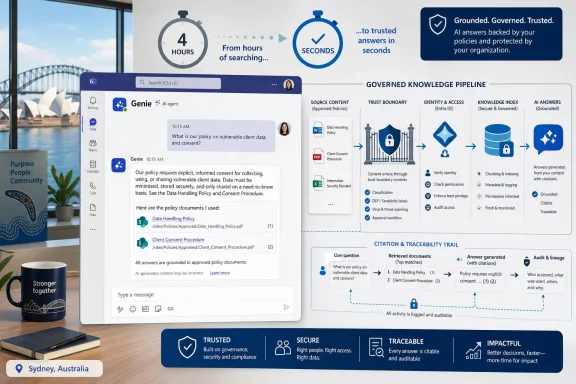
Cancer Council NSW, the Sydney-headquartered cancer charity, has built Genie, a Microsoft Copilot Studio agent embedded in Teams, to give roughly 475 employees fast, cited answers from approved SharePoint policy documents, according to a Microsoft customer story published on July 7, 2026. The obvious headline is that one staff member’s four-hour search became a seconds-long interaction. The more important story is that Cancer Council NSW is treating generative AI not as a magic search box, but as a governed front door to institutional memory. That distinction may matter more for enterprise AI adoption than another demo of a chatbot that can summarize a file.
Cancer Council NSW did not lack information. Like most mature organizations, it had policies, procedures, version histories, subject matter experts, SharePoint folders, and the accumulated muscle memory of staff who had answered the same questions before.
That was precisely the problem. When an employee needed guidance, the path to an answer might run through SharePoint search, a colleague’s recollection, a manager’s interpretation, or a document that looked authoritative but was not the current endorsed version. In routine situations, that wastes time. In sensitive or time-pressured situations, it creates operational risk.
Microsoft’s customer story describes a particularly stark example: after a customer service call, one staff member spent four hours locating the right response process. The policy existed, but it was buried deeply enough, and written or organized in a way that made retrieval difficult enough, that availability did not translate into usability.
That is the enterprise knowledge-management trap in miniature. The organization can honestly say the answer is documented, while the employee can honestly say it is practically inaccessible.
This is the version of Microsoft’s agent strategy that should make IT departments pay attention. It is not an open-ended assistant promising to “transform work” by touching every system on day one. It is a bounded tool aimed at a known pain point: employees need current policy guidance, and the organization needs them to stop relying on informal answers.
The choice of Teams is not incidental. As Cancer Council NSW’s Manager of Risk and Compliance Ben Horsley put it in Microsoft’s write-up, placing Genie where staff already work lowers adoption friction and makes the system easier to scale. That sounds mundane, but mundane deployment details often decide whether an internal AI project becomes infrastructure or theater.
The SharePoint grounding is equally important. Microsoft’s own Copilot Studio documentation explains that agents can use SharePoint content as a knowledge source for generative answers, retrieving and summarizing material from specified locations. In practice, that means the usefulness of the agent depends less on the language model’s sparkle than on the organization’s ability to curate what the model is allowed to see.
That is a subtle but critical separation. The future of workplace AI will not be one universal assistant answering every question with equal authority. It will be a hierarchy of tools with different trust boundaries.
For a user asking, “What did I miss in yesterday’s meeting?”, broad discovery is a feature. For a manager asking whether a delegation-of-authority threshold has changed, broad discovery can become a liability. The answer must reflect the latest signed-off policy, not the last version someone remembers or a draft circulated in a planning folder.
This is where grounding becomes more than a vendor term. Grounding is the operational discipline of deciding which documents count, who approves them, how they are maintained, and how the system behaves when no approved answer exists. Without that discipline, generative AI merely accelerates the old intranet problem.
That model breaks down because employees do not think like records managers. They ask operational questions: “What do I do after this call?” “Can I approve this expense?” “Who needs to sign off?” “What happens if the situation is urgent?” The document library stores answers by organizational taxonomy; the employee searches by immediate need.
Genie’s value is not that it eliminates the need for policy documents. It changes the interface between employee intent and organizational authority. The staff member no longer needs to know which document contains the answer, what the document is called, or whether a colleague’s memory reflects the current version.
The agent does the first pass of translation. It turns a natural-language query into a retrieval problem, then turns the retrieved policy text back into a usable answer. If the system is well governed, the employee receives not just a response, but a response anchored to the organization’s chosen source of truth.
An internal AI agent is only as good as the operational promises behind it. Who owns the content? Which SharePoint folders are authoritative? What happens when a policy changes? Who reviews bad answers? What data is captured in transcripts? How does the organization measure whether the tool is reducing risk rather than simply increasing chat volume?
Cancer Council NSW appears to have understood that governance cannot be bolted on after launch. Microsoft’s story says ownership, operational responsibility, and long-term sustainability were part of the initial design. For an agent giving policy guidance, that is not optional project management hygiene; it is the product.
The danger for copycat deployments is obvious. A team sees the “hours to seconds” claim and rushes to point an agent at a document library. But without a disciplined approval path and a known set of endorsed sources, the agent may simply make inconsistent guidance faster and more convincing.
Citations also change employee behavior. If a colleague answers from memory, the conversation often ends there. If an agent points back to the approved policy, it nudges the organization toward a healthier habit: consult the source, not the rumor network.
This is especially valuable when policies change. Microsoft’s story uses delegation-of-authority thresholds as an example. In many organizations, the most dangerous guidance is not obviously wrong; it is guidance that used to be right.
The agent’s job is therefore not only retrieval. It is also behavioral correction. It gives employees a fast path that is more reliable than asking around, which is the only way to displace informal knowledge-sharing without making people feel slowed down by compliance.
That creates an opening for Microsoft. Copilot Studio agents can be framed not as standalone applications but as extensions of the Microsoft 365 environment many organizations already use. For WindowsForum readers who administer Microsoft tenants, that means the agent conversation is not only about AI quality; it is about identity, permissions, SharePoint architecture, Teams deployment, auditing, licensing, and support.
Microsoft’s own documentation notes that SharePoint-backed generative answers in Teams rely on authentication choices and user access boundaries. That point deserves emphasis. A well-configured agent should not magically grant users access to content they could not otherwise read.
Still, “should” is doing work here. Administrators need to understand the permissions model, test edge cases, and account for limitations such as how agents behave in one-to-one Teams chats versus group or channel contexts. The glossy customer story is the beginning of the implementation conversation, not the end.
That context changes the tone of the case study. A staff member struggling to locate the right response process after a customer service call is not merely losing productivity. They may be delaying a sensitive response, increasing uncertainty, or escalating a situation that could have been handled more confidently with clear guidance.
This is where AI can be genuinely useful without becoming grandiose. The agent does not need to diagnose disease, replace human judgment, or make high-stakes decisions autonomously. It needs to help a staff member find the right organizational procedure quickly and consistently.
That is a much better model for enterprise AI than many of the inflated claims surrounding generative systems. Start with a workflow where the answer already exists, where the authorized source can be defined, and where the cost of delay or inconsistency is real.
Time saved is the easiest metric to communicate. The four-hour example is memorable because it compresses the problem into a before-and-after anecdote. But the more durable metrics are likely to be less theatrical: reduction in repeated questions to subject matter experts, fewer policy escalations caused by confusion, improved consistency across teams, and better visibility into what employees are actually trying to understand.
Genie also includes feedback and analytics capabilities, according to Microsoft’s story. That is essential because internal policy agents will produce a new kind of signal. Search logs used to show what people typed. Agent analytics can show what policies are unclear, what questions recur, and where employees need better guidance or training.
If Cancer Council NSW uses that feedback loop well, Genie becomes more than a retrieval tool. It becomes a diagnostic instrument for organizational knowledge.
That progression makes sense. Policy guidance is a strong first use case because it is common, document-heavy, and bounded. IT support is a logical next step because many organizations already track ticket volume, deflection, resolution time, and user satisfaction.
The risk is scope creep. Once an internal AI agent proves useful, every department will want its own version. HR will want policy and onboarding. IT will want troubleshooting. Finance will want approvals. Operations will want procedures. Each domain has different data quality, different risk levels, and different escalation rules.
The agent platform may scale technically, but governance must scale institutionally. The harder problem is not creating more agents. It is preventing the organization from creating a confusing sprawl of semi-authoritative bots.
That stack is powerful because it meets organizations where they already are. It is also dangerous because it can make deployment feel deceptively easy. Connecting an agent to SharePoint is not the same thing as making SharePoint ready for AI.
Many tenants are full of legacy libraries, inherited permissions, stale documents, duplicated policies, abandoned working drafts, and files whose names made sense only to the person who uploaded them. An agent does not erase that entropy. It exposes it.
The practical lesson is that AI readiness is information architecture readiness. If the content estate is messy, the agent will either underperform or force a cleanup that should have happened years ago. Either way, the chatbot becomes a mirror.
Subject matter experts paid it too. They became living indexes for policy, answering repetitive questions not because the organization lacked documentation, but because the documentation was hard to consume. That is a poor use of scarce expertise.
A governed agent redistributes that labor. The organization invests upfront in curated sources, approved folders, feedback loops, and agent design. In return, staff get faster answers and experts are reserved for edge cases, exceptions, and genuine judgment calls.
That is the strongest argument for this kind of AI. It does not pretend to eliminate expertise. It protects expertise from being wasted on retrieval.
Cancer Council NSW’s Genie is a reminder that the next phase of workplace AI will be won in the unglamorous places: policy libraries, permissions models, approval workflows, Teams app deployment, analytics dashboards, and the hard editorial work of deciding which documents deserve to answer on the organization’s behalf. If Microsoft and its customers can keep that discipline as agents expand from policy into IT support and beyond, Copilot Studio may become less a chatbot factory than a new interface layer for trusted work.
 The Search Problem Was Really a Trust Problem
Cancer Council NSW did not lack information. Like most mature organizations, it had policies, procedures, version histories, subject matter experts, SharePoint folders, and the accumulated muscle memory of staff who had answered the same questions before.That was precisely the problem. When an employee needed guidance, the path to an answer might run through SharePoint search, a colleague’s recollection, a manager’s interpretation, or a document that looked authoritative but was not the current endorsed version. In routine situations, that wastes time. In sensitive or time-pressured situations, it creates operational risk.
Microsoft’s customer story describes a particularly stark example: after a customer service call, one staff member spent four hours locating the right response process. The policy existed, but it was buried deeply enough, and written or organized in a way that made retrieval difficult enough, that availability did not translate into usability.
That is the enterprise knowledge-management trap in miniature. The organization can honestly say the answer is documented, while the employee can honestly say it is practically inaccessible.
Genie Is Microsoft’s Agent Pitch in Its Most Plausible Form
The agent Cancer Council NSW built, called Genie, uses Microsoft Copilot Studio and sits inside Microsoft Teams. It draws from approved policy content stored in SharePoint and returns conversational answers with citations, rather than asking staff to traverse folders and interpret documents manually.This is the version of Microsoft’s agent strategy that should make IT departments pay attention. It is not an open-ended assistant promising to “transform work” by touching every system on day one. It is a bounded tool aimed at a known pain point: employees need current policy guidance, and the organization needs them to stop relying on informal answers.
The choice of Teams is not incidental. As Cancer Council NSW’s Manager of Risk and Compliance Ben Horsley put it in Microsoft’s write-up, placing Genie where staff already work lowers adoption friction and makes the system easier to scale. That sounds mundane, but mundane deployment details often decide whether an internal AI project becomes infrastructure or theater.
The SharePoint grounding is equally important. Microsoft’s own Copilot Studio documentation explains that agents can use SharePoint content as a knowledge source for generative answers, retrieving and summarizing material from specified locations. In practice, that means the usefulness of the agent depends less on the language model’s sparkle than on the organization’s ability to curate what the model is allowed to see.
The Copilot Distinction Enterprises Cannot Ignore
Cancer Council NSW made a notable distinction between Microsoft 365 Copilot and a purpose-built Copilot Studio agent. Microsoft 365 Copilot is useful for broad personal productivity and discovery, but policy guidance needs a narrower contract: answers should come from curated, approved sources, not from drafts, working documents, or whatever happens to be discoverable in a user’s graph.That is a subtle but critical separation. The future of workplace AI will not be one universal assistant answering every question with equal authority. It will be a hierarchy of tools with different trust boundaries.
For a user asking, “What did I miss in yesterday’s meeting?”, broad discovery is a feature. For a manager asking whether a delegation-of-authority threshold has changed, broad discovery can become a liability. The answer must reflect the latest signed-off policy, not the last version someone remembers or a draft circulated in a planning folder.
This is where grounding becomes more than a vendor term. Grounding is the operational discipline of deciding which documents count, who approves them, how they are maintained, and how the system behaves when no approved answer exists. Without that discipline, generative AI merely accelerates the old intranet problem.
The Old Intranet Failed Because It Made Employees Do the Indexing
For decades, organizations have treated document repositories as if publishing information were the same as communicating it. Put the policy in the right folder, add metadata if someone remembers, hope search indexes it correctly, and expect employees to find it under pressure.That model breaks down because employees do not think like records managers. They ask operational questions: “What do I do after this call?” “Can I approve this expense?” “Who needs to sign off?” “What happens if the situation is urgent?” The document library stores answers by organizational taxonomy; the employee searches by immediate need.
Genie’s value is not that it eliminates the need for policy documents. It changes the interface between employee intent and organizational authority. The staff member no longer needs to know which document contains the answer, what the document is called, or whether a colleague’s memory reflects the current version.
The agent does the first pass of translation. It turns a natural-language query into a retrieval problem, then turns the retrieved policy text back into a usable answer. If the system is well governed, the employee receives not just a response, but a response anchored to the organization’s chosen source of truth.
The Real Work Starts Before the Chatbot Goes Live
The Microsoft story says Cancer Council NSW partnered with Engage Squared and began with validation, design workshops, success metrics, functional and non-functional requirements, and a prioritized backlog. That may sound like standard implementation boilerplate, but it is the most revealing part of the deployment.An internal AI agent is only as good as the operational promises behind it. Who owns the content? Which SharePoint folders are authoritative? What happens when a policy changes? Who reviews bad answers? What data is captured in transcripts? How does the organization measure whether the tool is reducing risk rather than simply increasing chat volume?
Cancer Council NSW appears to have understood that governance cannot be bolted on after launch. Microsoft’s story says ownership, operational responsibility, and long-term sustainability were part of the initial design. For an agent giving policy guidance, that is not optional project management hygiene; it is the product.
The danger for copycat deployments is obvious. A team sees the “hours to seconds” claim and rushes to point an agent at a document library. But without a disciplined approval path and a known set of endorsed sources, the agent may simply make inconsistent guidance faster and more convincing.
Citations Are a Product Feature, Not a Compliance Decoration
Genie returns cited answers, according to Microsoft’s account. That matters because the user experience of enterprise AI cannot be “trust me.” A staff member needs enough transparency to understand where the answer came from, and a manager or risk team needs enough traceability to investigate whether the answer was appropriate.Citations also change employee behavior. If a colleague answers from memory, the conversation often ends there. If an agent points back to the approved policy, it nudges the organization toward a healthier habit: consult the source, not the rumor network.
This is especially valuable when policies change. Microsoft’s story uses delegation-of-authority thresholds as an example. In many organizations, the most dangerous guidance is not obviously wrong; it is guidance that used to be right.
The agent’s job is therefore not only retrieval. It is also behavioral correction. It gives employees a fast path that is more reliable than asking around, which is the only way to displace informal knowledge-sharing without making people feel slowed down by compliance.
Teams Is the Trojan Horse for Governed AI
Embedding Genie in Teams is a practical design choice, but it also reveals Microsoft’s broader advantage. Teams has become the workplace surface where chat, meetings, apps, approvals, files, and notifications collide. If AI agents are going to become habitual, they need to live in that surface rather than in a separate portal employees visit only when instructed.That creates an opening for Microsoft. Copilot Studio agents can be framed not as standalone applications but as extensions of the Microsoft 365 environment many organizations already use. For WindowsForum readers who administer Microsoft tenants, that means the agent conversation is not only about AI quality; it is about identity, permissions, SharePoint architecture, Teams deployment, auditing, licensing, and support.
Microsoft’s own documentation notes that SharePoint-backed generative answers in Teams rely on authentication choices and user access boundaries. That point deserves emphasis. A well-configured agent should not magically grant users access to content they could not otherwise read.
Still, “should” is doing work here. Administrators need to understand the permissions model, test edge cases, and account for limitations such as how agents behave in one-to-one Teams chats versus group or channel contexts. The glossy customer story is the beginning of the implementation conversation, not the end.
The Nonprofit Context Makes the Stakes Sharper
Cancer Council NSW is not a bank shaving milliseconds off a trading workflow or a software company looking for developer productivity gains. It is a health-focused charity that supports people through difficult moments, runs prevention initiatives, advocates for better outcomes, and funds cancer research.That context changes the tone of the case study. A staff member struggling to locate the right response process after a customer service call is not merely losing productivity. They may be delaying a sensitive response, increasing uncertainty, or escalating a situation that could have been handled more confidently with clear guidance.
This is where AI can be genuinely useful without becoming grandiose. The agent does not need to diagnose disease, replace human judgment, or make high-stakes decisions autonomously. It needs to help a staff member find the right organizational procedure quickly and consistently.
That is a much better model for enterprise AI than many of the inflated claims surrounding generative systems. Start with a workflow where the answer already exists, where the authorized source can be defined, and where the cost of delay or inconsistency is real.
The Metrics Will Decide Whether Genie Becomes Infrastructure
Microsoft says Cancer Council NSW is still in the adoption phase, with staff already finding answers faster and relying less on informal workarounds. That is encouraging, but the next test is measurement.Time saved is the easiest metric to communicate. The four-hour example is memorable because it compresses the problem into a before-and-after anecdote. But the more durable metrics are likely to be less theatrical: reduction in repeated questions to subject matter experts, fewer policy escalations caused by confusion, improved consistency across teams, and better visibility into what employees are actually trying to understand.
Genie also includes feedback and analytics capabilities, according to Microsoft’s story. That is essential because internal policy agents will produce a new kind of signal. Search logs used to show what people typed. Agent analytics can show what policies are unclear, what questions recur, and where employees need better guidance or training.
If Cancer Council NSW uses that feedback loop well, Genie becomes more than a retrieval tool. It becomes a diagnostic instrument for organizational knowledge.
The Roadmap Points Toward Agent Orchestration
Cancer Council NSW’s CIO Mathews George described the policy agent as the start, saying Genie could look very different in twelve months. Microsoft’s story says the architecture is intended to become a front door to multiple specialized agents, with IT support identified as one possible future area.That progression makes sense. Policy guidance is a strong first use case because it is common, document-heavy, and bounded. IT support is a logical next step because many organizations already track ticket volume, deflection, resolution time, and user satisfaction.
The risk is scope creep. Once an internal AI agent proves useful, every department will want its own version. HR will want policy and onboarding. IT will want troubleshooting. Finance will want approvals. Operations will want procedures. Each domain has different data quality, different risk levels, and different escalation rules.
The agent platform may scale technically, but governance must scale institutionally. The harder problem is not creating more agents. It is preventing the organization from creating a confusing sprawl of semi-authoritative bots.
Windows and Microsoft 365 Admins Should Read This as an Architecture Story
For IT pros, the Cancer Council NSW case is less about charity-sector innovation and more about the architecture of trustworthy AI in Microsoft environments. The pattern is familiar: identity through Microsoft Entra ID, content in SharePoint, collaboration in Teams, low-code agent configuration in Copilot Studio, and analytics layered on top.That stack is powerful because it meets organizations where they already are. It is also dangerous because it can make deployment feel deceptively easy. Connecting an agent to SharePoint is not the same thing as making SharePoint ready for AI.
Many tenants are full of legacy libraries, inherited permissions, stale documents, duplicated policies, abandoned working drafts, and files whose names made sense only to the person who uploaded them. An agent does not erase that entropy. It exposes it.
The practical lesson is that AI readiness is information architecture readiness. If the content estate is messy, the agent will either underperform or force a cleanup that should have happened years ago. Either way, the chatbot becomes a mirror.
The Four-Hour Anecdote Hides a Larger Labor Shift
The most dramatic number in Microsoft’s story is four hours, but the deeper shift concerns who bears the cost of institutional complexity. In the old model, employees paid that cost individually every time they searched, asked around, interpreted documents, or waited for an expert.Subject matter experts paid it too. They became living indexes for policy, answering repetitive questions not because the organization lacked documentation, but because the documentation was hard to consume. That is a poor use of scarce expertise.
A governed agent redistributes that labor. The organization invests upfront in curated sources, approved folders, feedback loops, and agent design. In return, staff get faster answers and experts are reserved for edge cases, exceptions, and genuine judgment calls.
That is the strongest argument for this kind of AI. It does not pretend to eliminate expertise. It protects expertise from being wasted on retrieval.
The Useful Lesson Is Smaller Than the Hype and Bigger Than the Demo
Cancer Council NSW’s Genie deployment offers a narrow lesson with broad implications:- A successful policy agent depends on approved source material, not just a capable language model.
- Embedding the agent in Teams reduces adoption friction because employees do not have to visit another portal.
- Citations and “I don’t know” behavior are core trust features, not nice-to-have interface details.
- SharePoint governance becomes AI governance when agents use document libraries as knowledge sources.
- The best first use cases are bounded, high-volume, and measurable, with clear ownership and escalation paths.
- Scaling from one agent to many requires institutional governance, not just more low-code development.
Cancer Council NSW’s Genie is a reminder that the next phase of workplace AI will be won in the unglamorous places: policy libraries, permissions models, approval workflows, Teams app deployment, analytics dashboards, and the hard editorial work of deciding which documents deserve to answer on the organization’s behalf. If Microsoft and its customers can keep that discipline as agents expand from policy into IT support and beyond, Copilot Studio may become less a chatbot factory than a new interface layer for trusted work.
References
- Primary source: Microsoft
Published: 2026-07-07T17:30:12.499754
Loading…
www.microsoft.com