

EMPURON energy GmbH announced on June 9, 2026, from Nuremberg, Germany, that its CARTAN energy management platform can run in private cloud environments or locally on edge hardware, including compact minicomputers, while supporting both Linux and Windows Server deployments. The announcement is modest in the way industrial software announcements often are, but the strategic signal is larger than the press-release prose suggests. CARTAN is being positioned less as another dashboard for metering data and more as a hedge against two anxieties now shaping enterprise IT: dependence on external clouds and the fragility of centralized data paths. For WindowsForum readers, the interesting part is not simply that Windows Server is on the compatibility list; it is that energy management is becoming one more workload in the broader argument over where business-critical computing should live.
For the better part of a decade, the default answer to any new software problem was cloud-first. That made sense for many workloads: centralized compute, elastic storage, managed updates, and subscription economics were powerful enough to make the old server-room model look like a museum exhibit. But energy management sits in a less forgiving category than collaboration software or marketing analytics.
Factories, commercial buildings, retail estates, and mixed-use properties do not consume energy in PowerPoint diagrams. They consume it through meters, building systems, HVAC equipment, industrial controls, solar inverters, batteries, and other devices that often live far from the neat abstractions of cloud architecture. When connectivity drops, latency spikes, or a provider changes terms, the physical world keeps running.
That is the space EMPURON is trying to occupy with CARTAN. The company says the software is designed to operate in scalable private cloud environments and also directly on local hardware, including low-power minicomputers and compact systems. The pitch is not that one model replaces the other, but that customers should be able to decide where computation belongs.
That may sound obvious, but it cuts against a lot of software industry momentum. Many vendors have spent years training customers to accept a managed cloud service as the natural home for every new application. CARTAN’s framing suggests a different premise: for energy operations, infrastructure choice is not a deployment detail. It is part of the control plane.
Local processing can reduce latency. It can keep essential monitoring functions alive when wide-area connectivity is interrupted. It can also avoid the architectural absurdity of sending every operational signal to a distant service before deciding what the local facility should do next. In an energy-management context, that is not a philosophical preference. It can affect how quickly anomalies are detected, how reliably consumption is monitored, and how resilient the system remains during network trouble.
EMPURON’s announcement leans into this by saying CARTAN can run on resource-constrained devices as well as in data-center-style environments. That claim matters because the edge is full of compromises. A platform that only runs happily on generous server hardware is not really an edge platform; it is an on-premises platform with a marketing costume.
The harder engineering task is making software useful on modest hardware without giving up the features that make it worth deploying in the first place. EMPURON says CARTAN is optimized for resource efficiency and stable operation on lower-performance systems. If borne out in production, that would make it attractive for distributed estates where every site does not justify a full server stack.
That matters especially in Europe, where data sovereignty is not merely an IT talking point. German industrial and commercial buyers have long been sensitive to operational independence, regulatory exposure, and long-term supplier risk. EMPURON’s language around “system independence” and “data sovereignty” is aimed squarely at that buyer psychology.
The private-cloud model also gives larger organizations a way to standardize CARTAN without flattening every site into the same architecture. A headquarters or central IT team can host shared services in a controlled environment, while individual facilities can run local instances or edge nodes where necessary. The result is not pure decentralization. It is a hierarchy of control.
For Windows Server administrators, that distinction is familiar. The enterprise has never been purely cloud or purely local; it has always been a negotiation between central policy and local necessity. CARTAN’s announcement places energy management inside that same hybrid pattern.
Windows Server remains deeply embedded in small and midsize businesses, local government, property management, manufacturing, and mixed infrastructure environments. Even when Linux is preferred for appliances or containerized services, Windows Server often anchors directory services, file services, management tooling, and line-of-business applications. Supporting it keeps CARTAN from being treated as an outsider system that requires a separate operational island.
That does not mean Windows Server support automatically makes deployment easy. Administrators will still care about installation models, database dependencies, service accounts, update mechanisms, event logging, backup support, and security hardening. A platform can technically “support Windows Server” while still behaving like a Linux product wearing a compatibility badge.
Still, the inclusion matters. CARTAN is being pitched as open and hardware-agnostic, and operating-system flexibility is part of that story. In the real world, software openness is often measured not by slogans but by how little infrastructure customers must replace before the first useful dashboard appears.
But openness is not a binary attribute. APIs can exist and still be incomplete, poorly documented, rate-limited, or licensed in ways that discourage real portability. Modular architecture can be elegant internally while still exposing only a narrow surface to customers. Hardware-agnostic support can mean broad protocol compatibility, or it can mean “works with a few blessed devices if you pay for integration.”
EMPURON’s broader product materials describe an energy-management platform built around common industrial and building protocols, including Modbus, KNX, BACnet, OPC, IEC standards, and other interfaces. That is the right vocabulary for the market CARTAN wants to serve. Energy data is messy, multi-vendor, and long-lived; any serious system must speak to older equipment as well as new devices.
The real question is whether CARTAN’s openness helps customers exit as easily as it helps them enter. Can data be exported cleanly? Can integrations be maintained by in-house teams or third-party specialists? Can customers change hardware vendors without rebuilding their energy-management layer? Those are the tests that separate open systems from open-sounding systems.
That makes platforms like CARTAN part of the IT estate whether facilities teams like it or not. A metering dashboard connected to building systems is no longer a benign side application. It is a data platform, an integration layer, and potentially a control-adjacent system that needs governance.
This is where EMPURON’s private-cloud-and-edge framing becomes more than a deployment convenience. IT departments are being asked to support sustainability reporting, cost optimization, carbon accounting, demand response, local generation, and energy storage. Those demands do not fit neatly into one cloud service, one plant network, or one spreadsheet.
CARTAN’s promise is that the software can follow the topology of the business. A distributed retailer might need small edge devices across many stores. A manufacturer might want local resilience in plants and central analytics in a private cloud. A property manager might need tenant-level metering and billing functions without surrendering operational data to an external provider.
Energy costs, grid instability, electrification, and regulatory pressure are pushing organizations from reporting toward operational control. It is not enough to know after the fact that a building consumed too much power. The system needs to help identify patterns, support optimization, and make data available where decisions are made.
EMPURON’s own positioning reflects that shift. CARTAN is described as a platform for energy savings and optimization, not merely consumption visualization. The company also emphasizes billing, monitoring, and the ability to handle data from different meters and systems. That places CARTAN in the messy middle between facilities management, industrial data collection, and enterprise IT.
This is why deployment architecture matters. A reporting-only tool can tolerate more centralization because delayed insight is annoying rather than operationally damaging. A system closer to day-to-day energy optimization needs stronger local resilience. The closer software gets to physical operations, the less acceptable it becomes for the cloud to be the only place where intelligence resides.
A large facility can justify dedicated servers, integration work, and specialized support. A smaller retail branch, apartment building, or medium-sized commercial site often cannot. The deployment cost must be low enough that the energy savings and operational insight are worth the trouble.
Low-power local hardware can help, but only if the software is designed for it. The device must be easy to install, reliable after power events, manageable remotely, and secure enough not to become the weakest node in the network. Edge computing fails when every small box becomes a tiny snowflake that only one technician understands.
The Windows angle is mixed here. Windows Server is not usually the first choice for tiny edge boxes, where Linux-based appliances dominate for cost and footprint reasons. But many organizations still prefer Windows Server for central or private-cloud deployments, especially where existing administrator skill and tooling matter. CARTAN’s dual support lets organizations use different operating systems in different layers without forcing one answer everywhere.
For industrial firms, that information can be competitively sensitive. For property operators, it can overlap with billing and tenant relationships. For public-sector and regulated environments, it can create compliance and procurement concerns. Keeping the platform inside the organization’s own infrastructure can therefore be an operational requirement, not just a philosophical preference.
EMPURON’s message is tuned to that concern. By allowing CARTAN to run in private cloud or on local hardware, the company is arguing that customers should not have to trade modern energy analytics for external dependency. That is a compelling story in a market where buyers increasingly ask not only what software can do, but who controls the conditions under which it continues to work.
The counterpoint is that self-controlled infrastructure comes with self-controlled responsibility. If CARTAN runs locally, customers must handle patching, backups, access controls, physical security, and lifecycle management. Sovereignty is not free. It moves risk from the vendor’s platform into the customer’s operational discipline.
That is why EMPURON’s hardware-agnostic language is important. If CARTAN can connect to a wide range of data interfaces and third-party systems, it may help customers avoid rebuilding their monitoring environment whenever equipment changes. The practical value of that flexibility grows over time, because buildings and industrial sites rarely modernize all at once.
A facility may have new smart meters beside old fieldbus devices. It may have different HVAC vendors across buildings, different tenant metering arrangements, and different local connectivity constraints. A rigid energy platform becomes another legacy system almost immediately. A flexible one can absorb disorder.
The danger is that “hardware-agnostic” becomes a procurement phrase rather than a lived experience. Customers should ask which protocols are supported directly, which require additional gateways, what happens when devices fail, and how much integration work is needed for non-standard environments. The promise is attractive, but the details decide whether it saves money or simply shifts complexity.
Cloud services are still essential. Nobody should pretend that every organization wants to host its own analytics stack, update pipeline, or application infrastructure from scratch. But the idea that every operational workload should depend on a public cloud endpoint looks increasingly brittle in sectors where resilience, locality, and data control matter.
Energy management is a particularly good example because it spans so many boundaries. It involves IoT-like device collection, industrial protocols, building systems, dashboards, billing, optimization, and sometimes compliance reporting. It must be understandable to facilities teams but governable by IT teams. It benefits from central analysis but cannot always wait for central connectivity.
That makes CARTAN’s architecture more interesting than its feature list. The platform is being marketed as adaptable to the customer’s infrastructure rather than forcing infrastructure to adapt to the platform. Whether EMPURON can deliver that cleanly at scale is the open question, but the direction is aligned with what many administrators already know: the future is not cloud versus on-premises. It is controlled placement.
This is where vendors often understate the hard part. Running software locally is not enough. Customers need a secure update process, clear administrative roles, encrypted communication, logging, backup and restore procedures, and documented hardening guidance. If CARTAN is deployed across dozens or hundreds of sites, the management layer becomes as important as the local software.
Private cloud introduces its own security trade-offs. It can give organizations more control over data and access, but it also means the organization is responsible for designing the control environment correctly. Misconfigured internal systems are not magically safer than public cloud services. They are simply failures owned closer to home.
For Windows Server deployments, administrators will want to know how CARTAN fits with Active Directory or Entra-adjacent identity patterns, whether it supports least-privilege service accounts, how updates are delivered, and how logs can be collected into existing monitoring systems. Those are not glamorous questions, but they determine whether an “open” platform becomes manageable or just another exception in the environment.
The result is a market where the winners may not be the vendors with the flashiest dashboards, but those with the most credible deployment flexibility. Energy management software has to meet customers in their actual environments, including old meters, mixed networks, Windows servers, Linux appliances, private data centers, and budget-constrained edge sites.
This is not unique to EMPURON. The same pattern is visible across manufacturing software, building automation, security monitoring, and industrial analytics. The software layer is being asked to modernize without demanding that the physical layer become new overnight.
That is a hard business to be in. It requires product discipline, support discipline, and honest documentation. But it is also where real value lies, because the organizations that most need better energy insight are often the ones with the least uniform infrastructure.
Energy management systems fail when they become shelfware with sensors. They succeed when they become part of routine operations: checking consumption trends, spotting anomalies, supporting billing, informing maintenance, and justifying investment in efficiency measures. CARTAN’s deployment flexibility may help it reach more environments, but adoption depends on whether it stays useful after the launch project ends.
The platform’s claimed openness should also be judged over years, not weeks. A modular architecture is valuable when customers can extend it as needs change. Open APIs are valuable when they are stable, documented, and supported. Hardware flexibility is valuable when it reduces lifecycle cost rather than creating a larger compatibility matrix for IT to babysit.
That is the difference between a strategic platform and a technically interesting tool. EMPURON is clearly arguing for the former. Customers should evaluate it accordingly.
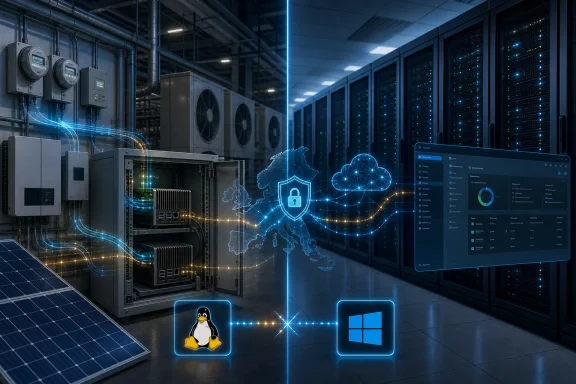 CARTAN Arrives as the Cloud Backlash Becomes Practical
For the better part of a decade, the default answer to any new software problem was cloud-first. That made sense for many workloads: centralized compute, elastic storage, managed updates, and subscription economics were powerful enough to make the old server-room model look like a museum exhibit. But energy management sits in a less forgiving category than collaboration software or marketing analytics.Factories, commercial buildings, retail estates, and mixed-use properties do not consume energy in PowerPoint diagrams. They consume it through meters, building systems, HVAC equipment, industrial controls, solar inverters, batteries, and other devices that often live far from the neat abstractions of cloud architecture. When connectivity drops, latency spikes, or a provider changes terms, the physical world keeps running.
That is the space EMPURON is trying to occupy with CARTAN. The company says the software is designed to operate in scalable private cloud environments and also directly on local hardware, including low-power minicomputers and compact systems. The pitch is not that one model replaces the other, but that customers should be able to decide where computation belongs.
That may sound obvious, but it cuts against a lot of software industry momentum. Many vendors have spent years training customers to accept a managed cloud service as the natural home for every new application. CARTAN’s framing suggests a different premise: for energy operations, infrastructure choice is not a deployment detail. It is part of the control plane.
The Edge Is Not a Buzzword When the Meter Is Down the Hall
The term edge computing has been abused badly enough that it now often lands with the thud of vendor marketing. In CARTAN’s case, however, the concept is straightforward. If energy data is generated inside a building, plant, campus, or retail location, then there are obvious reasons to process some of it nearby.Local processing can reduce latency. It can keep essential monitoring functions alive when wide-area connectivity is interrupted. It can also avoid the architectural absurdity of sending every operational signal to a distant service before deciding what the local facility should do next. In an energy-management context, that is not a philosophical preference. It can affect how quickly anomalies are detected, how reliably consumption is monitored, and how resilient the system remains during network trouble.
EMPURON’s announcement leans into this by saying CARTAN can run on resource-constrained devices as well as in data-center-style environments. That claim matters because the edge is full of compromises. A platform that only runs happily on generous server hardware is not really an edge platform; it is an on-premises platform with a marketing costume.
The harder engineering task is making software useful on modest hardware without giving up the features that make it worth deploying in the first place. EMPURON says CARTAN is optimized for resource efficiency and stable operation on lower-performance systems. If borne out in production, that would make it attractive for distributed estates where every site does not justify a full server stack.
Private Cloud Is the Politically Acceptable Middle Ground
CARTAN’s other deployment target, the private cloud, is just as important. Many organizations do not want a return to chaotic server sprawl, but they also do not want energy operations tied completely to a public cloud service. Private cloud gives IT departments a familiar compromise: centralized management, controlled infrastructure, and data residency under the organization’s own umbrella.That matters especially in Europe, where data sovereignty is not merely an IT talking point. German industrial and commercial buyers have long been sensitive to operational independence, regulatory exposure, and long-term supplier risk. EMPURON’s language around “system independence” and “data sovereignty” is aimed squarely at that buyer psychology.
The private-cloud model also gives larger organizations a way to standardize CARTAN without flattening every site into the same architecture. A headquarters or central IT team can host shared services in a controlled environment, while individual facilities can run local instances or edge nodes where necessary. The result is not pure decentralization. It is a hierarchy of control.
For Windows Server administrators, that distinction is familiar. The enterprise has never been purely cloud or purely local; it has always been a negotiation between central policy and local necessity. CARTAN’s announcement places energy management inside that same hybrid pattern.
Windows Server Support Is More Than a Checkbox
The announcement’s reference to Linux and Windows Server may look like routine compatibility language, but it is one of the more consequential details for IT buyers. Energy management systems are not deployed into greenfield fantasy environments. They land in organizations with existing identity systems, backup strategies, monitoring tools, patching policies, and administrator expertise.Windows Server remains deeply embedded in small and midsize businesses, local government, property management, manufacturing, and mixed infrastructure environments. Even when Linux is preferred for appliances or containerized services, Windows Server often anchors directory services, file services, management tooling, and line-of-business applications. Supporting it keeps CARTAN from being treated as an outsider system that requires a separate operational island.
That does not mean Windows Server support automatically makes deployment easy. Administrators will still care about installation models, database dependencies, service accounts, update mechanisms, event logging, backup support, and security hardening. A platform can technically “support Windows Server” while still behaving like a Linux product wearing a compatibility badge.
Still, the inclusion matters. CARTAN is being pitched as open and hardware-agnostic, and operating-system flexibility is part of that story. In the real world, software openness is often measured not by slogans but by how little infrastructure customers must replace before the first useful dashboard appears.
Openness Is the Claim That Needs Proof
EMPURON’s strongest claim is also the one that deserves the most scrutiny: openness. The company says CARTAN uses open interfaces and a modular architecture, allowing integration with existing IT ecosystems and third-party systems. In a market crowded with platforms that promise interoperability while quietly steering customers into proprietary gravity wells, that is a meaningful pitch.But openness is not a binary attribute. APIs can exist and still be incomplete, poorly documented, rate-limited, or licensed in ways that discourage real portability. Modular architecture can be elegant internally while still exposing only a narrow surface to customers. Hardware-agnostic support can mean broad protocol compatibility, or it can mean “works with a few blessed devices if you pay for integration.”
EMPURON’s broader product materials describe an energy-management platform built around common industrial and building protocols, including Modbus, KNX, BACnet, OPC, IEC standards, and other interfaces. That is the right vocabulary for the market CARTAN wants to serve. Energy data is messy, multi-vendor, and long-lived; any serious system must speak to older equipment as well as new devices.
The real question is whether CARTAN’s openness helps customers exit as easily as it helps them enter. Can data be exported cleanly? Can integrations be maintained by in-house teams or third-party specialists? Can customers change hardware vendors without rebuilding their energy-management layer? Those are the tests that separate open systems from open-sounding systems.
Energy Management Has Become an IT Problem
Energy management used to be treated as a facilities problem with some software attached. That boundary has collapsed. Modern energy systems generate data, require cybersecurity controls, interact with billing and compliance processes, and increasingly touch automation systems that can affect building behavior or industrial operations.That makes platforms like CARTAN part of the IT estate whether facilities teams like it or not. A metering dashboard connected to building systems is no longer a benign side application. It is a data platform, an integration layer, and potentially a control-adjacent system that needs governance.
This is where EMPURON’s private-cloud-and-edge framing becomes more than a deployment convenience. IT departments are being asked to support sustainability reporting, cost optimization, carbon accounting, demand response, local generation, and energy storage. Those demands do not fit neatly into one cloud service, one plant network, or one spreadsheet.
CARTAN’s promise is that the software can follow the topology of the business. A distributed retailer might need small edge devices across many stores. A manufacturer might want local resilience in plants and central analytics in a private cloud. A property manager might need tenant-level metering and billing functions without surrendering operational data to an external provider.
The Sustainability Stack Is Entering Its Infrastructure Phase
The first wave of corporate sustainability software often looked like reporting software. It collected data, produced charts, and helped organizations tell a cleaner story about emissions and efficiency. That phase is not over, but it is no longer sufficient.Energy costs, grid instability, electrification, and regulatory pressure are pushing organizations from reporting toward operational control. It is not enough to know after the fact that a building consumed too much power. The system needs to help identify patterns, support optimization, and make data available where decisions are made.
EMPURON’s own positioning reflects that shift. CARTAN is described as a platform for energy savings and optimization, not merely consumption visualization. The company also emphasizes billing, monitoring, and the ability to handle data from different meters and systems. That places CARTAN in the messy middle between facilities management, industrial data collection, and enterprise IT.
This is why deployment architecture matters. A reporting-only tool can tolerate more centralization because delayed insight is annoying rather than operationally damaging. A system closer to day-to-day energy optimization needs stronger local resilience. The closer software gets to physical operations, the less acceptable it becomes for the cloud to be the only place where intelligence resides.
Small Hardware Could Change the Economics of Deployment
One of the more practical parts of the announcement is EMPURON’s claim that CARTAN can run on minicomputers and compact small systems. If that works well, it changes the economics of rolling energy management out across distributed locations.A large facility can justify dedicated servers, integration work, and specialized support. A smaller retail branch, apartment building, or medium-sized commercial site often cannot. The deployment cost must be low enough that the energy savings and operational insight are worth the trouble.
Low-power local hardware can help, but only if the software is designed for it. The device must be easy to install, reliable after power events, manageable remotely, and secure enough not to become the weakest node in the network. Edge computing fails when every small box becomes a tiny snowflake that only one technician understands.
The Windows angle is mixed here. Windows Server is not usually the first choice for tiny edge boxes, where Linux-based appliances dominate for cost and footprint reasons. But many organizations still prefer Windows Server for central or private-cloud deployments, especially where existing administrator skill and tooling matter. CARTAN’s dual support lets organizations use different operating systems in different layers without forcing one answer everywhere.
Data Sovereignty Is Now an Operations Feature
“Data sovereignty” is one of those phrases that can sound inflated until a customer has to explain where operational data is stored, who can access it, and what happens if a provider relationship changes. Energy data may not always be personally identifiable in the narrowest sense, but it can reveal production patterns, occupancy rhythms, tenant behavior, equipment health, and business activity.For industrial firms, that information can be competitively sensitive. For property operators, it can overlap with billing and tenant relationships. For public-sector and regulated environments, it can create compliance and procurement concerns. Keeping the platform inside the organization’s own infrastructure can therefore be an operational requirement, not just a philosophical preference.
EMPURON’s message is tuned to that concern. By allowing CARTAN to run in private cloud or on local hardware, the company is arguing that customers should not have to trade modern energy analytics for external dependency. That is a compelling story in a market where buyers increasingly ask not only what software can do, but who controls the conditions under which it continues to work.
The counterpoint is that self-controlled infrastructure comes with self-controlled responsibility. If CARTAN runs locally, customers must handle patching, backups, access controls, physical security, and lifecycle management. Sovereignty is not free. It moves risk from the vendor’s platform into the customer’s operational discipline.
Vendor Lock-In Has a New Shape
When enterprise software buyers talk about vendor lock-in, they often mean data portability or subscription dependency. In energy management, lock-in can be more physical. It can involve meters, gateways, proprietary protocols, building automation systems, and site-specific integrations that become difficult to unwind after installation.That is why EMPURON’s hardware-agnostic language is important. If CARTAN can connect to a wide range of data interfaces and third-party systems, it may help customers avoid rebuilding their monitoring environment whenever equipment changes. The practical value of that flexibility grows over time, because buildings and industrial sites rarely modernize all at once.
A facility may have new smart meters beside old fieldbus devices. It may have different HVAC vendors across buildings, different tenant metering arrangements, and different local connectivity constraints. A rigid energy platform becomes another legacy system almost immediately. A flexible one can absorb disorder.
The danger is that “hardware-agnostic” becomes a procurement phrase rather than a lived experience. Customers should ask which protocols are supported directly, which require additional gateways, what happens when devices fail, and how much integration work is needed for non-standard environments. The promise is attractive, but the details decide whether it saves money or simply shifts complexity.
The WindowsForum Angle Is Hybrid Infrastructure, Not Energy Hype
WindowsForum readers do not need another vendor press release translated into enthusiasm. The reason CARTAN is worth attention here is that it reflects a broader enterprise pattern: hybrid infrastructure is becoming the default posture for workloads that touch the physical world.Cloud services are still essential. Nobody should pretend that every organization wants to host its own analytics stack, update pipeline, or application infrastructure from scratch. But the idea that every operational workload should depend on a public cloud endpoint looks increasingly brittle in sectors where resilience, locality, and data control matter.
Energy management is a particularly good example because it spans so many boundaries. It involves IoT-like device collection, industrial protocols, building systems, dashboards, billing, optimization, and sometimes compliance reporting. It must be understandable to facilities teams but governable by IT teams. It benefits from central analysis but cannot always wait for central connectivity.
That makes CARTAN’s architecture more interesting than its feature list. The platform is being marketed as adaptable to the customer’s infrastructure rather than forcing infrastructure to adapt to the platform. Whether EMPURON can deliver that cleanly at scale is the open question, but the direction is aligned with what many administrators already know: the future is not cloud versus on-premises. It is controlled placement.
Security Will Decide Whether the Edge Story Holds
Every edge deployment expands the security perimeter. A small device in a plant room or electrical cabinet may be operationally useful, but it is also a computer that needs identity, patching, monitoring, and protection from tampering. The more distributed the architecture, the more discipline it requires.This is where vendors often understate the hard part. Running software locally is not enough. Customers need a secure update process, clear administrative roles, encrypted communication, logging, backup and restore procedures, and documented hardening guidance. If CARTAN is deployed across dozens or hundreds of sites, the management layer becomes as important as the local software.
Private cloud introduces its own security trade-offs. It can give organizations more control over data and access, but it also means the organization is responsible for designing the control environment correctly. Misconfigured internal systems are not magically safer than public cloud services. They are simply failures owned closer to home.
For Windows Server deployments, administrators will want to know how CARTAN fits with Active Directory or Entra-adjacent identity patterns, whether it supports least-privilege service accounts, how updates are delivered, and how logs can be collected into existing monitoring systems. Those are not glamorous questions, but they determine whether an “open” platform becomes manageable or just another exception in the environment.
The Announcement Is Also a Sign of Where Industrial Software Is Heading
CARTAN’s positioning fits a larger shift in industrial and operational software. Vendors increasingly need to support multiple deployment models because their customers no longer share one infrastructure assumption. Some are cloud-forward. Some are sovereignty-driven. Some have isolated facilities. Some have central IT maturity but fragmented local equipment.The result is a market where the winners may not be the vendors with the flashiest dashboards, but those with the most credible deployment flexibility. Energy management software has to meet customers in their actual environments, including old meters, mixed networks, Windows servers, Linux appliances, private data centers, and budget-constrained edge sites.
This is not unique to EMPURON. The same pattern is visible across manufacturing software, building automation, security monitoring, and industrial analytics. The software layer is being asked to modernize without demanding that the physical layer become new overnight.
That is a hard business to be in. It requires product discipline, support discipline, and honest documentation. But it is also where real value lies, because the organizations that most need better energy insight are often the ones with the least uniform infrastructure.
The Practical Test Comes After Installation
The early story around CARTAN is promising, but the real test will be mundane. Can an administrator install it without a consulting engagement that consumes the expected savings? Can a facilities team understand the dashboard without living in the manual? Can integrations survive device replacement, network segmentation, and normal staff turnover?Energy management systems fail when they become shelfware with sensors. They succeed when they become part of routine operations: checking consumption trends, spotting anomalies, supporting billing, informing maintenance, and justifying investment in efficiency measures. CARTAN’s deployment flexibility may help it reach more environments, but adoption depends on whether it stays useful after the launch project ends.
The platform’s claimed openness should also be judged over years, not weeks. A modular architecture is valuable when customers can extend it as needs change. Open APIs are valuable when they are stable, documented, and supported. Hardware flexibility is valuable when it reduces lifecycle cost rather than creating a larger compatibility matrix for IT to babysit.
That is the difference between a strategic platform and a technically interesting tool. EMPURON is clearly arguing for the former. Customers should evaluate it accordingly.
CARTAN’s Real Message Is Control at the Point of Consumption
The most concrete lesson from EMPURON’s announcement is that energy software is being pulled toward the same architectural debates that reshaped the rest of enterprise IT. The interesting claims are not isolated features; they are about control, placement, and resilience.- CARTAN is being positioned as a hybrid energy management platform that can run in private cloud environments or directly on local edge hardware.
- EMPURON says the software supports both Linux and Windows Server, which matters for organizations with mixed infrastructure and established Windows administration practices.
- The platform’s edge story is strongest for sites where local processing, reduced dependency on internet connectivity, and proximity to metering data are operationally valuable.
- The private-cloud option gives organizations a way to centralize governance while keeping energy data inside infrastructure they control.
- CARTAN’s openness claims will ultimately depend on the quality of its APIs, protocol support, documentation, and customer freedom to change hardware or integrations over time.
- The security and manageability of distributed deployments will determine whether the edge model becomes a strength or a new operational burden.
References
- Primary source: openpr.com
Published: 2026-06-13T15:40:12.293982
CARTAN Energy Management Software Combines Private Cloud
Press release - EMPURON energy GmbH - CARTAN Energy Management Software Combines Private Cloud and Edge Computing - published on openPR.comwww.openpr.com - Related coverage: empuron.energy
EMPURON Superior Energy Management in an open system
Software, EMPURON Modules and Hardware can be easily adapted to your needs and are Big Data and Cloud ready.www.empuron.energy - Related coverage: empuron.com
EVE - Energy Management Software for more efficiency
EVE - Energy Management Software: Support DIN EN ISO 50001 | 16247 intelligently, use energy efficiently and reduce consumption.www.empuron.com - Related coverage: energypartnership-uae.org
