

CAS announced CAS Connections on June 3, 2026, in Columbus, Ohio, as an integration framework that embeds the CAS Content Collection and CAS Newton agentic AI into third-party R&D platforms including Albert Invent, Sapio Sciences, Inductive Bio, Scilligence, and Wolfram Research. The news is less about another AI chatbot entering the laboratory than about where scientific authority is being moved. CAS is trying to turn curated chemistry and life-sciences knowledge from a destination database into an ambient layer inside the software scientists already use. If it works, the next fight in research software will not be over who has the flashiest model, but who controls the trusted context around it.
For decades, CAS has occupied a privileged place in scientific information work: authoritative, structured, and indispensable, but often experienced as a separate stop in the research process. A chemist leaves an electronic lab notebook, an informatics system, or a modeling workflow, searches SciFinder or another CAS environment, collects the evidence, and brings it back into the task at hand. That pattern made sense when databases were the center of gravity.
CAS Connections signals that the center of gravity is shifting. The company is not merely adding AI features to its own applications; it is pushing CAS-curated data and CAS Newton into the platforms where experiments are planned, compounds are designed, assays are interpreted, and decisions are documented. The integration partners named in the first wave are not incidental. Albert Invent, Sapio Sciences, Inductive Bio, Scilligence, and Wolfram Research represent different parts of the modern R&D stack, from lab operations and scientific data management to computational chemistry and technical computing.
That is why the phrase “where discovery happens” matters, even if it arrives dressed in press-release clothing. Scientific software is becoming less like a shelf of discrete tools and more like a connected operating environment. The winning layer is the one that can follow the researcher across systems without breaking security, provenance, or intellectual property controls.
CAS is betting that its historical advantage — a deeply curated scientific corpus built over more than 150 years — becomes more valuable, not less, in the age of generative AI. General-purpose models can summarize and speculate, but R&D teams do not merely need fluent answers. They need answers that can survive peer review, regulatory scrutiny, patent analysis, safety review, and the cold reality of a failed synthesis.
The obvious temptation is to treat Newton as the headline. It is the shiny part of the story, and it fits the current market script: every incumbent database vendor needs an AI assistant, every workflow company needs a copilot, and every user interface is being rewritten around chat. But the more consequential move is the plumbing around Newton. CAS Connections is the mechanism that lets the agent reach into the systems researchers already inhabit.
That distinction matters because scientific AI is only as useful as its grounding. A language model that can talk about synthesis routes, adverse properties, structure-activity relationships, or freedom-to-operate concerns is impressive only until someone asks where the answer came from. In chemistry and drug discovery, hallucination is not a cute demo failure. It can mean wasted lab time, flawed patent assumptions, safety risk, or a false sense of novelty.
CAS is therefore trying to sell not just intelligence but defensibility. The company’s pitch is that Newton can combine conversational interaction with curated source material, returning answers that are not simply plausible but traceable. For enterprise R&D, that is the difference between a productivity toy and a system that might be allowed near consequential decisions.
Inductive Bio brings the story closer to drug discovery, where AI chemistry assistants are used to guide compound design, assess synthetic precedent, and incorporate structure-activity relationship knowledge. Scilligence has long played in cheminformatics, ELN, and collaboration tools. Wolfram Research adds a different flavor: symbolic computation, notebooks, technical computing, and structured knowledge work.
Together, these partners suggest that CAS does not want Connections to be a niche plug-in. It wants to be a trusted scientific layer across multiple work surfaces. That is a more ambitious posture than simply exposing an API for customers who already know they need CAS data. It is an attempt to make CAS knowledge appear at the moment of decision.
The user experience being promised is straightforward. A researcher evaluating a compound should be able to ask for prior art, safety data, synthesis routes, known transformations, novelty signals, or related literature without leaving the platform in which the compound is already being considered. The business implication is equally straightforward: if CAS becomes embedded in the daily workflow, it becomes harder to displace.
A modern R&D decision often depends on multiple kinds of evidence. There is public literature, proprietary experimental data, vendor data, patent data, assay history, chemical inventory, internal project context, and accumulated tribal knowledge. Each lives in a different system, with different permissions and different degrees of reliability. AI can make that fragmentation worse if it collapses all sources into one smooth answer without preserving their boundaries.
CAS is leaning into the opposite thesis. The company is arguing that AI should not erase provenance; it should make provenance easier to use. A Newton answer that cites its scientific basis and operates inside a secure enterprise environment is intended to give scientists and compliance teams something they can inspect, not just something they can admire.
That point will resonate with IT pros who have watched the same movie in other domains. In enterprise software, the value of an AI assistant is rarely limited by the model’s ability to write a paragraph. It is limited by identity, permissions, source quality, auditability, data loss prevention, and whether the assistant can respect the difference between public knowledge and confidential work product.
Scientific R&D simply raises the stakes. A poor answer may not just embarrass a user; it may redirect a project. For organizations spending millions on discovery programs, “AI-assisted” is not enough. The better question is whether an answer can be reconstructed later when someone asks why a decision was made.
For WindowsForum readers, Microsoft Copilot is the obvious reference point. Microsoft has been pushing Copilot across Windows, Microsoft 365, developer tooling, security operations, and enterprise workflows. But Copilot’s usefulness in specialized environments depends on whether it can safely reach the right domain knowledge. A generic assistant can draft emails and summarize meetings; it cannot responsibly answer chemistry-specific questions unless the relevant scientific context is made available with controls intact.
MCP has become one of the ways vendors talk about that bridge. In principle, it allows AI systems to connect to tools and data sources through a more standardized context layer. In practice, the value depends on implementation, authentication, authorization, logging, and the discipline of the data provider. CAS invoking MCP is therefore a signal to enterprise architects: this is not only a product integration story, but a platform interoperability story.
That does not mean every lab will suddenly expose CAS content through Copilot. Highly regulated or IP-sensitive environments will move cautiously, and many will prefer private deployments, tightly scoped connectors, or isolated application boundaries. But the direction is clear. Scientific intelligence is being packaged so that AI agents can call it as part of a workflow, rather than forcing a human to manually paste information between tools.
CAS has recognized that the cure for AI overconfidence is not simply a better model. It is curated content, domain-specific constraints, citation back to underlying records, and governance that lets organizations audit what happened. The company’s marketing language around Newton emphasizes verifiable answers, privacy boundaries, and the claim that user inputs are not used for cross-user model training. Those are not decorative assurances; they are buying criteria.
For CIOs, CISOs, and research informatics leaders, this is where AI procurement gets serious. A system that touches unpublished hypotheses, compound designs, assay results, or patent strategy is not comparable to a public chatbot. It becomes part of the organization’s knowledge infrastructure. That means vendor assurances must eventually turn into contractual obligations, technical controls, and evidence that can satisfy legal and compliance teams.
CAS has an advantage here because its brand is already associated with scientific curation rather than consumer AI experimentation. But that advantage can also become a burden. Customers will expect a higher standard. If Newton produces an answer grounded in CAS content, users will assume the chain of evidence is reliable, current, and properly scoped to the query.
That is the risk of becoming the trusted layer: mistakes carry more weight. A hallucination from a general chatbot may be dismissed as expected noise. A flawed answer from a curated scientific intelligence platform will be judged against the authority it claims.
That is the central tension of embedded intelligence. Integration increases reach, but it can blur ownership. When a scientist receives a CAS-grounded answer inside Albert OS or another platform, who gets credit for the experience? The workflow vendor that owns the screen, the AI layer that interprets the question, or the data provider that makes the answer defensible?
The likely answer is that all three will claim value, and customers will care less about attribution than friction. If embedded CAS data saves a researcher from breaking flow, that matters. If it creates licensing complexity, duplicated entitlements, or inconsistent access across platforms, enthusiasm will cool quickly.
This is where enterprise deployment details will matter more than announcement-day partner lists. R&D organizations do not standardize on a single tool. They inherit platforms through mergers, project needs, regulatory requirements, and local lab preferences. CAS Connections will have to work in messy environments, not just polished demos.
The best version of this framework would let organizations bring CAS knowledge into their preferred R&D systems while combining it with internal data under clear governance. The weaker version would become yet another integration layer that looks compelling in a press release but requires enough custom work that only the largest customers can benefit.
CAS Connections is notable because it frames the problem correctly. It does not ask scientists to adopt a new destination as the primary interface. It suggests CAS content and Newton’s capabilities can show up inside the systems researchers already trust. That is closer to how AI is likely to be adopted in serious work: not as a novelty window, but as a capability embedded in existing processes.
Still, integration is not the same as adoption. Scientists will judge the system by whether it helps at specific moments. Can it surface a plausible synthetic route with precedent? Can it flag prior art before a team falls in love with a compound series? Can it summarize a dense literature field without burying caveats? Can it distinguish between a weak analogy and a meaningful structure-activity relationship?
The announcement gives examples around prior art, safety data, synthesis routes, known transformations, SAR knowledge, novelty, and freedom-to-operate analysis. Those are high-value use cases because they sit near expensive decisions. They are also unforgiving use cases because partial answers can be dangerous if users mistake them for complete answers.
That means user interface design becomes a scientific control. A good integration should show confidence, provenance, and limits without overwhelming the researcher. A bad integration will turn CAS knowledge into another black-box answer engine, which would undermine the very trust CAS is trying to sell.
CAS’s emphasis on cited and verifiable answers fits that future. The old database interaction was relatively easy to understand: a user searched, reviewed records, and made notes. Agentic workflows are more complex. The system may expand a query, filter evidence, compare alternatives, and synthesize a conclusion. Each step creates potential value and potential ambiguity.
For IT departments, the key question is whether these systems can be governed like other enterprise tools. Identity integration, role-based access, retention policies, audit logs, export controls, and data residency may sound mundane compared with “AI for discovery,” but they will determine whether the technology leaves pilot mode. Labs do not operate outside enterprise risk management, even if researchers sometimes wish they did.
The security claims around private environments and no cross-user training are therefore table stakes. They address one of the first objections enterprises raise about AI: whether confidential prompts and outputs might become training material or leak across customers. But the next layer is harder. Organizations will want assurance that internal proprietary data can be combined with CAS content without contaminating access boundaries or creating discovery nightmares later.
That is why CAS Connections’ support for secure deployment is strategically important. It positions CAS not just as an information provider, but as a participant in enterprise AI architecture.
CAS’s differentiator is curation. The CAS Content Collection is not merely a pile of documents; it is structured scientific knowledge assembled over generations. That matters in chemistry, where names, structures, reactions, substances, patents, and biological context must be connected precisely. The more AI systems need reliable grounding, the more valuable that structure becomes.
But curation alone will not guarantee victory. Users increasingly expect fast, conversational, embedded, and interoperable experiences. If CAS remains authoritative but inconvenient, newer systems will nibble around the edges. If CAS becomes both authoritative and available inside daily tools, it strengthens its role in the R&D stack.
The integration strategy also creates defensive value. Workflow vendors want trusted scientific data because their own AI features become more credible when grounded in it. CAS wants distribution because researchers increasingly live inside specialized platforms rather than monolithic search tools. The partnership logic is sound because each side supplies what the other lacks.
The unresolved question is how open the ecosystem becomes. If every vendor builds a separate AI integration with separate entitlements, customers will face another round of fragmentation. If frameworks like MCP mature into reliable enterprise connectors, scientific AI could become more composable. CAS Connections is an early signal that the market is moving toward the latter, but the hard work will be in the deployment details.
The immediate result will not be a fully autonomous scientist. It will be a gradual reduction in the number of times human experts have to leave their workflow to validate basic scientific context. That is still meaningful. In discovery work, small reductions in friction can compound, especially when they occur at decision points repeated across thousands of compounds, experiments, and literature checks.
For Windows and enterprise technology readers, the parallels to broader Copilot-style computing are obvious. The user interface is becoming less important than the context graph behind it. Whether the front end is a lab notebook, a chemistry assistant, a computational notebook, or Microsoft Copilot, the decisive question is what the assistant is allowed to know and how reliably it can prove what it says.
This is the point at which AI stops being a feature and starts becoming infrastructure. CAS Connections is not merely a way to ask CAS Newton questions in more places. It is a bid to make CAS-curated science part of the connective tissue of digital R&D.
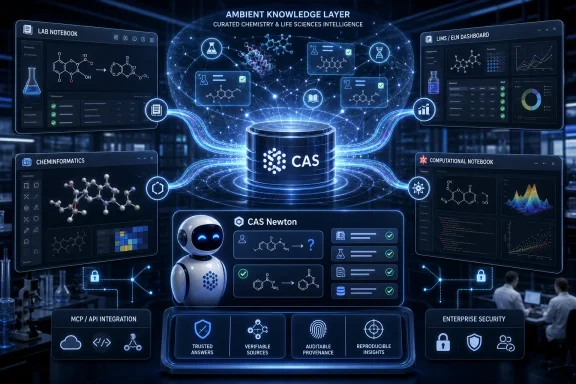 CAS Is Moving From Search Box to Substrate
For decades, CAS has occupied a privileged place in scientific information work: authoritative, structured, and indispensable, but often experienced as a separate stop in the research process. A chemist leaves an electronic lab notebook, an informatics system, or a modeling workflow, searches SciFinder or another CAS environment, collects the evidence, and brings it back into the task at hand. That pattern made sense when databases were the center of gravity.CAS Connections signals that the center of gravity is shifting. The company is not merely adding AI features to its own applications; it is pushing CAS-curated data and CAS Newton into the platforms where experiments are planned, compounds are designed, assays are interpreted, and decisions are documented. The integration partners named in the first wave are not incidental. Albert Invent, Sapio Sciences, Inductive Bio, Scilligence, and Wolfram Research represent different parts of the modern R&D stack, from lab operations and scientific data management to computational chemistry and technical computing.
That is why the phrase “where discovery happens” matters, even if it arrives dressed in press-release clothing. Scientific software is becoming less like a shelf of discrete tools and more like a connected operating environment. The winning layer is the one that can follow the researcher across systems without breaking security, provenance, or intellectual property controls.
CAS is betting that its historical advantage — a deeply curated scientific corpus built over more than 150 years — becomes more valuable, not less, in the age of generative AI. General-purpose models can summarize and speculate, but R&D teams do not merely need fluent answers. They need answers that can survive peer review, regulatory scrutiny, patent analysis, safety review, and the cold reality of a failed synthesis.
Agentic AI Makes the Data Layer More Important, Not Less
The term agentic AI has already been inflated by vendors into something close to vapor. In its useful sense, it describes systems that can break a task into steps, call tools, preserve context, refine a query, and return a synthesized answer rather than a static search result. CAS Newton is presented in that mold: conversational, multi-step, grounded in the CAS Content Collection, and designed to cite verifiable scientific literature.The obvious temptation is to treat Newton as the headline. It is the shiny part of the story, and it fits the current market script: every incumbent database vendor needs an AI assistant, every workflow company needs a copilot, and every user interface is being rewritten around chat. But the more consequential move is the plumbing around Newton. CAS Connections is the mechanism that lets the agent reach into the systems researchers already inhabit.
That distinction matters because scientific AI is only as useful as its grounding. A language model that can talk about synthesis routes, adverse properties, structure-activity relationships, or freedom-to-operate concerns is impressive only until someone asks where the answer came from. In chemistry and drug discovery, hallucination is not a cute demo failure. It can mean wasted lab time, flawed patent assumptions, safety risk, or a false sense of novelty.
CAS is therefore trying to sell not just intelligence but defensibility. The company’s pitch is that Newton can combine conversational interaction with curated source material, returning answers that are not simply plausible but traceable. For enterprise R&D, that is the difference between a productivity toy and a system that might be allowed near consequential decisions.
The Integration Partners Reveal the Real Strategy
The first CAS Connections partners sketch a map of the research software ecosystem CAS wants to inhabit. Albert Invent’s Albert OS targets chemistry and materials R&D workflows, where scientists are increasingly expected to move between experiment design, data capture, inventory, and AI-assisted interpretation. Sapio Sciences sits in the laboratory informatics world, where LIMS, ELN, and scientific data management systems form the operational backbone of modern labs.Inductive Bio brings the story closer to drug discovery, where AI chemistry assistants are used to guide compound design, assess synthetic precedent, and incorporate structure-activity relationship knowledge. Scilligence has long played in cheminformatics, ELN, and collaboration tools. Wolfram Research adds a different flavor: symbolic computation, notebooks, technical computing, and structured knowledge work.
Together, these partners suggest that CAS does not want Connections to be a niche plug-in. It wants to be a trusted scientific layer across multiple work surfaces. That is a more ambitious posture than simply exposing an API for customers who already know they need CAS data. It is an attempt to make CAS knowledge appear at the moment of decision.
The user experience being promised is straightforward. A researcher evaluating a compound should be able to ask for prior art, safety data, synthesis routes, known transformations, novelty signals, or related literature without leaving the platform in which the compound is already being considered. The business implication is equally straightforward: if CAS becomes embedded in the daily workflow, it becomes harder to displace.
The Old Pain Point Was Never Just Search
The problem CAS Connections tries to solve is often described as context-switching, and that is true as far as it goes. Scientists lose time when they jump among databases, lab notebooks, modeling tools, internal document stores, patent systems, and messaging platforms. But the deeper problem is fragmentation of trust.A modern R&D decision often depends on multiple kinds of evidence. There is public literature, proprietary experimental data, vendor data, patent data, assay history, chemical inventory, internal project context, and accumulated tribal knowledge. Each lives in a different system, with different permissions and different degrees of reliability. AI can make that fragmentation worse if it collapses all sources into one smooth answer without preserving their boundaries.
CAS is leaning into the opposite thesis. The company is arguing that AI should not erase provenance; it should make provenance easier to use. A Newton answer that cites its scientific basis and operates inside a secure enterprise environment is intended to give scientists and compliance teams something they can inspect, not just something they can admire.
That point will resonate with IT pros who have watched the same movie in other domains. In enterprise software, the value of an AI assistant is rarely limited by the model’s ability to write a paragraph. It is limited by identity, permissions, source quality, auditability, data loss prevention, and whether the assistant can respect the difference between public knowledge and confidential work product.
Scientific R&D simply raises the stakes. A poor answer may not just embarrass a user; it may redirect a project. For organizations spending millions on discovery programs, “AI-assisted” is not enough. The better question is whether an answer can be reconstructed later when someone asks why a decision was made.
MCP Is the Quiet WindowsForum Angle
The most interesting technical phrase in the announcement is not “agentic AI.” It is Model Context Protocol. CAS says Connections supports deployment through API, MCP, and AI platform integrations, including tools such as Anthropic’s Claude and Microsoft Copilot. That detail places the announcement inside a larger industry shift: AI assistants are becoming clients of enterprise systems, not merely front ends to web search.For WindowsForum readers, Microsoft Copilot is the obvious reference point. Microsoft has been pushing Copilot across Windows, Microsoft 365, developer tooling, security operations, and enterprise workflows. But Copilot’s usefulness in specialized environments depends on whether it can safely reach the right domain knowledge. A generic assistant can draft emails and summarize meetings; it cannot responsibly answer chemistry-specific questions unless the relevant scientific context is made available with controls intact.
MCP has become one of the ways vendors talk about that bridge. In principle, it allows AI systems to connect to tools and data sources through a more standardized context layer. In practice, the value depends on implementation, authentication, authorization, logging, and the discipline of the data provider. CAS invoking MCP is therefore a signal to enterprise architects: this is not only a product integration story, but a platform interoperability story.
That does not mean every lab will suddenly expose CAS content through Copilot. Highly regulated or IP-sensitive environments will move cautiously, and many will prefer private deployments, tightly scoped connectors, or isolated application boundaries. But the direction is clear. Scientific intelligence is being packaged so that AI agents can call it as part of a workflow, rather than forcing a human to manually paste information between tools.
Trust Becomes a Product Feature Because AI Made It Scarce
Before generative AI, trust in scientific search was often implicit. A trained researcher knew which databases mattered, which journals were credible, how to read a record, and when to be skeptical. AI changes that social contract. It produces a polished synthesis that can look more certain than the underlying evidence deserves.CAS has recognized that the cure for AI overconfidence is not simply a better model. It is curated content, domain-specific constraints, citation back to underlying records, and governance that lets organizations audit what happened. The company’s marketing language around Newton emphasizes verifiable answers, privacy boundaries, and the claim that user inputs are not used for cross-user model training. Those are not decorative assurances; they are buying criteria.
For CIOs, CISOs, and research informatics leaders, this is where AI procurement gets serious. A system that touches unpublished hypotheses, compound designs, assay results, or patent strategy is not comparable to a public chatbot. It becomes part of the organization’s knowledge infrastructure. That means vendor assurances must eventually turn into contractual obligations, technical controls, and evidence that can satisfy legal and compliance teams.
CAS has an advantage here because its brand is already associated with scientific curation rather than consumer AI experimentation. But that advantage can also become a burden. Customers will expect a higher standard. If Newton produces an answer grounded in CAS content, users will assume the chain of evidence is reliable, current, and properly scoped to the query.
That is the risk of becoming the trusted layer: mistakes carry more weight. A hallucination from a general chatbot may be dismissed as expected noise. A flawed answer from a curated scientific intelligence platform will be judged against the authority it claims.
The Workflow Battle Is Also a Business Model Battle
There is a commercial strategy hiding beneath the productivity language. If CAS content lives only inside CAS applications, then the user must come to CAS. If CAS content becomes available inside partner platforms, then CAS can follow the user — but it also has to negotiate its role inside someone else’s interface, pricing model, and customer relationship.That is the central tension of embedded intelligence. Integration increases reach, but it can blur ownership. When a scientist receives a CAS-grounded answer inside Albert OS or another platform, who gets credit for the experience? The workflow vendor that owns the screen, the AI layer that interprets the question, or the data provider that makes the answer defensible?
The likely answer is that all three will claim value, and customers will care less about attribution than friction. If embedded CAS data saves a researcher from breaking flow, that matters. If it creates licensing complexity, duplicated entitlements, or inconsistent access across platforms, enthusiasm will cool quickly.
This is where enterprise deployment details will matter more than announcement-day partner lists. R&D organizations do not standardize on a single tool. They inherit platforms through mergers, project needs, regulatory requirements, and local lab preferences. CAS Connections will have to work in messy environments, not just polished demos.
The best version of this framework would let organizations bring CAS knowledge into their preferred R&D systems while combining it with internal data under clear governance. The weaker version would become yet another integration layer that looks compelling in a press release but requires enough custom work that only the largest customers can benefit.
Scientists Want Fewer Portals, Not Another AI Persona
The history of enterprise software is littered with portals that promised to unify work and instead became one more tab. Scientists are especially resistant to tools that interrupt the logic of their work. The lab is already fragmented by instruments, notebooks, analysis packages, inventory systems, compliance forms, and collaboration channels. Adding an AI persona on top of that mess does not automatically simplify anything.CAS Connections is notable because it frames the problem correctly. It does not ask scientists to adopt a new destination as the primary interface. It suggests CAS content and Newton’s capabilities can show up inside the systems researchers already trust. That is closer to how AI is likely to be adopted in serious work: not as a novelty window, but as a capability embedded in existing processes.
Still, integration is not the same as adoption. Scientists will judge the system by whether it helps at specific moments. Can it surface a plausible synthetic route with precedent? Can it flag prior art before a team falls in love with a compound series? Can it summarize a dense literature field without burying caveats? Can it distinguish between a weak analogy and a meaningful structure-activity relationship?
The announcement gives examples around prior art, safety data, synthesis routes, known transformations, SAR knowledge, novelty, and freedom-to-operate analysis. Those are high-value use cases because they sit near expensive decisions. They are also unforgiving use cases because partial answers can be dangerous if users mistake them for complete answers.
That means user interface design becomes a scientific control. A good integration should show confidence, provenance, and limits without overwhelming the researcher. A bad integration will turn CAS knowledge into another black-box answer engine, which would undermine the very trust CAS is trying to sell.
The AI Assistant Is Becoming Part of the Audit Trail
One underappreciated consequence of agentic AI in R&D is that the assistant’s reasoning path may become part of the record. In regulated or IP-sensitive environments, organizations will not only ask what answer an AI produced. They will ask what sources it used, what internal data it accessed, who initiated the query, what version of the data was available, and whether the output influenced a decision.CAS’s emphasis on cited and verifiable answers fits that future. The old database interaction was relatively easy to understand: a user searched, reviewed records, and made notes. Agentic workflows are more complex. The system may expand a query, filter evidence, compare alternatives, and synthesize a conclusion. Each step creates potential value and potential ambiguity.
For IT departments, the key question is whether these systems can be governed like other enterprise tools. Identity integration, role-based access, retention policies, audit logs, export controls, and data residency may sound mundane compared with “AI for discovery,” but they will determine whether the technology leaves pilot mode. Labs do not operate outside enterprise risk management, even if researchers sometimes wish they did.
The security claims around private environments and no cross-user training are therefore table stakes. They address one of the first objections enterprises raise about AI: whether confidential prompts and outputs might become training material or leak across customers. But the next layer is harder. Organizations will want assurance that internal proprietary data can be combined with CAS content without contaminating access boundaries or creating discovery nightmares later.
That is why CAS Connections’ support for secure deployment is strategically important. It positions CAS not just as an information provider, but as a participant in enterprise AI architecture.
The Competitive Field Will Not Wait
CAS is not moving in a vacuum. Scientific publishers, database companies, cloud providers, ELN vendors, LIMS vendors, cheminformatics specialists, and AI-native drug discovery startups are all racing to become the trusted assistant inside R&D workflows. Each brings a different claim: proprietary models, specialized datasets, workflow ownership, compute scale, or deep domain interfaces.CAS’s differentiator is curation. The CAS Content Collection is not merely a pile of documents; it is structured scientific knowledge assembled over generations. That matters in chemistry, where names, structures, reactions, substances, patents, and biological context must be connected precisely. The more AI systems need reliable grounding, the more valuable that structure becomes.
But curation alone will not guarantee victory. Users increasingly expect fast, conversational, embedded, and interoperable experiences. If CAS remains authoritative but inconvenient, newer systems will nibble around the edges. If CAS becomes both authoritative and available inside daily tools, it strengthens its role in the R&D stack.
The integration strategy also creates defensive value. Workflow vendors want trusted scientific data because their own AI features become more credible when grounded in it. CAS wants distribution because researchers increasingly live inside specialized platforms rather than monolithic search tools. The partnership logic is sound because each side supplies what the other lacks.
The unresolved question is how open the ecosystem becomes. If every vendor builds a separate AI integration with separate entitlements, customers will face another round of fragmentation. If frameworks like MCP mature into reliable enterprise connectors, scientific AI could become more composable. CAS Connections is an early signal that the market is moving toward the latter, but the hard work will be in the deployment details.
The Lab’s Next Platform Shift Is Hiding in Plain Sight
The concrete implications of CAS Connections are easy to miss because the announcement is packaged as a partner integration story. The larger shift is that trusted knowledge bases are being turned into callable infrastructure for AI-mediated work. That changes how researchers search, how software vendors differentiate, and how IT teams govern scientific data flows.The immediate result will not be a fully autonomous scientist. It will be a gradual reduction in the number of times human experts have to leave their workflow to validate basic scientific context. That is still meaningful. In discovery work, small reductions in friction can compound, especially when they occur at decision points repeated across thousands of compounds, experiments, and literature checks.
For Windows and enterprise technology readers, the parallels to broader Copilot-style computing are obvious. The user interface is becoming less important than the context graph behind it. Whether the front end is a lab notebook, a chemistry assistant, a computational notebook, or Microsoft Copilot, the decisive question is what the assistant is allowed to know and how reliably it can prove what it says.
This is the point at which AI stops being a feature and starts becoming infrastructure. CAS Connections is not merely a way to ask CAS Newton questions in more places. It is a bid to make CAS-curated science part of the connective tissue of digital R&D.
The CAS Connections Bet Comes Down to Proof, Permissions, and Patience
The most grounded way to read the announcement is neither as hype nor as inevitability. CAS has a credible asset, a timely AI product, and a partner strategy that maps well to how R&D software is actually used. But the value will be proven in production, not in the elegance of the integration framework.- CAS Connections moves CAS-curated scientific knowledge and CAS Newton from standalone research destinations into third-party R&D platforms.
- The first wave of partners spans laboratory informatics, chemistry workflows, AI-assisted compound design, cheminformatics, and technical computing.
- The framework’s support for APIs, MCP, and AI platform integrations points toward a future where scientific databases become callable enterprise AI infrastructure.
- The practical value will depend on whether answers remain cited, auditable, permission-aware, and useful inside the researcher’s actual workflow.
- The biggest risk is not that scientists reject AI outright, but that poorly governed integrations turn trusted content into another opaque answer stream.
References
- Primary source: BioPharma APAC
Published: 2026-06-07T00:50:14.682601
CAS Brings Trusted Scientific Intelligence Directly Into R&D Workflows Through New Connections Framework
CAS Brings Trusted Scientific Intelligence Directly Into R&D Workflows Through New Connections Frameworkbiopharmaapac.com - Related coverage: knowledgespeak.com
CAS launches CAS Newton<sup>℠</sup>, agentic AI tool for scientific discovery
CAS, a division of the American Chemical Society (ACS), has announced the launch of CAS Newton<sup>℠</sup>, an agentic AI system developed for scientific discovery. www.knowledgespeak.com
- Related coverage: hpcwire.com
BigDATAwire - Data Science • AI • Advanced Analytics
COLUMBUS, Ohio, June 3, 2026 — CAS, a division of the American Chemical Society specializing in scientific knowledge management, today announced CAS Connections, a new integration framework that embeds the […]www.hpcwire.com - Related coverage: technologynetworks.com

CAS Launches Agentic AI in BioFinder and SciFinder | Technology Networks
CAS is introducing agentic AI in BioFinder and SciFinder, offering scientists evidence-based answers and faster insights from curated data.
www.technologynetworks.com
- Related coverage: prnewswire.com
CAS Connections fournit des données scientifiques et des capacités d'IA fiables aux principales plateformes de R&D.
/PRNewswire/ -- CAS, une division de l'American Chemical Society spécialisée dans la gestion des connaissances scientifiques, a présenté aujourd'hui CAS... www.prnewswire.com
- Related coverage: prnewswire.co.uk
CAS Connections brings trusted scientific data and AI to leading R&D platforms
/PRNewswire/ -- CAS, a division of the American Chemical Society specializing in scientific knowledge management, today announced CAS Connections, a new... www.prnewswire.co.uk
