

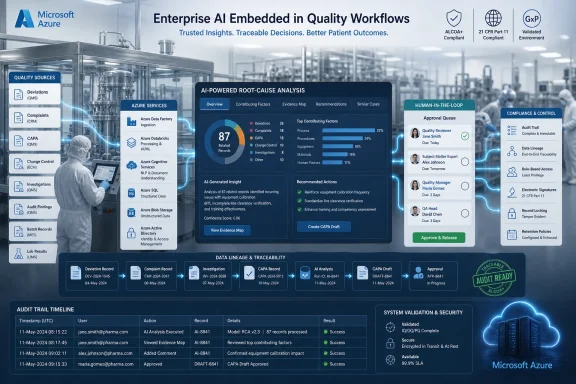
Catalent has launched Qai, its first enterprise AI quality-management tool, across its CDMO network in June 2026, using Microsoft AI technologies powered by Azure, including Microsoft Foundry and Fabric, to support deviations, complaints, root-cause analysis, and corrective-action workflows. The announcement is not just another vendor-friendly AI rollout. It is a useful signal of where enterprise AI is actually finding traction: not in replacing experts, but in compressing the time between evidence, judgment, documentation, and compliance. For Microsoft watchers, it is also a reminder that Azure’s most important AI wins may happen far from chatbots, inside regulated workflows where every decision has to survive an audit.
The first wave of enterprise generative AI was sold through demos: ask a question, get an answer, watch the room applaud. Catalent’s Qai belongs to a more consequential second wave, where the product is not the answer box but the workflow around it. In pharmaceutical manufacturing, the expensive problem is rarely that a qualified person cannot write a paragraph. It is that deviations, complaints, investigations, and corrective actions must move through a system that is slow, evidence-heavy, and unforgiving.
That is why the language in Catalent’s announcement matters. Qai is described as strengthening quality management system processes, accelerating analysis, improving root-cause identification, and helping develop corrective and preventive actions. Those are not office-productivity claims. They are claims about the machinery of compliance.
For WindowsForum readers, the Microsoft angle should feel familiar. Microsoft’s enterprise AI strategy has gradually shifted from “put Copilot everywhere” toward a deeper platform argument: business data lives in Microsoft-controlled identity, security, analytics, developer, and collaboration layers, and AI becomes useful when it can reason across those layers without blowing up governance. Qai is a tidy example of that pitch landing in the real world.
This is also why the announcement feels more substantial than a generic “AI in pharma” headline. Catalent is not presenting Qai as a magic molecule-discovery engine or an autonomous plant manager. It is positioning the tool as an assistant embedded inside existing quality workflows, where humans still own the decision but AI shortens the investigative path.
That makes this a demanding use case for AI. A model that produces fluent speculation is worse than useless if it cannot be grounded in the right evidence, constrained by the right permissions, and reviewed by the right people. Pharmaceutical quality teams do not need AI that sounds confident. They need AI that helps them find patterns, assemble context, draft consistent records, and avoid repeating preventable failures.
Catalent’s framing suggests that Qai is aimed precisely at that middle layer. The tool is meant to harness enterprise data, integrate into quality workflows, and improve consistency and speed. That is less glamorous than a lab breakthrough, but it is arguably more deployable.
The value proposition is not that Qai knows more than a quality expert. It is that a quality expert should not have to manually reassemble the same fragments of operational history every time a deviation appears. AI’s job here is to reduce the search cost of institutional memory.
Foundry is the piece Microsoft wants developers and enterprises to see as the place where AI applications and agents move from experiments into managed production. Fabric is the data and analytics layer Microsoft wants to make unavoidable for companies trying to unify operational, business, and analytical data. Together, they form the enterprise AI architecture Microsoft has been advertising: models on top, governed data underneath, controls around the edges.
In consumer AI, success is measured by delight. In life sciences manufacturing, success is measured by whether the system can help produce repeatable, documented, reviewable work. That plays to Microsoft’s strengths more than a raw model benchmark ever could.
The more interesting point is that Catalent’s first enterprise AI solution is not described as a standalone chatbot. It is described as a workflow-integrated quality tool. That is exactly where Microsoft wants Azure AI to live: inside line-of-business processes, connected to enterprise data, governed by enterprise controls, and sold as operational infrastructure rather than novelty software.
Catalent’s own editor’s framing gets this right: AI’s value is less about replacing human expertise and more about supporting decision-making, reducing delays, and strengthening compliance. In quality management, the person signing off still matters. The investigation still has to make sense. The corrective action still has to be appropriate to the risk.
What AI can change is the amount of friction between the event and the decision. If a deviation resembles earlier cases, the system can help surface that history. If documentation tends to vary across sites, AI can help normalize the structure and completeness of reports. If corrective actions are repeatedly weak or late, analytics can help expose the pattern earlier.
That is not automation in the science-fiction sense. It is automation in the sysadmin sense: reduce repetitive work, enforce consistency, surface anomalies, and leave accountable humans with a clearer queue. The result is not a factory without experts. It is a factory where experts spend less time digging through records and more time judging what the records mean.
This is why Microsoft Fabric matters in the announcement. Fabric’s role is not to make the story sound more modern. It is the plumbing that can help organize and analyze the data that an AI tool needs to be useful. In manufacturing quality, that might include deviation histories, complaint records, batch information, site-level patterns, process parameters, training documentation, and corrective-action outcomes.
The hard part is not connecting an AI model to a database. The hard part is making sure the model is allowed to see the right information, understands the relevant context, and produces output that can be reviewed and defended. In a regulated setting, an answer without provenance is a liability.
That is where enterprise AI begins to resemble enterprise search, business intelligence, records management, and workflow automation more than it resembles consumer chat. The model is one component. The governance architecture is the product.
The company’s recent corporate backdrop adds weight to the move. Catalent was acquired by Novo Holdings in a $16.5 billion transaction completed in December 2024, while Novo Nordisk acquired three Catalent fill-finish sites in a related deal. That transaction was widely understood in the context of demand for GLP-1 drugs such as Wegovy and Ozempic, though Catalent’s broader network supports far more than one therapeutic category.
Against that backdrop, a network-wide quality AI tool is not just an IT project. It is a scaling project. If a CDMO wants to improve consistency across sites, customers, modalities, and geographies, quality workflows become a natural target for enterprise AI.
The obvious caveat is that announcements do not prove operational impact. Catalent says Qai will accelerate analysis, improve root-cause work, reduce repeat deviations, and minimize documentation delays. Those are measurable claims, and the real test will be whether customers and auditors see fewer cycles of rework, clearer investigations, and more durable corrective actions.
That matters in life sciences. A quality system that touches deviations and complaints must be governed with care. It needs role-based access, auditability, retention policies, security monitoring, and integration with existing systems. The more AI moves into regulated workflows, the more buyers will care about boring words like lineage, permissions, traceability, and validation.
Microsoft Foundry’s sales pitch is built for that environment. It gives Microsoft a way to say that enterprises can build AI applications and agents with model flexibility while still maintaining governance. Fabric adds the data foundation that lets those systems reason over business context rather than isolated files.
This does not mean Azure wins every regulated AI workload by default. AWS, Google Cloud, specialist vendors, and existing life-sciences software providers all have credible pieces of the stack. But Catalent’s Qai announcement shows why Microsoft’s platform bundling is strategically powerful: when a company wants to operationalize AI inside a regulated process, Microsoft can sell not just the model, but the surrounding control system.
Anyone who has worked around enterprise compliance systems knows the pattern. The work happens, the facts live in several systems, the responsible employees know the context, and the final written record becomes the bottleneck. The organization is not waiting for intelligence. It is waiting for the intelligence to be assembled in an acceptable form.
AI is well suited to parts of that problem. It can summarize related records, compare current events with prior deviations, suggest structure for reports, and identify missing information. It can help make the first draft less painful and the review process more consistent.
But the risk is equally obvious. If AI-generated documentation becomes boilerplate, it can obscure rather than clarify. If teams trust the draft too much, weak reasoning may slip into official records. If the tool is not validated and monitored properly, consistency can become a veneer over systemic error.
That is why Qai’s usefulness will depend on how Catalent implements review, escalation, and accountability. The best version of this tool gives quality teams a stronger starting point. The worst version gives them a faster way to produce documents that look complete before they are truly understood.
An AI-assisted tool can help widen the field of view. It can surface similar historical events, compare corrective actions, and highlight recurring language or failure modes across sites. In a distributed CDMO network, that can be especially useful because lessons learned in one facility may not naturally travel to another.
The danger is premature closure. Root cause analysis already suffers when teams settle too quickly on a convenient explanation. AI can make that failure mode faster if it presents plausible patterns without sufficient evidence. A system that suggests root causes must be designed to invite verification, not replace it.
This is where the “AI supports experts” formulation is more than public-relations language. The expert’s role is to challenge the machine’s pattern, not merely accept it. In high-consequence workflows, the most useful AI may be the one that asks, in effect, “Have you considered these prior cases?” rather than the one that declares, “This is the answer.”
Manufacturing quality has its own version of that problem. Deviations and complaints are incident reports. Corrective actions are remediation plans. Repeat deviations are recurring incidents. Documentation delays are process latency.
Seen that way, Qai is part of a broader enterprise trend: applying AI to the operational exhaust of the business. The model reads across records, finds similarity, proposes structure, and helps humans move from incident to explanation. That does not make quality management identical to DevOps, but it does make the analogy useful.
The lesson from IT operations is that tooling only works when culture and process change with it. Dashboards did not eliminate outages. Ticketing systems did not eliminate bad escalation paths. AI will not eliminate poor quality discipline. It can, however, make poor discipline harder to hide and good discipline easier to scale.
In regulated industries, that governance is the product. If Microsoft can convince life-sciences companies that Azure is the safest place to build AI-enabled workflows, it wins workloads that are sticky, expensive, and deeply integrated. A quality-management AI tool is not something a company swaps out casually after a better demo appears.
This is why Microsoft’s AI strategy should not be judged only by consumer sentiment around Copilot. The more durable business may be in internal tools that never go viral: claims processing, clinical documentation support, manufacturing quality, legal review, cybersecurity triage, procurement analysis, and field-service troubleshooting.
For IT administrators, that means the AI wave will arrive less as a single app and more as a series of embedded capabilities inside systems they already have to secure. The question will not be “Do users have access to AI?” The question will be “Which business processes now depend on AI, what data do they touch, and how are they governed?”
The practical questions are the same ones any enterprise AI buyer should ask. How is the model grounded? Which systems of record does it access? How are permissions enforced? What is logged? How are outputs reviewed? How does the organization detect hallucinated reasoning, stale context, or biased pattern-matching?
In life sciences, validation adds another layer. If an AI tool materially affects quality-system processes, companies need to understand how it fits into computer system validation, change control, audit trails, and regulatory expectations. Even when AI does not make final decisions, it can influence the humans who do.
That influence is the real governance challenge. A suggested root cause can shape an investigation. A draft corrective action can anchor a review. A summary can omit nuance. The tool does not need formal authority to affect outcomes.
That does not make them small. A system that reduces repeat deviations across a manufacturing network can have enormous operational value. A system that shortens documentation lag can improve customer responsiveness. A system that makes quality investigations more consistent can reduce friction with auditors and sponsors.
But the value comes from disciplined integration rather than theatrical capability. AI has to meet the workflow where it is, not demand that the workflow reorganize itself around a chat window. Catalent’s announcement is notable because Qai is framed as embedded in existing quality workflows, not as a separate intelligence layer floating above the business.
That is the direction enterprise AI has to go. The prompt box was a useful introduction. The process-aware system is the product.
If Qai can help Catalent identify patterns across sites and investigations, it may turn local incidents into network-wide learning. That is a powerful idea for a CDMO. A lesson learned in one facility could inform another before the same issue appears again.
This is where AI’s pattern-recognition strengths align with a real business need. Human experts are good at deep contextual judgment. AI systems are good at scanning large amounts of structured and unstructured information for similarity and recurrence. The combination can be useful if the organization resists the urge to treat machine suggestions as conclusions.
The outcome to watch is not whether employees like the interface. It is whether quality events close faster without becoming shallower, whether CAPAs become more durable, and whether investigations become more consistent without becoming generic. Those are the metrics that would separate an enterprise AI milestone from an enterprise AI press release.
The announcement’s most concrete implications are easy to miss because they are not flashy. They sit in the operational middle of the business, where quality, data, compliance, and cloud architecture meet.
 The Real AI Story Is Moving From Prompts to Process
The first wave of enterprise generative AI was sold through demos: ask a question, get an answer, watch the room applaud. Catalent’s Qai belongs to a more consequential second wave, where the product is not the answer box but the workflow around it. In pharmaceutical manufacturing, the expensive problem is rarely that a qualified person cannot write a paragraph. It is that deviations, complaints, investigations, and corrective actions must move through a system that is slow, evidence-heavy, and unforgiving.That is why the language in Catalent’s announcement matters. Qai is described as strengthening quality management system processes, accelerating analysis, improving root-cause identification, and helping develop corrective and preventive actions. Those are not office-productivity claims. They are claims about the machinery of compliance.
For WindowsForum readers, the Microsoft angle should feel familiar. Microsoft’s enterprise AI strategy has gradually shifted from “put Copilot everywhere” toward a deeper platform argument: business data lives in Microsoft-controlled identity, security, analytics, developer, and collaboration layers, and AI becomes useful when it can reason across those layers without blowing up governance. Qai is a tidy example of that pitch landing in the real world.
This is also why the announcement feels more substantial than a generic “AI in pharma” headline. Catalent is not presenting Qai as a magic molecule-discovery engine or an autonomous plant manager. It is positioning the tool as an assistant embedded inside existing quality workflows, where humans still own the decision but AI shortens the investigative path.
Quality Management Is Where AI Has to Behave Like Software, Not Theater
In a regulated manufacturing environment, quality management is a system of record as much as it is a management discipline. A deviation is not merely an inconvenience on a production line; it is a documented event that can affect batch release, customer confidence, regulatory posture, and ultimately patient access. A complaint is not just customer service; it may become a signal in a broader quality trend.That makes this a demanding use case for AI. A model that produces fluent speculation is worse than useless if it cannot be grounded in the right evidence, constrained by the right permissions, and reviewed by the right people. Pharmaceutical quality teams do not need AI that sounds confident. They need AI that helps them find patterns, assemble context, draft consistent records, and avoid repeating preventable failures.
Catalent’s framing suggests that Qai is aimed precisely at that middle layer. The tool is meant to harness enterprise data, integrate into quality workflows, and improve consistency and speed. That is less glamorous than a lab breakthrough, but it is arguably more deployable.
The value proposition is not that Qai knows more than a quality expert. It is that a quality expert should not have to manually reassemble the same fragments of operational history every time a deviation appears. AI’s job here is to reduce the search cost of institutional memory.
Microsoft’s Role Is the Platform, Not the Headline
Catalent says Qai was built with Microsoft support using Microsoft AI technologies powered by Azure, including Foundry, with data and analytics capabilities from Fabric. That stack choice is not incidental. Microsoft has spent the past two years turning Azure AI from a model-access story into an enterprise-control story, emphasizing model choice, grounding, observability, governance, and integration with business data.Foundry is the piece Microsoft wants developers and enterprises to see as the place where AI applications and agents move from experiments into managed production. Fabric is the data and analytics layer Microsoft wants to make unavoidable for companies trying to unify operational, business, and analytical data. Together, they form the enterprise AI architecture Microsoft has been advertising: models on top, governed data underneath, controls around the edges.
In consumer AI, success is measured by delight. In life sciences manufacturing, success is measured by whether the system can help produce repeatable, documented, reviewable work. That plays to Microsoft’s strengths more than a raw model benchmark ever could.
The more interesting point is that Catalent’s first enterprise AI solution is not described as a standalone chatbot. It is described as a workflow-integrated quality tool. That is exactly where Microsoft wants Azure AI to live: inside line-of-business processes, connected to enterprise data, governed by enterprise controls, and sold as operational infrastructure rather than novelty software.
The Human-in-the-Loop Era Is Not a Compromise
The lazy argument about AI in regulated industries is that adoption will be slow because humans have to remain involved. That misunderstands the market. Human oversight is not a drag on these systems; it is the condition that makes them deployable.Catalent’s own editor’s framing gets this right: AI’s value is less about replacing human expertise and more about supporting decision-making, reducing delays, and strengthening compliance. In quality management, the person signing off still matters. The investigation still has to make sense. The corrective action still has to be appropriate to the risk.
What AI can change is the amount of friction between the event and the decision. If a deviation resembles earlier cases, the system can help surface that history. If documentation tends to vary across sites, AI can help normalize the structure and completeness of reports. If corrective actions are repeatedly weak or late, analytics can help expose the pattern earlier.
That is not automation in the science-fiction sense. It is automation in the sysadmin sense: reduce repetitive work, enforce consistency, surface anomalies, and leave accountable humans with a clearer queue. The result is not a factory without experts. It is a factory where experts spend less time digging through records and more time judging what the records mean.
The Compliance Bet Is Really a Data Bet
Qai’s promise depends on the quality of Catalent’s underlying data. That is both the opportunity and the trap. Enterprise AI systems do not become reliable simply because a large model is placed on top of them. They become reliable when the data they use is complete, permissioned, contextualized, and maintained.This is why Microsoft Fabric matters in the announcement. Fabric’s role is not to make the story sound more modern. It is the plumbing that can help organize and analyze the data that an AI tool needs to be useful. In manufacturing quality, that might include deviation histories, complaint records, batch information, site-level patterns, process parameters, training documentation, and corrective-action outcomes.
The hard part is not connecting an AI model to a database. The hard part is making sure the model is allowed to see the right information, understands the relevant context, and produces output that can be reviewed and defended. In a regulated setting, an answer without provenance is a liability.
That is where enterprise AI begins to resemble enterprise search, business intelligence, records management, and workflow automation more than it resembles consumer chat. The model is one component. The governance architecture is the product.
Catalent’s Timing Reflects a Bigger CDMO Pressure Cooker
Catalent is not operating in a quiet corner of the pharmaceutical supply chain. Contract development and manufacturing organizations sit at the intersection of drug sponsors, regulators, capacity constraints, technology transfer, quality systems, and patient demand. When a CDMO becomes more efficient, the benefit may show up as fewer delays, smoother audits, faster investigations, or more reliable supply.The company’s recent corporate backdrop adds weight to the move. Catalent was acquired by Novo Holdings in a $16.5 billion transaction completed in December 2024, while Novo Nordisk acquired three Catalent fill-finish sites in a related deal. That transaction was widely understood in the context of demand for GLP-1 drugs such as Wegovy and Ozempic, though Catalent’s broader network supports far more than one therapeutic category.
Against that backdrop, a network-wide quality AI tool is not just an IT project. It is a scaling project. If a CDMO wants to improve consistency across sites, customers, modalities, and geographies, quality workflows become a natural target for enterprise AI.
The obvious caveat is that announcements do not prove operational impact. Catalent says Qai will accelerate analysis, improve root-cause work, reduce repeat deviations, and minimize documentation delays. Those are measurable claims, and the real test will be whether customers and auditors see fewer cycles of rework, clearer investigations, and more durable corrective actions.
The Microsoft Stack Wants to Be the Audit-Friendly AI Stack
Microsoft’s enterprise advantage has never been that it owns the most dazzling AI demo. Its advantage is that it already sits inside the messy administrative reality of large organizations. Identity, access control, compliance tooling, data platforms, productivity software, developer tools, endpoint management, and cloud infrastructure are all places where Microsoft can make AI feel less like an outside system.That matters in life sciences. A quality system that touches deviations and complaints must be governed with care. It needs role-based access, auditability, retention policies, security monitoring, and integration with existing systems. The more AI moves into regulated workflows, the more buyers will care about boring words like lineage, permissions, traceability, and validation.
Microsoft Foundry’s sales pitch is built for that environment. It gives Microsoft a way to say that enterprises can build AI applications and agents with model flexibility while still maintaining governance. Fabric adds the data foundation that lets those systems reason over business context rather than isolated files.
This does not mean Azure wins every regulated AI workload by default. AWS, Google Cloud, specialist vendors, and existing life-sciences software providers all have credible pieces of the stack. But Catalent’s Qai announcement shows why Microsoft’s platform bundling is strategically powerful: when a company wants to operationalize AI inside a regulated process, Microsoft can sell not just the model, but the surrounding control system.
Documentation Delay Is a Business Problem Masquerading as Paperwork
One of the most revealing claims in Catalent’s announcement is that Qai can minimize documentation delays. That may sound like the least exciting feature, but in regulated manufacturing it may be one of the most important. Documentation delays are not merely administrative inconvenience; they can hold up investigations, batch disposition, customer communication, and regulatory readiness.Anyone who has worked around enterprise compliance systems knows the pattern. The work happens, the facts live in several systems, the responsible employees know the context, and the final written record becomes the bottleneck. The organization is not waiting for intelligence. It is waiting for the intelligence to be assembled in an acceptable form.
AI is well suited to parts of that problem. It can summarize related records, compare current events with prior deviations, suggest structure for reports, and identify missing information. It can help make the first draft less painful and the review process more consistent.
But the risk is equally obvious. If AI-generated documentation becomes boilerplate, it can obscure rather than clarify. If teams trust the draft too much, weak reasoning may slip into official records. If the tool is not validated and monitored properly, consistency can become a veneer over systemic error.
That is why Qai’s usefulness will depend on how Catalent implements review, escalation, and accountability. The best version of this tool gives quality teams a stronger starting point. The worst version gives them a faster way to produce documents that look complete before they are truly understood.
Root Cause Analysis Is Where AI Can Help and Harm
Root cause analysis is an attractive AI target because it is pattern-heavy. Repeat deviations may share equipment, materials, operators, procedures, environmental factors, supplier issues, or process steps. Humans can find those links, but only if the relevant records are accessible and the organization has time to examine them carefully.An AI-assisted tool can help widen the field of view. It can surface similar historical events, compare corrective actions, and highlight recurring language or failure modes across sites. In a distributed CDMO network, that can be especially useful because lessons learned in one facility may not naturally travel to another.
The danger is premature closure. Root cause analysis already suffers when teams settle too quickly on a convenient explanation. AI can make that failure mode faster if it presents plausible patterns without sufficient evidence. A system that suggests root causes must be designed to invite verification, not replace it.
This is where the “AI supports experts” formulation is more than public-relations language. The expert’s role is to challenge the machine’s pattern, not merely accept it. In high-consequence workflows, the most useful AI may be the one that asks, in effect, “Have you considered these prior cases?” rather than the one that declares, “This is the answer.”
Enterprise AI Is Becoming Site Reliability Engineering for Business Processes
There is a useful analogy for WindowsForum’s IT-pro audience: Qai sounds less like a chatbot and more like an observability layer for quality management. In software operations, the move from logs to monitoring to full observability changed how teams diagnosed complex systems. Instead of waiting for a failure and manually reconstructing the incident, teams built systems that made patterns visible.Manufacturing quality has its own version of that problem. Deviations and complaints are incident reports. Corrective actions are remediation plans. Repeat deviations are recurring incidents. Documentation delays are process latency.
Seen that way, Qai is part of a broader enterprise trend: applying AI to the operational exhaust of the business. The model reads across records, finds similarity, proposes structure, and helps humans move from incident to explanation. That does not make quality management identical to DevOps, but it does make the analogy useful.
The lesson from IT operations is that tooling only works when culture and process change with it. Dashboards did not eliminate outages. Ticketing systems did not eliminate bad escalation paths. AI will not eliminate poor quality discipline. It can, however, make poor discipline harder to hide and good discipline easier to scale.
The Windows Angle Is Azure’s Quiet Expansion Into Regulated Work
This story is not about Windows desktop features, but it belongs on a Windows-focused site because it shows where Microsoft’s ecosystem is heading. The company’s center of gravity is increasingly the managed enterprise substrate: Azure, Entra, Fabric, Foundry, Purview, Defender, Microsoft 365, and the developer stack around them. Windows remains important, but the strategic battle is over who governs the work.In regulated industries, that governance is the product. If Microsoft can convince life-sciences companies that Azure is the safest place to build AI-enabled workflows, it wins workloads that are sticky, expensive, and deeply integrated. A quality-management AI tool is not something a company swaps out casually after a better demo appears.
This is why Microsoft’s AI strategy should not be judged only by consumer sentiment around Copilot. The more durable business may be in internal tools that never go viral: claims processing, clinical documentation support, manufacturing quality, legal review, cybersecurity triage, procurement analysis, and field-service troubleshooting.
For IT administrators, that means the AI wave will arrive less as a single app and more as a series of embedded capabilities inside systems they already have to secure. The question will not be “Do users have access to AI?” The question will be “Which business processes now depend on AI, what data do they touch, and how are they governed?”
The Vendor Language Is Optimistic, but the Deployment Questions Are Concrete
Catalent and Microsoft describe Qai in the optimistic register common to enterprise announcements: better decision-making, greater consistency, faster insight, stronger oversight, patient impact. Those claims are plausible. They are not yet proof.The practical questions are the same ones any enterprise AI buyer should ask. How is the model grounded? Which systems of record does it access? How are permissions enforced? What is logged? How are outputs reviewed? How does the organization detect hallucinated reasoning, stale context, or biased pattern-matching?
In life sciences, validation adds another layer. If an AI tool materially affects quality-system processes, companies need to understand how it fits into computer system validation, change control, audit trails, and regulatory expectations. Even when AI does not make final decisions, it can influence the humans who do.
That influence is the real governance challenge. A suggested root cause can shape an investigation. A draft corrective action can anchor a review. A summary can omit nuance. The tool does not need formal authority to affect outcomes.
The Best AI Deployments Will Look Almost Boring
There is a temptation to view enterprise AI success as a march toward autonomy. In regulated manufacturing, the opposite may be true. The best deployments may look boring because they operate within boundaries: they retrieve, summarize, compare, draft, flag, and route.That does not make them small. A system that reduces repeat deviations across a manufacturing network can have enormous operational value. A system that shortens documentation lag can improve customer responsiveness. A system that makes quality investigations more consistent can reduce friction with auditors and sponsors.
But the value comes from disciplined integration rather than theatrical capability. AI has to meet the workflow where it is, not demand that the workflow reorganize itself around a chat window. Catalent’s announcement is notable because Qai is framed as embedded in existing quality workflows, not as a separate intelligence layer floating above the business.
That is the direction enterprise AI has to go. The prompt box was a useful introduction. The process-aware system is the product.
Qai’s Real Test Will Be Whether Fewer Deviations Come Back
The most important claim around Qai is not that it can produce reports faster. It is that improved root-cause analysis could reduce repeat deviations. In quality management, recurrence is the enemy because it suggests the organization did not fully understand or correct the original problem.If Qai can help Catalent identify patterns across sites and investigations, it may turn local incidents into network-wide learning. That is a powerful idea for a CDMO. A lesson learned in one facility could inform another before the same issue appears again.
This is where AI’s pattern-recognition strengths align with a real business need. Human experts are good at deep contextual judgment. AI systems are good at scanning large amounts of structured and unstructured information for similarity and recurrence. The combination can be useful if the organization resists the urge to treat machine suggestions as conclusions.
The outcome to watch is not whether employees like the interface. It is whether quality events close faster without becoming shallower, whether CAPAs become more durable, and whether investigations become more consistent without becoming generic. Those are the metrics that would separate an enterprise AI milestone from an enterprise AI press release.
The Pharma Floor Shows Where Enterprise AI Is Headed
Catalent’s Qai rollout gives Microsoft a useful proof point and the life-sciences sector a case study worth watching. It also gives IT leaders a preview of the next phase of AI adoption: less spectacle, more workflow; fewer general assistants, more domain-specific systems; less “ask anything,” more “help me complete this regulated process correctly.”The announcement’s most concrete implications are easy to miss because they are not flashy. They sit in the operational middle of the business, where quality, data, compliance, and cloud architecture meet.
- Catalent is using Qai as its first enterprise AI solution, aimed specifically at quality-management workflows such as deviations and complaints.
- The tool is built with Microsoft support and uses Azure-based AI technologies, including Foundry, with Fabric providing supporting data and analytics capabilities.
- The stated goal is to accelerate analysis, improve root-cause identification, support corrective and preventive action development, and reduce documentation delays.
- The most meaningful business test will be whether Qai helps reduce repeat deviations while preserving strong human review and auditability.
- For Microsoft, the deployment supports a broader strategy of making Azure the governed platform for production AI in regulated enterprise environments.
References
- Primary source: Contract Pharma
Published: Tue, 16 Jun 2026 13:34:44 GMT
Catalent Debuts AI Tool for Quality Management | Contract Pharma
Catalent Inc. has launched Qai, an enterprise AI tool designed to elevate the best quality management systems and processes across Catalent’s network.www.contractpharma.com - Related coverage: catalent.com
Novo Holdings to Acquire Catalent | Catalent Pharma Solutions
Catalent and Novo Holdings have entered into a merger agreement in an all-cash transaction that values Catalent at $16.5 billion.www.catalent.com - Related coverage: nasdaq.com
The acquisition of Catalent by Novo Holdings, and the related acquisition by Novo Nordisk of three manufacturing sites from Novo Holdings, is completed | Nasdaq
Bagsværd, Denmark, 18 December 2024— Today, Novo Nordisk completed its acquisition of three manufacturing sites from Novo Holdings A/S. The acquisition will enable us to reach significantly more people living with serious chronic diseases," said Lars Fruergaard Jørgensen, president and...www.nasdaq.com - Related coverage: globenewswire.com
The acquisition of Catalent by Novo Holdings, and the
Bagsværd, Denmark, 18 December 2024 — Today, Novo Nordisk completed its acquisition of three manufacturing sites from Novo Holdings A/S. The completion...www.globenewswire.com - Related coverage: pharmamanufacturing.com
Novo Holdings completes $16.5B acquisition of Catalent | Pharma Manufacturing
The buyout takes private one of the largest CDMOs. In a separate transaction, Novo Nordisk paid Novo Holdings $11 billion to take over three Catalent fill-finish sites.www.pharmamanufacturing.com
- Related coverage: finance.yahoo.com
Novo Holdings completes Catalent acquisition for $16.5bn
Catalent common stock holders are set to obtain $63.50 per share in cash.finance.yahoo.com
