

China’s emerging agricultural-robotics companies are arguing in June 2026 that AI-powered “agribots” could let the country leapfrog foreign farm-machinery leaders, much as electric vehicles helped Chinese automakers overtake legacy carmakers after decades of weakness in combustion engines. The comparison is seductive because it captures something real: China has unusual overlap between AI ambition, battery supply chains, electronics manufacturing, and state-backed industrial policy. But farming is not a cleaner version of the EV market. It is messier, older, poorer, more fragmented, and far less forgiving of machines that work beautifully on a demo plot and fail in mud, rain, orchards, terraces, and thin-margin fields.
The South China Morning Post’s framing rests on a familiar Chinese industrial story: miss the first technological wave, then dominate the next one. China did not beat Germany, Japan, or the United States at the internal-combustion car as traditionally understood. It did, however, become the defining force in electric vehicles once the competitive center shifted from engines and transmissions to batteries, software, power electronics, supply chains, and scale.
That history matters because agricultural machinery has a similar incumbency problem. Global farm equipment is still associated with names such as John Deere, CNH, AGCO, and Kubota, companies with decades of accumulated trust in tractors, harvesters, implements, dealer networks, parts logistics, and precision-agriculture systems. Chinese agricultural machinery exists at scale domestically, but it does not carry the same global prestige or installed-base power.
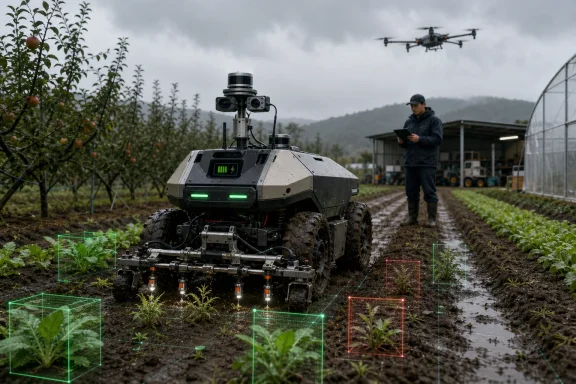
The pitch from Zhao Feng, founder of Shenzhen-based GrainCore Dynamics, is that embodied intelligence changes the basis of competition. If the farm machine of the future is less a tractor with attachments and more a mobile AI platform that can perceive, decide, and act, China’s relative weakness in old-line farm machinery may matter less. The new contest would be fought with sensors, batteries, compute modules, manufacturing scale, and model training rather than only hydraulics, diesel engines, and mechanical durability.
That is the half that rings true. China’s EV success was not magic; it was industrial redirection at the moment the technical stack changed. If agriculture now undergoes a similar stack change, Chinese companies have reason to believe they can enter through the side door.
The other half is more complicated. Cars are mass consumer products that travel on standardized infrastructure. Farms are biological systems disguised as workplaces. The machine that wins in a showroom or a subsidy program is not necessarily the machine that wins in a soybean field, a greenhouse, a rice paddy, or a hillside orchard.
This is why the agribot pitch is not merely about replacing a tractor driver. The deeper claim is that the farm becomes a data-rich, semi-autonomous operating environment. Machines do not just execute a farmer’s commands; they sense plant health, distinguish weeds from crops, choose routes, adjust chemical application, and learn seasonal patterns.
China has been preparing the industrial substrate for that kind of world. Its robotics push, EV battery capacity, low-cost electronics ecosystem, drone industry, and AI model race all feed into agricultural automation. A farm robot is not identical to an electric car, but it shares enough components — motors, batteries, cameras, lidar or radar in some cases, edge processors, wireless connectivity, ruggedized control systems — that China’s manufacturing strengths are relevant.
This is where Shenzhen’s role is important. A Shenzhen robotics company can draw from the same dense supplier base that helped consumer electronics, drones, and EV components scale quickly. Iteration cycles can be faster. Prototype costs can be lower. Hardware founders can find suppliers, contract manufacturers, and embedded-systems talent within a compact industrial geography.
That does not guarantee agricultural dominance, but it gives Chinese agribot firms a better starting position than a country trying to build the entire stack from scratch. The bet is that agriculture’s next generation of machines will look less like standalone iron and more like distributed robotics. On that terrain, China is not an outsider.
That is why Zhao’s remark that an aging agricultural sector contains opportunity is more than a startup slogan. Aging farmers do not merely create a social challenge; they create an adoption pressure. A farmer who cannot easily hire workers for weeding, spraying, harvesting, or crop monitoring may consider automation sooner than one with abundant seasonal labor.
The EV analogy becomes stronger when viewed through the lens of structural pressure. China’s EV boom was helped by pollution concerns, oil-security worries, industrial policy, and a massive domestic market open to experimentation. Agribots could be helped by food-security concerns, rural labor scarcity, and the political need to raise agricultural productivity without waiting for a new generation of young farmers to return to the countryside.
There is also an important social distinction. In wealthy countries, farm automation can be framed as a way to reduce labor costs. In China, it may increasingly be framed as a way to keep production viable when labor simply is not there. That makes adoption less discretionary in some contexts.
Still, demographic pressure does not automatically create a profitable robotics market. Many aging farmers operate on small plots and tight budgets. They may need automation most, but be least able to buy it. The companies that win will not only build clever machines; they will solve the financing, service, training, and cooperative-use model that lets those machines reach fragmented farms.
That is the great friction in embodied AI. The physical world refuses to behave like a benchmark. A vision model that recognizes a weed in one soil condition may fail under different light, leaf overlap, crop variety, growth stage, or mud splatter. A robot arm that picks a perfect tomato in a lab may bruise fruit, miss hidden produce, or move too slowly to justify its cost in commercial conditions.
Agriculture is also regionally specific. Rice paddies, wheat fields, greenhouses, apple orchards, tea plantations, and vegetable farms present different machine-design problems. China’s diverse agricultural geography gives domestic companies a large test bed, but it also denies them a single universal product. The agribot market may be a portfolio of specialized machines rather than one blockbuster equivalent to a mass-market EV sedan.
Reliability is the unglamorous issue that matters most. Farmers are pragmatic technologists. They will tolerate ugly interfaces and inelegant design if a machine works in season, can be repaired quickly, and produces measurable returns. They will reject beautiful AI if it fails when rain is coming and the harvest window is closing.
This is where legacy farm-equipment makers still have an advantage. They know service networks, dealer relationships, replacement parts, and the economics of uptime. Chinese startups may have speed and AI talent, but agriculture rewards boring operational competence. The company that treats maintenance as an afterthought will learn quickly that a farm robot is not a smartphone on wheels.
That difference could work in China’s favor. The country already has experience with mechanization services, where specialized operators provide machinery access to farmers who cannot justify owning equipment themselves. Agribots could fit into that model: not a robot in every shed, but a robot fleet managed by a service company that sells weeding, spraying, inspection, or harvesting by the acre, hour, or season.
This would reduce the upfront burden on farmers and give robotics companies more control over deployment, data collection, maintenance, and upgrades. It would also create a path for rapid iteration. A robot-as-a-service operator can learn from hundreds of farms and feed that experience back into hardware and software design faster than a company selling isolated units to scattered customers.
The business model matters because agricultural robotics often fails at the gap between technical possibility and farm economics. A machine can be impressive and still too expensive, too slow, too fragile, or too specialized. Service models can smooth those problems by spreading costs across more users and keeping utilization high.
Yet service models also introduce operational complexity. Someone must transport machines, clean them, repair them, insure them, schedule them, train local operators, and handle disputes when performance disappoints. In EVs, scale lowered unit costs. In agribots, scale must lower not just hardware costs but operational friction.
Agricultural robotics sits at the intersection of several policy priorities: food security, rural revitalization, AI leadership, robotics, advanced manufacturing, and demographic resilience. That makes it attractive to planners. A robot that reduces labor intensity, improves yields, and reduces chemical waste is not just a gadget; it is a policy object.
This is where China may differ from markets that rely more heavily on private farm ROI from day one. If Beijing and provincial governments decide agribots are strategic, they can support test fields, procurement programs, university-industry partnerships, and subsidy schemes. Even imperfect machines may get enough deployment to improve.
But policy support can also distort. China’s EV market created champions, but it also produced overcapacity, price wars, uneven quality, and waves of consolidation. If agribots become the next favored sector, the same pattern could emerge: too many startups, too many pilot projects, too much capital chasing vague “AI plus agriculture” slogans, and too little attention to whether the machine actually earns its place in the field.
For IT pros watching from outside agriculture, this should sound familiar. Every platform shift attracts vendors selling the future before the deployment model is ready. The difference is that in farming, failed deployments are not just abandoned dashboards. They can mean missed harvests, wasted chemicals, damaged crops, and angry operators who will not buy the next version.
Agribots do not enjoy such simplicity. There is no single “farm robot” equivalent to the passenger car. The replacement target may be a worker, a tractor attachment, a sprayer, a drone, a seasonal crew, or a farmer’s own time. The value proposition shifts by crop, region, season, and labor availability.
The purchasing cycle is also different. Consumers may buy cars for performance, status, comfort, subsidies, and operating costs. Farmers buy tools under harsher economic discipline. A robot that saves labor but requires constant supervision may not be automation at all; it may simply move work from the field to the troubleshooting screen.
There is also less room for theatrical failure. A self-driving feature in a car can be limited, branded as driver assistance, and improved over time. A harvesting robot that misses fruit or damages crops faces immediate economic judgment. Farmers do not reward autonomy as an aesthetic; they reward completed work.
The better analogy may not be EVs but drones. China became a global drone power because the machines combined electronics, batteries, cameras, control systems, and manufacturing scale, then found practical niches in photography, inspection, mapping, and agriculture. Agribots could follow a similar path: not replacing the entire farm overnight, but taking over specific jobs where autonomy is good enough and economics are obvious.
But data collection in agriculture is not frictionless. Fields are private or collectively managed, connectivity can be uneven, labeling data is laborious, and seasonal cycles slow iteration. A mistake in a chatbot can be corrected immediately; a mistake in a crop model may not reveal its full cost until weeks later.
Distribution may prove just as important as algorithms. Farm machinery is sold through trust networks. Buyers ask neighbors, contractors, local officials, and service technicians what actually works. A robotics company with great AI but weak local support will struggle against a less sophisticated competitor that shows up quickly with spare parts.
This is one reason legacy manufacturers should not be written off. Deere, Kubota, CNH, and AGCO have their own autonomy and precision-agriculture strategies, and they understand farm channels. If Chinese firms move quickly, incumbents can respond with partnerships, acquisitions, localized products, and software upgrades to existing platforms.
The global market will also be politically sensitive. Agricultural automation touches food security, rural employment, data sovereignty, and critical infrastructure. Chinese agribots entering foreign markets may face scrutiny similar to drones, telecom gear, connected cars, and industrial IoT devices. A robot that maps fields and uploads operational data is not just a machine; it is a sensor platform inside a food system.
That creates a familiar attack surface. A compromised robot fleet could disrupt spraying, harvesting, transport, or crop monitoring. A ransomware operator does not need to encrypt an entire agribusiness if it can disable machines during a narrow harvest window. A hostile actor could tamper with application rates, route planning, sensor data, or maintenance systems.
The industry will be tempted to treat security as a later-stage enterprise feature. That would be a mistake. Agricultural robots may operate in remote areas with limited connectivity and limited IT staff, which makes patching and monitoring harder. They may also be used by operators whose primary expertise is agronomy, not endpoint management.
If Chinese agribots go global, security reviews will likely become part of procurement. Buyers will ask where data is stored, how remote access works, whether machines can operate offline, how firmware is signed, how vendors handle vulnerabilities, and what happens if a cloud service is cut off. These are not abstract concerns in a world where connected vehicles and industrial systems already face geopolitical scrutiny.
The winning vendors will be those that make security boring, auditable, and built-in. The losers will discover that a field robot can become an IT liability with wheels.
Weeding is a natural candidate because it is labor-intensive and chemically consequential. Precision spraying is another, especially where targeted application can reduce input costs and environmental harm. Crop inspection, yield estimation, greenhouse logistics, and orchard monitoring also offer plausible early markets because they pair perception with repeatable movement.
Harvesting is more difficult, especially for delicate fruits and vegetables. It is also potentially valuable because harvest labor shortages are acute in many countries. But robotic harvesting must compete with human dexterity, speed, and judgment under brutal time pressure. That makes it a harder proving ground.
China’s domestic market may allow companies to test many of these niches simultaneously. Some will fail. Some will survive only as subsidized pilots. The important question is whether a few categories reach the point where farmers talk about them the way they talk about useful machinery rather than futuristic experiments.
That is the threshold EVs crossed. At some point, Chinese EVs stopped being policy artifacts and became desirable products. Agribots need a comparable moment, not in a showroom, but in a field where a farmer decides the robot has earned a second season.
EVs survived that chaos because the addressable market was enormous and the consumer product improved rapidly. Even then, the sector has faced intense price competition and consolidation pressure. Agricultural robotics may be less forgiving because volumes are smaller, use cases are fragmented, and after-sales service is expensive.
A premature price war could damage the sector. Cheap robots that fail in the field would poison farmer trust. Subsidized deployments that disappear after a pilot would make buyers skeptical. Overpromising autonomy would invite backlash when machines still require close human supervision.
The better path is slower and less glamorous: prove one task, in one crop type, in one region, with measurable economics, then expand. That is not the mythology of leapfrogging, but it is how durable industrial technologies usually spread. China can move fast, but farms will still impose their own clock.
The most serious companies will resist the temptation to sell “AI farming” as a single revolution. They will sell completed jobs. A robot that weeds reliably is worth more than a platform deck promising autonomous agriculture in every climate.
Farm machinery buyers remember downtime. They remember whether a vendor answered the phone. They remember whether parts arrived before weather changed. They remember whether software updates improved the machine or broke workflows. In agriculture, trust is cumulative and local.
Chinese firms have a path to advantage if they combine low-cost manufacturing with fast field iteration and service models that reduce buyer risk. They have a path to failure if they treat farms as just another robotics demo environment. The machine must be rugged, repairable, and economically legible.
There is also a human factor. Agribots will not eliminate farmers; they will change what farmers and service operators do. The work shifts toward supervision, scheduling, maintenance, data interpretation, and exception handling. That may help older farmers reduce physical strain, but it also requires training and interface design that respects real users rather than venture-capital pitch decks.
This is where China’s rural modernization challenge becomes concrete. A robot is not adopted by “the agriculture sector.” It is adopted by people with habits, debts, seasonal anxieties, local knowledge, and limited patience for technology that makes their day harder.
But the EV comparison should be handled carefully. China’s EV rise was extraordinary, yet it depended on a product category with clearer standardization and stronger consumer-market dynamics. Agribots must deal with fragmented tasks, biological complexity, lower margins, rougher environments, and more demanding service economics.
The most concrete lessons are narrower than the grand analogy suggests:
 The EV Analogy Is Powerful Because It Is Half True
The South China Morning Post’s framing rests on a familiar Chinese industrial story: miss the first technological wave, then dominate the next one. China did not beat Germany, Japan, or the United States at the internal-combustion car as traditionally understood. It did, however, become the defining force in electric vehicles once the competitive center shifted from engines and transmissions to batteries, software, power electronics, supply chains, and scale.That history matters because agricultural machinery has a similar incumbency problem. Global farm equipment is still associated with names such as John Deere, CNH, AGCO, and Kubota, companies with decades of accumulated trust in tractors, harvesters, implements, dealer networks, parts logistics, and precision-agriculture systems. Chinese agricultural machinery exists at scale domestically, but it does not carry the same global prestige or installed-base power.
The pitch from Zhao Feng, founder of Shenzhen-based GrainCore Dynamics, is that embodied intelligence changes the basis of competition. If the farm machine of the future is less a tractor with attachments and more a mobile AI platform that can perceive, decide, and act, China’s relative weakness in old-line farm machinery may matter less. The new contest would be fought with sensors, batteries, compute modules, manufacturing scale, and model training rather than only hydraulics, diesel engines, and mechanical durability.
That is the half that rings true. China’s EV success was not magic; it was industrial redirection at the moment the technical stack changed. If agriculture now undergoes a similar stack change, Chinese companies have reason to believe they can enter through the side door.
The other half is more complicated. Cars are mass consumer products that travel on standardized infrastructure. Farms are biological systems disguised as workplaces. The machine that wins in a showroom or a subsidy program is not necessarily the machine that wins in a soybean field, a greenhouse, a rice paddy, or a hillside orchard.
Embodied Intelligence Gives Beijing a New Industrial Shortcut
The term embodied intelligence can sound like marketing jargon, but it describes a real shift. Instead of AI that lives mainly in a browser, chatbot, camera feed, or data center, embodied AI is intelligence attached to a machine that moves through physical space and performs tasks. In farming, that could mean robots that weed, spray, pick fruit, inspect crops, haul produce, prune branches, monitor soil, or coordinate with drones and irrigation systems.This is why the agribot pitch is not merely about replacing a tractor driver. The deeper claim is that the farm becomes a data-rich, semi-autonomous operating environment. Machines do not just execute a farmer’s commands; they sense plant health, distinguish weeds from crops, choose routes, adjust chemical application, and learn seasonal patterns.
China has been preparing the industrial substrate for that kind of world. Its robotics push, EV battery capacity, low-cost electronics ecosystem, drone industry, and AI model race all feed into agricultural automation. A farm robot is not identical to an electric car, but it shares enough components — motors, batteries, cameras, lidar or radar in some cases, edge processors, wireless connectivity, ruggedized control systems — that China’s manufacturing strengths are relevant.
This is where Shenzhen’s role is important. A Shenzhen robotics company can draw from the same dense supplier base that helped consumer electronics, drones, and EV components scale quickly. Iteration cycles can be faster. Prototype costs can be lower. Hardware founders can find suppliers, contract manufacturers, and embedded-systems talent within a compact industrial geography.
That does not guarantee agricultural dominance, but it gives Chinese agribot firms a better starting position than a country trying to build the entire stack from scratch. The bet is that agriculture’s next generation of machines will look less like standalone iron and more like distributed robotics. On that terrain, China is not an outsider.
China’s Aging Countryside Turns Automation From Luxury Into Necessity
The most persuasive part of the argument is demographic. Chinese agriculture faces a labor problem that is not abstract or distant. Rural populations are aging, younger workers have moved toward cities and non-farm employment, and many villages face a shortage of people willing to perform labor-intensive agricultural work at wages that fit farm economics.That is why Zhao’s remark that an aging agricultural sector contains opportunity is more than a startup slogan. Aging farmers do not merely create a social challenge; they create an adoption pressure. A farmer who cannot easily hire workers for weeding, spraying, harvesting, or crop monitoring may consider automation sooner than one with abundant seasonal labor.
The EV analogy becomes stronger when viewed through the lens of structural pressure. China’s EV boom was helped by pollution concerns, oil-security worries, industrial policy, and a massive domestic market open to experimentation. Agribots could be helped by food-security concerns, rural labor scarcity, and the political need to raise agricultural productivity without waiting for a new generation of young farmers to return to the countryside.
There is also an important social distinction. In wealthy countries, farm automation can be framed as a way to reduce labor costs. In China, it may increasingly be framed as a way to keep production viable when labor simply is not there. That makes adoption less discretionary in some contexts.
Still, demographic pressure does not automatically create a profitable robotics market. Many aging farmers operate on small plots and tight budgets. They may need automation most, but be least able to buy it. The companies that win will not only build clever machines; they will solve the financing, service, training, and cooperative-use model that lets those machines reach fragmented farms.
Farm Robots Must Survive the World That Software Usually Ignores
The road from AI demo to farm deployment is longer than the road from concept car to EV showroom. A carmaker can design around roads, traffic laws, charging standards, and predictable passenger expectations. A farm robot enters an environment full of soft objects, uneven surfaces, variable weather, biological irregularity, and low tolerance for downtime during short seasonal windows.That is the great friction in embodied AI. The physical world refuses to behave like a benchmark. A vision model that recognizes a weed in one soil condition may fail under different light, leaf overlap, crop variety, growth stage, or mud splatter. A robot arm that picks a perfect tomato in a lab may bruise fruit, miss hidden produce, or move too slowly to justify its cost in commercial conditions.
Agriculture is also regionally specific. Rice paddies, wheat fields, greenhouses, apple orchards, tea plantations, and vegetable farms present different machine-design problems. China’s diverse agricultural geography gives domestic companies a large test bed, but it also denies them a single universal product. The agribot market may be a portfolio of specialized machines rather than one blockbuster equivalent to a mass-market EV sedan.
Reliability is the unglamorous issue that matters most. Farmers are pragmatic technologists. They will tolerate ugly interfaces and inelegant design if a machine works in season, can be repaired quickly, and produces measurable returns. They will reject beautiful AI if it fails when rain is coming and the harvest window is closing.
This is where legacy farm-equipment makers still have an advantage. They know service networks, dealer relationships, replacement parts, and the economics of uptime. Chinese startups may have speed and AI talent, but agriculture rewards boring operational competence. The company that treats maintenance as an afterthought will learn quickly that a farm robot is not a smartphone on wheels.
The Real Product May Be a Service, Not a Machine
One reason the EV comparison can mislead is that cars are usually sold as products to individual buyers or fleets. Agricultural robots may follow a more mixed pattern. In many Chinese farming contexts, the buyer may not be an individual smallholder but a cooperative, service provider, village collective, agribusiness, local government-backed platform, or machinery contractor.That difference could work in China’s favor. The country already has experience with mechanization services, where specialized operators provide machinery access to farmers who cannot justify owning equipment themselves. Agribots could fit into that model: not a robot in every shed, but a robot fleet managed by a service company that sells weeding, spraying, inspection, or harvesting by the acre, hour, or season.
This would reduce the upfront burden on farmers and give robotics companies more control over deployment, data collection, maintenance, and upgrades. It would also create a path for rapid iteration. A robot-as-a-service operator can learn from hundreds of farms and feed that experience back into hardware and software design faster than a company selling isolated units to scattered customers.
The business model matters because agricultural robotics often fails at the gap between technical possibility and farm economics. A machine can be impressive and still too expensive, too slow, too fragile, or too specialized. Service models can smooth those problems by spreading costs across more users and keeping utilization high.
Yet service models also introduce operational complexity. Someone must transport machines, clean them, repair them, insure them, schedule them, train local operators, and handle disputes when performance disappoints. In EVs, scale lowered unit costs. In agribots, scale must lower not just hardware costs but operational friction.
Beijing’s Industrial Policy Can Create a Market Before the Market Exists
China’s industrial system is unusually capable of pushing technologies through the awkward stage between prototype and commercial maturity. Subsidies, procurement, demonstration zones, standards, local-government targets, and state-guided financing can create early demand before private adoption is fully proven. That pattern helped EVs, solar panels, batteries, and other strategic sectors move down cost curves.Agricultural robotics sits at the intersection of several policy priorities: food security, rural revitalization, AI leadership, robotics, advanced manufacturing, and demographic resilience. That makes it attractive to planners. A robot that reduces labor intensity, improves yields, and reduces chemical waste is not just a gadget; it is a policy object.
This is where China may differ from markets that rely more heavily on private farm ROI from day one. If Beijing and provincial governments decide agribots are strategic, they can support test fields, procurement programs, university-industry partnerships, and subsidy schemes. Even imperfect machines may get enough deployment to improve.
But policy support can also distort. China’s EV market created champions, but it also produced overcapacity, price wars, uneven quality, and waves of consolidation. If agribots become the next favored sector, the same pattern could emerge: too many startups, too many pilot projects, too much capital chasing vague “AI plus agriculture” slogans, and too little attention to whether the machine actually earns its place in the field.
For IT pros watching from outside agriculture, this should sound familiar. Every platform shift attracts vendors selling the future before the deployment model is ready. The difference is that in farming, failed deployments are not just abandoned dashboards. They can mean missed harvests, wasted chemicals, damaged crops, and angry operators who will not buy the next version.
The EV Playbook Will Not Transfer Cleanly
China’s EV breakthrough depended on several reinforcing conditions. Batteries became the cost and performance center of the vehicle. Domestic demand was enormous. Charging infrastructure could be built. Government policy pushed both supply and demand. Urban consumers were open to software-heavy cars. The product category had a clear replacement target: the combustion passenger vehicle.Agribots do not enjoy such simplicity. There is no single “farm robot” equivalent to the passenger car. The replacement target may be a worker, a tractor attachment, a sprayer, a drone, a seasonal crew, or a farmer’s own time. The value proposition shifts by crop, region, season, and labor availability.
The purchasing cycle is also different. Consumers may buy cars for performance, status, comfort, subsidies, and operating costs. Farmers buy tools under harsher economic discipline. A robot that saves labor but requires constant supervision may not be automation at all; it may simply move work from the field to the troubleshooting screen.
There is also less room for theatrical failure. A self-driving feature in a car can be limited, branded as driver assistance, and improved over time. A harvesting robot that misses fruit or damages crops faces immediate economic judgment. Farmers do not reward autonomy as an aesthetic; they reward completed work.
The better analogy may not be EVs but drones. China became a global drone power because the machines combined electronics, batteries, cameras, control systems, and manufacturing scale, then found practical niches in photography, inspection, mapping, and agriculture. Agribots could follow a similar path: not replacing the entire farm overnight, but taking over specific jobs where autonomy is good enough and economics are obvious.
Data, Dirt, and Distribution Will Decide the Winners
The AI component of agribots depends heavily on data. Machines must see enough crop varieties, soil conditions, pests, weeds, terrain types, lighting changes, and failure modes to become reliable. China’s large agricultural base gives domestic firms a chance to gather that data at scale, especially if deployments are coordinated through service providers or local-government pilots.But data collection in agriculture is not frictionless. Fields are private or collectively managed, connectivity can be uneven, labeling data is laborious, and seasonal cycles slow iteration. A mistake in a chatbot can be corrected immediately; a mistake in a crop model may not reveal its full cost until weeks later.
Distribution may prove just as important as algorithms. Farm machinery is sold through trust networks. Buyers ask neighbors, contractors, local officials, and service technicians what actually works. A robotics company with great AI but weak local support will struggle against a less sophisticated competitor that shows up quickly with spare parts.
This is one reason legacy manufacturers should not be written off. Deere, Kubota, CNH, and AGCO have their own autonomy and precision-agriculture strategies, and they understand farm channels. If Chinese firms move quickly, incumbents can respond with partnerships, acquisitions, localized products, and software upgrades to existing platforms.
The global market will also be politically sensitive. Agricultural automation touches food security, rural employment, data sovereignty, and critical infrastructure. Chinese agribots entering foreign markets may face scrutiny similar to drones, telecom gear, connected cars, and industrial IoT devices. A robot that maps fields and uploads operational data is not just a machine; it is a sensor platform inside a food system.
The Security Question Will Follow the Robots Into the Field
For WindowsForum readers, the cybersecurity angle is not incidental. The more agriculture becomes robotic, the more farms become operational-technology environments. Agribots will need firmware updates, cloud dashboards, fleet management, remote diagnostics, identity systems, wireless links, APIs, and probably integration with farm-management software.That creates a familiar attack surface. A compromised robot fleet could disrupt spraying, harvesting, transport, or crop monitoring. A ransomware operator does not need to encrypt an entire agribusiness if it can disable machines during a narrow harvest window. A hostile actor could tamper with application rates, route planning, sensor data, or maintenance systems.
The industry will be tempted to treat security as a later-stage enterprise feature. That would be a mistake. Agricultural robots may operate in remote areas with limited connectivity and limited IT staff, which makes patching and monitoring harder. They may also be used by operators whose primary expertise is agronomy, not endpoint management.
If Chinese agribots go global, security reviews will likely become part of procurement. Buyers will ask where data is stored, how remote access works, whether machines can operate offline, how firmware is signed, how vendors handle vulnerabilities, and what happens if a cloud service is cut off. These are not abstract concerns in a world where connected vehicles and industrial systems already face geopolitical scrutiny.
The winning vendors will be those that make security boring, auditable, and built-in. The losers will discover that a field robot can become an IT liability with wheels.
China’s Best Chance Is in the Jobs Farmers Hate Most
The first successful agribots are unlikely to be general-purpose humanoids wandering through farms like science-fiction farmhands. They will probably be narrower machines that perform specific tasks better, cheaper, safer, or more consistently than available labor. Agriculture rewards specialization before generality.Weeding is a natural candidate because it is labor-intensive and chemically consequential. Precision spraying is another, especially where targeted application can reduce input costs and environmental harm. Crop inspection, yield estimation, greenhouse logistics, and orchard monitoring also offer plausible early markets because they pair perception with repeatable movement.
Harvesting is more difficult, especially for delicate fruits and vegetables. It is also potentially valuable because harvest labor shortages are acute in many countries. But robotic harvesting must compete with human dexterity, speed, and judgment under brutal time pressure. That makes it a harder proving ground.
China’s domestic market may allow companies to test many of these niches simultaneously. Some will fail. Some will survive only as subsidized pilots. The important question is whether a few categories reach the point where farmers talk about them the way they talk about useful machinery rather than futuristic experiments.
That is the threshold EVs crossed. At some point, Chinese EVs stopped being policy artifacts and became desirable products. Agribots need a comparable moment, not in a showroom, but in a field where a farmer decides the robot has earned a second season.
The Price War Could Arrive Before the Product-Market Fit
If China’s robotics boom follows the pattern of other favored sectors, capital may arrive faster than customers. Startups will multiply, local governments will court projects, and vendors will race to announce deployments. The danger is that the market becomes crowded before the machines become indispensable.EVs survived that chaos because the addressable market was enormous and the consumer product improved rapidly. Even then, the sector has faced intense price competition and consolidation pressure. Agricultural robotics may be less forgiving because volumes are smaller, use cases are fragmented, and after-sales service is expensive.
A premature price war could damage the sector. Cheap robots that fail in the field would poison farmer trust. Subsidized deployments that disappear after a pilot would make buyers skeptical. Overpromising autonomy would invite backlash when machines still require close human supervision.
The better path is slower and less glamorous: prove one task, in one crop type, in one region, with measurable economics, then expand. That is not the mythology of leapfrogging, but it is how durable industrial technologies usually spread. China can move fast, but farms will still impose their own clock.
The most serious companies will resist the temptation to sell “AI farming” as a single revolution. They will sell completed jobs. A robot that weeds reliably is worth more than a platform deck promising autonomous agriculture in every climate.
The Agribot Race Will Be Won in the Maintenance Shed
The public story of AI agriculture will focus on models, sensors, and autonomy. The private story will be told in maintenance sheds, spare-parts depots, muddy fields, and operator WeChat groups. That is where reputations will form.Farm machinery buyers remember downtime. They remember whether a vendor answered the phone. They remember whether parts arrived before weather changed. They remember whether software updates improved the machine or broke workflows. In agriculture, trust is cumulative and local.
Chinese firms have a path to advantage if they combine low-cost manufacturing with fast field iteration and service models that reduce buyer risk. They have a path to failure if they treat farms as just another robotics demo environment. The machine must be rugged, repairable, and economically legible.
There is also a human factor. Agribots will not eliminate farmers; they will change what farmers and service operators do. The work shifts toward supervision, scheduling, maintenance, data interpretation, and exception handling. That may help older farmers reduce physical strain, but it also requires training and interface design that respects real users rather than venture-capital pitch decks.
This is where China’s rural modernization challenge becomes concrete. A robot is not adopted by “the agriculture sector.” It is adopted by people with habits, debts, seasonal anxieties, local knowledge, and limited patience for technology that makes their day harder.
The Shortcut Through the Field Has Potholes
The emerging agribot story is not hype in the empty sense. China has real strengths that map onto the next phase of agricultural automation. It has AI ambition, hardware supply chains, robotics talent, battery capacity, drones, manufacturing scale, and a domestic farming system under demographic pressure.But the EV comparison should be handled carefully. China’s EV rise was extraordinary, yet it depended on a product category with clearer standardization and stronger consumer-market dynamics. Agribots must deal with fragmented tasks, biological complexity, lower margins, rougher environments, and more demanding service economics.
The most concrete lessons are narrower than the grand analogy suggests:
- China’s best opportunity is not to build a universal robotic farmer, but to dominate specific high-value agricultural tasks where labor scarcity and machine perception overlap.
- The country’s EV and electronics supply chains give agribot companies a real cost and iteration advantage, especially in batteries, sensors, motors, and embedded systems.
- Aging rural labor makes automation more urgent, but small farm sizes and thin margins mean ownership models may matter as much as hardware design.
- Legacy farm-equipment companies remain formidable because uptime, parts, dealers, and trust are as important as AI accuracy.
- Security, data governance, and remote-management controls will become procurement issues as agribots turn farms into connected operational environments.
- The sector’s biggest risk is that subsidies and investor enthusiasm create too many weak deployments before farmers see durable economic value.
References
- Primary source: South China Morning Post
Published: Sun, 21 Jun 2026 13:00:06 GMT
Will China’s AI-powered agribots repeat its EV success story? | South China Morning Post
Chinese tech and mass production capabilities could transform the nation’s farming industry with AI-enabled workforce.www.scmp.com - Related coverage: china.org.cn
- Related coverage: paultan.org
BYD still China's best-selling carmaker, shifts 4,602,436 vehicles globally in 2025 - exports up 151% - paultan.org
BYD is China’s best-selling carmaker for the third year in a row, shifting 4,602,436 vehicles around the world in 2025 (+7.73% over 2024), including 2,256,714 EVs (+27.86%). These figures include 57,013 commercial vehicles. Where the …paultan.org
- Related coverage: theguardian.com
China’s BYD overtakes Tesla as world’s biggest electric car seller | Automotive industry | The Guardian
Sales at Elon Musk’s company slump after Donald Trump’s withdrawal of EV subsidieswww.theguardian.com - Related coverage: fortune.com
BYD posts slowest annual sales growth in 5 years, but still set to outsell Tesla | Fortune
BYD sold 4.6 million vehicles last year, compared to 4.3 million in 2024. Monthly sales for December dropped by 18.3% year-on-year.fortune.com
- Related coverage: cnevpost.com
Automakers' share in China NEV market in 2025: BYD leads with 27.2%, Tesla 5th with 4.9% - CnEVPost
Both BYD and Tesla saw year-on-year declines in their 2025 retail sales in China. cnevpost.com
- Related coverage: lemonde.fr
China's all-round dominance, from batteries to medicine, from high-speed trains to AI
'How China is Devouring Europe' (2/4). Beijing has caught up with and then surpassed the West across an impressive number of technologies and economic sectors, seeking to control entire value chains.www.lemonde.fr - Related coverage: cadenaser.com
- Related coverage: techxplore.com
- Related coverage: uscc.gov
- Related coverage: carnegieendowment.org
Embodied AI: China’s Big Bet on Smart Robots | Carnegie Endowment for International Peace
Beijing believes that true AI dominance will come from systems capable of autonomous operation in the physical world—AI-powered robotics, or embodied AI.carnegieendowment.org - Related coverage: pt.china-embassy.gov.cn
