

As of June 28, 2026, Chinese silicon carbide chipmakers are positioning their power semiconductors for AI data centers, with Shenzhen-based Basic Semiconductor advancing toward a Hong Kong IPO after passing a listing hearing this month. The timing is not accidental. AI infrastructure has turned electricity delivery into a strategic bottleneck, and the companies that once sold SiC as an electric-vehicle efficiency story now see the server rack as the next battlefield. The bet is that the future of AI will be constrained not only by GPUs, memory, and networking, but by the unglamorous hardware that moves power safely and efficiently from the grid to the accelerator.
The AI boom has spent the past three years teaching the industry to think in bigger units. First it was the GPU, then the node, then the rack, then the cluster, and now the entire data center is being discussed as an AI factory. That language is not just Nvidia marketing. It reflects a real shift in the physical scale of computing.
Training and serving modern AI models requires dense arrays of accelerators that draw extraordinary amounts of power. The problem is not merely that total electricity consumption is rising. It is that power must be delivered inside the data center at densities that older enterprise facilities were never designed to support.
That changes the semiconductor conversation. In the PC era, the glamour parts were CPUs and GPUs, while power delivery was the domain of engineers and procurement teams. In the AI era, the power stack is moving closer to center stage because efficiency losses become painfully expensive at megawatt scale.
A small conversion loss looks trivial in a laptop charger. At the scale of a hyperscale AI cluster, it becomes waste heat, cooling load, capital expense, grid stress, and lost compute capacity. That is why silicon carbide and gallium nitride are suddenly being discussed alongside advanced packaging and high-bandwidth memory.
In EVs, SiC can improve inverter efficiency, reduce losses, and help extend range or reduce battery burden. That made it a natural target for Chinese industrial policy because China’s EV supply chain is deep, aggressive, and globally competitive. It also made SiC vulnerable to the same boom-and-bust dynamics that have hit other parts of the EV-adjacent component market.
The South China Morning Post report lands at a moment when analysts say the SiC market is oversupplied, partly because Chinese firms expanded capacity aggressively. That is the uncomfortable backdrop to the AI data center narrative. SiC’s new opportunity is not arriving in a vacuum; it is arriving after a capacity race.
That matters because the data center opportunity may be real without being an immediate rescue. Power architecture transitions are slow, qualification-heavy, and conservative, especially when the hardware sits between the grid and millions of dollars of accelerators. The AI sector may absorb some excess SiC capacity over time, but it will not magically turn every wafer line into a winner.
That integration is strategically attractive. Power semiconductors are not simply commodity chips that can be swapped blindly into systems. Device characteristics, packaging, thermal behavior, reliability, and system design all interact. A company that controls more of the stack can tune products more tightly and capture more value if demand materializes.
But integration is also capital-intensive. SiC manufacturing requires specialized processes, materials know-how, and yield discipline. An IPO can fund expansion, but public markets also impose their own logic: growth expectations, margin scrutiny, and quarterly pressure. The same capital that helps a company scale can punish it if the AI data center ramp takes longer than investors imagine.
Basic’s listing push should therefore be read as part financing event, part industrial-policy milestone, and part market wager. It is a bet that SiC will not remain mostly an EV component story. It is also a bet that Chinese suppliers can win a meaningful role in the next generation of AI infrastructure even as geopolitical pressure limits access to the most advanced GPU supply chains.
That shift matters because power architecture tends to set the agenda for everyone underneath it. If Nvidia’s rack-scale designs become the reference pattern for AI factories, then suppliers of converters, modules, protection systems, cables, cooling hardware, and power semiconductors will organize around that voltage regime. The GPU vendor becomes, indirectly, a power-infrastructure kingmaker.
This is where SiC and GaN enter the picture. Traditional silicon power devices are not going away, and different voltage stages may favor different materials. But wide-bandgap semiconductors are well suited to many of the high-efficiency, high-frequency, high-voltage conversion tasks that become more valuable in dense AI infrastructure.
The South China Morning Post report cites UBS research suggesting that SiC and GaN could capture 10 to 15 percent of the power semiconductor architecture in Nvidia’s advanced 800V Kyber rack configurations, slated for mass deployment in 2027. That is not the same as saying SiC will dominate the rack. It says wide-bandgap devices could claim an important slice of a much larger and more expensive power stack.
The traditional data center was built around rows of servers that consumed power at levels operators could manage with familiar distribution systems. AI racks are different. They concentrate accelerators, high-speed networking, memory, and liquid cooling into dense assemblies that behave less like conventional server cabinets and more like industrial equipment.
That shift changes procurement. Cloud providers and large enterprises are no longer buying servers as isolated boxes. They are buying rack-scale systems with integrated power and cooling assumptions. The downstream effect is that power components become part of platform differentiation.
If an AI rack can deliver more compute per megawatt, the economics change. If it requires a facility retrofit that takes years and millions of dollars, the economics change again. The winning architecture will not be judged only by benchmark charts. It will be judged by whether utilities, facilities teams, safety regulators, and operators can actually deploy it.
Power semiconductors sit in a different but related lane. They are strategically important, technically demanding, and central to electrification, industrial automation, EVs, renewable energy, and now AI infrastructure. China has spent years trying to reduce dependence on foreign semiconductor suppliers across multiple categories, and SiC fits that agenda neatly.
The attraction is obvious. Even if Chinese GPU vendors face an uphill climb against Nvidia, Chinese firms may still supply pieces of the infrastructure stack that AI data centers require. In a constrained world, controlling the power layer becomes a way to capture value adjacent to compute.
But this is not a simple nationalism story. SiC supply chains are global, and the highest-reliability customers will care about performance, qualification, lifecycle support, and consistency. A domestic label may help in China’s own market, but international adoption will require proof that devices can survive punishing operating conditions over long service periods.
Chinese SiC producers expanded aggressively for EVs and industrial applications. If demand growth slows or qualification cycles stretch, inventory builds. Prices fall. Weaker suppliers struggle to finance technology upgrades. The industry then discovers that “strategic” does not mean “immune to economics.”
AI data centers may provide a new demand stream, but the timing matters. Nvidia’s 800V deployment horizon points toward 2027 and 2028 for broader adoption, not an overnight surge today. The early systems will be high-profile, but qualification into critical infrastructure can be narrow and selective.
That creates a two-speed market. Investors may price in the AI upside immediately, while engineers and customers move at the pace of validation. The gap between those two clocks is where disappointment often lives.
Yet SiC and GaN are not interchangeable. Broadly speaking, SiC is often associated with higher-voltage, higher-power applications, while GaN has found strong opportunities in fast switching, compact power supplies, and certain lower- to mid-voltage conversion stages. The exact choice depends on topology, voltage, current, thermal constraints, cost, and reliability requirements.
That means the AI rack will not crown one universal winner. A future 800V data center architecture may use SiC in some conversion and protection stages, GaN in others, and advanced silicon where it remains cost-effective. The real battle is not material versus material; it is device plus package plus system design.
This is also why claims about market share should be read carefully. A 10 to 15 percent role in a power semiconductor architecture could be lucrative if the rack power bill of materials expands dramatically. But it does not mean every SiC producer gets an equal seat at the table.
When AI infrastructure becomes expensive or constrained, those costs surface somewhere. They may show up as higher cloud prices, stricter quotas, delayed feature rollouts, regional capacity differences, or more aggressive enterprise licensing strategies. Microsoft is not alone here, but Windows users live inside the Microsoft ecosystem more visibly than most.
The data center power problem also affects where AI features run. If cloud inference remains power-constrained and expensive, more pressure shifts toward local NPUs and efficient client-side models. That could make Copilot+ PCs and future Windows hardware more important, not less.
In other words, the SiC story is part of a larger tug-of-war between cloud-scale AI and client-side AI. Power electronics will not determine that balance alone, but they influence the cost curve. The cheaper and more efficient cloud AI becomes, the easier it is to centralize intelligence. The more constrained it remains, the more attractive local inference becomes.
Efficiency is attractive, but reliability is non-negotiable. Power semiconductors in AI infrastructure must operate under severe electrical and thermal stress. Failure modes are not merely inconvenient; they can take down expensive compute capacity and create safety risks.
That is why wide-bandgap adoption will likely proceed through conservative qualification. Vendors will need to prove not just peak efficiency but long-term stability, ruggedness, fault handling, and serviceability. The enterprise market will not accept a fragile power stack just because it looks elegant in a reference design.
This is a useful corrective to the investment hype. AI infrastructure is pushing power electronics forward, but the buyers are not hobbyists. They are hyperscalers, colocation operators, OEMs, and large enterprises with little tolerance for unproven components in mission-critical systems.
That is why the AI power story has spilled beyond the data center walls. Utilities, regulators, real estate developers, and governments are now part of the AI supply chain. A company can order GPUs and still be unable to energize them if the local grid cannot support the load.
Higher-voltage DC architectures help with the inside-the-fence problem. They can reduce losses and make dense racks more practical. But they do not eliminate the need for generation, transmission, substations, backup power, and cooling water or alternatives.
This is where the phrase “breaking point” should be handled carefully. AI is not literally breaking every data center grid today. But it is exposing the limits of a model built for lower-density computing and more predictable growth. The industry is discovering that power is not a background assumption; it is the operating system of the physical cloud.
The winners will likely be companies that combine manufacturing scale with genuine technical credibility. In power semiconductors, quality is cumulative. Customers learn which suppliers deliver consistent devices, which packaging survives, which modules handle thermal cycling, and which vendors respond when something fails in the field.
Basic Semiconductor’s integrated model could be an advantage if it helps the company manage quality across the stack. It could also become a burden if capital expenditure runs ahead of customer adoption. Vertical integration magnifies both control and risk.
The broader Chinese ecosystem will face the same test. A national push can create capacity, but it cannot shortcut trust. AI data center operators will qualify suppliers through performance, reliability, and cost, not patriotic slide decks.
A rack-scale AI system is a bundle of dependencies. It needs memory, optics, switches, power supplies, power semiconductors, cooling plates, pumps, manifolds, cables, firmware, monitoring software, and facility integration. Every one of those categories can become a bottleneck.
That is why companies far from the traditional GPU narrative are suddenly marketing themselves as AI infrastructure suppliers. Some of this is opportunistic branding. Some of it is real. The trick is telling the difference.
SiC sits on the more plausible end of that spectrum because the power-density problem is real and measurable. But plausibility is not proof of profit. The companies that benefit most may be those already embedded in power supply ecosystems, not necessarily those with the loudest AI messaging.
China’s advantage is scale, state support, and proximity to a massive electronics and EV manufacturing base. The incumbents’ advantage is qualification history, global reach, and trust in demanding applications. AI data centers will likely pull from both worlds, depending on geography, customer risk tolerance, and supply-chain politics.
Geopolitics complicates the picture. Western hyperscalers may be cautious about sourcing critical power components from Chinese suppliers for sensitive facilities. Chinese cloud and AI operators, meanwhile, may prefer domestic suppliers where possible. The result could be a partially bifurcated market rather than a single global winner-take-all race.
That fragmentation has consequences. It may improve supply resilience in some regions while reducing standardization globally. It may also create duplicate capacity and price pressure, especially if everyone builds for the same expected AI ramp.
If AI demand grows faster than efficiency improves, total power consumption still rises. This is the old rebound problem in a new rack-scale costume. Better power electronics can reduce waste per unit of compute while also making it easier to deploy more compute overall.
That does not make efficiency pointless. On the contrary, it becomes more important as the industry scales. But the public debate should not pretend that better semiconductors alone solve the energy problem.
For operators, the practical benefit is still substantial. More efficient power delivery means less heat, lower operating costs, and more usable compute per megawatt. For society, the question is whether those gains are used to reduce pressure on grids or simply to accelerate the buildout.
This mixed environment is normal. Infrastructure transitions rarely look clean from the inside. The industry will experiment with different topologies, vendors, safety practices, and maintenance models before a dominant pattern emerges.
That messy middle creates opportunity for suppliers that can support multiple stages of the transition. Devices that work only in a narrow architecture may win in specific deployments. Vendors that can serve both bridge systems and future-native 800V designs may have a smoother path.
For IT buyers, the lesson is to avoid assuming that “AI-ready” means one thing. Facility readiness, rack density, cooling design, power conversion architecture, and vendor ecosystem will all matter. The spec sheet will not tell the whole story.
That is why the service model may become as important as the device physics. Who replaces failed modules? How quickly can faults be isolated? Are parts interoperable? Can operators monitor degradation before catastrophic failure? Does the architecture make maintenance safer or more dangerous?
These questions are not glamorous, but they determine adoption. A hyperscaler can tolerate complexity if it delivers enough performance and if the vendor ecosystem supports it. A smaller enterprise or colocation customer may need something more standardized and serviceable.
SiC suppliers that want to ride the AI wave will need to think beyond die shipments. They will need to fit into modules, power shelves, solid-state transformers, monitoring systems, and field-service workflows. The winners will sell confidence, not just efficiency.
The market will reward companies that can prove their devices belong in high-density, high-reliability environments. It will punish those that merely relabel EV capacity as AI infrastructure without solving the specific demands of data center power. The distinction may take time to become obvious, but it will become obvious.
The 2027 and 2028 window is therefore crucial. If Nvidia’s 800V ecosystem ramps as expected, wide-bandgap suppliers will get a powerful demand signal. If deployment is slower, fragmented, or concentrated among a few qualified suppliers, the broader SiC market may remain under pressure.
The irony is that oversupply could help customers while hurting producers. Lower prices may make SiC more attractive in more applications. But if pricing falls too far, weaker suppliers may be unable to fund the reliability improvements that critical infrastructure buyers demand.
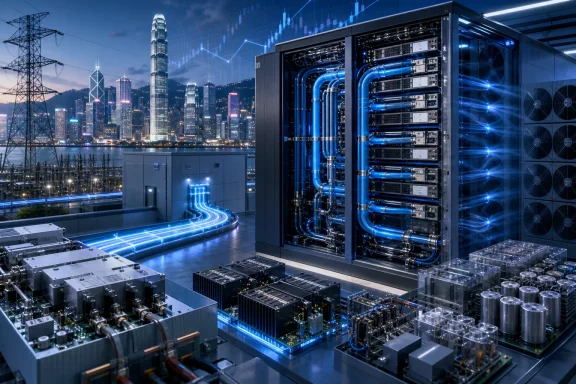 AI’s New Bottleneck Is Not the Model, It Is the Wall Socket
The AI boom has spent the past three years teaching the industry to think in bigger units. First it was the GPU, then the node, then the rack, then the cluster, and now the entire data center is being discussed as an AI factory. That language is not just Nvidia marketing. It reflects a real shift in the physical scale of computing.Training and serving modern AI models requires dense arrays of accelerators that draw extraordinary amounts of power. The problem is not merely that total electricity consumption is rising. It is that power must be delivered inside the data center at densities that older enterprise facilities were never designed to support.
That changes the semiconductor conversation. In the PC era, the glamour parts were CPUs and GPUs, while power delivery was the domain of engineers and procurement teams. In the AI era, the power stack is moving closer to center stage because efficiency losses become painfully expensive at megawatt scale.
A small conversion loss looks trivial in a laptop charger. At the scale of a hyperscale AI cluster, it becomes waste heat, cooling load, capital expense, grid stress, and lost compute capacity. That is why silicon carbide and gallium nitride are suddenly being discussed alongside advanced packaging and high-bandwidth memory.
Silicon Carbide Moves Out of the EV Slide Deck
Silicon carbide is not new, and neither is the claim that it can make power electronics more efficient. The material has been prized because it can handle high voltages, high temperatures, and high switching frequencies better than conventional silicon in many demanding applications. For years, the cleanest commercial story was electric vehicles.In EVs, SiC can improve inverter efficiency, reduce losses, and help extend range or reduce battery burden. That made it a natural target for Chinese industrial policy because China’s EV supply chain is deep, aggressive, and globally competitive. It also made SiC vulnerable to the same boom-and-bust dynamics that have hit other parts of the EV-adjacent component market.
The South China Morning Post report lands at a moment when analysts say the SiC market is oversupplied, partly because Chinese firms expanded capacity aggressively. That is the uncomfortable backdrop to the AI data center narrative. SiC’s new opportunity is not arriving in a vacuum; it is arriving after a capacity race.
That matters because the data center opportunity may be real without being an immediate rescue. Power architecture transitions are slow, qualification-heavy, and conservative, especially when the hardware sits between the grid and millions of dollars of accelerators. The AI sector may absorb some excess SiC capacity over time, but it will not magically turn every wafer line into a winner.
Basic Semiconductor’s IPO Is a Supply-Chain Signal
Basic Semiconductor’s progress toward a Hong Kong listing is important less because of one company’s fundraising and more because of what it says about the market China wants to build. Founded in 2016 by graduates from Tsinghua University and the University of Cambridge, the Shenzhen company is described as one of China’s few integrated SiC device manufacturers, spanning design, wafer fabrication, and module packaging.That integration is strategically attractive. Power semiconductors are not simply commodity chips that can be swapped blindly into systems. Device characteristics, packaging, thermal behavior, reliability, and system design all interact. A company that controls more of the stack can tune products more tightly and capture more value if demand materializes.
But integration is also capital-intensive. SiC manufacturing requires specialized processes, materials know-how, and yield discipline. An IPO can fund expansion, but public markets also impose their own logic: growth expectations, margin scrutiny, and quarterly pressure. The same capital that helps a company scale can punish it if the AI data center ramp takes longer than investors imagine.
Basic’s listing push should therefore be read as part financing event, part industrial-policy milestone, and part market wager. It is a bet that SiC will not remain mostly an EV component story. It is also a bet that Chinese suppliers can win a meaningful role in the next generation of AI infrastructure even as geopolitical pressure limits access to the most advanced GPU supply chains.
Nvidia’s 800V Road Map Turns Power Electronics Into Platform Politics
The most important phrase in this story is not “silicon carbide.” It is “800V.” Nvidia has been pushing an 800-volt DC architecture for future AI data centers, tied to next-generation rack-scale systems expected around the 2027 time frame. The goal is straightforward: move much more power with lower current, less copper, and better efficiency as racks climb toward hundreds of kilowatts and eventually megawatt-class designs.That shift matters because power architecture tends to set the agenda for everyone underneath it. If Nvidia’s rack-scale designs become the reference pattern for AI factories, then suppliers of converters, modules, protection systems, cables, cooling hardware, and power semiconductors will organize around that voltage regime. The GPU vendor becomes, indirectly, a power-infrastructure kingmaker.
This is where SiC and GaN enter the picture. Traditional silicon power devices are not going away, and different voltage stages may favor different materials. But wide-bandgap semiconductors are well suited to many of the high-efficiency, high-frequency, high-voltage conversion tasks that become more valuable in dense AI infrastructure.
The South China Morning Post report cites UBS research suggesting that SiC and GaN could capture 10 to 15 percent of the power semiconductor architecture in Nvidia’s advanced 800V Kyber rack configurations, slated for mass deployment in 2027. That is not the same as saying SiC will dominate the rack. It says wide-bandgap devices could claim an important slice of a much larger and more expensive power stack.
The Rack Is Becoming the New Unit of Competition
For WindowsForum readers, the phrase “data center power architecture” may sound remote from everyday computing. It is not. The same AI buildout shaping cloud services, Copilot-class assistants, enterprise inference platforms, and developer tooling depends on whether operators can deliver enough power into racks without blowing up costs or reliability.The traditional data center was built around rows of servers that consumed power at levels operators could manage with familiar distribution systems. AI racks are different. They concentrate accelerators, high-speed networking, memory, and liquid cooling into dense assemblies that behave less like conventional server cabinets and more like industrial equipment.
That shift changes procurement. Cloud providers and large enterprises are no longer buying servers as isolated boxes. They are buying rack-scale systems with integrated power and cooling assumptions. The downstream effect is that power components become part of platform differentiation.
If an AI rack can deliver more compute per megawatt, the economics change. If it requires a facility retrofit that takes years and millions of dollars, the economics change again. The winning architecture will not be judged only by benchmark charts. It will be judged by whether utilities, facilities teams, safety regulators, and operators can actually deploy it.
China Sees the Opening Created by Export Controls
The AI chip race is usually framed around leading-edge GPUs and export restrictions. That framing is not wrong, but it is incomplete. The United States and its allies have constrained China’s access to the most advanced AI accelerators and manufacturing tools, pushing Chinese firms to develop domestic alternatives where possible.Power semiconductors sit in a different but related lane. They are strategically important, technically demanding, and central to electrification, industrial automation, EVs, renewable energy, and now AI infrastructure. China has spent years trying to reduce dependence on foreign semiconductor suppliers across multiple categories, and SiC fits that agenda neatly.
The attraction is obvious. Even if Chinese GPU vendors face an uphill climb against Nvidia, Chinese firms may still supply pieces of the infrastructure stack that AI data centers require. In a constrained world, controlling the power layer becomes a way to capture value adjacent to compute.
But this is not a simple nationalism story. SiC supply chains are global, and the highest-reliability customers will care about performance, qualification, lifecycle support, and consistency. A domestic label may help in China’s own market, but international adoption will require proof that devices can survive punishing operating conditions over long service periods.
Oversupply Is the Shadow Behind the Optimism
The most sobering word in the SCMP report is “oversupplied.” A market can have a strong long-term growth story and still hurt suppliers in the near term. In semiconductors, that combination is common: everyone sees the same demand curve, everyone builds capacity, and then margins collapse before the next application arrives at scale.Chinese SiC producers expanded aggressively for EVs and industrial applications. If demand growth slows or qualification cycles stretch, inventory builds. Prices fall. Weaker suppliers struggle to finance technology upgrades. The industry then discovers that “strategic” does not mean “immune to economics.”
AI data centers may provide a new demand stream, but the timing matters. Nvidia’s 800V deployment horizon points toward 2027 and 2028 for broader adoption, not an overnight surge today. The early systems will be high-profile, but qualification into critical infrastructure can be narrow and selective.
That creates a two-speed market. Investors may price in the AI upside immediately, while engineers and customers move at the pace of validation. The gap between those two clocks is where disappointment often lives.
SiC and GaN Are Allies Until They Are Rivals
The wide-bandgap story often groups silicon carbide and gallium nitride together, and for good reason. Both can outperform conventional silicon in important power applications. Both are central to the push for smaller, more efficient, higher-density power conversion. Both are benefiting from the industry’s realization that energy delivery is now a computing bottleneck.Yet SiC and GaN are not interchangeable. Broadly speaking, SiC is often associated with higher-voltage, higher-power applications, while GaN has found strong opportunities in fast switching, compact power supplies, and certain lower- to mid-voltage conversion stages. The exact choice depends on topology, voltage, current, thermal constraints, cost, and reliability requirements.
That means the AI rack will not crown one universal winner. A future 800V data center architecture may use SiC in some conversion and protection stages, GaN in others, and advanced silicon where it remains cost-effective. The real battle is not material versus material; it is device plus package plus system design.
This is also why claims about market share should be read carefully. A 10 to 15 percent role in a power semiconductor architecture could be lucrative if the rack power bill of materials expands dramatically. But it does not mean every SiC producer gets an equal seat at the table.
The Windows Angle Is the Cloud Beneath the Desktop
At first glance, this story belongs in a semiconductor trade publication, not a Windows community. But modern Windows is increasingly tied to cloud infrastructure. Copilot features, cloud gaming, Azure-hosted enterprise workloads, developer assistants, security analytics, and remote desktops all depend on data center economics.When AI infrastructure becomes expensive or constrained, those costs surface somewhere. They may show up as higher cloud prices, stricter quotas, delayed feature rollouts, regional capacity differences, or more aggressive enterprise licensing strategies. Microsoft is not alone here, but Windows users live inside the Microsoft ecosystem more visibly than most.
The data center power problem also affects where AI features run. If cloud inference remains power-constrained and expensive, more pressure shifts toward local NPUs and efficient client-side models. That could make Copilot+ PCs and future Windows hardware more important, not less.
In other words, the SiC story is part of a larger tug-of-war between cloud-scale AI and client-side AI. Power electronics will not determine that balance alone, but they influence the cost curve. The cheaper and more efficient cloud AI becomes, the easier it is to centralize intelligence. The more constrained it remains, the more attractive local inference becomes.
Enterprises Will Care About Reliability Before Efficiency Claims
For sysadmins and enterprise IT leaders, the AI data center conversation is not just about hyperscaler bragging rights. Enterprises buying AI capacity, deploying private clusters, or colocating high-density racks will eventually face the same physical constraints. Power availability, cooling capacity, and facility readiness will determine what can be deployed.Efficiency is attractive, but reliability is non-negotiable. Power semiconductors in AI infrastructure must operate under severe electrical and thermal stress. Failure modes are not merely inconvenient; they can take down expensive compute capacity and create safety risks.
That is why wide-bandgap adoption will likely proceed through conservative qualification. Vendors will need to prove not just peak efficiency but long-term stability, ruggedness, fault handling, and serviceability. The enterprise market will not accept a fragile power stack just because it looks elegant in a reference design.
This is a useful corrective to the investment hype. AI infrastructure is pushing power electronics forward, but the buyers are not hobbyists. They are hyperscalers, colocation operators, OEMs, and large enterprises with little tolerance for unproven components in mission-critical systems.
The Grid Is the Constraint Nobody Can Patch on Tuesday
Software people are used to iteration. Data center power is less forgiving. You cannot patch a substation overnight, install new transmission capacity with a firmware update, or make local permitting disappear with a better driver.That is why the AI power story has spilled beyond the data center walls. Utilities, regulators, real estate developers, and governments are now part of the AI supply chain. A company can order GPUs and still be unable to energize them if the local grid cannot support the load.
Higher-voltage DC architectures help with the inside-the-fence problem. They can reduce losses and make dense racks more practical. But they do not eliminate the need for generation, transmission, substations, backup power, and cooling water or alternatives.
This is where the phrase “breaking point” should be handled carefully. AI is not literally breaking every data center grid today. But it is exposing the limits of a model built for lower-density computing and more predictable growth. The industry is discovering that power is not a background assumption; it is the operating system of the physical cloud.
Beijing’s Industrial Bet Meets the Reality of Qualification
China’s push into SiC has the familiar ingredients of a national technology campaign: local champions, capital markets, state-aligned priorities, and a large domestic market. That formula has worked well in some sectors and produced wasteful overcapacity in others. SiC may end up showing both outcomes at once.The winners will likely be companies that combine manufacturing scale with genuine technical credibility. In power semiconductors, quality is cumulative. Customers learn which suppliers deliver consistent devices, which packaging survives, which modules handle thermal cycling, and which vendors respond when something fails in the field.
Basic Semiconductor’s integrated model could be an advantage if it helps the company manage quality across the stack. It could also become a burden if capital expenditure runs ahead of customer adoption. Vertical integration magnifies both control and risk.
The broader Chinese ecosystem will face the same test. A national push can create capacity, but it cannot shortcut trust. AI data center operators will qualify suppliers through performance, reliability, and cost, not patriotic slide decks.
The AI Hardware Story Is Becoming Less Nvidia-Centric
Nvidia remains the gravitational center of AI infrastructure. Its GPUs, networking, software stack, and reference architectures shape the market. But the power discussion shows how the AI hardware story is widening beyond accelerators.A rack-scale AI system is a bundle of dependencies. It needs memory, optics, switches, power supplies, power semiconductors, cooling plates, pumps, manifolds, cables, firmware, monitoring software, and facility integration. Every one of those categories can become a bottleneck.
That is why companies far from the traditional GPU narrative are suddenly marketing themselves as AI infrastructure suppliers. Some of this is opportunistic branding. Some of it is real. The trick is telling the difference.
SiC sits on the more plausible end of that spectrum because the power-density problem is real and measurable. But plausibility is not proof of profit. The companies that benefit most may be those already embedded in power supply ecosystems, not necessarily those with the loudest AI messaging.
Europe, Japan, and the US Are Not Standing Still
The Chinese SiC push should not be mistaken for a one-country race. Established power semiconductor firms in Europe, Japan, and the United States have deep experience, strong customer relationships, and proven product portfolios. Infineon, STMicroelectronics, Onsemi, Rohm, Wolfspeed, Mitsubishi Electric, and others have spent years building positions in wide-bandgap devices and power modules.China’s advantage is scale, state support, and proximity to a massive electronics and EV manufacturing base. The incumbents’ advantage is qualification history, global reach, and trust in demanding applications. AI data centers will likely pull from both worlds, depending on geography, customer risk tolerance, and supply-chain politics.
Geopolitics complicates the picture. Western hyperscalers may be cautious about sourcing critical power components from Chinese suppliers for sensitive facilities. Chinese cloud and AI operators, meanwhile, may prefer domestic suppliers where possible. The result could be a partially bifurcated market rather than a single global winner-take-all race.
That fragmentation has consequences. It may improve supply resilience in some regions while reducing standardization globally. It may also create duplicate capacity and price pressure, especially if everyone builds for the same expected AI ramp.
The Efficiency Story Has a Carbon Footnote
AI’s energy demand has become a political and environmental issue, and efficiency improvements are often presented as the answer. SiC and GaN can contribute meaningfully by reducing conversion losses and enabling denser, more efficient power systems. But efficiency is not the same as restraint.If AI demand grows faster than efficiency improves, total power consumption still rises. This is the old rebound problem in a new rack-scale costume. Better power electronics can reduce waste per unit of compute while also making it easier to deploy more compute overall.
That does not make efficiency pointless. On the contrary, it becomes more important as the industry scales. But the public debate should not pretend that better semiconductors alone solve the energy problem.
For operators, the practical benefit is still substantial. More efficient power delivery means less heat, lower operating costs, and more usable compute per megawatt. For society, the question is whether those gains are used to reduce pressure on grids or simply to accelerate the buildout.
The Old Data Center Is Being Rewritten One Conversion Stage at a Time
The coming power transition will not happen uniformly. Existing facilities will coexist with new builds. Some operators will adopt intermediate architectures. Some workloads will run in facilities optimized for today’s 48V or 54V rack-level distribution, while the most aggressive AI deployments move toward higher-voltage designs.This mixed environment is normal. Infrastructure transitions rarely look clean from the inside. The industry will experiment with different topologies, vendors, safety practices, and maintenance models before a dominant pattern emerges.
That messy middle creates opportunity for suppliers that can support multiple stages of the transition. Devices that work only in a narrow architecture may win in specific deployments. Vendors that can serve both bridge systems and future-native 800V designs may have a smoother path.
For IT buyers, the lesson is to avoid assuming that “AI-ready” means one thing. Facility readiness, rack density, cooling design, power conversion architecture, and vendor ecosystem will all matter. The spec sheet will not tell the whole story.
The Real Test Comes When the Hype Meets the Service Manual
There is a difference between demonstrating an architecture and operating it for years. AI infrastructure must survive dust, vibration, thermal cycling, component aging, firmware bugs, technician errors, utility disturbances, and unpredictable workload spikes. Power systems live in the real world.That is why the service model may become as important as the device physics. Who replaces failed modules? How quickly can faults be isolated? Are parts interoperable? Can operators monitor degradation before catastrophic failure? Does the architecture make maintenance safer or more dangerous?
These questions are not glamorous, but they determine adoption. A hyperscaler can tolerate complexity if it delivers enough performance and if the vendor ecosystem supports it. A smaller enterprise or colocation customer may need something more standardized and serviceable.
SiC suppliers that want to ride the AI wave will need to think beyond die shipments. They will need to fit into modules, power shelves, solid-state transformers, monitoring systems, and field-service workflows. The winners will sell confidence, not just efficiency.
The SiC Gold Rush Has a Long Qualification Queue
The most concrete lesson from Basic Semiconductor’s IPO push is that the AI power story has become investable. The harder lesson is that investable does not mean inevitable. Between a listing hearing and a major role in global AI infrastructure lies a long road of engineering validation and customer trust.The market will reward companies that can prove their devices belong in high-density, high-reliability environments. It will punish those that merely relabel EV capacity as AI infrastructure without solving the specific demands of data center power. The distinction may take time to become obvious, but it will become obvious.
The 2027 and 2028 window is therefore crucial. If Nvidia’s 800V ecosystem ramps as expected, wide-bandgap suppliers will get a powerful demand signal. If deployment is slower, fragmented, or concentrated among a few qualified suppliers, the broader SiC market may remain under pressure.
The irony is that oversupply could help customers while hurting producers. Lower prices may make SiC more attractive in more applications. But if pricing falls too far, weaker suppliers may be unable to fund the reliability improvements that critical infrastructure buyers demand.
The Part of the AI Boom That Fits in a Power Cabinet
The AI industry likes to talk about intelligence, but its next constraint may be electrical discipline. For Windows users, developers, and administrators watching cloud AI become part of the operating system, the power layer is no longer background plumbing. It is one of the factors that will decide how fast AI services expand, how much they cost, and where compute happens.- Basic Semiconductor’s Hong Kong IPO progress shows that Chinese SiC firms are trying to convert EV-era capacity and national semiconductor policy into an AI infrastructure story.
- Nvidia’s 800V data center architecture gives wide-bandgap power devices a credible path into next-generation AI racks, especially as rack power moves toward hundreds of kilowatts and beyond.
- SiC and GaN are likely to coexist in AI power systems, with different materials serving different voltage, switching, and thermal requirements.
- Oversupply remains a serious risk for SiC producers, because AI data center adoption is likely to be selective and qualification-driven rather than immediate and universal.
- Enterprise IT should watch power architecture as closely as accelerator road maps, because facility constraints will increasingly determine what AI capacity can actually be deployed.
- The cloud AI services built into Windows and Microsoft’s enterprise stack will ultimately reflect the economics of data center power, not just the availability of faster GPUs.
References
- Primary source: South China Morning Post
Published: Sun, 28 Jun 2026 05:00:09 GMT
As AI pushes data centres to breaking point, some Chinese chipmakers bet on SiC | South China Morning Post
Basic Semiconductor is the latest firm in the space to move forward with an IPO.www.scmp.com - Related coverage: ibselectronics.com
- Related coverage: edwealth.ai
- Related coverage: tomshardware.com
China's premier GPU maker Biren kicks off Hong Kong IPO — GPU startups vying for Nvidia's crown race to fund AI chip development | Tom's Hardware
Shanghai-based Biren is targeting up to US$624 million in what would be the first Hong Kong listing by a mainland GPU developer.www.tomshardware.com - Related coverage: investing.com
Chinese AI, chip firms are driving an onshore IPO rebound By Reuters
Chinese AI, chip firms are driving an onshore IPO reboundwww.investing.com - Related coverage: peaknano.com
