

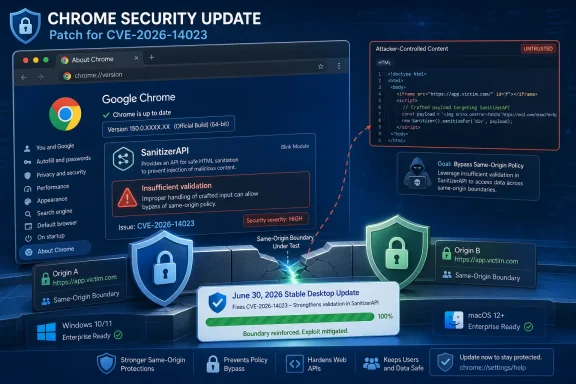
Google fixed CVE-2026-14023, a medium-severity Chrome SanitizerAPI input-validation flaw that could let a remote attacker bypass same-origin protections with a crafted HTML page, in Chrome 150.0.7871.47 for Windows and Mac after publishing the stable desktop update on June 30, 2026. The bug is not the loudest item in Chrome 150’s enormous security ledger, but it is one of the more conceptually important ones. When a browser feature designed to make untrusted HTML safer becomes part of a same-origin-policy bypass story, the lesson is not “panic”; it is “patch the browser, then revisit every assumption about browser-side sanitization.” As documented by Google’s Chrome Releases blog and reflected in the National Vulnerability Database entry, this is a medium-rated vulnerability with a practical enterprise message: trust boundaries in the browser are only as strong as the validation code that feeds them.
Chrome 150 arrived as one of those security releases that makes vulnerability managers reach for automation rather than coffee. Google’s release notes say the desktop stable update included 433 security fixes, with Windows and macOS moving to the 150.0.7871.46/.47 line and Linux to 150.0.7871.46. Buried in that flood is CVE-2026-14023, listed by Google as “Insufficient validation of untrusted input in SanitizerAPI.”
That wording is dry, but the affected boundary is not. The same-origin policy is one of the browser’s bedrock constraints: content from one origin should not be able to freely reach into another origin’s data or execution context. A bypass does not automatically mean arbitrary code execution, credential theft, or drive-by compromise, but it does mean the browser’s central compartmentalization model has been stressed in a way defenders should take seriously.
The NVD entry, sourced from Chrome and later enriched by CISA’s ADP data, describes the attack condition as a crafted HTML page and assigns a CVSS 3.1 score of 6.5 through CISA-ADP. The vector matters: network reachable, low attack complexity, no privileges required, user interaction required, unchanged scope, high integrity impact, and no listed confidentiality or availability impact. In plain English, the attacker needs the user to load hostile content, but the consequences may involve altering trust assumptions rather than merely crashing a tab.
That is why this CVE should not be dismissed as just another medium in a release overflowing with critical and high issues. Browser security is a layered system, and the medium-rated bugs are often the ones that reveal where abstractions are getting thin. Sanitization APIs, origin boundaries, and modern web application patterns now sit close enough together that a validation bug can become a policy bug.
That is the optimistic version. The harder truth is that any native sanitizer becomes part of the browser’s security perimeter once applications start treating it as a trusted gatekeeper. It must understand not only obvious script-bearing markup but also the weird edges of parsing, namespaces, URL handling, templates, custom elements, shadow DOM interactions, and browser-specific behavior.
CVE-2026-14023 is therefore interesting because it lands exactly where web-platform ambition meets browser reality. The issue is not described as “the web is unsafe” or “developers used the API wrong.” Google and NVD describe it as insufficient validation of untrusted input in the SanitizerAPI itself, which means the browser-side machinery accepted something it should not have accepted or processed something in a way that undermined a security boundary.
Google has not made the underlying Chromium issue freely readable to everyone at publication time, which is normal for fresh Chrome security bugs. The Chrome Releases blog repeats Google’s standard warning that bug details and links may remain restricted until a majority of users have received the fix. That policy frustrates researchers and administrators who want full root-cause detail immediately, but it also limits copycat exploitation during the rollout window.
The result is an uncomfortable middle ground. We know enough to prioritize the update, but not enough to produce a responsible exploit narrative. For IT teams, that is exactly the point: browser patching cannot wait for a postmortem.
A same-origin-policy bypass is dangerous because it undermines a rule the web stack silently relies on all day. Cookies, local storage, embedded frames, authentication flows, cross-site documents, and internal admin consoles all assume that the browser will enforce hard lines between origins. If an attacker can blur those lines under the right conditions, the damage may look like unauthorized state changes, DOM manipulation, or trust confusion rather than a dramatic process takeover.
CISA-ADP’s scoring is revealing here. The vector lists no confidentiality impact but high integrity impact. That suggests the assessed risk is not primarily about reading secrets directly; it is about influencing content, behavior, or trust decisions in a way the browser should have prevented. For security teams that model only data theft and shell access, that kind of vulnerability is easy to underrate.
The user-interaction requirement also deserves sober interpretation. In browser security, “user interaction required” often means “the victim must visit a page” or otherwise encounter attacker-controlled web content. That is not a high bar in a world of phishing, malvertising, compromised sites, collaboration tools, and links flying through Teams, Slack, Discord, email, and forums.
No public evidence in the NVD entry indicates exploitation in the wild for CVE-2026-14023. CISA’s SSVC data says exploitation is “none” and automation is “no,” with partial technical impact. That should lower the temperature, not the priority. The responsible response is fast routine patching, not emergency theatrics.
That is why the SanitizerAPI context matters for Windows administrators. Windows shops may standardize on Edge, Chrome, or both, but the Chromium engine sits underneath large portions of the modern desktop browsing estate. A Chrome CVE often becomes a signal for administrators to check not just Chrome, but Chromium-based browser update posture across managed endpoints.
There is also a developer lesson. If an application assumes that browser-native sanitization eliminates the need for server-side validation, contextual output encoding, Content Security Policy, and careful origin design, it has misunderstood the role of the API. Sanitization is a mitigation, not a sovereign border guard. CVE-2026-14023 is a reminder that even native platform security features can fail in ways that application architecture must be able to absorb.
For sysadmins, the immediate concern is version inventory. Chrome before 150.0.7871.47 is listed as affected in the NVD data for this CVE. The practical task is to ensure Windows and Mac systems are on 150.0.7871.47 or later where Chrome is deployed, and to account for any machines pinned to delayed channels, manually installed builds, or user-controlled update paths.
For security engineers, the more strategic concern is telemetry. If the exploit requires crafted HTML and user interaction, traditional endpoint logs may not tell a satisfying story. Browser version coverage, web proxy telemetry, phishing reports, and EDR browser-event visibility all become relevant, but none provides a perfect answer after the fact. That makes prevention via update enforcement the cleaner control.
According to the change history in the NVD entry, NIST added a CPE configuration for Google Chrome versions up to but excluding 150.0.7871.47 during its initial analysis on July 1, 2026. That means the entry did gain the essential vulnerable-product mapping after the CVE was received from Chrome on June 30. The “missing CPE” prompt is part of NVD’s interface for feedback, not proof that the record lacks a Chrome mapping.
Still, administrators are right to be skeptical. Browser CVEs can be especially awkward for asset tools because Chrome may exist as a system install, a per-user install, an enterprise-managed package, a bundled runtime, or a component updated independently of the base operating system. Add macOS, Linux distributions, VDI images, and unmanaged developer machines, and a single CPE string becomes necessary but not sufficient.
The better operational answer is to combine sources. Use NVD and vendor advisories for authoritative identifiers and affected-version ranges, but use endpoint management platforms to validate installed versions directly. In a Windows environment, that may mean Intune, Configuration Manager, Defender Vulnerability Management, enterprise browser management, or another inventory agent that reports executable versions rather than inferred package names.
CVE enrichment is useful, but it is not a substitute for knowing what is installed. The Chrome 150 update is a reminder that vulnerability management begins with data hygiene and ends with patch compliance, not with a CVSS number.
The CISA-ADP CVSS vector gives defenders a useful shape of the risk. The attack is network-based and low complexity, requiring no privileges, but it does require user interaction. The listed integrity impact is high, while confidentiality and availability are scored as none. That points to a bug that may allow an attacker to cause the browser to accept, transform, or treat content in a way that violates the intended origin model.
That does not mean every organization should declare an incident. It does mean this is a bad candidate for a leisurely browser update cycle measured in weeks. Chrome’s own release notes state the update rolls out over coming days and weeks, but enterprises should not confuse rollout availability with compliance completion.
For most managed Windows environments, the right target is straightforward: verify Chrome has moved beyond the affected build line, confirm update services are healthy, and monitor for devices that remain stale after the normal maintenance window. The machines to watch are not always the obvious ones. Kiosks, conference-room PCs, lab systems, non-persistent virtual desktops, and developer workstations often become the long tail of browser exposure.
Where Chrome updates are paused for compatibility testing, CVE-2026-14023 should be part of the exception discussion. A medium browser bug that touches same-origin behavior may justify accelerating validation, especially in organizations with heavy web-app usage or high exposure to untrusted external content.
In this case, the underlying issue link is permission-restricted, and the public release note gives only the component and class of bug. The NVD record adds the same-origin-policy bypass language and the crafted HTML page attack condition. CISA-ADP adds scoring and SSVC attributes. Together, those sources give enough to prioritize, but not enough to determine whether a specific web app pattern is exposed.
That is not a defect in disclosure so much as a tradeoff. Detailed exploitability analysis would help defenders model risk, but it would also help attackers target lagging systems. The Chrome team’s standard practice assumes the most important security outcome is rapid update adoption before technical details diffuse.
For WindowsForum readers, the practical takeaway is that the absence of a long technical write-up is not exculpatory. Some of the most consequential browser fixes begin life as one-line release-note entries. The browser is a moving target, and the safest posture is to treat stable-channel security updates as routine infrastructure maintenance rather than optional application polish.
The scale of Chrome 150 reinforces that point. With 433 security fixes in a single desktop update, no administrator is going to hand-triage every issue to perfection. The governance model has to be update-first, investigate-second, with exceptions reserved for known business breakage rather than theoretical comfort.
That does not mean administrators should assume Edge is affected by CVE-2026-14023 without a Microsoft advisory saying so. It means they should avoid the opposite mistake: treating Chrome CVEs as irrelevant because Edge is the corporate default. Many organizations still have Chrome installed for compatibility, developer workflows, acquired business units, or user preference, and unmanaged copies can linger long after a standard-browser decision.
The same applies to embedded Chromium frameworks and applications with bundled browser components. Not every Chromium-based product exposes the same API surface, update cadence, or attack path. But where applications render untrusted web content, Chromium security debt can become application security debt.
Microsoft-centric shops should therefore use this as a moment to audit browser sprawl. Chrome, Edge, WebView2 runtimes, Electron apps, and embedded web surfaces do not all patch the same way. A vulnerability like CVE-2026-14023 is a small example of a large operational truth: the web engine has become a dependency you may be running in more places than your software inventory admits.
The safer pattern is layered. Validate input according to business rules before storage. Encode output according to context. Apply Content Security Policy where it can meaningfully reduce script execution risk. Avoid mixing trusted and untrusted markup in the same rendering path. Keep cross-origin content isolated through frames, sandboxing, and careful messaging discipline.
The same-origin-policy angle should also push teams to review assumptions around embedded content. If an application uses sanitized HTML inside a privileged area, or passes sanitized fragments across origin or frame boundaries, it should be designed so that sanitizer failure does not immediately become privilege confusion. That is easy to say and hard to retrofit, which is why browser security bugs tend to expose architectural shortcuts.
There is also a testing implication. Fuzzing and browser conformance tests catch a great deal, and Google explicitly credits tools such as sanitizers and fuzzers in many Chrome security cycles. But application teams should still test how their own products behave when given malformed HTML, unexpected namespaces, inert documents, templates, SVG, MathML, and other historically sharp corners.
The best developer response is boring and durable: patch local browsers, update CI images, refresh test baselines, and assume that web-platform security primitives are helpful but imperfect. A native SanitizerAPI bug is not an indictment of the API. It is a warning against monoculture thinking in application defense.
For administrators, this should be folded into the Chrome 150 rollout already underway. For developers, it should trigger a modest review of sanitizer assumptions and origin boundaries. For security teams, it should be treated as another proof point that vulnerability databases, vendor release notes, and endpoint inventory must be reconciled rather than read in isolation.
 Chrome 150 Turns a Medium Bug Into a Governance Problem
Chrome 150 arrived as one of those security releases that makes vulnerability managers reach for automation rather than coffee. Google’s release notes say the desktop stable update included 433 security fixes, with Windows and macOS moving to the 150.0.7871.46/.47 line and Linux to 150.0.7871.46. Buried in that flood is CVE-2026-14023, listed by Google as “Insufficient validation of untrusted input in SanitizerAPI.”That wording is dry, but the affected boundary is not. The same-origin policy is one of the browser’s bedrock constraints: content from one origin should not be able to freely reach into another origin’s data or execution context. A bypass does not automatically mean arbitrary code execution, credential theft, or drive-by compromise, but it does mean the browser’s central compartmentalization model has been stressed in a way defenders should take seriously.
The NVD entry, sourced from Chrome and later enriched by CISA’s ADP data, describes the attack condition as a crafted HTML page and assigns a CVSS 3.1 score of 6.5 through CISA-ADP. The vector matters: network reachable, low attack complexity, no privileges required, user interaction required, unchanged scope, high integrity impact, and no listed confidentiality or availability impact. In plain English, the attacker needs the user to load hostile content, but the consequences may involve altering trust assumptions rather than merely crashing a tab.
That is why this CVE should not be dismissed as just another medium in a release overflowing with critical and high issues. Browser security is a layered system, and the medium-rated bugs are often the ones that reveal where abstractions are getting thin. Sanitization APIs, origin boundaries, and modern web application patterns now sit close enough together that a validation bug can become a policy bug.
The SanitizerAPI Was Supposed to Move Risk Out of JavaScript Glue
The SanitizerAPI exists because web applications have spent decades turning strings into DOM, often with inconsistent homegrown filtering in between. The broad idea is simple: give developers a native, browser-provided way to sanitize HTML before it becomes live document content. If the platform can standardize the dangerous parts, developers are less likely to rely on brittle regular expressions, stale libraries, or permissive allowlists copied from old Stack Overflow answers.That is the optimistic version. The harder truth is that any native sanitizer becomes part of the browser’s security perimeter once applications start treating it as a trusted gatekeeper. It must understand not only obvious script-bearing markup but also the weird edges of parsing, namespaces, URL handling, templates, custom elements, shadow DOM interactions, and browser-specific behavior.
CVE-2026-14023 is therefore interesting because it lands exactly where web-platform ambition meets browser reality. The issue is not described as “the web is unsafe” or “developers used the API wrong.” Google and NVD describe it as insufficient validation of untrusted input in the SanitizerAPI itself, which means the browser-side machinery accepted something it should not have accepted or processed something in a way that undermined a security boundary.
Google has not made the underlying Chromium issue freely readable to everyone at publication time, which is normal for fresh Chrome security bugs. The Chrome Releases blog repeats Google’s standard warning that bug details and links may remain restricted until a majority of users have received the fix. That policy frustrates researchers and administrators who want full root-cause detail immediately, but it also limits copycat exploitation during the rollout window.
The result is an uncomfortable middle ground. We know enough to prioritize the update, but not enough to produce a responsible exploit narrative. For IT teams, that is exactly the point: browser patching cannot wait for a postmortem.
A Same-Origin Bypass Is Not a Crash, and That Is Why It Matters
Many Chrome security advisories are easier to mentally rank because they fit familiar buckets: use-after-free, heap buffer overflow, type confusion, out-of-bounds write. Those are memory-safety phrases that naturally trigger concern about code execution, sandbox escapes, and exploit chains. CVE-2026-14023 is different. Its center of gravity is policy.A same-origin-policy bypass is dangerous because it undermines a rule the web stack silently relies on all day. Cookies, local storage, embedded frames, authentication flows, cross-site documents, and internal admin consoles all assume that the browser will enforce hard lines between origins. If an attacker can blur those lines under the right conditions, the damage may look like unauthorized state changes, DOM manipulation, or trust confusion rather than a dramatic process takeover.
CISA-ADP’s scoring is revealing here. The vector lists no confidentiality impact but high integrity impact. That suggests the assessed risk is not primarily about reading secrets directly; it is about influencing content, behavior, or trust decisions in a way the browser should have prevented. For security teams that model only data theft and shell access, that kind of vulnerability is easy to underrate.
The user-interaction requirement also deserves sober interpretation. In browser security, “user interaction required” often means “the victim must visit a page” or otherwise encounter attacker-controlled web content. That is not a high bar in a world of phishing, malvertising, compromised sites, collaboration tools, and links flying through Teams, Slack, Discord, email, and forums.
No public evidence in the NVD entry indicates exploitation in the wild for CVE-2026-14023. CISA’s SSVC data says exploitation is “none” and automation is “no,” with partial technical impact. That should lower the temperature, not the priority. The responsible response is fast routine patching, not emergency theatrics.
The Real Risk Is the Browser as a Shared Enterprise Runtime
Chrome is no longer just a user application. In many organizations, it is the runtime for SaaS productivity, identity administration, device management portals, HR systems, customer dashboards, browser-based remote access, developer consoles, and internal line-of-business apps. A flaw in browser policy enforcement is therefore a flaw in the layer where many business workflows now converge.That is why the SanitizerAPI context matters for Windows administrators. Windows shops may standardize on Edge, Chrome, or both, but the Chromium engine sits underneath large portions of the modern desktop browsing estate. A Chrome CVE often becomes a signal for administrators to check not just Chrome, but Chromium-based browser update posture across managed endpoints.
There is also a developer lesson. If an application assumes that browser-native sanitization eliminates the need for server-side validation, contextual output encoding, Content Security Policy, and careful origin design, it has misunderstood the role of the API. Sanitization is a mitigation, not a sovereign border guard. CVE-2026-14023 is a reminder that even native platform security features can fail in ways that application architecture must be able to absorb.
For sysadmins, the immediate concern is version inventory. Chrome before 150.0.7871.47 is listed as affected in the NVD data for this CVE. The practical task is to ensure Windows and Mac systems are on 150.0.7871.47 or later where Chrome is deployed, and to account for any machines pinned to delayed channels, manually installed builds, or user-controlled update paths.
For security engineers, the more strategic concern is telemetry. If the exploit requires crafted HTML and user interaction, traditional endpoint logs may not tell a satisfying story. Browser version coverage, web proxy telemetry, phishing reports, and EDR browser-event visibility all become relevant, but none provides a perfect answer after the fact. That makes prevention via update enforcement the cleaner control.
The CPE Confusion Is a Symptom of a Bigger Vulnerability-Data Problem
The user-facing question in the NVD entry — “Are we missing a CPE here?” — looks minor, but it points to a chronic problem in vulnerability management. Security tools do not reason about risk in prose; they reason about product identifiers, versions, package names, and sometimes fragile mappings between all of them. If the CPE data is late, incomplete, or ambiguous, dashboards undercount exposure.According to the change history in the NVD entry, NIST added a CPE configuration for Google Chrome versions up to but excluding 150.0.7871.47 during its initial analysis on July 1, 2026. That means the entry did gain the essential vulnerable-product mapping after the CVE was received from Chrome on June 30. The “missing CPE” prompt is part of NVD’s interface for feedback, not proof that the record lacks a Chrome mapping.
Still, administrators are right to be skeptical. Browser CVEs can be especially awkward for asset tools because Chrome may exist as a system install, a per-user install, an enterprise-managed package, a bundled runtime, or a component updated independently of the base operating system. Add macOS, Linux distributions, VDI images, and unmanaged developer machines, and a single CPE string becomes necessary but not sufficient.
The better operational answer is to combine sources. Use NVD and vendor advisories for authoritative identifiers and affected-version ranges, but use endpoint management platforms to validate installed versions directly. In a Windows environment, that may mean Intune, Configuration Manager, Defender Vulnerability Management, enterprise browser management, or another inventory agent that reports executable versions rather than inferred package names.
CVE enrichment is useful, but it is not a substitute for knowing what is installed. The Chrome 150 update is a reminder that vulnerability management begins with data hygiene and ends with patch compliance, not with a CVSS number.
Medium Severity Still Deserves a Fast Patch Window
The word “medium” has been overworked into near uselessness. It can mean “barely relevant edge case,” or it can mean “not a one-click worm, but still a meaningful security boundary failure.” CVE-2026-14023 belongs closer to the second category because the affected boundary is central to web security.The CISA-ADP CVSS vector gives defenders a useful shape of the risk. The attack is network-based and low complexity, requiring no privileges, but it does require user interaction. The listed integrity impact is high, while confidentiality and availability are scored as none. That points to a bug that may allow an attacker to cause the browser to accept, transform, or treat content in a way that violates the intended origin model.
That does not mean every organization should declare an incident. It does mean this is a bad candidate for a leisurely browser update cycle measured in weeks. Chrome’s own release notes state the update rolls out over coming days and weeks, but enterprises should not confuse rollout availability with compliance completion.
For most managed Windows environments, the right target is straightforward: verify Chrome has moved beyond the affected build line, confirm update services are healthy, and monitor for devices that remain stale after the normal maintenance window. The machines to watch are not always the obvious ones. Kiosks, conference-room PCs, lab systems, non-persistent virtual desktops, and developer workstations often become the long tail of browser exposure.
Where Chrome updates are paused for compatibility testing, CVE-2026-14023 should be part of the exception discussion. A medium browser bug that touches same-origin behavior may justify accelerating validation, especially in organizations with heavy web-app usage or high exposure to untrusted external content.
Google’s Disclosure Style Leaves Defenders With a Patch, Not a Story
Google’s Chrome security advisories are intentionally concise. They list the CVE, severity, component, reporter, and sometimes a reward, then withhold deep technical details until enough users have patched. That model has served Chrome well in limiting exploit replication, but it leaves enterprise defenders in a familiar bind: the patch is available before the narrative is.In this case, the underlying issue link is permission-restricted, and the public release note gives only the component and class of bug. The NVD record adds the same-origin-policy bypass language and the crafted HTML page attack condition. CISA-ADP adds scoring and SSVC attributes. Together, those sources give enough to prioritize, but not enough to determine whether a specific web app pattern is exposed.
That is not a defect in disclosure so much as a tradeoff. Detailed exploitability analysis would help defenders model risk, but it would also help attackers target lagging systems. The Chrome team’s standard practice assumes the most important security outcome is rapid update adoption before technical details diffuse.
For WindowsForum readers, the practical takeaway is that the absence of a long technical write-up is not exculpatory. Some of the most consequential browser fixes begin life as one-line release-note entries. The browser is a moving target, and the safest posture is to treat stable-channel security updates as routine infrastructure maintenance rather than optional application polish.
The scale of Chrome 150 reinforces that point. With 433 security fixes in a single desktop update, no administrator is going to hand-triage every issue to perfection. The governance model has to be update-first, investigate-second, with exceptions reserved for known business breakage rather than theoretical comfort.
Edge Shops Should Read This as a Chromium Warning, Not a Chrome Footnote
This CVE is formally a Google Chrome entry, and the NVD affected configuration refers to Google Chrome. But Windows environments increasingly live in a Chromium ecosystem where browser-engine vulnerabilities have implications beyond a single brand. Microsoft Edge is built on Chromium, and while each vendor ships its own update channel and advisories, the shared codebase means Chrome security releases are often an early warning to look for corresponding Chromium-derived fixes elsewhere.That does not mean administrators should assume Edge is affected by CVE-2026-14023 without a Microsoft advisory saying so. It means they should avoid the opposite mistake: treating Chrome CVEs as irrelevant because Edge is the corporate default. Many organizations still have Chrome installed for compatibility, developer workflows, acquired business units, or user preference, and unmanaged copies can linger long after a standard-browser decision.
The same applies to embedded Chromium frameworks and applications with bundled browser components. Not every Chromium-based product exposes the same API surface, update cadence, or attack path. But where applications render untrusted web content, Chromium security debt can become application security debt.
Microsoft-centric shops should therefore use this as a moment to audit browser sprawl. Chrome, Edge, WebView2 runtimes, Electron apps, and embedded web surfaces do not all patch the same way. A vulnerability like CVE-2026-14023 is a small example of a large operational truth: the web engine has become a dependency you may be running in more places than your software inventory admits.
Developers Need Defense in Depth Around Native Sanitization
For developers, CVE-2026-14023 is not a reason to abandon browser-native sanitization. It is a reason to stop treating any single sanitizer as a complete trust boundary. Native APIs can reduce risk, improve consistency, and remove dangerous custom parsing from application code, but they cannot carry the whole security model alone.The safer pattern is layered. Validate input according to business rules before storage. Encode output according to context. Apply Content Security Policy where it can meaningfully reduce script execution risk. Avoid mixing trusted and untrusted markup in the same rendering path. Keep cross-origin content isolated through frames, sandboxing, and careful messaging discipline.
The same-origin-policy angle should also push teams to review assumptions around embedded content. If an application uses sanitized HTML inside a privileged area, or passes sanitized fragments across origin or frame boundaries, it should be designed so that sanitizer failure does not immediately become privilege confusion. That is easy to say and hard to retrofit, which is why browser security bugs tend to expose architectural shortcuts.
There is also a testing implication. Fuzzing and browser conformance tests catch a great deal, and Google explicitly credits tools such as sanitizers and fuzzers in many Chrome security cycles. But application teams should still test how their own products behave when given malformed HTML, unexpected namespaces, inert documents, templates, SVG, MathML, and other historically sharp corners.
The best developer response is boring and durable: patch local browsers, update CI images, refresh test baselines, and assume that web-platform security primitives are helpful but imperfect. A native SanitizerAPI bug is not an indictment of the API. It is a warning against monoculture thinking in application defense.
The Patch Work Is Smaller Than the Assumption Work
The immediate fix is simple: update Chrome. The larger work is to identify the places where organizations have quietly turned browsers into privileged enterprise runtimes without giving them the same patch discipline as operating systems and endpoint agents. CVE-2026-14023 is useful because it is just serious enough to expose that gap without requiring crisis language.For administrators, this should be folded into the Chrome 150 rollout already underway. For developers, it should trigger a modest review of sanitizer assumptions and origin boundaries. For security teams, it should be treated as another proof point that vulnerability databases, vendor release notes, and endpoint inventory must be reconciled rather than read in isolation.
- Chrome versions before 150.0.7871.47 are listed as affected for CVE-2026-14023, and managed Windows and Mac fleets should be verified against that fixed version or later.
- Google’s June 30, 2026 Chrome 150 stable-channel release included 433 security fixes, making single-CVE prioritization less useful than update compliance.
- The vulnerability is medium severity, but the same-origin-policy bypass language makes it more significant than a routine cosmetic browser defect.
- CISA-ADP scored the issue at CVSS 6.5 and marked exploitation as none, which supports rapid patching without incident-response panic.
- The NVD record does include a Google Chrome CPE configuration for versions up to but excluding 150.0.7871.47, but asset tools should still validate installed browser versions directly.
- Developers should keep using sanitization defensively, but they should not let any sanitizer replace server-side validation, contextual encoding, CSP, and careful origin isolation.
References
- Primary source: NVD / Chromium
Published: 2026-07-03T07:00:03-07:00
NVD - CVE-2026-14023
 nvd.nist.gov
- Security advisory: MSRC
Published: 2026-07-03T07:00:03-07:00
Original feed URL
Security Update Guide - Microsoft Security Response Center
 msrc.microsoft.com
- Official source: nist.gov
National Vulnerability Database
NIST maintains the National Vulnerability Database (NVD), a repository of information on software and hardware flaws that can compromise computer security. This is a key piece of the nation’s cybersecurity infrastructure.www.nist.gov - Related coverage: labs.cloudsecurityalliance.org
NVD Enrichment Triage: Enterprise Vulnerability Programs Must Adapt
PDF documentlabs.cloudsecurityalliance.org
