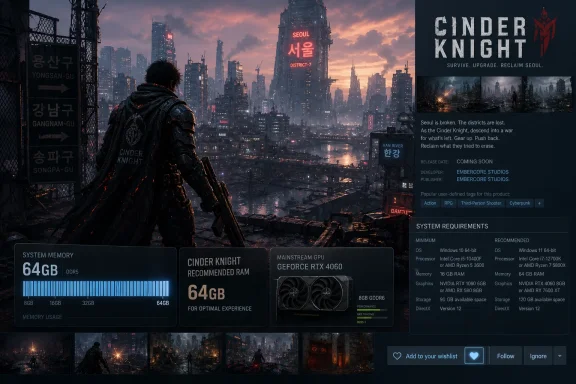
NC and Big Fire Games opened the Steam page for Cinder City on June 30, 2026, listing the upcoming open-world cinematic third-person shooter for Windows 10 and Windows 11 with a startling 32GB minimum memory requirement and an even more startling 64GB recommended RAM specification. That single line in the requirements table has done what a slick developer preview rarely can: it has turned a new Korean sci-fi shooter into a referendum on the future cost of playing PC games. The game itself may be about reclaiming a ruined Seoul from mutants, gangs, and hostile factions, but its Steam page has accidentally raised a more immediate question for players: when did “recommended” start meaning workstation-class memory?
Cinder City is not being pitched as a modest shooter with a pretty skyline. NC and its development studio Big Fire Games are selling scale: a near-future Seoul broken by an alternate-history catastrophe, cinematic third-person combat, open-world traversal, cooperative PvE, instanced dungeons, field bosses, and large world raids. It is part shooter, part MMO, part Korean blockbuster spectacle, and part hardware stress test.
The premise is pulpy in the best way. Seoul has fallen to mutated creatures, criminal organizations, and collapsing social order, while super-soldiers known as Cinder Knights remain one of humanity’s last lines of defense. The player takes on the role of Seven, a Cinder Knight whose search for his daughter Zoe begins in Samseong-dong and spirals outward into the secrets of a broken megacity.
That is the kind of setup that can justify enormous environments, heavy streaming, persistent activity, and piles of AI-controlled enemies. It also happens to be exactly the kind of setup that makes PC players nervous, because modern open-world games increasingly ship with more ambition than optimization. A 64GB recommendation does not merely say “this game is big.” It says the developer may be designing around assumptions that only a minority of gaming PCs currently meet.
The irony is that the rest of the recommended specification is not absurd. An Intel Core i7-12700 or Ryzen 7 7800X3D is strong but not exotic. An RTX 4060 with 8GB of VRAM is a mainstream GPU, not a halo card. The 50GB storage requirement is almost quaint in an era where some games sprawl past 150GB. It is the memory line that looks like it wandered in from a workstation spec sheet.
But until NC or Big Fire Games clarifies it, the 64GB recommendation has to be treated as real. The Steam page separately lists 32GB as the minimum and 64GB as recommended, which makes it less likely to be a simple copy-paste error. It also pairs that memory demand with a relatively modest RTX 4060, suggesting the developers may be targeting a memory-heavy workload rather than simply describing a top-end graphics preset.
That distinction matters. A 64GB RAM recommendation is not the same kind of flex as demanding an RTX 5090 or a top-end Ryzen chip. GPU requirements usually map cleanly to resolution, frame rate, ray tracing, and texture settings. System memory requirements are murkier. They can signal large asset caches, aggressive world streaming, multiplayer simulation overhead, heavy background systems, memory leaks, poor optimization, or simply a desire to avoid support complaints from users running browsers, Discord, capture tools, and launchers alongside the game.
For Windows users, that last point is not trivial. A modern gaming PC is rarely just running a game. It is running Steam, overlays, RGB utilities, anti-cheat, voice chat, GPU software, browser tabs, monitoring tools, and sometimes a screen recorder. The number printed on a Steam page is not just about the executable. It is about the messy reality of a Windows desktop under load.
Cinder City is notable because it appears to skip the social negotiation phase. It does not merely recommend 32GB while tolerating 16GB. It lists 32GB as the floor. That means a large number of otherwise competent gaming PCs, including systems with strong CPUs and GPUs, would technically fall below the minimum.
This is where the Steam Hardware Survey looms over the story, even without needing to turn the article into a spreadsheet. The PC market does not move in lockstep with developer ambition. Millions of players still treat 16GB as normal, and many laptops sold as gaming machines continue to ship with configurations that are difficult or impossible to upgrade. A 64GB recommendation is not just a spec; it is a filter.
That filter may not bite at launch if the game is well optimized and the requirement is conservative. Players have long run games below listed recommendations. But it does shape expectations. It tells reviewers what to test. It tells players what to fear. It tells system builders what to upsell. And it tells the broader industry that one more major game is willing to normalize a memory tier that recently belonged mostly to creators, developers, and people who keep 200 browser tabs open as a lifestyle.
Large shared-world games have different pressure points from linear shooters. They need to stream geography, track mission states, handle multiple players, manage NPC behavior, cache assets for unpredictable encounters, and keep enough state around that the world feels alive instead of stitched together. If Cinder City really is attempting a dense, cinematic, open-world Seoul with MMO-scale combat encounters, memory could become the cushion that prevents constant loading and stutter.
That does not automatically justify 64GB. Plenty of online games run on far less. But it makes the number less ridiculous than it first appears. A dense urban open world is expensive because cities are full of hard edges, interiors, signage, vehicles, clutter, verticality, and sightlines that punish weak streaming systems. A ruined Seoul full of mutants and faction battles may be artistically compelling precisely because it is technically inconvenient.
The danger is that “massive open world” and “large-scale multiplayer” have become marketing phrases that can hide as much as they reveal. Players have been burned by games that promised persistent dynamism and delivered repetitive event loops. A high memory recommendation will be judged more charitably if the world actually feels dense, reactive, and populated. If it feels empty, the spec will become evidence in the prosecution.
System RAM is only one part of that pipeline. GPU memory, storage speed, shader compilation strategy, CPU scheduling, engine-level streaming, and driver behavior all matter. But RAM is the most visible and easily misunderstood number. When a developer says 64GB, players often hear, “We could not make the streaming system fit inside a normal enthusiast PC.”
That may be unfair. It may also be a rational response to years of rough PC launches. The market has trained players to treat system requirements as clues about optimization quality. A high requirement can indicate ambition; it can also indicate brute force. The difference is rarely clear before release.
WindowsForum readers know this pattern well from the OS side. Windows itself has become better at memory management, but the perception of bloat never really leaves. Add a demanding game, a kernel-level anti-cheat driver, a launcher, and always-on overlays, and suddenly the “recommended” number feels less like a technical metric and more like an indictment of the whole stack.
This mismatch creates a strange target machine. A player with a Ryzen 7 7800X3D, RTX 4060, and 64GB of RAM exists, but it is not the most common configuration. Many people who spend for 64GB also spend beyond an RTX 4060. Many RTX 4060 owners bought that GPU precisely because they were building or upgrading within a budget. For those users, doubling system memory may not have been part of the plan.
It also raises the possibility that the recommended spec is not describing a premium graphics mode at all. It may describe the developers’ preferred baseline for stable play in the intended multiplayer environment. In other words, 64GB may not be for prettier screenshots. It may be for fewer hitches, fewer out-of-memory crashes, and smoother world traversal under real-world conditions.
That would be a defensible engineering choice, but a risky commercial one. PC players are often willing to lower shadows, reduce post-processing, and sacrifice ray tracing. They are less happy when the answer is “buy more RAM,” because memory upgrades are unevenly distributed across the market. Desktop users may shrug. Laptop users may be trapped.
That matters because the Windows gaming market is fragmenting. At the high end, users are buying CPUs with huge cache, GPUs with frame generation, and NVMe storage fast enough to make last-generation loading screens feel antique. At the low end, handheld PCs, older desktops, and midrange laptops are teaching developers that portability and efficiency still matter. Cinder City appears to be planting its flag firmly in the former camp.
For Windows 10 users, the listing is also a reminder that platform support is not the same as comfort. A game can support Windows 10 and still assume a modern desktop configuration. Microsoft’s older OS remains in the market, but the hardware paired with it varies wildly. Some Windows 10 machines are monsters. Others are aging systems that happen to meet the OS line but not much else.
For Windows 11 users, the issue is less compatibility than expectation. A modern Windows 11 gaming rig with 32GB of RAM feels current. If 64GB recommendations become more common, the upgrade cycle shifts again. Memory capacity becomes another dividing line between “runs new games” and “runs new games the way developers intend.”
That ambition cuts both ways. On one hand, NC understands persistent games better than many publishers trying to chase the multiplayer trend. On the other, the company’s history means players will scrutinize monetization, grind, server stability, and long-term support from day one. Hardware requirements are only the first trust test.
The developer preview emphasizes cinematic action, a massive world, and cooperative content. Those pillars are attractive because they promise a game with both authored drama and repeatable multiplayer structure. They are also difficult to balance. A story-driven shooter wants pacing, set pieces, and emotional focus. An MMO-like PvE game wants retention loops, buildcraft, raids, and social friction. An open world wants freedom. Each pillar pulls resources from the others.
That is why the memory story matters beyond the meme. A 64GB recommendation suggests Big Fire Games may be building for density and concurrency rather than restraint. If that ambition pays off, Cinder City could feel like a genuine next-generation shared-world shooter. If it does not, it risks becoming another expensive-looking live-service pitch whose technical demands arrive before its identity is proven.
That is enough. The significance is not the trophy. It is the normalization. Once a large publisher lists 64GB as recommended for a high-profile game, the number stops looking impossible. Other developers can point to it. Hardware vendors can market around it. Players can argue about it. The baseline moves not because every game requires it, but because the market starts treating it as reasonable.
This is how PC requirements evolve. They do not change evenly. One or two demanding games establish a new anxiety, then a handful of major releases make the anxiety ordinary. Eventually, the old “enthusiast” spec becomes the new “safe” spec, and everyone pretends it was inevitable.
The open question is whether 64GB is actually the next safe spec or merely an overcorrection for a particularly ambitious online world. For most PC games today, 32GB remains a strong and sensible target. But Cinder City is a warning that the upper edge is moving, especially for games that combine open worlds, multiplayer simulation, high-fidelity assets, and always-online systems.
But players should not ignore the signal either. A 32GB minimum is already aggressive. If accurate, it means the developer does not want to support the old 16GB mainstream baseline. That alone is a meaningful shift, especially for laptop buyers and anyone planning a PC build intended to last several years.
The practical advice is boring because the practical advice is correct: wait for benchmarks, watch memory usage under real play conditions, and pay attention to whether the game stutters because it is memory-limited, VRAM-limited, CPU-limited, or simply unfinished. RAM capacity solves some problems and does nothing for others. A 64GB kit will not fix bad shader compilation, weak netcode, or a poorly paced live-service loop.
Still, the listing changes the conversation around future-proofing. If you are building a new desktop in 2026 and planning to keep it for years, 32GB is the sensible floor and 64GB is no longer absurd for a high-end system. That does not mean every gamer needs it today. It means the old assumption that 16GB is “plenty” is increasingly hard to defend outside budget builds.
Historically, the thing that gave was graphics quality. Turn down textures, shadows, reflections, draw distance, and anti-aliasing, and a game could scale across a wide range of PCs. Modern open-world and multiplayer games are harder to scale because many costs are structural. If the world simulation, asset streaming, encounter density, or multiplayer state management assumes a large memory pool, the lower-end version is not just uglier. It may be less stable.
That is the uncomfortable part. PC gaming’s great promise is configurability, but some design choices are not easily reduced to a slider. A city either streams smoothly or it hitches. A raid either keeps enough assets ready or it pauses. A dynamic event system either tracks the world convincingly or it fakes it. More RAM can paper over those pressures, but it also shifts the burden from engineering to the buyer.
This is why Cinder City has become interesting before anyone outside controlled previews has played it. Its setting, combat, and story may turn out to be the real news later. For now, its most consequential creative choice is hidden in the requirements table: Big Fire Games appears willing to define its ideal PC experience around a memory pool many players still consider excessive.
For sysadmins and IT pros who also game, there is a familiar echo here. The consumer PC is inheriting the resource assumptions of professional workloads: more background services, more telemetry, more resident tools, more memory-hungry apps, more concurrent tasks. A gaming machine is increasingly a general-purpose performance workstation that happens to launch Steam at night.
That does not mean developers get a free pass. Optimization remains a product feature. A game that requires 64GB should earn that requirement visibly, through density, stability, scale, and responsiveness. If the result is merely another pretty but stutter-prone open world, players will rightly conclude that the spec was not ambition but waste.
The burden is now on NC and Big Fire Games to explain, demonstrate, or revise the number. A developer note could help. So could a more detailed requirements table that distinguishes 1080p, 1440p, 4K, ray tracing, frame generation, and multiplayer raid scenarios. The single “recommended” column is too blunt for a game that appears to be technically complex.
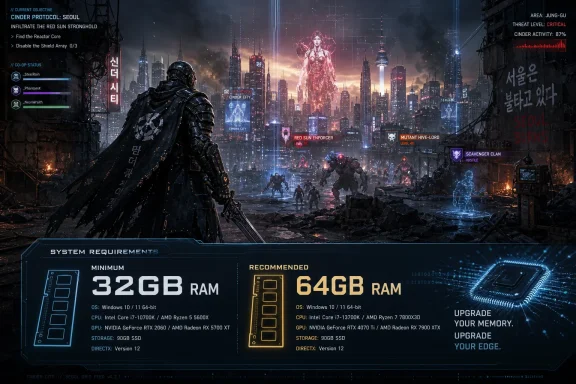 A Ruined Seoul Arrives With a Very Real PC Upgrade Bill
Cinder City is not being pitched as a modest shooter with a pretty skyline. NC and its development studio Big Fire Games are selling scale: a near-future Seoul broken by an alternate-history catastrophe, cinematic third-person combat, open-world traversal, cooperative PvE, instanced dungeons, field bosses, and large world raids. It is part shooter, part MMO, part Korean blockbuster spectacle, and part hardware stress test.The premise is pulpy in the best way. Seoul has fallen to mutated creatures, criminal organizations, and collapsing social order, while super-soldiers known as Cinder Knights remain one of humanity’s last lines of defense. The player takes on the role of Seven, a Cinder Knight whose search for his daughter Zoe begins in Samseong-dong and spirals outward into the secrets of a broken megacity.
That is the kind of setup that can justify enormous environments, heavy streaming, persistent activity, and piles of AI-controlled enemies. It also happens to be exactly the kind of setup that makes PC players nervous, because modern open-world games increasingly ship with more ambition than optimization. A 64GB recommendation does not merely say “this game is big.” It says the developer may be designing around assumptions that only a minority of gaming PCs currently meet.
The irony is that the rest of the recommended specification is not absurd. An Intel Core i7-12700 or Ryzen 7 7800X3D is strong but not exotic. An RTX 4060 with 8GB of VRAM is a mainstream GPU, not a halo card. The 50GB storage requirement is almost quaint in an era where some games sprawl past 150GB. It is the memory line that looks like it wandered in from a workstation spec sheet.
The 64GB Line Is More Than a Typo Until Someone Says Otherwise
The safest interpretation is also the most boring: this may be a placeholder, an overcautious early listing, or a mistake that will be revised before launch. Steam system requirements often change as games move from pre-release marketing to certification, performance profiling, and release candidate builds. Early PC requirement tables are not contracts; they are snapshots of where the build, the engine, and the publisher’s risk tolerance happen to be.But until NC or Big Fire Games clarifies it, the 64GB recommendation has to be treated as real. The Steam page separately lists 32GB as the minimum and 64GB as recommended, which makes it less likely to be a simple copy-paste error. It also pairs that memory demand with a relatively modest RTX 4060, suggesting the developers may be targeting a memory-heavy workload rather than simply describing a top-end graphics preset.
That distinction matters. A 64GB RAM recommendation is not the same kind of flex as demanding an RTX 5090 or a top-end Ryzen chip. GPU requirements usually map cleanly to resolution, frame rate, ray tracing, and texture settings. System memory requirements are murkier. They can signal large asset caches, aggressive world streaming, multiplayer simulation overhead, heavy background systems, memory leaks, poor optimization, or simply a desire to avoid support complaints from users running browsers, Discord, capture tools, and launchers alongside the game.
For Windows users, that last point is not trivial. A modern gaming PC is rarely just running a game. It is running Steam, overlays, RGB utilities, anti-cheat, voice chat, GPU software, browser tabs, monitoring tools, and sometimes a screen recorder. The number printed on a Steam page is not just about the executable. It is about the messy reality of a Windows desktop under load.
PC Gaming’s New Baseline Is Quietly Moving Again
For most of the last decade, 16GB of RAM was the comfortable recommendation for mainstream PC gaming. It was the point where Windows had room to breathe, modern games stopped thrashing, and users could leave a few background apps open without punishment. In the early 2020s, 32GB became the enthusiast sweet spot, especially for open-world games, simulation-heavy titles, content creation, and anyone tired of micromanaging browser tabs.Cinder City is notable because it appears to skip the social negotiation phase. It does not merely recommend 32GB while tolerating 16GB. It lists 32GB as the floor. That means a large number of otherwise competent gaming PCs, including systems with strong CPUs and GPUs, would technically fall below the minimum.
This is where the Steam Hardware Survey looms over the story, even without needing to turn the article into a spreadsheet. The PC market does not move in lockstep with developer ambition. Millions of players still treat 16GB as normal, and many laptops sold as gaming machines continue to ship with configurations that are difficult or impossible to upgrade. A 64GB recommendation is not just a spec; it is a filter.
That filter may not bite at launch if the game is well optimized and the requirement is conservative. Players have long run games below listed recommendations. But it does shape expectations. It tells reviewers what to test. It tells players what to fear. It tells system builders what to upsell. And it tells the broader industry that one more major game is willing to normalize a memory tier that recently belonged mostly to creators, developers, and people who keep 200 browser tabs open as a lifestyle.
The MMO Part Explains Some of the Hunger
The most plausible defense of Cinder City’s memory appetite is not its graphics, but its structure. Big Fire Games describes a game built around story missions, side missions, dynamic events, cooperative PvE, instanced dungeons, field bosses, and massive world raids. That combination pushes the title closer to the MMO end of the spectrum than a traditional campaign shooter.Large shared-world games have different pressure points from linear shooters. They need to stream geography, track mission states, handle multiple players, manage NPC behavior, cache assets for unpredictable encounters, and keep enough state around that the world feels alive instead of stitched together. If Cinder City really is attempting a dense, cinematic, open-world Seoul with MMO-scale combat encounters, memory could become the cushion that prevents constant loading and stutter.
That does not automatically justify 64GB. Plenty of online games run on far less. But it makes the number less ridiculous than it first appears. A dense urban open world is expensive because cities are full of hard edges, interiors, signage, vehicles, clutter, verticality, and sightlines that punish weak streaming systems. A ruined Seoul full of mutants and faction battles may be artistically compelling precisely because it is technically inconvenient.
The danger is that “massive open world” and “large-scale multiplayer” have become marketing phrases that can hide as much as they reveal. Players have been burned by games that promised persistent dynamism and delivered repetitive event loops. A high memory recommendation will be judged more charitably if the world actually feels dense, reactive, and populated. If it feels empty, the spec will become evidence in the prosecution.
Unreal Engine 5 Has Made Stutter a Consumer Issue
Cinder City has been associated with the current wave of high-fidelity, Unreal Engine 5-era development, and that broader context matters even if the Steam page itself is the immediate trigger. In recent years, PC players have grown wary of shader compilation stutter, traversal hitching, VRAM pressure, and asset streaming problems in visually ambitious games. The old question was whether a PC could hit 60 frames per second. The newer question is whether it can do so without freezing for a fraction of a second every time the world changes its mind.System RAM is only one part of that pipeline. GPU memory, storage speed, shader compilation strategy, CPU scheduling, engine-level streaming, and driver behavior all matter. But RAM is the most visible and easily misunderstood number. When a developer says 64GB, players often hear, “We could not make the streaming system fit inside a normal enthusiast PC.”
That may be unfair. It may also be a rational response to years of rough PC launches. The market has trained players to treat system requirements as clues about optimization quality. A high requirement can indicate ambition; it can also indicate brute force. The difference is rarely clear before release.
WindowsForum readers know this pattern well from the OS side. Windows itself has become better at memory management, but the perception of bloat never really leaves. Add a demanding game, a kernel-level anti-cheat driver, a launcher, and always-on overlays, and suddenly the “recommended” number feels less like a technical metric and more like an indictment of the whole stack.
The RTX 4060 Pairing Makes the Requirement Stranger
The recommended GPU is the most interesting detail after the RAM figure. If Cinder City recommended 64GB alongside a flagship GPU, the message would be simple: this is an ultra preset for people with money to burn. Instead, the Steam page recommends an RTX 4060 with 8GB of VRAM. That is a card sold into the mainstream, often paired with 16GB or 32GB of system memory.This mismatch creates a strange target machine. A player with a Ryzen 7 7800X3D, RTX 4060, and 64GB of RAM exists, but it is not the most common configuration. Many people who spend for 64GB also spend beyond an RTX 4060. Many RTX 4060 owners bought that GPU precisely because they were building or upgrading within a budget. For those users, doubling system memory may not have been part of the plan.
It also raises the possibility that the recommended spec is not describing a premium graphics mode at all. It may describe the developers’ preferred baseline for stable play in the intended multiplayer environment. In other words, 64GB may not be for prettier screenshots. It may be for fewer hitches, fewer out-of-memory crashes, and smoother world traversal under real-world conditions.
That would be a defensible engineering choice, but a risky commercial one. PC players are often willing to lower shadows, reduce post-processing, and sacrifice ray tracing. They are less happy when the answer is “buy more RAM,” because memory upgrades are unevenly distributed across the market. Desktop users may shrug. Laptop users may be trapped.
Windows 10 and Windows 11 Remain the Platform, but the Comfort Zone Changes
The Steam page lists Windows 10 and Windows 11, both in 64-bit form, which is expected but still worth noting. This is a PC-first requirement table for the modern Windows ecosystem, not an experiment aimed at Linux handhelds or low-power devices. There is no sign here that Cinder City is being designed around the Steam Deck class of hardware.That matters because the Windows gaming market is fragmenting. At the high end, users are buying CPUs with huge cache, GPUs with frame generation, and NVMe storage fast enough to make last-generation loading screens feel antique. At the low end, handheld PCs, older desktops, and midrange laptops are teaching developers that portability and efficiency still matter. Cinder City appears to be planting its flag firmly in the former camp.
For Windows 10 users, the listing is also a reminder that platform support is not the same as comfort. A game can support Windows 10 and still assume a modern desktop configuration. Microsoft’s older OS remains in the market, but the hardware paired with it varies wildly. Some Windows 10 machines are monsters. Others are aging systems that happen to meet the OS line but not much else.
For Windows 11 users, the issue is less compatibility than expectation. A modern Windows 11 gaming rig with 32GB of RAM feels current. If 64GB recommendations become more common, the upgrade cycle shifts again. Memory capacity becomes another dividing line between “runs new games” and “runs new games the way developers intend.”
NC Is Selling a Blockbuster, Not a Modest Experiment
NC’s involvement gives the story a different texture from the usual indie-spec surprise. This is not a tiny studio accidentally frightening players with a sloppy Steam page. NC has long experience with online worlds, RPG systems, and live-service infrastructure. Big Fire Games is not pitching a small tactical shooter; it is pitching a major online action game with global ambitions.That ambition cuts both ways. On one hand, NC understands persistent games better than many publishers trying to chase the multiplayer trend. On the other, the company’s history means players will scrutinize monetization, grind, server stability, and long-term support from day one. Hardware requirements are only the first trust test.
The developer preview emphasizes cinematic action, a massive world, and cooperative content. Those pillars are attractive because they promise a game with both authored drama and repeatable multiplayer structure. They are also difficult to balance. A story-driven shooter wants pacing, set pieces, and emotional focus. An MMO-like PvE game wants retention loops, buildcraft, raids, and social friction. An open world wants freedom. Each pillar pulls resources from the others.
That is why the memory story matters beyond the meme. A 64GB recommendation suggests Big Fire Games may be building for density and concurrency rather than restraint. If that ambition pays off, Cinder City could feel like a genuine next-generation shared-world shooter. If it does not, it risks becoming another expensive-looking live-service pitch whose technical demands arrive before its identity is proven.
The “First Game” Claim Is Less Important Than the Direction of Travel
The headline-friendly claim is that Cinder City may be the first game to recommend 64GB of RAM. That may be true in spirit, but “first” is always a dangerous word in PC gaming. Steam is enormous, requirements are user-editable by publishers, and obscure simulations, development tools, early-access builds, or niche titles can complicate any absolute claim. The safer observation is that this is one of the most visible and mainstream-facing examples of a 64GB recommended RAM spec for a game.That is enough. The significance is not the trophy. It is the normalization. Once a large publisher lists 64GB as recommended for a high-profile game, the number stops looking impossible. Other developers can point to it. Hardware vendors can market around it. Players can argue about it. The baseline moves not because every game requires it, but because the market starts treating it as reasonable.
This is how PC requirements evolve. They do not change evenly. One or two demanding games establish a new anxiety, then a handful of major releases make the anxiety ordinary. Eventually, the old “enthusiast” spec becomes the new “safe” spec, and everyone pretends it was inevitable.
The open question is whether 64GB is actually the next safe spec or merely an overcorrection for a particularly ambitious online world. For most PC games today, 32GB remains a strong and sensible target. But Cinder City is a warning that the upper edge is moving, especially for games that combine open worlds, multiplayer simulation, high-fidelity assets, and always-online systems.
Players Should Read the Spec as a Warning, Not a Verdict
Nobody should panic-buy RAM because of one unreleased game. Steam pages change, optimization continues late into development, and publishers sometimes choose inflated requirements to reduce complaints from borderline systems. The fact that Cinder City lists 64GB today does not prove it will be unplayable on 32GB at launch.But players should not ignore the signal either. A 32GB minimum is already aggressive. If accurate, it means the developer does not want to support the old 16GB mainstream baseline. That alone is a meaningful shift, especially for laptop buyers and anyone planning a PC build intended to last several years.
The practical advice is boring because the practical advice is correct: wait for benchmarks, watch memory usage under real play conditions, and pay attention to whether the game stutters because it is memory-limited, VRAM-limited, CPU-limited, or simply unfinished. RAM capacity solves some problems and does nothing for others. A 64GB kit will not fix bad shader compilation, weak netcode, or a poorly paced live-service loop.
Still, the listing changes the conversation around future-proofing. If you are building a new desktop in 2026 and planning to keep it for years, 32GB is the sensible floor and 64GB is no longer absurd for a high-end system. That does not mean every gamer needs it today. It means the old assumption that 16GB is “plenty” is increasingly hard to defend outside budget builds.
The Spec Sheet Says the Quiet Part Out Loud
Cinder City’s Steam page is useful because it compresses several years of PC gaming tension into one line of text. Players want bigger worlds, richer simulations, seamless co-op, cinematic fidelity, faster travel, fewer loading screens, and more persistent activity. Developers want to deliver all of that without spending years hand-optimizing for every configuration still alive in the Steam ecosystem. Something has to give.Historically, the thing that gave was graphics quality. Turn down textures, shadows, reflections, draw distance, and anti-aliasing, and a game could scale across a wide range of PCs. Modern open-world and multiplayer games are harder to scale because many costs are structural. If the world simulation, asset streaming, encounter density, or multiplayer state management assumes a large memory pool, the lower-end version is not just uglier. It may be less stable.
That is the uncomfortable part. PC gaming’s great promise is configurability, but some design choices are not easily reduced to a slider. A city either streams smoothly or it hitches. A raid either keeps enough assets ready or it pauses. A dynamic event system either tracks the world convincingly or it fakes it. More RAM can paper over those pressures, but it also shifts the burden from engineering to the buyer.
This is why Cinder City has become interesting before anyone outside controlled previews has played it. Its setting, combat, and story may turn out to be the real news later. For now, its most consequential creative choice is hidden in the requirements table: Big Fire Games appears willing to define its ideal PC experience around a memory pool many players still consider excessive.
The Upgrade Path Is Clearer Than the Game Itself
For Windows enthusiasts, the near-term response is not complicated. Desktop DDR4 and DDR5 memory pricing fluctuates, but RAM remains one of the more straightforward upgrades if the motherboard has free slots and the platform supports the capacity. The problem is not technical difficulty; it is whether one unreleased game should influence a purchasing decision.For sysadmins and IT pros who also game, there is a familiar echo here. The consumer PC is inheriting the resource assumptions of professional workloads: more background services, more telemetry, more resident tools, more memory-hungry apps, more concurrent tasks. A gaming machine is increasingly a general-purpose performance workstation that happens to launch Steam at night.
That does not mean developers get a free pass. Optimization remains a product feature. A game that requires 64GB should earn that requirement visibly, through density, stability, scale, and responsiveness. If the result is merely another pretty but stutter-prone open world, players will rightly conclude that the spec was not ambition but waste.
The burden is now on NC and Big Fire Games to explain, demonstrate, or revise the number. A developer note could help. So could a more detailed requirements table that distinguishes 1080p, 1440p, 4K, ray tracing, frame generation, and multiplayer raid scenarios. The single “recommended” column is too blunt for a game that appears to be technically complex.
The Real Test Comes When Seoul Starts Streaming
The most concrete lesson from the Cinder City listing is not that every PC gamer needs 64GB immediately. It is that developers are beginning to treat large memory pools as a practical answer to the complexity of modern game worlds. That should make players curious, skeptical, and patient.- Cinder City currently lists 32GB of RAM as its minimum and 64GB as its recommended memory requirement on Steam.
- The rest of the recommended PC specification is comparatively mainstream, especially the RTX 4060 GPU requirement.
- The game’s open-world Seoul, cooperative PvE structure, dynamic events, dungeons, field bosses, and world raids offer plausible reasons for heavy system memory use.
- The requirement may still change before launch, and players should wait for independent benchmarks before upgrading for this game alone.
- A 32GB minimum is already a stronger signal than the 64GB recommendation, because it suggests 16GB gaming PCs may fall outside the intended support target.
- If the final game visibly delivers density, scale, and smooth streaming, the requirement will look ambitious; if it does not, it will look like poor optimization with a price tag.
References
- Primary source: Wccftech
Published: 2026-07-01T08:20:14.984931
Cinder City's Steam Page Is Out, and This May Be the First Game to Recommend a Staggering 64GB of RAM
Cinder City’s Steam page is live, and the MMO third person shooter game could be among the first to recommend a massive 64GB of RAM.wccftech.com
- Related coverage: store.steampowered.com
CINDER CITY on Steam
CINDER CITY is an open-world cinematic third-person shooter set in a fallen near-future Seoul. Fight alongside allies, push back against overwhelming threats, and reclaim the city from the forces tearing it apart.store.steampowered.com
- Related coverage: mmorpg.com
NC Shares First Developer Preview for Open-World Sci-Fi TPS Cinder City | MMORPG.com
Cinder City, an upcoming sci-fi third-person shooter from developer Bigfire Games and published by NC gets a first developer preview showing its dystopian Seoul setting and multiplayer, open-world PvE gameplay.www.mmorpg.com - Related coverage: invenglobal.com
NC's Shooter 'CINDER CITY' Unveils First Developer Preview and Steam Page - Inven Global
NC's development studio, Bigfire Games, has begun introducing its new shooter, 'CINDER CITY,' by releasing its first developer preview video and launching a Steam page.On the 30th,...www.invenglobal.com - Related coverage: cogconnected.com
CINDER CITY Steam Page Goes Live as BigFire Games Shares New Developer Preview - COGconnected
BigFire Games and NC have officially launched the Steam page for CINDER CITY and released a brand-new developer preview video. cogconnected.com
- Related coverage: nevermoreniche.com
Cinder City Gets Developer Preview Video
Cinder City is an ambitious title that's coming to Steam from NC, and today, a special video from the team breaks it down.nevermoreniche.com
- Related coverage: en.gamegpu.com
Ray tracing and DLSS 4.5 will be the foundation of Cinder City's graphics.
The shooter Cinder City will offer players support for ray tracing and DLSS 4.5 upscaling in a post-apocalyptic open world.en.gamegpu.com
- Related coverage: cdn.steamstatic.com
- Related coverage: shared.steamstatic.com
- Related coverage: kingsporttn.gov