

CISA Turns a Middleware Bug into a Deadline
The most important thing about CISA’s announcement is not its length. It is the bureaucratic force behind it. The Known Exploited Vulnerabilities catalog is not a blog roll of scary CVEs; under Binding Operational Directive 22-01, it is the federal government’s enforceable list of bugs that agencies must remediate by assigned due dates.
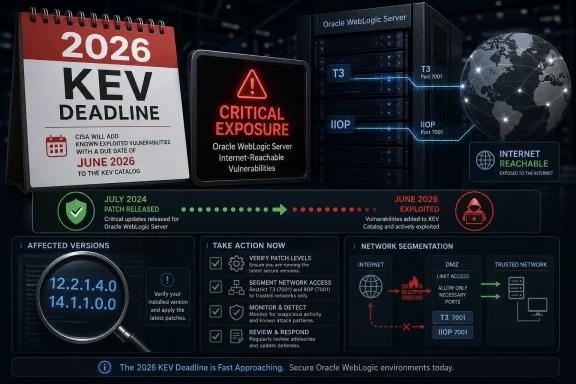
That distinction matters because CVE-2024-21182 was not disclosed today. Oracle addressed it in the July 2024 Critical Patch Update, where it appeared as a WebLogic Server Core vulnerability affecting supported versions 12.2.1.4.0 and 14.1.1.0.0. Its addition to the KEV catalog on June 1, 2026, means the risk has crossed from theoretical exposure to observed exploitation.
For system owners, this is the moment when vulnerability management stops being a spreadsheet exercise. A CVSS 7.5 flaw can sit below a parade of 9.8s in a dashboard, but KEV status changes the practical math. Exploitation evidence is a better signal than severity branding, especially in environments where patch windows are scarce and every maintenance outage has to be negotiated.
CISA’s language is deliberately spare. It does not name the threat actors, describe exploit chains, or publish indicators of compromise in the alert. That restraint is common for KEV additions, but it also means defenders should avoid drawing comfort from missing details. The absence of a public exploit narrative is not evidence that exploitation is narrow, unsophisticated, or irrelevant.
WebLogic Remains the Kind of Target Attackers Do Not Forget
Oracle WebLogic occupies an awkward place in enterprise computing: too important to casually replace, too complex to casually secure, and often too old to receive the attention lavished on flashier cloud-native stacks. It sits behind portals, business applications, identity workflows, and integration layers that were built to last. Attackers like that kind of software because it tends to be exposed, privileged, and operationally sticky.
CVE-2024-21182 affects the WebLogic Server Core component and is reachable over network protocols including T3 and IIOP. Oracle’s own risk matrix described it as remotely exploitable without authentication, with low attack complexity and no user interaction. In plain English, the wrong exposed service can give an unauthenticated attacker a path to data they should never see.
The flaw’s advertised impact is primarily confidentiality. Successful exploitation can allow unauthorized access to critical data, or potentially to all data accessible through the WebLogic Server instance. That makes it different from the loudest WebLogic bugs of the past, which were often framed around remote code execution, but it does not make it harmless.
Data access is the prize in many modern intrusions. Ransomware crews, espionage operators, and initial-access brokers do not need every bug to hand them a shell if the vulnerable application can reveal secrets, credentials, business records, or internal topology. A confidentiality-only impact can still become the first step in a broader compromise when the compromised application is deeply wired into the rest of the enterprise.
The CVSS Score Undersells the Operational Risk
Security teams have spent years being told to prioritize by severity, and then years being told that severity is not enough. CVE-2024-21182 is a neat example of why both statements are true. A 7.5 score is high, but not catastrophic on paper; KEV status says attackers have already done the more important scoring in the real world.
CVSS is useful as a common language. It tells defenders that the vulnerability is network-accessible, requires no privileges, has low attack complexity, and does not require a victim to click anything. Those traits should already push it toward the front of a patch queue, especially if T3 or IIOP services are reachable from untrusted networks.
But CVSS does not know whether a particular organization has an abandoned WebLogic instance in a DMZ, a legacy line-of-business application with no owner, or a brittle cluster that everyone is afraid to reboot. It does not know whether the same server has access to customer records, HR data, payment workflows, or identity infrastructure. It cannot tell the difference between a lab server and a forgotten crown-jewel dependency.
KEV partially corrects that blindness. It adds the missing fact that someone, somewhere, is using the vulnerability offensively. That does not mean every WebLogic server is under active attack this afternoon, but it does mean defenders should stop treating the bug as one item among thousands.
Oracle Patched the Bug Long Before CISA Raised the Flag
One uncomfortable detail in this alert is the timeline. Oracle published the relevant fix in July 2024. CISA added the vulnerability to KEV in June 2026. That gap is not unusual in vulnerability management, but it is damning in its own quiet way.
Enterprises often defend slow patching as a form of prudence. Middleware updates can break applications, require regression testing, collide with vendor support matrices, or trigger change-control headaches across multiple business units. Those are real constraints, and anyone who has patched a production Java application stack knows that “just update” is rarely a complete sentence.
Still, attackers benefit from the same calendar. Once a vendor advisory names affected versions and protocols, defenders are not the only audience reading it. Even when exploit details are not public on day one, the disclosure narrows the search space for capable operators. Over time, reverse engineering, proof-of-concept work, and opportunistic scanning can turn a patched vulnerability into a reliable weapon against laggards.
This is the long tail that KEV exposes. A patch released in 2024 can become an emergency in 2026 because enough exposed systems remained vulnerable to make exploitation worthwhile. The industry likes to talk about zero-days, but a great deal of real compromise still flows through known bugs with known fixes.
The Protocol Detail Is the Clue Administrators Should Not Skip
The mention of T3 and IIOP is not trivia. WebLogic’s T3 protocol has appeared in multiple past security incidents because it is central to WebLogic’s internal and remote communication model. IIOP, used for CORBA interoperability, is similarly not the kind of thing most organizations want casually reachable from the internet.
For administrators, protocol exposure should be the first triage question after version identification. A vulnerable WebLogic server with T3 or IIOP exposed to untrusted networks represents a different level of urgency than an isolated instance behind strict network controls. Patch status matters most, but exposure determines who gets to try the door.
Network segmentation is not a substitute for patching, particularly once a vulnerability is in KEV. It is, however, the difference between a race and a controlled maintenance plan. Organizations that already restrict administrative and application protocols to narrow trust zones have more room to maneuver than those that allow legacy middleware to sit directly on the public edge.
The practical advice is blunt: find the WebLogic servers, identify the versions, map protocol exposure, and apply the Oracle Critical Patch Update or supported mitigation path. If an instance cannot be patched immediately, it should be treated as an exception with executive visibility, compensating controls, logging, and a hard deadline. “We will get to it eventually” is not a mitigation strategy.
Federal Compliance Is the Floor, Not the Ceiling
BOD 22-01 applies to Federal Civilian Executive Branch agencies, but CISA’s KEV catalog has become a de facto priority list far beyond government. Insurers, auditors, managed security providers, and enterprise security teams use it because it filters the endless CVE stream down to vulnerabilities with observed exploitation. That makes it useful even when the directive itself has no legal force.
Private-sector organizations should resist the temptation to read the federal mandate too narrowly. If attackers are exploiting a WebLogic vulnerability against someone, they are not likely to stop at agency boundary lines. Internet exposure, valuable data, and unpatched software are more important to attackers than sector labels.
The federal deadline model also exposes a useful governance pattern. A KEV addition should not merely generate a ticket; it should trigger a defined workflow. Asset owners should be identified, risk exceptions should be reviewed, patch status should be verified, and security teams should confirm that remediation actually landed on the systems in scope.
That last step is where many organizations stumble. Patch management reports often show intent rather than reality. WebLogic deployments can include clustered nodes, cloned environments, test systems that quietly became production dependencies, and vendor-managed appliances that fall outside normal endpoint tooling. Verification is the difference between closing a ticket and reducing risk.
Windows Shops Should Care About a Java Middleware Alert
At first glance, an Oracle WebLogic alert may seem outside the core WindowsForum lane. It is not a Windows vulnerability, and Microsoft is not the vendor at the center of the story. But many Windows-heavy enterprises run WebLogic as part of larger application stacks, and Windows administrators are often responsible for the servers, firewalls, identity integration, certificates, monitoring, and incident response around those applications.
The modern Windows environment is rarely just Windows. Active Directory may authenticate users into Java applications. SQL Server or Oracle Database may sit behind them. Windows Server may host adjacent services, scheduled jobs, file shares, or management tooling that interact with the WebLogic tier. A compromise in middleware can become a Windows problem very quickly if credentials, service accounts, or trusted network paths are exposed.
That is especially true for older enterprise applications. The business unit may think of the application as a finance portal, a case-management system, a procurement workflow, or a customer service platform. The infrastructure team may think of it as a VM pair that nobody wants to touch. Attackers think of it as an address, a version, a protocol, and a path inward.
For Windows admins, the action item is not to become WebLogic specialists overnight. It is to make sure Java middleware assets are visible in the same risk conversations as domain controllers, Exchange servers, VPN concentrators, and endpoint management platforms. If it can expose business data or authenticate against enterprise identity, it belongs in the security inventory.
The Real Failure Is Asset Amnesia
Every KEV addition carries an implied accusation: somewhere, a known vulnerable system remained exploitable long enough to matter. Sometimes that is because patches were unavailable, mitigations were unclear, or vendors moved too slowly. In this case, the core patch lineage traces back to Oracle’s July 2024 CPU, which means the harder question is whether organizations knew they still had vulnerable WebLogic at all.
Asset amnesia is more dangerous than patch delay. A team can manage a known risk, escalate it, isolate it, and plan around it. An unknown WebLogic instance, built years ago for a project that changed owners three times, will not appear in a remediation dashboard unless discovery is honest and broad.
Legacy middleware also falls through organizational seams. Application teams assume infrastructure owns the server. Infrastructure assumes the application team owns the runtime. Security sees a scanner result but lacks the business context to force downtime. Vendors may manage the software under contract, but only within the boundaries of a support agreement that nobody has read since renewal.
CISA’s KEV catalog is useful precisely because it cuts through that ambiguity. It says: whatever your internal ownership model, this vulnerability is being exploited. That should be enough to convene the right people before an attacker does the mapping for you.
A Small CISA Alert Carries a Large Operational Message
CISA added only one vulnerability in this update, but single-CVE alerts can be more revealing than bulk drops. They force attention onto a specific product and a specific class of enterprise exposure. In this case, the product is WebLogic, the exposure is unauthenticated network access, and the risk is unauthorized access to sensitive data.
The immediate operational reading is straightforward:
- Organizations running Oracle WebLogic Server 12.2.1.4.0 or 14.1.1.0.0 should verify whether the July 2024 Critical Patch Update or later applicable fixes have been applied across all environments.
- Security teams should treat KEV status as a higher-priority signal than the CVSS score alone, because it indicates observed exploitation rather than theoretical severity.
- Administrators should review whether T3 and IIOP are exposed beyond trusted networks and restrict access wherever business requirements allow.
- Vulnerable systems that cannot be patched quickly should receive documented compensating controls, enhanced monitoring, and a dated remediation plan.
- Windows-centric IT teams should include Java middleware and Oracle Fusion Middleware assets in enterprise vulnerability management, because identity, data access, and lateral movement rarely respect platform boundaries.
These are not glamorous tasks, but they are the work that separates resilient operations from security theater. The hardest part is not understanding the CVE. It is finding every place the affected software still runs and proving the fix is actually in place.
CVE-2024-21182 is another reminder that the most dangerous vulnerability in an enterprise is often not the newest one, but the one that survived two years of patch cycles, ownership drift, and postponed maintenance. CISA’s catalog does not eliminate that problem; it makes it harder to ignore. The organizations that fare best will be the ones that treat KEV additions not as compliance noise, but as a live-fire test of whether their asset inventory, patch process, and network boundaries still reflect reality.