

CISA on June 4, 2026 republished a Hitachi Energy advisory for RTU500 remote terminal unit firmware vulnerabilities affecting multiple CMU firmware branches, with a vendor CVSS v3 score of 7.8 and impacts centered on device availability across deployments in dams, energy, water, and wastewater environments. The advisory is not a Windows story in the narrow desktop sense, but it is very much a WindowsForum story in the infrastructure sense: the systems that run quietly behind enterprise operations are increasingly where patch discipline, network segmentation, and incident response are tested. For administrators who spend their days thinking about endpoints, VPNs, domain boundaries, and firewall rules, this is another reminder that the perimeter has stretched far beyond laptops and servers. The lesson is blunt: operational technology does not get safer just because it is supposed to be isolated.
The latest public notice is a CISA republication of Hitachi Energy PSIRT advisory 8DBD000252, initially released by the vendor on May 26, 2026 and republished by CISA on June 4, 2026. That distinction matters. CISA is not presenting this as newly discovered government research; it is amplifying a vendor advisory in Common Security Advisory Framework form to widen visibility among critical infrastructure operators.
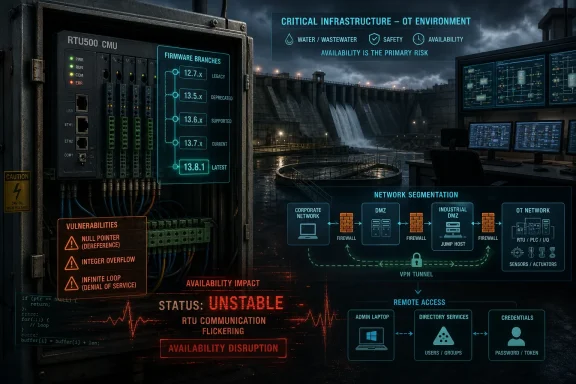
The advisory names Hitachi Energy’s RTU500 series CMU firmware as the affected product family, with vulnerable versions across several maintained branches. The affected ranges include 12.7.1 through 12.7.7, 13.5.1 through 13.5.4, 13.6.1 through 13.6.3, 13.7.1 through 13.7.8, and version 13.8.1, with the advisory text also repeating a 13.7.1 through 13.7.7 range for some of the listed CVEs. That repetition is probably an artifact of the CSAF conversion, but the practical message is not ambiguous: operators should inventory RTU500 CMU firmware rather than assume that a recent 13.x build is safe.
The named vulnerability classes are familiar to software engineers and worrying to control-system operators: null pointer dereference, integer overflow or wraparound, and an infinite-loop condition. In ordinary enterprise software, those bugs might mean a crashed process, a service restart, or an alert in a monitoring console. In a remote terminal unit used for substations, water facilities, dams, or distributed industrial processes, availability is not a convenience feature. It is the point of the product.
CISA’s summary says exploitation primarily affects availability, with potential secondary consequences for confidentiality and integrity. That phrasing should not be read as comforting. In OT, a denial-of-service condition can become a physical-world incident when the affected device is part of a telemetry, control, or safety-adjacent workflow.
That is why the RTU500 advisory deserves more attention than its CVSS score alone might attract. A 7.8 high-severity rating does not scream in the same way a 9.8 internet-facing remote code execution bug does. But severity scoring was never a substitute for context, and the context here is critical infrastructure.
Hitachi Energy lists the affected equipment as deployed worldwide, with exposure across dams, energy, water, and wastewater sectors. Those are not abstract verticals. They are the systems that decide whether electricity flows, water treatment continues, reservoir instrumentation remains visible, and operators can trust what their control screens are telling them.
The most important sentence in the advisory is not the CVSS number. It is the line that says exploitation primarily affects availability. In enterprise IT, availability incidents are often measured in missed service-level objectives and angry executives. In industrial environments, availability failures can force manual workarounds, degrade situational awareness, or trigger conservative shutdown behavior.
What changes the risk profile is where the code runs. Embedded industrial devices often have long deployment lives, conservative update cycles, and operational dependencies that make rapid patching difficult. Firmware updates may require maintenance windows, vendor coordination, site access, staged testing, or rollback planning that looks nothing like pushing a cumulative update to a Windows fleet.
A null pointer dereference may sound mundane, but it can still crash a process or destabilize a device if reachable through the wrong interface. An integer overflow can produce unexpected behavior when arithmetic crosses a boundary the developer did not anticipate. An infinite loop can consume processing time until a device becomes unresponsive or functionally unavailable.
The advisory does not describe weaponized exploitation in the wild, and it does not claim that attackers can seize control of equipment. That restraint is important. But it also should not tempt administrators into thinking this is merely theoretical. Availability bugs are frequently attractive because they are easy to explain, easy to trigger once understood, and hard for operators to ignore.
For Windows admins used to KB numbers, update rings, WSUS approvals, Intune compliance policies, or Defender vulnerability recommendations, OT firmware advisories can feel frustratingly manual. The asset inventory has to be right before the patch plan can even begin. The same product family may be running different firmware branches across different sites because of project timing, certification constraints, or integration dependencies.
This is where the work becomes less about reading the advisory and more about interrogating the environment. Which RTU500 units are deployed? Which CMU firmware versions are they actually running? Which systems can reach them? Which management interfaces are enabled? Which maintenance laptops and jump hosts are trusted to administer them?
The advisory’s repetition should therefore be treated as a prompt, not a clerical annoyance. If your organization owns or supports RTU500 deployments, assume the only safe answer is a verified inventory, not a spreadsheet last updated during commissioning.
The reason the recommendations repeat is that the same architectural failures keep turning product vulnerabilities into incidents. Industrial operators may believe a device is isolated because it is not intentionally exposed to the internet. Then a flat network, a dual-homed engineering workstation, a forgotten modem, a remote vendor support path, or an over-permissive firewall rule quietly disproves the assumption.
The advisory also includes the standard warning that VPNs are only as secure as the connected devices and that VPN software itself must remain updated. That sentence has gained weight over the last several years as edge appliances, remote access gateways, and identity systems have become favorite targets. A VPN is not a magical moat. It is another managed technology with its own attack surface.
For Windows-heavy shops, the OT boundary often runs through very familiar territory. Active Directory accounts may be used for jump hosts. Windows engineering workstations may run configuration tools. File shares may hold firmware packages and backups. Remote desktop gateways may sit between corporate IT and plant-floor networks. The RTU may not run Windows, but the route to it often does.
Vendors need remote support. Operators need telemetry. Engineers need configuration access. Compliance teams need logs. Management wants dashboards. Cloud analytics, predictive maintenance, and centralized monitoring all add pressure to connect systems that were once deliberately hard to reach.
None of that is inherently reckless. Better visibility can improve reliability and safety. But connectivity changes the threat model, and too many organizations adopt the connectivity first and update the threat model later. The RTU500 advisory is a useful test case because the recommended mitigations are almost entirely architectural: exposure reduction, segmentation, firewalling, controlled remote access, and risk assessment.
That is the quiet truth of many OT vulnerabilities. The patch matters, but the network design decides whether the bug is reachable in the first place. A vulnerable RTU behind strict segmentation, monitored access paths, and controlled engineering workflows is a very different risk from the same firmware sitting one misconfigured NAT rule away from the wider internet.
Firmware updates can carry operational risk. They may require field validation, redundancy checks, coordination with control-room staff, and fallback procedures. Some sites may have limited windows where equipment can be touched. Others may require vendor involvement or specialized personnel. The result is that a high-severity advisory can sit in limbo while teams debate whether the patch risk is more immediate than the vulnerability risk.
That debate is understandable, but it cannot become paralysis. CISA specifically reminds organizations to perform impact analysis and risk assessment before deploying defensive measures. That language is not an invitation to postpone indefinitely. It is a reminder that OT patching needs a procedure mature enough to evaluate both cyber risk and operational risk without pretending either one does not exist.
A serious RTU500 response should therefore split the work into parallel tracks. One team should verify affected versions and vendor remediation options. Another should validate network exposure and access paths. A third should confirm monitoring, logging, and incident escalation procedures. If all the organization does is forward the advisory to an overworked plant engineer, it has not responded.
The engineering laptop matters. The jump server matters. The domain trust model matters. The patch level of the VPN client matters. The firewall management workstation matters. The file server holding configuration exports matters. An attacker targeting availability in an industrial setting may not begin at the RTU. They may begin with the everyday IT infrastructure that has a path to it.
This is especially relevant for organizations that have converged IT and OT responsibilities without converging their risk models. A corporate endpoint compromise may be treated as contained if the attacker did not reach sensitive business data. But if that endpoint has cached credentials, remote access rights, or tooling for a control network, the real exposure may sit somewhere the IT incident report barely mentions.
Windows admins do not need to become power engineers to contribute meaningfully here. They need to understand which Windows systems bridge business and control environments, how privileged access is governed, where remote access terminates, and whether routine enterprise compromises could become OT footholds. That is not vendor-specific work. It is basic boundary hygiene.
In control systems, availability is often the first security property that matters. If an operator cannot communicate with a remote device, cannot trust telemetry, or cannot rely on automated behavior, the system moves into a degraded state. That degraded state may still be safe, but it is less efficient, less visible, and more dependent on manual intervention.
The Hitachi Energy advisory captures that hierarchy. The primary impact is availability, with possible secondary impacts on confidentiality and integrity. That ordering should guide remediation. The goal is not merely to prevent data loss. The goal is to preserve operational continuity and keep the control environment predictable.
Denial-of-service conditions also have an asymmetric quality. Attackers may need only a small amount of knowledge to create repeated disruption, while defenders must coordinate engineering, operations, incident response, and vendor support to restore confidence. That asymmetry is why availability bugs in industrial devices deserve faster attention than their generic descriptions sometimes receive.
But machine-readable does not always mean human-readable. The advisory text as presented is dense, repetitive, and not especially friendly to an operator trying to make a quick triage decision. CVE lists repeat. Version ranges overlap. Product identifiers appear in a syntax closer to vulnerability database logic than operational prose.
This is the tradeoff of automated advisory conversion. It can increase speed and consistency, but it may also push interpretation onto already busy defenders. For large organizations, that is manageable if vulnerability intelligence teams normalize the data before it reaches plant operations. For smaller utilities and infrastructure operators, the advisory may arrive as a wall of text and a vague sense of urgency.
The industry should not abandon CSAF because of that friction. It should build better translation layers. A good advisory should be both machine-actionable and operationally legible: affected versions, fixed versions, exposure conditions, likely impacts, and immediate compensating controls should be unmistakable to both software and humans.
But the absence of public exploitation is not the same as safety. Industrial vulnerability disclosure can alter attacker incentives by naming affected products, firmware ranges, and bug classes. Even when technical details are limited, adversaries can begin looking for exposed devices, vulnerable branches, and organizations slow to remediate.
This is especially true for high-value sectors. Dams, energy, water, and wastewater are not ordinary targets. They attract criminal extortion attempts, state-linked probing, hacktivist attention, and opportunistic scanning from actors who may not fully understand the physical consequences of disruption. The risk is not just that an elite adversary weaponizes the exact CVEs tomorrow. It is that known weaknesses accumulate in environments where change is slow.
A defensible response does not require panic. It requires not treating “no known exploitation” as a reason to wait until exploitation is known. By then, the organization may be responding under pressure, with fewer maintenance options and more stakeholders watching.
The advisory recommends minimizing network exposure for all control-system devices and ensuring they are not accessible from the internet. That may sound obvious, but internet exposure is only the most embarrassing failure mode. A segmented device can still be reachable through a compromised jump host. A firewall can still allow too much. A VPN can still authenticate users who should not have access to the OT environment.
The second practical question is whether asset owners can identify the firmware version without disrupting operations. Mature environments should already have that visibility. Less mature environments may discover that their asset inventory is incomplete, stale, or maintained separately by engineering teams and central IT.
The third question is whether the organization has a tested update process. In industrial settings, “apply the update” is not a sentence; it is a project. The right answer may involve lab validation, staged deployment, redundant path checks, scheduled maintenance, and formal acceptance from operations.
That advice can feel generic until an actual vulnerability lands in an actual deployed product. Then every line becomes a test. Are control systems truly separated from business networks? Are firewall rules minimal or merely inherited? Are portable computers scanned before connection, or is that policy language no one enforces? Are process-control systems protected from casual browsing, or do operators use whatever workstation is nearby?
The RTU500 advisory is therefore less a one-off firmware notice than an audit prompt. It gives organizations a concrete reason to examine whether their written OT security posture matches reality. If the answer is uncomfortable, the vulnerability has already provided value by exposing governance gaps before an incident does.
For Windows-centric administrators, this is also a moment to look at identity. Shared accounts, overbroad VPN groups, stale vendor credentials, unmanaged local administrator passwords, and weak logging are not OT-specific sins. They are familiar enterprise problems that become more dangerous when they cross into control environments.
A firmware vulnerability in an RTU is not something a Windows admin can fix with Group Policy. Nor is it something a plant engineer should be left to handle without network, identity, and incident-response support. The right response is shared: inventory from OT, segmentation from network teams, access control from identity teams, monitoring from security operations, and operational signoff from the people responsible for uptime.
That shared responsibility is also where many organizations are weakest. Budget lines, reporting structures, and toolchains often separate the people who understand the process from the people who understand the attack path. Advisories like this one force those groups into the same room, because a vulnerable field device and an overprivileged remote access path are not separate risks. They are one scenario.
The future of industrial security will not be decided by advisories alone. It will be decided by whether organizations can turn advisories into repeatable action while preserving the reliability that made these systems conservative in the first place. The RTU500 notice is a high-severity warning about specific firmware defects, but its broader message is more durable: critical infrastructure cannot rely on obscurity, isolation folklore, or paperwork segmentation. It needs verified inventories, controlled access, tested patch paths, and IT teams that understand where their Windows estate quietly touches the physical world.
 CISA’s Republication Turns a Vendor Advisory Into an Operational Deadline
The latest public notice is a CISA republication of Hitachi Energy PSIRT advisory 8DBD000252, initially released by the vendor on May 26, 2026 and republished by CISA on June 4, 2026. That distinction matters. CISA is not presenting this as newly discovered government research; it is amplifying a vendor advisory in Common Security Advisory Framework form to widen visibility among critical infrastructure operators.The advisory names Hitachi Energy’s RTU500 series CMU firmware as the affected product family, with vulnerable versions across several maintained branches. The affected ranges include 12.7.1 through 12.7.7, 13.5.1 through 13.5.4, 13.6.1 through 13.6.3, 13.7.1 through 13.7.8, and version 13.8.1, with the advisory text also repeating a 13.7.1 through 13.7.7 range for some of the listed CVEs. That repetition is probably an artifact of the CSAF conversion, but the practical message is not ambiguous: operators should inventory RTU500 CMU firmware rather than assume that a recent 13.x build is safe.
The named vulnerability classes are familiar to software engineers and worrying to control-system operators: null pointer dereference, integer overflow or wraparound, and an infinite-loop condition. In ordinary enterprise software, those bugs might mean a crashed process, a service restart, or an alert in a monitoring console. In a remote terminal unit used for substations, water facilities, dams, or distributed industrial processes, availability is not a convenience feature. It is the point of the product.
CISA’s summary says exploitation primarily affects availability, with potential secondary consequences for confidentiality and integrity. That phrasing should not be read as comforting. In OT, a denial-of-service condition can become a physical-world incident when the affected device is part of a telemetry, control, or safety-adjacent workflow.
The RTU Is Where Cybersecurity Becomes Physics
A remote terminal unit is not glamorous computing hardware. It is a field device that collects signals, communicates status, and often sits between control centers and the equipment that actually moves, switches, measures, opens, closes, pumps, and reports. RTUs are common in environments where distance, uptime, and predictable behavior matter more than sleek user interfaces.That is why the RTU500 advisory deserves more attention than its CVSS score alone might attract. A 7.8 high-severity rating does not scream in the same way a 9.8 internet-facing remote code execution bug does. But severity scoring was never a substitute for context, and the context here is critical infrastructure.
Hitachi Energy lists the affected equipment as deployed worldwide, with exposure across dams, energy, water, and wastewater sectors. Those are not abstract verticals. They are the systems that decide whether electricity flows, water treatment continues, reservoir instrumentation remains visible, and operators can trust what their control screens are telling them.
The most important sentence in the advisory is not the CVSS number. It is the line that says exploitation primarily affects availability. In enterprise IT, availability incidents are often measured in missed service-level objectives and angry executives. In industrial environments, availability failures can force manual workarounds, degrade situational awareness, or trigger conservative shutdown behavior.
The Bug Classes Are Old, but the Environment Makes Them New Again
The vulnerability categories in this advisory are not exotic. Null pointer dereferences and integer overflows are the kind of memory-safety defects that have haunted C, C++, embedded systems, networking appliances, and operating systems for decades. Infinite loops are even more conceptually simple: the software gets stuck doing something it cannot escape.What changes the risk profile is where the code runs. Embedded industrial devices often have long deployment lives, conservative update cycles, and operational dependencies that make rapid patching difficult. Firmware updates may require maintenance windows, vendor coordination, site access, staged testing, or rollback planning that looks nothing like pushing a cumulative update to a Windows fleet.
A null pointer dereference may sound mundane, but it can still crash a process or destabilize a device if reachable through the wrong interface. An integer overflow can produce unexpected behavior when arithmetic crosses a boundary the developer did not anticipate. An infinite loop can consume processing time until a device becomes unresponsive or functionally unavailable.
The advisory does not describe weaponized exploitation in the wild, and it does not claim that attackers can seize control of equipment. That restraint is important. But it also should not tempt administrators into thinking this is merely theoretical. Availability bugs are frequently attractive because they are easy to explain, easy to trigger once understood, and hard for operators to ignore.
The Repeated Version Ranges Signal the Real Work Ahead
One of the more awkward details in the advisory is the way the affected firmware ranges and CVE list appear repeated. The listed CVEs include CVE-2025-69421, CVE-2026-24515, CVE-2026-25210, CVE-2026-32776, CVE-2026-32777, CVE-2026-32778, and CVE-2026-8479, repeated across multiple version groupings. That is not elegant reading, but it reflects a real problem for defenders: industrial advisories often arrive as version matrices, not as a single patch-this-now instruction.For Windows admins used to KB numbers, update rings, WSUS approvals, Intune compliance policies, or Defender vulnerability recommendations, OT firmware advisories can feel frustratingly manual. The asset inventory has to be right before the patch plan can even begin. The same product family may be running different firmware branches across different sites because of project timing, certification constraints, or integration dependencies.
This is where the work becomes less about reading the advisory and more about interrogating the environment. Which RTU500 units are deployed? Which CMU firmware versions are they actually running? Which systems can reach them? Which management interfaces are enabled? Which maintenance laptops and jump hosts are trusted to administer them?
The advisory’s repetition should therefore be treated as a prompt, not a clerical annoyance. If your organization owns or supports RTU500 deployments, assume the only safe answer is a verified inventory, not a spreadsheet last updated during commissioning.
CISA’s Boilerplate Is Boring Because It Is Usually Right
Every CISA industrial advisory contains a familiar set of recommendations: minimize network exposure, keep control systems off the public internet, place control networks behind firewalls, isolate them from business networks, and use secure remote-access methods such as VPNs when remote access is required. It is easy to skim past these lines because they appear so often. That would be a mistake.The reason the recommendations repeat is that the same architectural failures keep turning product vulnerabilities into incidents. Industrial operators may believe a device is isolated because it is not intentionally exposed to the internet. Then a flat network, a dual-homed engineering workstation, a forgotten modem, a remote vendor support path, or an over-permissive firewall rule quietly disproves the assumption.
The advisory also includes the standard warning that VPNs are only as secure as the connected devices and that VPN software itself must remain updated. That sentence has gained weight over the last several years as edge appliances, remote access gateways, and identity systems have become favorite targets. A VPN is not a magical moat. It is another managed technology with its own attack surface.
For Windows-heavy shops, the OT boundary often runs through very familiar territory. Active Directory accounts may be used for jump hosts. Windows engineering workstations may run configuration tools. File shares may hold firmware packages and backups. Remote desktop gateways may sit between corporate IT and plant-floor networks. The RTU may not run Windows, but the route to it often does.
The Air Gap Is Now More Myth Than Method
Industrial cybersecurity conversations still suffer from the ghost of the air gap. The idea is comforting: critical systems are separate, therefore internet-era threats are less relevant. In practice, few modern facilities are truly isolated, and even fewer remain isolated over the lifetime of the equipment.Vendors need remote support. Operators need telemetry. Engineers need configuration access. Compliance teams need logs. Management wants dashboards. Cloud analytics, predictive maintenance, and centralized monitoring all add pressure to connect systems that were once deliberately hard to reach.
None of that is inherently reckless. Better visibility can improve reliability and safety. But connectivity changes the threat model, and too many organizations adopt the connectivity first and update the threat model later. The RTU500 advisory is a useful test case because the recommended mitigations are almost entirely architectural: exposure reduction, segmentation, firewalling, controlled remote access, and risk assessment.
That is the quiet truth of many OT vulnerabilities. The patch matters, but the network design decides whether the bug is reachable in the first place. A vulnerable RTU behind strict segmentation, monitored access paths, and controlled engineering workflows is a very different risk from the same firmware sitting one misconfigured NAT rule away from the wider internet.
Patch Management in OT Is a Governance Problem Disguised as a Firmware Problem
In a conventional IT environment, patch management is already political. Someone owns the application, someone owns the server, someone owns the change window, and someone gets blamed if the update breaks production. In OT, that politics becomes more complicated because the production environment may be a substation, treatment plant, dam facility, or geographically distributed process.Firmware updates can carry operational risk. They may require field validation, redundancy checks, coordination with control-room staff, and fallback procedures. Some sites may have limited windows where equipment can be touched. Others may require vendor involvement or specialized personnel. The result is that a high-severity advisory can sit in limbo while teams debate whether the patch risk is more immediate than the vulnerability risk.
That debate is understandable, but it cannot become paralysis. CISA specifically reminds organizations to perform impact analysis and risk assessment before deploying defensive measures. That language is not an invitation to postpone indefinitely. It is a reminder that OT patching needs a procedure mature enough to evaluate both cyber risk and operational risk without pretending either one does not exist.
A serious RTU500 response should therefore split the work into parallel tracks. One team should verify affected versions and vendor remediation options. Another should validate network exposure and access paths. A third should confirm monitoring, logging, and incident escalation procedures. If all the organization does is forward the advisory to an overworked plant engineer, it has not responded.
Windows Administrators Are Already Part of the Blast Radius
The WindowsForum audience may reasonably ask why a Hitachi Energy RTU firmware advisory belongs in a Windows community. The answer is that modern OT environments rarely live in a separate universe. They are administered, monitored, documented, and connected through systems that Windows administrators often maintain.The engineering laptop matters. The jump server matters. The domain trust model matters. The patch level of the VPN client matters. The firewall management workstation matters. The file server holding configuration exports matters. An attacker targeting availability in an industrial setting may not begin at the RTU. They may begin with the everyday IT infrastructure that has a path to it.
This is especially relevant for organizations that have converged IT and OT responsibilities without converging their risk models. A corporate endpoint compromise may be treated as contained if the attacker did not reach sensitive business data. But if that endpoint has cached credentials, remote access rights, or tooling for a control network, the real exposure may sit somewhere the IT incident report barely mentions.
Windows admins do not need to become power engineers to contribute meaningfully here. They need to understand which Windows systems bridge business and control environments, how privileged access is governed, where remote access terminates, and whether routine enterprise compromises could become OT footholds. That is not vendor-specific work. It is basic boundary hygiene.
Availability Is the Security Property OT Cannot Trade Away
Security conversations often orbit confidentiality because stolen data is easy to describe and easy to monetize. Integrity gets attention when attackers alter records, manipulate transactions, or tamper with software supply chains. Availability is sometimes treated as the least sophisticated member of the triad, as if knocking something offline is crude compared with stealing secrets.In control systems, availability is often the first security property that matters. If an operator cannot communicate with a remote device, cannot trust telemetry, or cannot rely on automated behavior, the system moves into a degraded state. That degraded state may still be safe, but it is less efficient, less visible, and more dependent on manual intervention.
The Hitachi Energy advisory captures that hierarchy. The primary impact is availability, with possible secondary impacts on confidentiality and integrity. That ordering should guide remediation. The goal is not merely to prevent data loss. The goal is to preserve operational continuity and keep the control environment predictable.
Denial-of-service conditions also have an asymmetric quality. Attackers may need only a small amount of knowledge to create repeated disruption, while defenders must coordinate engineering, operations, incident response, and vendor support to restore confidence. That asymmetry is why availability bugs in industrial devices deserve faster attention than their generic descriptions sometimes receive.
The CSAF Pipeline Is Improving Visibility, but Not Clarity
CISA’s note that the advisory is a verbatim republication of Hitachi Energy’s CSAF advisory is more than legal housekeeping. It reflects a broader shift toward machine-readable security advisories that can be consumed by vulnerability management platforms, asset inventories, and automated workflows. That is a necessary evolution, especially for sprawling industrial product portfolios.But machine-readable does not always mean human-readable. The advisory text as presented is dense, repetitive, and not especially friendly to an operator trying to make a quick triage decision. CVE lists repeat. Version ranges overlap. Product identifiers appear in a syntax closer to vulnerability database logic than operational prose.
This is the tradeoff of automated advisory conversion. It can increase speed and consistency, but it may also push interpretation onto already busy defenders. For large organizations, that is manageable if vulnerability intelligence teams normalize the data before it reaches plant operations. For smaller utilities and infrastructure operators, the advisory may arrive as a wall of text and a vague sense of urgency.
The industry should not abandon CSAF because of that friction. It should build better translation layers. A good advisory should be both machine-actionable and operationally legible: affected versions, fixed versions, exposure conditions, likely impacts, and immediate compensating controls should be unmistakable to both software and humans.
The Absence of Known Exploitation Is Not a Permission Slip
The advisory does not say these CVEs are being actively exploited in the wild. That is meaningful and should be stated plainly. There is a difference between a vulnerability that exists and a vulnerability being used in attacks, and defenders should prioritize based on evidence, reachability, asset criticality, and operational constraints.But the absence of public exploitation is not the same as safety. Industrial vulnerability disclosure can alter attacker incentives by naming affected products, firmware ranges, and bug classes. Even when technical details are limited, adversaries can begin looking for exposed devices, vulnerable branches, and organizations slow to remediate.
This is especially true for high-value sectors. Dams, energy, water, and wastewater are not ordinary targets. They attract criminal extortion attempts, state-linked probing, hacktivist attention, and opportunistic scanning from actors who may not fully understand the physical consequences of disruption. The risk is not just that an elite adversary weaponizes the exact CVEs tomorrow. It is that known weaknesses accumulate in environments where change is slow.
A defensible response does not require panic. It requires not treating “no known exploitation” as a reason to wait until exploitation is known. By then, the organization may be responding under pressure, with fewer maintenance options and more stakeholders watching.
The Real Remediation Starts With Reachability
For affected operators, the first practical question is not whether the CVSS score is 7.8. It is whether the vulnerable firmware is reachable by an attacker through any plausible path. That includes direct exposure, remote access systems, engineering workstations, vendor support channels, and lateral movement paths from business networks.The advisory recommends minimizing network exposure for all control-system devices and ensuring they are not accessible from the internet. That may sound obvious, but internet exposure is only the most embarrassing failure mode. A segmented device can still be reachable through a compromised jump host. A firewall can still allow too much. A VPN can still authenticate users who should not have access to the OT environment.
The second practical question is whether asset owners can identify the firmware version without disrupting operations. Mature environments should already have that visibility. Less mature environments may discover that their asset inventory is incomplete, stale, or maintained separately by engineering teams and central IT.
The third question is whether the organization has a tested update process. In industrial settings, “apply the update” is not a sentence; it is a project. The right answer may involve lab validation, staged deployment, redundant path checks, scheduled maintenance, and formal acceptance from operations.
Security Advice That Sounds Generic Becomes Specific Under Pressure
CISA’s recommended practices read like a greatest-hits album of ICS security guidance. Keep control systems off the internet. Put them behind firewalls. Separate them from business networks. Use secure remote access. Scan removable media. Avoid email and web browsing from process-control systems. Follow password policies. Report suspected malicious activity.That advice can feel generic until an actual vulnerability lands in an actual deployed product. Then every line becomes a test. Are control systems truly separated from business networks? Are firewall rules minimal or merely inherited? Are portable computers scanned before connection, or is that policy language no one enforces? Are process-control systems protected from casual browsing, or do operators use whatever workstation is nearby?
The RTU500 advisory is therefore less a one-off firmware notice than an audit prompt. It gives organizations a concrete reason to examine whether their written OT security posture matches reality. If the answer is uncomfortable, the vulnerability has already provided value by exposing governance gaps before an incident does.
For Windows-centric administrators, this is also a moment to look at identity. Shared accounts, overbroad VPN groups, stale vendor credentials, unmanaged local administrator passwords, and weak logging are not OT-specific sins. They are familiar enterprise problems that become more dangerous when they cross into control environments.
What the RTU500 Advisory Really Asks Operators to Prove
The practical message of this advisory is not simply “patch Hitachi Energy RTU500 firmware.” It is that organizations operating critical infrastructure need to prove they can connect a public vulnerability notice to a specific operational response without improvising the whole process.- Organizations using Hitachi Energy RTU500 series CMU firmware should verify whether they run affected versions in the 12.7, 13.5, 13.6, 13.7, or 13.8 branches named in the advisory.
- Operators should treat the primary risk as availability disruption, not as a low-priority issue just because the advisory does not describe full device takeover.
- Network exposure should be reviewed immediately, including indirect paths through VPNs, jump hosts, engineering workstations, and business-network connections.
- Firmware remediation should be planned through normal OT change-control processes, but risk assessment should not become an excuse for indefinite delay.
- Windows administrators should identify any Windows systems that administer, authenticate, monitor, or bridge access to RTU500 environments.
- Incident-response teams should know how suspected RTU disruption would be escalated, investigated, and reported before an outage forces the question.
Critical Infrastructure Security Is Becoming a Shared Discipline
The Hitachi Energy RTU500 advisory lands in a security world that has mostly accepted the theory of IT/OT convergence but still struggles with the practice. Enterprise teams know how to patch servers, harden endpoints, and manage identities. Operations teams know how to keep plants, substations, and field devices running. The risk sits in the seams between those disciplines.A firmware vulnerability in an RTU is not something a Windows admin can fix with Group Policy. Nor is it something a plant engineer should be left to handle without network, identity, and incident-response support. The right response is shared: inventory from OT, segmentation from network teams, access control from identity teams, monitoring from security operations, and operational signoff from the people responsible for uptime.
That shared responsibility is also where many organizations are weakest. Budget lines, reporting structures, and toolchains often separate the people who understand the process from the people who understand the attack path. Advisories like this one force those groups into the same room, because a vulnerable field device and an overprivileged remote access path are not separate risks. They are one scenario.
The future of industrial security will not be decided by advisories alone. It will be decided by whether organizations can turn advisories into repeatable action while preserving the reliability that made these systems conservative in the first place. The RTU500 notice is a high-severity warning about specific firmware defects, but its broader message is more durable: critical infrastructure cannot rely on obscurity, isolation folklore, or paperwork segmentation. It needs verified inventories, controlled access, tested patch paths, and IT teams that understand where their Windows estate quietly touches the physical world.
References
- Primary source: CISA
Published: 2026-06-04T12:00:00+00:00

Hitachi Energy RTU500 | CISA
www.cisa.gov
- Related coverage: incibe.es
Múltiples vulnerabilidades en RTU500 de Hitachi Energy | INCIBE-CERT | INCIBE
Hitachi Energy PSIRT ha informado sobre 4 vulnerabilidades: 3 de severidad alta y 1 de severidad mediawww.incibe.es
- Related coverage: isssource.com
Hitachi Energy Updates RTU500 Series - ISSSource
Hitachi Energy has an update available to handle multiple vulnerabilities in its RTU500 series, according to a report with CISA. www.isssource.com
- Related coverage: aviatrix.ai
Hitachi Energy RTU500 Vulnerabilities Disclosed in 2026
Multiple vulnerabilities in Hitachi Energy's RTU500 series could lead to unauthorized access and device outages. Immediate updates and mitigations are recommended.aviatrix.ai - Related coverage: hitachienergy.com
Print
Petroleum oil refinery engineer worker in oil and gas industrial with personal safety equipment PPE to inspection follow checklist by tablet. Classic Energy business concept.www.hitachienergy.com
