

CISA on June 9, 2026, republished Siemens ProductCERT advisory SSA-545643 for multiple vulnerabilities in KACO blueplanet inverters, warning that affected devices may allow attackers to derive service credentials from serial numbers and use them for unauthorized access. The advisory is not just another entry in the industrial-control vulnerability queue; it is a reminder that energy infrastructure is increasingly made of networked embedded systems whose security assumptions were often formed before today’s threat model arrived. The practical risk is local or adjacent-network compromise, but the strategic lesson is broader: renewable-energy equipment has become operational technology, and it now deserves the same inventory discipline, segmentation, patch governance, and incident planning as substations, PLCs, and SCADA servers.
For years, solar inverters occupied an awkward place in the security imagination. They were electrical equipment first, IT equipment second, and often treated by owners as appliances that converted DC to AC until a maintenance technician needed to touch them. That view is now badly outdated.
Modern inverters are monitored, managed, remotely serviced, enrolled in vendor portals, and tied into energy-management systems. In commercial and utility settings, they sit close to the boundary between physical power flows and digital control. That makes a credential flaw in an inverter line very different from a password bug in a consumer gadget.
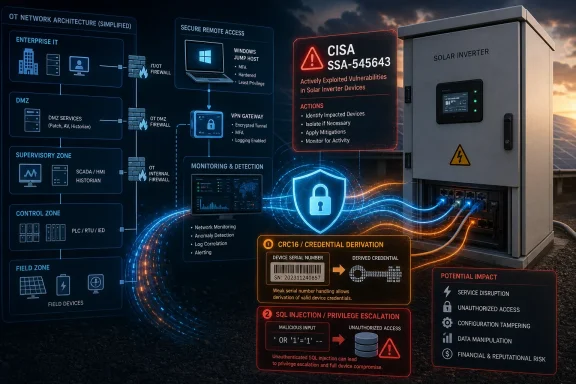
The Siemens and KACO blueplanet advisory is built around two vulnerability classes that should make defenders uneasy. One concerns a CRC16-based algorithm used to generate technical service credentials, which could let an attacker derive those credentials from a device serial number. The other is an SQL injection issue in the KACO Meteor server that could let an already authorized attacker elevate privileges over a local network.
Neither issue automatically means a remote internet attacker can casually switch off a solar farm from across the planet. The published CVSS vector for the higher-rated flaw describes adjacent-network access, not unlimited global reach. But that distinction should not become a sleeping pill. In industrial environments, “adjacent” is often where the most consequential compromises begin.
That granularity matters because asset owners do not patch “Siemens KACO inverters” as an abstract category. They patch particular models, firmware branches, deployed sites, and operational windows. In a fleet with mixed inverter generations, the answer may be “update this subgroup to V6.1.4.9 or later, move that gridsave line to V3.91 or later, apply compensating controls to legacy TL3 units, and verify whether the NX3 and hybrid units in inventory are actually in the affected set.”
This is where the energy transition collides with the less photogenic work of security operations. Solar capacity is expanding, battery systems are being deployed behind meters and at grid scale, and owners increasingly expect remote visibility. But the operational discipline required to secure distributed energy resources is still catching up with the deployment curve.
The KACO case is not a story about solar being uniquely insecure. It is a story about solar becoming normal infrastructure. Normal infrastructure has old firmware, field-service workflows, forgotten network paths, vendor portals, technicians with laptops, shared credentials, and occasionally design assumptions that look brittle once exposed to adversarial review.
That score is high for a reason. A service credential mechanism is supposed to control privileged access, not collapse into a puzzle whose input is printed, logged, photographed, registered, or otherwise discoverable. Serial numbers are not secrets. They appear on labels, installation records, service tickets, commissioning documents, asset databases, photographs, and sometimes web interfaces.
This is the core sin of the design: it confuses an identifier with an authenticator. A serial number is meant to tell humans and systems which device they are dealing with. It should not be a viable path to proving that someone is allowed to administer it.
CRC16 is also a telling detail. CRCs are useful for detecting accidental corruption, not for protecting secrets against attackers. When a credential-generation scheme rests on something in that family, the problem is rarely one isolated function call. It often points to a service model built for controlled maintenance channels rather than hostile networks.
The uncomfortable part for operators is that this kind of weakness can outlive the original engineering assumptions. A device that was once installed on a closed maintenance network may later be connected to a monitoring system, bridged into a site LAN, exposed through a misconfigured VPN, or touched by a contractor laptop that moves between networks. The product did not necessarily change. Its environment did.
It would be a mistake to dismiss it because of that lower score. In industrial environments, privilege escalation paths are often what turn a foothold into control. A user account that should have limited operational visibility can become an administrative channel; a compromised maintenance account can become broader persistence; a local network compromise can become an application-layer compromise.
SQL injection is also an old category, which makes its presence in energy equipment more frustrating than surprising. The vulnerability class has been widely understood for decades. Yet embedded and industrial software stacks often include web components, local servers, databases, configuration tools, and service interfaces that do not receive the same continuous pressure testing as mainstream enterprise software.
The Meteor server flaw underscores that inverter security is not only about the power electronics. It is also about the management software wrapped around them. In practice, attackers do not care whether the vulnerable code lives in the inverter firmware, a local service tool, an embedded web server, or a companion management component. They care whether it helps them move from access to authority.
That last category is the part many asset owners dislike reading. “No fix planned” does not mean “no risk.” It means the mitigation burden shifts more heavily from vendor patching to operator architecture, compensating controls, lifecycle decisions, and sometimes replacement planning.
The advisory also includes a “known not affected” set. Several NX3 and hybrid lines are listed as not affected by the named CVEs because of a different code base or absent component. That is useful, but it also reinforces why sloppy inventory is dangerous. If an organization only knows that it has “KACO blueplanet” devices, it does not know enough.
For administrators and OT engineers, the job begins with model and firmware reconciliation. The affected table should be compared against real site inventory, not procurement spreadsheets alone. Commissioning records, monitoring platforms, cabinet labels, remote-management tools, and maintenance logs all have a role in establishing what is actually deployed.
CISA’s republication also comes with a disclaimer that the advisory is a verbatim conversion of the Siemens CSAF material and is provided as-is for visibility. That is bureaucratic language, but it matters. CISA is amplifying the vendor’s technical warning, not independently rewriting the risk model for every installation.
For operators, the distinction is important. The advisory tells you what Siemens and KACO know about affected products and available mitigations. It does not tell you whether a particular inverter fleet is reachable through a vendor VPN, whether a site firewall actually enforces the diagram, whether a contractor jump host has stale credentials, or whether serial numbers have been leaked through maintenance documentation.
That is why these alerts should not be treated as PDF-shaped compliance artifacts. They are triggers for local investigation. The value is not in forwarding the advisory to a shared inbox; it is in converting the advisory into site-specific action.
Adjacent networks are where maintenance laptops live. They are where poorly segmented vendor access lands. They are where engineering workstations, data historians, HMIs, monitoring gateways, and site networks sometimes share more trust than the architecture diagram admits. An attacker who has phished a contractor, compromised a VPN credential, or reached a misconfigured remote-access appliance may already be “adjacent” in the only sense that matters.
This is why CISA’s standard recommendations still matter even when they sound repetitive: minimize exposure, keep control-system devices off the public internet, put control networks behind firewalls, separate OT from business networks, and use VPNs cautiously and with current patches. The recommendations are generic because the failure modes are generic. The blast radius of an inverter flaw is often determined less by the flaw itself than by the network it sits on.
There is also a cultural risk in over-focusing on whether exploitation requires local access. In OT, local access is not rare enough to be ignored. Facilities are serviced by multiple parties, sites may be geographically distributed, and operational convenience often pressures teams to open remote paths that later become security debt.
That means Windows administrators may be closer to the risk than they think. A compromised domain account can open access to an OT jump box. A poorly governed remote desktop path can bridge business IT into site operations. A technician’s Windows laptop can become the carrier between an enterprise compromise and an energy asset.
The advisory does not claim that Windows is vulnerable here, and it would be wrong to frame it that way. The point is subtler: Windows environments often provide the identity, endpoint, and remote-access layer through which inverter management happens. If that layer is weak, the inverter’s adjacent-network assumption becomes a lower barrier.
For sysadmins, this turns an OT advisory into a checklist of familiar controls. Review who can reach the inverter management network. Audit VPN groups and remote-access appliances. Confirm that jump hosts are patched, monitored, and isolated. Make sure service credentials are not stored in shared documents or password spreadsheets. Treat serial-number exposure as part of asset-data hygiene, not trivia.
Inverters are not just endpoints. They participate in power generation, grid support, storage, and site-level energy economics. Taking them offline at the wrong time can mean lost production, operational risk, contractual trouble, or coordination with grid operators. Firmware updates must be tested and scheduled, not sprayed like browser patches.
That does not make patching optional. It means patch governance must be built into the operational model. The right question is not whether a site can afford to patch. It is whether the site has a defensible process for deciding when, how, and in what order to patch, while reducing exposure in the meantime.
This is especially important where fixes are pending or unavailable. Compensating controls are not second-class security if they are specific, verified, and monitored. Network isolation, restricted management access, jump-host enforcement, logging, credential rotation, vendor-access governance, and replacement planning can meaningfully reduce risk when firmware alone cannot.
A brand family is not a code base. A model range is not necessarily a shared vulnerability surface. Even devices with similar names, similar functions, and similar appearances may have different embedded platforms, management interfaces, libraries, and service mechanisms.
For defenders, this cuts both ways. A vulnerability in one line may not affect another, which prevents unnecessary panic. But it also means broad assumptions are dangerous. You cannot safely infer exposure from marketing names, and you cannot safely infer safety from them either.
The strongest asset inventories capture the details that vulnerability advisories actually use: model, hardware revision where relevant, firmware version, management software version, network location, exposure path, owner, vendor support status, and operational criticality. Without that, every industrial advisory becomes a scavenger hunt.
Coordinated disclosure is not glamorous. It is slow, legalistic, and sometimes frustrating for everyone involved. But in critical infrastructure, it remains one of the few mechanisms that can balance public warning, vendor remediation, and operator preparation.
Still, disclosure is only the start of the security lifecycle. The practical outcome depends on whether operators read the advisory, map it to assets, obtain firmware, test updates, schedule maintenance, close network gaps, and document exceptions. A beautifully coordinated advisory can still fail in the field if it dies in an inbox.
This is the chronic weakness of OT vulnerability management. The publication of a CVE creates the illusion of closure because the issue now has a name. In reality, the hard part begins after naming.
That does not mean every inverter flaw threatens grid stability. Siemens itself points to the importance of resilient grid design and multi-level redundant secondary protection schemes for critical power systems. Properly engineered grids should not rely on the cyber integrity of one device class to preserve reliability.
But resilience is not an excuse for weak device security. Defense in depth means each layer matters because every layer can fail. If an attacker can compromise enough devices, interfere with enough management systems, or abuse enough trusted access paths, the cumulative effect becomes the concern.
The blueplanet advisory is therefore best read as part of a larger pattern: energy assets are becoming more software-defined, more remotely managed, and more exposed to conventional cyber operations. The security model has to move from “protect the SCADA core” to “understand every controllable edge device that can affect operations.”
The highest urgency belongs to devices that are affected, reachable from maintenance or site networks, and running versions below available fixed releases. Devices that lack fixes demand a different response: exposure reduction, access review, monitoring, and a decision about whether the business can tolerate their continued support posture.
Operators should also resist the temptation to treat “not affected” as a permanent label. It applies to the named CVEs and the stated product versions, not to all future vulnerabilities or all management paths. Security status is per vulnerability, per version, and per deployment context.
For Windows-centric IT teams supporting energy operations, the immediate work may be outside the inverter itself. Restrict who can access the management network. Harden the jump hosts. Verify VPN posture. Confirm endpoint detection coverage where it is operationally appropriate. Review logs for unusual access to inverter management systems, especially from accounts or hosts that should not be involved.
The energy sector’s software problem is not going away as generation becomes cleaner and more distributed; it is becoming more central to how power systems are built and maintained. The Siemens KACO blueplanet advisory is a manageable vulnerability event for prepared operators and an uncomfortable audit for everyone else. The next inverter flaw, battery-management bug, or remote-service weakness will land in the same operational reality, and the organizations that fare best will be the ones that stopped treating the renewable edge as an exception to OT security and started treating it as one of its most important front lines.
 The Solar Inverter Is No Longer a Dumb Box on the Wall
For years, solar inverters occupied an awkward place in the security imagination. They were electrical equipment first, IT equipment second, and often treated by owners as appliances that converted DC to AC until a maintenance technician needed to touch them. That view is now badly outdated.Modern inverters are monitored, managed, remotely serviced, enrolled in vendor portals, and tied into energy-management systems. In commercial and utility settings, they sit close to the boundary between physical power flows and digital control. That makes a credential flaw in an inverter line very different from a password bug in a consumer gadget.
The Siemens and KACO blueplanet advisory is built around two vulnerability classes that should make defenders uneasy. One concerns a CRC16-based algorithm used to generate technical service credentials, which could let an attacker derive those credentials from a device serial number. The other is an SQL injection issue in the KACO Meteor server that could let an already authorized attacker elevate privileges over a local network.
Neither issue automatically means a remote internet attacker can casually switch off a solar farm from across the planet. The published CVSS vector for the higher-rated flaw describes adjacent-network access, not unlimited global reach. But that distinction should not become a sleeping pill. In industrial environments, “adjacent” is often where the most consequential compromises begin.
Siemens’ Advisory Lands in the Middle of the Energy Transition’s Security Hangover
The affected product list is long enough to matter. It spans multiple blueplanet TL3, TL3 GEN2, NX3, gridsave, and hybrid families, including products used in residential, commercial, industrial, utility-scale, storage, and hybrid installations. Siemens’ advisory also distinguishes between products that are affected, products with firmware updates available, products with fixes still pending, products where no fix is currently planned, and products Siemens says are not affected because they use a different code base.That granularity matters because asset owners do not patch “Siemens KACO inverters” as an abstract category. They patch particular models, firmware branches, deployed sites, and operational windows. In a fleet with mixed inverter generations, the answer may be “update this subgroup to V6.1.4.9 or later, move that gridsave line to V3.91 or later, apply compensating controls to legacy TL3 units, and verify whether the NX3 and hybrid units in inventory are actually in the affected set.”
This is where the energy transition collides with the less photogenic work of security operations. Solar capacity is expanding, battery systems are being deployed behind meters and at grid scale, and owners increasingly expect remote visibility. But the operational discipline required to secure distributed energy resources is still catching up with the deployment curve.
The KACO case is not a story about solar being uniquely insecure. It is a story about solar becoming normal infrastructure. Normal infrastructure has old firmware, field-service workflows, forgotten network paths, vendor portals, technicians with laptops, shared credentials, and occasionally design assumptions that look brittle once exposed to adversarial review.
A Serial Number Should Not Be a Skeleton Key
The most attention-grabbing flaw is CVE-2025-40946, the credential derivation issue. Siemens describes a CRC16-based algorithm for generating technical service credentials that could allow an attacker to derive credentials from a device serial number and misuse them for unauthorized access. The weakness is mapped to hard-coded cryptographic key usage, and it carries a CVSS v3.1 base score of 8.3.That score is high for a reason. A service credential mechanism is supposed to control privileged access, not collapse into a puzzle whose input is printed, logged, photographed, registered, or otherwise discoverable. Serial numbers are not secrets. They appear on labels, installation records, service tickets, commissioning documents, asset databases, photographs, and sometimes web interfaces.
This is the core sin of the design: it confuses an identifier with an authenticator. A serial number is meant to tell humans and systems which device they are dealing with. It should not be a viable path to proving that someone is allowed to administer it.
CRC16 is also a telling detail. CRCs are useful for detecting accidental corruption, not for protecting secrets against attackers. When a credential-generation scheme rests on something in that family, the problem is rarely one isolated function call. It often points to a service model built for controlled maintenance channels rather than hostile networks.
The uncomfortable part for operators is that this kind of weakness can outlive the original engineering assumptions. A device that was once installed on a closed maintenance network may later be connected to a monitoring system, bridged into a site LAN, exposed through a misconfigured VPN, or touched by a contractor laptop that moves between networks. The product did not necessarily change. Its environment did.
The SQL Injection Bug Is Less Flashy, but Still Operationally Serious
The second vulnerability, CVE-2026-41125, is an SQL injection issue in the KACO Meteor server. Siemens says an authorized attacker on a local network could exploit improper neutralization of SQL command elements to elevate privileges. Its CVSS v3.1 base score is 6.0, lower than the credential flaw, and its prerequisites are heavier: high privileges, high attack complexity, and adjacent-network access.It would be a mistake to dismiss it because of that lower score. In industrial environments, privilege escalation paths are often what turn a foothold into control. A user account that should have limited operational visibility can become an administrative channel; a compromised maintenance account can become broader persistence; a local network compromise can become an application-layer compromise.
SQL injection is also an old category, which makes its presence in energy equipment more frustrating than surprising. The vulnerability class has been widely understood for decades. Yet embedded and industrial software stacks often include web components, local servers, databases, configuration tools, and service interfaces that do not receive the same continuous pressure testing as mainstream enterprise software.
The Meteor server flaw underscores that inverter security is not only about the power electronics. It is also about the management software wrapped around them. In practice, attackers do not care whether the vulnerable code lives in the inverter firmware, a local service tool, an embedded web server, or a companion management component. They care whether it helps them move from access to authority.
The Affected-Product Matrix Is the Real Work
The advisory’s affected-product table is dense because the product reality is dense. Some TL3 GEN2 models are affected by the credential issue below firmware V6.1.4.9 and should be updated to that version or later. The blueplanet gridsave 92.0 TL3-S, 110 TL3-S, and 137 TL3-S lines are listed with remediation at V3.91 or later for the credential issue. Other product families are marked as affected with no fix currently available, while some are listed as affected with no fix planned.That last category is the part many asset owners dislike reading. “No fix planned” does not mean “no risk.” It means the mitigation burden shifts more heavily from vendor patching to operator architecture, compensating controls, lifecycle decisions, and sometimes replacement planning.
The advisory also includes a “known not affected” set. Several NX3 and hybrid lines are listed as not affected by the named CVEs because of a different code base or absent component. That is useful, but it also reinforces why sloppy inventory is dangerous. If an organization only knows that it has “KACO blueplanet” devices, it does not know enough.
For administrators and OT engineers, the job begins with model and firmware reconciliation. The affected table should be compared against real site inventory, not procurement spreadsheets alone. Commissioning records, monitoring platforms, cabinet labels, remote-management tools, and maintenance logs all have a role in establishing what is actually deployed.
CISA’s Republication Makes This a U.S. Critical-Infrastructure Story, Not Just a Vendor Notice
Siemens published the original advisory on May 12, 2026. CISA’s June 9 republication places it in the U.S. industrial-control advisory stream and labels the relevant critical-infrastructure sector as Energy, with worldwide deployment and a German company headquarters location. That combination is typical of modern OT risk: international vendors, global deployments, local regulatory consequences.CISA’s republication also comes with a disclaimer that the advisory is a verbatim conversion of the Siemens CSAF material and is provided as-is for visibility. That is bureaucratic language, but it matters. CISA is amplifying the vendor’s technical warning, not independently rewriting the risk model for every installation.
For operators, the distinction is important. The advisory tells you what Siemens and KACO know about affected products and available mitigations. It does not tell you whether a particular inverter fleet is reachable through a vendor VPN, whether a site firewall actually enforces the diagram, whether a contractor jump host has stale credentials, or whether serial numbers have been leaked through maintenance documentation.
That is why these alerts should not be treated as PDF-shaped compliance artifacts. They are triggers for local investigation. The value is not in forwarding the advisory to a shared inbox; it is in converting the advisory into site-specific action.
“Adjacent Network” Is Not the Comforting Phrase Vendors Think It Is
Both vulnerabilities are framed around adjacent or local network conditions rather than broad internet exposure. In consumer-software land, that can sound reassuring. In industrial environments, it is more complicated.Adjacent networks are where maintenance laptops live. They are where poorly segmented vendor access lands. They are where engineering workstations, data historians, HMIs, monitoring gateways, and site networks sometimes share more trust than the architecture diagram admits. An attacker who has phished a contractor, compromised a VPN credential, or reached a misconfigured remote-access appliance may already be “adjacent” in the only sense that matters.
This is why CISA’s standard recommendations still matter even when they sound repetitive: minimize exposure, keep control-system devices off the public internet, put control networks behind firewalls, separate OT from business networks, and use VPNs cautiously and with current patches. The recommendations are generic because the failure modes are generic. The blast radius of an inverter flaw is often determined less by the flaw itself than by the network it sits on.
There is also a cultural risk in over-focusing on whether exploitation requires local access. In OT, local access is not rare enough to be ignored. Facilities are serviced by multiple parties, sites may be geographically distributed, and operational convenience often pressures teams to open remote paths that later become security debt.
The Windows Angle Is the Management Plane
At first glance, a solar inverter vulnerability might not look like WindowsForum territory. But for IT pros, the relevant connection is the management plane. Industrial equipment rarely exists in isolation; it is administered through laptops, browser sessions, engineering tools, vendor portals, jump hosts, domain accounts, VPN clients, and monitoring stacks that often run on Windows.That means Windows administrators may be closer to the risk than they think. A compromised domain account can open access to an OT jump box. A poorly governed remote desktop path can bridge business IT into site operations. A technician’s Windows laptop can become the carrier between an enterprise compromise and an energy asset.
The advisory does not claim that Windows is vulnerable here, and it would be wrong to frame it that way. The point is subtler: Windows environments often provide the identity, endpoint, and remote-access layer through which inverter management happens. If that layer is weak, the inverter’s adjacent-network assumption becomes a lower barrier.
For sysadmins, this turns an OT advisory into a checklist of familiar controls. Review who can reach the inverter management network. Audit VPN groups and remote-access appliances. Confirm that jump hosts are patched, monitored, and isolated. Make sure service credentials are not stored in shared documents or password spreadsheets. Treat serial-number exposure as part of asset-data hygiene, not trivia.
Patch Management Meets the Physics of Power
The vendor recommendation is straightforward: apply the provided security updates using the documented tooling and procedures, validate updates before deployment, and supervise the process with trained staff. In IT, that might sound like normal Tuesday work. In energy operations, it is more sensitive.Inverters are not just endpoints. They participate in power generation, grid support, storage, and site-level energy economics. Taking them offline at the wrong time can mean lost production, operational risk, contractual trouble, or coordination with grid operators. Firmware updates must be tested and scheduled, not sprayed like browser patches.
That does not make patching optional. It means patch governance must be built into the operational model. The right question is not whether a site can afford to patch. It is whether the site has a defensible process for deciding when, how, and in what order to patch, while reducing exposure in the meantime.
This is especially important where fixes are pending or unavailable. Compensating controls are not second-class security if they are specific, verified, and monitored. Network isolation, restricted management access, jump-host enforcement, logging, credential rotation, vendor-access governance, and replacement planning can meaningfully reduce risk when firmware alone cannot.
The Vendor’s Product Split Tells a Bigger Story About Embedded Code
One notable detail in the Siemens advisory is the “different code base” explanation for several product families that are known not to be affected. That is good news for owners of those devices, but it also illustrates a recurring challenge in embedded and industrial security: product names can hide very different software realities.A brand family is not a code base. A model range is not necessarily a shared vulnerability surface. Even devices with similar names, similar functions, and similar appearances may have different embedded platforms, management interfaces, libraries, and service mechanisms.
For defenders, this cuts both ways. A vulnerability in one line may not affect another, which prevents unnecessary panic. But it also means broad assumptions are dangerous. You cannot safely infer exposure from marketing names, and you cannot safely infer safety from them either.
The strongest asset inventories capture the details that vulnerability advisories actually use: model, hardware revision where relevant, firmware version, management software version, network location, exposure path, owner, vendor support status, and operational criticality. Without that, every industrial advisory becomes a scavenger hunt.
Researcher Disclosure Still Works, but It Cannot Carry the Whole Load
Siemens credits Ruben Santamarta of Reversemode for coordinated disclosure. That matters because industrial-control vulnerability handling depends heavily on researchers, vendors, national CERTs, and operators maintaining enough trust to move flaws from discovery to remediation without turning every finding into a public scramble.Coordinated disclosure is not glamorous. It is slow, legalistic, and sometimes frustrating for everyone involved. But in critical infrastructure, it remains one of the few mechanisms that can balance public warning, vendor remediation, and operator preparation.
Still, disclosure is only the start of the security lifecycle. The practical outcome depends on whether operators read the advisory, map it to assets, obtain firmware, test updates, schedule maintenance, close network gaps, and document exceptions. A beautifully coordinated advisory can still fail in the field if it dies in an inbox.
This is the chronic weakness of OT vulnerability management. The publication of a CVE creates the illusion of closure because the issue now has a name. In reality, the hard part begins after naming.
Renewable Energy Needs an OT Security Model That Matches Its Scale
The inverter market has changed faster than many security programs. Distributed energy resources are now part of the grid’s operational fabric, not experimental add-ons. Residential aggregations, commercial rooftops, utility-scale solar plants, and battery systems all increase the number of intelligent devices that can influence power flows.That does not mean every inverter flaw threatens grid stability. Siemens itself points to the importance of resilient grid design and multi-level redundant secondary protection schemes for critical power systems. Properly engineered grids should not rely on the cyber integrity of one device class to preserve reliability.
But resilience is not an excuse for weak device security. Defense in depth means each layer matters because every layer can fail. If an attacker can compromise enough devices, interfere with enough management systems, or abuse enough trusted access paths, the cumulative effect becomes the concern.
The blueplanet advisory is therefore best read as part of a larger pattern: energy assets are becoming more software-defined, more remotely managed, and more exposed to conventional cyber operations. The security model has to move from “protect the SCADA core” to “understand every controllable edge device that can affect operations.”
The Practical Signal Hidden in the Model List
For organizations that operate KACO blueplanet equipment, the response should be concrete rather than theatrical. The advisory names specific firmware thresholds and product families, and that is where the work should start. Treat this as an inventory and segmentation exercise first, a patch exercise second, and a lifecycle exercise third.The highest urgency belongs to devices that are affected, reachable from maintenance or site networks, and running versions below available fixed releases. Devices that lack fixes demand a different response: exposure reduction, access review, monitoring, and a decision about whether the business can tolerate their continued support posture.
Operators should also resist the temptation to treat “not affected” as a permanent label. It applies to the named CVEs and the stated product versions, not to all future vulnerabilities or all management paths. Security status is per vulnerability, per version, and per deployment context.
For Windows-centric IT teams supporting energy operations, the immediate work may be outside the inverter itself. Restrict who can access the management network. Harden the jump hosts. Verify VPN posture. Confirm endpoint detection coverage where it is operationally appropriate. Review logs for unusual access to inverter management systems, especially from accounts or hosts that should not be involved.
The KACO Advisory Turns Into a Site Test
The useful response to this advisory can be compressed into a few operational tests. If the organization cannot answer them quickly, that is itself the finding.- The organization should be able to identify every deployed KACO blueplanet inverter by exact model, firmware version, site, network segment, and business owner.
- The organization should compare affected TL3 GEN2 and gridsave devices against the fixed-version thresholds of V6.1.4.9 and V3.91 where those thresholds apply.
- The organization should assume serial numbers are not secret and should not rely on any workflow that treats them as adequate proof of authorization.
- The organization should verify that inverter management interfaces are unreachable from the public internet and reachable only through controlled, logged, and patched access paths.
- The organization should document compensating controls for affected devices that do not yet have fixes or for which no fix is currently planned.
- The organization should treat Windows jump hosts, technician laptops, VPN clients, and identity groups as part of the inverter security boundary.
The energy sector’s software problem is not going away as generation becomes cleaner and more distributed; it is becoming more central to how power systems are built and maintained. The Siemens KACO blueplanet advisory is a manageable vulnerability event for prepared operators and an uncomfortable audit for everyone else. The next inverter flaw, battery-management bug, or remote-service weakness will land in the same operational reality, and the organizations that fare best will be the ones that stopped treating the renewable edge as an exception to OT security and started treating it as one of its most important front lines.
References
- Primary source: CISA
Published: 2026-06-09T12:00:00+00:00

Siemens KACO Blueplanet Inverters | CISA
www.cisa.gov
- Related coverage: cert-portal.siemens.com
- Related coverage: siemens.com
CERT Services | Siemens
The central expert teams for immediate response to security threats and issues affecting Siemens products, solutions, services or infrastructure. www.siemens.com
- Related coverage: certvde.com
Bulletins
 certvde.com
- Related coverage: incibe.es
Avisos de seguridad de Siemens de mayo de 2026 | INCIBE-CERT | INCIBE
Siemens ha publicado en su comunicado mensual varias actualizaciones de seguridad en varios de sus prowww.incibe.es
- Related coverage: feeder.co
- Related coverage: support.industry.siemens.com
- Related coverage: kaco-newenergy.com
