On June 18, 2026, CISA republished Rockwell Automation’s SD1773 advisory warning that FactoryTalk Historian Site Edition 11 and earlier releases contain three vulnerabilities that can let attackers obtain valid authentication tokens, trigger denial-of-service conditions, or crash affected systems. The flaws carry a vendor CVSS v3 score of 7.7 and land in the uncomfortable middle ground between “not yet exploited” and “too operationally important to ignore.” For industrial operators, the lesson is not that every historian server is suddenly doomed. It is that the software used to remember what happened on the plant floor has become another authentication boundary that must be treated like production infrastructure, not back-office reporting plumbing.
FactoryTalk Historian Site Edition is not a glamorous target in the way a domain controller, VPN concentrator, or cloud identity provider is glamorous. Its job is to collect, store, and make sense of industrial process data: the temperatures, pressures, batch events, machine states, quality readings, and operational breadcrumbs that tell a manufacturer what actually happened.
That quiet role is exactly why the advisory matters. In many environments, historians sit at the seam between operations technology and business systems. They are close enough to production networks to ingest sensitive process data, but useful enough to be queried by engineers, analysts, reporting tools, and sometimes enterprise dashboards.
That makes a historian a bridge, and bridges are where attackers like to stand. A vulnerability that enables authentication bypass or denial of service against a historian does not need to directly reprogram a controller to be dangerous. It can disrupt visibility, degrade incident response, expose operational data, or give an attacker a foothold in a network segment that defenders often assume is less interactive than it really is.
CISA’s advisory does not report known public exploitation at this time. That is good news, but it is not a reason to relax. In industrial security, “no known exploitation” often means defenders have a patch window, not a pardon.
That detail deserves attention because it moves the issue out of the abstract. This is not merely “software may behave unexpectedly.” It is an authentication system that can reportedly be pressured into handing out something useful to the wrong party.
Race conditions are especially awkward for defenders because they often look less like a single elegant break-in and more like repeated, noisy pressure against a timing window. The attacker is not necessarily guessing a password or stealing a credential from an endpoint. They are exploiting the difference between how the software is supposed to sequence access to a shared resource and what actually happens under concurrent load.
For administrators, the practical question is not whether the bug has a cinematic proof of concept. It is whether the login surface is reachable from networks where it should not be reachable, whether logs would show suspicious repeated authentication attempts, and whether a compromised token would be enough to move deeper into the environment.
This is also where industrial software’s long life cycle becomes a liability. Version 11 may be current or near-current in many operational environments, but “current enough to run production” is not the same as “current enough to survive adversarial traffic.”
In an industrial environment, availability is often the point. If a historian becomes unavailable, operators may not lose control of the plant, but they can lose the data needed to diagnose abnormal behavior, reconstruct events, satisfy quality requirements, or prove that a process stayed within limits. That is operationally meaningful.
The distinction matters because security teams sometimes triage historian vulnerabilities as if the historian were simply a database with a specialized front end. In practice, it can be part of alarm analysis, compliance reporting, batch review, maintenance planning, and production optimization. A crash at the wrong moment can have consequences that outlast the outage itself.
Denial of service is also useful to attackers as cover. If defenders are trying to understand whether process data is trustworthy, whether an event happened before or after an alarm, or whether a login sequence was abused, taking out the system that records those facts can be more than vandalism. It can be a way to muddy the timeline.
The fact that the guidance is familiar should not make it feel boilerplate. These advisories keep returning to segmentation and exposure because industrial environments keep accumulating exceptions. A reporting server needs data. A vendor needs remote access. A corporate dashboard needs a feed. An engineer needs to query the historian from a laptop that also lives in the enterprise world.
Every exception can be justified in isolation. Over time, they turn into architecture.
That is why the FactoryTalk Historian advisory is less about one product than about the messy middle of OT modernization. Operators have spent years extracting more value from production data, pushing it into analytics platforms, business intelligence tools, and remote support workflows. That business case is real. So is the security cost.
A historian that once served a small group of controls engineers may now sit in the path of digital transformation projects. If its authentication layer can be manipulated, or if its service can be crashed remotely, the blast radius is shaped by years of connectivity decisions that may never have been reviewed together.
Industrial advisories often land before exploit chatter becomes obvious. Sometimes that is because the vendor reported the issue responsibly and customers have time to patch. Sometimes it is because the affected software is niche enough that exploit development takes longer. Sometimes it is because attackers do not need to publish anything to use what they know.
The authentication-token issue is the one that should sharpen attention. A valid token can be more valuable than a crash because it may let the attacker appear, at least partially, like an authenticated user or service. Even if permissions are limited, defenders now have to reason about what the token can access, how long it remains valid, whether it can be replayed, and where the activity would be logged.
That is why mitigation should not stop at applying a vendor patch or upgrading a component. Teams should review whether the historian is reachable from user subnets, engineering workstations, jump hosts, remote access paths, and business reporting systems. They should also ask whether abnormal login bursts would trigger an alert or simply disappear into verbose application logs.
The absence of exploitation buys time. It does not remove the need to spend it well.
That does not excuse delay. It changes the order of operations.
The first move is inventory. Teams need to identify whether they are running FactoryTalk Historian SE 11 or earlier versions covered by the advisory. That sounds obvious, but OT software estates are often less centrally visible than Windows server fleets. A historian may live on a dedicated server, a virtual machine, a vendor-managed appliance, or a system whose ownership is split between controls engineering and IT.
The second move is exposure review. If the vulnerable service is reachable only from a tightly controlled segment, the immediate risk is different from a deployment exposed across broad enterprise networks or remote access corridors. This is where network diagrams need to be checked against actual firewall rules and live traffic, not against what the architecture was supposed to be.
The third move is maintenance planning. If Rockwell provides an update or mitigation path through its support channels, operators should validate it in a test environment where possible, schedule downtime where necessary, and document compensating controls where immediate patching is not possible. In regulated or high-availability industrial settings, the paper trail is not bureaucracy; it is how the security decision becomes operationally defensible.
That means this advisory belongs on both sides of the IT/OT line. Controls engineers may own the application, but Windows administrators may own the host hardening, patch baselines, backup jobs, endpoint telemetry, and domain policies that determine how much damage a compromised historian account can do. Security teams may own the detection logic that decides whether repeated login requests are suspicious.
This is where many organizations still struggle. OT teams do not want enterprise patching practices to break production systems. IT teams do not want unmanaged Windows servers becoming soft spots in the network. Both positions are rational, and both become dangerous if they harden into turf protection.
The better model is shared operational risk. The historian is not “just OT” if it authenticates users, serves data to business systems, and runs on general-purpose infrastructure. It is not “just IT” if taking it down affects production visibility. The FactoryTalk advisory is a reminder that identity, availability, and segmentation now meet inside products that used to be treated as specialized industrial middleware.
The key word is ensure. Many organizations believe their control systems are isolated because the intended architecture says so. The reality can include forgotten NAT rules, legacy VPN profiles, engineering laptops with dual access, stale firewall exceptions, vendor remote support tunnels, and reporting services that were opened during a project and never closed.
For this advisory, the relevant question is specific: who can reach the FactoryTalk Historian login endpoint, and from where? If the answer is “any authenticated enterprise user,” “any VPN user,” or “we are not sure,” the organization has work to do even before the patch conversation begins.
Network segmentation should also be paired with identity review. If a valid authentication token can be obtained under certain conditions, defenders need to know what roles and privileges exist inside the historian environment, how service accounts are scoped, and whether access is broader than operational need requires. A weak boundary plus generous permissions is how medium-severity architecture becomes high-impact incident.
The denial-of-service and crash conditions point to a different telemetry need. Operators should review application logs, Windows event logs, service restarts, crash dumps, and monitoring alerts around the historian server. A sudden crash may be an ordinary reliability problem. It may also be the visible symptom of probing.
This is where baseline knowledge matters. In a busy industrial site, strange traffic is not always malicious; it can be a misconfigured connector, a reporting job gone wrong, or a vendor tool behaving badly. But without a baseline, defenders cannot tell the difference between operational noise and attack preparation.
The goal is not to build perfect exploit detection overnight. It is to make sure the organization would notice the kinds of behavior this advisory makes plausible. If a login endpoint can be hammered into an unsafe state and no one would see the hammering, the security control is mostly theoretical.
That principle sounds simple until it collides with how historians are actually used. Engineers want easy access. Managers want dashboards. Vendors want support paths. Data teams want feeds. Security teams want containment. The historian becomes the negotiation table where all of those needs meet.
A safer design does not pretend the historian is unimportant. It treats it as important enough to protect. That means jump hosts instead of broad access, monitored service accounts instead of shared credentials, restricted firewall paths instead of “temporary” openings, and tested backups instead of hopeful assumptions.
It also means accepting that operational data has security value. Attackers who understand a process can time disruption better, hide more effectively, and choose more damaging moments. The historian is not merely a passive archive. It is a map of how the plant behaves.
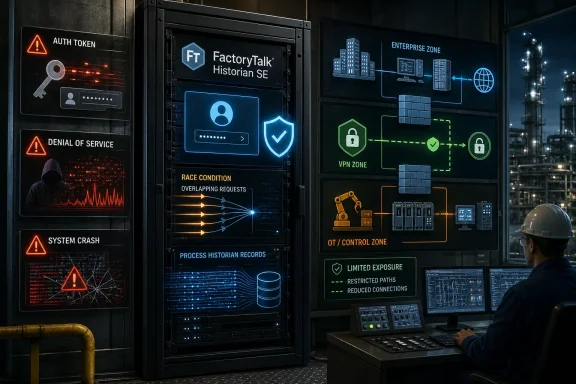 The Historian Has Become Part of the Attack Surface
FactoryTalk Historian Site Edition is not a glamorous target in the way a domain controller, VPN concentrator, or cloud identity provider is glamorous. Its job is to collect, store, and make sense of industrial process data: the temperatures, pressures, batch events, machine states, quality readings, and operational breadcrumbs that tell a manufacturer what actually happened.That quiet role is exactly why the advisory matters. In many environments, historians sit at the seam between operations technology and business systems. They are close enough to production networks to ingest sensitive process data, but useful enough to be queried by engineers, analysts, reporting tools, and sometimes enterprise dashboards.
That makes a historian a bridge, and bridges are where attackers like to stand. A vulnerability that enables authentication bypass or denial of service against a historian does not need to directly reprogram a controller to be dangerous. It can disrupt visibility, degrade incident response, expose operational data, or give an attacker a foothold in a network segment that defenders often assume is less interactive than it really is.
CISA’s advisory does not report known public exploitation at this time. That is good news, but it is not a reason to relax. In industrial security, “no known exploitation” often means defenders have a patch window, not a pardon.
The Most Serious Bug Is a Login Race, Not a Fancy Exploit Chain
The headline vulnerability is CVE-2025-13036, which affects FactoryTalk Historian SE 11. CISA describes it as a concurrent execution issue using a shared resource with improper synchronization — in plain English, a race condition. Rockwell’s summary says that by continually sending requests to the login endpoint, an attacker may obtain a valid authentication token.That detail deserves attention because it moves the issue out of the abstract. This is not merely “software may behave unexpectedly.” It is an authentication system that can reportedly be pressured into handing out something useful to the wrong party.
Race conditions are especially awkward for defenders because they often look less like a single elegant break-in and more like repeated, noisy pressure against a timing window. The attacker is not necessarily guessing a password or stealing a credential from an endpoint. They are exploiting the difference between how the software is supposed to sequence access to a shared resource and what actually happens under concurrent load.
For administrators, the practical question is not whether the bug has a cinematic proof of concept. It is whether the login surface is reachable from networks where it should not be reachable, whether logs would show suspicious repeated authentication attempts, and whether a compromised token would be enough to move deeper into the environment.
This is also where industrial software’s long life cycle becomes a liability. Version 11 may be current or near-current in many operational environments, but “current enough to run production” is not the same as “current enough to survive adversarial traffic.”
Denial of Service Is Not a Lesser Outcome on the Plant Floor
The other affected entries, CVE-2025-44019 and CVE-2025-36539, apply to FactoryTalk Historian SE versions up to and including 11.00. CISA’s summary groups the possible outcomes as denial of service and system crash conditions. In a conventional IT setting, that can sound less severe than remote code execution or credential theft.In an industrial environment, availability is often the point. If a historian becomes unavailable, operators may not lose control of the plant, but they can lose the data needed to diagnose abnormal behavior, reconstruct events, satisfy quality requirements, or prove that a process stayed within limits. That is operationally meaningful.
The distinction matters because security teams sometimes triage historian vulnerabilities as if the historian were simply a database with a specialized front end. In practice, it can be part of alarm analysis, compliance reporting, batch review, maintenance planning, and production optimization. A crash at the wrong moment can have consequences that outlast the outage itself.
Denial of service is also useful to attackers as cover. If defenders are trying to understand whether process data is trustworthy, whether an event happened before or after an alarm, or whether a login sequence was abused, taking out the system that records those facts can be more than vandalism. It can be a way to muddy the timeline.
CISA’s Advice Is Familiar Because the Architecture Problem Is Familiar
CISA’s recommended practices are the standard industrial-control-system canon: minimize network exposure, keep control system devices off the public internet, isolate control networks from business networks, put remote access behind updated VPNs, and perform impact analysis before making defensive changes. None of that is new.The fact that the guidance is familiar should not make it feel boilerplate. These advisories keep returning to segmentation and exposure because industrial environments keep accumulating exceptions. A reporting server needs data. A vendor needs remote access. A corporate dashboard needs a feed. An engineer needs to query the historian from a laptop that also lives in the enterprise world.
Every exception can be justified in isolation. Over time, they turn into architecture.
That is why the FactoryTalk Historian advisory is less about one product than about the messy middle of OT modernization. Operators have spent years extracting more value from production data, pushing it into analytics platforms, business intelligence tools, and remote support workflows. That business case is real. So is the security cost.
A historian that once served a small group of controls engineers may now sit in the path of digital transformation projects. If its authentication layer can be manipulated, or if its service can be crashed remotely, the blast radius is shaped by years of connectivity decisions that may never have been reviewed together.
“No Known Exploitation” Is a Starting Gun, Not a Finish Line
CISA says it has not received reports of public exploitation specifically targeting these vulnerabilities. That sentence is important, but it should be read narrowly. It means no known public exploitation has been reported to CISA at the time of the advisory, not that exploitation is impossible, unattractive, or unlikely forever.Industrial advisories often land before exploit chatter becomes obvious. Sometimes that is because the vendor reported the issue responsibly and customers have time to patch. Sometimes it is because the affected software is niche enough that exploit development takes longer. Sometimes it is because attackers do not need to publish anything to use what they know.
The authentication-token issue is the one that should sharpen attention. A valid token can be more valuable than a crash because it may let the attacker appear, at least partially, like an authenticated user or service. Even if permissions are limited, defenders now have to reason about what the token can access, how long it remains valid, whether it can be replayed, and where the activity would be logged.
That is why mitigation should not stop at applying a vendor patch or upgrading a component. Teams should review whether the historian is reachable from user subnets, engineering workstations, jump hosts, remote access paths, and business reporting systems. They should also ask whether abnormal login bursts would trigger an alert or simply disappear into verbose application logs.
The absence of exploitation buys time. It does not remove the need to spend it well.
Patch Management Still Collides With Uptime Culture
Rockwell Automation reported the vulnerabilities to CISA, and CISA’s June 18 republication gives asset owners a public marker for action. The hard part is the familiar one: many factories cannot patch industrial systems on the same cadence as office software. A historian may be tied to validated processes, vendor support matrices, legacy integrations, or production schedules that make “just update it” a misleadingly simple phrase.That does not excuse delay. It changes the order of operations.
The first move is inventory. Teams need to identify whether they are running FactoryTalk Historian SE 11 or earlier versions covered by the advisory. That sounds obvious, but OT software estates are often less centrally visible than Windows server fleets. A historian may live on a dedicated server, a virtual machine, a vendor-managed appliance, or a system whose ownership is split between controls engineering and IT.
The second move is exposure review. If the vulnerable service is reachable only from a tightly controlled segment, the immediate risk is different from a deployment exposed across broad enterprise networks or remote access corridors. This is where network diagrams need to be checked against actual firewall rules and live traffic, not against what the architecture was supposed to be.
The third move is maintenance planning. If Rockwell provides an update or mitigation path through its support channels, operators should validate it in a test environment where possible, schedule downtime where necessary, and document compensating controls where immediate patching is not possible. In regulated or high-availability industrial settings, the paper trail is not bureaucracy; it is how the security decision becomes operationally defensible.
Windows Administrators Are in the Story, Even If the Advisory Says ICS
WindowsForum readers should care because FactoryTalk deployments usually do not float in a pure OT vacuum. They run on Windows servers, interact with Windows identity infrastructure, depend on service accounts, traverse firewalls, and often sit behind the same remote-access technologies that enterprise IT teams manage.That means this advisory belongs on both sides of the IT/OT line. Controls engineers may own the application, but Windows administrators may own the host hardening, patch baselines, backup jobs, endpoint telemetry, and domain policies that determine how much damage a compromised historian account can do. Security teams may own the detection logic that decides whether repeated login requests are suspicious.
This is where many organizations still struggle. OT teams do not want enterprise patching practices to break production systems. IT teams do not want unmanaged Windows servers becoming soft spots in the network. Both positions are rational, and both become dangerous if they harden into turf protection.
The better model is shared operational risk. The historian is not “just OT” if it authenticates users, serves data to business systems, and runs on general-purpose infrastructure. It is not “just IT” if taking it down affects production visibility. The FactoryTalk advisory is a reminder that identity, availability, and segmentation now meet inside products that used to be treated as specialized industrial middleware.
Segmentation Has to Be Proven, Not Assumed
CISA’s first recommendation is to minimize network exposure for control system devices and ensure they are not accessible from the internet. That line appears in so many advisories that it risks becoming wallpaper. It should instead be treated as an audit prompt.The key word is ensure. Many organizations believe their control systems are isolated because the intended architecture says so. The reality can include forgotten NAT rules, legacy VPN profiles, engineering laptops with dual access, stale firewall exceptions, vendor remote support tunnels, and reporting services that were opened during a project and never closed.
For this advisory, the relevant question is specific: who can reach the FactoryTalk Historian login endpoint, and from where? If the answer is “any authenticated enterprise user,” “any VPN user,” or “we are not sure,” the organization has work to do even before the patch conversation begins.
Network segmentation should also be paired with identity review. If a valid authentication token can be obtained under certain conditions, defenders need to know what roles and privileges exist inside the historian environment, how service accounts are scoped, and whether access is broader than operational need requires. A weak boundary plus generous permissions is how medium-severity architecture becomes high-impact incident.
Detection Needs to Watch Behavior, Not Just Known Exploits
Because CISA reports no known public exploitation, defenders may not have a tidy indicator list to deploy. That does not mean they are blind. The described authentication-token issue implies behavior worth watching: repeated requests to the login endpoint, unusual authentication rates, unexpected token issuance patterns, and access from hosts that normally do not interact with the historian.The denial-of-service and crash conditions point to a different telemetry need. Operators should review application logs, Windows event logs, service restarts, crash dumps, and monitoring alerts around the historian server. A sudden crash may be an ordinary reliability problem. It may also be the visible symptom of probing.
This is where baseline knowledge matters. In a busy industrial site, strange traffic is not always malicious; it can be a misconfigured connector, a reporting job gone wrong, or a vendor tool behaving badly. But without a baseline, defenders cannot tell the difference between operational noise and attack preparation.
The goal is not to build perfect exploit detection overnight. It is to make sure the organization would notice the kinds of behavior this advisory makes plausible. If a login endpoint can be hammered into an unsafe state and no one would see the hammering, the security control is mostly theoretical.
The Real Fix Is Smaller Blast Radius
The short-term response is to follow Rockwell and CISA guidance, update affected systems where possible, and add compensating controls where patching has to wait. The longer-term lesson is that industrial data platforms need smaller blast radii. They should not be reachable from more places than necessary, trusted by more systems than necessary, or granted broader permissions than necessary.That principle sounds simple until it collides with how historians are actually used. Engineers want easy access. Managers want dashboards. Vendors want support paths. Data teams want feeds. Security teams want containment. The historian becomes the negotiation table where all of those needs meet.
A safer design does not pretend the historian is unimportant. It treats it as important enough to protect. That means jump hosts instead of broad access, monitored service accounts instead of shared credentials, restricted firewall paths instead of “temporary” openings, and tested backups instead of hopeful assumptions.
It also means accepting that operational data has security value. Attackers who understand a process can time disruption better, hide more effectively, and choose more damaging moments. The historian is not merely a passive archive. It is a map of how the plant behaves.
The June 18 Advisory Narrows the Work
The practical message for FactoryTalk Historian SE operators is concrete, even if the environment around it is complex. This is a bounded advisory with named versions, named CVEs, and a known publication date. That gives teams enough structure to act.- Organizations should identify every FactoryTalk Historian Site Edition deployment and confirm whether it is version 11 or an earlier 11.00-or-below release affected by the advisory.
- Administrators should treat CVE-2025-13036 as an authentication-boundary issue because repeated login requests may result in a valid authentication token.
- Operators should review whether historian services are reachable from enterprise networks, VPN users, vendor access paths, or any internet-facing route.
- Security teams should look for unusual login bursts, unexpected token-related activity, historian service crashes, and unexplained restarts around affected systems.
- Sites that cannot patch immediately should document compensating controls, including segmentation, firewall restrictions, remote-access limits, and increased monitoring.
- IT and OT teams should handle this as shared infrastructure risk, not as a niche controls-engineering problem.
References
- Primary source: CISA
Published: 2026-06-18T12:00:00+00:00
- Related coverage: rockwellautomation.com
Security Advisories | Rockwell Automation | IN
 www.rockwellautomation.com
- Related coverage: securityweek.com
Rockwell Automation Patches Vulnerabilities in ICS Controllers and Software - SecurityWeek
Rockwell Automation informed customers that patches are available for several vulnerabilities affecting its ICS controllers and software.www.securityweek.com
- Related coverage: 1898advisories.burnsmcd.com

Rockwell Automation FactoryTalk View Site Edition: Local Privilege Escalation and Code Injection Vulnerabilities
Rockwell Automation has disclosed two high-severity vulnerabilities in FactoryTalk View Site Edition (View SE), a widely deployed SCADA human-machine interface (HMI) platform used across industrial and critical infrastructure environments.
1898advisories.burnsmcd.com