

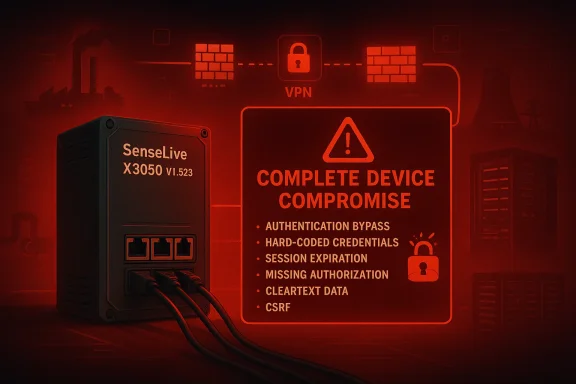
SenseLive X3050 is the latest reminder that industrial and embedded devices often fail in clusters, not as isolated bugs. CISA says version X3050 V1.523 is affected by 11 vulnerabilities spanning authentication bypass, hard-coded credentials, insufficient session expiration, missing authorization, cleartext transmission, CSRF, and other control-plane weaknesses, with a CVSS 9.8 rating and a worst-case outcome of complete device compromise. CISA also notes that the product is deployed worldwide across critical manufacturing, water and wastewater, energy, and information technology, which makes the disclosure more than a routine vendor notice; it is a broad operational warning for anyone running the platform in exposed or semi-trusted environments. irst thing that stands out about the SenseLive X3050 advisory is not the number of bugs, but the shape of them. This is not a single memory corruption issue or a one-off logic error; it is a stack of authentication and access-control failures that point to a product whose security model appears to have been built too loosely from the start. When a device can be reached through an alternate path, retain sessions too long, expose credentials in unsafe ways, and permit critical actions without robust authorization, the result is not merely a vulnerable device. It is a device that may have been trusting the wrong things in the wrong places.
CISA’s language is b agency says successful exploitation could allow an attacker to take complete control of the device, and it places the advisory in the context of industrial and infrastructure environments rather than a consumer product line. That context matters because control systems are rarely isolated in the neat, textbook sense. They sit beside legacy networks, remote support channels, vendor maintenance paths, and business systems that were never designed with modern threat assumptions in mind.
The sectors listed by CISA tell their own facturing, water and wastewater, energy, and information technology** are all environments where availability, integrity, and operational continuity matter at least as much as confidentiality. In those settings, a management interface that can be subverted is not just a dashboard problem; it can become a plant-wide or service-wide risk multiplier. The fact that the device is also deployed worldwide increases the odds that internet exposure, inconsistent patching, and fragmented asset inventories will all make remediation slower than it should be.
There is also a familiar industrial-security pattern here: once common enough, defenders tend to assume vendor defaults, remote access routines, or “temporary” exceptions will stay contained. They often do not. A product with hard-coded credentials or missing authorization controls tends to become a long-tail problem because those weaknesses are easy for attackers to discover and exploit repeatedly. CISA’s recommendation to minimize network exposure and isolate control system networks is not generic boilerplate; it is a direct response to the way these devices are actually deployed.
The timing is important because CISA published the , 2026, and the agency explicitly states that no known public exploitation** has yet been reported to it. That creates a narrow but valuable window: defenders can still move from warning to mitigation before the issue becomes a live intrusions-and-pivoting event. In industrial security, that window is often shorter than teams assume, especially when the affected device is reachable from business networks or remote support channels.
This is also the sort of disclosure that tends to get underestimated at first glance. Some teams will see “aand think in terms of a web app login page, while others will focus on CVSS 9.8 and assume it is simply a high-severity patch item. The real significance is broader: when multiple weaknesses line up in one product, attackers do not need to defeat every layer at once. They only need the easiest route into a management plane that was already too trusting.
The broader lesson is that industrial devices fail safely only when administrators design them that way. If a platform contains hard-coded credentials, insufficiently protected credentials, and missing authorization in the same ecosystem, then the usual assumption that only authenticated users can make consequential changes becomes unreliable. In practice, that means a compromised session, leaked password, or exposed management path may be enough to change the device state in ways that ripple outward.
CISA’s note on social engineering is not accidental either. Even when the exploit path is technical, the access path often begins with a human shortcut: a bad link, a malicious attachment, a support request, oess exception. Industrial and infrastructure teams frequently blend operational urgency with weak identity hygiene, and attackers know it. That makes the advisory as much about process discipline as about patching.
Other listed issues deepen the concern. Hard-coded credentials and insufficiently protected credentials create the possibility that attackers can move from discovery to access without much sophistication. Cleartext transmission of sensitive information eond the device itself, because traffic interception or internal network visibility can expose secrets in transit. CSRF adds another layer of risk by making browser-based abuse possible when a valid session exists.
The presence of CVE-2026-40630, CVE-2026-25720, CVE-2026-35503, CVE-2026-39462, CVE-2026-27843, CVE-2026-40431, CVE-2026-40623, CVE-2026-27841, CVE-2026-40620, CVE-2026-35064, and CVE-2026-25775 is also a reminder that the public advisory is still abstracted at a high level. CISA gives tes, but not a full exploit narrative in the pasted summary. That means security teams should resist the temptation to infer a single exploit path and instead assume that multiple paths may exist depending on device role, exposure, and configuration.
This matters more in OT than in ordinary IT because admin sessions in industrial systems are often left open during long shifts, maintenance windows, or emergency changes. That makes session lifetime a practical security issue, not a theoretical one. It also means that compromised credentials can remain useful long after the human operator thinks the work is done.
The agency also repeats a familiar but necessary point: control system networks and remote devices should be behind firewalls and separated from business networks. That advice is often harder to implement than it sounds because many organizations rely on shared identity, shared monitoring, or vendor support workflows that collapse the boundary in practice. Still, segmentation is one of the few controls that can slow down a compromise even when the product itself is weak.
Remote access is where things get especially tricky. CISA says to use VPNs when remote access is required, while recognizing that VPNs themselves may have vulnerabilities and are only as secure as the connected devices. That is an honest warning, not a hedge. A VPN can reduce exposure, but it cannot compensate for a system that accepts bad credentials, stale sessions, or unauthorized actions once traffic arrives.
For many organizations, the real challenge is not the lack of security products but the abundance of exceptions. Remote maintenance, third-party support, and “temporary” troubleshooting paths often stay in place long after the ticket is closed. The SenseLive advisory is a strong argument for reviewing those exceptions now, before an attacker reviews them for you.
Missing authorization and missing authentication for critical function are even more direct. These flaws imply that some sensitive actions may have been reachable without the expected privilege checks. In a control device, that can translate into configuration changes, service disruption, or malicious reprogramming. It is the kind of flaw that transforms an interface from management tool to attack surface.
The combination of these issues is what makes the advisory especially dangerous. Any one of them would be bad; together, they suggest a device that may be vulnerable to a layered attack chain in which one weakness feeds the next. That is why CISitation could allow complete control rather than a narrower outcome like disclosure or disruption.
For defenders, the key takeaway is that authentication and authorization are different jobs. Authentication answers who you are; authorization answers what you may do. If either layer is broken, the security model weakens. If both are weak, the attack surface becomes much easier to exploit.
Cleartext transmission is especially dangerous in environments that assume internal traffic is inherently trustworthy. That assumption has aged badly. Modern attackers frequently operate inside perimeter networks after phishing, VPN abuse, supplier compromise, or lateral movement from less important systems. Oncartext control traffic becomes an invitation rather than an accident.
This is where the advisory begins to overlap with broader ICS hardening guidance. CISA’s longstanding recommended practices emphasize defense-in-depth**, segmentation, and targeted intrusion detection because the boundary between “inside” and “safe” is no longer reliable on its own. The SenseLive disclosure is a useful example of why that guidance remains relevant in 2026.
The better fra is not merely a confidentiality problem. It is a capability leak. Once an attacker can see commands, tokens, or session data, they may be able to impersonate legitimate users or reconstruct the device’s trust model. That is exactly the kind of informational advantage defenders do not want to hand out for free.
The advisory also points users toward CISA’s ICS recommended practices and related defensive strategy material. That may sound routine, but it shows the agency is treating product patch, but as a device class that should trigger a broader security review. In other words, the vulnerabilities are the event; the response should be a programmatic improvement.
There is a practical benefit to that approach. Industrial teams often need more than a CVE list; they need a checklist that maps directly to exposure reduction, remote-access governance, and segmentation. CISA’s existing ICS guidance gives them that structure, and the SenseLive advisory fits neatly into it.
It is also a reminder that industrial cyber defense is as much about where systems live as about what version they run. A vulnerable device tucked behind a segmented boundary is still vulnerable, but its blast radius is smaller. A vulnerable device exposed to the internet or to broad internal access is a much more urgent problem.
It will also be worth watching whether industrial operators treat this as a one-off product issue or as a sign to revisit broader control-plane assumptions. In mature environments, a disclosure like this should trigger inventory validation, access review, and remote-access hardening across adjacent systeKU in the headline. That is especially true when a product is deployed worldwide and touches multiple critical sectors.
Source: CISA SenseLive X3050 | CISA
CISA’s language is b agency says successful exploitation could allow an attacker to take complete control of the device, and it places the advisory in the context of industrial and infrastructure environments rather than a consumer product line. That context matters because control systems are rarely isolated in the neat, textbook sense. They sit beside legacy networks, remote support channels, vendor maintenance paths, and business systems that were never designed with modern threat assumptions in mind.
The sectors listed by CISA tell their own facturing, water and wastewater, energy, and information technology** are all environments where availability, integrity, and operational continuity matter at least as much as confidentiality. In those settings, a management interface that can be subverted is not just a dashboard problem; it can become a plant-wide or service-wide risk multiplier. The fact that the device is also deployed worldwide increases the odds that internet exposure, inconsistent patching, and fragmented asset inventories will all make remediation slower than it should be.
There is also a familiar industrial-security pattern here: once common enough, defenders tend to assume vendor defaults, remote access routines, or “temporary” exceptions will stay contained. They often do not. A product with hard-coded credentials or missing authorization controls tends to become a long-tail problem because those weaknesses are easy for attackers to discover and exploit repeatedly. CISA’s recommendation to minimize network exposure and isolate control system networks is not generic boilerplate; it is a direct response to the way these devices are actually deployed.
 Why this advisory matters now
The timing is important because CISA published the , 2026, and the agency explicitly states that no known public exploitation** has yet been reported to it. That creates a narrow but valuable window: defenders can still move from warning to mitigation before the issue becomes a live intrusions-and-pivoting event. In industrial security, that window is often shorter than teams assume, especially when the affected device is reachable from business networks or remote support channels.This is also the sort of disclosure that tends to get underestimated at first glance. Some teams will see “aand think in terms of a web app login page, while others will focus on CVSS 9.8 and assume it is simply a high-severity patch item. The real significance is broader: when multiple weaknesses line up in one product, attackers do not need to defeat every layer at once. They only need the easiest route into a management plane that was already too trusting.
- 11 CVEs are named in the advisory.
- V1.523 is the affected SenseLive X3050 version.
- CISA rates the overall advisory asector impact includes critical manufacturing and energy.
- CISA says the device could be taken over completely if exploited.
Overview
CISA’s recommended practices line up with long-standing ICS guidance, but they gain extra urgency here because the issue is not theoreticalanizations to minimize network exposure, place control system networks behind firewalls, and use VPNs only as part of a broader defense-in-depth model. That is a subtle but important distinction: VPNs are useful, but they are not a magic shield, especially when the connected endpoint or the device itself is weakly protected.The broader lesson is that industrial devices fail safely only when administrators design them that way. If a platform contains hard-coded credentials, insufficiently protected credentials, and missing authorization in the same ecosystem, then the usual assumption that only authenticated users can make consequential changes becomes unreliable. In practice, that means a compromised session, leaked password, or exposed management path may be enough to change the device state in ways that ripple outward.
CISA’s note on social engineering is not accidental either. Even when the exploit path is technical, the access path often begins with a human shortcut: a bad link, a malicious attachment, a support request, oess exception. Industrial and infrastructure teams frequently blend operational urgency with weak identity hygiene, and attackers know it. That makes the advisory as much about process discipline as about patching.
The significance of multiple weakness classes
The mix of weaknesses in this advisory suggests more than a single coding flaw. Authentication bypass using an alternate path or channel indicates that one route into the system may have been insufficiently controlled even if the “main” route appeared secure. Insufficient session expiration suggests stale sessions could remain valid longer than they should, turning short-lived access into a durable foothold. Missing authorization and missing authentication for critical function imply that some actions were reachable without the checks defenders would normally expect.Other listed issues deepen the concern. Hard-coded credentials and insufficiently protected credentials create the possibility that attackers can move from discovery to access without much sophistication. Cleartext transmission of sensitive information eond the device itself, because traffic interception or internal network visibility can expose secrets in transit. CSRF adds another layer of risk by making browser-based abuse possible when a valid session exists.
- Alternate-path authentication flaws are often harder to spot than main-line login bugs.
- Stale sessions can turn a brief breach into persistent access.
- Cleartext traffic can leak credentials or commands inside the network.
- CSRF can weaponize a legitimate browser session against thauthorization is often the difference between “logged in” and “fully compromised.”
Vulnerability Profile
The advisory’s 11 CVEs are not just a count; they are a sign that the product’s attack surface likely spans multiple layers, from login logic to request handling to transport security. That breadth is important because defenders may patch one weakness only to leave others intact.iation probably has to be treated as a bundle, not a checkbox.The presence of CVE-2026-40630, CVE-2026-25720, CVE-2026-35503, CVE-2026-39462, CVE-2026-27843, CVE-2026-40431, CVE-2026-40623, CVE-2026-27841, CVE-2026-40620, CVE-2026-35064, and CVE-2026-25775 is also a reminder that the public advisory is still abstracted at a high level. CISA gives tes, but not a full exploit narrative in the pasted summary. That means security teams should resist the temptation to infer a single exploit path and instead assume that multiple paths may exist depending on device role, exposure, and configuration.
Authentication and session handling
Authentication bypass and insufficient session expiration are especially dangerous in administrative interfaces because they erode the trust boundary at the exact point where operators expect the system to be most strict. If a management session remains live too long, or if an alternate path to the same functionmal gate, then the attacker does not need to brute-force the front door. They can simply use the side door the product forgot to lock.This matters more in OT than in ordinary IT because admin sessions in industrial systems are often left open during long shifts, maintenance windows, or emergency changes. That makes session lifetime a practical security issue, not a theoretical one. It also means that compromised credentials can remain useful long after the human operator thinks the work is done.
- Sessitrol, not a convenience feature.
- Alternate paths often survive because test coverage misses them.
- Admin workflows tend to normalize long-lived authenticated sessions.
- Real-world exposure depends heavily on operational habits.
Network Exposure and Remote Access
CISA’s first recommendation is to minimize network exposure so the devices are not accessiblnd that remains the most practical immediate defense. Industrial devices do not need to be globally reachable to function, and every externally reachable service makes the attacker’s job easier. If the X3050 is exposed directly or indirectly, then the advisory shrompt to reduce that surface immediately.The agency also repeats a familiar but necessary point: control system networks and remote devices should be behind firewalls and separated from business networks. That advice is often harder to implement than it sounds because many organizations rely on shared identity, shared monitoring, or vendor support workflows that collapse the boundary in practice. Still, segmentation is one of the few controls that can slow down a compromise even when the product itself is weak.
Remote access is where things get especially tricky. CISA says to use VPNs when remote access is required, while recognizing that VPNs themselves may have vulnerabilities and are only as secure as the connected devices. That is an honest warning, not a hedge. A VPN can reduce exposure, but it cannot compensate for a system that accepts bad credentials, stale sessions, or unauthorized actions once traffic arrives.
Practical exposure reduction
A disciplined response usually starts with placement and reachability. If the device is internet-exposed, that is the first problem to fix; if it is reachable from broad internal networks, that is the second. Only after the exposure model is understood does it make sense to assess whether local access control, patching, or monitoring will actually reduce the danger.For many organizations, the real challenge is not the lack of security products but the abundance of exceptions. Remote maintenance, third-party support, and “temporary” troubleshooting paths often stay in place long after the ticket is closed. The SenseLive advisory is a strong argument for reviewing those exceptions now, before an attacker reviews them for you.
- Identify whether any X3050 devices are internet-reachable.
- Map remote-access pathways used by vendors and operators.
- Restrict access with firewalls and network segmentation.
- Validate whether VPN use is necessary and current.
- Remove any standing access that no longer has a business need.
Credential and Authorization Weaknesses
The advisory’s credential-related findings are some of the most concerning because they go to the heart of device trust. Hard-coded credentials are a classic embedded-system failure mode: once discovered, they are effectively shared secrets, ntually become public secrets. Insufficiently protected credentials are almost as bad, because weak storage or handling can expose secrets to local compromise, memory scraping, logs, backups, or network interception.Missing authorization and missing authentication for critical function are even more direct. These flaws imply that some sensitive actions may have been reachable without the expected privilege checks. In a control device, that can translate into configuration changes, service disruption, or malicious reprogramming. It is the kind of flaw that transforms an interface from management tool to attack surface.
The combination of these issues is what makes the advisory especially dangerous. Any one of them would be bad; together, they suggest a device that may be vulnerable to a layered attack chain in which one weakness feeds the next. That is why CISitation could allow complete control rather than a narrower outcome like disclosure or disruption.
Why credentials are only part of the problem
There is a temptation to think the fix is simply to rotate passwords or change defaults. That is necessary, but it is not sufficient if the underlying product allows unauthorized actions or accepts traffic in cleartext. Credential hygiene helps only when the device boundary between “known user” and “authorized operator.”For defenders, the key takeaway is that authentication and authorization are different jobs. Authentication answers who you are; authorization answers what you may do. If either layer is broken, the security model weakens. If both are weak, the attack surface becomes much easier to exploit.
- **Hard-coded creed-secret risk.
- Protected credentials still fail if stored or transmitted badly.
- Missing authorization can expose critical actions.
- Missing authentication can turn routine operations into open doors.
- Security teams should treat credential fixes as only one part of remediation.
Data Exposure and Transport Security
CISA’s inclusion of cleartext transmission of sensitiv not be brushed aside as a minor protocol note. In industrial environments, “sensitive information” can mean credentials, command data, configuration parameters, or operational state. If that information moves unencrypted, then anyone with the right network visibility may be able to observe it to stage deeper access.Cleartext transmission is especially dangerous in environments that assume internal traffic is inherently trustworthy. That assumption has aged badly. Modern attackers frequently operate inside perimeter networks after phishing, VPN abuse, supplier compromise, or lateral movement from less important systems. Oncartext control traffic becomes an invitation rather than an accident.
This is where the advisory begins to overlap with broader ICS hardening guidance. CISA’s longstanding recommended practices emphasize defense-in-depth**, segmentation, and targeted intrusion detection because the boundary between “inside” and “safe” is no longer reliable on its own. The SenseLive disclosure is a useful example of why that guidance remains relevant in 2026.
Why clin 2026
It is easy to assume encrypted transport is now table stakes. In reality, many legacy devices, low-cost appliances, and operational systems still expose management or telemetry paths without modern protection. That creates a hidden risk: a device can be physically secure, rack-mounted, and behind firewalls, yet still leak enough information on the wire to make compromise easier.The better fra is not merely a confidentiality problem. It is a capability leak. Once an attacker can see commands, tokens, or session data, they may be able to impersonate legitimate users or reconstruct the device’s trust model. That is exactly the kind of informational advantage defenders do not want to hand out for free.
- Cleartext traffic can reveal credentials or commands.
- Internal networks are not inherently trusted anymore.
- Packet visibility can turn into operator impersonation.
- Encryption must be paired with access control and segmentation.
CISA Guidance in Context
CISA’s mitigation language is consistent with the agency’s broader ICS guidance: firewalls, network isolation, VPNs with caution, and a willingness to do proper impact analysis before deploying defensive measures. That last point is worth strial operators sometimes break availability while trying to improve security. A rushed segmentation or access-control change can have operational consequences if it is not tested.The advisory also points users toward CISA’s ICS recommended practices and related defensive strategy material. That may sound routine, but it shows the agency is treating product patch, but as a device class that should trigger a broader security review. In other words, the vulnerabilities are the event; the response should be a programmatic improvement.
There is a practical benefit to that approach. Industrial teams often need more than a CVE list; they need a checklist that maps directly to exposure reduction, remote-access governance, and segmentation. CISA’s existing ICS guidance gives them that structure, and the SenseLive advisory fits neatly into it.
What makes the guidance operationally useful
The best part of the CISA guidance is that it is not limited to patching. It tells organizations to isolate networks, review exposure, consider the security of remote access, and report suspicious activity through established procedures. That matters because exploitation often begins before the patch is applied and sometimes before the vulnerability is even fully understood.It is also a reminder that industrial cyber defense is as much about where systems live as about what version they run. A vulnerable device tucked behind a segmented boundary is still vulnerable, but its blast radius is smaller. A vulnerable device exposed to the internet or to broad internal access is a much more urgent problem.
- CISA recommends defense-in-depth rather than single-control reliance.
- Impact analysis matters before network changes.
- Incident reporting should stay part of standard procedure.
- Segmentation reduces the blast radius even when a flaw exists.
- Guidance is only useful if it maps to the actual deployment model.
Strengths and Opportunities
The positive side of this disclosure is that it gives defenders a clear, actionable signal before public exploitation is reported. The advisory is detailed enough to drive immediate triage, and the weakness classes are familiar enough that most security teams know where to start. It also provides a useful opportunity to audit whether industrial remote access, session management, and credential handliir oldest exceptions suggest.- The advisory is explicit about complete control risk.
- CISA gives a clear affected version: X3050 V1.523.
- The weakness list points directly to concrete remediation themes.
- The guidance reinforces segmentation and exposure reduction.
- It is a good forcing function for reviewing remote support paths.
- It may uncover other legacy authentication problems in adjacent systems.
- Teams can use the event to improve asset inventory and network mapping.
Risks and Concerns
The obvious concern is that the affected device may be deployed in places where security ownership is fuzzy and downtime is expensive. That combination often leads to delay, and delay is exactly what exploitation depends on. Another concern is that products with multiple authentication and authorization flaws often have more than one viable attack path, which complicates validation and raises the odds that one overlooked vector survives the first remediation pass.- Asset owners may not know where every X3050 is installed.
- Remote support exceptions may be more permissive than documented.
- Hard-coded credentials can survive long after other patches land.
- Cleartext traffic may expose secrets even if login ndor backports may fix some issues but not all deployment variants.
- Operational urgency can lead to incomplete verification.
- Lack of public exploitation today does not guarantee safety tomorrow.
Looking Ahead
The next thing to watch is whether SenseLive issues a technical remediation package that clearly maps each CVE to a fixed build, a configuration change, or both. That detail will determine whether this becomes a straightforward patch rollout or a mplacement, network-isolation, or maintenance-window exercise. CISA’s advisory gives defenders the reason to act; the vendor’s follow-up will determine how hard that action is to execute.It will also be worth watching whether industrial operators treat this as a one-off product issue or as a sign to revisit broader control-plane assumptions. In mature environments, a disclosure like this should trigger inventory validation, access review, and remote-access hardening across adjacent systeKU in the headline. That is especially true when a product is deployed worldwide and touches multiple critical sectors.
- Confirm whether any X3050 units are running V1.523.
- Remove internet exposure wherever the device is reachable.
- Review all remote support and vendor access pathways.
- Verify whether any cleartext service or session channel remains enabled.
- Watch for vendor guidance that maps each CVE to a specific fix.
- Reassess adjacent industrial devntication weaknesses.
Source: CISA SenseLive X3050 | CISA
