

CISA on June 30, 2026, published an industrial-control-system advisory warning that multiple vulnerabilities in StoneFly Storage Concentrator and Storage Concentrator Virtual Machine before fixed 8.0.4.x releases could enable unauthorized access, root-level command execution, sensitive-data theft, SQL injection, and cross-site scripting in deployed systems. The uncomfortable part is not merely the CVSS 10 rating, though that will rightly draw eyes in security dashboards. It is that the affected product sits in the storage layer, where authentication, backup, virtualization, disaster recovery, and operational continuity tend to converge. When storage infrastructure becomes the attack surface, the blast radius is no longer theoretical.
StoneFly Storage Concentrator is not a consumer NAS forgotten under a desk. It is the sort of infrastructure product that often lives close to the crown jewels: virtual machine images, backup sets, shared storage, disaster recovery workflows, and the administrative plane that makes all of that usable. CISA’s advisory places the affected deployments across defense industrial base, energy, financial services, healthcare and public health, and information technology environments, which is exactly the list that turns a product vulnerability into an operational-risk story.
The advisory covers both the Storage Concentrator hardware/software product line and the Storage Concentrator Virtual Machine. That matters because virtual appliances are frequently treated as easier to deploy, snapshot, migrate, and forget. The same convenience that makes them useful to lean IT teams can also make them surprisingly durable residents of an environment long after their patch status has stopped being visible.
The primary warning is severe: successful exploitation could allow attackers to gain broad unauthorized access, execute arbitrary commands with root privileges, steal sensitive data, and act on behalf of legitimate users across interconnected systems. That is not the language of a nuisance bug. It is the language of a platform compromise.
For Windows administrators, the StoneFly name may surface most often in backup, disaster recovery, Veeam-adjacent, cloud extension, and storage-virtualization contexts rather than as a day-to-day Windows component. That distinction is irrelevant once the appliance is joined to the same operational fabric as Active Directory, hypervisors, backup repositories, SMB shares, iSCSI targets, management VLANs, or monitoring stacks. The Windows estate is often only as resilient as the storage plane beneath it.
CISA identifies several affected version thresholds rather than a single “everything before X” line. Storage Concentrator and Storage Concentrator Virtual Machine releases before 8.0.4.22 are affected by three listed CVEs. Versions before 8.0.4.26 are affected by another. Versions before 8.0.4.29 are affected by the final listed CVE. The practical reading is simple: if you are below 8.0.4.29, you should not assume you are outside the danger zone without mapping each installed build to the advisory.
That version cadence also tells a small story. These fixes appear to have landed across multiple point releases, not one dramatic security patch. For busy administrators, that is exactly how appliances drift into risk: one release fixed something, another release fixed something else, and the team that thought it “patched StoneFly” six months ago may still be exposed to a later-disclosed issue.
The problem with infrastructure appliances is that they do not always travel through the same patch pipeline as Windows servers. Microsoft Update, WSUS, Intune, Defender reporting, vulnerability-management agents, and configuration baselines may give teams a reasonably clear picture of Windows endpoint exposure. A storage appliance web console may sit outside that telemetry, especially if it was deployed by a storage team, a backup vendor, a managed service provider, or an integrator years earlier.
This is why the score should be treated as a triage trigger, not the end of the analysis. A CVSS 10 finding on an isolated lab appliance is very different from the same finding on a production storage concentrator reachable from a management subnet shared by backup operators and domain administrators. The score says “pay attention now.” The network map says how bad the weekend might get.
None of those classes is new, and that is precisely the indictment. Mature infrastructure software is supposed to make these bug classes rarer through secure design, code review, input validation, least privilege, secret management, and test coverage. When they appear together in a management-facing product, defenders should assume the attack path may not be one clean exploit but a sequence.
A plausible chain does not require Hollywood imagination. An attacker who obtains access to a management interface might use a credential weakness to enter, a web injection issue to pivot through application logic, command injection to execute code with elevated privileges, and cross-site scripting to harvest or replay administrative context. Each individual flaw has its own CVE identifier, but operationally the concern is how they combine.
The root-privilege language is especially important. Appliances frequently present a polished web UI while hiding a Linux or Unix-like operating system beneath it. If an attacker can run arbitrary commands as root, the appliance stops being a storage product and becomes a foothold. From there, stored credentials, mounted shares, replication links, backup targets, network routes, logs, and administrative scripts become part of the evidence locker or the attacker’s toolkit.
For ransomware crews and data-theft operators, storage and backup infrastructure has become a priority target because it offers leverage. Encrypting endpoints is one path to extortion. Deleting snapshots, corrupting replicas, stealing backup data, or sabotaging recovery paths is often more powerful. The industry has spent years telling organizations to build immutable, segmented, recoverable backup environments. A critical flaw in the management layer of a storage product cuts directly against that strategy.
The safest operational conclusion is that 8.0.4.29 is the minimum target administrators should be looking for unless StoneFly has provided an even newer supported release for the relevant deployment. Anything short of that invites a footnote-driven risk calculation that most environments do not need. Storage infrastructure is not where teams should be bargaining with point-release ambiguity.
Still, version discovery may not be as straightforward as it sounds. Appliance UIs sometimes report one product version while underlying packages, virtual appliance images, or hotfix levels tell a more complicated story. Virtual machine templates can be cloned from old golden images. Disaster-recovery sites can lag production. Lab appliances can quietly become production dependencies.
This is where Windows shops should resist the temptation to define the problem narrowly as “the storage team’s issue.” If the appliance stores Hyper-V workloads, backs up Windows Server systems, presents shares used by Windows clients, participates in identity-integrated workflows, or supports recovery objectives for Microsoft infrastructure, then it belongs in the same risk conversation as domain controllers and backup servers. It may not run Windows, but it protects Windows.
The inventory question is also broader than product name matching. Many organizations buy storage as an appliance bundle, a backup target, a disaster-recovery platform, a vendor-managed solution, or part of a larger project. The label on the purchase order may not match the vulnerable component name. A good response starts with procurement records and CMDB entries, but it should end with network discovery and direct console verification.
The phrase “not accessible from the internet” should be treated literally. Storage management interfaces do not belong on public IP space, behind weak port-forwarding rules, or reachable through forgotten remote-administration paths. If a vendor, integrator, or managed service provider needs access, that access should be specific, logged, time-bounded where possible, and mediated through hardened remote-access infrastructure.
The VPN caveat is worth dwelling on. CISA notes that VPNs may themselves have vulnerabilities and should be kept current. In practice, many organizations use VPN access as a magic phrase that ends the security conversation. It should begin one instead. Who can reach the StoneFly interface after connecting? Is MFA enforced? Are vendor accounts separated from internal administrator accounts? Is the storage network reachable from general corporate VPN pools?
Segmentation is equally unforgiving. A storage concentrator that is reachable from every admin workstation, backup server, monitoring server, and jump host may be convenient, but convenience is not a compensating control. The goal is not simply to hide the appliance from the internet; it is to reduce the number of systems that can talk to it at all.
CISA also recommends impact analysis and risk assessment before deploying defensive measures. That caution is not bureaucratic throat-clearing. Storage changes can break production workloads, replication, backups, and recovery assumptions. The right answer is not to panic-click every firewall rule into oblivion; it is to move quickly with a dependency map in hand.
The history of infrastructure exploitation is full of quiet intervals that ended abruptly. Once an advisory lands, researchers, criminal groups, and opportunistic scanners all begin their own version of patch-diffing and product reconnaissance. If the vulnerable surface is reachable and the weakness class is straightforward enough, the window between disclosure and weaponization can shrink quickly.
Hard-coded credentials and command injection are particularly dangerous in that regard. They are often easier to validate than memory-corruption bugs, do not require a deep exploit-development pipeline, and can produce obvious proof of compromise. Even when exploit details are not published, attackers can infer a great deal from version differences, endpoint names, error messages, and vendor patches.
There is another subtlety in the wording. “No known public exploitation specifically targeting these vulnerabilities” does not mean no one has ever abused a misconfigured StoneFly deployment, compromised a related appliance, or used adjacent weaknesses in the wild. It means this specific set of CVEs has not been reported to CISA as exploited. Defenders should hear that as a timestamped status, not a guarantee.
For organizations in healthcare, energy, finance, and defense-adjacent supply chains, waiting for exploitation to become known is the wrong threshold. By the time a storage appliance compromise appears in public reporting, the useful defensive window may have closed. The correct threshold is exposure plus consequence.
Administrators should examine whether the management interface was reachable from untrusted networks, broad VPN pools, general admin subnets, or user workstations. They should review authentication logs, administrative actions, configuration changes, backup deletions, replication failures, unusual snapshots, new local users, and unexplained outbound connections. Root-level command execution risk means the appliance itself should be treated as a potentially compromised host if exposure was significant.
Credential hygiene deserves special attention. If the appliance stored, proxied, or reused credentials for directory services, backup platforms, cloud storage, hypervisors, SMTP, monitoring, or remote support, those secrets may need rotation. This is tedious work, but it is exactly where storage compromises become enterprise compromises. A patched appliance with stolen reusable credentials remains a live problem.
Windows environments should also review the relationship between the appliance and Active Directory. Does it authenticate administrators through domain groups? Does it store LDAP bind credentials? Does it present SMB shares with domain permissions? Does it interact with Windows backup agents or VSS-related workflows? Each of those touchpoints can turn a storage vulnerability into an identity and lateral-movement issue.
Backup integrity checks should be part of the response. If the appliance participates in recovery workflows, teams should validate that recent backups are restorable, snapshots are present and protected, replication is functioning, and immutability controls remain intact. The point is not to assume compromise; it is to prove recoverability while the organization is already focused on the platform.
Virtual appliances complicate the picture further. They inherit the operational discipline of the virtualization platform but not necessarily its visibility. A VMware, Hyper-V, KVM, or cloud-hosted appliance can be snapshotted, cloned, restored, and isolated easily, yet its application-level patching may remain manual and opaque. The VM looks modern; the maintenance model may still be old-school.
The StoneFly advisory is a reminder that infrastructure appliances should be part of vulnerability management as first-class assets. That means ownership, patch cadence, asset tagging, authenticated scanning where supported, vendor bulletin monitoring, configuration backups, log forwarding, and documented emergency update procedures. If a product is important enough to hold backups or production storage, it is important enough to have a named owner.
There is also a procurement lesson. Security questionnaires often focus on encryption, ransomware resistance, immutability, MFA, role-based access control, and compliance language. Those matter, but buyers should also ask how the vendor handles secure development, credential storage, vulnerability disclosure, patch distribution, release notes, and appliance telemetry. “Hardened storage” is not a slogan; it is an engineering process.
This does not mean every appliance vendor should be treated as suspect by default. It means the old bargain—trust the box because it is specialized—has expired. Specialized boxes are now high-value software platforms, and high-value software platforms need scrutiny.
This is where the advisory intersects with ransomware resilience. Modern extortion groups try to disable security tools, steal data, destroy backups, and pressure victims before encryption ever begins. A storage concentrator with privileged access to backup repositories or replication targets is an attractive place to interfere with the organization’s last line of defense. Even failed exploitation attempts should be taken seriously if they targeted systems that underpin recovery.
The impact is not limited to ransomware. In regulated environments, unauthorized access to storage systems can raise data-exposure questions even without obvious disruption. Healthcare records, financial files, defense-related data, legal archives, and identity stores may live in the same broad storage ecosystem. SQL injection and unauthorized access risks can become audit, disclosure, and compliance events depending on what the appliance can see.
There is also the operational downtime angle. Storage changes are inherently risky because they can cascade. A rushed patch without a backup of the appliance configuration can cause service interruption. A delayed patch can leave the environment exposed. The art is to move fast without pretending storage is just another stateless web app.
That is why the best response teams will pair security urgency with operations discipline. They will capture configurations, confirm vendor upgrade paths, schedule maintenance windows where needed, isolate management access immediately, and perform validation after the update. They will also document what was reachable before the fix, because that fact may matter later.
Start with exposure. If the management interface was never reachable beyond a tightly controlled jump host, the post-patch investigation may be bounded. If it was reachable from broad internal networks, remote vendor access, or VPN pools, the organization should treat the situation as a potential compromise review. Internal-only exposure is still exposure; many serious breaches begin after attackers obtain one valid foothold elsewhere.
Next comes identity. Administrative appliances often accumulate local users, shared accounts, emergency credentials, vendor support logins, and directory integrations. Hard-coded credential vulnerabilities make this area especially sensitive. Teams should remove unnecessary accounts, rotate secrets, confirm MFA where available, and avoid shared administrator identities that make audit trails meaningless.
Then comes logging. If logs are stored only on the appliance, root-level compromise can threaten their integrity. Forwarding logs to a SIEM or central syslog platform is not just a compliance nicety; it is what lets responders ask what happened after the device itself can no longer be fully trusted. For WindowsForum readers running hybrid Microsoft environments, this is where Sentinel, Defender XDR integrations, or other SIEM pipelines can provide useful correlation if they are already collecting the right signals.
Finally comes recovery validation. Do not assume that because an update succeeded, the protected data remains usable. Test representative restores. Confirm backup chains. Verify that retention and immutability settings remain as expected. Review replication destinations. The difference between a patched appliance and a trustworthy recovery platform is evidence.
That faster clock does not mean reckless patching. It means pre-arranged playbooks. Administrators should already know who owns the appliance, how to check its version, how to obtain updates, whether support contracts are current, how to back up its configuration, which services depend on it, and what maintenance window is acceptable in an emergency. If those answers have to be discovered after the advisory drops, the organization is already late.
The same logic applies to vendor-managed environments. Outsourcing operation does not outsource accountability. Customers should ask their providers whether affected StoneFly components exist in the environment, what versions are deployed, when updates were applied, what exposure existed before mitigation, and whether logs show suspicious activity. A vague “we are aware and monitoring” response is not enough for a CVSS 10 advisory touching storage infrastructure.
There is a governance angle here, too. Boards and executives have heard years of messaging about backups as the antidote to ransomware. That message is incomplete unless backup and storage platforms receive their own security investment. Recovery infrastructure cannot be the underfunded corner of the environment and the centerpiece of resilience at the same time.
This advisory also reinforces a broader shift in infrastructure risk. Attackers do not need to compromise every Windows endpoint if they can compromise the systems that store, restore, authenticate, or administer those endpoints. The control plane is the battlefield, and storage is part of that control plane now.
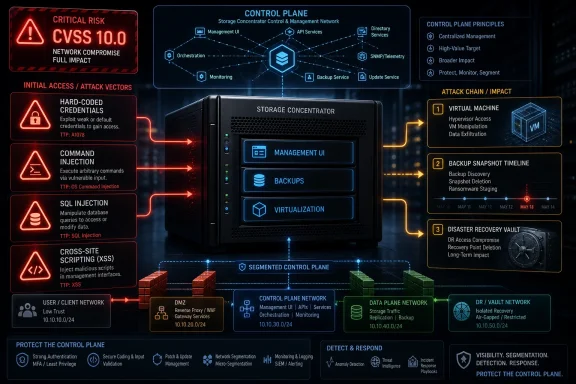 The Storage Box Has Become the Control Plane
StoneFly Storage Concentrator is not a consumer NAS forgotten under a desk. It is the sort of infrastructure product that often lives close to the crown jewels: virtual machine images, backup sets, shared storage, disaster recovery workflows, and the administrative plane that makes all of that usable. CISA’s advisory places the affected deployments across defense industrial base, energy, financial services, healthcare and public health, and information technology environments, which is exactly the list that turns a product vulnerability into an operational-risk story.The advisory covers both the Storage Concentrator hardware/software product line and the Storage Concentrator Virtual Machine. That matters because virtual appliances are frequently treated as easier to deploy, snapshot, migrate, and forget. The same convenience that makes them useful to lean IT teams can also make them surprisingly durable residents of an environment long after their patch status has stopped being visible.
The primary warning is severe: successful exploitation could allow attackers to gain broad unauthorized access, execute arbitrary commands with root privileges, steal sensitive data, and act on behalf of legitimate users across interconnected systems. That is not the language of a nuisance bug. It is the language of a platform compromise.
For Windows administrators, the StoneFly name may surface most often in backup, disaster recovery, Veeam-adjacent, cloud extension, and storage-virtualization contexts rather than as a day-to-day Windows component. That distinction is irrelevant once the appliance is joined to the same operational fabric as Active Directory, hypervisors, backup repositories, SMB shares, iSCSI targets, management VLANs, or monitoring stacks. The Windows estate is often only as resilient as the storage plane beneath it.
A CVSS 10 Is a Siren, Not a Full Risk Model
The headline number is CVSS v3 10, the maximum score. Security teams have learned to be wary of score inflation, but this is not the kind of advisory where the number looks detached from the technical implications. Hard-coded credentials, operating-system command injection, SQL injection, and cross-site scripting are not esoteric weakness classes; they are old, well-understood failure modes that become devastating when found in administrative infrastructure.CISA identifies several affected version thresholds rather than a single “everything before X” line. Storage Concentrator and Storage Concentrator Virtual Machine releases before 8.0.4.22 are affected by three listed CVEs. Versions before 8.0.4.26 are affected by another. Versions before 8.0.4.29 are affected by the final listed CVE. The practical reading is simple: if you are below 8.0.4.29, you should not assume you are outside the danger zone without mapping each installed build to the advisory.
That version cadence also tells a small story. These fixes appear to have landed across multiple point releases, not one dramatic security patch. For busy administrators, that is exactly how appliances drift into risk: one release fixed something, another release fixed something else, and the team that thought it “patched StoneFly” six months ago may still be exposed to a later-disclosed issue.
The problem with infrastructure appliances is that they do not always travel through the same patch pipeline as Windows servers. Microsoft Update, WSUS, Intune, Defender reporting, vulnerability-management agents, and configuration baselines may give teams a reasonably clear picture of Windows endpoint exposure. A storage appliance web console may sit outside that telemetry, especially if it was deployed by a storage team, a backup vendor, a managed service provider, or an integrator years earlier.
This is why the score should be treated as a triage trigger, not the end of the analysis. A CVSS 10 finding on an isolated lab appliance is very different from the same finding on a production storage concentrator reachable from a management subnet shared by backup operators and domain administrators. The score says “pay attention now.” The network map says how bad the weekend might get.
The Worst Bugs Are Boring Until They Are Chained
The weakness categories in the advisory read like a survey of web-application security’s greatest hits. Hard-coded credentials can undermine authentication before an attacker ever needs to brute-force anything. Command injection can turn a web request into shell execution. SQL injection can expose or manipulate data behind the application. Cross-site scripting can make the browser of a legitimate administrator do work for the attacker.None of those classes is new, and that is precisely the indictment. Mature infrastructure software is supposed to make these bug classes rarer through secure design, code review, input validation, least privilege, secret management, and test coverage. When they appear together in a management-facing product, defenders should assume the attack path may not be one clean exploit but a sequence.
A plausible chain does not require Hollywood imagination. An attacker who obtains access to a management interface might use a credential weakness to enter, a web injection issue to pivot through application logic, command injection to execute code with elevated privileges, and cross-site scripting to harvest or replay administrative context. Each individual flaw has its own CVE identifier, but operationally the concern is how they combine.
The root-privilege language is especially important. Appliances frequently present a polished web UI while hiding a Linux or Unix-like operating system beneath it. If an attacker can run arbitrary commands as root, the appliance stops being a storage product and becomes a foothold. From there, stored credentials, mounted shares, replication links, backup targets, network routes, logs, and administrative scripts become part of the evidence locker or the attacker’s toolkit.
For ransomware crews and data-theft operators, storage and backup infrastructure has become a priority target because it offers leverage. Encrypting endpoints is one path to extortion. Deleting snapshots, corrupting replicas, stealing backup data, or sabotaging recovery paths is often more powerful. The industry has spent years telling organizations to build immutable, segmented, recoverable backup environments. A critical flaw in the management layer of a storage product cuts directly against that strategy.
The Affected Versions Demand Inventory, Not Assumptions
The advisory’s version boundaries deserve careful reading. StoneFly Storage Concentrator and Storage Concentrator Virtual Machine versions earlier than 8.0.4.22 are listed as affected by CVE-2026-56415, CVE-2026-55721, and CVE-2026-50040. Versions earlier than 8.0.4.26 are listed as affected by CVE-2026-50110. Versions earlier than 8.0.4.29 are listed as affected by CVE-2026-56413.The safest operational conclusion is that 8.0.4.29 is the minimum target administrators should be looking for unless StoneFly has provided an even newer supported release for the relevant deployment. Anything short of that invites a footnote-driven risk calculation that most environments do not need. Storage infrastructure is not where teams should be bargaining with point-release ambiguity.
Still, version discovery may not be as straightforward as it sounds. Appliance UIs sometimes report one product version while underlying packages, virtual appliance images, or hotfix levels tell a more complicated story. Virtual machine templates can be cloned from old golden images. Disaster-recovery sites can lag production. Lab appliances can quietly become production dependencies.
This is where Windows shops should resist the temptation to define the problem narrowly as “the storage team’s issue.” If the appliance stores Hyper-V workloads, backs up Windows Server systems, presents shares used by Windows clients, participates in identity-integrated workflows, or supports recovery objectives for Microsoft infrastructure, then it belongs in the same risk conversation as domain controllers and backup servers. It may not run Windows, but it protects Windows.
The inventory question is also broader than product name matching. Many organizations buy storage as an appliance bundle, a backup target, a disaster-recovery platform, a vendor-managed solution, or part of a larger project. The label on the purchase order may not match the vulnerable component name. A good response starts with procurement records and CMDB entries, but it should end with network discovery and direct console verification.
CISA’s Mitigation Advice Is Familiar Because It Keeps Being Ignored
CISA’s recommended practices follow the standard industrial-control-system pattern: minimize network exposure, keep control system devices off the open internet, place control networks and remote devices behind firewalls, isolate them from business networks, and use secure remote-access methods such as updated VPNs when remote access is required. These are not glamorous recommendations. They are also the line between a critical vulnerability and an incident.The phrase “not accessible from the internet” should be treated literally. Storage management interfaces do not belong on public IP space, behind weak port-forwarding rules, or reachable through forgotten remote-administration paths. If a vendor, integrator, or managed service provider needs access, that access should be specific, logged, time-bounded where possible, and mediated through hardened remote-access infrastructure.
The VPN caveat is worth dwelling on. CISA notes that VPNs may themselves have vulnerabilities and should be kept current. In practice, many organizations use VPN access as a magic phrase that ends the security conversation. It should begin one instead. Who can reach the StoneFly interface after connecting? Is MFA enforced? Are vendor accounts separated from internal administrator accounts? Is the storage network reachable from general corporate VPN pools?
Segmentation is equally unforgiving. A storage concentrator that is reachable from every admin workstation, backup server, monitoring server, and jump host may be convenient, but convenience is not a compensating control. The goal is not simply to hide the appliance from the internet; it is to reduce the number of systems that can talk to it at all.
CISA also recommends impact analysis and risk assessment before deploying defensive measures. That caution is not bureaucratic throat-clearing. Storage changes can break production workloads, replication, backups, and recovery assumptions. The right answer is not to panic-click every firewall rule into oblivion; it is to move quickly with a dependency map in hand.
“No Known Exploitation” Is Comfort With an Expiration Date
CISA says it has not received reports of known public exploitation specifically targeting these vulnerabilities at the time of publication. That is useful information, but it is not a reason to wait. Public exploitation status is a lagging indicator, especially for appliances that may sit in narrower vertical markets or behind private management networks.The history of infrastructure exploitation is full of quiet intervals that ended abruptly. Once an advisory lands, researchers, criminal groups, and opportunistic scanners all begin their own version of patch-diffing and product reconnaissance. If the vulnerable surface is reachable and the weakness class is straightforward enough, the window between disclosure and weaponization can shrink quickly.
Hard-coded credentials and command injection are particularly dangerous in that regard. They are often easier to validate than memory-corruption bugs, do not require a deep exploit-development pipeline, and can produce obvious proof of compromise. Even when exploit details are not published, attackers can infer a great deal from version differences, endpoint names, error messages, and vendor patches.
There is another subtlety in the wording. “No known public exploitation specifically targeting these vulnerabilities” does not mean no one has ever abused a misconfigured StoneFly deployment, compromised a related appliance, or used adjacent weaknesses in the wild. It means this specific set of CVEs has not been reported to CISA as exploited. Defenders should hear that as a timestamped status, not a guarantee.
For organizations in healthcare, energy, finance, and defense-adjacent supply chains, waiting for exploitation to become known is the wrong threshold. By the time a storage appliance compromise appears in public reporting, the useful defensive window may have closed. The correct threshold is exposure plus consequence.
Windows Shops Should Look Beyond the Patch Button
The immediate action is to update affected StoneFly Storage Concentrator and Storage Concentrator Virtual Machine deployments to a fixed version. But the more important work starts once the version number looks clean. Critical infrastructure appliance advisories should trigger a short forensic and architectural review, not just a maintenance-ticket closure.Administrators should examine whether the management interface was reachable from untrusted networks, broad VPN pools, general admin subnets, or user workstations. They should review authentication logs, administrative actions, configuration changes, backup deletions, replication failures, unusual snapshots, new local users, and unexplained outbound connections. Root-level command execution risk means the appliance itself should be treated as a potentially compromised host if exposure was significant.
Credential hygiene deserves special attention. If the appliance stored, proxied, or reused credentials for directory services, backup platforms, cloud storage, hypervisors, SMTP, monitoring, or remote support, those secrets may need rotation. This is tedious work, but it is exactly where storage compromises become enterprise compromises. A patched appliance with stolen reusable credentials remains a live problem.
Windows environments should also review the relationship between the appliance and Active Directory. Does it authenticate administrators through domain groups? Does it store LDAP bind credentials? Does it present SMB shares with domain permissions? Does it interact with Windows backup agents or VSS-related workflows? Each of those touchpoints can turn a storage vulnerability into an identity and lateral-movement issue.
Backup integrity checks should be part of the response. If the appliance participates in recovery workflows, teams should validate that recent backups are restorable, snapshots are present and protected, replication is functioning, and immutability controls remain intact. The point is not to assume compromise; it is to prove recoverability while the organization is already focused on the platform.
The Appliance Era Has Outgrown Appliance Security Habits
Enterprise IT still has a habit of treating appliances as sealed boxes. The vendor ships it, the admin configures it, and the organization assumes the internals are someone else’s problem. That model never made much sense, but it is especially brittle now that appliances are routinely Linux servers, web applications, storage engines, databases, schedulers, monitoring agents, remote-support hooks, and cloud connectors in a single branded package.Virtual appliances complicate the picture further. They inherit the operational discipline of the virtualization platform but not necessarily its visibility. A VMware, Hyper-V, KVM, or cloud-hosted appliance can be snapshotted, cloned, restored, and isolated easily, yet its application-level patching may remain manual and opaque. The VM looks modern; the maintenance model may still be old-school.
The StoneFly advisory is a reminder that infrastructure appliances should be part of vulnerability management as first-class assets. That means ownership, patch cadence, asset tagging, authenticated scanning where supported, vendor bulletin monitoring, configuration backups, log forwarding, and documented emergency update procedures. If a product is important enough to hold backups or production storage, it is important enough to have a named owner.
There is also a procurement lesson. Security questionnaires often focus on encryption, ransomware resistance, immutability, MFA, role-based access control, and compliance language. Those matter, but buyers should also ask how the vendor handles secure development, credential storage, vulnerability disclosure, patch distribution, release notes, and appliance telemetry. “Hardened storage” is not a slogan; it is an engineering process.
This does not mean every appliance vendor should be treated as suspect by default. It means the old bargain—trust the box because it is specialized—has expired. Specialized boxes are now high-value software platforms, and high-value software platforms need scrutiny.
The Real Risk Is the Recovery Plan You Cannot Trust
For many organizations, the scariest part of a storage vulnerability is not initial compromise. It is uncertainty. If a platform that stores backups, replicas, or shared data may have been exposed to root-level command execution, how confident can the team be that recovery will work when needed?This is where the advisory intersects with ransomware resilience. Modern extortion groups try to disable security tools, steal data, destroy backups, and pressure victims before encryption ever begins. A storage concentrator with privileged access to backup repositories or replication targets is an attractive place to interfere with the organization’s last line of defense. Even failed exploitation attempts should be taken seriously if they targeted systems that underpin recovery.
The impact is not limited to ransomware. In regulated environments, unauthorized access to storage systems can raise data-exposure questions even without obvious disruption. Healthcare records, financial files, defense-related data, legal archives, and identity stores may live in the same broad storage ecosystem. SQL injection and unauthorized access risks can become audit, disclosure, and compliance events depending on what the appliance can see.
There is also the operational downtime angle. Storage changes are inherently risky because they can cascade. A rushed patch without a backup of the appliance configuration can cause service interruption. A delayed patch can leave the environment exposed. The art is to move fast without pretending storage is just another stateless web app.
That is why the best response teams will pair security urgency with operations discipline. They will capture configurations, confirm vendor upgrade paths, schedule maintenance windows where needed, isolate management access immediately, and perform validation after the update. They will also document what was reachable before the fix, because that fact may matter later.
The Patch Is the Easy Part; Proving Containment Is the Work
The immediate technical target is clear: identify StoneFly Storage Concentrator and Storage Concentrator Virtual Machine deployments and bring them to a fixed release, with 8.0.4.29 serving as the key advisory threshold for the final listed vulnerability. But the security outcome depends on what happens around that upgrade. A critical advisory handled as a version-number exercise can leave the most important questions unanswered.Start with exposure. If the management interface was never reachable beyond a tightly controlled jump host, the post-patch investigation may be bounded. If it was reachable from broad internal networks, remote vendor access, or VPN pools, the organization should treat the situation as a potential compromise review. Internal-only exposure is still exposure; many serious breaches begin after attackers obtain one valid foothold elsewhere.
Next comes identity. Administrative appliances often accumulate local users, shared accounts, emergency credentials, vendor support logins, and directory integrations. Hard-coded credential vulnerabilities make this area especially sensitive. Teams should remove unnecessary accounts, rotate secrets, confirm MFA where available, and avoid shared administrator identities that make audit trails meaningless.
Then comes logging. If logs are stored only on the appliance, root-level compromise can threaten their integrity. Forwarding logs to a SIEM or central syslog platform is not just a compliance nicety; it is what lets responders ask what happened after the device itself can no longer be fully trusted. For WindowsForum readers running hybrid Microsoft environments, this is where Sentinel, Defender XDR integrations, or other SIEM pipelines can provide useful correlation if they are already collecting the right signals.
Finally comes recovery validation. Do not assume that because an update succeeded, the protected data remains usable. Test representative restores. Confirm backup chains. Verify that retention and immutability settings remain as expected. Review replication destinations. The difference between a patched appliance and a trustworthy recovery platform is evidence.
The StoneFly Advisory Should Change the Maintenance Calendar
Security teams tend to categorize advisories by vendor, severity, exploit status, and whether a patch exists. This one should also be categorized by asset class. Storage and backup infrastructure deserves a faster clock than ordinary business applications because it can determine whether the organization survives a separate incident.That faster clock does not mean reckless patching. It means pre-arranged playbooks. Administrators should already know who owns the appliance, how to check its version, how to obtain updates, whether support contracts are current, how to back up its configuration, which services depend on it, and what maintenance window is acceptable in an emergency. If those answers have to be discovered after the advisory drops, the organization is already late.
The same logic applies to vendor-managed environments. Outsourcing operation does not outsource accountability. Customers should ask their providers whether affected StoneFly components exist in the environment, what versions are deployed, when updates were applied, what exposure existed before mitigation, and whether logs show suspicious activity. A vague “we are aware and monitoring” response is not enough for a CVSS 10 advisory touching storage infrastructure.
There is a governance angle here, too. Boards and executives have heard years of messaging about backups as the antidote to ransomware. That message is incomplete unless backup and storage platforms receive their own security investment. Recovery infrastructure cannot be the underfunded corner of the environment and the centerpiece of resilience at the same time.
This advisory also reinforces a broader shift in infrastructure risk. Attackers do not need to compromise every Windows endpoint if they can compromise the systems that store, restore, authenticate, or administer those endpoints. The control plane is the battlefield, and storage is part of that control plane now.
The Concrete Moves for StoneFly Customers This Week
This advisory is not a reason for theatrical panic, but it is a reason for disciplined urgency. The organizations most likely to handle it well are the ones that treat the StoneFly appliance as production security infrastructure rather than a storage sidebar.- Confirm whether any StoneFly Storage Concentrator or Storage Concentrator Virtual Machine deployment exists in production, disaster recovery, lab, remote-site, or vendor-managed environments.
- Verify the exact installed version and treat any deployment below 8.0.4.29 as requiring immediate review against the advisory’s affected-version matrix.
- Restrict management access to trusted administrative paths only, and remove any internet exposure, broad VPN reachability, or unnecessary internal network access.
- Rotate credentials associated with the appliance if exposure was meaningful, especially local administrator accounts, directory bind accounts, backup-platform credentials, cloud keys, and vendor-support access.
- Review logs and configuration history for suspicious administrative actions, unusual command execution indicators, unexpected users, altered backup settings, failed authentication spikes, or unexplained network connections.
- Validate restore operations, replication health, snapshot integrity, and immutability controls after patching so the organization can trust the recovery layer it is trying to protect.
References
- Primary source: CISA
Published: 2026-06-30T12:00:00+00:00

StoneFly Storage Concentrator | CISA
www.cisa.gov
- Related coverage: stonefly.com
Enterprise Storage, Disaster Recovery & Cloud Solutions | StoneFly
Protect critical business data with StoneFly's enterprise storage, backup, disaster recovery, cloud, and HCI solutions. Secure, scalable, and built for modern IT infrastructure stonefly.com
- Related coverage: cvefeed.io
Stonefly > Storage concentrator Vulnerability Maturity Index CVE
Product security and vulnerability maturity CVE Indexcvefeed.io - Related coverage: helpnetsecurity.com
CISA: Patch actively exploited SolarWinds Serv-U DoS vulnerability (CVE-2026-28318) - Help Net Security
A vulnerability (CVE-2026-28318) that can be exploited to crash SolarWinds Serv-U file transfer servers is being leveraged by attackers.www.helpnetsecurity.com - Related coverage: thehackernews.com
CISA Adds Cisco, Chrome, and Arista Flaws to KEV Catalog Amid Active Exploitation
CISA added 3 actively exploited flaws in Cisco SD-WAN Manager, Chrome V8, and Arista EOS to its KEV catalog.thehackernews.com
- Related coverage: securityaffairs.com
U.S. CISA adds SolarWinds Serv-U flaw to its Known Exploited Vulnerabilities catalog
U.S. Cybersecurity and Infrastructure Security Agency (CISA) adds SolarWinds Serv-U flaw to its Known Exploited Vulnerabilities catalog.securityaffairs.com
- Related coverage: levelblue.com
Command Injection and Path Traversal in StoneFly Storage Concentrator
CVE-2024-30213, CVE-2024-31947: Blind Operating System Command Injection and Path Traversal in StoneFly Storage Concentrator levelblue.com
- Related coverage: bleepingcomputer.com
CISA: Hackers now exploit SolarWinds Serv-U flaw to crash servers
CISA warned today that hackers are now actively exploiting a recently patched high-severity SolarWinds Serv-U flaw to crash servers.www.bleepingcomputer.com - Related coverage: hivepro.com
