

CISA published an industrial-control security advisory on June 11, 2026, warning that Yarbo’s Android and iOS mobile apps and cloud MQTT infrastructure exposed hard-coded credentials and weak authorization that could let attackers view fleet telemetry and potentially send robot commands. The uncomfortable part is not merely that a smart yard robot had bugs. It is that the cloud control plane appears to have treated a global fleet of physical machines like a convenience feature bolted onto a mobile app. For WindowsForum readers, the lesson is familiar from enterprise IT: when identity is shared, authorization is ornamental, and “cloud” becomes a single blast radius.
Yarbo is not a Windows endpoint, a domain controller, or an Azure tenant. It is a modular outdoor robot platform — the kind of device marketed to consumers and property owners as a way to automate mowing, snow blowing, leaf clearing, and other outdoor chores. But once a machine can move through the physical world, receive remote commands, and report location-rich telemetry through a vendor cloud, it stops being just another gadget.
That is why CISA’s advisory lands in the industrial-control lane rather than the usual consumer-app embarrassment bucket. The agency places the affected product in the Commercial Facilities sector, with deployments worldwide and the company headquarters listed in China. That classification is important: a robot moving around residential estates, campuses, business parks, or facility grounds is not a thermostat with branding. It is a small autonomous vehicle attached to cloud infrastructure.
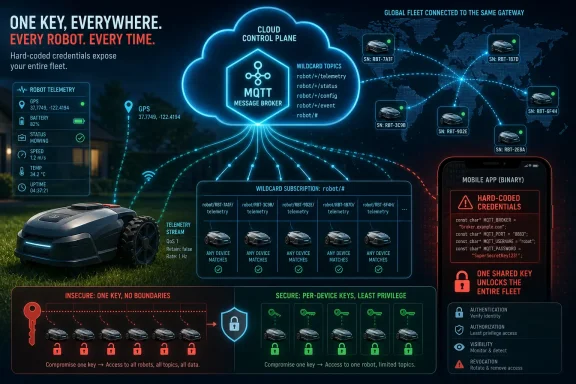
The advisory covers two vulnerabilities. CVE-2026-10557 is the more immediately dramatic one: hard-coded MQTT broker credentials embedded in Yarbo’s Android and iOS apps, identical across users and devices. CISA says those credentials were extractable from the application binary and could provide access to MQTT brokers carrying real-time telemetry for the global Yarbo robot fleet.
The second flaw, CVE-2026-7368, is the more architecturally damning one. According to the advisory, Yarbo’s cloud did not enforce per-device or per-user authorization, meaning any client with valid credentials could subscribe to wildcard topics covering all robots globally and publish to command topics using only a robot serial number. That means removing the hard-coded password is only half the repair. The real fix is proving that one authenticated identity can no longer wander across the entire fleet.
Mobile applications are distributed to adversaries by design. APKs can be decompiled. iOS apps can be inspected. Network traffic can be observed, replayed, and compared across versions. If a credential grants broad access to backend infrastructure and that credential is shipped to every customer device, it should be considered public information from the moment the app reaches an app store.
In Yarbo’s case, CISA describes the MQTT credentials as identical for all users and all devices. That detail matters because it collapses the difference between one customer and another. The app is no longer merely authenticating a user session; it is carrying a shared key to a common message bus.
MQTT itself is not the villain here. It is a widely used lightweight publish-and-subscribe protocol, well suited to telemetry and IoT messaging. The problem is what happens when topic-level authorization is loose or missing, because MQTT’s convenience features — especially wildcard subscriptions — become surveillance and control features in the wrong hands.
The combination CISA describes is the classic IoT security anti-pattern: a mobile app contains the secret, the cloud broker trusts the secret too broadly, and device identity is represented by a serial number rather than enforced by scoped authorization. Once an attacker extracts the credential, the cloud has no meaningful basis to distinguish legitimate control from hostile control.
CISA says the exposed credentials allowed subscription to all robot telemetry topics and publishing to any robot’s command topic using only the robot’s serial number. That is a profound failure of containment. It means the unit of compromise was not an account, not a household, and not a robot. The unit of compromise was the fleet.
Telemetry is often underrated in security discussions because it does not sound as dramatic as remote control. But telemetry from outdoor robots can be sensitive. It may reveal GPS coordinates, operating schedules, device identifiers, owner behavior patterns, and the presence of robots at particular facilities. Even without issuing a single command, an attacker watching a global stream of robot data could learn where devices are, when they are active, and which serial numbers are valid targets.
The command side is even more troubling. CISA’s wording is careful — exploitation could “potentially” allow operational commands to be sent — but the advisory makes clear that publishing to command topics was in scope. When a cloud broker mediates commands to a moving machine, publish rights are not a harmless permission. They are control-plane power.
This is where consumer IoT starts to resemble operational technology. A compromised webcam is invasive; a compromised mower or yard robot is kinetic. Even if safety interlocks limit what a robot can do, the security model should not depend on the last line of physical safety defense after the cloud has already accepted unauthorized command traffic.
That split is revealing. App updates can remove embedded shared credentials from the mobile binary, but they cannot by themselves solve missing authorization in the cloud. If the backend still accepts any valid credential for wildcard access or cross-device publishing, then the credential source changes while the blast radius remains dangerously large.
This is why CVE-2026-7368 may be the more important vulnerability for administrators and security architects to study. The advisory explicitly says that even after hard-coded credentials are removed, a single compromised credential could still provide fleet-wide access without per-device access controls. That is the kind of sentence that should make cloud platform teams sit up straight.
The correct pattern is not mysterious. Identity should be scoped. Authorization should be enforced server-side. Device topics should be bound to accounts, tenants, and device identities. Publishing to command channels should require more than knowledge of a serial number. Wildcard subscriptions should be tightly constrained, audited, and usually unavailable to ordinary clients.
The inconvenient truth is that many IoT systems grow in the opposite direction. Early prototypes use simple shared broker credentials because they are easy. Fleet telemetry gets centralized because it helps support and diagnostics. Command topics follow predictable naming conventions because developers need sane routing. Then the product ships, the fleet grows, and the prototype trust model becomes production infrastructure.
The CVSS 4.0 score for the same issue is 9.3, still Critical. The exact numerical difference is less important than the shape of the risk. The vulnerability combines easy exploitability with broad backend access and possible command consequences.
CVE-2026-7368 is rated 8.1 under CVSS 3.1 and 8.6 under CVSS 4.0. It is not “less serious” in the way casual readers might assume; it is scored differently because it requires possession of valid credentials. But in a system where credentials have already been hard-coded into apps, extracted from clients, or otherwise compromised, that prerequisite may not be much comfort.
The pairing of the two CVEs is the story. The first says the secret was poorly protected. The second says the system trusted the secret far too much. Either flaw would be concerning; together, they describe a cloud control plane with insufficient defense in depth.
CISA also says no known public exploitation specifically targeting these vulnerabilities had been reported to the agency at the time of publication. That is good news, but it is not a clean bill of health. “No known exploitation” is a visibility statement, not a guarantee that nothing happened, and telemetry access vulnerabilities are notoriously difficult for customers to detect unless the vendor provides detailed logs.
That design pattern is everywhere. Mobile apps configure routers, cameras, NAS appliances, EV chargers, access-control systems, thermostats, and building equipment. The app may look like a remote control, but in practice it is often the identity provider, provisioning client, telemetry viewer, support bridge, and command console all at once.
Security teams should be especially skeptical when a vendor says a cloud-connected device is “consumer” or “prosumer” and therefore outside normal enterprise risk planning. A robot operating at a commercial site can disclose location and usage patterns. A compromised appliance on a guest Wi-Fi segment can still become a pivot point. A vendor support tunnel can bypass carefully designed local controls.
The old enterprise boundary model is poorly matched to these systems. The device may be on a segmented network, but its real control path may run through a vendor cloud. The user may not expose ports to the internet, but the device may maintain outbound sessions that accept commands indirectly. The administrator may block inbound traffic and still have little visibility into what the robot is receiving from its broker.
That is why CISA’s standard recommendations — minimize network exposure, isolate control systems, use secure remote access, keep VPNs patched, and perform impact analysis — are necessary but incomplete for cloud-mediated robots. Network segmentation helps, but it cannot fix a vendor broker that authorizes the wrong client. The control plane is not always on your network.
Serial numbers are not secrets. They appear in logs, labels, support tickets, telemetry, invoices, app screens, packaging, and sometimes public resale listings. Treating a serial number as sufficient to route commands is tolerable only if strong authentication and authorization have already established that the caller has rights over that device.
In secure systems, identifiers help you find an object; they do not grant power over it. A domain SID does not let you administer Active Directory. A MAC address does not prove ownership of a laptop. A vehicle VIN does not authorize remote unlock. The same principle should apply to robot serial numbers.
The danger grows when telemetry discloses the identifiers needed for command routing. If a wildcard subscription reveals serial numbers across the fleet, and command topics are predictable from those serial numbers, the system has effectively published its own target list. That does not mean exploitation is automatic in every environment, but it does mean the architecture has removed several barriers an attacker should have had to overcome.
This is the kind of design flaw that does not vanish with a password rotation. It requires rethinking the relationship between device identity, user identity, command authorization, and telemetry visibility. If Yarbo’s May 2026 server-side changes enforce broker authorization properly, that is the repair that matters most.
A robot that moves outdoors has a different risk profile from a smart bulb. It has motors, blades or attachments depending on configuration, location awareness, and the ability to interact with people, pets, property, and infrastructure. Even if built-in safety controls prevent catastrophic misuse, unauthorized command pathways should be treated as serious safety-adjacent risks.
This does not mean every robot vulnerability is a Hollywood hacking scenario. Real-world exploitation depends on many factors: attacker knowledge, broker access, device state, safety interlocks, firmware behavior, network conditions, and whether the vendor has already deployed mitigations. But responsible security analysis should not require proof of disaster before recognizing a flawed control plane.
The vendor response also matters. According to public reporting in May, Yarbo had already been under scrutiny for earlier security findings involving remote diagnostics, credential management, and data handling. The CISA advisory now formalizes a specific mobile-app and cloud-infrastructure slice of that broader concern. Even if the company is moving quickly to remediate, the sequence suggests that security debt accumulated across multiple layers.
For buyers, this should shift the procurement conversation. The question is not only whether the robot can mow straight lines or survive winter. It is whether the vendor can explain credential rotation, device-scoped authorization, telemetry retention, cloud logging, firmware update integrity, and incident notification. Those are not enterprise-only questions anymore.
The Yarbo advisory is a reminder that asset inventory cannot end at laptops and servers. Facilities teams buy robots, cameras, access panels, HVAC controllers, displays, kiosks, and sensors. Those devices may never join Active Directory, but they still use corporate networks, vendor clouds, mobile apps, and sometimes privileged maintenance workflows.
The mobile-app angle is also relevant to Microsoft shops because enterprise mobile management often focuses on employee phones and corporate apps, not the vendor apps used to administer facility equipment. If a grounds crew or facilities manager uses a personal phone to control a robot deployed on company property, that control relationship may live entirely outside the IT department’s normal visibility.
The practical response is not to ban every smart device. It is to stop pretending they are invisible. If a device can move, record, unlock, heat, cool, signal, or command other systems, it deserves a place in the risk register. If it depends on a vendor cloud, procurement should ask what happens when the vendor’s authorization layer fails.
Windows administrators are already used to thinking in terms of blast radius. A shared local administrator password across endpoints is bad. A service account with domain-wide privileges is worse. A cloud token that can read every tenant object is catastrophic. Yarbo’s MQTT design, as described by CISA, belongs in that same mental model.
A user can update an app. An administrator can segment a network. A cautious owner can monitor for strange behavior, restrict Wi-Fi access, and review vendor communications. But customers cannot retrofit per-device authorization into someone else’s MQTT broker.
That matters because too much IoT security advice shifts burden to the buyer after architecture decisions have already been made. “Put it on a separate network” is good hygiene, but it does not prevent a cloud-originated command if the robot is designed to obey the vendor broker. “Use a strong password” is irrelevant if the app ships with a shared backend credential. “Patch promptly” helps only after the vendor has built a real patch.
There is also a detection gap. If an attacker subscribes to telemetry from the vendor’s broker, the affected customer may see nothing locally. If command messages traverse normal cloud channels, they may look like legitimate traffic at the network edge. Without vendor-side audit logs exposed to customers, even sophisticated administrators may struggle to determine whether their specific devices were accessed.
This is where regulators and large buyers can exert pressure. Vendors selling physical automation need to provide more than marketing assurances. They need documented access-control models, independent security testing, vulnerability disclosure processes, and customer-visible incident timelines. In other words, they need to act less like gadget makers and more like infrastructure providers.
The process is imperfect. Advisories often arrive after public reporting, patches may be partial, and vendors vary widely in transparency. But the alternative is worse: silent flaws, private exploitation, and customers who never learn that their devices depended on shared credentials or missing authorization.
The timing is notable. The advisory’s initial release date is June 11, 2026, while the mitigation references a May 2026 server-side authorization update. That suggests at least some remediation activity preceded the formal advisory. For customers, the key question is whether the promised server-side enforcement is now fully deployed and whether app version 3.17.4 or later is actually installed on every phone used to operate the robots.
Security teams should not treat a vendor’s “no user action required” line as permission to ignore the issue. It may be true for the server-side fix, but it does not answer operational questions. Which robots are in use? Which accounts control them? Which mobile devices have the app installed? Are there logs showing command history? Has the vendor rotated all relevant credentials? Were any abnormal wildcard subscriptions observed before enforcement changed?
Those are uncomfortable questions for a lawn robot. They are also exactly the questions that separate mature incident response from hopeful patch management.
The industry has known for a long time that secrets embedded in client software are not durable secrets. It has also known that authorization must be enforced where the protected resource lives, not where the user interface runs. Yet IoT repeatedly rediscovers these lessons because product velocity rewards working demos more than constrained identities.
The incentives are structural. Shared credentials are easier to debug. Wildcard telemetry is useful for support dashboards. Predictable topics simplify fleet management. Remote access helps engineers fix customer problems without truck rolls. Each decision is convenient in isolation; together they can create a system where compromise of one component exposes everyone.
This is why secure-by-design language needs to be tested against specifics. Does every device have a unique credential? Can credentials be rotated without replacing hardware? Are command topics protected by per-device ACLs? Are wildcard subscriptions prohibited for customer clients? Are support privileges time-limited and audited? Can customers disable remote diagnostics? Are mobile apps free of backend secrets?
If a vendor cannot answer those questions, buyers should assume the architecture is immature until proven otherwise. Not malicious, not uniquely negligent, but immature. In 2026, that is no longer good enough for robots moving around the physical world.
For individual owners, that means keeping the app current, reviewing account access, and being attentive to unexpected device behavior. For businesses, schools, campuses, and property managers, it means placing outdoor robots in the same governance category as cameras, access-control systems, and other connected facilities equipment. If it can observe or act in the real world, it belongs in inventory and risk review.
Network segmentation remains useful. A robot should not share unrestricted access with workstations, servers, NAS appliances, printers, or administrative networks. But segmentation should be understood as a damage-limiting control, not a cure for vendor-cloud authorization flaws.
The sharper procurement requirement is evidence of least privilege. A vendor should be able to state that one customer cannot see another customer’s telemetry, one device cannot publish commands for another device, and one leaked credential cannot become a master key. If that statement depends on app secrecy rather than broker enforcement, it is not a security claim; it is a wish.
Yarbo’s advisory should not be remembered simply as a bad week for a robot maker. It should be remembered as a clean illustration of how cloud convenience becomes physical risk when identity and authorization are treated as afterthoughts. If the May 2026 server-side changes do what they are supposed to do, Yarbo customers may soon be safer than they were; the rest of the industry should take the hint before CISA has to explain the same lesson with a different logo.
 The Yard Robot Became an ICS Problem
Yarbo is not a Windows endpoint, a domain controller, or an Azure tenant. It is a modular outdoor robot platform — the kind of device marketed to consumers and property owners as a way to automate mowing, snow blowing, leaf clearing, and other outdoor chores. But once a machine can move through the physical world, receive remote commands, and report location-rich telemetry through a vendor cloud, it stops being just another gadget.That is why CISA’s advisory lands in the industrial-control lane rather than the usual consumer-app embarrassment bucket. The agency places the affected product in the Commercial Facilities sector, with deployments worldwide and the company headquarters listed in China. That classification is important: a robot moving around residential estates, campuses, business parks, or facility grounds is not a thermostat with branding. It is a small autonomous vehicle attached to cloud infrastructure.
The advisory covers two vulnerabilities. CVE-2026-10557 is the more immediately dramatic one: hard-coded MQTT broker credentials embedded in Yarbo’s Android and iOS apps, identical across users and devices. CISA says those credentials were extractable from the application binary and could provide access to MQTT brokers carrying real-time telemetry for the global Yarbo robot fleet.
The second flaw, CVE-2026-7368, is the more architecturally damning one. According to the advisory, Yarbo’s cloud did not enforce per-device or per-user authorization, meaning any client with valid credentials could subscribe to wildcard topics covering all robots globally and publish to command topics using only a robot serial number. That means removing the hard-coded password is only half the repair. The real fix is proving that one authenticated identity can no longer wander across the entire fleet.
Hard-Coded Credentials Are Not a Bug; They Are a Governance Failure
There is a tendency in vulnerability writeups to treat hard-coded credentials as a discrete implementation mistake: a password was left in the app, a token was shipped in a binary, a developer took a shortcut. That framing is technically accurate and strategically inadequate. Hard-coded credentials in a mobile app are not just a bad secret; they are evidence that the system’s trust model was upside down.Mobile applications are distributed to adversaries by design. APKs can be decompiled. iOS apps can be inspected. Network traffic can be observed, replayed, and compared across versions. If a credential grants broad access to backend infrastructure and that credential is shipped to every customer device, it should be considered public information from the moment the app reaches an app store.
In Yarbo’s case, CISA describes the MQTT credentials as identical for all users and all devices. That detail matters because it collapses the difference between one customer and another. The app is no longer merely authenticating a user session; it is carrying a shared key to a common message bus.
MQTT itself is not the villain here. It is a widely used lightweight publish-and-subscribe protocol, well suited to telemetry and IoT messaging. The problem is what happens when topic-level authorization is loose or missing, because MQTT’s convenience features — especially wildcard subscriptions — become surveillance and control features in the wrong hands.
The combination CISA describes is the classic IoT security anti-pattern: a mobile app contains the secret, the cloud broker trusts the secret too broadly, and device identity is represented by a serial number rather than enforced by scoped authorization. Once an attacker extracts the credential, the cloud has no meaningful basis to distinguish legitimate control from hostile control.
Wildcard Telemetry Turns One Mistake Into a Fleet-Wide View
The phrase “wildcard subscription” may sound like implementation trivia, but it is the hinge of the advisory. In a properly designed fleet, a user should see only the devices assigned to that account, and a device should publish only to topics it is authorized to use. In a poorly segmented fleet, a wildcard subscription can become a window into everything.CISA says the exposed credentials allowed subscription to all robot telemetry topics and publishing to any robot’s command topic using only the robot’s serial number. That is a profound failure of containment. It means the unit of compromise was not an account, not a household, and not a robot. The unit of compromise was the fleet.
Telemetry is often underrated in security discussions because it does not sound as dramatic as remote control. But telemetry from outdoor robots can be sensitive. It may reveal GPS coordinates, operating schedules, device identifiers, owner behavior patterns, and the presence of robots at particular facilities. Even without issuing a single command, an attacker watching a global stream of robot data could learn where devices are, when they are active, and which serial numbers are valid targets.
The command side is even more troubling. CISA’s wording is careful — exploitation could “potentially” allow operational commands to be sent — but the advisory makes clear that publishing to command topics was in scope. When a cloud broker mediates commands to a moving machine, publish rights are not a harmless permission. They are control-plane power.
This is where consumer IoT starts to resemble operational technology. A compromised webcam is invasive; a compromised mower or yard robot is kinetic. Even if safety interlocks limit what a robot can do, the security model should not depend on the last line of physical safety defense after the cloud has already accepted unauthorized command traffic.
The Patch Story Is Split Between the App Store and the Broker
Yarbo’s remediation guidance, as summarized by CISA, has two parts. Users should update the Yarbo mobile app to version 3.17.4 or later. Separately, server-side broker authorization is supposed to be enforced automatically with the May 2026 update, with no user action required.That split is revealing. App updates can remove embedded shared credentials from the mobile binary, but they cannot by themselves solve missing authorization in the cloud. If the backend still accepts any valid credential for wildcard access or cross-device publishing, then the credential source changes while the blast radius remains dangerously large.
This is why CVE-2026-7368 may be the more important vulnerability for administrators and security architects to study. The advisory explicitly says that even after hard-coded credentials are removed, a single compromised credential could still provide fleet-wide access without per-device access controls. That is the kind of sentence that should make cloud platform teams sit up straight.
The correct pattern is not mysterious. Identity should be scoped. Authorization should be enforced server-side. Device topics should be bound to accounts, tenants, and device identities. Publishing to command channels should require more than knowledge of a serial number. Wildcard subscriptions should be tightly constrained, audited, and usually unavailable to ordinary clients.
The inconvenient truth is that many IoT systems grow in the opposite direction. Early prototypes use simple shared broker credentials because they are easy. Fleet telemetry gets centralized because it helps support and diagnostics. Command topics follow predictable naming conventions because developers need sane routing. Then the product ships, the fleet grows, and the prototype trust model becomes production infrastructure.
CISA’s Scorecard Reflects Both Reach and Consequence
CISA assigns CVE-2026-10557 a CVSS 3.1 score of 9.8, rated Critical, with network attack vector, low complexity, no privileges required, no user interaction, and high impact across confidentiality, integrity, and availability. In plain English, that is the “anyone on the internet who can obtain the app secret may have a path to the crown jewels” category.The CVSS 4.0 score for the same issue is 9.3, still Critical. The exact numerical difference is less important than the shape of the risk. The vulnerability combines easy exploitability with broad backend access and possible command consequences.
CVE-2026-7368 is rated 8.1 under CVSS 3.1 and 8.6 under CVSS 4.0. It is not “less serious” in the way casual readers might assume; it is scored differently because it requires possession of valid credentials. But in a system where credentials have already been hard-coded into apps, extracted from clients, or otherwise compromised, that prerequisite may not be much comfort.
The pairing of the two CVEs is the story. The first says the secret was poorly protected. The second says the system trusted the secret far too much. Either flaw would be concerning; together, they describe a cloud control plane with insufficient defense in depth.
CISA also says no known public exploitation specifically targeting these vulnerabilities had been reported to the agency at the time of publication. That is good news, but it is not a clean bill of health. “No known exploitation” is a visibility statement, not a guarantee that nothing happened, and telemetry access vulnerabilities are notoriously difficult for customers to detect unless the vendor provides detailed logs.
The Consumer App Was the Door to the Industrial Control Plane
For Windows administrators, this case should feel uncomfortably familiar. The weakest part of a serious system is often not the server that everyone hardens, but the client application that everyone treats as an accessory. In Yarbo’s case, the mobile app appears to have been a route into the cloud infrastructure that mediated telemetry and commands.That design pattern is everywhere. Mobile apps configure routers, cameras, NAS appliances, EV chargers, access-control systems, thermostats, and building equipment. The app may look like a remote control, but in practice it is often the identity provider, provisioning client, telemetry viewer, support bridge, and command console all at once.
Security teams should be especially skeptical when a vendor says a cloud-connected device is “consumer” or “prosumer” and therefore outside normal enterprise risk planning. A robot operating at a commercial site can disclose location and usage patterns. A compromised appliance on a guest Wi-Fi segment can still become a pivot point. A vendor support tunnel can bypass carefully designed local controls.
The old enterprise boundary model is poorly matched to these systems. The device may be on a segmented network, but its real control path may run through a vendor cloud. The user may not expose ports to the internet, but the device may maintain outbound sessions that accept commands indirectly. The administrator may block inbound traffic and still have little visibility into what the robot is receiving from its broker.
That is why CISA’s standard recommendations — minimize network exposure, isolate control systems, use secure remote access, keep VPNs patched, and perform impact analysis — are necessary but incomplete for cloud-mediated robots. Network segmentation helps, but it cannot fix a vendor broker that authorizes the wrong client. The control plane is not always on your network.
The Serial Number Should Never Be a Capability
One of the most striking details in the advisory is that publishing to any robot’s command topic could be done using only the robot’s serial number, with serial numbers disclosed in the telemetry stream. That is a textbook example of confusing an identifier with an authorization mechanism.Serial numbers are not secrets. They appear in logs, labels, support tickets, telemetry, invoices, app screens, packaging, and sometimes public resale listings. Treating a serial number as sufficient to route commands is tolerable only if strong authentication and authorization have already established that the caller has rights over that device.
In secure systems, identifiers help you find an object; they do not grant power over it. A domain SID does not let you administer Active Directory. A MAC address does not prove ownership of a laptop. A vehicle VIN does not authorize remote unlock. The same principle should apply to robot serial numbers.
The danger grows when telemetry discloses the identifiers needed for command routing. If a wildcard subscription reveals serial numbers across the fleet, and command topics are predictable from those serial numbers, the system has effectively published its own target list. That does not mean exploitation is automatic in every environment, but it does mean the architecture has removed several barriers an attacker should have had to overcome.
This is the kind of design flaw that does not vanish with a password rotation. It requires rethinking the relationship between device identity, user identity, command authorization, and telemetry visibility. If Yarbo’s May 2026 server-side changes enforce broker authorization properly, that is the repair that matters most.
Physical Robots Raise the Bar for Cloud Vendors
Every connected product vendor likes the operational benefits of cloud control. Cloud telemetry simplifies diagnostics. Remote commands reduce support costs. Fleet-wide updates let companies patch quickly and add features without customer intervention. But the more physical the product becomes, the less acceptable it is to carry over the security habits of low-stakes consumer apps.A robot that moves outdoors has a different risk profile from a smart bulb. It has motors, blades or attachments depending on configuration, location awareness, and the ability to interact with people, pets, property, and infrastructure. Even if built-in safety controls prevent catastrophic misuse, unauthorized command pathways should be treated as serious safety-adjacent risks.
This does not mean every robot vulnerability is a Hollywood hacking scenario. Real-world exploitation depends on many factors: attacker knowledge, broker access, device state, safety interlocks, firmware behavior, network conditions, and whether the vendor has already deployed mitigations. But responsible security analysis should not require proof of disaster before recognizing a flawed control plane.
The vendor response also matters. According to public reporting in May, Yarbo had already been under scrutiny for earlier security findings involving remote diagnostics, credential management, and data handling. The CISA advisory now formalizes a specific mobile-app and cloud-infrastructure slice of that broader concern. Even if the company is moving quickly to remediate, the sequence suggests that security debt accumulated across multiple layers.
For buyers, this should shift the procurement conversation. The question is not only whether the robot can mow straight lines or survive winter. It is whether the vendor can explain credential rotation, device-scoped authorization, telemetry retention, cloud logging, firmware update integrity, and incident notification. Those are not enterprise-only questions anymore.
The Windows Angle Is Fleet Management, Not Operating System Tribalism
A WindowsForum audience might reasonably ask why this belongs in a Windows community at all. The answer is that modern Windows environments rarely stop at Windows. The same administrators managing Intune, Defender, Entra ID, firewall rules, VLANs, Wi-Fi, VPNs, and endpoint inventories are increasingly asked to tolerate or support cloud-connected physical devices on the same properties.The Yarbo advisory is a reminder that asset inventory cannot end at laptops and servers. Facilities teams buy robots, cameras, access panels, HVAC controllers, displays, kiosks, and sensors. Those devices may never join Active Directory, but they still use corporate networks, vendor clouds, mobile apps, and sometimes privileged maintenance workflows.
The mobile-app angle is also relevant to Microsoft shops because enterprise mobile management often focuses on employee phones and corporate apps, not the vendor apps used to administer facility equipment. If a grounds crew or facilities manager uses a personal phone to control a robot deployed on company property, that control relationship may live entirely outside the IT department’s normal visibility.
The practical response is not to ban every smart device. It is to stop pretending they are invisible. If a device can move, record, unlock, heat, cool, signal, or command other systems, it deserves a place in the risk register. If it depends on a vendor cloud, procurement should ask what happens when the vendor’s authorization layer fails.
Windows administrators are already used to thinking in terms of blast radius. A shared local administrator password across endpoints is bad. A service account with domain-wide privileges is worse. A cloud token that can read every tenant object is catastrophic. Yarbo’s MQTT design, as described by CISA, belongs in that same mental model.
The Advisory Also Shows the Limits of User-Facing Mitigation
CISA’s mitigation guidance tells users to update the Yarbo mobile app to 3.17.4 or later, while noting that server-side broker authorization will be enforced automatically. That is sensible advice, but it also exposes the asymmetry between customer responsibility and vendor responsibility.A user can update an app. An administrator can segment a network. A cautious owner can monitor for strange behavior, restrict Wi-Fi access, and review vendor communications. But customers cannot retrofit per-device authorization into someone else’s MQTT broker.
That matters because too much IoT security advice shifts burden to the buyer after architecture decisions have already been made. “Put it on a separate network” is good hygiene, but it does not prevent a cloud-originated command if the robot is designed to obey the vendor broker. “Use a strong password” is irrelevant if the app ships with a shared backend credential. “Patch promptly” helps only after the vendor has built a real patch.
There is also a detection gap. If an attacker subscribes to telemetry from the vendor’s broker, the affected customer may see nothing locally. If command messages traverse normal cloud channels, they may look like legitimate traffic at the network edge. Without vendor-side audit logs exposed to customers, even sophisticated administrators may struggle to determine whether their specific devices were accessed.
This is where regulators and large buyers can exert pressure. Vendors selling physical automation need to provide more than marketing assurances. They need documented access-control models, independent security testing, vulnerability disclosure processes, and customer-visible incident timelines. In other words, they need to act less like gadget makers and more like infrastructure providers.
The Researcher Credit Matters Because Disclosure Still Works
CISA credits Markus Lassfolk of Truesec with reporting the vulnerabilities. That acknowledgement is more than a courtesy; it is part of the machinery that makes coordinated disclosure work. A researcher finds a flaw, reports it through channels, the vendor and CISA coordinate, and users receive a public advisory with remediation steps.The process is imperfect. Advisories often arrive after public reporting, patches may be partial, and vendors vary widely in transparency. But the alternative is worse: silent flaws, private exploitation, and customers who never learn that their devices depended on shared credentials or missing authorization.
The timing is notable. The advisory’s initial release date is June 11, 2026, while the mitigation references a May 2026 server-side authorization update. That suggests at least some remediation activity preceded the formal advisory. For customers, the key question is whether the promised server-side enforcement is now fully deployed and whether app version 3.17.4 or later is actually installed on every phone used to operate the robots.
Security teams should not treat a vendor’s “no user action required” line as permission to ignore the issue. It may be true for the server-side fix, but it does not answer operational questions. Which robots are in use? Which accounts control them? Which mobile devices have the app installed? Are there logs showing command history? Has the vendor rotated all relevant credentials? Were any abnormal wildcard subscriptions observed before enforcement changed?
Those are uncomfortable questions for a lawn robot. They are also exactly the questions that separate mature incident response from hopeful patch management.
A Small Robot Exposes a Very Large Cloud Habit
The Yarbo case fits into a broader pattern that security teams have seen for years. Vendors build connected products around shared infrastructure, ship quickly, and rely on the obscurity of mobile binaries, topic names, or device identifiers to keep casual attackers out. That approach collapses when researchers look closely.The industry has known for a long time that secrets embedded in client software are not durable secrets. It has also known that authorization must be enforced where the protected resource lives, not where the user interface runs. Yet IoT repeatedly rediscovers these lessons because product velocity rewards working demos more than constrained identities.
The incentives are structural. Shared credentials are easier to debug. Wildcard telemetry is useful for support dashboards. Predictable topics simplify fleet management. Remote access helps engineers fix customer problems without truck rolls. Each decision is convenient in isolation; together they can create a system where compromise of one component exposes everyone.
This is why secure-by-design language needs to be tested against specifics. Does every device have a unique credential? Can credentials be rotated without replacing hardware? Are command topics protected by per-device ACLs? Are wildcard subscriptions prohibited for customer clients? Are support privileges time-limited and audited? Can customers disable remote diagnostics? Are mobile apps free of backend secrets?
If a vendor cannot answer those questions, buyers should assume the architecture is immature until proven otherwise. Not malicious, not uniquely negligent, but immature. In 2026, that is no longer good enough for robots moving around the physical world.
The Patch Is the Beginning of Trust, Not the End
The immediate customer advice is straightforward: update the Yarbo mobile app to version 3.17.4 or later and watch for vendor confirmation that the server-side authorization changes are fully deployed. But the longer-term lesson is not “install the patch and move on.” The lesson is that cloud robotics depends on trust boundaries most customers cannot see.For individual owners, that means keeping the app current, reviewing account access, and being attentive to unexpected device behavior. For businesses, schools, campuses, and property managers, it means placing outdoor robots in the same governance category as cameras, access-control systems, and other connected facilities equipment. If it can observe or act in the real world, it belongs in inventory and risk review.
Network segmentation remains useful. A robot should not share unrestricted access with workstations, servers, NAS appliances, printers, or administrative networks. But segmentation should be understood as a damage-limiting control, not a cure for vendor-cloud authorization flaws.
The sharper procurement requirement is evidence of least privilege. A vendor should be able to state that one customer cannot see another customer’s telemetry, one device cannot publish commands for another device, and one leaked credential cannot become a master key. If that statement depends on app secrecy rather than broker enforcement, it is not a security claim; it is a wish.
The Mower’s Message to IT Is Uncomfortably Concrete
The most useful reading of the Yarbo advisory is not panic, but discipline. It gives administrators and security-minded buyers a concrete checklist of failure modes to look for in every connected physical product entering their environment.- Yarbo mobile app users should update to version 3.17.4 or later, because earlier versions are listed as affected by the hard-coded credential issue.
- The server-side MQTT authorization fix is the crucial control, because removing embedded credentials does not by itself prevent fleet-wide access from another valid credential.
- Serial numbers should be treated as identifiers, not secrets, and any system that lets them authorize command routing deserves scrutiny.
- Organizations using cloud-connected robots should inventory the devices, the controlling accounts, the mobile phones used to administer them, and the networks on which the robots operate.
- Buyers should ask vendors for written answers about per-device credentials, topic-level authorization, support access, logging, and credential rotation before deploying robots in commercial settings.
- “No known exploitation” should be read as a current reporting status, not as proof that telemetry or command channels were never accessed.
Yarbo’s advisory should not be remembered simply as a bad week for a robot maker. It should be remembered as a clean illustration of how cloud convenience becomes physical risk when identity and authorization are treated as afterthoughts. If the May 2026 server-side changes do what they are supposed to do, Yarbo customers may soon be safer than they were; the rest of the industry should take the hint before CISA has to explain the same lesson with a different logo.
References
- Primary source: CISA
Published: 2026-06-11T12:00:00+00:00
- Related coverage: malwarebytes.com
Yarbo responds to robot flaws that could mow down their owners | Malwarebytes
A researcher found a host of vulnerabilities in Yarbo garden robots that could expose Wi-Fi passwords, hijack cameras, and run over their owners on command.www.malwarebytes.com - Related coverage: techspot.com
Your Yarbo lawnmower is a backdoor into your Wi-Fi network | TechSpot
Security researcher Andreas Makris recently outlined exploits that could allow hackers to hijack thousands of Yarbo lawnmowers sold across more than 30 countries. According to Makris, all...www.techspot.com - Related coverage: yarbo.com

Security Update Regarding Yarbo Remote Diagnostic Systems
I'm writing this directly because the issues raised in the recent security report deserve a direct response, not a corporate one. On May 7, 2026, security researcher Andreas Makris published a detailed report identifying serious vulnerabilities in Yarbo's remote diagnostic, credential...
www.yarbo.com
- Related coverage: truesec.com
Compromised @redhat-Cloud-Services Npm Packages Distribute Credential-Stealing Worm - Truesec
The payload is described as a multi-stage credential harvester targeting sensitive material including GitHub Actions secrets, AWS, GCP, Azure, Kubernetes,www.truesec.com - Related coverage: aicerts.ai
Yarbo Robot Flaws Pose Physical Risk - AI CERTs News
Yarbo lawn robots expose buyers to Physical Risk via critical flaws. Explore timeline, insights, safety tips, and certifications to stay secure. www.aicerts.ai

- Related coverage: itpro.com
'Vast majority' of mobile apps found leaking AWS credentials are on iOS | IT Pro
Only 2% of the apps that were found to be leaking hard-coded AWS credentials were on the Android platform, research has shownwww.itpro.com - Related coverage: thehackacademy.com
Yarbo robot lawn mowers exposed in remote hack
Security flaws in Yarbo robot lawn mowers exposed remote control, user data and connected device safety risks.www.thehackacademy.com
