

Cisco and Microsoft are integrating Cisco Secure Access with Microsoft Edge for Business in June 2026 to let enterprises apply browser-level security, data-loss prevention, zero-trust access, and AI governance policies to users and AI agents working through Microsoft’s enterprise browser. The move is less about another vendor partnership than about where enterprise security is being forced to relocate. As work, SaaS, and generative AI collapse into the browser, the browser is becoming the new policy enforcement point. That is good news for organizations drowning in VPNs, VDI farms, and shadow AI—but only if they understand what this integration can and cannot solve.
For two decades, enterprise security architecture pretended the network was the center of gravity. Users connected to corporate infrastructure, applications sat behind managed boundaries, and security teams built controls around ingress, egress, and identity. That model was already creaking under SaaS and remote work; generative AI has pushed it closer to collapse.
Employees now paste customer records into chatbots, summarize regulated documents in browser tabs, and ask AI assistants to reason across pages that may contain proprietary data. The browser is no longer a passive window onto the internet. It is where work is composed, moved, analyzed, copied, uploaded, and increasingly automated.
That is why Cisco’s integration with Edge for Business matters. Cisco Secure Access, the company’s security service edge platform, is being tied into Microsoft’s enterprise browser so security controls can follow work into the browser session itself. Instead of relying only on endpoint agents, VPN tunnels, or cloud gateways, organizations can enforce policy at the point where users and AI systems are actually interacting with data.
This is also a strategic win for Microsoft. Edge for Business has been positioned as a secure enterprise browser, and Microsoft has been folding Copilot more deeply into Edge as the company tries to make AI-native browsing feel like normal office work. Cisco gives that pitch a familiar security vocabulary: zero trust, DLP, private app access, threat detection, and centralized policy.
Cisco is entering that gap with a more skeptical premise. If the browser is going to become an AI workbench, then the security stack needs to understand browser activity, generative AI destinations, and agent behavior as governed enterprise activity rather than casual web use. The integration lets Cisco policies apply inside Edge for Business, including controls for data loss prevention, access to private applications, and threat detection.
The key distinction is that this is not merely about blocking risky websites. The more interesting part is policy continuity. Cisco wants organizations to define a set of rules once and apply them across web browsing, private app access, endpoint contexts, and generative AI interactions. That is the kind of consolidation security teams say they want, especially after years of layering one tool over another.
There is a hard commercial edge to that message. Enterprise browsers, secure web gateways, SSE platforms, endpoint DLP, CASB tools, and AI governance products are converging on the same budget line. Cisco and Microsoft are arguing that customers do not need to buy yet another isolated browser security product if they can get governance through Edge for Business plus Cisco Secure Access.
The Cisco-Microsoft integration reflects the next phase: governance enforced at runtime. If an employee attempts to send sensitive data to a generative AI service through Edge for Business, Cisco’s DLP policies can inspect the activity and block or limit the transfer. That makes the browser session a practical enforcement point for rules that previously lived in PDFs and training modules.
The harder problem is agentic AI. A human pasting a spreadsheet into a chatbot is relatively easy to understand. An AI agent reading browser content, calling tools, moving between applications, and acting on behalf of a user is a more complicated security subject. It does not behave exactly like a user, an app, or a traditional service account.
Cisco says its model context protocol security capabilities can provide visibility into AI agent actions and allow policy controls at the tool-call layer. In plain English, that means security teams want to see not just that an AI agent was used, but what it tried to do, what tools it called, and whether those calls were appropriate. This is where AI governance becomes less like content filtering and more like application control for autonomous workflows.
Cisco’s pitch is that its DLP technology can inspect browser activity and web traffic, identify sensitive information, and stop unauthorized transfers. Organizations can create policies for users, applications, and destinations, using prebuilt identifiers or custom rules to detect regulated or proprietary information. That is familiar ground, but the AI use case gives it sharper relevance.
A public chatbot does not have to be malicious to become a data exposure risk. Employees may paste source code, contracts, customer tickets, meeting transcripts, or financial drafts into a model because the tool is genuinely useful. The risk is not only exfiltration in the classic attacker sense; it is uncontrolled data processing outside approved boundaries.
The more subtle issue is context leakage. AI tools thrive on rich context, and employees are rewarded for giving them more of it. The better the prompt, the greater the temptation to include sensitive material. Browser-level DLP is an attempt to put a guardrail at the moment of use rather than after the data has already left the organization.
The Cisco integration strengthens that argument because it lets Edge participate in a broader security service edge strategy. For organizations already invested in Cisco Secure Access, Edge for Business can become a policy enforcement surface rather than just another browser to manage. That matters in Windows shops where administrators are trying to reduce agent sprawl and simplify access controls for hybrid work.
It also gives Microsoft a stronger answer to the wave of dedicated enterprise browser vendors. Those companies have argued that traditional browsers were never designed for unmanaged devices, contractors, SaaS sprawl, and AI-era data flows. Microsoft’s counterargument is increasingly that Edge for Business can become that enterprise browser without forcing organizations to adopt a niche browser.
There is a WindowsForum angle here that should not be missed. For Windows administrators, the browser has become as important as the operating system shell. If Edge is where Microsoft 365, Copilot, SaaS applications, private apps, and security policies converge, then managing Edge is no longer a side task. It is core infrastructure.
Browser-based access control offers a cleaner compromise. A contractor can access approved applications through Edge for Business while Cisco Secure Access applies policy to the session. Sensitive uploads can be restricted, private app access can be brokered through zero-trust controls, and the organization can avoid handing out broad network access.
This is also where the VDI comparison comes in. Virtual desktop infrastructure has long been used to contain risky access scenarios, especially for contractors or regulated workflows. But VDI is expensive, operationally heavy, and often disliked by users. If a secure enterprise browser can provide enough isolation, visibility, and DLP enforcement, some organizations will see it as a lighter alternative.
The word “some” matters. Browser-based controls cannot replace every VDI deployment. High-risk environments, legacy thick-client apps, specialized desktop workflows, and strict isolation requirements may still justify full virtual desktops. But for SaaS-heavy work and web-delivered private applications, the secure browser model is becoming much harder to ignore.
MCP has become a common way to connect AI systems to external tools and data sources. That makes it useful, but it also creates a new control plane that security teams need to understand. If an agent can call a CRM tool, query a knowledge base, summarize a confidential file, and post an update into another system, the organization needs a record of those actions and a way to limit them.
This is a different problem from scanning prompts. Prompt inspection may catch obvious attempts to paste sensitive data into an AI tool, but it does not fully address what happens when the AI system itself can retrieve context from approved systems. The risk shifts from “What did the user type?” to “What did the agent access, infer, transform, and send?”
Cisco is trying to plant its flag in that control layer. The company has been expanding its AI security portfolio around models, applications, and agentic systems, including its Secure AI Factory work with Nvidia and Red Hat. The Edge for Business integration is therefore not a one-off browser feature; it is part of Cisco’s larger attempt to make security infrastructure relevant in the agentic AI stack.
Cisco and Microsoft are now bringing the same logic into the mainstream platform stack. Cisco contributes SSE, DLP, zero-trust access, and network security credibility. Microsoft contributes the browser, identity integration, Windows gravity, and Copilot. Together, they create a bundled answer to a market that had been tilting toward specialized secure browsers.
That does not mean dedicated enterprise browsers disappear. In some organizations, especially those with heterogeneous browser environments or aggressive unmanaged-device requirements, a purpose-built secure browser may still offer deeper isolation or more granular session controls. But the burden of proof changes when Microsoft can say Edge for Business already sits on the endpoint and Cisco can say Secure Access already brokers access.
For security buyers, this is both helpful and dangerous. Consolidation can reduce complexity, but it can also deepen platform dependency. If browser security, AI governance, private access, DLP, and Copilot policy all become tied to a handful of large vendors, organizations may find themselves with fewer independent control points later.
DLP policies are only as good as their classification, tuning, and enforcement. If the organization cannot identify its sensitive data reliably, browser-level controls will produce blind spots or false positives. If policies are too strict, users will route around them. If policies are too loose, the AI governance story becomes mostly theater.
Agent visibility is also not the same as agent safety. Seeing that an AI agent called a tool is useful, but it does not automatically prove the action was semantically appropriate. An agent may access data it is technically permitted to access but should not use in a given business context. Traditional access control was not designed for systems that can synthesize across many weakly related sources.
There is also the question of user trust. Employees already complain when browsers feel overmanaged. Add AI monitoring, DLP prompts, blocked uploads, and session restrictions, and the browser can start to feel like a surveillance interface. Enterprises will need to communicate clearly that governance is about protecting regulated and proprietary data, not watching every mundane browsing action.
That creates practical work. Administrators will need to decide which users get the managed browser experience, how policies differ for employees and contractors, which AI destinations are allowed, and which categories of data trigger DLP actions. They will also need to test how these controls behave on unmanaged or lightly managed devices.
The operational challenge is policy consistency. A rule that blocks confidential data from being uploaded to an AI chatbot in Edge should not silently fail in another browser, a mobile context, or an unmanaged workflow. If the Cisco-Microsoft stack becomes the preferred path, organizations still need to account for everything outside that path.
There is also a training burden. Users need to understand why a prompt was blocked, why an AI agent could not complete an action, or why a contractor can access an app only through a managed browser session. Security controls that appear arbitrary become help desk tickets. Controls that explain themselves become part of the workflow.
Before secure browser access matured, organizations often faced bad choices. They could issue managed devices to everyone, force contractors through VDI, punch holes through VPN access, or tolerate unmanaged SaaS usage with limited visibility. Each exception created cost, risk, or user frustration.
A browser-centered model offers a middle path. It can give a contractor access to a private web app without broad network access. It can let an employee use an approved AI tool while blocking sensitive data from leaving. It can apply consistent policy to browser sessions without rebuilding the entire desktop environment.
That is why this announcement should be read as infrastructure news, not merely AI news. AI is the accelerant, but the underlying shift is about where enterprise control lives. The browser is becoming the point where identity, data, apps, agents, and policy meet.
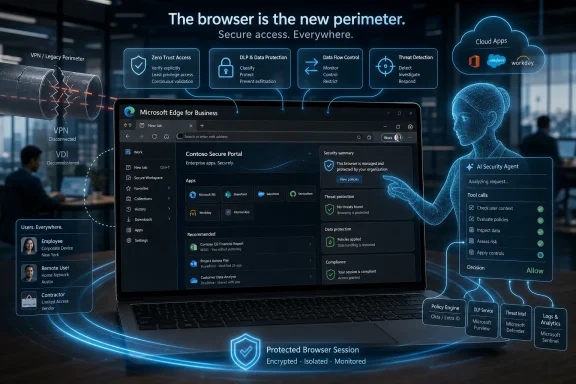 The Browser Has Become the New Security Perimeter
For two decades, enterprise security architecture pretended the network was the center of gravity. Users connected to corporate infrastructure, applications sat behind managed boundaries, and security teams built controls around ingress, egress, and identity. That model was already creaking under SaaS and remote work; generative AI has pushed it closer to collapse.Employees now paste customer records into chatbots, summarize regulated documents in browser tabs, and ask AI assistants to reason across pages that may contain proprietary data. The browser is no longer a passive window onto the internet. It is where work is composed, moved, analyzed, copied, uploaded, and increasingly automated.
That is why Cisco’s integration with Edge for Business matters. Cisco Secure Access, the company’s security service edge platform, is being tied into Microsoft’s enterprise browser so security controls can follow work into the browser session itself. Instead of relying only on endpoint agents, VPN tunnels, or cloud gateways, organizations can enforce policy at the point where users and AI systems are actually interacting with data.
This is also a strategic win for Microsoft. Edge for Business has been positioned as a secure enterprise browser, and Microsoft has been folding Copilot more deeply into Edge as the company tries to make AI-native browsing feel like normal office work. Cisco gives that pitch a familiar security vocabulary: zero trust, DLP, private app access, threat detection, and centralized policy.
Cisco Is Selling Control Where Microsoft Is Selling Flow
Microsoft’s AI story is built around reducing friction. Copilot in Edge, Microsoft 365 Copilot, and agentic browser features all point in the same direction: users should be able to ask the browser to read, compare, summarize, draft, and eventually act. That is a productivity story, but in enterprise IT it is also a governance nightmare.Cisco is entering that gap with a more skeptical premise. If the browser is going to become an AI workbench, then the security stack needs to understand browser activity, generative AI destinations, and agent behavior as governed enterprise activity rather than casual web use. The integration lets Cisco policies apply inside Edge for Business, including controls for data loss prevention, access to private applications, and threat detection.
The key distinction is that this is not merely about blocking risky websites. The more interesting part is policy continuity. Cisco wants organizations to define a set of rules once and apply them across web browsing, private app access, endpoint contexts, and generative AI interactions. That is the kind of consolidation security teams say they want, especially after years of layering one tool over another.
There is a hard commercial edge to that message. Enterprise browsers, secure web gateways, SSE platforms, endpoint DLP, CASB tools, and AI governance products are converging on the same budget line. Cisco and Microsoft are arguing that customers do not need to buy yet another isolated browser security product if they can get governance through Edge for Business plus Cisco Secure Access.
AI Governance Moves From Policy Document to Runtime Control
Most companies began their AI governance journey with acceptable-use policies. Employees were told not to paste confidential information into public AI tools. Legal teams drafted guidance. Security teams warned about shadow AI. None of that stopped people from using AI where it was useful.The Cisco-Microsoft integration reflects the next phase: governance enforced at runtime. If an employee attempts to send sensitive data to a generative AI service through Edge for Business, Cisco’s DLP policies can inspect the activity and block or limit the transfer. That makes the browser session a practical enforcement point for rules that previously lived in PDFs and training modules.
The harder problem is agentic AI. A human pasting a spreadsheet into a chatbot is relatively easy to understand. An AI agent reading browser content, calling tools, moving between applications, and acting on behalf of a user is a more complicated security subject. It does not behave exactly like a user, an app, or a traditional service account.
Cisco says its model context protocol security capabilities can provide visibility into AI agent actions and allow policy controls at the tool-call layer. In plain English, that means security teams want to see not just that an AI agent was used, but what it tried to do, what tools it called, and whether those calls were appropriate. This is where AI governance becomes less like content filtering and more like application control for autonomous workflows.
DLP Gets a Second Life Because AI Made Copy-Paste Dangerous Again
Data loss prevention has a reputation problem. Many IT pros associate DLP with noisy alerts, brittle rules, and frustrated users trying to send legitimate files. Yet generative AI has made the old DLP problem newly urgent because the easiest way to leak corporate data is once again the simplest one: copy, paste, upload, summarize.Cisco’s pitch is that its DLP technology can inspect browser activity and web traffic, identify sensitive information, and stop unauthorized transfers. Organizations can create policies for users, applications, and destinations, using prebuilt identifiers or custom rules to detect regulated or proprietary information. That is familiar ground, but the AI use case gives it sharper relevance.
A public chatbot does not have to be malicious to become a data exposure risk. Employees may paste source code, contracts, customer tickets, meeting transcripts, or financial drafts into a model because the tool is genuinely useful. The risk is not only exfiltration in the classic attacker sense; it is uncontrolled data processing outside approved boundaries.
The more subtle issue is context leakage. AI tools thrive on rich context, and employees are rewarded for giving them more of it. The better the prompt, the greater the temptation to include sensitive material. Browser-level DLP is an attempt to put a guardrail at the moment of use rather than after the data has already left the organization.
Edge for Business Becomes More Than Microsoft’s Default Browser
Edge has always had a distribution advantage on Windows, but enterprise adoption is not won by being preinstalled. IT departments need a reason to standardize, and Microsoft has been trying to provide one by making Edge for Business a managed, identity-aware, policy-rich browser tied to Microsoft 365 and Entra ID.The Cisco integration strengthens that argument because it lets Edge participate in a broader security service edge strategy. For organizations already invested in Cisco Secure Access, Edge for Business can become a policy enforcement surface rather than just another browser to manage. That matters in Windows shops where administrators are trying to reduce agent sprawl and simplify access controls for hybrid work.
It also gives Microsoft a stronger answer to the wave of dedicated enterprise browser vendors. Those companies have argued that traditional browsers were never designed for unmanaged devices, contractors, SaaS sprawl, and AI-era data flows. Microsoft’s counterargument is increasingly that Edge for Business can become that enterprise browser without forcing organizations to adopt a niche browser.
There is a WindowsForum angle here that should not be missed. For Windows administrators, the browser has become as important as the operating system shell. If Edge is where Microsoft 365, Copilot, SaaS applications, private apps, and security policies converge, then managing Edge is no longer a side task. It is core infrastructure.
BYOD and Contractors Are the Real-World Test
Cisco is positioning the integration as useful for bring-your-own-device environments and third-party contractors. That is sensible because these are the scenarios where traditional endpoint control breaks down fastest. The company may not own the device, may not want to install a heavy agent, and may not be able to route all traffic through a legacy VPN.Browser-based access control offers a cleaner compromise. A contractor can access approved applications through Edge for Business while Cisco Secure Access applies policy to the session. Sensitive uploads can be restricted, private app access can be brokered through zero-trust controls, and the organization can avoid handing out broad network access.
This is also where the VDI comparison comes in. Virtual desktop infrastructure has long been used to contain risky access scenarios, especially for contractors or regulated workflows. But VDI is expensive, operationally heavy, and often disliked by users. If a secure enterprise browser can provide enough isolation, visibility, and DLP enforcement, some organizations will see it as a lighter alternative.
The word “some” matters. Browser-based controls cannot replace every VDI deployment. High-risk environments, legacy thick-client apps, specialized desktop workflows, and strict isolation requirements may still justify full virtual desktops. But for SaaS-heavy work and web-delivered private applications, the secure browser model is becoming much harder to ignore.
The MCP Layer Is Where the Story Gets Interesting
The most forward-looking part of Cisco’s announcement is not Edge integration by itself. It is Cisco’s claim that its model context protocol security capabilities can expose and govern what AI agents are doing at the tool-call layer. That is where enterprise AI security is heading because agents do not merely generate text; they request data, invoke tools, and chain actions.MCP has become a common way to connect AI systems to external tools and data sources. That makes it useful, but it also creates a new control plane that security teams need to understand. If an agent can call a CRM tool, query a knowledge base, summarize a confidential file, and post an update into another system, the organization needs a record of those actions and a way to limit them.
This is a different problem from scanning prompts. Prompt inspection may catch obvious attempts to paste sensitive data into an AI tool, but it does not fully address what happens when the AI system itself can retrieve context from approved systems. The risk shifts from “What did the user type?” to “What did the agent access, infer, transform, and send?”
Cisco is trying to plant its flag in that control layer. The company has been expanding its AI security portfolio around models, applications, and agentic systems, including its Secure AI Factory work with Nvidia and Red Hat. The Edge for Business integration is therefore not a one-off browser feature; it is part of Cisco’s larger attempt to make security infrastructure relevant in the agentic AI stack.
The Enterprise Browser Market Is Becoming a Proxy War
Cato Networks, Island, Talon before its acquisition by Palo Alto Networks, and other enterprise browser players have been arguing that the browser should be the new security perimeter. Their case is straightforward: most work happens in browsers, so controls should live there. AI has made that argument more compelling.Cisco and Microsoft are now bringing the same logic into the mainstream platform stack. Cisco contributes SSE, DLP, zero-trust access, and network security credibility. Microsoft contributes the browser, identity integration, Windows gravity, and Copilot. Together, they create a bundled answer to a market that had been tilting toward specialized secure browsers.
That does not mean dedicated enterprise browsers disappear. In some organizations, especially those with heterogeneous browser environments or aggressive unmanaged-device requirements, a purpose-built secure browser may still offer deeper isolation or more granular session controls. But the burden of proof changes when Microsoft can say Edge for Business already sits on the endpoint and Cisco can say Secure Access already brokers access.
For security buyers, this is both helpful and dangerous. Consolidation can reduce complexity, but it can also deepen platform dependency. If browser security, AI governance, private access, DLP, and Copilot policy all become tied to a handful of large vendors, organizations may find themselves with fewer independent control points later.
The Risk Is Policy Theater With Better Branding
The optimistic version of this story is that Cisco and Microsoft are giving enterprises the missing runtime controls for AI-era work. The pessimistic version is that vendors are wrapping old security categories in AI language while the hardest problems remain unresolved. The truth is likely somewhere between those poles.DLP policies are only as good as their classification, tuning, and enforcement. If the organization cannot identify its sensitive data reliably, browser-level controls will produce blind spots or false positives. If policies are too strict, users will route around them. If policies are too loose, the AI governance story becomes mostly theater.
Agent visibility is also not the same as agent safety. Seeing that an AI agent called a tool is useful, but it does not automatically prove the action was semantically appropriate. An agent may access data it is technically permitted to access but should not use in a given business context. Traditional access control was not designed for systems that can synthesize across many weakly related sources.
There is also the question of user trust. Employees already complain when browsers feel overmanaged. Add AI monitoring, DLP prompts, blocked uploads, and session restrictions, and the browser can start to feel like a surveillance interface. Enterprises will need to communicate clearly that governance is about protecting regulated and proprietary data, not watching every mundane browsing action.
Windows Administrators Inherit the AI Control Plane
For Windows admins, this integration reinforces a trend that has been building for years: browser management is now security management. Edge policies, Entra identity, Microsoft Purview, Defender integrations, Cisco Secure Access, and Copilot controls are becoming part of the same operational surface. The old separation between desktop management and security architecture is fading.That creates practical work. Administrators will need to decide which users get the managed browser experience, how policies differ for employees and contractors, which AI destinations are allowed, and which categories of data trigger DLP actions. They will also need to test how these controls behave on unmanaged or lightly managed devices.
The operational challenge is policy consistency. A rule that blocks confidential data from being uploaded to an AI chatbot in Edge should not silently fail in another browser, a mobile context, or an unmanaged workflow. If the Cisco-Microsoft stack becomes the preferred path, organizations still need to account for everything outside that path.
There is also a training burden. Users need to understand why a prompt was blocked, why an AI agent could not complete an action, or why a contractor can access an app only through a managed browser session. Security controls that appear arbitrary become help desk tickets. Controls that explain themselves become part of the workflow.
The Real Win Is Fewer Exceptions
The best argument for the Cisco-Microsoft integration is not that it creates perfect AI governance. It does not. The best argument is that it may reduce the number of exceptions enterprises make just to keep work moving.Before secure browser access matured, organizations often faced bad choices. They could issue managed devices to everyone, force contractors through VDI, punch holes through VPN access, or tolerate unmanaged SaaS usage with limited visibility. Each exception created cost, risk, or user frustration.
A browser-centered model offers a middle path. It can give a contractor access to a private web app without broad network access. It can let an employee use an approved AI tool while blocking sensitive data from leaving. It can apply consistent policy to browser sessions without rebuilding the entire desktop environment.
That is why this announcement should be read as infrastructure news, not merely AI news. AI is the accelerant, but the underlying shift is about where enterprise control lives. The browser is becoming the point where identity, data, apps, agents, and policy meet.
The Edge Deal Gives IT a Shorter Checklist, Not a Free Pass
The practical consequences for Windows and security teams are concrete, even if the product details will vary by tenant, licensing, and rollout schedule.- Organizations using Cisco Secure Access and Edge for Business will be able to apply Cisco security policies directly inside the enterprise browser experience.
- DLP controls can be extended to generative AI tools accessed through the browser, reducing the risk of sensitive data being pasted into public AI services.
- AI agents operating through Microsoft’s Copilot environment are expected to fall under the same policy framework as human users.
- Cisco’s MCP security work points toward deeper visibility into agent tool calls, which is becoming essential as AI systems move from answering questions to taking actions.
- Browser-based access may reduce reliance on VPN or VDI for some BYOD and contractor scenarios, but it will not eliminate the need for stronger isolation in high-risk environments.
- Administrators should treat Edge policy, AI governance, and SSE configuration as one operating model rather than three separate projects.
References
- Primary source: SDxCentral
Published: 2026-06-04T07:50:06.737350
Cisco and Microsoft bring AI governance to edge for business - SDxCentral
The integration allows organizations to enforce Cisco security policies directly within Edge for Businesswww.sdxcentral.com - Official source: microsoft.com

The Secure Enterprise AI Browser | Microsoft Edge for Business
Roll out AI safely with Microsoft Edge for Business—secure, enterprise-ready, and under IT control. Agentic browsing with Copilot executes multi-step workflows, while features like the new tab page, multi-tab reasoning, and video summarization keep users productive in the flow of work. All...
www.microsoft.com
- Official source: learn.microsoft.com
Understand Data Loss Prevention (DLP) in Microsoft Edge for Business | Microsoft Learn
Understand Data Loss Prevention (DLP) in Microsoft Edge for Businesslearn.microsoft.com - Related coverage: blogs.cisco.com
Zero trust access for private apps: Cisco Secure Access and Microsoft Edge for Business Integration
Announcing the new integration between Cisco Secure Access and Microsoft Edge for Business, designed to enhance enterprise browser security and protect an organization’s applications and data.blogs.cisco.com - Official source: adoption.microsoft.com
Microsoft Edge for Business – Microsoft Adoption
Edge for Business is the secure enterprise browser optimized for AI, for any device, anywhere. It provides enterprise-grade protection and secure productivity while taking advantage of your existing Microsoft 365 investments and tools. And deployment is seamless, as Edge for Business comes...adoption.microsoft.com - Related coverage: cisco.com
Cisco Secure Access
Cisco Secure Access is a converged, cloud-delivered security service edge (SSE) solution, grounded in zero trust, for secure access from anywhere users work.www.cisco.com
- Official source: blogs.windows.com
Edge for Business presents: the world’s first secure enterprise AI browser
You deserve a browser that truly understands the demands of your business. The market is getting crowded with new AI browsers, each promising productivity gains. But the truth is—they are not built for your organization's needs. In their haste, somblogs.windows.com - Official source: support.microsoft.com
- Related coverage: windowscentral.com
Microsoft Edge ditching Copilot Mode means more AI in your browser, not less | Windows Central
Microsoft claims it is simplifying Edge, but AI features just got spread throughout the browser.www.windowscentral.com - Related coverage: tomshardware.com
Edge browser's new Copilot Mode lets you talk to AI about your tabs if you opt in — but it's only free for 'a limited time' | Tom's Hardware
Copilot Mode in Edge will be available on Windows and macOSwww.tomshardware.com - Related coverage: pcgamer.com
Microsoft rolls out 'experimental' AI mode for the Edge browser you can ask to spy on all your internetting and lend a helping hand. Yikes! | PC Gamer
But it's optional, for now. Phew!www.pcgamer.com - Related coverage: investor.cisco.com
Cisco Redefines Security for the Agentic Era with AI Defense Expansion and AI Aware SASE 2026
PDF documentinvestor.cisco.com
- Official source: cdn-dynmedia-1.microsoft.com
