

Claire’s plan to replace aging back‑end systems and deploy a modern point‑of‑sale (POS) platform in 2026 is both a practical recovery move and a clear signal that legacy specialty retailers now view technology as a frontline tool for customer experience, cost control, and operational resilience.
Claire’s announced a multi‑year technology refresh led by Malcolm Lamboy, executive director of enterprise architecture, generative AI, data, e‑commerce and strategy, describing 2025 as a transformational year for the retailer and outlining plans to modernize its data architecture, tighten integrations, and roll out a contemporary POS platform in 2026. Those comments were published in Lamboy’s LinkedIn post and reported by multiple trade outlets. The public narrative centers on three linked goals:
Two converging themes explain the timing:
However, success is not automatic. The most common failure modes for retail modernization are rushed rollouts, incomplete integration with inventory and promotions, and weak governance on agentic systems that can execute changes without sufficient human oversight. Claire’s has identified the right technical levers — but will need disciplined execution, strong vendor contracts, and clear KPIs to convert promise into durable improvement.
For Windows‑focused IT teams and retail technologists, Claire’s story reinforces several best practices: prioritize data quality and observable pipelines, treat POS modernization as both a hardware and integration project, and build governance into any AI or automation. When paired with conservative rollouts and clear runbooks, the promised benefits — faster checkout, tighter cost control, and better omnichannel merchandising — are within reach.
Conclusion
Claire’s public roadmap — cutting cloud spend, rationalizing licenses, rebuilding data foundations and launching a modern POS in 2026 — is a condensed playbook for legacy retail survival in the 2020s. The approach balances fiscal discipline with targeted customer experience investment, and it maps cleanly to industry trends around data governance, agentic automation, and edge‑to‑cloud orchestration. The next 12–24 months will show whether the program achieves durable operational gains or merely produces short‑term optics; the differentiator will be integration rigor, governance, and the retailer’s willingness to treat technology as a sustained strategic capability rather than a one‑time cost center.
Source: Trend Hunter https://www.trendhunter.com/amp/trends/retail-technology-upgrades/
 Background
Claire’s announced a multi‑year technology refresh led by Malcolm Lamboy, executive director of enterprise architecture, generative AI, data, e‑commerce and strategy, describing 2025 as a transformational year for the retailer and outlining plans to modernize its data architecture, tighten integrations, and roll out a contemporary POS platform in 2026. Those comments were published in Lamboy’s LinkedIn post and reported by multiple trade outlets. The public narrative centers on three linked goals:- Replace brittle legacy systems that hinder omni‑channel coordination.
- Centralize and clean data to enable faster insights and safer AI.
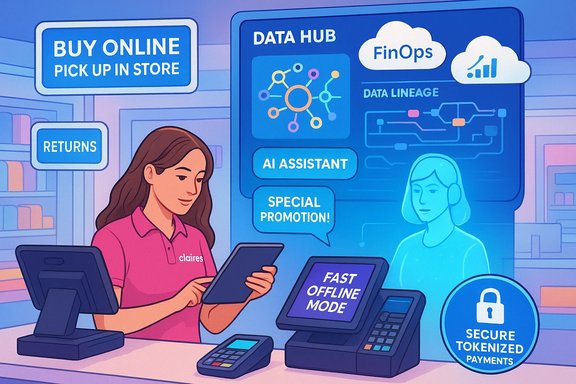
- Deploy a modern POS to improve checkout speed, reduce outages, and enable omnichannel services (buy online, pick up in store; returns; loyalty tie‑ins).
Why this matters now: the retail technology inflection
Modern retail is increasingly a triad of data, edge systems (stores), and orchestration. The economics and customer expectations that once insulated mall‑based specialty brands like Claire’s have shifted: shoppers demand fast, reliable checkout; loyalty and personalization are table stakes; and cost pressures force tighter capital allocation. What Claire’s is doing — pairing cost discipline with targeted investments — mirrors broader industry moves to turn technology investments into direct levers for margin and experience.Two converging themes explain the timing:
- Operational survival: after a turbulent 2025 for the company and a change in ownership, modernization is part of stabilizing store operations and preserving physical footprint value.
- Platform opportunity: new cloud, data and agentic AI toolsets let even mid‑market retailers stitch together capabilities (catalog, POS, analytics, conversational assistants) faster than a decade ago — if they first fix canonical data and governance.
What Claire’s is actually changing
Data architecture and governance
Claire’s states it rebuilt and streamlined its data architecture, employing a medallion‑style approach and governance tooling to make analytics trustworthy and repeatable. The emphasis on a single source of truth and active validation (for example, using automated data checks) is consistent with modern retail data practices that prioritize cleansing and lineage before adding advanced analytics or generative‑AI overlays. This effort is a prerequisite to reliable recommendations, real‑time inventory reasoning, and safe agentic automation.Cloud cost optimization
The company reports cutting Azure costs by more than 48% year‑over‑year through:- Right‑sizing compute and storage workloads,
- Strengthening governance and automation to shut down unused environments,
- Shifting workloads to cost‑efficient runtimes.
Microsoft 365 licensing optimization
Claire’s says it rationalized Microsoft 365 licenses to align cost with actual usage patterns. License optimization (consolidating SKUs, mapping roles to license tiers, and reclaiming unused seats) is a low‑risk, high‑reward lever that funds other investments without increasing headcount. The company reports doing this to free budget for integration work and POS upgrades.POS modernization and store technology refresh
The planned 2026 rollout of a contemporary POS platform is the most visible customer‑facing change. Modern POS platforms typically offer:- Faster transaction processing and improved offline resilience.
- Better integration with loyalty, inventory, and payment tokenization.
- Extensibility for mobile checkout, click‑and‑collect, and in‑store services.
Verification and independent corroboration
Multiple independent trade outlets and Claire’s own posts converge on the same set of claims: the 2026 POS program, the Azure cost reduction, and data modernization as the core priorities. Retail Dive and CIO Dive republished Lamboy’s LinkedIn summary and framed it within Claire’s broader restructuring narrative. Retail Tech Innovation Hub republished the LinkedIn highlights and emphasized the 48% Azure reduction Lamboy cited. These independent echoes increase confidence that the program is real and company‑driven rather than mere rumor. Caveat: financial or percentage claims are company disclosures. While multiple outlets repeated Lamboy’s numbers, they originate from an internal executive communication, not an audited financial statement. Treat those precise numbers as company‑reported operational metrics rather than independently verified financial facts.Strategic strengths in Claire’s approach
- Focused thrift + targeted reinvestment: Using immediate cost wins (FinOps and license optimization) to fund strategic modernization is a pragmatic financial play that shortens payback timelines.
- Data‑first posture: Rebuilding data foundations before layering AI agents or complex merchandising systems reduces downstream risk from hallucination, bad recommendations, and inconsistent inventory signals.
- Realistic scope: The public statements emphasize integration and POS modernization rather than a simultaneous rewrite of every system. Prioritizing store experience and canonical inventory data aligns technical scope with customer impact.
- Microsoft stack alignment: Operating heavily inside the Microsoft ecosystem (Azure, Microsoft 365, Fabric/OneLake patterns) can speed integration and reduce engineering overhead for teams already familiar with Microsoft tooling. That said, it also concentrates dependency (see risks).
Material risks and trade‑offs
1) Vendor and platform lock‑in
A concentrated Microsoft stack simplifies integration but raises long‑term portability and negotiation risk. Deeper reliance on OneLake, Fabric, Purview, or Foundry primitives can increase exit costs and complicate multi‑cloud strategies. Retailers should design exportable data artifacts and require contractual exit provisions when negotiating ISV partnerships.2) Data quality, speed and operational latency
Agentic or near‑real‑time merchandising tools depend on near‑real‑time POS and inventory feeds. If the POS modernization lags integrations to inventory and promotion engines, analytic gains will be delayed. Ensuring tight SLAs for data freshness and observability is critical to realize the promised speed‑to‑insight.3) Security and compliance surface expansion
Modern POS platforms and tighter data integration broaden the attack surface. Tokenized payments, device fleet management, and multi‑tenant cloud connectors introduce new identity and secrets management needs. Any agentic or automation layers that can execute changes (price updates, inventory moves) must have circuit breakers and human approval for high‑risk actions.4) Over‑reliance on headline metrics
The reported 48% Azure savings is encouraging but should be judged against total cost of ownership (TCO): cost to migrate, integration engineering, vendor support, edge device replacement, and the lifecycle costs of POS hardware. Short‑term cloud savings may be offset by new capital or recurring SaaS fees if not modeled holistically.What a modern POS program must deliver at Claire’s scale
A successful modernization must address both technical fidelity and store operations. Key functional and operational requirements include:- High availability with robust offline mode so stores can transact during WAN outages.
- Fast reconciliation and near‑real‑time replication to central catalog and finance systems.
- Support for omnichannel flows: returns, exchanges from other channels, split tenders, and loyalty integrations.
- Simple device management and secure bootstrapping to reduce field IT effort.
- PCI‑compliant, tokenized payments and support for delegated checkout flows where required.
- Extensible APIs to integrate with merchandising analytics, promotion engines, and potential agentic automation layers.
Practical rollout playbook (recommended)
- Prioritize pilot stores by risk and value:
- Urban, high‑velocity stores and a mix of formats (mall, outlet, freestanding).
- Harden integration contracts:
- Ensure POS vendor provides documented APIs, offline reconciliation, and support for required fiscal/regional compliance.
- Validate data plumbing first:
- Build canonical SKU resolution, standardize SKU/GTIN mapping, and run reconciliation tests before cutover.
- FinOps and procurement alignment:
- Lock in predictable pricing for cloud and SaaS services; avoid surprise metering.
- Security and runbook readiness:
- Require vulnerability SLAs, patch cadence, identity/pass‑through for devices, and a zero‑trust endpoint posture.
- Human + AI operating model:
- Start with decision‑support mode for any agentic or automation features; phase in semi‑automated execution only when operational controls are proven.
How Claire’s move fits wider retail trends
Claire’s modernization mirrors multiple industry currents observed across enterprise retail players:- Agentic commerce & AI: Vendors and cloud providers are pushing agentic assistants for merchandising, promotions, and post‑purchase workflows; these agents demand canonical product and store data. Retailers must get data hygiene and governance in place before agents deliver reliable value.
- Edge + cloud integration: Stores are becoming edge nodes with ESLs, cameras, and local services feeding cloud digital twins and agentic decision systems. The architecture that connects store sensors, POS, and cloud analytics is the new battleground for operational advantage.
- FinOps‑first modernization: Cost discipline is not an afterthought; many retailers now deliberately harvest savings from cloud and SaaS to fund modernization — a prudent approach in a capital‑constrained retail environment. Claire’s explicit use of Azure savings to fund POS and integration work is a textbook example.
WindowsForum IT playbook — what Windows‑centric IT leaders should do
- Inventory and map device estate:
- Know which POS terminals run Windows, their OS versions, and patch posture. Plan image standardization and automated provisioning tools.
- Integrate with Microsoft identity and security:
- Use Entra ID/Conditional Access and endpoint management (Intune) to secure device fleets and simplify credential rollout.
- Instrument telemetry and SLOs:
- Collect performance and transaction metrics from POS endpoints and enforce SLAs for transaction latency and reconciliation delays.
- Prioritize data hygiene:
- Sponsor medallion architecture pilots that feed Power BI and Fabric artifacts used by merchandising and operations teams.
- Prepare for hybrid agent tooling:
- Validate integration patterns with Foundry/agent frameworks and require audit trails for any agent that can execute store changes.
A realistic timeline and expected milestones
- Short term (0–6 months): pilots of modern POS in select stores, consolidation of Microsoft 365 licenses, initial FinOps lowerings in cloud spend, and data model stabilization.
- Mid term (6–18 months): broader POS rollouts in prioritized regions, integtration of POS → inventory → promotions pipelines, and operational runbooks completed.
- Long term (18–36 months): advanced merchandising automation, potential agentic tools for prioritized use cases, and phased replacement of remaining legacy back‑end systems.
Final assessment: measured optimism
Claire’s approach is commendable for its pragmatism: harvest measurable savings, clean the data plumbing, and use the freed resources to modernize the in‑store customer experience. That sequencing — cost control first, then selective reinvestment — reduces political friction and shortens payback windows.However, success is not automatic. The most common failure modes for retail modernization are rushed rollouts, incomplete integration with inventory and promotions, and weak governance on agentic systems that can execute changes without sufficient human oversight. Claire’s has identified the right technical levers — but will need disciplined execution, strong vendor contracts, and clear KPIs to convert promise into durable improvement.
For Windows‑focused IT teams and retail technologists, Claire’s story reinforces several best practices: prioritize data quality and observable pipelines, treat POS modernization as both a hardware and integration project, and build governance into any AI or automation. When paired with conservative rollouts and clear runbooks, the promised benefits — faster checkout, tighter cost control, and better omnichannel merchandising — are within reach.
Conclusion
Claire’s public roadmap — cutting cloud spend, rationalizing licenses, rebuilding data foundations and launching a modern POS in 2026 — is a condensed playbook for legacy retail survival in the 2020s. The approach balances fiscal discipline with targeted customer experience investment, and it maps cleanly to industry trends around data governance, agentic automation, and edge‑to‑cloud orchestration. The next 12–24 months will show whether the program achieves durable operational gains or merely produces short‑term optics; the differentiator will be integration rigor, governance, and the retailer’s willingness to treat technology as a sustained strategic capability rather than a one‑time cost center.
Source: Trend Hunter https://www.trendhunter.com/amp/trends/retail-technology-upgrades/
