

Anthropic’s Claude Code creator Boris Cherny is arguing that software engineering is moving from writing code to directing AI systems that write, test and revise it. In a new overview published by StartupHub.ai, Cherny describes Claude Code less as an autocomplete tool and more as a collaborator whose work must be guided by an engineer-built “harness.”
Cherny leads Claude Code at Anthropic and has become one of the more visible advocates for agent-driven development. Anthropic’s own recent material describes Claude Code workflows built around asynchronous tasks and parallel agents; Cherny’s broader point is that the useful unit of work is no longer a single prompt or code completion, but a system that can retain instructions, work through a repository, use tools and report back.
The proposed “harness” is the surrounding engineering discipline: project instructions, source-control boundaries, testing, permissions, observability and review. In that model, a developer spends less time typing implementation details and more time deciding what the agent may change, supplying relevant context, breaking down work and verifying the result.
That will sound familiar to Windows developers already using terminal-based coding agents alongside Visual Studio, VS Code, PowerShell and Git. Agent output can accelerate routine changes, migrations and test work, but it also expands the blast radius of a bad instruction or over-broad permission. A model that can edit dozens of files, invoke local tools and open pull requests needs stronger guardrails than a code-completion extension.
For enterprise teams, the immediate implication is procedural rather than philosophical: treat AI coding agents as automation with identity, access and change-control requirements. Restrict credentials, isolate working copies, require automated tests, and keep human review for security-sensitive or production-bound changes.
Anthropic has encouraged teams to store project guidance in repository files such as
Long-lived context also does not eliminate verification. It can make an agent more consistent, but consistent mistakes are still mistakes. Tests, static analysis, dependency scanning and code review remain the controls that establish whether an AI-generated change is safe to ship.
For Windows shops, the practical near-term change is to build disciplined agent workflows around existing development and security controls, rather than letting an AI tool bypass them.
Cherny leads Claude Code at Anthropic and has become one of the more visible advocates for agent-driven development. Anthropic’s own recent material describes Claude Code workflows built around asynchronous tasks and parallel agents; Cherny’s broader point is that the useful unit of work is no longer a single prompt or code completion, but a system that can retain instructions, work through a repository, use tools and report back.
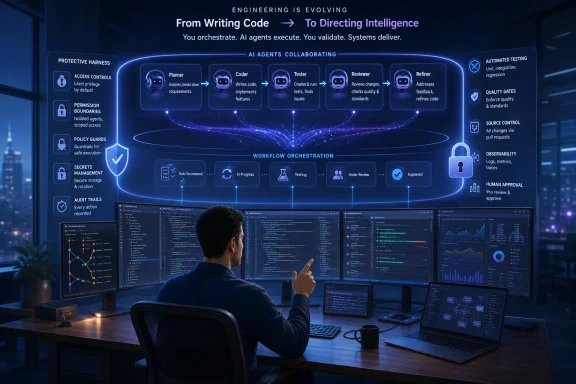 The harness becomes the job
The proposed “harness” is the surrounding engineering discipline: project instructions, source-control boundaries, testing, permissions, observability and review. In that model, a developer spends less time typing implementation details and more time deciding what the agent may change, supplying relevant context, breaking down work and verifying the result.That will sound familiar to Windows developers already using terminal-based coding agents alongside Visual Studio, VS Code, PowerShell and Git. Agent output can accelerate routine changes, migrations and test work, but it also expands the blast radius of a bad instruction or over-broad permission. A model that can edit dozens of files, invoke local tools and open pull requests needs stronger guardrails than a code-completion extension.
For enterprise teams, the immediate implication is procedural rather than philosophical: treat AI coding agents as automation with identity, access and change-control requirements. Restrict credentials, isolate working copies, require automated tests, and keep human review for security-sensitive or production-bound changes.
Memory is useful, but it is also context
StartupHub.ai’s summary links this shift to better model memory and longer-running sessions. That is important because coding agents become more useful when they retain project conventions, past mistakes and architectural constraints rather than re-learning them in every prompt.Anthropic has encouraged teams to store project guidance in repository files such as
CLAUDE.md. That approach is practical, but Windows administrators and developers should regard such files as operational configuration. They can contain internal architecture details, environment names, commands and workflow assumptions. They should be reviewed like other repository content, not treated as harmless documentation.Long-lived context also does not eliminate verification. It can make an agent more consistent, but consistent mistakes are still mistakes. Tests, static analysis, dependency scanning and code review remain the controls that establish whether an AI-generated change is safe to ship.
Not the end of engineering
Cherny’s prediction is not that software roles disappear, but that they evolve toward orchestration: defining outcomes, supervising agents and validating complex systems. That claim remains a vision for how teams may work rather than a settled outcome, and it will vary sharply by codebase, regulatory exposure and tolerance for automation risk.For Windows shops, the practical near-term change is to build disciplined agent workflows around existing development and security controls, rather than letting an AI tool bypass them.
References
- Primary source: startuphub.ai
Published: 2026-07-20T09:08:00.838000+00:00
Anthropic's Claude Code Creator on AI's Future | StartupHub.ai
Boris Cherny, Head of Claude Code at Anthropic, discusses the evolution of AI models, the future of software engineering, and Anthropic's focus on AI safety.www.startuphub.ai - Official source: claude.com
Live coding session with Boris Cherny and Jarred Sumner | Session | Code w/ Claude 2026
Ever wonder how the Claude Code team uses Claude Code themselves? Watch Boris Cherney, Head of Claude Code, and Jarred Sumner, creator of Bun, livestream their everyday workflows together. claude.com
- Related coverage: fortune.com
Anthropic’s Claude Code creator says he manages tens of thousands of AI agents at once | Fortune
As Claude Code increasingly writes, tests, reviews, and proposes improvements to itself, Cherny says developers are becoming managers of vast fleets of AI agents.fortune.com
- Related coverage: infoq.com
Inside the Development Workflow of Claude Code's Creator - InfoQ
Claude Code's creator Boris Cherny described how he uses it at Anthropic, highlighting practices such as running parallel instances, sharing learnings, automating prompting, and rigorously verifying rwww.infoq.com
- Related coverage: frenxt.com
Boris Cherny: CLAUDE.md as a living postmortem (Jan 2026): turning Claude into team memory · cables
*Part 3 of 4. Breaking down the Claude Code creator's actual workflow with FRE|Nxt Labs production commentary.*www.frenxt.com - Related coverage: podscripts.co
Lenny's Podcast: Product | Career | Growth - Head of Claude Code: What happens after coding is solved | Boris Cherny Transcript and Discussion
Head of Claude Code: What happens after coding is solved | Boris Cherny - Lenny's Podcast: Product | Career | Growth Transcript and Discussionpodscripts.co
