

A Quasa.io report published July 20 argues that Claude Code users should treat model choice and effort level as separate controls—and Anthropic’s own product guidance supports the central point: raising effort is not a substitute for selecting a model capable of solving the task.
In Claude Code, the model determines the system’s underlying capability, while effort adjusts the trade-off between deeper reasoning and agentic work on one side, and latency, token use, and usage-limit consumption on the other. Anthropic describes effort levels as a way to choose how much thinking a model performs, not as an upgrade that changes what the model fundamentally knows.
The useful diagnostic for developers is straightforward. If Claude has read the relevant code, used the available tools, and still cannot solve the problem, changing to a stronger model is the logical next move. More effort may produce a longer attempt, but it cannot reliably overcome a capability ceiling.
If the model prematurely stops, fails to inspect the files that matter, skips tests, or does not carry a multi-stage refactor through to verification, effort is the more relevant control. Higher settings encourage more sustained reasoning and tool use, but they also increase runtime and token consumption.
That distinction matters for Windows developers and IT teams using Claude Code against large repositories, PowerShell automation, deployment scripts, or configuration-management code. A weak result is often a context problem first: incomplete instructions, missing project conventions, unclear acceptance criteria, or insufficient access to test tooling. Raising effort before fixing those inputs can simply make the agent spend more time pursuing the wrong interpretation.
The company’s stated defaults now place Opus 4.7 at
Its newer model announcements make the same economic case. Anthropic says higher effort can produce better results on difficult and long-running tasks, but it consumes more tokens. The company specifically recommends extra effort for hard work rather than as a blanket setting. Conversely, a more capable model can sometimes be cheaper for a complex job if it reaches a correct solution in fewer failed iterations.
For most Claude Code users, the practical order is to improve the prompt and repository context, confirm tool access, use the default effort level, and only then change effort or models based on the type of failure.
In Claude Code, the model determines the system’s underlying capability, while effort adjusts the trade-off between deeper reasoning and agentic work on one side, and latency, token use, and usage-limit consumption on the other. Anthropic describes effort levels as a way to choose how much thinking a model performs, not as an upgrade that changes what the model fundamentally knows.
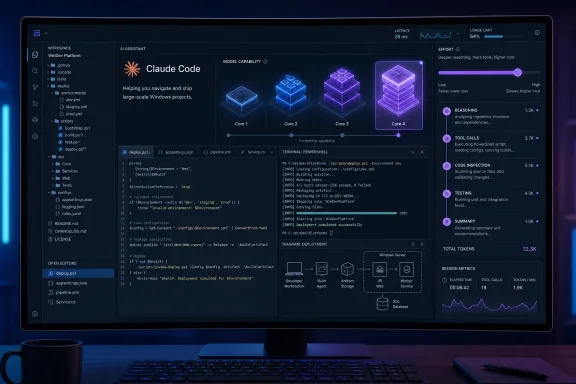 Different controls, different failures
The useful diagnostic for developers is straightforward. If Claude has read the relevant code, used the available tools, and still cannot solve the problem, changing to a stronger model is the logical next move. More effort may produce a longer attempt, but it cannot reliably overcome a capability ceiling.If the model prematurely stops, fails to inspect the files that matter, skips tests, or does not carry a multi-stage refactor through to verification, effort is the more relevant control. Higher settings encourage more sustained reasoning and tool use, but they also increase runtime and token consumption.
That distinction matters for Windows developers and IT teams using Claude Code against large repositories, PowerShell automation, deployment scripts, or configuration-management code. A weak result is often a context problem first: incomplete instructions, missing project conventions, unclear acceptance criteria, or insufficient access to test tooling. Raising effort before fixing those inputs can simply make the agent spend more time pursuing the wrong interpretation.
Defaults are meant to be used
Anthropic has already learned the hard way that effort defaults are highly visible to users. In an April 23 postmortem, the company said it had temporarily lowered Claude Code’s default reasoning effort from high to medium on March 4, 2026, in response to long latencies. Users subsequently reported that the tool felt less capable, and Anthropic reverted the change on April 7.The company’s stated defaults now place Opus 4.7 at
xhigh effort and other models at high. Anthropic says those choices reflect its preferred balance of quality, latency, and usage limits, rather than a recommendation that users constantly tune the setting per prompt.Its newer model announcements make the same economic case. Anthropic says higher effort can produce better results on difficult and long-running tasks, but it consumes more tokens. The company specifically recommends extra effort for hard work rather than as a blanket setting. Conversely, a more capable model can sometimes be cheaper for a complex job if it reaches a correct solution in fewer failed iterations.
For most Claude Code users, the practical order is to improve the prompt and repository context, confirm tool access, use the default effort level, and only then change effort or models based on the type of failure.
References
- Primary source: quasa.io
Published: 2026-07-20T08:48:22+00:00
Anthropic Explained When to Tinker with Effort Level in Claude Code (Spoiler: Not Often)
Claude Code’s power comes from understanding these two axes clearly. Model sets the height of the ceiling. Effort sets how aggressively you climb toward itquasa.io
- Official source: anthropic.com
Introducing Claude Sonnet 5 \ Anthropic
Our most agentic Sonnet yet, with top-tier intelligence for coding and everyday professional work.www.anthropic.com - Official source: www-cdn.anthropic.com
- Official source: docs.anthropic.com
Advanced setup - Claude Code Docs
System requirements, platform-specific installation, version management, and uninstallation for Claude Code.docs.anthropic.com - Official source: assets.anthropic.com
