

Anthropic’s Claude was experiencing a significant service disruption on Tuesday, June 23, 2026, with user reports and status-page updates pointing to elevated error rates across multiple models and access points, including Claude.ai, the API, Claude Code, and related tools. The outage is not merely another “AI chatbot is down” blip. It is a useful stress test of how quickly generative AI has moved from novelty to infrastructure, and how poorly many workflows still tolerate the failure of a single model provider.
The uncomfortable lesson is that Claude’s reliability problem is now also a customer architecture problem. Anthropic owns the service, the status page, and the engineering response; users and companies own the decision to wire business processes, development loops, and research tasks to one external system with no graceful fallback. The outage reminds us that in 2026, AI dependency is no longer hypothetical. It is already operational.
The most visible sign of a Claude outage is not a technical incident report. It is the sudden crowding of social platforms, developer communities, and workplace chats with the same terse question: “Is Claude down for everyone?” That pattern repeated during this latest disruption, as users reported failed prompts, stalled chats, login trouble, API errors, and degraded behavior across tools that now sit inside daily work routines.
That matters because Claude is no longer used only for casual experimentation. It is a writing assistant, a coding partner, a research aide, a support-desk accelerator, and in some organizations a quiet layer inside customer-facing or internal applications. When it fails, the impact is not limited to people losing a toy. It can interrupt debugging sessions, documentation work, data analysis, legal review preparation, product planning, and automated systems that rely on the API.
Anthropic’s public status updates reportedly pointed to elevated error rates rather than a complete universal blackout, which is often how modern cloud incidents present themselves. Some users see total failure. Others see intermittent success, higher latency, partial model availability, or strange retries that make the service feel haunted rather than simply offline.
That ambiguity is especially corrosive for AI tools. A storage bucket that is unavailable usually fails loudly. A chatbot or agentic coding tool can fail softly: it hangs, returns a generic error, consumes time, or forces the user to wonder whether the problem is their prompt, their account, their network, the model, or Anthropic itself.
“Elevated error rates” is accurate as far as it goes, but it does not capture the practical reality of a developer watching Claude Code stall mid-refactor or a writer losing access to a long-running project conversation. It does not explain whether a model is failing because of capacity pressure, a routing issue, a backend dependency, a bad deployment, authentication trouble, or a broader infrastructure incident. In many cases, vendors quite reasonably avoid giving premature root-cause explanations while the fire is still burning.
But the gap between status-page phrasing and user experience is widening. As AI tools become embedded in workflows, customers increasingly want to know not just whether a service is “operational,” but which surfaces are affected, whether retries are safe, whether usage limits are being consumed, whether degraded outputs should be trusted, and whether enterprise traffic is isolated from consumer load.
This is where Anthropic, OpenAI, Google, Microsoft, and every other serious AI provider are discovering that model quality is only one half of the product. The other half is operational predictability. The best model in the world is a weak dependency if a team cannot tell whether it will be there at 9:15 a.m. when a deployment, deadline, or support queue depends on it.
That is not unique to Anthropic. Every major AI platform has faced outages, rate-limit surprises, degraded model behavior, or unexpected service interruptions. The difference in 2026 is that users are less forgiving because they have moved from curiosity to dependence.
Cloud computing went through a similar maturation curve. Early cloud outages were embarrassing but expected; later ones became boardroom events because the cloud became the business. AI is now entering that phase, only faster. The adoption curve has compressed what took cloud infrastructure a decade into a few frantic years of chatbot subscriptions, developer tools, API integrations, and enterprise pilots.
Anthropic’s challenge is particularly sharp because Claude has earned a strong following among programmers, writers, analysts, and users who prefer its style or safety posture. Success increases load. Load stresses systems. Stressed systems create incidents. Incidents test whether growth has been matched by investment in capacity, observability, communication, and graceful degradation.
When one Claude model is degraded, another may still work. When the web interface is failing, the API may be healthier. When the API is degraded, a desktop tool or coding assistant may behave differently depending on the backend path it uses. Users may experience a single “Claude is down” moment, but Anthropic’s engineers may be fighting several narrower incidents across model-serving, authentication, billing, routing, capacity allocation, or client-specific integrations.
This fragmentation complicates communication. A status page that says one model is affected may not match the experience of users who see errors elsewhere. A fix for one layer may not resolve symptoms in another. An incident can be technically partial while feeling total to the person whose preferred workflow is broken.
For IT pros, this is the part worth watching. The more enterprises adopt model portfolios and AI agents, the more they will need the kind of service mapping they already use for conventional systems. Which model handles which task? Which tasks can be routed elsewhere? Which integrations fail closed, and which fail dangerously? Which users need a human fallback, and which processes can safely wait?
A company that uses Claude for brainstorming can switch to ChatGPT or Gemini with minor friction. A company that embeds Claude’s API into a customer support workflow, document pipeline, code-review bot, or internal agent cannot improvise so easily. Prompt formats differ. Tool-calling behavior differs. Context limits differ. Safety filters differ. Output style differs. Even when two models can perform the same broad task, they may not be interchangeable at the level of production behavior.
This is where AI reliability starts to look less like app availability and more like database or payments architecture. You can have a backup provider, but failover is not free. You need abstraction layers, test suites, fallback prompts, retry policies, circuit breakers, cost controls, logging, and human escalation paths. You also need to decide when failing over is worse than waiting, because a different model may produce subtly different answers in a regulated, contractual, or security-sensitive process.
The consumer workaround is simple: open another tab. The enterprise workaround is architecture.
That brand cuts both ways. When a provider sells trust, reliability becomes part of the trust contract. Users may forgive a startup for occasional hiccups; they are less forgiving when the tool has become the place where they keep project context, code reasoning, research notes, and business logic.
This is especially true for Claude Code and similar agentic developer tools. The closer AI moves to the command line, repository, and build process, the more outages feel like infrastructure failures rather than website interruptions. A coding agent that cannot reach its model is not merely unavailable. It may interrupt a chain of thought, abandon a partially completed task, or force a developer to reconstruct context manually.
Anthropic can reasonably argue that rapid growth creates scaling pressure and that occasional incidents are inevitable. That is true. But the market will not grade AI providers on a curve forever. The more these companies charge enterprise prices and promise productivity transformation, the more they will be judged like infrastructure vendors.
AI systems also introduce failure modes that are harder to classify. If a model times out, that is obvious. If it returns a weaker answer because requests have been routed differently during congestion, that may not be obvious. If a coding assistant loses tool access but still responds conversationally, the user may not immediately understand the boundary of the failure.
This creates a new category of operational question: not just “is the system available?” but “is the system behaving within expected bounds?” Enterprise customers will increasingly demand model-specific telemetry, latency histories, error-rate transparency, and clearer separation between consumer app incidents and API reliability.
For now, many users are piecing together the truth from status pages, Reddit threads, social media posts, and their own failed prompts. That is familiar from the early cloud era, but it is not where mature infrastructure should remain.
But switching is often less seamless than it looks. Claude users may prefer its writing cadence, code reasoning, long-context handling, or project memory. Developers may have tuned prompts to Claude-specific behavior. Teams may have internal documentation that assumes Claude’s strengths and quirks. Even a short outage can expose how much tacit workflow design has grown around one model’s personality.
The result is a strange form of lock-in that is not based on file formats or contracts alone. It is behavioral lock-in. People learn how to ask Claude for what they want. They build habits around its responses. They trust its failures because they have seen them before. When they move to another model under pressure, the alternative may be technically available but cognitively expensive.
That is why reliability now has competitive value. The winning AI platforms will not simply be the ones with the most impressive demo videos. They will be the ones users can depend on when the novelty wears off and the workday starts.
That makes cloud AI outages relevant even to users who do not think of themselves as cloud customers. If your IDE extension, browser assistant, note-taking workflow, or coding tool depends on a remote model, your local machine inherits the reliability of that service. The PC may be working perfectly while the workflow is still broken.
Microsoft’s own AI strategy makes this tension unavoidable. Copilot features, cloud-backed assistants, local model experiments, and developer integrations all point toward a hybrid future where some AI runs on-device and some runs in the cloud. The more useful these features become, the more visible their failures will be.
Claude’s outage is therefore not just an Anthropic story. It is a preview of the support tickets, admin policies, user complaints, and fallback planning that will accompany AI’s arrival as a standard part of the desktop computing stack.
The first step is inventory. IT cannot protect workflows it does not know exist. Shadow AI adoption means employees may already depend on Claude or other services for summarization, scripting, troubleshooting, translation, data cleanup, or customer communication without any formal approval.
The second step is classification. Some AI uses are convenience layers. Others are operational dependencies. A developer asking Claude to explain an error message is different from an internal automation that uses Claude’s API to triage support tickets or generate regulated documents.
The third step is policy. Users should know when they can switch providers, when they must wait, when they need to disclose AI-generated work, and when sensitive data cannot be pasted into an alternative service during an outage. Without that guidance, a disruption becomes not only a productivity event but a governance risk.
Good incident communication should distinguish between Claude.ai, mobile apps, desktop clients, API access, Claude Code, specific model families, and account-management systems. It should explain whether errors are intermittent or widespread, whether retries are recommended, and whether customers should expect degraded latency after service returns. Post-incident summaries should be clear enough for enterprise customers to update their own risk models.
This is not merely a public relations exercise. Better communication reduces duplicate support load, helps administrators make decisions, and prevents users from wasting time on browser-cache rituals when the backend is the problem. It also signals operational maturity.
Anthropic has the talent and incentives to improve here. The company is competing not only for consumers but for developers and enterprises that care about reliability as much as model quality. If Claude is to become infrastructure, Anthropic must communicate like an infrastructure company.
The uncomfortable lesson is that Claude’s reliability problem is now also a customer architecture problem. Anthropic owns the service, the status page, and the engineering response; users and companies own the decision to wire business processes, development loops, and research tasks to one external system with no graceful fallback. The outage reminds us that in 2026, AI dependency is no longer hypothetical. It is already operational.
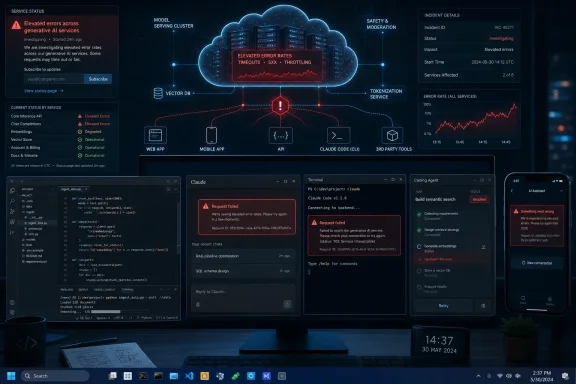 Claude’s Outage Became a Productivity Story Before It Became an Engineering Story
The most visible sign of a Claude outage is not a technical incident report. It is the sudden crowding of social platforms, developer communities, and workplace chats with the same terse question: “Is Claude down for everyone?” That pattern repeated during this latest disruption, as users reported failed prompts, stalled chats, login trouble, API errors, and degraded behavior across tools that now sit inside daily work routines.That matters because Claude is no longer used only for casual experimentation. It is a writing assistant, a coding partner, a research aide, a support-desk accelerator, and in some organizations a quiet layer inside customer-facing or internal applications. When it fails, the impact is not limited to people losing a toy. It can interrupt debugging sessions, documentation work, data analysis, legal review preparation, product planning, and automated systems that rely on the API.
Anthropic’s public status updates reportedly pointed to elevated error rates rather than a complete universal blackout, which is often how modern cloud incidents present themselves. Some users see total failure. Others see intermittent success, higher latency, partial model availability, or strange retries that make the service feel haunted rather than simply offline.
That ambiguity is especially corrosive for AI tools. A storage bucket that is unavailable usually fails loudly. A chatbot or agentic coding tool can fail softly: it hangs, returns a generic error, consumes time, or forces the user to wonder whether the problem is their prompt, their account, their network, the model, or Anthropic itself.
The Status Page Is Necessary, But It Is Not Enough
Status pages are the ritual infrastructure of the cloud age. They provide a public ledger of partial outages, degraded performance, elevated errors, and eventual resolution. They also have a habit of reducing messy user experience to antiseptic operational language.“Elevated error rates” is accurate as far as it goes, but it does not capture the practical reality of a developer watching Claude Code stall mid-refactor or a writer losing access to a long-running project conversation. It does not explain whether a model is failing because of capacity pressure, a routing issue, a backend dependency, a bad deployment, authentication trouble, or a broader infrastructure incident. In many cases, vendors quite reasonably avoid giving premature root-cause explanations while the fire is still burning.
But the gap between status-page phrasing and user experience is widening. As AI tools become embedded in workflows, customers increasingly want to know not just whether a service is “operational,” but which surfaces are affected, whether retries are safe, whether usage limits are being consumed, whether degraded outputs should be trusted, and whether enterprise traffic is isolated from consumer load.
This is where Anthropic, OpenAI, Google, Microsoft, and every other serious AI provider are discovering that model quality is only one half of the product. The other half is operational predictability. The best model in the world is a weak dependency if a team cannot tell whether it will be there at 9:15 a.m. when a deployment, deadline, or support queue depends on it.
AI Has Adopted Cloud Economics Without Yet Earning Cloud Expectations
The AI industry sells itself with the language of inevitability: agents will write code, summarize meetings, answer customers, design products, and automate workflows. But the infrastructure beneath those promises still behaves like a frontier system, where demand spikes, model launches, product experiments, and compute constraints can collide in public.That is not unique to Anthropic. Every major AI platform has faced outages, rate-limit surprises, degraded model behavior, or unexpected service interruptions. The difference in 2026 is that users are less forgiving because they have moved from curiosity to dependence.
Cloud computing went through a similar maturation curve. Early cloud outages were embarrassing but expected; later ones became boardroom events because the cloud became the business. AI is now entering that phase, only faster. The adoption curve has compressed what took cloud infrastructure a decade into a few frantic years of chatbot subscriptions, developer tools, API integrations, and enterprise pilots.
Anthropic’s challenge is particularly sharp because Claude has earned a strong following among programmers, writers, analysts, and users who prefer its style or safety posture. Success increases load. Load stresses systems. Stressed systems create incidents. Incidents test whether growth has been matched by investment in capacity, observability, communication, and graceful degradation.
The Model Picker Has Become a New Failure Surface
A few years ago, the average user thought of an AI chatbot as one product. Now even casual users are learning a vocabulary of models, modes, contexts, connectors, projects, desktop apps, mobile clients, coding agents, and API endpoints. That creates a more powerful ecosystem, but it also creates more places for things to go wrong.When one Claude model is degraded, another may still work. When the web interface is failing, the API may be healthier. When the API is degraded, a desktop tool or coding assistant may behave differently depending on the backend path it uses. Users may experience a single “Claude is down” moment, but Anthropic’s engineers may be fighting several narrower incidents across model-serving, authentication, billing, routing, capacity allocation, or client-specific integrations.
This fragmentation complicates communication. A status page that says one model is affected may not match the experience of users who see errors elsewhere. A fix for one layer may not resolve symptoms in another. An incident can be technically partial while feeling total to the person whose preferred workflow is broken.
For IT pros, this is the part worth watching. The more enterprises adopt model portfolios and AI agents, the more they will need the kind of service mapping they already use for conventional systems. Which model handles which task? Which tasks can be routed elsewhere? Which integrations fail closed, and which fail dangerously? Which users need a human fallback, and which processes can safely wait?
Outages Expose the Weakness of Single-Vendor AI Workflows
The most practical lesson from Claude’s disruption is not “use a different chatbot.” It is that serious AI adoption needs provider failure as a design assumption. That is a different mindset from merely signing up for several tools.A company that uses Claude for brainstorming can switch to ChatGPT or Gemini with minor friction. A company that embeds Claude’s API into a customer support workflow, document pipeline, code-review bot, or internal agent cannot improvise so easily. Prompt formats differ. Tool-calling behavior differs. Context limits differ. Safety filters differ. Output style differs. Even when two models can perform the same broad task, they may not be interchangeable at the level of production behavior.
This is where AI reliability starts to look less like app availability and more like database or payments architecture. You can have a backup provider, but failover is not free. You need abstraction layers, test suites, fallback prompts, retry policies, circuit breakers, cost controls, logging, and human escalation paths. You also need to decide when failing over is worse than waiting, because a different model may produce subtly different answers in a regulated, contractual, or security-sensitive process.
The consumer workaround is simple: open another tab. The enterprise workaround is architecture.
Anthropic’s Reliability Problem Is Sharpened by Its Reputation
Claude’s appeal has never been only raw benchmark performance. Anthropic has positioned itself around safety, helpfulness, constitutional AI, and a more controlled interaction style. Many users choose Claude because it feels steady: thoughtful in prose, strong in long-context work, capable in coding, and less chaotic than some rivals.That brand cuts both ways. When a provider sells trust, reliability becomes part of the trust contract. Users may forgive a startup for occasional hiccups; they are less forgiving when the tool has become the place where they keep project context, code reasoning, research notes, and business logic.
This is especially true for Claude Code and similar agentic developer tools. The closer AI moves to the command line, repository, and build process, the more outages feel like infrastructure failures rather than website interruptions. A coding agent that cannot reach its model is not merely unavailable. It may interrupt a chain of thought, abandon a partially completed task, or force a developer to reconstruct context manually.
Anthropic can reasonably argue that rapid growth creates scaling pressure and that occasional incidents are inevitable. That is true. But the market will not grade AI providers on a curve forever. The more these companies charge enterprise prices and promise productivity transformation, the more they will be judged like infrastructure vendors.
Users Are Learning That “AI Uptime” Is Not One Number
Traditional uptime metrics can be misleading for AI services. A platform may be technically up while model quality degrades, latency spikes, context windows fail, file uploads stall, tool calls break, or only certain models return errors. For users, those distinctions matter more than a green badge.AI systems also introduce failure modes that are harder to classify. If a model times out, that is obvious. If it returns a weaker answer because requests have been routed differently during congestion, that may not be obvious. If a coding assistant loses tool access but still responds conversationally, the user may not immediately understand the boundary of the failure.
This creates a new category of operational question: not just “is the system available?” but “is the system behaving within expected bounds?” Enterprise customers will increasingly demand model-specific telemetry, latency histories, error-rate transparency, and clearer separation between consumer app incidents and API reliability.
For now, many users are piecing together the truth from status pages, Reddit threads, social media posts, and their own failed prompts. That is familiar from the early cloud era, but it is not where mature infrastructure should remain.
The Competitive Escape Hatch Is Real, But Messy
During Claude disruptions, users often migrate temporarily to ChatGPT, Gemini, Copilot, Grok, or local models. That competitive escape hatch is healthy for consumers. It prevents any one AI provider from becoming the only place work can happen.But switching is often less seamless than it looks. Claude users may prefer its writing cadence, code reasoning, long-context handling, or project memory. Developers may have tuned prompts to Claude-specific behavior. Teams may have internal documentation that assumes Claude’s strengths and quirks. Even a short outage can expose how much tacit workflow design has grown around one model’s personality.
The result is a strange form of lock-in that is not based on file formats or contracts alone. It is behavioral lock-in. People learn how to ask Claude for what they want. They build habits around its responses. They trust its failures because they have seen them before. When they move to another model under pressure, the alternative may be technically available but cognitively expensive.
That is why reliability now has competitive value. The winning AI platforms will not simply be the ones with the most impressive demo videos. They will be the ones users can depend on when the novelty wears off and the workday starts.
For Windows Users, the AI Outage Is Already a Desktop Problem
WindowsForum readers should see this incident as part of a broader shift in the PC itself. AI is no longer confined to a browser tab. It is being pulled into editors, terminals, browsers, office suites, search boxes, help systems, and eventually more deeply into the operating system experience.That makes cloud AI outages relevant even to users who do not think of themselves as cloud customers. If your IDE extension, browser assistant, note-taking workflow, or coding tool depends on a remote model, your local machine inherits the reliability of that service. The PC may be working perfectly while the workflow is still broken.
Microsoft’s own AI strategy makes this tension unavoidable. Copilot features, cloud-backed assistants, local model experiments, and developer integrations all point toward a hybrid future where some AI runs on-device and some runs in the cloud. The more useful these features become, the more visible their failures will be.
Claude’s outage is therefore not just an Anthropic story. It is a preview of the support tickets, admin policies, user complaints, and fallback planning that will accompany AI’s arrival as a standard part of the desktop computing stack.
IT Departments Need AI Incident Plans Before the Next Outage
Most organizations do not need a grand AI resilience strategy for every casual chatbot user. They do need one for any workflow where AI failure blocks revenue, security, compliance, customer response, or engineering velocity. That line is being crossed quietly in many companies.The first step is inventory. IT cannot protect workflows it does not know exist. Shadow AI adoption means employees may already depend on Claude or other services for summarization, scripting, troubleshooting, translation, data cleanup, or customer communication without any formal approval.
The second step is classification. Some AI uses are convenience layers. Others are operational dependencies. A developer asking Claude to explain an error message is different from an internal automation that uses Claude’s API to triage support tickets or generate regulated documents.
The third step is policy. Users should know when they can switch providers, when they must wait, when they need to disclose AI-generated work, and when sensitive data cannot be pasted into an alternative service during an outage. Without that guidance, a disruption becomes not only a productivity event but a governance risk.
Anthropic’s Next Test Is Communication, Not Just Capacity
Every AI provider will have outages. The more important test is what the company learns from them and how clearly it communicates with the people affected. Anthropic does not need to publish every internal detail during an active incident, but customers increasingly need more than generic reassurance.Good incident communication should distinguish between Claude.ai, mobile apps, desktop clients, API access, Claude Code, specific model families, and account-management systems. It should explain whether errors are intermittent or widespread, whether retries are recommended, and whether customers should expect degraded latency after service returns. Post-incident summaries should be clear enough for enterprise customers to update their own risk models.
This is not merely a public relations exercise. Better communication reduces duplicate support load, helps administrators make decisions, and prevents users from wasting time on browser-cache rituals when the backend is the problem. It also signals operational maturity.
Anthropic has the talent and incentives to improve here. The company is competing not only for consumers but for developers and enterprises that care about reliability as much as model quality. If Claude is to become infrastructure, Anthropic must communicate like an infrastructure company.
The Claude Outage Teaches the Same Lesson Twice
The immediate story is that Claude experienced a disruptive incident and users felt it. The larger story is that the industry is still learning how to operationalize AI at the same speed it is commercializing it.- Claude’s latest reported disruption affected users across multiple access paths, making the outage feel broader than a simple chatbot glitch.
- Anthropic’s status language around elevated errors is useful, but users need clearer operational detail as Claude becomes embedded in work.
- Organizations that rely on AI tools should treat provider downtime as expected behavior rather than an exceptional surprise.
- Switching to a rival chatbot may work for individuals, but production applications need designed fallback paths and tested recovery behavior.
- Windows users and administrators should expect more AI incidents to show up as desktop, browser, IDE, and workflow problems rather than isolated web-app failures.
References
- Primary source: International Business Times Australia
Published: 2026-06-23T14:35:38.517085
Is Claude AI Down Now? Claude AI Experiences Outage as Users Report Service Disruptions Across Platforms
Anthropic's Claude AI experienced a global outage, affecting users and highlighting the challenges of maintaining AI reliability. The incident underscores the importance of infrastructure resiliencewww.ibtimes.com.au - Official source: status.claude.com

Claude Status - Incident History
Claude's Incident and Scheduled Maintenance History
status.claude.com
- Related coverage: anthropic.statuspage.io
Claude Status
Welcome to Claude's home for real-time and historical data on system performance.
anthropic.statuspage.io
- Related coverage: techtimes.com
Claude Outage: Tenth Disruption in 12 Days Exposes Anthropic Infrastructure Strain
Claude outage on June 16, 2026 marks the tenth significant service disruption since June 5, with Opus 4.8 and Haiku 4.5 errors persisting despite a fix attempt at 2:00 PM ET. Anthropic haswww.techtimes.com - Related coverage: the-agent-report.com
Anthropic’s June 5 Outage: Claude Goes Dark in Fourth Disruption of the Week | The Agent Report
On June 5, 2026, Anthropic's Claude ecosystem went dark for over three hours — the fourth outage in a single week. With nearly 1,000 user reports on Downdete... the-agent-report.com
- Related coverage: claude-news.today

Claude Code Daily Briefing - 2026-06-06
Today (6/6) brought v2.1.166. Yesterday's v2.1.165 was a quiet "bug fixes and reliability" release, but v2.1.166 lands three substantive changes at once: model…
claude-news.today
- Related coverage: isdown.app
- Related coverage: devhelm.io
Anthropic Status — Is Anthropic Down? | DevHelm
Current status and incident history for Anthropic. Check if Anthropic is experiencing outages, degraded performance, or scheduled maintenance.devhelm.io - Related coverage: openstatus.dev
Is Anthropic Down? Anthropic Status & Incidents | openstatus
Is Anthropic down right now? Check the live Anthropic status, uptime over the last 45 days, and recent Anthropic incidents tracked by OpenStatus.www.openstatus.dev - Related coverage: techradar.com
Claude is down for many — here's what we know about the outage | TechRadar
Anthropic has confirmed the "partial outage"www.techradar.com - Related coverage: itpro.com
Anthropic’s Claude AI chatbot is down as company confirms ‘elevated error rates’ for Opus 4.5 and Sonnet 4.5 | IT Pro
Users of Anthropic's Claude Sonnet 4.5 and Opus 4.5 models are being met with "elevated error rates".www.itpro.com - Related coverage: tomsguide.com
Claude was down — Live updates on the outage that hit Anthropic AI services | Tom's Guide
Looks like the popular AI tool was having issueswww.tomsguide.com - Related coverage: claudehq.netlify.app
Claude API Deadlines — What to Migrate Before It Breaks | ClaudeHQ
PDF documentclaudehq.netlify.app
