
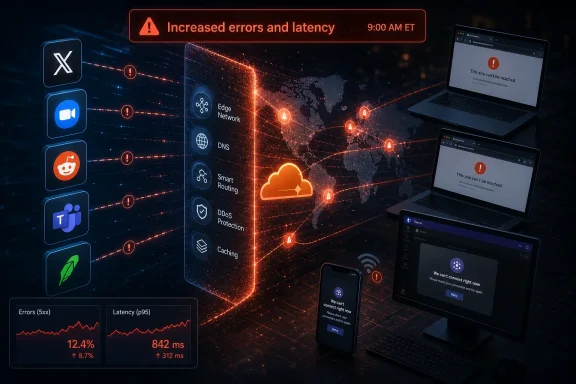
On Monday morning, June 22, 2026, X, Zoom, Reddit, Microsoft Teams and other services suffered simultaneous disruptions across the United States after Cloudflare reported increased error rates and latency across multiple services, briefly breaking access to consumer apps, collaboration tools, and trading platforms. The outage appears to have been short, but its lesson is larger than the hour it consumed. A modern workday can now be derailed not by one app failing, but by a shared layer underneath many apps failing at once. The internet still looks decentralized from the browser, but operationally it often behaves like a very small club of critical vendors.
The user-facing story was familiar: apps would not load, feeds stalled, calls failed, dashboards complained, and users did what users now do first — they checked Downdetector and posted wherever posting still worked. Reports began shortly after 9:00 a.m. Eastern Time, a particularly painful window because the U.S. workday was just coming online.
X appeared to draw the largest visible surge, with tens of thousands of user reports clustered around the outage peak. Reddit, Zoom, Teams, Robinhood and other platforms also saw complaint spikes, which made the event feel less like an isolated app problem and more like a systemic wobble.
That distinction matters. When one app is down, users blame the app. When social media, workplace chat, video meetings and financial apps stumble together, the failure starts to look like infrastructure.
Cloudflare’s status messaging pointed to increased error rates and latency across multiple services, with a fix reportedly deployed not long after the company identified the issue. By roughly an hour later, reports had fallen substantially and services were returning to normal. The internet’s emergency passed quickly; the architectural question did not.
That is why Cloudflare problems can create the impression that half the internet has vanished. The affected services may not share ownership, engineering stacks, business models or user bases. But if enough of them depend on the same network edge, identity protection, DNS, routing or application firewalling layer, a fault there can rhyme across the web.
This is not a Cloudflare-only problem. The same pattern applies to AWS, Azure, Google Cloud, Fastly, Akamai, major DNS providers, identity platforms and payment processors. The internet’s original mythology is peer-to-peer resilience; its commercial reality is concentration behind a handful of hyperscale intermediaries.
There are good reasons for that concentration. Running a globally distributed, secure, low-latency network is hard. Most companies should not be building their own DDoS mitigation, edge caching, TLS plumbing and bot defense from scratch. Cloudflare and its peers exist because they solve real problems at a scale most individual service providers cannot.
But resilience borrowed from a third party is still dependency. When that third party has a bad morning, every customer’s carefully tuned uptime promise suddenly inherits someone else’s blast radius.
Still, user reports are valuable because they show the shape of public impact. In this case, the complaint pattern was broad enough to suggest a common infrastructure problem rather than a coincidental run of unrelated app bugs. Cloudflare’s own acknowledgement of elevated errors and latency provided the missing connective tissue.
The exact blast radius will depend on what each affected platform used Cloudflare for and how its own failover paths behaved. X taking the brunt of complaints does not necessarily mean X was technically hit hardest. It may mean X has more users checking constantly, more users inclined to report, or more visible failure modes when its edge path misbehaves.
For IT teams, the lesson is to avoid over-reading the leaderboard. The important fact is not that one service had more reports than another. The important fact is that unrelated services became unreliable at the same time because a shared internet layer faltered.
Teams also illustrates the difficulty of assigning blame from the outside. A user may experience “Teams is down” when the actual failure involves DNS, routing, authentication, embedded web content, a CDN path, an ISP, a browser cache, or Microsoft’s own service health. Modern SaaS failure is rarely a single red light on a single dashboard.
That ambiguity is brutal for help desks. Users want a sentence: “Teams is down.” IT sees a dependency graph. Microsoft’s status page may be green, Cloudflare may be degraded, local DNS may be flaky, and the CEO may only care that the morning leadership call failed.
The result is that enterprise communications stacks need more than vendor status pages. They need internal observability, external synthetic checks, fallback channels and a practiced communications plan. If the only way to tell employees that Teams is down is to send a Teams message, the outage has already exposed a governance problem.
A company can use multiple cloud providers and still rely on one DNS provider. It can use multiple collaboration tools and still authenticate them through one identity provider. It can maintain disaster recovery infrastructure and still route all users through one edge security layer. The failure point is often not where the architecture diagram is most colorful; it is where everyone assumed the platform vendor had already handled it.
The difficult question is not whether an organization uses Cloudflare. Many do, and often sensibly. The better question is what happens when Cloudflare is slow, partially broken, or returning intermittent errors rather than completely unavailable.
Partial failure is the villain here. Clean outages are easier to detect and route around. Intermittent latency and elevated error rates are messier because clients retry, caches behave unevenly, health checks disagree, and users in different regions report contradictory experiences. The system is neither alive nor dead; it is unreliable enough to consume the morning.
That is why tabletop exercises should include degraded third-party infrastructure, not just total data-center failure. “What if the CDN is returning intermittent 500s?” is a better drill than “What if the primary region explodes?” because the former is more likely and often harder to explain.
That is the bargain the web has made. We accept concentration because the baseline quality of service is usually better. We accept shared infrastructure because the alternative is thousands of underfunded, undersecured, badly maintained bespoke systems. Centralization is not merely a corporate land grab; it is also a response to the internet becoming hostile, global and real-time.
But concentration changes the moral weight of operational mistakes. A bad deployment, misconfiguration or routing incident at a critical edge provider is not just an internal reliability event. It becomes a public infrastructure incident because downstream platforms, businesses and users experience it as their own outage.
Cloudflare has had high-profile incidents before, as have other major providers. The pattern is now familiar enough that each new event feels less like a freak accident and more like a recurring tax on platform consolidation. The question is not whether these vendors can eliminate outages. They cannot. The question is whether customers and regulators will keep treating each incident as a surprise.
That matters because troubleshooting instincts can send users down the wrong path. Rebooting Windows, clearing Edge or Chrome cache, flushing DNS, switching Wi-Fi networks, toggling VPNs and reinstalling apps may all be reasonable in a local incident. During a shared infrastructure outage, most of that becomes ritual.
Administrators need to help users distinguish local breakage from internet-wide dependency failures. A quick internal status page, SMS alert, email from a separate provider, or banner in a device-management portal can prevent hundreds of duplicate tickets. The practical goal is not to give users a networking lecture; it is to stop them from burning an hour debugging a problem they cannot fix.
There is also a security wrinkle. Outages create phishing opportunities. When Teams, Zoom or Microsoft 365 is flaky, users become more willing to click “backup meeting links,” “alternate login portals” or fake status updates. An infrastructure failure is a perfect moment for attackers to exploit confusion.
The best response is boring but effective: preapproved fallback channels, known status locations, and clear instructions that users should not trust ad hoc login links distributed during outages. Reliability and security are often treated as separate disciplines. In incidents like this, they become the same discipline.
That mismatch is not always bad faith. Large providers see an aggregate picture; users experience a local one. If the global error rate drops below a threshold, the incident may be operationally mitigated even though a subset of customers still sees pain.
For enterprise IT, this means vendor status pages should feed an incident response process, not replace one. The organization still needs its own probes from multiple networks, tests for critical user journeys, and escalation paths that do not depend on the affected service.
A useful internal question is simple: can we prove from our own telemetry whether our users can reach our most important SaaS tools right now? If the answer is no, then the company is outsourcing not only infrastructure but situational awareness.
That is a risky place to be. In an outage, the first team with credible information controls the narrative. If IT cannot explain what is happening, users will fill the gap with screenshots, rumors and Slack messages — assuming Slack works.
Companies have spent years decomposing monoliths into microservices while recomposing their risk around giant external dependencies. They have moved from owned data centers to cloud regions, from appliances to managed security services, from PBX systems to Teams and Zoom, from local apps to browser-delivered SaaS. Each move often makes sense individually. Together, they create a new kind of fragility.
The fragility is not that everything fails all the time. It is that failures can become synchronized. A payroll system, social network, meeting platform and trading app may have little in common as products, yet all can be affected by the same edge-network event. That is the defining outage pattern of the 2020s.
The answer is not nostalgia for on-prem everything. Most organizations are not going back, and many should not. The answer is more honest dependency management: knowing which vendors sit in the critical path, testing what happens when they degrade, and building fallback plans that assume the internet’s shared layers will occasionally misbehave.
The practical lessons are specific enough to act on:
The next major outage will almost certainly arrive with a different vendor name attached, a different status-page phrase, and a different mix of apps on the complaint charts. The durable lesson is that internet resilience can no longer be judged app by app; it has to be judged dependency by dependency, because the services that define the workday increasingly stand on the same narrow ledges.
 The Internet Did Not Go Down, but the Workday Did
The user-facing story was familiar: apps would not load, feeds stalled, calls failed, dashboards complained, and users did what users now do first — they checked Downdetector and posted wherever posting still worked. Reports began shortly after 9:00 a.m. Eastern Time, a particularly painful window because the U.S. workday was just coming online.X appeared to draw the largest visible surge, with tens of thousands of user reports clustered around the outage peak. Reddit, Zoom, Teams, Robinhood and other platforms also saw complaint spikes, which made the event feel less like an isolated app problem and more like a systemic wobble.
That distinction matters. When one app is down, users blame the app. When social media, workplace chat, video meetings and financial apps stumble together, the failure starts to look like infrastructure.
Cloudflare’s status messaging pointed to increased error rates and latency across multiple services, with a fix reportedly deployed not long after the company identified the issue. By roughly an hour later, reports had fallen substantially and services were returning to normal. The internet’s emergency passed quickly; the architectural question did not.
Cloudflare Is the Invisible Front Door for Too Much of the Web
Cloudflare is often described as a content delivery network, but that label undersells its role. For many sites, it is the front door, the security guard, the traffic cop, the cache, the DDoS shield, the DNS layer, the bot filter, and increasingly the compute platform sitting between users and origin servers.That is why Cloudflare problems can create the impression that half the internet has vanished. The affected services may not share ownership, engineering stacks, business models or user bases. But if enough of them depend on the same network edge, identity protection, DNS, routing or application firewalling layer, a fault there can rhyme across the web.
This is not a Cloudflare-only problem. The same pattern applies to AWS, Azure, Google Cloud, Fastly, Akamai, major DNS providers, identity platforms and payment processors. The internet’s original mythology is peer-to-peer resilience; its commercial reality is concentration behind a handful of hyperscale intermediaries.
There are good reasons for that concentration. Running a globally distributed, secure, low-latency network is hard. Most companies should not be building their own DDoS mitigation, edge caching, TLS plumbing and bot defense from scratch. Cloudflare and its peers exist because they solve real problems at a scale most individual service providers cannot.
But resilience borrowed from a third party is still dependency. When that third party has a bad morning, every customer’s carefully tuned uptime promise suddenly inherits someone else’s blast radius.
The Numbers Tell a Human Story, Not a Perfect Technical One
Downdetector-style reports are not precise telemetry. They measure user pain, not packet loss; complaint volume, not root cause. A service can receive thousands of reports because its login page fails, because an embedded resource times out, because users cannot reach a region, or because an outage at a dependency makes the app appear broken.Still, user reports are valuable because they show the shape of public impact. In this case, the complaint pattern was broad enough to suggest a common infrastructure problem rather than a coincidental run of unrelated app bugs. Cloudflare’s own acknowledgement of elevated errors and latency provided the missing connective tissue.
The exact blast radius will depend on what each affected platform used Cloudflare for and how its own failover paths behaved. X taking the brunt of complaints does not necessarily mean X was technically hit hardest. It may mean X has more users checking constantly, more users inclined to report, or more visible failure modes when its edge path misbehaves.
For IT teams, the lesson is to avoid over-reading the leaderboard. The important fact is not that one service had more reports than another. The important fact is that unrelated services became unreliable at the same time because a shared internet layer faltered.
Microsoft Teams Being in the Mix Is the Enterprise Warning Light
The presence of Microsoft Teams in the outage reports is what will make many administrators pay attention. Social media outages are annoying; video and collaboration outages interrupt revenue-generating work. Teams is now a default operating layer for many organizations, especially those already standardized on Microsoft 365.Teams also illustrates the difficulty of assigning blame from the outside. A user may experience “Teams is down” when the actual failure involves DNS, routing, authentication, embedded web content, a CDN path, an ISP, a browser cache, or Microsoft’s own service health. Modern SaaS failure is rarely a single red light on a single dashboard.
That ambiguity is brutal for help desks. Users want a sentence: “Teams is down.” IT sees a dependency graph. Microsoft’s status page may be green, Cloudflare may be degraded, local DNS may be flaky, and the CEO may only care that the morning leadership call failed.
The result is that enterprise communications stacks need more than vendor status pages. They need internal observability, external synthetic checks, fallback channels and a practiced communications plan. If the only way to tell employees that Teams is down is to send a Teams message, the outage has already exposed a governance problem.
Redundancy Is Easy to Buy and Hard to Prove
Every major vendor sells resilience. Multi-region, multi-cloud, Anycast, edge failover, active-active, zero trust, distributed DNS — the vocabulary is mature and the diagrams are beautiful. The June 22 outage is a reminder that resilience is not a purchased feature so much as a repeatedly tested behavior.A company can use multiple cloud providers and still rely on one DNS provider. It can use multiple collaboration tools and still authenticate them through one identity provider. It can maintain disaster recovery infrastructure and still route all users through one edge security layer. The failure point is often not where the architecture diagram is most colorful; it is where everyone assumed the platform vendor had already handled it.
The difficult question is not whether an organization uses Cloudflare. Many do, and often sensibly. The better question is what happens when Cloudflare is slow, partially broken, or returning intermittent errors rather than completely unavailable.
Partial failure is the villain here. Clean outages are easier to detect and route around. Intermittent latency and elevated error rates are messier because clients retry, caches behave unevenly, health checks disagree, and users in different regions report contradictory experiences. The system is neither alive nor dead; it is unreliable enough to consume the morning.
That is why tabletop exercises should include degraded third-party infrastructure, not just total data-center failure. “What if the CDN is returning intermittent 500s?” is a better drill than “What if the primary region explodes?” because the former is more likely and often harder to explain.
The Public Cloud Era Made Outages Bigger and Shorter
There is an uncomfortable tradeoff in modern infrastructure: large platforms can fail spectacularly, but they can also recover quickly. A small company running its own edge stack might avoid a Cloudflare-specific outage, but it would probably be worse at absorbing DDoS attacks, patching global vulnerabilities, scaling traffic spikes, or maintaining worldwide latency.That is the bargain the web has made. We accept concentration because the baseline quality of service is usually better. We accept shared infrastructure because the alternative is thousands of underfunded, undersecured, badly maintained bespoke systems. Centralization is not merely a corporate land grab; it is also a response to the internet becoming hostile, global and real-time.
But concentration changes the moral weight of operational mistakes. A bad deployment, misconfiguration or routing incident at a critical edge provider is not just an internal reliability event. It becomes a public infrastructure incident because downstream platforms, businesses and users experience it as their own outage.
Cloudflare has had high-profile incidents before, as have other major providers. The pattern is now familiar enough that each new event feels less like a freak accident and more like a recurring tax on platform consolidation. The question is not whether these vendors can eliminate outages. They cannot. The question is whether customers and regulators will keep treating each incident as a surprise.
Windows Users Feel the Failure Through the Browser, the App and the Office Suite
For Windows users, outages like this are often experienced as application weirdness rather than infrastructure failure. A browser tab spins. The Teams desktop client refuses to connect. A Zoom meeting link opens slowly. A Reddit page loads without comments. X shows errors or stale content. Robinhood or another app may appear unreliable at precisely the wrong moment.That matters because troubleshooting instincts can send users down the wrong path. Rebooting Windows, clearing Edge or Chrome cache, flushing DNS, switching Wi-Fi networks, toggling VPNs and reinstalling apps may all be reasonable in a local incident. During a shared infrastructure outage, most of that becomes ritual.
Administrators need to help users distinguish local breakage from internet-wide dependency failures. A quick internal status page, SMS alert, email from a separate provider, or banner in a device-management portal can prevent hundreds of duplicate tickets. The practical goal is not to give users a networking lecture; it is to stop them from burning an hour debugging a problem they cannot fix.
There is also a security wrinkle. Outages create phishing opportunities. When Teams, Zoom or Microsoft 365 is flaky, users become more willing to click “backup meeting links,” “alternate login portals” or fake status updates. An infrastructure failure is a perfect moment for attackers to exploit confusion.
The best response is boring but effective: preapproved fallback channels, known status locations, and clear instructions that users should not trust ad hoc login links distributed during outages. Reliability and security are often treated as separate disciplines. In incidents like this, they become the same discipline.
The Vendor Status Page Is Necessary but Not Sufficient
Status pages have become part of the outage theater. They are useful, but they are also curated, delayed and necessarily broad. A provider may report “increased latency” while users experience total failure. A provider may mark an incident resolved while some customers remain affected by caches, DNS propagation, client retries or regional routing.That mismatch is not always bad faith. Large providers see an aggregate picture; users experience a local one. If the global error rate drops below a threshold, the incident may be operationally mitigated even though a subset of customers still sees pain.
For enterprise IT, this means vendor status pages should feed an incident response process, not replace one. The organization still needs its own probes from multiple networks, tests for critical user journeys, and escalation paths that do not depend on the affected service.
A useful internal question is simple: can we prove from our own telemetry whether our users can reach our most important SaaS tools right now? If the answer is no, then the company is outsourcing not only infrastructure but situational awareness.
That is a risky place to be. In an outage, the first team with credible information controls the narrative. If IT cannot explain what is happening, users will fill the gap with screenshots, rumors and Slack messages — assuming Slack works.
The Cloudflare Lesson Is Bigger Than Cloudflare
It would be easy to turn this into a story about one provider’s bad morning. That would miss the point. Cloudflare is visible here because it sits in front of many things and because its status messaging offered a plausible explanation for the simultaneous failures. But the strategic issue is the platformization of the internet.Companies have spent years decomposing monoliths into microservices while recomposing their risk around giant external dependencies. They have moved from owned data centers to cloud regions, from appliances to managed security services, from PBX systems to Teams and Zoom, from local apps to browser-delivered SaaS. Each move often makes sense individually. Together, they create a new kind of fragility.
The fragility is not that everything fails all the time. It is that failures can become synchronized. A payroll system, social network, meeting platform and trading app may have little in common as products, yet all can be affected by the same edge-network event. That is the defining outage pattern of the 2020s.
The answer is not nostalgia for on-prem everything. Most organizations are not going back, and many should not. The answer is more honest dependency management: knowing which vendors sit in the critical path, testing what happens when they degrade, and building fallback plans that assume the internet’s shared layers will occasionally misbehave.
The Hour That Exposed the Dependency Map
This outage will probably not be remembered as one of the catastrophic internet failures. Services came back, users moved on, and the business day resumed. But small outages can be diagnostically useful because they reveal the dependency map without causing long-term damage.The practical lessons are specific enough to act on:
- Organizations should identify which critical services depend on the same CDN, DNS, identity, security, or cloud provider before an outage forces the discovery.
- Help desks should maintain an incident script for broad third-party failures so users do not waste time reinstalling apps or rebooting devices.
- Collaboration platforms need out-of-band fallback channels, because the primary chat tool is often one of the first things users lose.
- Security teams should treat major SaaS outages as phishing-risk windows and warn users against improvised login links or unofficial meeting portals.
- Synthetic monitoring from multiple networks is more useful than waiting for a vendor status page to match what employees are already seeing.
The next major outage will almost certainly arrive with a different vendor name attached, a different status-page phrase, and a different mix of apps on the complaint charts. The durable lesson is that internet resilience can no longer be judged app by app; it has to be judged dependency by dependency, because the services that define the workday increasingly stand on the same narrow ledges.
References
- Primary source: Geo News
Published: 2026-06-22T15:34:07.638021
X (formerly Twitter), Zoom, Reddit, Teams all go down at once: Reason revealed
X , Zoom, Reddit, and Microsoft Teams suffered a major outage on Monday morning, June 22. The outage left thousands of users unable to access their social media platforms and workplace communication tools. Users began reporting...www.geo.tv - Related coverage: techradar.com
DoorDash was down for many — here's what happened in the major outage | TechRadar
DoorDash crashed today, but is now back onlinewww.techradar.com - Related coverage: tomsguide.com
Microsoft outage now 'resolved' — latest updates as 365, Outlook and Teams return | Tom's Guide
Everything you need to know about the major Microsoft outagewww.tomsguide.com - Related coverage: itpro.com
A massive Cloudflare outage has taken down X and OpenAI – and even bricked outage tracker site Downdetector | IT Pro
Web users trying to access X, OpenAI, and creative design platforms have been affected by the Cloudflare outagewww.itpro.com - Related coverage: windowscentral.com
Is Cloudflare down? Here's why Fortnite isn't working | Windows Central
Cloudflare's scheduled downtime aligned with its team "investigating issues" that took out productivity apps and games.www.windowscentral.com - Related coverage: pingoru.io
Is Zoom Down? Outages, Status & Downtime — June 2026 · Pingoru
Zoom is up — no major outages reported in the last 30 days. Track Zoom status, get email + webhook alerts the moment Zoom reports an incident, outage, or maintenance window. Free for 5 monitors. pingoru.io
